


10 RocketReach Alternatives With Better Data and Pricing
You're paying $83/month per user for RocketReach Team Pro (billed annually), and half your lookups come back with outdated emails. Five users on that plan runs $415/month - and phone numbers are gated to Pro+, since Essentials is email-only. The G2 complaint data tells the story: "Inaccurate Data" (115 mentions) and "Outdated Contacts" (111 mentions) are the two most common themes. The Reddit consensus is blunter - practitioners call RocketReach "a lookup tool, not a list building tool."
If you're shopping for RocketReach alternatives, that distinction is the whole ballgame. Here are 10 tools that solve the data quality problem, the pricing problem, or both.
Our Picks (TL;DR)
| Pick | Tool | Why | Starting Price |
|---|---|---|---|
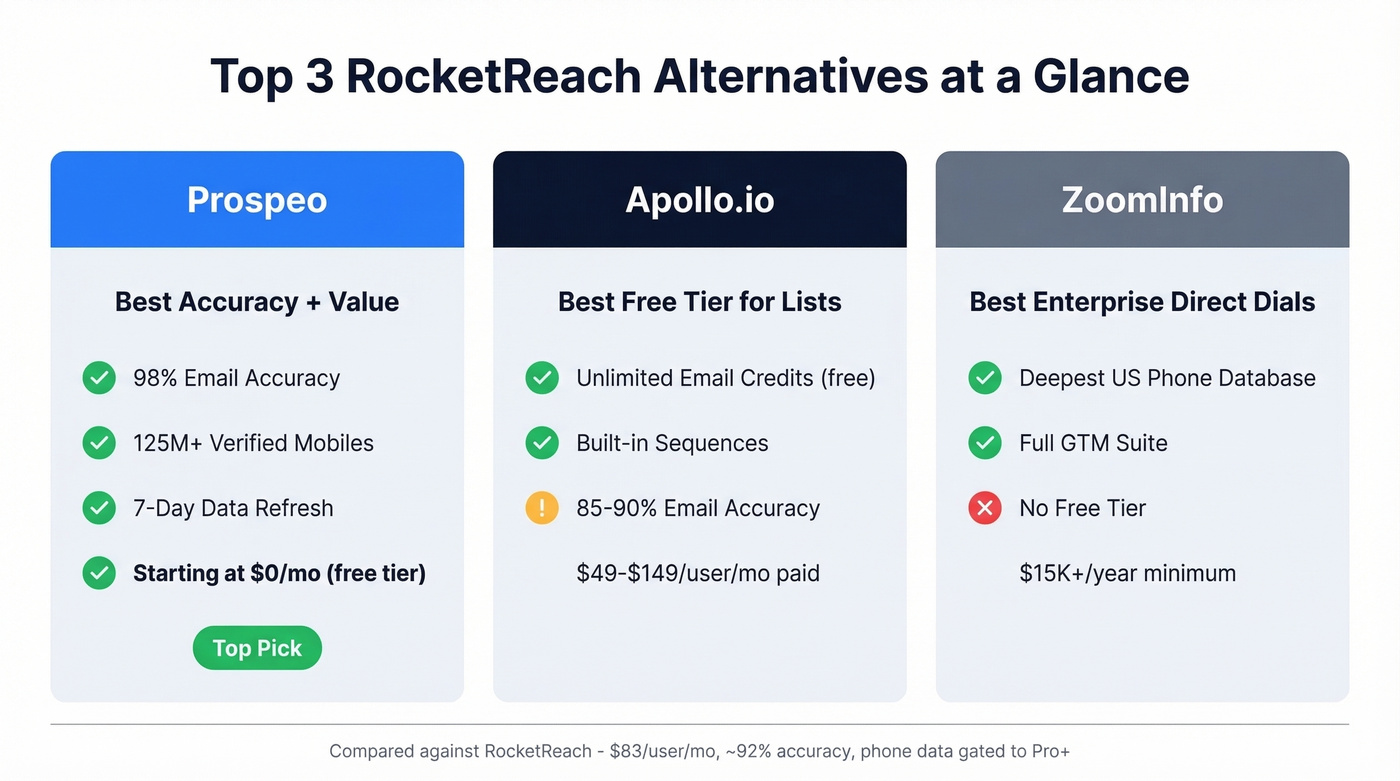
| Best accuracy + value | Prospeo | 98% email accuracy, 7-day refresh, starts free | $0/mo (free tier) |
| Best free tier for lists | Apollo.io | Unlimited email credits on free plan, built-in sequences | $0/mo (free tier) |
| Best enterprise direct dials | ZoomInfo | Deepest phone database in the market | ~$15K+/year |
Why Teams Switch From RocketReach
RocketReach's 700M+ profile database is massive, but size doesn't equal accuracy. The real pain is how pricing compounds on a per-user model:
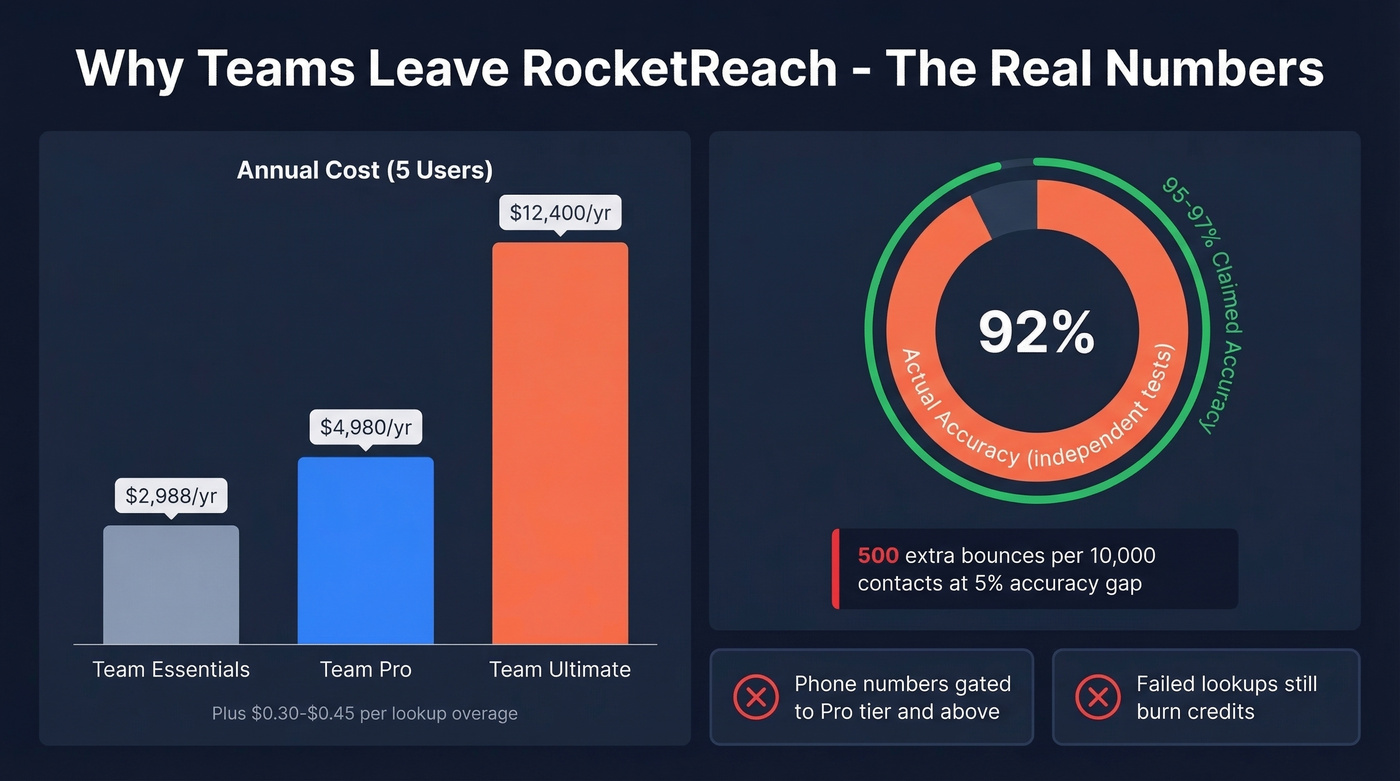
- 5 users on Team Pro: ~$415/month ($4,980/year)
- 5 users on Team Ultimate: ~$1,035/month ($12,400/year)
- Phone numbers gated to Pro tier and above
- Failed lookups can still burn credits if any result is returned
- Overage charges run $0.30-$0.45 per lookup when you exhaust your allocation
Third-party pricing guides peg RocketReach at 95-97% email accuracy, but independent tests put it closer to ~92%. That gap matters at scale - a 5% accuracy difference across 10,000 contacts means 500 extra bounces hammering your domain reputation.
The tool earns its 4.4/5 on G2 across 1,212 reviews for ease of use and quick individual lookups. But 69% five-star ratings mask a real pattern: teams outgrow it the moment they need volume prospecting, reliable phone data, or CRM-grade enrichment.
Best RocketReach Alternatives for 2026
Prospeo
Use this if you need the highest email accuracy in the market without enterprise pricing. Prospeo's database covers 300M+ profiles, 143M+ verified emails, and 125M+ verified mobile numbers - all on a 7-day refresh cycle while the industry average sits at six weeks. The 98% email accuracy comes from a proprietary 5-step verification process with catch-all handling, spam-trap removal, and honeypot filtering.

Search filters span 30+ options: buyer intent covering 15,000 Bombora topics, technographics, job changes, funding rounds, and headcount growth. The Chrome extension has 40K+ users and works across company websites and professional profiles. CRM enrichment returns 50+ data points per contact, with a 92% API match rate and 83% enrichment match rate.
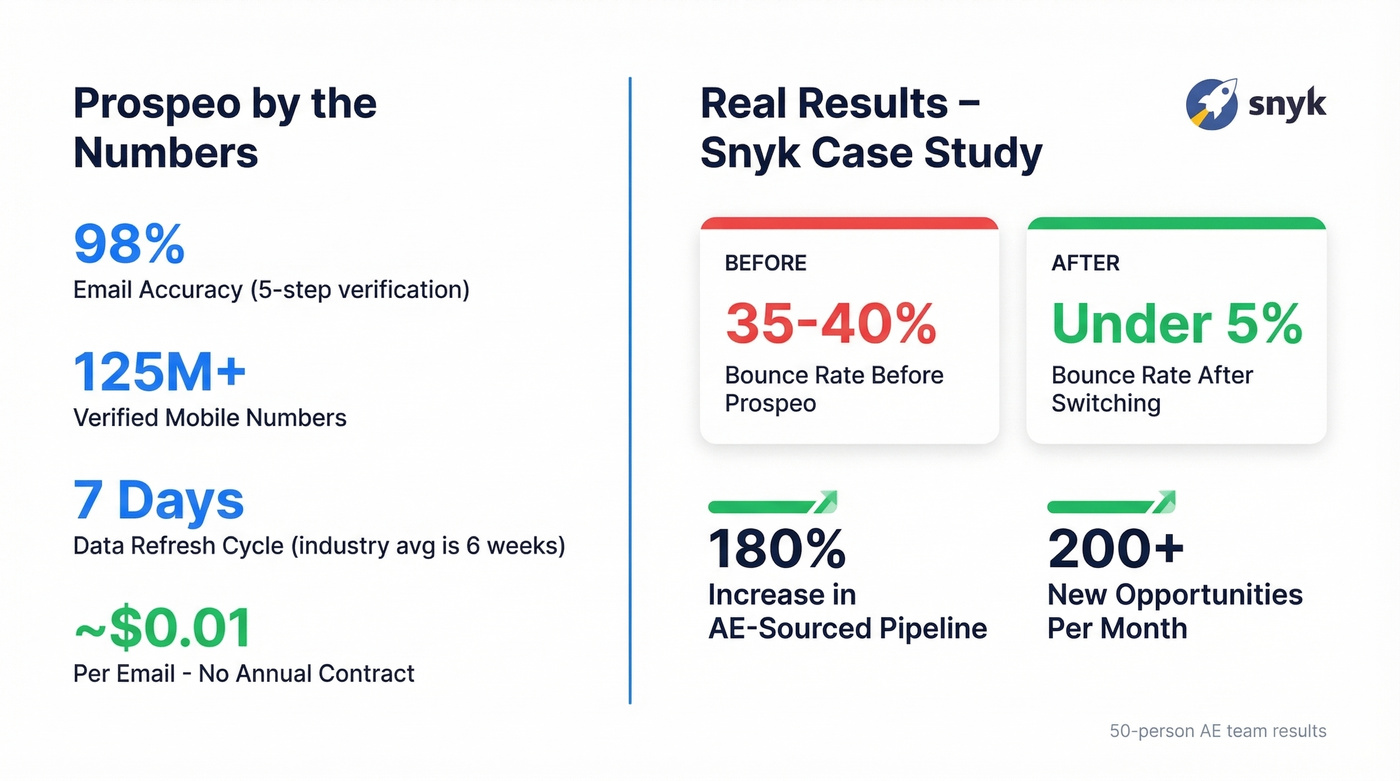
Real-world proof: Snyk's 50-person AE team cut bounce rates from 35-40% to under 5% after switching, with AE-sourced pipeline up 180% and 200+ new opportunities per month. That's not a marginal improvement - it's a fundamentally different outbound motion.
Pricing is refreshingly simple. The free tier gives you 75 emails and 100 Chrome extension credits monthly. Paid plans run ~$0.01/email with no contracts. Native integrations with Salesforce, HubSpot, Smartlead, Instantly, Lemlist, Clay, Zapier, and Make.
Pairs best with Instantly or Lemlist for email sequences - Prospeo handles the data, your sequencer handles the sending.
Apollo.io
Apollo is the default starting point for most SMB outbound teams, and the 4.7/5 G2 rating across 9,510 reviews backs that up. The free tier includes unlimited email credits with limited exports, and the built-in sequence engine means you can go from search to send without leaving the tool.
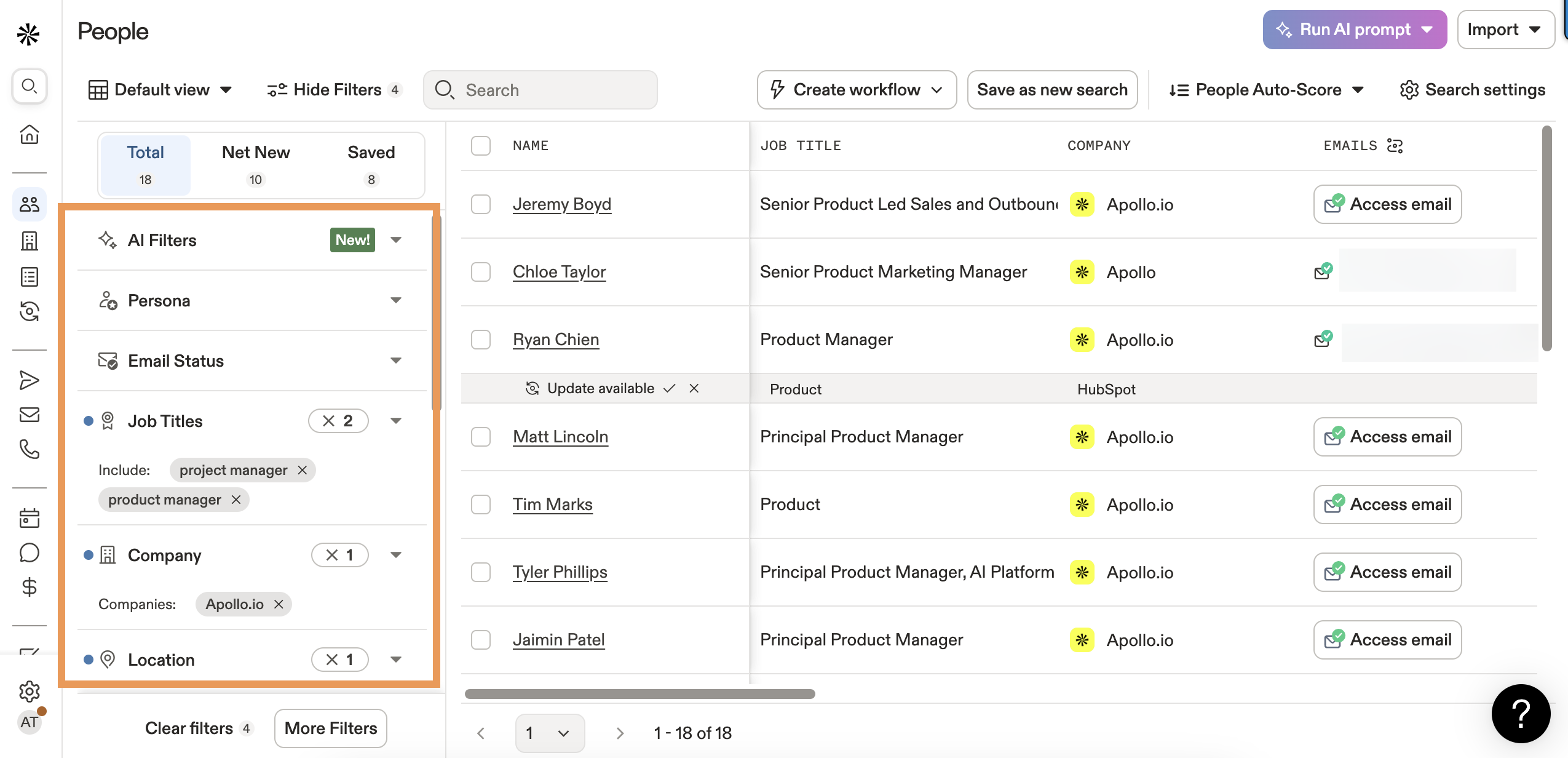
Paid plans run ~$49-$149/user/month depending on the tier. The data is decent for email - practitioners report roughly 85-90% accuracy - but phone numbers are hit or miss. Where Apollo beats RocketReach: volume list building, workflow integration, and price. Where RocketReach still wins: individual lookup precision for specific contacts.
Skip this if email accuracy is your top priority. An 85-90% hit rate means you'll want a verification layer on top, which adds cost and friction.
ZoomInfo
Here's the thing about ZoomInfo: it's still the best all-in-one GTM platform. But most teams don't need all-in-one, and they definitely don't need a $15K-$40K+ annual commitment to find out.
ZoomInfo's phone data is genuinely better than anything else on this list for US-based prospects, especially at the director-and-above level. The platform bundles intent data, website visitor tracking, and workflow automation - it's a full GTM suite, not just a database. But we've seen this pattern repeatedly: teams sign up for the database and end up paying for intent, chat, and enrichment modules that sit unused for the entire contract term.
Annual contracts are mandatory, and there's no free tier worth mentioning. If your team is under 10 reps or your annual data budget is below $15K, you'll get 80% of the value from a credit-based tool at a fraction of the cost.
Cognism
Use this if you're selling into European markets and GDPR compliance isn't optional. Cognism's Diamond Data provides phone-verified mobile numbers - a human actually calls the number to confirm it's live - which is rare in the industry. Bombora intent data comes bundled, and the European contact coverage is stronger than most US-first competitors.
Where Cognism wins over ZoomInfo: EMEA compliance and mobile verification. Where ZoomInfo still wins: US database depth and workflow breadth. Pricing runs ~$1,500-$8,500/month for small-to-mid teams, with annual contracts required.
Skip this if your ICP is primarily US-based. You're paying a premium for European data quality you won't use.
Lusha
Lusha is used by 280K+ revenue teams, but the credit math matters more than the user count. The free plan gives you 70 credits/month - 1 credit reveals an email, while a phone number costs 10 credits. So that "70 credits" is really 7 phone reveals if direct dials are what you need.
The credit rollover policy is decent: monthly credits accumulate up to 2x your plan limit. Paid plans require a sales conversation - expect $30-$80/user/month depending on volume. Lusha works well as a lightweight prospecting layer for small teams who primarily need emails, but the phone credit economics get expensive fast at scale.
Skip this if phone numbers are your primary use case. The 10:1 credit ratio eats through your allocation quickly.
Hunter.io
Hunter is the specialist pick for email finding and verification - nothing more, nothing less. The free tier gives you 50 credits/month, and paid plans start at $49/month or $34/month billed annually for 2,000 credits. One standout: unlimited users on every plan, which is rare in this space.
We'd recommend Hunter specifically for teams that already have a phone data source and just need a reliable, affordable email layer. It does one thing and does it well.
Skip this if you need phone numbers - Hunter is email-first and doesn't compete on direct dials.
UpLead
UpLead takes a different approach to the accuracy problem: a 95% accuracy guarantee where they won't charge you for bad emails. One credit unlocks one contact with both email and direct dial included, which simplifies the math compared to tools that charge separately for phone numbers.
Essentials runs $99/month for 170 credits, or $74/month on annual billing. The 7-day free trial gives you 5 credits to test. At ~$0.58/credit on the monthly plan, it's pricier per contact than most competitors - but the accuracy guarantee means you're paying for contacts that actually work.
Kaspr
Kaspr's free plan offers unlimited B2B email credits - the catch is you need to invite three colleagues to unlock it. Paid plans start at $49/user/month. The tool shines for European phone data and profile-based prospecting via its Chrome extension, and it's GDPR-aligned from the ground up.
Skip this if your prospects are primarily in North America. Kaspr's strength is European coverage, and the invite requirement on the free tier is a friction point for solo users.
Seamless.AI
No public pricing - you'll need a sales call, which is the #1 complaint on Reddit. User-reported numbers put Pro at ~$79/user/month for 1,000 credits and Enterprise at ~$149/user/month with a 5-user minimum, creating a $745/month floor. Accuracy runs ~85% overall, with phone accuracy closer to 60% per user reports. The forced sales process and opaque pricing make it hard to recommend when transparent alternatives exist.
Lead411
Solid mid-market option with Bombora-powered intent data included at every tier - no upsell required. Basic Plus Unlimited runs $75/user/month on annual billing with unlimited email credits, which is a straightforward flat-rate model. The 7-day free trial lets you test before committing. Worth a look if intent data is a priority but ZoomInfo's price tag isn't in the budget.

RocketReach users report 92% email accuracy at best - that's 800 extra bounces per 10K contacts torching your domain. Prospeo's 5-step verification delivers 98% accuracy, 125M+ verified mobiles, and a 7-day data refresh cycle. All at ~$0.01/email with no annual contract.
Stop paying $83/month per user for emails that bounce.
Snyk's 50 AEs cut bounce rates from 35% to under 5% after switching to Prospeo - pipeline jumped 180%. With 300M+ profiles, 30+ search filters, and native CRM enrichment returning 50+ data points, you get volume prospecting and accuracy without the ZoomInfo price tag.
Build lists that actually convert - start with 75 free emails today.
Pricing Comparison
RocketReach is the baseline row below - everything else is measured against it.
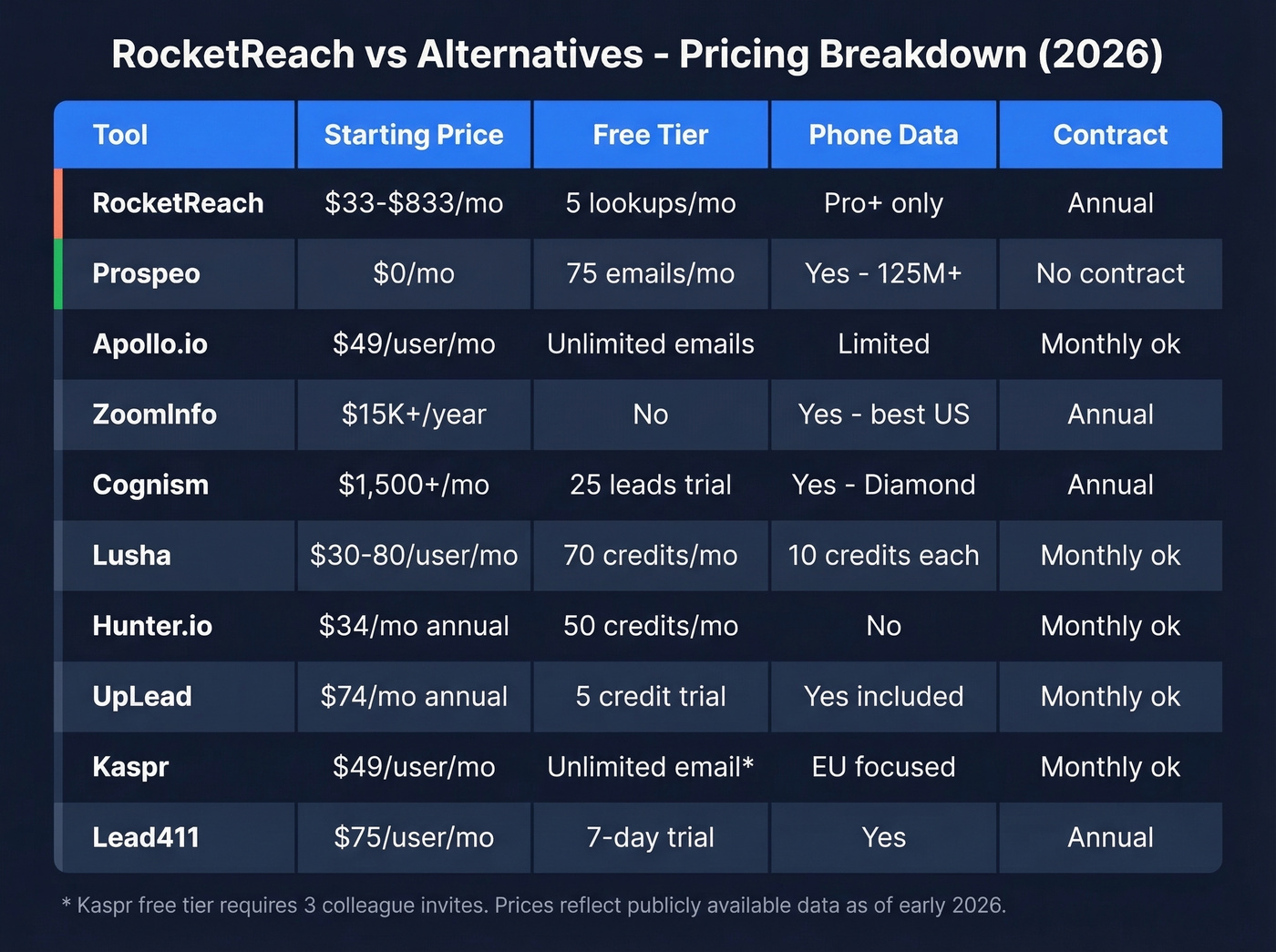
| Tool | Starting Price | Free Tier? | Credits/Contacts | Phone Included? | Contract? |
|---|---|---|---|---|---|
| RocketReach | ~$33/mo (annual) to $833/mo (monthly Ultimate) | 5 lookups/mo | 80-500/mo by tier | Pro+ only | Annual |
| Apollo.io | $49/user/mo | Unlimited emails | 900-12,000 mobile/mo by tier | Limited | Monthly ok |
| ZoomInfo | ~$15K+/year | No | Bulk credits by contract | Yes | Annual |
| Cognism | ~$1,500+/mo | 25 leads trial | Custom by contract | Yes (Diamond) | Annual |
| Lusha | ~$30-$80/user/mo | 70 credits/mo | 70-1,000+/mo by tier | 10 credits each | Monthly ok |
| Hunter.io | $49/mo or $34/mo annual | 50 credits/mo | 2,000-30,000/mo by tier | No | Monthly ok |
| UpLead | $99/mo or $74/mo annual | 7-day trial | 170-1,000+/mo by tier | Yes | Monthly ok |
| Kaspr | $49/user/mo | Unlimited emails* | Varies by tier | Yes | Monthly ok |
| Seamless.AI | ~$79/user/mo | 50 credits | ~1,000/mo (Pro) | Yes | Sales call |
| Lead411 | $75/user/mo (annual) | 7-day trial | Unlimited emails | Yes | Annual |
How Accurate Is the Data?
This is where most comparison articles hand-wave. We've run these tools side by side on the same prospect lists, and the differences are real.
A Dropcontact benchmark tested 15 email finder tools across 20,000 real contacts, updated February 2026. Hard bounce rates ranged from 0.9% to 3.6% - that spread means the tool you choose can be the difference between reaching 3 out of 4 prospects or losing 1 in 5 to bounces.

Let's be clear about something that trips people up: "email accuracy" and "find rate" are different metrics that often get conflated. Find rate measures how many contacts a tool returns results for. Accuracy measures how many of those results are valid, deliverable addresses. A tool can have a high find rate but low accuracy - returning lots of bad emails - or a lower find rate but near-perfect accuracy, only returning emails it's confident about. When evaluating tools, ask which metric they're reporting. The answer changes everything.
How to Choose the Right Tool
Your team size and budget narrow the field fast.
Small team, under $200/month: UpLead's accuracy guarantee or a credit-based model will keep costs predictable. Neither locks you into annual contracts, and both prioritize data quality over feature bloat.
Mid-market team needing sequences: Apollo gives you list building and outreach in one tool. If Apollo's 85-90% accuracy isn't cutting it for your domain reputation, add a verification layer before sending.
Enterprise with $15K+ budget: ZoomInfo or Cognism, depending on whether your ICP is US-heavy or Europe-heavy. Other tools worth a look at this tier: ContactOut for profile-heavy workflows and LeadIQ for pipeline-focused teams.
Real talk: trial two or three alternatives simultaneously on the same prospect list. The "lookup tool vs. list-building platform" distinction matters more than any feature comparison. RocketReach is great for finding one specific person's contact info. If you need to build and enrich lists at scale, you need a different category of tool entirely.
FAQ
Is there a free RocketReach alternative?
Apollo offers unlimited email credits on its free plan with limited exports, making it the most generous free option for list building. Prospeo's free tier provides 75 verified emails per month with full accuracy, Hunter gives 50 credits monthly, and Kaspr offers unlimited B2B emails if you invite three colleagues.
What's the most accurate alternative?
Prospeo delivers 98% email accuracy via 5-step verification on a 7-day refresh cycle - the highest in this comparison. UpLead guarantees 95% and won't charge for bad emails. Apollo sits around 85-90% based on practitioner reports, which is serviceable but benefits from a verification layer for high-volume outbound.
Which RocketReach competitor is best for phone numbers?
ZoomInfo has the deepest direct-dial database for US prospects but costs $15K+/year minimum. Cognism's Diamond Data provides phone-verified numbers specifically for European markets. Prospeo covers 125M+ verified mobiles globally at ~$0.10/number with a 30% pickup rate - the strongest mid-market option.
Why is RocketReach so expensive?
RocketReach uses per-user pricing that compounds fast - 5 users on Team Pro costs ~$415/month. Phone numbers require higher tiers, failed lookups still burn credits, and overage charges run $0.30-$0.45 per lookup. Most alternatives offer better per-contact economics through credit-based or flat-rate models instead of per-seat pricing.