

How to Build a SaaS Sales Pipeline That Actually Predicts Revenue
Your SaaS sales pipeline wasn't a forecast last quarter - it was a wish list with dollar signs attached. You're not alone. In a survey of 76 SaaS commercial leaders, only 14% rated their pipeline-building efforts as highly effective. That's a staggering failure rate for the single most important revenue-predicting tool a sales org has.
Here's what separates teams that forecast accurately from teams that scramble at quarter-end: 5-7 stages with clear exit criteria your reps can recite without opening the CRM, weighted coverage instead of raw totals, a velocity number measured in dollars per day, monthly pipeline cleanups, and verified contact data so the pipeline reflects reality from the first touch.
What a SaaS Pipeline Actually Is
A SaaS sales pipeline is the sequence of stages a deal moves through from first qualified conversation to closed revenue - and beyond. Renewals, expansion, and upsells aren't afterthoughts. They're pipeline stages too.
Don't confuse pipeline with funnel. The funnel tracks volume from awareness to lead. The pipeline is the seller's view of deal stages, starting when someone qualifies an opportunity and assigns it a dollar value. High-performing sales teams are 1.5x more likely to base forecasts on data-driven insights, which means structure isn't optional. Whether you're running a dedicated pipeline management tool or tracking stages in a spreadsheet, the principle doesn't change: every deal needs a defined path forward.
The 7 Pipeline Stages for SaaS
If your reps can't name exit criteria from memory, you have too many stages. Seven is the sweet spot for most mid-market teams, though the right number depends on your average deal size and sales cycle length. Fewer stages create blind spots. More stages create CRM friction that reps route around by ignoring the system entirely.
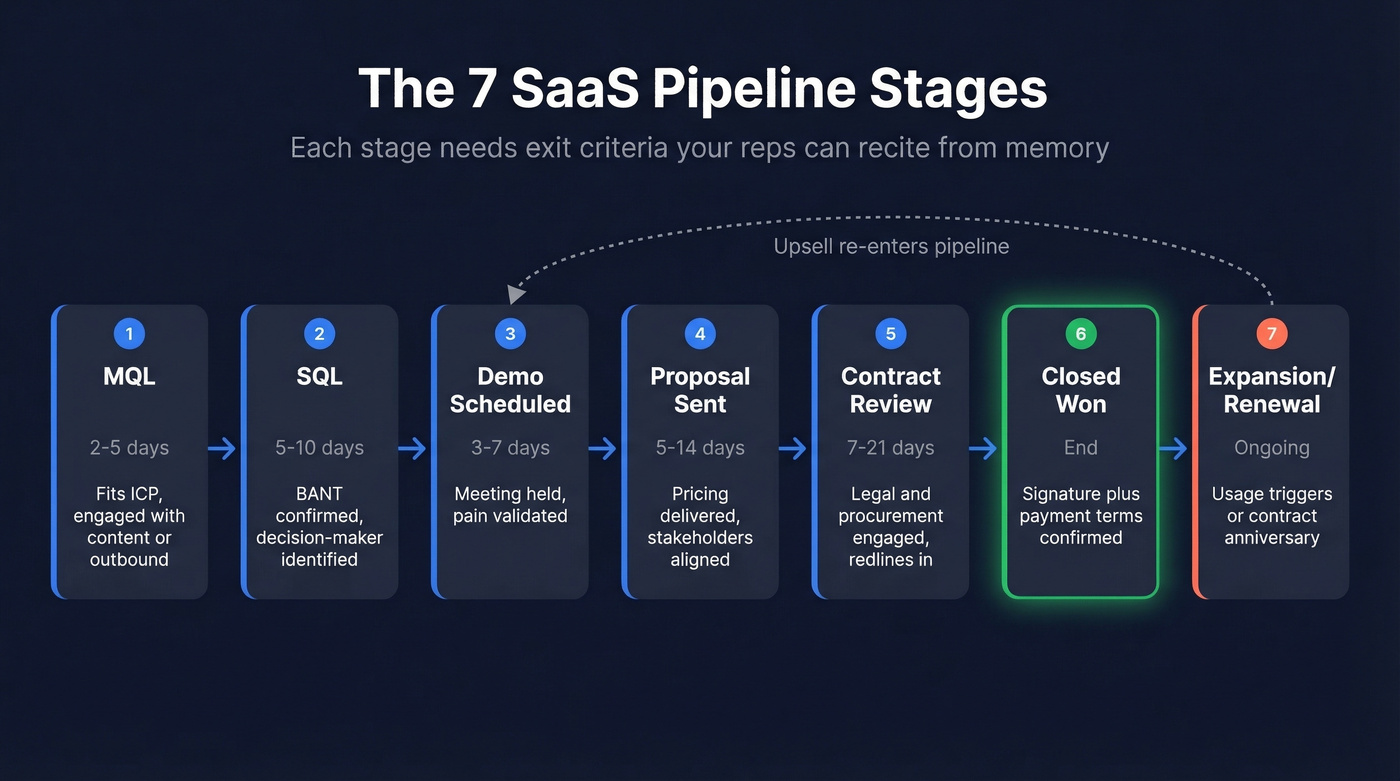
| Stage | Typical Duration | Exit Criteria |
|---|---|---|
| MQL | 2-5 days | Fits ICP, engaged with content or outbound |
| SQL | 5-10 days | Fits ICP, BANT confirmed, decision-maker identified |
| Demo Scheduled | 3-7 days | Meeting held, pain validated |
| Proposal Sent | 5-14 days | Pricing delivered, stakeholders aligned |
| Contract Review | 7-21 days | Legal/procurement engaged, redlines in |
| Closed Won | - | Signature + payment terms confirmed |
| Expansion/Renewal | Ongoing | Usage triggers or contract anniversary |
Metrics That Drive Pipeline Performance
Four numbers drive everything. David Sacks' pipeline metrics framework breaks reporting into generation, conversion, and active pipeline - and introduces cohorted win rates, where you track close rates by the month a deal entered the pipeline rather than the month it closed. This eliminates the survivorship bias baked into most CRM dashboards, and it's a distinction that changes how you interpret your numbers.
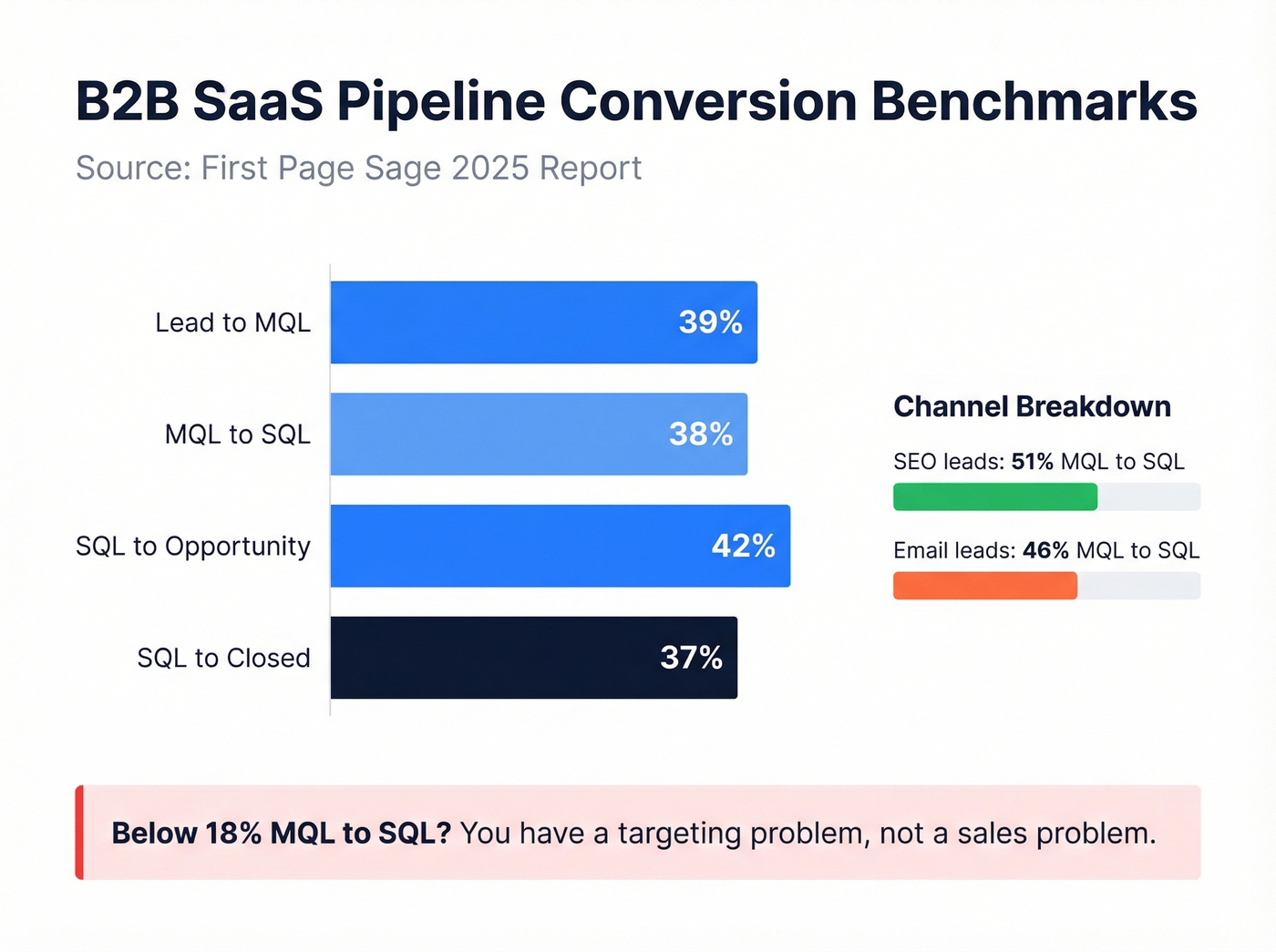
First Page Sage's B2B SaaS benchmarks give us stage-by-stage conversion rates:
| Stage Transition | Benchmark |
|---|---|
| Lead to MQL | 39% |
| MQL to SQL | 38% |
| SQL to Opportunity | 42% |
| SQL to Closed | 37% |
Channel matters too: SEO-sourced leads convert at roughly 51% from MQL to SQL, while email sits around 46%. If you're consistently below 18% MQL-to-SQL, you have a targeting and qualification problem, not a sales problem.
Velocity tells you how many dollars your pipeline generates per day:
(# Opportunities x Avg Deal Size x Win Rate) / Sales Cycle Length = $/day
Worked example: 50 x $50,000 x 25% / 45 days = $13,889/day (~$5M annualized). The B2B SaaS average is $8,219/day (~$3M annualized) across a 939-company dataset. If you're below that, one of your four levers is broken. The fix isn't "more pipeline" - it's diagnosing which lever is dragging.

Pipeline velocity depends on reaching real buyers. If 20% of your emails bounce, your $13,889/day velocity is actually $11,111. Prospeo delivers 98% email accuracy with a 7-day data refresh - so every deal in your pipeline starts with a verified contact, not a guess.
Stop forecasting on bad data. Start with contacts that connect.
Pipeline Coverage - The 3x Rule Is Wrong
Every sales leader has heard "you need 3x pipeline coverage." It's dangerously incomplete.
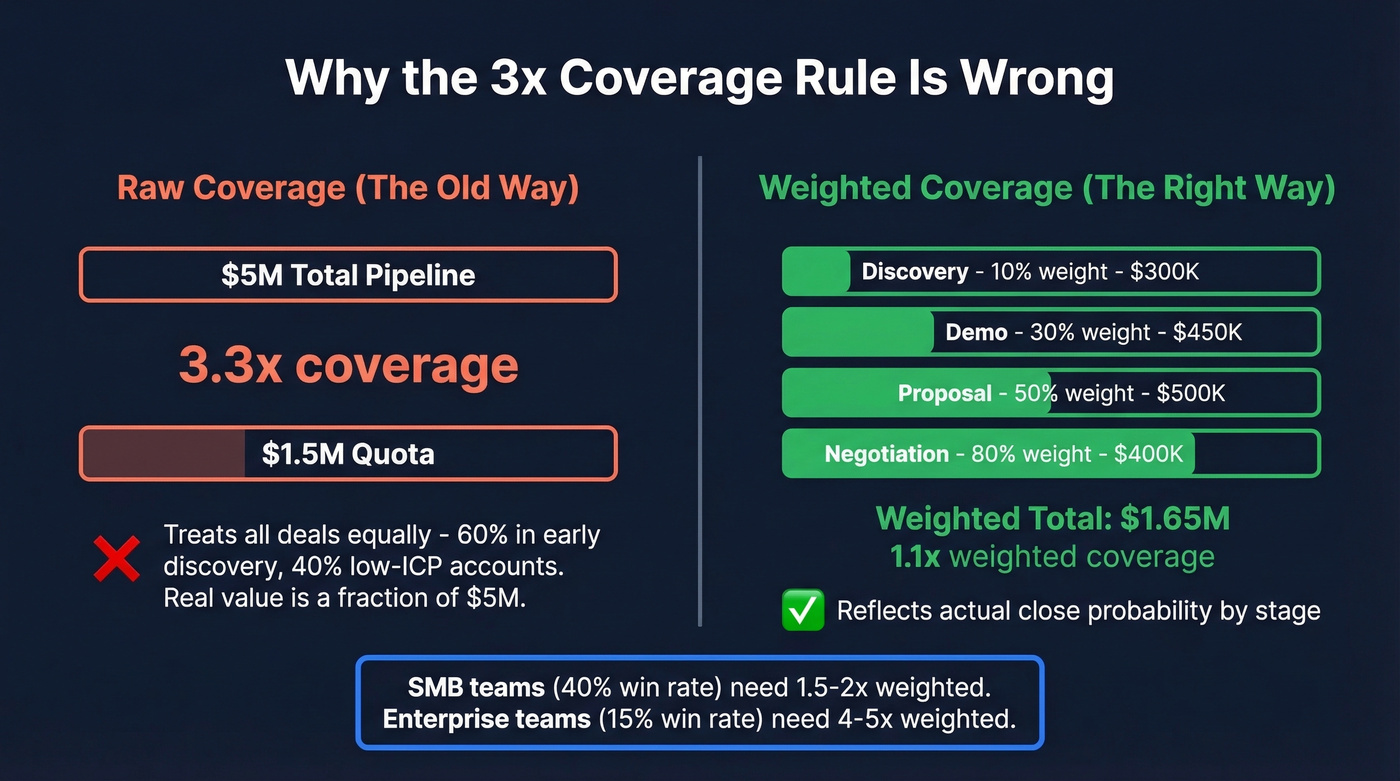
The 3x rule assumes a ~33% close rate, which is generous for most B2B SaaS teams. Worse, it treats all pipeline equally. A $5M pipeline where 60% of deals are in early discovery and 40% come from low-ICP accounts isn't worth $5M. Fullcast's benchmark data found that high-ICP accounts represent only 23% of total pipeline for many orgs. If your pipeline is top-heavy - lots of early-stage deals, few in negotiation - your real coverage is a fraction of what your dashboard shows.
Weighted coverage fixes this. Assign probabilities by stage: Discovery at 10-15%, Demo at ~30%, Proposal at ~50%, Negotiation at ~80%. Multiply each deal's value by its probability, sum it up, divide by your target. SMB teams with 40% win rates need 1.5-2x weighted coverage. Enterprise teams closing at 15% need 4-5x. Let's be honest - if you're still reporting raw pipeline to your board, you're setting yourself up for a bad quarter-end conversation.
PLG Pipelines - Different Math
A self-serve signup flow is a lead source, not a pipeline. The distinction matters.
A PAL (Product Acquired Lead) is someone who signed up. A PQL (Product Qualified Lead) hit activation milestones that correlate with buying. Free-trial-to-paid conversion averages 8-12%, and half of those conversions happen within the first 7 days, which means your onboarding experience is doing more pipeline work than your SDRs during that window.
The stat that justifies adding sales to a PLG motion: sales and success teams drive 58% of upsells, while product alone drives just 10%. A pure self-serve pipeline leaves most expansion revenue on the table. If you're running PLG, you still need to define pipeline stages that account for product usage signals alongside traditional qualification criteria - otherwise you're flying blind on your biggest growth lever.
Pipeline Hygiene - The 30-Day Rule
Dirty pipelines kill forecasts faster than bad quota-setting. We run four rules with no exceptions, and I'd recommend the same for any team serious about forecast accuracy:
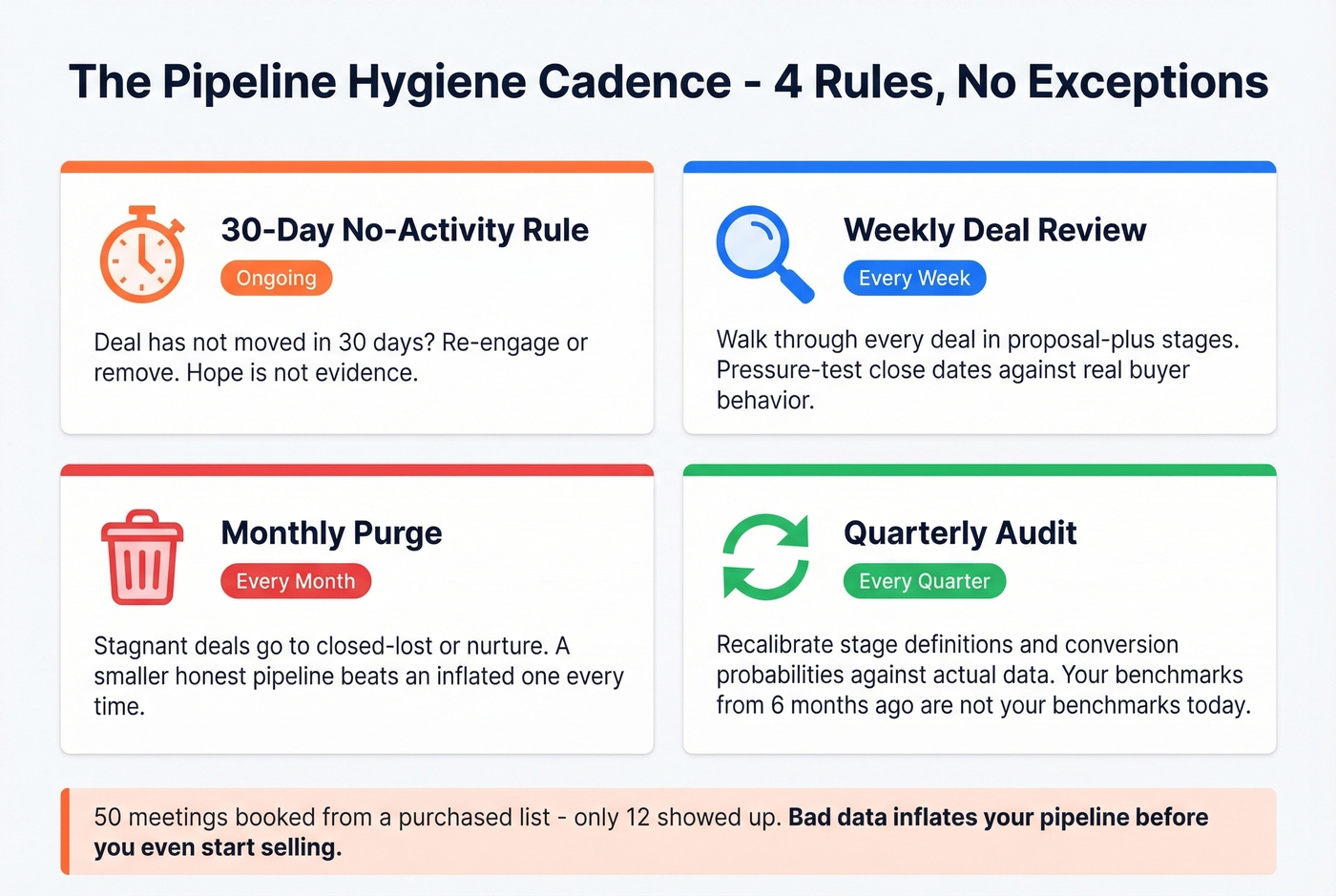
30-day no-activity rule. Deal hasn't moved? Re-engage or remove. "But they said they're interested" isn't evidence. It's hope.
Weekly review. Reps walk through every deal in proposal-plus stages. Close dates get pressure-tested against actual buyer behavior, not optimistic guesses.
Monthly purge. Stagnant deals go to closed-lost or nurture. An inflated pipeline hurts worse than a smaller honest one because it distorts every downstream decision - hiring, spend, board reporting.
Quarterly audit. Recalibrate stage definitions and conversion probabilities against actual data. The benchmarks from six months ago aren't your benchmarks today.
We've watched teams book 50 meetings from a purchased list, only to have 12 actually show up. The other 38 were wrong titles, departed employees, or bounced emails inflating the top of the funnel. Starting with data that refreshes weekly instead of decaying for months between cleanups eliminates the rot before it compounds.
Tools for Managing Your Pipeline
You need a CRM to manage stages and a data platform to feed it clean contacts. Don't overthink this.
| Tool | Category | Starting Price |
|---|---|---|
| Prospeo | Prospecting/Data | ~$0.01/email, free tier |
| Apollo | Prospecting/Data | $49/user/mo |
| HubSpot | CRM | $90/user/mo (Pro) |
| Salesforce | CRM | $25/user/mo (Starter) |
| Pipedrive | CRM | $14/user/mo |
| Close | CRM | $29/user/mo |
HubSpot if you want speed. Salesforce if you need customization. Pipedrive if you value simplicity over configurability. Skip Close unless your team is under 10 reps - it's great for small teams but starts to creak at scale.
For the prospecting layer, the consensus on r/sales is pretty clear: the biggest pipeline killer isn't your CRM choice, it's feeding that CRM garbage data. Pair whichever CRM fits your stage with a prospecting tool that won't poison your pipeline with contacts who left the company six months ago. If you want a deeper look at pipeline reporting, use these sales pipeline benchmarks to sanity-check your stage math.
Weighted coverage means nothing if your reps can't reach decision-makers. Prospeo gives you 30+ filters - buyer intent, job changes, department headcount - to fill your pipeline with high-ICP accounts. 125M+ verified mobiles with a 30% pickup rate turn stalled deals into conversations.
Target the 23% of accounts that actually close. Find them now.
FAQ
How many stages should a SaaS sales pipeline have?
Five to seven, each with clear exit criteria your reps can name without looking them up. Above seven, consolidate. CRM friction kills adoption, and reps start ignoring the system entirely.
What's a good pipeline coverage ratio?
Use weighted coverage, not raw totals. SMB teams with ~40% win rates typically need 1.5-2x weighted coverage; enterprise teams closing at 15% need 4-5x. Raw pipeline is a vanity metric that masks forecast risk.
How do I stop bad data from inflating my pipeline?
Use a prospecting tool with real-time verification and enforce a 30-day no-activity rule. If a deal hasn't moved in 30 days, remove it or re-engage. Clean data at the top of the funnel is the single highest-leverage fix you can make - everything downstream depends on it.