

Sales Agency Guide: Types, Pricing, and How to Choose
Your CEO just told you to double pipeline by Q3. You've got two SDRs, a CRM full of contacts that haven't been updated since the last admin left, and a budget that won't stretch to a six-person hiring spree. So you start looking into sales agencies - and every result is an agency trying to sell you, not educate you.
Let's fix that.
This guide covers what a sales agency actually does, what it costs (real numbers, not "contact us" pages), when outsourcing is worth it, and when you're better off building in-house.
The Short Version
A sales agency is a third-party company you hire to execute sales activities - prospecting, booking meetings, sometimes closing deals. They're often a strong fit for companies around $1M-$20M ARR that need pipeline now but can't wait six months to hire and ramp an internal team.
What it costs: $2,500-$15,000/mo on retainer, or $125-$800 per qualified meeting. For context, a single in-house SDR runs $100K-$130K in year one when you factor in salary, tools, benefits, and ramp time. Outsourcing can save up to 40%.
The #1 variable that determines whether your agency investment pays off isn't the reps or their playbook - it's data quality. Contact information decays roughly 30% annually. If your agency is emailing stale lists, you're burning money regardless of how talented their team is.
What Is a Sales Agency?
Unlike a marketing agency, which focuses on awareness, content, and inbound demand, a sales agency does the direct selling work: cold calls, email sequences, appointment setting, and sometimes full-cycle deal management through close. Marketing agencies generate interest. Sales agencies generate conversations. Some buyers confuse lead generation firms with marketing vendors, but the distinction matters: a lead generation company fills your pipeline with qualified prospects, not brand impressions.
Compensation models vary. Some agencies work on a flat monthly retainer. Others charge per meeting booked. A smaller number operate on commission, typically 5-20% of closed revenue, though pure commission-only models are increasingly rare - good salespeople don't work for free. Most reputable firms use a hybrid: retainer plus performance bonuses tied to meetings or pipeline.
The best outsourced teams don't just dial phones. They build sequences that blend email, calling, and social touches into a coordinated nurture flow, and companies with strong lead nurturing generate 20% more business opportunities than those without it. That's why you'll see agencies marketing themselves as "sales and marketing" hybrids. The label matters less than the output.
Types of Sales Agencies
Sales agencies typically fall into five categories, and hiring the wrong type is one of the most common mistakes buyers make.
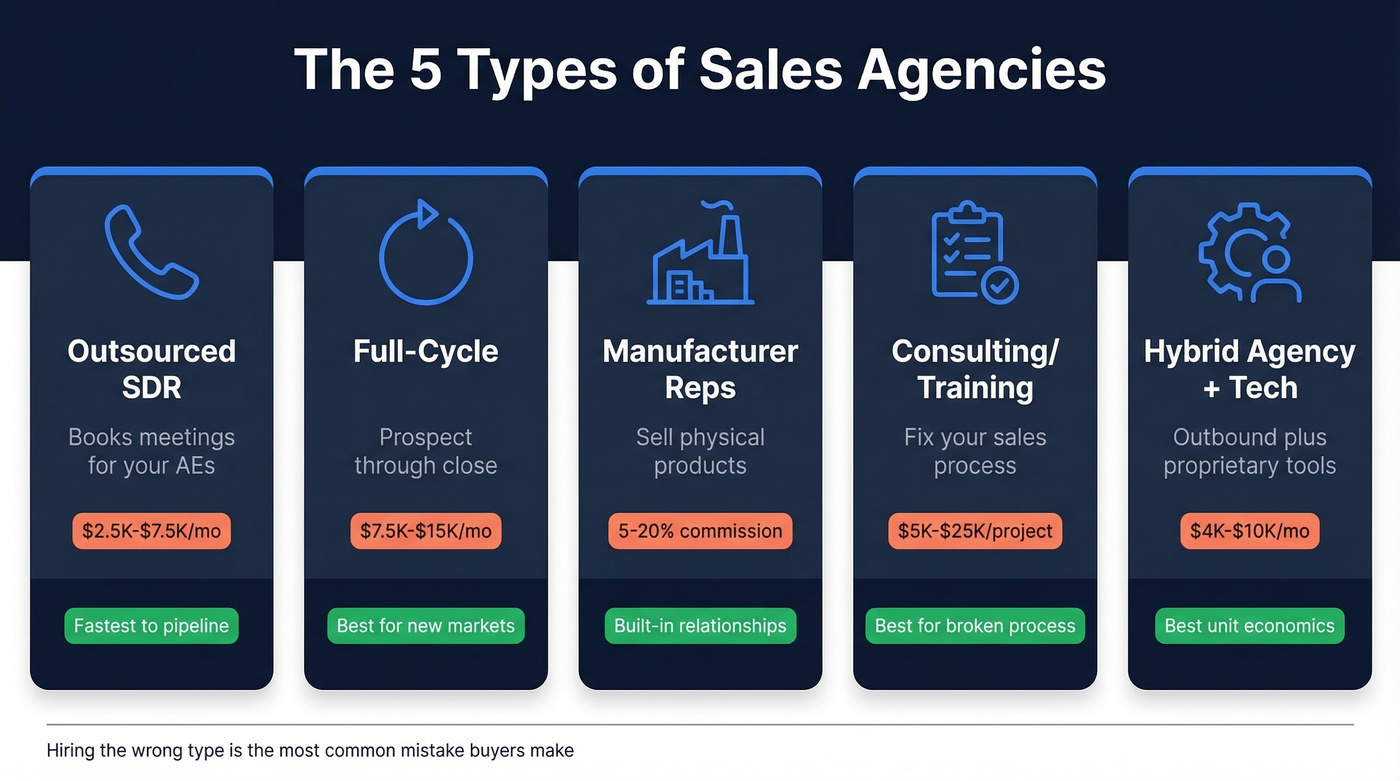
| Type | What They Do | Typical Cost |
|---|---|---|
| Outsourced SDR | Book meetings for your AEs | $2.5K-$7.5K/mo |
| Full-cycle | Prospect through close | $7.5K-$15K/mo |
| Manufacturer's reps | Sell physical products | 5-20% commission |
| Consulting/training | Fix your sales process | $5K-$25K/project |
| Hybrid agency + tech | Outbound + proprietary tools | $4K-$10K/mo |
Outsourced SDR Firms
The most common type - sometimes called "SDR as a service." These firms provide dedicated SDRs/BDRs who prospect on your behalf and book qualified meetings for your closers. You keep the AEs, they feed the top of funnel. This is the model from firms like Belkins, SalesHive, and CIENCE.
In our experience, the outsourced SDR model delivers the fastest time-to-pipeline of any agency type, which is why so many B2B lead generation companies operate here. The tradeoff is that you still need strong AEs to close what they book. If your closers aren't converting, adding more meetings at the top won't fix the problem.
Full-Cycle Sales Outsourcing
The agency handles everything from first touch to signed contract. This makes sense when you're entering a new market and don't have the internal team to cover it, or when you're testing a new ICP before committing to hires. It's more expensive because you're paying for experienced closers, not just appointment setters.
Manufacturer's Reps
Independent sales agents that represent multiple suppliers and sell physical products into specific territories or verticals. Common in industrial, distribution, and consumer goods. Compensation is almost always commission-based, and they bring established buyer relationships you'd spend years building internally.
Sales Consulting & Training
Not execution-focused. These firms audit your sales process, build playbooks, train reps, and optimize your existing team. Think of them as the "teach a man to fish" option. If your problem is process, not headcount, start here.
Hybrid Agency + Tech
This category blurs the line between "agency" and "software." These firms combine human reps with proprietary technology - AI-powered sequencing, intent data, custom enrichment workflows. Their margins depend on tech leverage rather than scaling linearly with headcount, which means they can deliver better unit economics than traditional SDR shops.
Some companies skip agencies entirely and use AI SDR tools like Artisan or 11x to automate outbound. That works for high-volume, low-complexity prospecting - but the moment your deal requires nuance, relationship-building, or multi-threading into an account, you need humans in the loop.
How Much Does It Cost?
Let's get specific. The ranges below come from published pricing guides and practitioner examples - not from agency sales pages designed to make you "book a call."
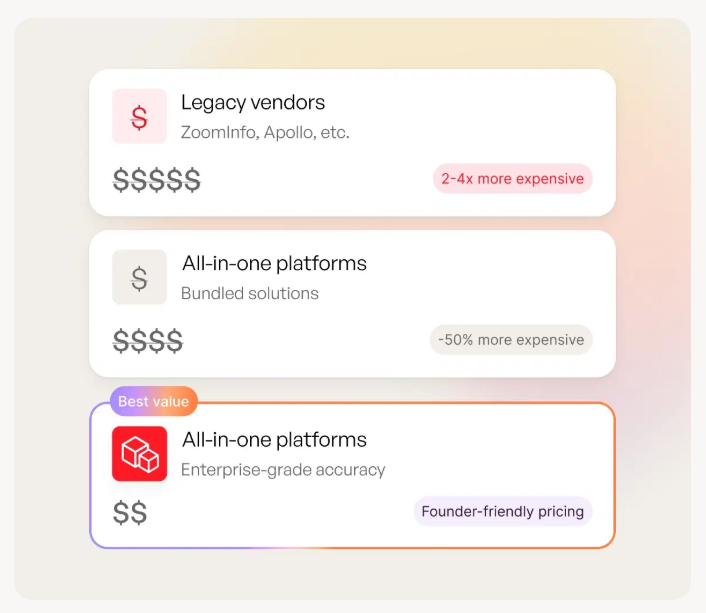
Retainer vs. Pay-Per-Meeting vs. Commission
| Model | Entry-Level | Mid-Market | Enterprise |
|---|---|---|---|
| Monthly retainer | $2,500-$4,000 | $4,000-$7,500 | $7,500-$15,000 |
| Pay-per-meeting | $125-$250 | $250-$450 | $450-$800+ |
| Commission | 5-10% | 10-15% | 15-20% |
| Setup/onboarding | $500-$2,000 | $2,000-$3,500 | $3,500-$5,000 |
One Reddit agency owner shared their model: $4,500 upfront plus $210 per booked meeting on a 4-month contract. That's a realistic mid-market example - not the cheapest, not enterprise pricing, just a working firm trying to cover costs while delivering results.
Don't forget hidden costs. Agencies need SPF/DKIM/DMARC-compliant sending infrastructure, and they need to keep spam complaint rates well under 0.3% to avoid deliverability issues. Tech and CRM access runs $50-$300/mo on top of the retainer. If a quote doesn't mention these, ask - they're either baked in or they'll surprise you later.
The Cost-Per-Meeting Curve
Here's where the math gets interesting. Belkins published their cost-per-meeting trajectory: year one runs $3,000-$5,000 per meeting booked for mid-market and enterprise B2B. Sounds brutal. But it drops to about $2,000 in year two, $1,000 in year three, and can reach $250 per meeting with long-term optimization.
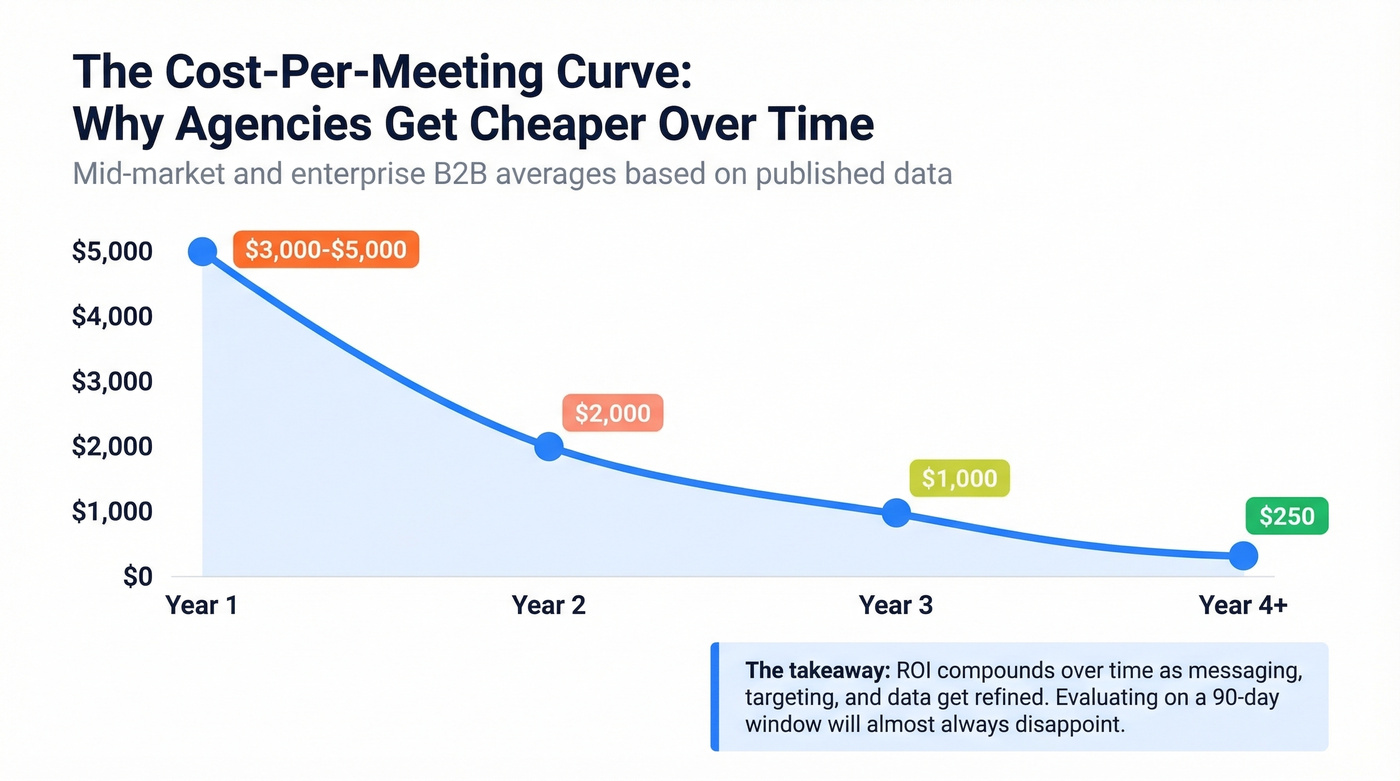
The takeaway: agencies are expensive at first. The ROI compounds over time as messaging, targeting, and data get refined. If you're evaluating on a 90-day window, you'll almost always be disappointed.
In-House vs. Outsourced Sales
| Factor | In-House SDR | Outsourced Agency |
|---|---|---|
| Year-one cost | $100K-$130K | $36K-$180K |
| Annual fully loaded | $200K-$300K | $70K-$100K |
| Time to first output | ~6 months | 2-4 weeks |
| Cost per meeting (yr 1) | $821-$1,150 | $250-$600 |
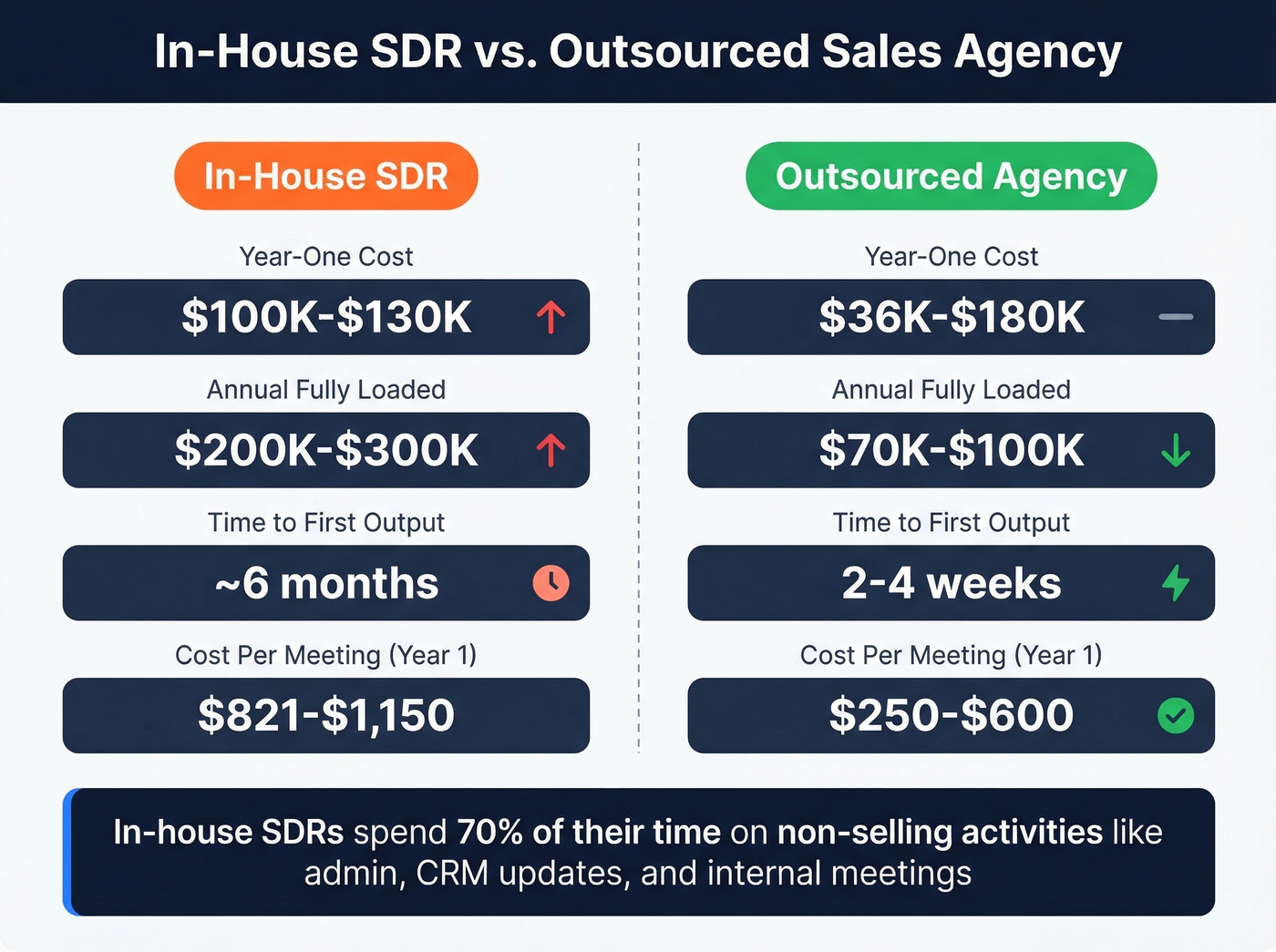
The annual numbers tell the story. In-house teams can accumulate $200K-$300K per SDR when you factor in recruiting, training, tools, turnover, and management time. In-house SDRs also spend 70% of their time on non-selling activities - admin, CRM updates, internal meetings - while outsourced teams are structured to minimize that overhead. Outsourced agencies average $70K-$100K for comparable output.
Here's the contrarian take: you probably don't need an agency. You might need better data and a part-time SDR. We've seen teams throw $5K/month at an outsourced firm when the real problem was a CRM full of dead contacts and no ICP definition. An agency can't fix a targeting problem - they'll just send more emails to the wrong people, faster.
When outsourcing genuinely makes sense: you're entering a new market and need pipeline in weeks, not months. Your sales cycle is complex enough that you need experienced reps, not junior hires learning on the job. Or you need to prove B2B sales outsourcing works before the board approves headcount. Those are legitimate use cases. "We don't want to deal with hiring" is not - that's a management problem, not a sales problem.

You read it above: contact data decays 30% annually. That's why agencies burn your budget on stale lists. Prospeo refreshes every 7 days - not every 6 weeks like competitors - with 98% email accuracy and 143M+ verified addresses. Whether you outsource or build in-house, clean data is the #1 variable.
Stop paying agencies to email dead inboxes.
How to Choose the Right Partner
The fact that you can't find a single straightforward pricing page from most agencies tells you everything about how this industry operates. Here's how to cut through it.
A standard engagement follows five phases: discovery, strategy development, outreach, sales execution, and reporting/optimization. Knowing this upfront helps you evaluate whether a firm has a real process or is winging it.
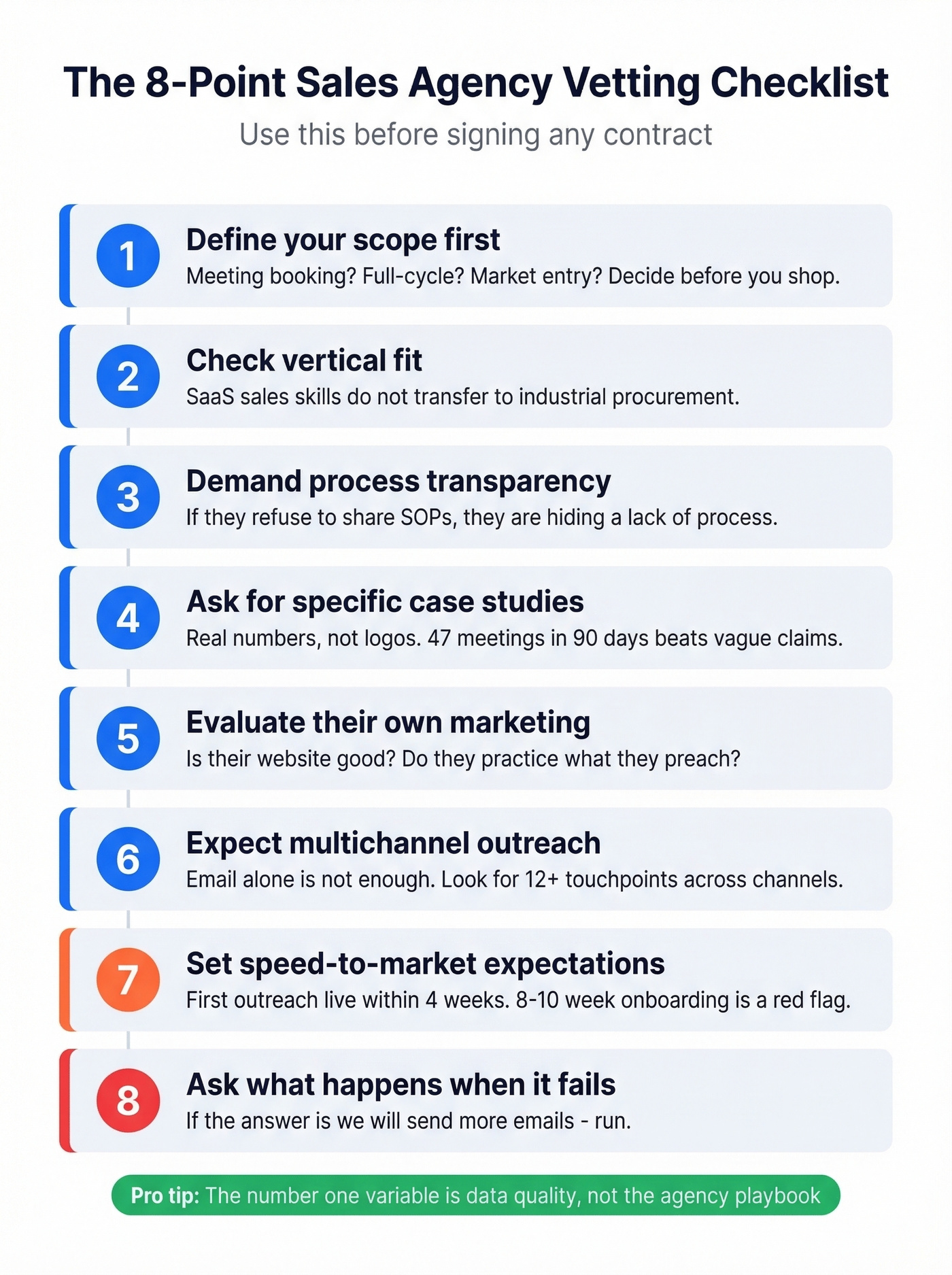
The 8-point vetting checklist:
Define your scope first. What exactly do you need - meeting booking, full-cycle closing, market entry support? Badly-defined expectations lead to misunderstanding and disappointment on both sides.
Check vertical fit. A firm that crushes it selling SaaS to mid-market won't necessarily know how to sell industrial equipment to procurement teams. Ask how niche their experience is.
Demand process transparency. We've found that agencies refusing to share SOPs are hiding a lack of process, not protecting trade secrets. Walk away.
Ask for specific case studies. Not logos on a website - actual numbers. "We booked 47 meetings in 90 days for a Series B fintech targeting CFOs" beats "we work with leading technology companies."
Evaluate their own marketing. This one comes straight from Reddit's agency vetting threads: check how the agency markets itself. Is their website good? Can you find their ads? Do they practice what they preach?
Expect outreach across email, phone, and social. Email alone doesn't cut it. A solid agency runs at least 12 touchpoints across channels to nurture a prospect.
Set a speed-to-market expectation. A good agency should have your first outreach live within 4 weeks of signing. If onboarding takes 8-10 weeks, that's a red flag.
Ask what happens when it doesn't work. Every agency will tell you about their wins. The good ones will explain how they diagnose and fix underperformance. If the answer is "we'll send more emails," run.
What Results to Expect
Let's ground expectations in reality, not pitch decks.
80% of B2B sales interactions now happen through digital channels. Buyers spend just 17% of their buying time actually meeting with suppliers. Most deals require 5-12 touchpoints before a conversation happens. And here's the sobering one: 84% of sales reps missed quota last year.
A competent agency should deliver 8-20 qualified meetings per month depending on your ICP complexity and deal size. Show rates with proper confirmation processes run 60-80%. The average B2B close rate sits around 29%, so don't expect every meeting to become a deal.
On the cost side, average B2B cost per lead runs about $200, but demo request CPLs can hit $600-$800. If your agency is delivering meetings at $300-$500 each and your AEs close at even a 20% rate, the math works - but only if the meetings are genuinely qualified. Unqualified meetings are worse than no meetings because they waste your closers' time and erode trust in the agency relationship.
The Data Problem That Kills ROI
Here's the thing most agencies won't tell you upfront.
You hired an agency three months ago. They've sent 15,000 emails. Your bounce rate is 22%. You've booked 6 meetings, and 2 were no-shows. Sound familiar?
Most outsourced sales efforts fail because of bad data, not bad salespeople. Contact information decays about 30% annually - people change jobs, companies get acquired, email domains rotate. If an agency won't tell you exactly how they source contact data, that's your biggest red flag.
Firms charging $2,500/mo use the same stale databases everyone else uses. Firms charging $7,500+ invest in better data and run outreach across multiple channels. The price difference often comes down to data quality. This is the hidden reason so many lead generation companies underperform - the reps are fine, but the lists are garbage.

Whether you hire an agency or build in-house, run every list through a verification layer first. Prospeo's 98% email accuracy and 7-day data refresh cycle (the industry average is six weeks) exist specifically for this use case. Stack Optimize built from $0 to $1M ARR using Prospeo data - bounce rates under 3%, zero domain flags across all clients. At roughly $0.01 per email credit, that's 90% cheaper than enterprise databases.
Agencies charge $125-$800 per meeting, and bad data inflates that cost fast. Prospeo delivers verified emails at $0.01 each and 125M+ direct dials with a 30% pickup rate. Arm your agency - or your in-house SDRs - with data that actually connects to real buyers.
Cut your cost-per-meeting by fixing the data layer first.
Agencies Worth Evaluating
If you're evaluating for the first time, start with Belkins, SalesHive, or CIENCE - they're among the most visible and well-documented options. Here's a quick rundown of firms worth a conversation:
Belkins - One of the more data-forward agencies. Their published cost-per-meeting optimization curve is one of the few honest pieces of agency pricing content on the internet. Strong in mid-market B2B.
SalesHive - Tech-forward with a relatively transparent process. Good fit if you want a modern outbound stack without building it yourself.
CIENCE - Positions itself as AI and data-driven outbound at scale, with an emphasis on targeting and volume.
Callbox - Strong option for multilingual and global campaigns. If you're selling into APAC or LATAM, they've got the coverage and deep expertise in multi-channel prospecting.
Sales Roads - US-based reps, US-focused campaigns. Straightforward positioning for domestic sales development.
MarketJoy - SMB-focused with lower entry points. Good for companies testing outbound for the first time without committing to enterprise pricing. Skip this if you're selling six-figure deals into enterprise accounts - they're not built for that motion.
EBQ - Full-funnel coverage from lead gen through customer success. Worth evaluating if you want one vendor across the entire lifecycle.
TeamRocket - Startup-oriented. They understand the urgency and budget constraints of early-stage companies and price accordingly.
How to Start Your Own Sales Agency
If you're on the other side of this - thinking about launching your own B2B sales development agency - here's the realistic playbook based on what founders actually do.
- Choose a niche. "We do outbound for everyone" is a death sentence. Pick a vertical or ICP you know cold.
- Register your company and domain. Get the legal basics done before you start prospecting.
- Build a website and social presence. You're selling sales services - your own marketing needs to be sharp.
- Test-hire via freelance platforms. Upwork is the standard starting point for finding email marketers and cold callers before you commit to full-time hires.
- Build your scripts, templates, proposals, and contracts. These are your operating system. Don't wing it.
- Onboard a CRM. HubSpot's starter plan with a dialer is a common choice for new agencies.
- Lock in your data stack. For contact data, skip the expensive enterprise databases. Prospeo's free tier gives you 75 verified emails per month - enough to test your first campaigns without a contract.
- Set an outreach start date and go. Momentum matters more than perfection in the first 90 days.
One trend worth watching: 78% of organizations now use AI in at least one business function, and 23% are scaling agentic AI systems. The smartest new agencies are building proprietary tech from day one. Agency margins get eaten by delivery overhead when you scale linearly with people - the ones that survive build leverage through automation.
FAQ
What's the difference between a sales agency and a lead gen firm?
A sales agency executes the full sales process - calls, meetings, objection handling, and sometimes closing. A lead generation firm stops at delivering contacts or booked meetings. If you need someone to run the entire pipeline, you want a full-cycle agency. If you just need qualified names, a lead gen company is cheaper and simpler.
How long before an agency delivers results?
Expect 2-4 weeks for onboarding and first outreach. Meaningful pipeline appears in months two and three. Cost per meeting improves significantly by year two as messaging and targeting get refined. Don't judge performance on 30-day results.
Can I use an agency for a short-term project?
Yes - many firms offer 3-4 month contracts, ideal for testing a new market or ICP before committing to in-house hires. Short engagements won't benefit from the compounding optimization that makes outsourcing cost-effective over time, so set expectations accordingly.
What tools should I pair with an outsourced team?
A CRM like HubSpot or Salesforce, a verified contact data platform for list quality, and a deliverability monitoring tool. The CRM is the system of record, the data platform ensures you're not burning sends on bad contacts, and deliverability monitoring catches domain reputation issues before they tank campaigns.
Are commission-only agencies a good deal?
Rarely. Nobody good works on pure commission anymore - the structure attracts desperate reps or firms that cherry-pick easy deals and ignore the rest of your pipeline. Expect a retainer plus performance bonus from any reputable partner. If someone offers commission-only, ask yourself why they can't command a retainer.
The agencies that deliver are the ones with clean data, transparent processes, and enough patience to let the compounding work. Everything else is noise.