

How to Build a Sales and Marketing Tech Stack That Doesn't Waste Money
There are 15,384 martech solutions on the market right now - a 100X increase since 2011. That's not a category. It's a landfill. Most teams don't need to navigate 15,000 tools. They need a small set that actually talk to each other, then they need to stop shopping.
Building a sales and marketing tech stack that drives revenue isn't about buying more software. The teams closing the most revenue aren't running the biggest stacks - they're running tight ones where every tool earns its seat.
The Minimum Viable Stack
What's a Revenue Tech Stack?
It's the set of software your revenue team uses to find, engage, convert, and retain customers - sales and marketing technology combined into one system. The CRM sits at the center. Salesforce appears in roughly 50% of documented B2B stacks, and the HubSpot + LinkedIn Ads + Google Analytics combo shows up in about 28.5% of mid-market companies.
The mistake most guides make is splitting sales tools and marketing tools into separate universes. In practice, they're one RevOps system. Your sequencing tool feeds your CRM, which feeds your marketing automation, which feeds your attribution. Treat it as a single architecture or you'll spend half your time duct-taping handoffs between siloed platforms that were never designed to share data cleanly.
Five Layers of a B2B Tech Stack
Every stack, regardless of budget, follows the same five-layer architecture. The tools change; the layers don't.
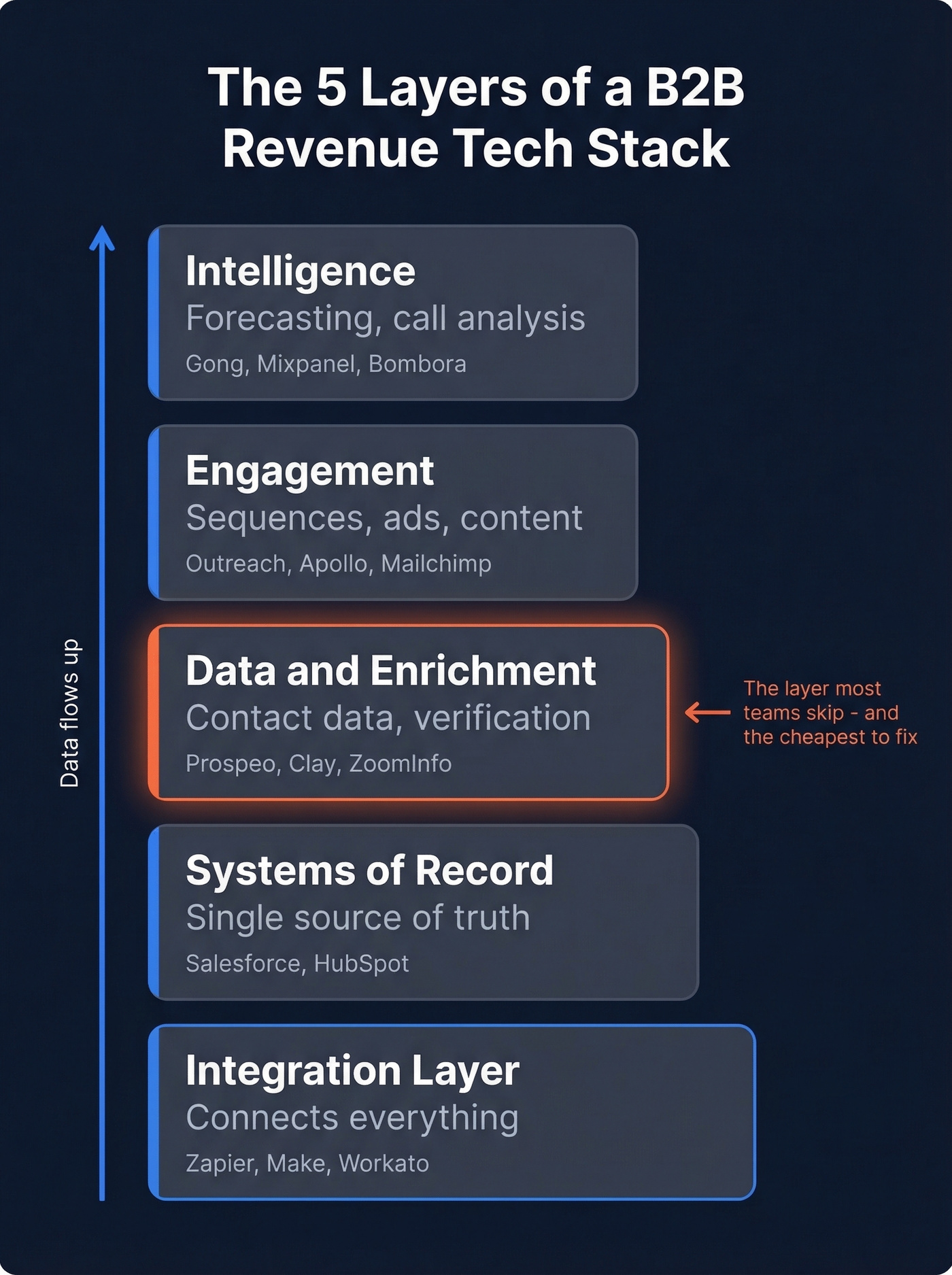
| Layer | What It Does | Example Tools |
|---|---|---|
| Systems of Record | Single source of truth | Salesforce, HubSpot |
| Data & Enrichment | Contact data, verification | Prospeo, Clay, ZoomInfo |
| Engagement | Sequences, ads, content | Outreach, Apollo, Mailchimp |
| Intelligence | Forecasting, call analysis | Gong, Mixpanel, Bombora |
| Integration | Connects everything | Zapier, Make, Workato |
The data and enrichment layer is where most stacks quietly bleed money. Bad contact data cascades into bounced sequences, wrecked sender reputation, and reps wasting 12 hours a week chasing information instead of selling. You need at least one strong tool in this layer, and it's the one most teams underinvest in.
One trend reshaping these layers: AI agents are starting to consolidate entire categories. Meeting notes, first-draft sequences, basic enrichment - 94% of sales leaders with AI agents already call them critical. Don't overbuy tools that an agent will replace within a year.
The RevOps architecture framework from CXToday adds governance as a sixth layer - ownership rules, SLAs, audit logs, consent management. You can skip formal governance tooling early on, but define who owns which fields in your CRM. That alone prevents half the data quality problems we see.

Most stacks bleed money at the data layer. Prospeo gives you 300M+ profiles with 98% email accuracy, 125M+ verified mobiles, and a 7-day refresh cycle - so every tool downstream actually works. At ~$0.01/email, it costs 90% less than ZoomInfo.
Stop feeding bad data into a good stack. Start with Prospeo free.
How Many Tools Do You Need?
| Company Stage | Typical Tool Count |
|---|---|
| Seed - Series A | 10-20 |
| Series B - D | 25-60 |
| Enterprise | 60-120+ |
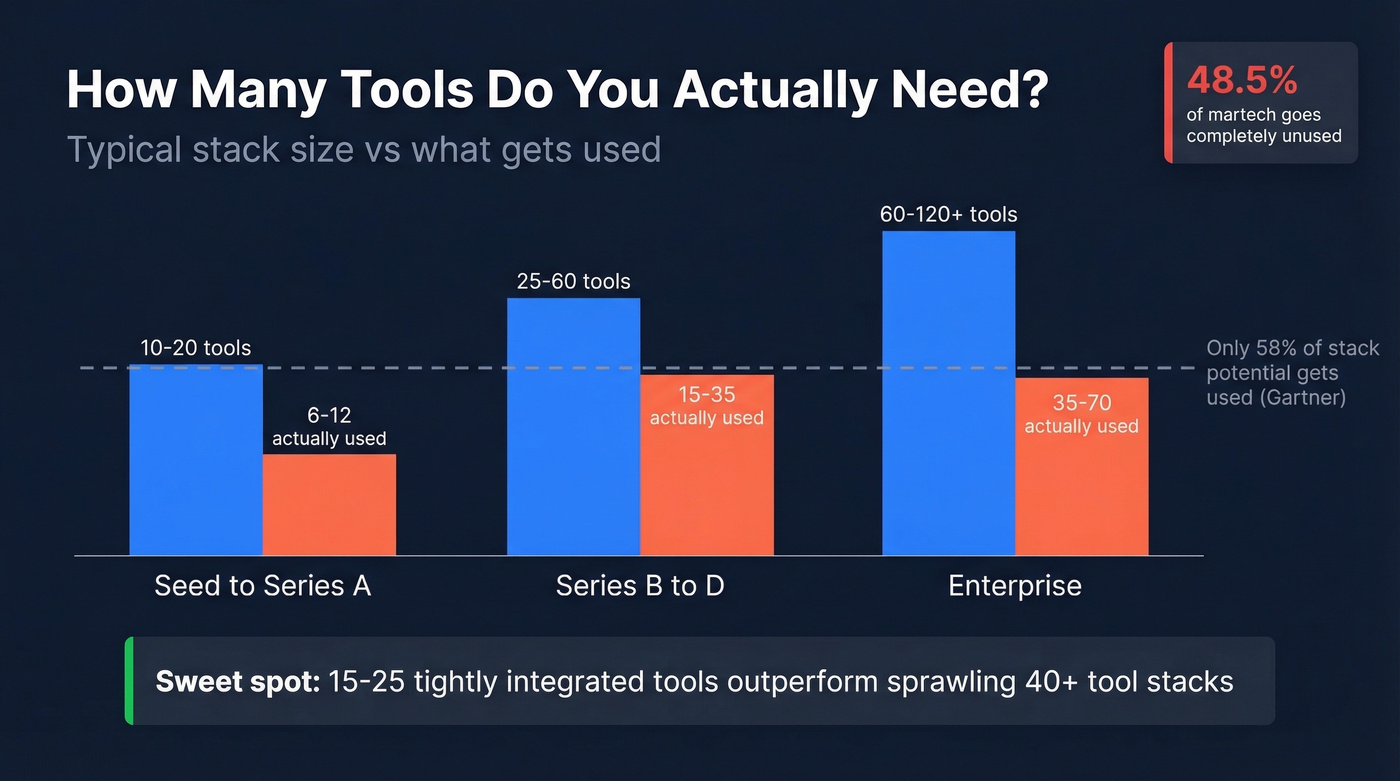
Those Pedowitz benchmarks reflect reality, but they don't reflect what's optimal. Marketing teams use only 58% of their stack's potential, per Gartner. Another study puts it starker: just 51.5% of purchased martech tools are actually being used. Meanwhile, 92% keep their stacks at 20 tools or fewer.
Here's the heuristic we use: if a tool's adoption rate is under 40%, it's either redundant or a bad fit. Cut it. The martech landscape has an 8.6% annual churn rate - tools come and go constantly. Don't get attached.
Most teams with 40+ tools would close more deals with 15 and a better data layer. The common sweet spot for mid-market teams is 35-45 tools, but the ones outperforming their peers run much leaner.
What to Build at Every Budget
Marketing budgets fell to 7.7% of company revenue in recent years. Every dollar matters more now.
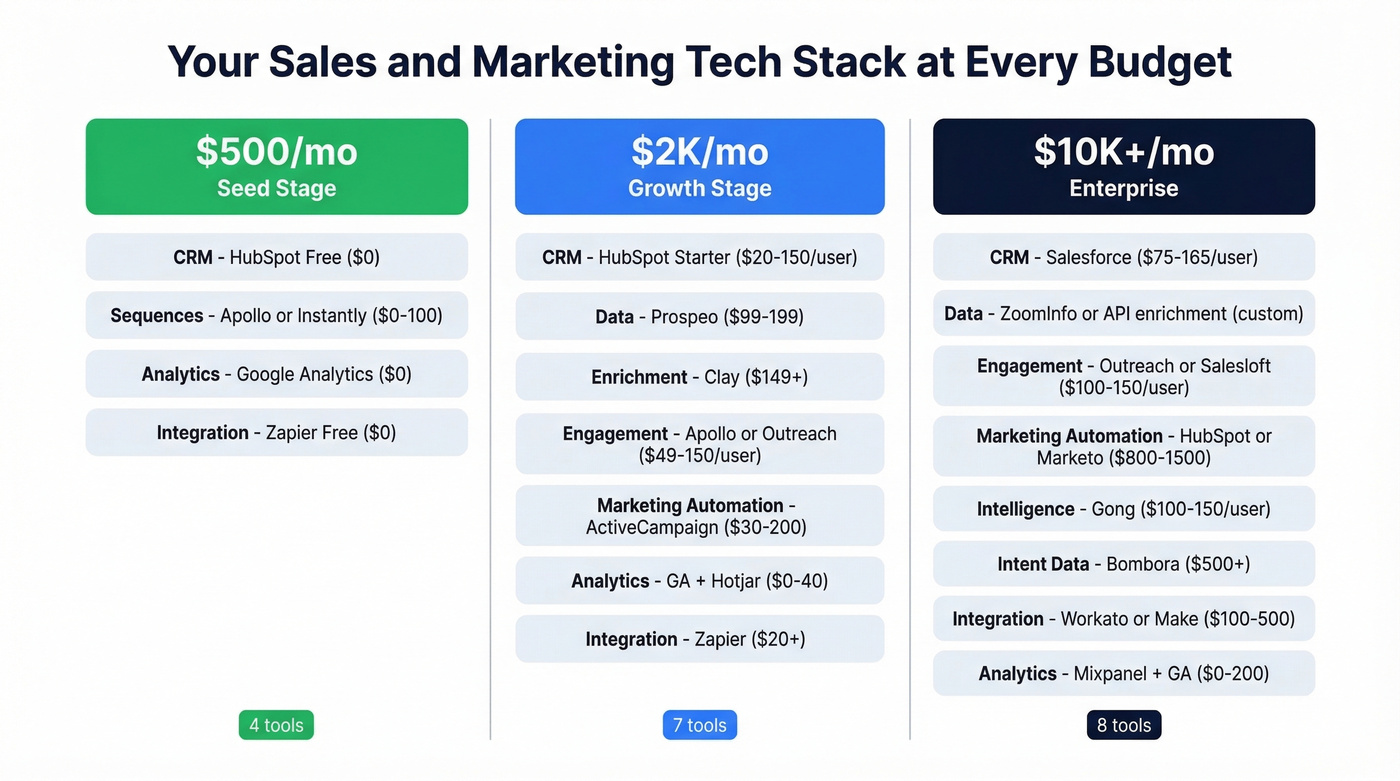
If you're pre-Series A spending $500/mo+ on tools, you're usually overbuying. One founder on r/startups described the pain perfectly: "If you're running sales all by yourself they really tax you for automation." Start lean.
The $500/mo Stack
| Layer | Tool | ~Cost/mo |
|---|---|---|
| CRM | HubSpot (free) | $0 |
| Sequencing | Apollo or Instantly | $0-$100/user |
| Analytics | Google Analytics | $0 |
| Integration | Zapier (free tier) | $0 |
This is a real, functional outbound and inbound stack. Prospeo handles contact data and email accuracy - with 98% verified email accuracy and a 7-day data refresh cycle, you're not sending sequences to dead addresses. Apollo or Instantly runs your sequences. HubSpot tracks your pipeline. You can prospect, sequence, and close without a bloated stack.
The $2K/mo Stack
| Layer | Tool | ~Cost/mo |
|---|---|---|
| CRM | HubSpot Starter or Salesforce | ~$20-$150/user |
| Data/Verification | Prospeo | $99-199 |
| Enrichment | Clay | ~$149+ |
| Engagement | Apollo or Outreach | ~$49-$150/user |
| Marketing Automation | ActiveCampaign or Mailchimp | ~$30-$200+ |
| Analytics | GA + Hotjar | $0-$40 |
| Integration | Zapier | ~$20+ |
At this tier, you're adding orchestration through Clay for waterfall enrichment, marketing automation for nurture sequences, and heatmap analytics. Clay pulls data from multiple sources, and a verification step catches bad records before they hit your sequences - spam traps, honeypots, and catch-all domains that other tools miss. This is where most B2B technology investments start paying off with real pipeline acceleration.
The $10K+/mo Stack
| Layer | Tool | ~Cost/mo |
|---|---|---|
| CRM | Salesforce | ~$75-$165/user |
| Data | ZoomInfo or API-based enrichment | ZoomInfo: custom; API: credit-based |
| Engagement | Outreach or Salesloft | ~$100-$150/user |
| Marketing Automation | HubSpot or Marketo | ~$800-$1,500 |
| Intelligence | Gong | ~$100-$150/user |
| Intent Data | Bombora | $500+ |
| Integration | Workato or Make | $100-$500 |
| Analytics | Mixpanel + GA | $0-$200 |
At enterprise scale, the question isn't which tools - it's whether they're integrated tightly enough to justify the spend. A 10-seat ZoomInfo contract with intent data and mobile numbers typically runs $40-60k/year. Mid-market teams should seriously consider pairing a high-accuracy, lower-cost data tool with Gong for intelligence rather than paying ZoomInfo's all-in-one premium. We've seen teams make that switch and drop their bounce rate from 35% to under 4% while tripling pipeline.
The Layer Most Teams Skip
Here's the thing: your CRM, your sequences, your marketing automation - they're all downstream of your data. And 82% of companies make decisions using stale information. No matter how sophisticated your engagement and intelligence layers are, garbage data in means garbage results out.
About 30% of email addresses become invalid within a year. Sales reps spend 65% of their time on non-selling work - admin, internal meetings, chasing down bad contact info. One Reddit practitioner described abandoning cold email entirely after domain reputation damage from bounced sends. Another on r/sales estimated they wasted two full months of pipeline before realizing their data provider was feeding them dead addresses.
That's genuinely infuriating. Two months of pipeline, gone, because nobody verified the data before loading it into sequences.
This is the cheapest layer to fix and the most expensive to ignore. At roughly $0.01 per verified email - 90% cheaper than ZoomInfo's per-lead cost - there's no excuse for sending sequences to unverified contacts. (If you want the mechanics, start with email verification and work backward.)
Teams that switched to Prospeo dropped bounce rates from 35% to under 4% and tripled pipeline - without adding more tools. 30+ search filters, intent data across 15,000 topics, and native integrations with Salesforce, HubSpot, Instantly, and Clay.
The highest-ROI upgrade to your tech stack costs $0.01 per lead.
Three Mistakes That Waste Your Budget
Shelfware. 48.5% of purchased martech tools go unused. Every quarterly audit should ask one question: did anyone log into this tool in the last 30 days? If not, kill it. (A simple RevOps Manager owner model helps make this stick.)
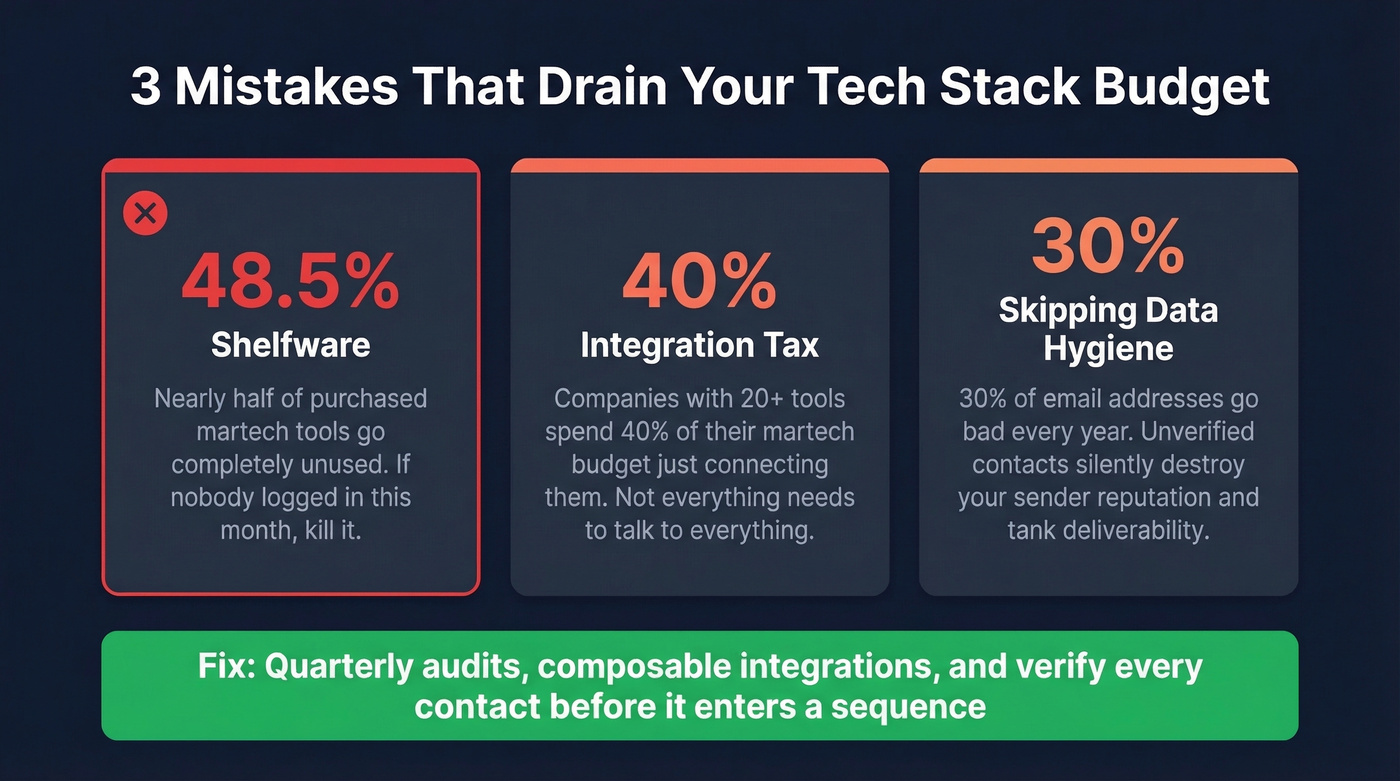
Integration tax. Companies with 20+ tools spend roughly 40% of their martech budget on integration. That's not a tech problem - it's an architecture problem. Composable approaches, where you connect only high-impact data flows like lead handoffs, customer context, and attribution, deliver 60% faster implementation and 40% lower total cost of ownership. Not everything needs to talk to everything.
Skipping data hygiene. That 30% annual email decay doesn't announce itself. It silently tanks your deliverability, inflates your bounce rate, and trains inbox providers to flag your domain. If you aren't verifying contacts before they enter your sequences, nothing else in your stack matters. Skip this if you enjoy watching your sender reputation crater in real time. (If you're already seeing issues, use an email deliverability guide and an email reputation tools checklist.)
FAQ
What tools should every B2B stack include?
At minimum: a CRM (HubSpot free works), a data verification tool, a sequencing tool (Apollo or Instantly), and Google Analytics. That covers prospecting through pipeline tracking. Add marketing automation and intent data once you scale past 10 reps.
How often should you audit your tech stack?
Quarterly. Check utilization rates for every tool - anything under 40% adoption is a candidate for removal. Most stacks have at least one tool to cut every cycle. Treating your B2B revenue tools as a unified system makes audits faster because you can trace data flow end to end.
How many tools does the average B2B company use?
Early-stage teams run 10-20, mid-market 25-60, enterprises 60-120+. But the teams with the tightest revenue efficiency typically run focused stacks of 15-25 tools they use daily, not sprawling portfolios they forget about.
What's the biggest waste in a sales and marketing tech stack?
Shelfware - tools nobody uses. Studies show 48.5% of purchased martech goes unused. The second biggest waste is skipping data verification: bounced emails destroy sender reputation and kill pipeline before your engagement tools even get a chance to work. Let's be honest - if your data layer is broken, the rest of your stack is just expensive decoration.