

The Complete Guide to Sales Appointment Setting in 2026
Your new setter just finished week one. Four hundred dials, 200 emails, three meetings booked, one no-show. That's not a bad week - that's a normal one. Sales appointment setting is the unglamorous engine that turns a list of names into pipeline, and most teams underestimate how much precision it takes to do well.
What Is Appointment Setting?
Appointment setting is the process of qualifying prospects and scheduling meetings between them and your closers. It sits between lead generation - finding names - and the sales conversation where deals actually close. The online appointment scheduling market is projected to hit $1.52B by 2032 at a 15.7% CAGR, which tells you something about how seriously companies are investing in this function.
The fundamentals haven't changed: you need the right person, the right message, and the right timing.
What You Need (Quick Version)
Setting appointments consistently works when you nail three things:
- Clean contact data. Your setters can't book meetings with bad phone numbers and bounced emails. With cold call success rates in the 2.3-4.8% range, every dial counts.
- A repeatable multi-channel process. It takes 18 dials to reach a buyer and an average of eight points of contact to convert. You need a system, not a suggestion.
- Tight qualification criteria. A "meeting" that wastes your AE's time is worse than no meeting at all. Define "qualified" before you start dialing.
Setter vs. SDR vs. BDR vs. AE
Titles in sales development are a mess. One company's SDR is another company's BDR, and some orgs use "appointment setter" as a catch-all. Here's how the roles typically break down.
| Role | Focus | Reports To | Scope | Quota Type |
|---|---|---|---|---|
| Setter | Outbound booking | Sales | Meeting volume | Meetings set |
| SDR | Inbound qualifying | Marketing/Sales | Lead follow-up | SQLs or meetings |
| BDR | Outbound prospecting | Sales | New accounts | Pipeline created |
| AE | Closing deals | Sales | Full cycle | Revenue |
The SEC Gold Standard Prospecting Report found that 58% of SDRs manage 75+ accounts per quarter. That's a lot of plates spinning. The practical difference between a setter and an SDR often comes down to whether they're working inbound leads or cold lists, and whether they own qualification or just the calendar invite.
Don't get hung up on titles. What matters is clarity on who owns what. If your setter is also qualifying, they're doing SDR work. If your BDR is also booking meetings, they're setting appointments. Define the job, not the acronym.
The Appointment Setting Process
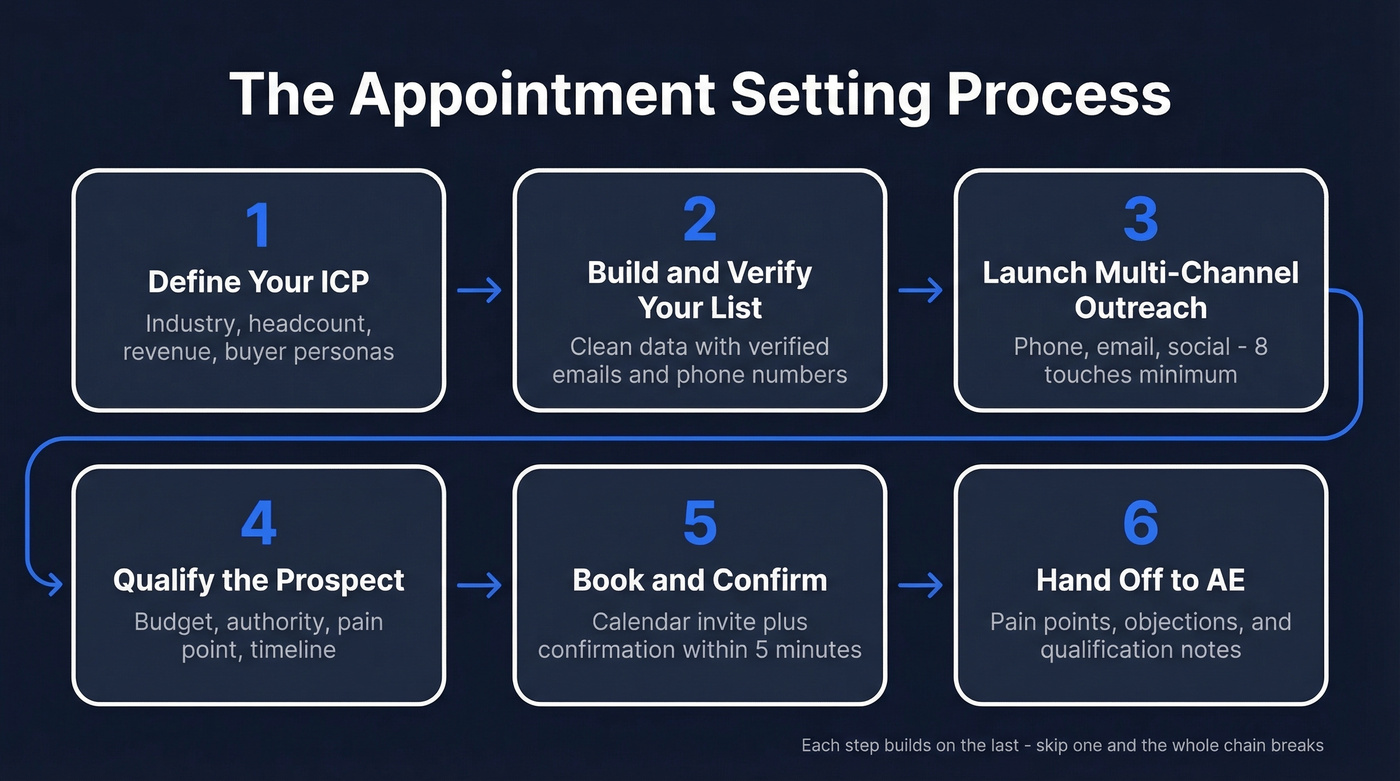
Step 1: Define Your ICP
Start with firmographics - industry, headcount, revenue - then layer in buyer personas by title, department, and seniority. A tight ICP means fewer wasted dials. A loose one means your setters burn through lists without hitting decision-makers.
Step 2: Build and Verify Your List
This is where most teams lose before they start. Unverified lists mean bounced emails, disconnected numbers, and wasted hours.
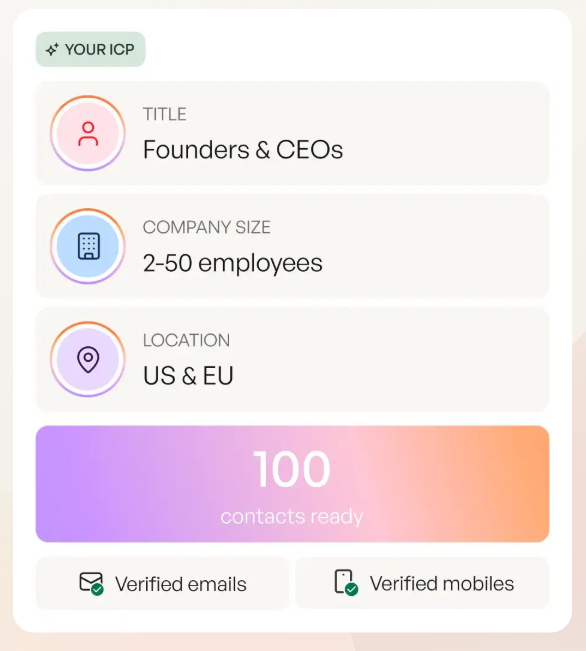
Prospeo covers 300M+ professional profiles with 98% email verification accuracy and 125M+ verified mobile numbers, all refreshed every 7 days. That matters because stale data degrades fast - the industry average refresh cycle is six weeks. When Snyk rolled out Prospeo across 50 AEs, their bounce rate dropped from 35-40% to under 5%, and AE-sourced pipeline jumped 180%.
Step 3: Launch Multi-Channel Outreach
Phone, email, and social touches in a coordinated sequence. Prospects require an average of eight points of contact to convert. A single cold call or lone email isn't a strategy - it's a lottery ticket.
Step 4: Qualify the Prospect
Before you book anything, confirm the prospect has budget authority, a relevant pain point, and a realistic timeline. A meeting with someone who can't buy is a meeting your AE will resent.
Step 5: Book and Confirm
Send a calendar invite immediately. Follow up with a confirmation email that includes a brief agenda or value prop. Leads contacted within 5-6 minutes are 8-10x more likely to convert than those contacted an hour later. Speed matters.
Step 6: Hand Off to the AE
A clean handoff includes the prospect's pain points, qualification notes, and any objections raised. The AE should walk into the meeting knowing exactly why this person agreed to talk.

Every wasted dial chips away at your setter's morale and your pipeline. Prospeo gives your appointment setting team 300M+ profiles with 98% email accuracy and 125M+ verified mobiles - refreshed every 7 days, not every 6 weeks. Snyk's 50 AEs cut bounce rates from 35% to under 5% and grew pipeline 180%.
Stop burning dials on dead data. Start booking real meetings.
Scripts That Actually Work
With cold call success rates hovering between 2.3% and 4.8% and 18 dials needed to reach a single buyer, your script needs to earn attention in the first few seconds. Here's the thing: most scripts fail because they open with the company name and a feature dump instead of a question the prospect actually cares about.
New Prospect Cold Call
"Hi [Name], this is [Your Name] with [Company]. I know I'm calling out of the blue - do you have 30 seconds? [Pause.] We help [role/industry] teams solve [specific problem]. I'm curious - is [pain point] something your team is dealing with right now?"
The pause after the permission opener is critical. Let them say yes or no. If they say no, respect it and move on.
Follow-Up Call
"Hi [Name], it's [Your Name] again from [Company]. I sent you an email last [day] about [specific topic]. I wanted to see if that landed - did anything in there resonate?"
Follow-ups convert better than cold opens because you're no longer a stranger. Reference the specific email or voicemail you left. Generic "just checking in" calls get hung up on.
Gatekeeper Navigation
"Hi, I'm hoping you can help me. I'm trying to reach [Name] about [specific business topic]. Is there a good time to catch them, or would email be better?"
Treat gatekeepers as allies, not obstacles. Capture their name and the best path to the decision-maker. When targeting C-level executives, lead with a business outcome rather than a product pitch - executive assistants are trained to filter vendor calls, but they'll pass along something that sounds like a peer-level conversation about a problem the exec actually cares about. Request 10 minutes instead of 30; time scarcity is real at the top.
Benchmarks for 2026
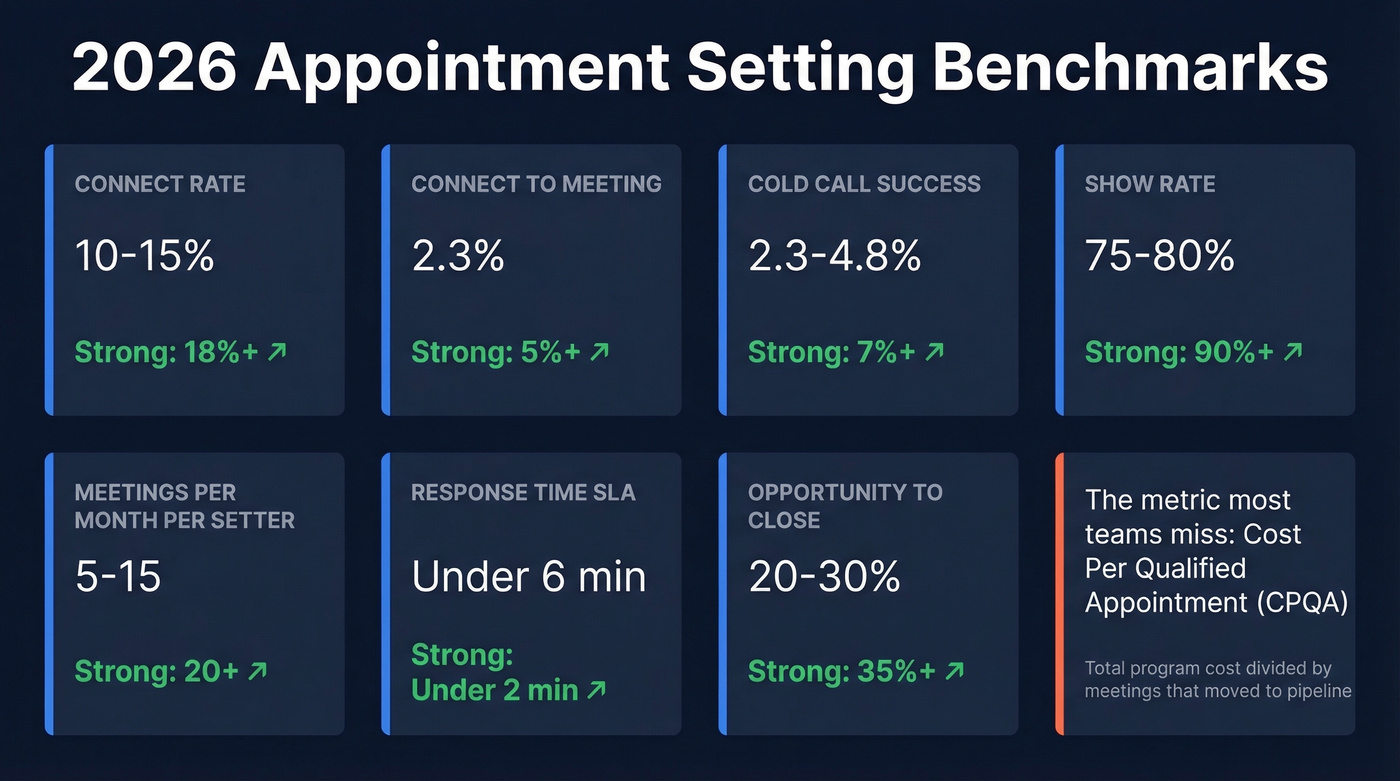
Numbers keep your team honest. Here's what good looks like - and the trendline is sobering. Cold call conversion rates have been declining; Cognism's industrial sales data shows a drop from 4.8% in 2024 to 2.3% in 2025, making every dial more precious heading into 2026.
| Metric | Benchmark | Strong |
|---|---|---|
| Connect rate | 10-15% | 18%+ |
| Connect-to-meeting | 2.3% | 5%+ |
| Cold call success | 2.3-4.8% | 7%+ |
| Show rate | 75-80% | 90%+ |
| Meetings/month/setter | 5-15 | 20+ |
| Response-time SLA | Under 6 min | Under 2 min |
| Opportunity-to-close | 20-30% | 35%+ |
The metric that matters most and gets tracked least is Cost Per Qualified Appointment (CPQA): total program expense divided by meetings that actually moved into pipeline. High-quality appointments reduce sales cycles by 10-12%, which means your CPQA directly impacts revenue velocity.
We've seen teams obsess over meetings booked while ignoring show rates and AE acceptance rates. A setter booking 20 meetings a month sounds great until you learn that 8 are no-shows and 5 get rejected by AEs as unqualified. We've also tested dozens of outreach sequences across different verticals, and the 8-touch minimum holds up every time - teams that quit after 3-4 touches leave the majority of their meetings on the table.
What It Actually Costs
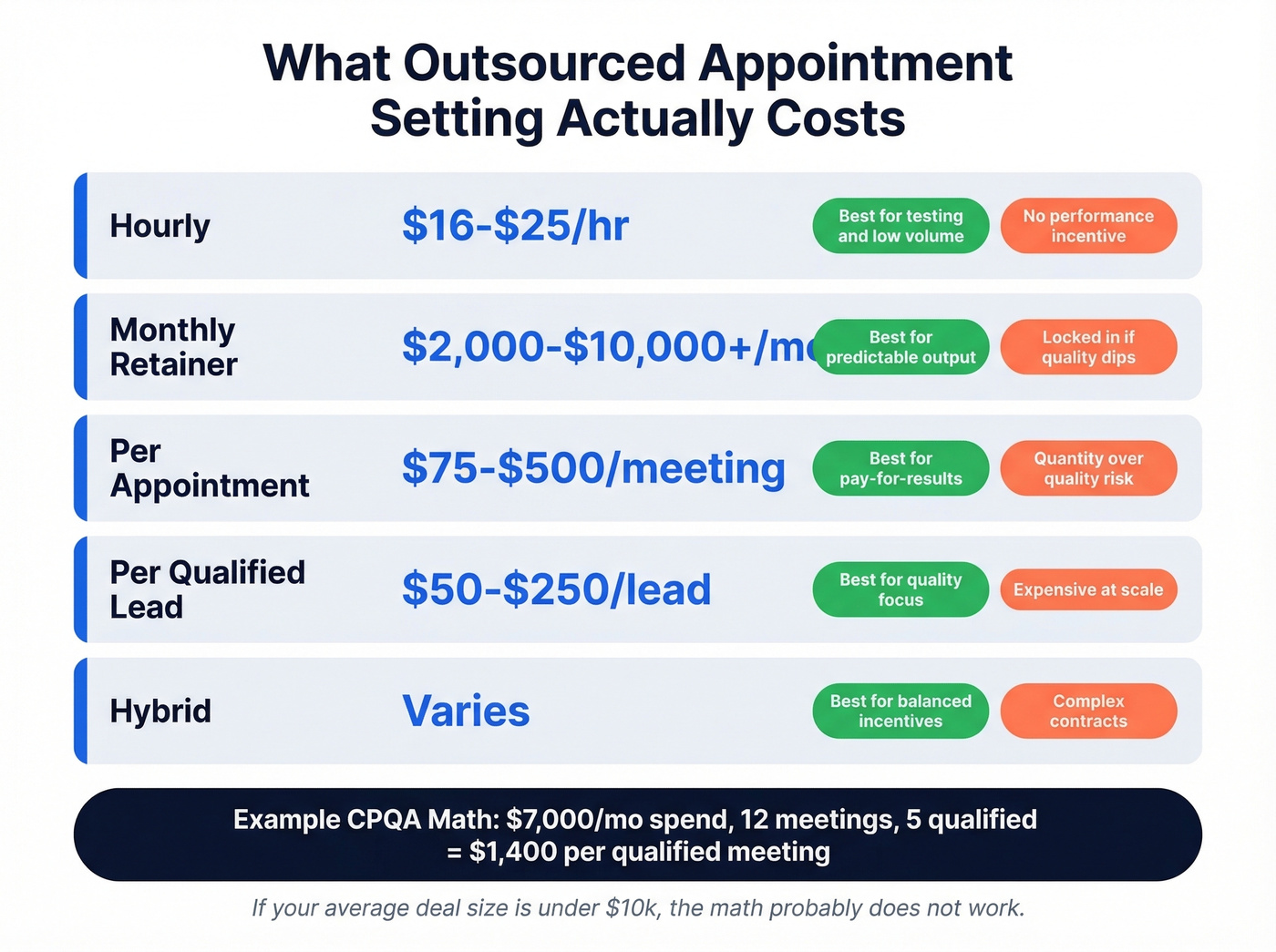
Outsourced appointment setting pricing varies wildly depending on the model.
| Model | Price Range | Best For | Watch Out For |
|---|---|---|---|
| Hourly | $16-$25/hr | Testing, low volume | No performance incentive |
| Retainer | $2,000-$10,000+/mo | Predictable output | Locked in if quality dips |
| Per appointment | $75-$500/meeting | Pay for results | Quantity over quality risk |
| Per qualified lead | $50-$250/lead | Quality focus | Expensive at scale |
| Hybrid | Varies | Balanced incentives | Complex contracts |
Real-world examples: SalesRoads runs $6,950/mo for fractional service and $9,500/mo for a full SDR. CIENCE starts around $2,000/mo. Expect setup fees of $1,000-$3,000 on top of monthly costs.
Let's do the CPQA math. You're paying $7,000/mo for an outsourced team. They deliver 12 meetings. Five are qualified and move to pipeline. That's $1,400 per qualified meeting. For teams closing $50k+ deals, $1,400 per at-bat is reasonable. For teams selling four-figure contracts, it probably isn't.
Look - if your average deal size doesn't justify a $1,400 cost-per-meeting, you probably don't need dedicated appointment setting at all. Have your AEs self-source with good data and a sequencer. The overhead of a separate setter function only pays off when deal sizes justify the cost-per-meeting math. The consensus on r/sales backs this up: most threads about outsourced setters end with someone pointing out that the math only works above a certain deal size threshold.
The decision heuristic is simple. Outsource when you need speed and don't have the hiring bandwidth. Hire in-house when volume justifies a full-time headcount and you want tighter control over messaging and quality.
Five Mistakes That Kill Conversions
1. Bad contact data. If 30-40% of your emails bounce, your domain reputation tanks and your setters waste hours on dead numbers. Verify before you dial.
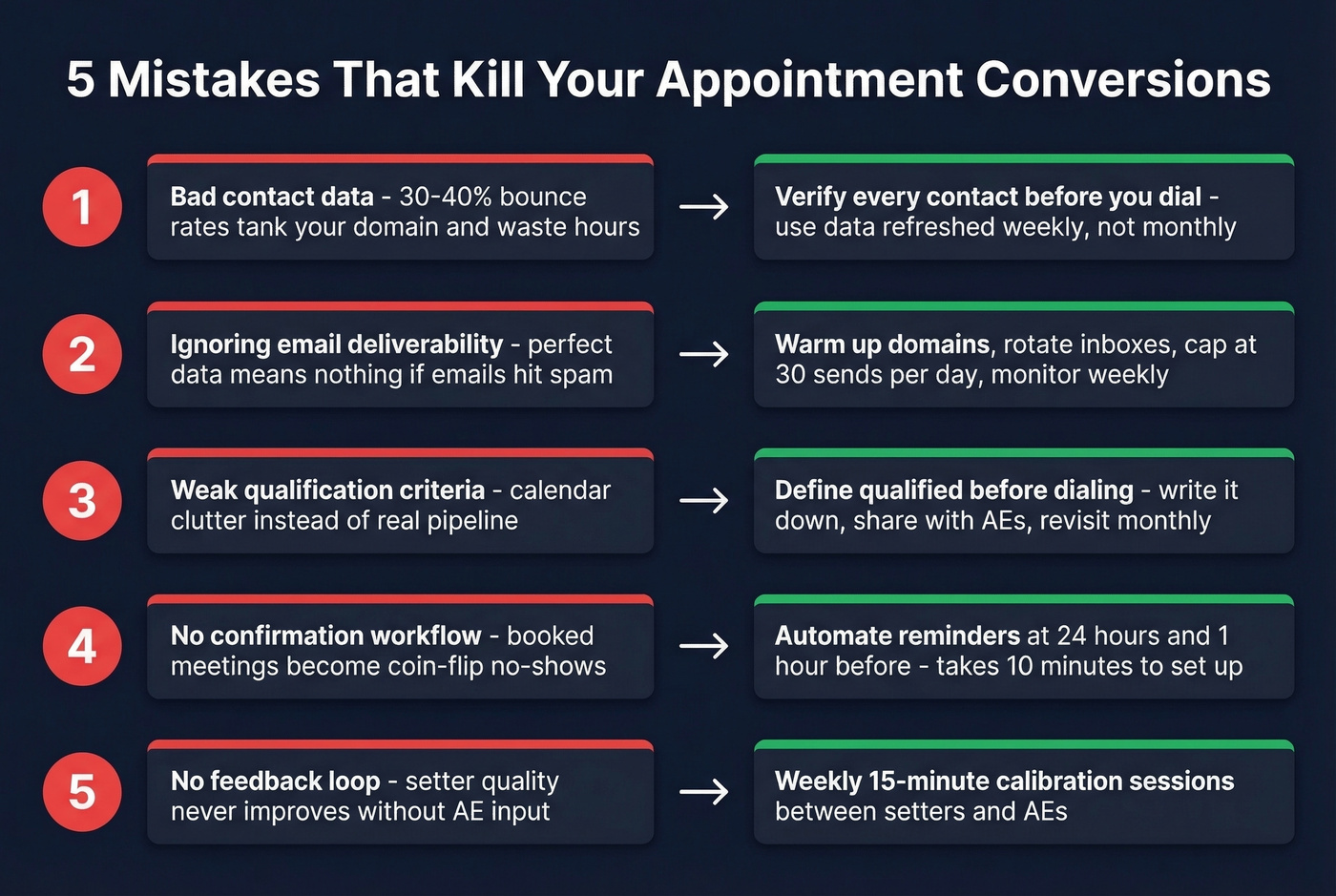
2. Ignoring email deliverability. Even perfect contact data won't help if your emails land in spam. Warm up new sending domains before running volume, use inbox rotation to spread sends across multiple mailboxes, and cap each inbox at around 30 sends per day. Monitor placement rates weekly. A burned domain takes months to recover - prevention is the only real fix.
3. Weak qualification criteria. If you haven't defined what a "qualified meeting" looks like before your setters start calling, you'll get calendar clutter instead of pipeline. Write it down. Share it with AEs. Revisit it monthly.
4. No confirmation or reminder workflow. A booked meeting without a confirmation email and two reminders - 24 hours and 1 hour before - is a coin flip. No-shows are one of the biggest frustrations in this entire process, and the fix is dead simple: automate it with Calendly or Chili Piper. Takes 10 minutes to set up.
5. No feedback loop between setter and AE. If your AEs aren't telling setters which meetings were good and which were garbage, quality never improves. Weekly calibration sessions - even 15 minutes - fix this. Skip this step and you're flying blind.
The 2026 Tech Stack
You don't need 10 tools. You need three categories covered well.
Contact Data and Verification
Prospeo delivers 98% email verification, 125M+ verified mobiles with a 30% pickup rate, and pricing around $0.01 per verified email. For comparison, ZoomInfo runs roughly $1/lead, and Apollo's free tier is generous but sits at around 79% email accuracy. Cognism runs $1,000-$3,000/mo for small teams. In our experience, the data freshness gap matters more than most teams realize - a 7-day refresh cycle catches job changes and new hires that a 6-week cycle misses entirely, and those stale records are the ones that bounce.
Outreach Sequencing
Instantly and Smartlead are popular picks for cold email because warmup, health monitoring, and inbox rotation matter more than most teams realize. Salesloft and Outreach are the enterprise plays, with deeper CRM integrations and call recording built in.
Scheduling and AI Setters
Calendly ($10-$16/seat/mo) handles basic scheduling. Chili Piper adds intelligent routing and CRM sync for mid-market teams. When evaluating AI scheduling tools, prioritize deep CRM integration, intelligent lead routing with qualification logic, and real-time availability management with buffer times between meetings - these are the features that actually reduce no-shows and AE frustration.
The newer category is conversational AI setters - tools like Cal.com's AI phone agent ($0.29/min) and Appointwise ($97/mo) that qualify prospects, handle objections, and book inside the conversation. These aren't replacing human setters yet, but they're handling after-hours leads and speed-to-lead gaps that humans can't cover. If your team is small and you're losing leads overnight, they're worth testing. For complex B2B sales with long buying committees, skip them for now.
When cold call conversion sits at 2.3-4.8%, you can't afford a single dial going to a disconnected number. Prospeo's 125M+ verified mobiles hit a 30% pickup rate - nearly 3x the industry average. At $0.01 per email, your cost per qualified appointment drops before your setters even pick up the phone.
Make every one of those 18 dials count with data that connects.
FAQ
How many appointments should a setter book per month?
Plan for 5-15 qualified meetings per month per setter, depending on ICP tightness, list quality, and channel mix. Top performers in narrow verticals hit 20+. Track CPQA and AE acceptance rate alongside raw volume - the number matters less than the quality.
What's the difference between appointment setting and lead generation?
Lead generation identifies potential buyers through marketing, content, or outbound research. Appointment setting takes those leads and books a specific meeting with a sales rep. One fills the top of funnel; the other converts it into scheduled pipeline.
Is outsourced appointment setting worth it?
Compare your CPQA to your average deal value. If an outsourced vendor charges $7,000/month and delivers 5 qualified meetings, that's $1,400 per meeting. For $50k+ deals that math works; for sub-$10k contracts, self-sourcing with verified data and a sequencer is usually cheaper.
What tools do appointment setters need?
Three essentials: a verified contact database for accurate emails and direct dials, an outreach sequencer like Instantly or Salesloft, and a scheduling tool like Calendly or Chili Piper. Everything else is optional until you've maxed out those three.
How do I reduce no-shows on booked appointments?
Automate confirmation emails and reminders at 24 hours and 1 hour before the meeting. Send a brief agenda ahead of time. Book meetings soon after the initial conversation - longer gaps between contact and the scheduled call increase drop-off significantly.