

Sales Call Scripts Backed by 300M+ Calls of Data
It's 10:15 AM on a Tuesday. You've got 40 dials to make before lunch, a sales call script that hasn't been updated since Q3, and a nagging suspicion that half your numbers are wrong anyway. Cold calling isn't dead - 82% of buyers still accept meetings from salespeople who reach out proactively. Bad scripts are what's dead. The robotic, "Hi, how are you today?" openers that prospects can smell from the first syllable.
You don't need 25 templates. You need 3 great ones and the discipline to call the right people.
The Cheat Sheet
If you're short on time:
- Use a permission-based opener. The 300M-call study from Gong puts it at 11.18% success - five times better than "Did I catch you at a bad time?"
- Hit the 43/57 talk ratio. You talk 43% of the call, they talk 57%. Reps who flip this lose deals at measurably higher rates.
- Fix your data before your script. The best opener in the world doesn't help when 12 of your 38 dials hit disconnected numbers.
Keep reading for the full frameworks and the data behind them.
Which Openers Actually Work
Most "best cold call script" articles hand you a template and call it a day. Let's start with what Gong found after analyzing 300M+ cold calls - the gap between the best and worst opener is staggering.
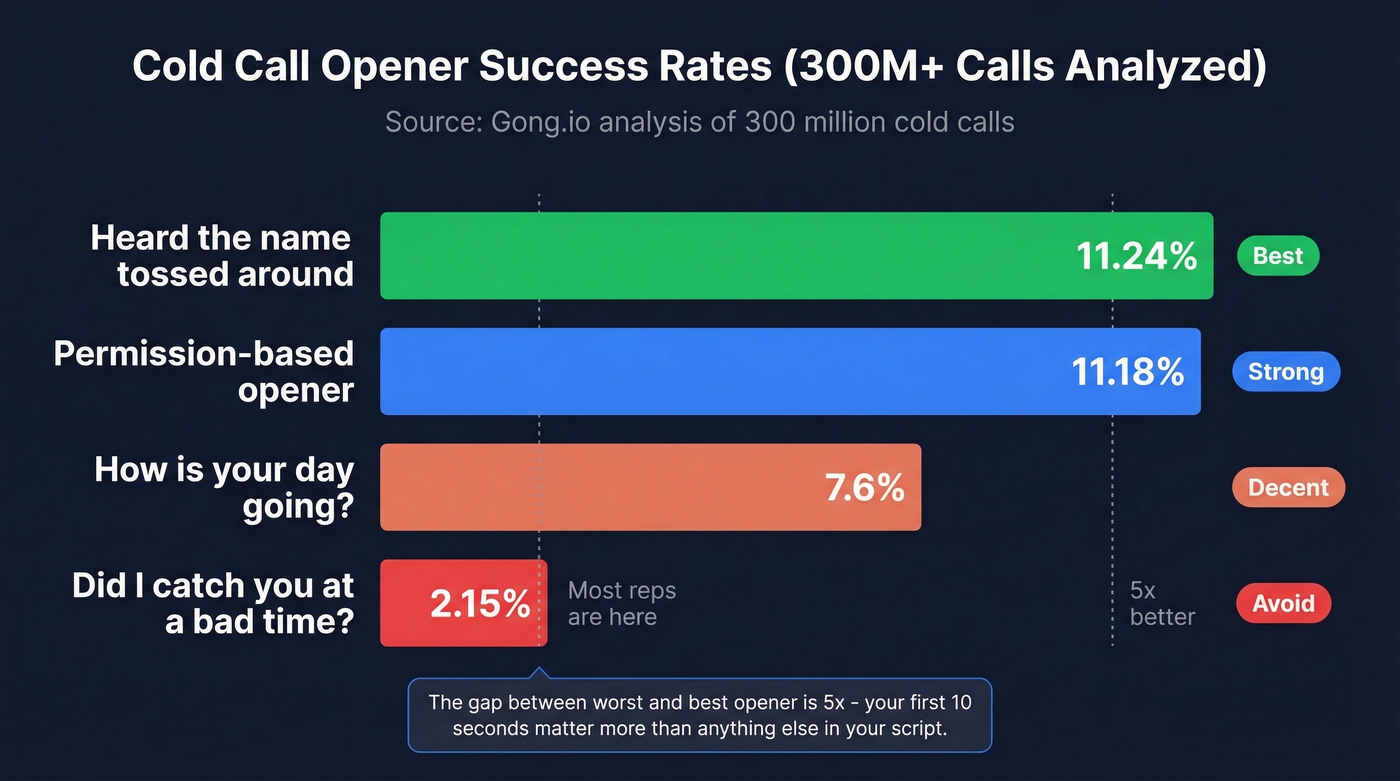
| Opener Type | Success Rate | Verdict |
|---|---|---|
| "Did I catch you at a bad time?" | 2.15% | Avoid |
| "How's your day going?" | 7.6% | Decent |
| Permission-based opener | 11.18% | Strong |
| "Heard the name tossed around" | 11.24% | Best |
The "bad time" opener is a self-fulfilling prophecy - you're handing the prospect an exit before you've said anything of value. The permission-based opener works because it acknowledges the interruption honestly. "Heard the name tossed around" triggers curiosity and social proof at the same time.
We've tested both top openers across different verticals, and the permission-based version is more versatile - it works even when you don't have a plausible reason to have "heard the name." The structure behind both follows the same pattern: lead with context, own the cold call, then ask for permission to continue. The worst openers skip context entirely and jump to a question the prospect has no reason to answer honestly.
Cold Calling by the Numbers
Let's calibrate expectations. The average cold calling success rate sits at 2.3% - meaning out of 100 dials, roughly 2 convert into warm leads. In 2026, that number has crept up to 2.7% as teams adopt better data and AI-assisted personalization. Top-performing teams hit 6.7% and up to 11.3%.
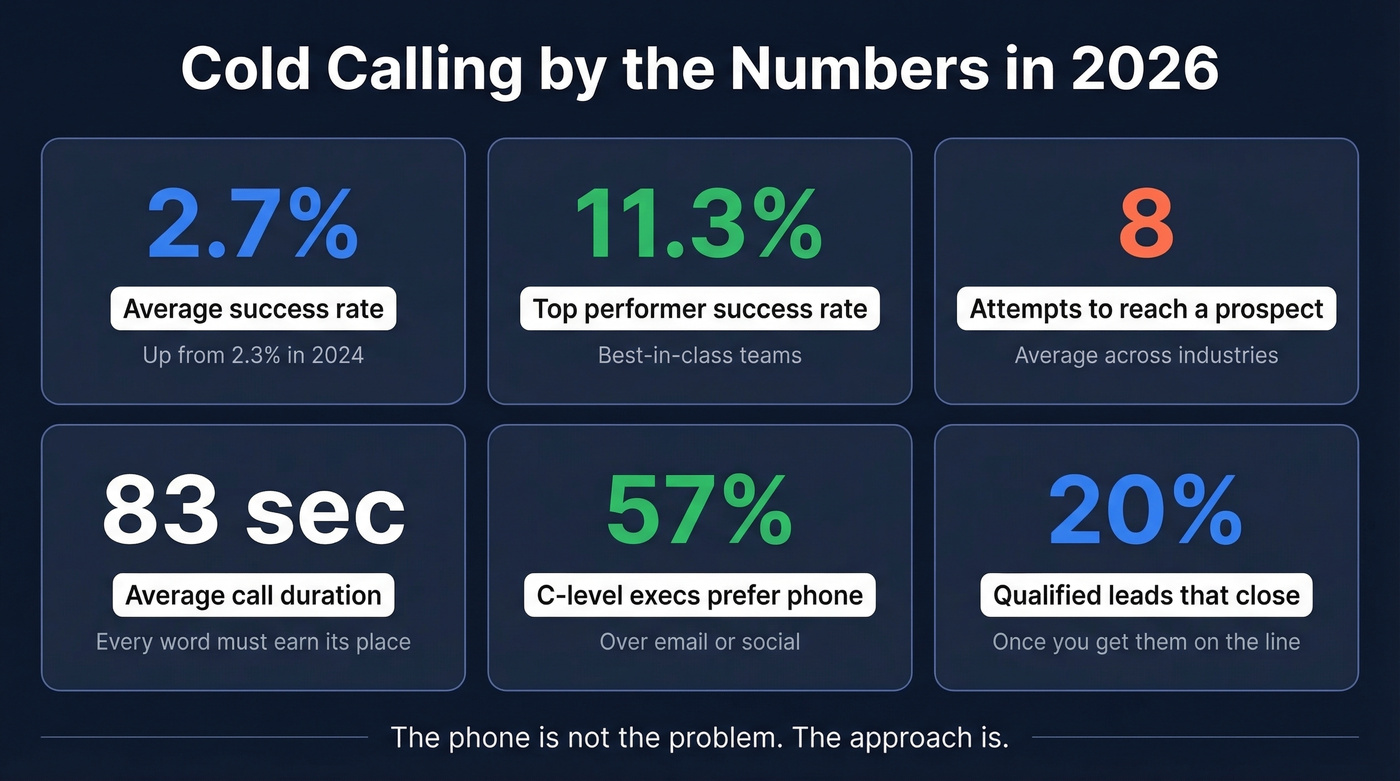
It takes an average of 8 call attempts to reach a prospect. The average call lasts 83 seconds, which means every word in your script has to earn its place. Once you've got a qualified lead on the line, about 20% convert into a closed deal. And despite what the "cold calling is dead" crowd says, 57% of C-level executives and VPs still prefer phone over any other outreach channel. The phone isn't the problem. The approach is.
10 Scripts for Every Scenario
These aren't templates to read verbatim - they're frameworks to internalize. Practice them until the words are yours, not the page's.
1. Permission-Based Cold Call
This is the workhorse. It's validated by the 300M-call dataset and echoed by practitioners on r/sales who actually pick up the phone for a living. Stand up, smile, and slow your speaking pace before you dial - it sounds ridiculous, but the difference comes through on the other end.
"Hi Sarah, this is James Mitchell calling from Acme. Appreciate I caught you out of the blue here - you got a minute?"
[If yes]: "We help companies in [their space] do [your coolest feature]. Companies like [their competitor] are using us to [specific result]. The purpose of my call was to set aside 30 minutes later this week to see if it's a fit. Does Thursday at 2 work?"
[If no]: "Totally fair. When's a better time to grab 60 seconds?"
Don't apologize for calling. Acknowledge the interruption, then move forward with confidence.
2. Context-Led Opener ("Heard the Name")
The highest-performing opener in the dataset at 11.24%. It works because you're leading with social proof before introducing yourself.
"Hi Mark - I've heard your name come up a few times talking with folks in the fintech space. This is Lisa Chen with Acme. Have you heard of us?"
[If yes]: "Great - then you know we help [specific outcome]. I'd love 15 minutes to show you what we're doing with [similar company]."
[If no]: "No worries - quick version: we [one-sentence value prop]. Worth a 15-minute conversation?"
3. Warm Follow-Up Call
For prospects who've opened your emails two or more times. They know your name - use that.
"Hi David, this is Sarah from Acme. I noticed you've been checking out some of the content we sent over - figured a quick call might be more useful than another email. What caught your eye?"
This opener works because it's honest about why you're calling without being creepy. Don't say "I saw you opened my email 7 times." Just reference the content.
4. Voicemail (Under 30 Seconds)
Most voicemails get deleted in 3 seconds. Name, company, one result, number, repeat number. That's the entire formula:
"Hi Rachel, James Mitchell, Acme. Quick reason for my call - we just helped [competitor or peer company] cut their [specific metric] by 30%, and I think there's something similar for your team. My number is 555-0142. Again, James at Acme, 555-0142."
5. Gatekeeper Navigation
Don't fight gatekeepers. Recruit them.
"Hi - I'm hoping you can help me out. I'm trying to reach someone who handles [function] at [company]. Would that be [prospect name], or is there someone else I should talk to?"
[If they ask what it's about]: "We work with companies like [peer company] on [outcome]. I just wanted a quick conversation to see if it's relevant. I'd really appreciate the help."
Asking for the gatekeeper's name and framing it as a favor changes the dynamic entirely. You're no longer a salesperson trying to get past them - you're someone asking for their expertise.
6. Referral-Based Call
The highest-converting call type, period.
"Hi Tom, this is Lisa Chen from Acme. [Mutual connection] suggested I reach out - they mentioned you're dealing with [specific challenge]. We helped them [result], and they thought it'd be relevant for your team. Worth a 15-minute chat this week?"
7. The "Choose Your Own Adventure" Demo Set
When you've already established interest and need to convert to a calendar hold, give the prospect control over what they see. Instead of asking an open-ended "when works for you?", offer two specific options that both lead to the same outcome.
Instead of: "Would you like to see a demo sometime?"
Try: "Based on what you've told me, I think a 20-minute demo would answer most of your questions. I can either walk you through how [Feature A] works for teams like yours, or show you the [Feature B] workflow that [peer company] uses. Which sounds more useful? And would Tuesday or Wednesday afternoon work better?"
Two content options plus two time options. The prospect feels in control while you guide the outcome.
8. Discovery Call (SPICED)
For complex deals where you need to understand the full picture before pitching. Don't launch into your deck - lead with questions:
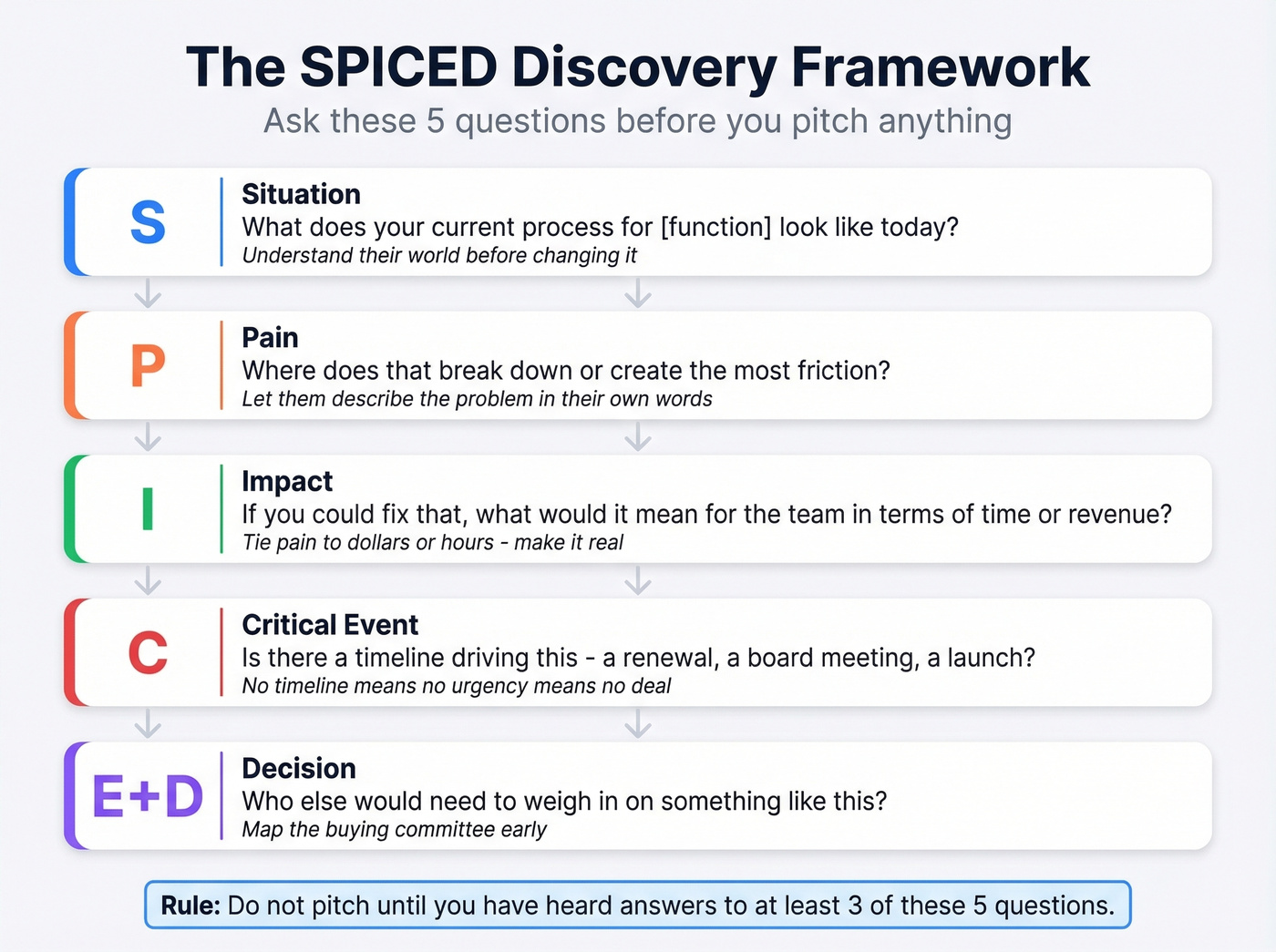
"Before I walk through anything, I want to make sure I'm showing you the right stuff."
- "What does your current process for [function] look like today?" (Situation)
- "Where does that break down or create the most friction?" (Pain)
- "If you could fix that, what would it mean for the team in terms of time or revenue?" (Impact)
- "Is there a timeline driving this - a renewal, a board meeting, a launch?" (Critical Event)
- "Who else would need to weigh in on something like this?" (Decision)
Let their answers guide the rest of the call. Don't pitch until you've heard at least three of these.
9. Breakup / Last-Attempt Call
When you've tried 6+ times and need to either get a response or close the loop.
"Hi Sarah, this is James from Acme. I've reached out a few times and haven't been able to connect - totally understand you're busy. This'll be my last attempt. If [challenge] is still on your radar, I'd love 10 minutes. If not, no hard feelings - I'll close out your file. Either way, my number is 555-0142."
The permission to walk away often triggers a callback. You're the first rep who's ever offered to stop calling.
10. Price Objection Rebuttal
What most reps do: Defend the price. Rattle off features. Offer a discount.
What actually works: Bridge from the objection to a concrete next step by reframing the comparison.
"Totally fair - price matters. Can I ask what you're comparing us to? ... Got it. The way most of our customers think about it: [competitor] costs X, but they're spending Y hours a week on [manual process] that our platform eliminates. When you factor in that time, the math usually flips. Would it help if I put together a quick ROI comparison?"
Never defend price in the abstract. Make it about their specific math.

You read the stat: 8 attempts to reach a prospect. Now imagine 12 of those 38 dials hitting disconnected numbers. Prospeo gives you 125M+ verified mobile numbers with a 30% pickup rate - refreshed every 7 days, not every 6 weeks.
Fix your data before you fix your script. Start at $0.01 per lead.
Adapting Scripts by Industry
Those 10 frameworks cover the mechanics. The framework stays the same - context, permission, value, ask - but the words shift depending on who you're calling.
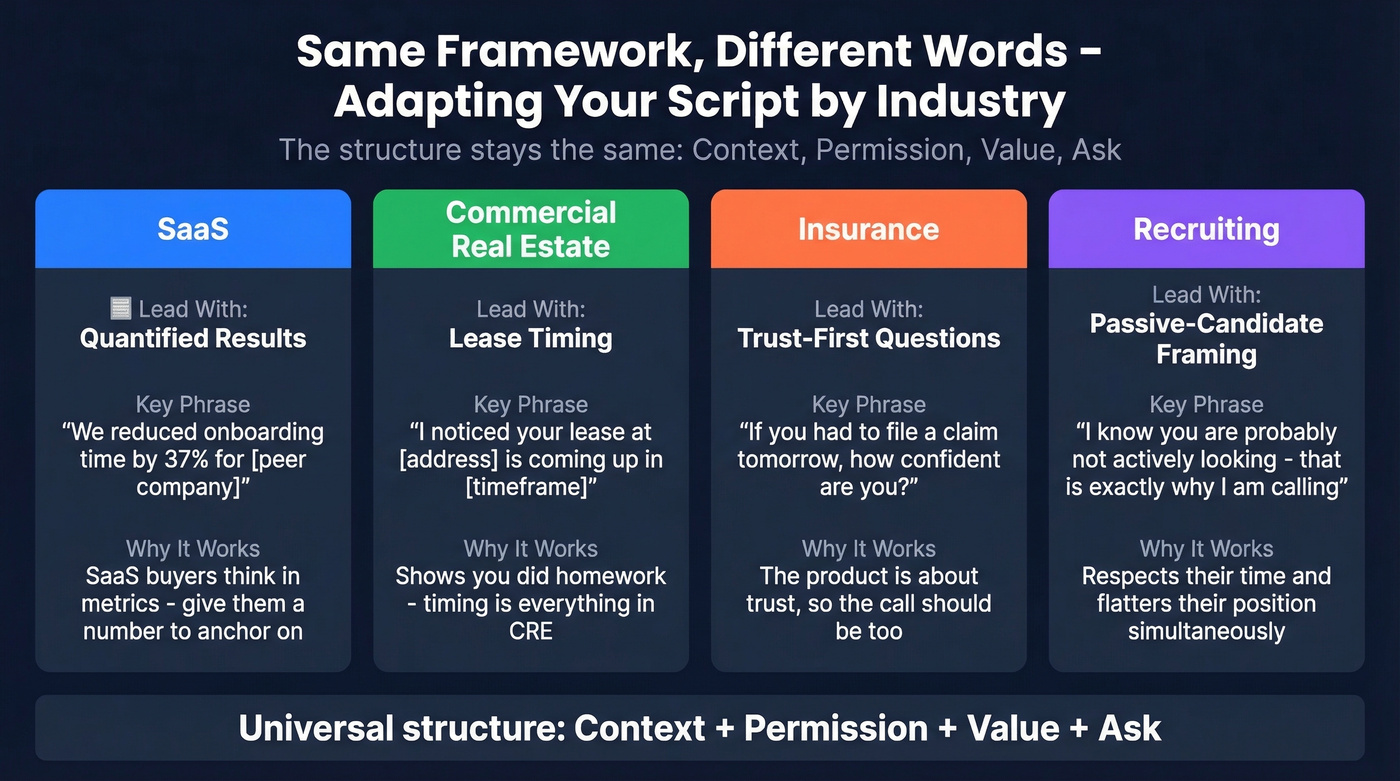
SaaS: Lead with a quantified result. SaaS buyers think in metrics.
"Hi [Name], we help [similar companies] cut [specific metric] by [number] - for example, we reduced onboarding time by 37% for [peer company]. Is that a problem your team's dealing with?"
Commercial Real Estate: Lease timing is everything. Show you've done your homework.
"Hi [Name], I focus on [neighborhood/market] commercial properties. I noticed your lease at [address] is coming up in [timeframe] - are you exploring options, or planning to renew?"
Insurance: Trust-first questions work because the product is inherently about trust.
"Hi [Name], quick question - if you had to file a claim tomorrow, how confident are you that your current coverage handles it? ... I ask because we've been saving businesses in [industry] about $100/year on average. Worth a free quote to compare?"
Recruiting: Passive-candidate framing respects their time and flatters their position at the same time.
"Hi [Name], I know you're probably not actively looking - and that's exactly why I'm calling. The best candidates rarely are. I've got a [role] at [company] that matches your background almost perfectly. Can I give you the 60-second version?"
Financial Services: Lead with credibility, keep the commitment low. Skip this approach if you're selling commoditized products - it works best for advisory or complex financial services where expertise is the differentiator.
"Hi [Name], this is [Your Name] with [Firm]. I'm not selling anything today - I just want to share something we're seeing in [their sector] that's affecting companies your size. If it's relevant, great. If not, I'll be out of your hair in 2 minutes. Fair enough?"
Objections vs. Obstructions
Not every pushback is the same. Cognism's framework draws a useful line: an obstruction is an excuse to get off the phone. An objection is genuine uncertainty you can address. The response strategy is completely different for each.
| Signal | Type | Response Strategy |
|---|---|---|
| "I don't have time" | Obstruction | Acknowledge + offer 2-min pitch |
| "We already use [competitor]" | Objection | Ask what drove the decision |
| "Send me an email" | Obstruction | Agree + set follow-up call |
| "I don't see how this helps" | Objection | Ask about current pain |
| "We don't have budget" | Objection (Budget) | Explore timeline + ROI |
| "I need to talk to my boss" | Objection (Authority) | Offer to join that conversation |
For obstructions, you need to earn 30 more seconds - not launch into a rebuttal. "Totally understand you're busy. If I can explain in under two minutes why companies like [peer] switched to us, would that be fair?" That's an obstruction response.
For real objections, dig deeper. "You're using [competitor] - what made you go with them?" opens a conversation. "Let me tell you why we're better" closes one.
SPICED vs. BANT
Two dominant discovery frameworks, very different use cases.
BANT (Budget, Authority, Need, Timeline) was popularized by IBM and works best for high-velocity sales where you need to qualify fast. SPICED (Situation, Pain, Impact, Critical Event, Decision) was developed by Winning by Design and shines in complex, recurring-revenue deals where understanding the buyer's world matters more than checking boxes.
| Framework | Best For | Sample Question | Origin |
|---|---|---|---|
| BANT | Short cycles (<30 days), inbound qualification | "Is there budget allocated, or would we need to build a case?" | IBM |
| SPICED | Six-figure deals, multiple stakeholders | "What happens to the team if this doesn't get solved by Q3?" | Winning by Design |
Companies with a formal sales process experience 18% more revenue growth than those winging it. The framework matters less than having one at all. And here's a data point that makes SPICED especially compelling for enterprise deals: the 300M-call analysis of 1.8M opportunities found multi-threading boosts win rates by 130% in deals over $50K, which is exactly why SPICED's stakeholder mapping through the Decision question matters so much.
5 Mistakes That Kill Cold Calls
Talking more than listening. The data is unambiguous: reps who won deals talked 54% of the time. Reps who lost talked 64%. That 10-point swing is the difference between a conversation and a monologue. Aim for the 43/57 ratio and actually track it.
Skipping pre-call research. Three to five minutes per prospect. That's it. Check their company news, role, and one recent trigger event. Walking in cold to a cold call is a double penalty.
Calling at the wrong time. Tuesday through Thursday, 10-11 AM and 2-4 PM are the highest-connect windows. Friday afternoons are underrated for C-suite - gatekeepers leave early, executives pick up their own phones.
Sounding scripted. Here's the irony of a sales call script article: if you sound like you're reading, you've already lost. Internalize the framework, then speak naturally. In our experience, reps who record and review their own calls improve within a week. Listen back to yourself - you'll hear the difference immediately.
Wasting the first 30 seconds. If your opener is "Hi, my name is James and I'm calling from Acme, we're a leading provider of..." - they're already reaching for the hang-up button. Lead with context or permission, not your company's elevator pitch.
Your Data Is the Real Script
Look, here's the thing nobody wants to hear: if your deal sizes exceed $5K and you're still loading unverified lists into your dialer, you're burning more money on wasted rep time than you'd spend fixing the data. Even the best sales call script is the last 20% of the problem. The first 80% is whether anyone picks up.
We've seen this play out too many times. A rep blocks 90 minutes for cold calls, dials 38 numbers, and 12 are disconnected or wrong. That's a third of their call block wasted - not on rejection, which is expected, but on dead air. No script fixes that.
Meritt, an outbound agency, was running a 35% email bounce rate before switching their data source. After moving to Prospeo, bounces dropped under 4% and their connect rate tripled to 20-25%. The script didn't change. The data did.
If you're building a repeatable outbound motion, start with a real cold calling system and a clean pipeline of lead enrichment so reps aren't dialing ghosts.
The best permission-based opener converts at 11.18%. But that number drops to zero when you're calling stale data. Prospeo's 7-day refresh cycle means every number you dial is current - not recycled from last quarter.
Stop wasting dials on dead numbers. Build your call list in minutes.
How long should a cold call last?
Aim for 5-8 minutes on a connect. Top performers keep their opener under 30 seconds and spend 57% of the call listening. If you're past 10 minutes on a first cold call, you're pitching when you should be qualifying. Get to the meeting ask before the conversation loses momentum.
What's the best time to make cold calls?
Tuesday through Thursday, 10-11 AM and 2-4 PM local time for your prospect. Friday afternoons are a sleeper pick for reaching VPs and C-suite - gatekeepers leave early, and executives are more relaxed heading into the weekend.
How many attempts does it take to book a meeting?
The industry average is 8 attempts to reach a prospect, with a 2.3% conversion rate from dial to warm lead. Top-performing teams push that to 6.7-11.3% by combining verified contact data, permission-based openers, and multi-channel sequences that warm prospects before the call.
Do scripted openers actually outperform improvised ones?
Yes - by roughly 5x, according to the 300M-call dataset. But reading word-for-word kills the advantage. Internalizing a framework so you hit the right beats naturally is what separates a 2% connect-to-meeting rate from an 11% one. The script is the training wheels; the conversation is the ride.