

The Sales Call Strategy That Replaces Your Bookmarks
You've read the "21 tips for better sales calls" posts. You've bookmarked three. Your calls haven't changed.
That's because tips aren't strategy. They're decoration on a process that doesn't exist yet.
A real sales call strategy is a system: you pick the right call type, run the right framework, hit a few non-negotiable benchmarks, and fix the unsexy stuff (like bad data) that quietly wrecks your connect rate before your opener even lands.
Let's break it down.
Why tips don't stick
Your sales process is what to do: stages, steps, CRM fields, handoffs. Your methodology is how to win: the thinking behind each conversation and the tradeoffs you make in real time.
Tips live in neither category. They sound smart in a blog post and evaporate the moment a prospect answers with something you didn't predict.
Strategy is what holds up when the buyer goes off-script, your champion goes dark, or procurement shows up early. If your "strategy" can't handle those moments, it's not a strategy.
Match the framework to the call type
| Call type | Framework | Why it fits |
|---|---|---|
| Inbound triage | BANT | Fast filter for fit and urgency |
| Discovery | SPIN | Pain-first questioning that builds business impact |
| Demo / presentation | Challenger | Teach-Tailor-Take Control when you need to reframe |
| Enterprise qualification | MEDDIC | Maps stakeholders, process, and proof in complex deals |
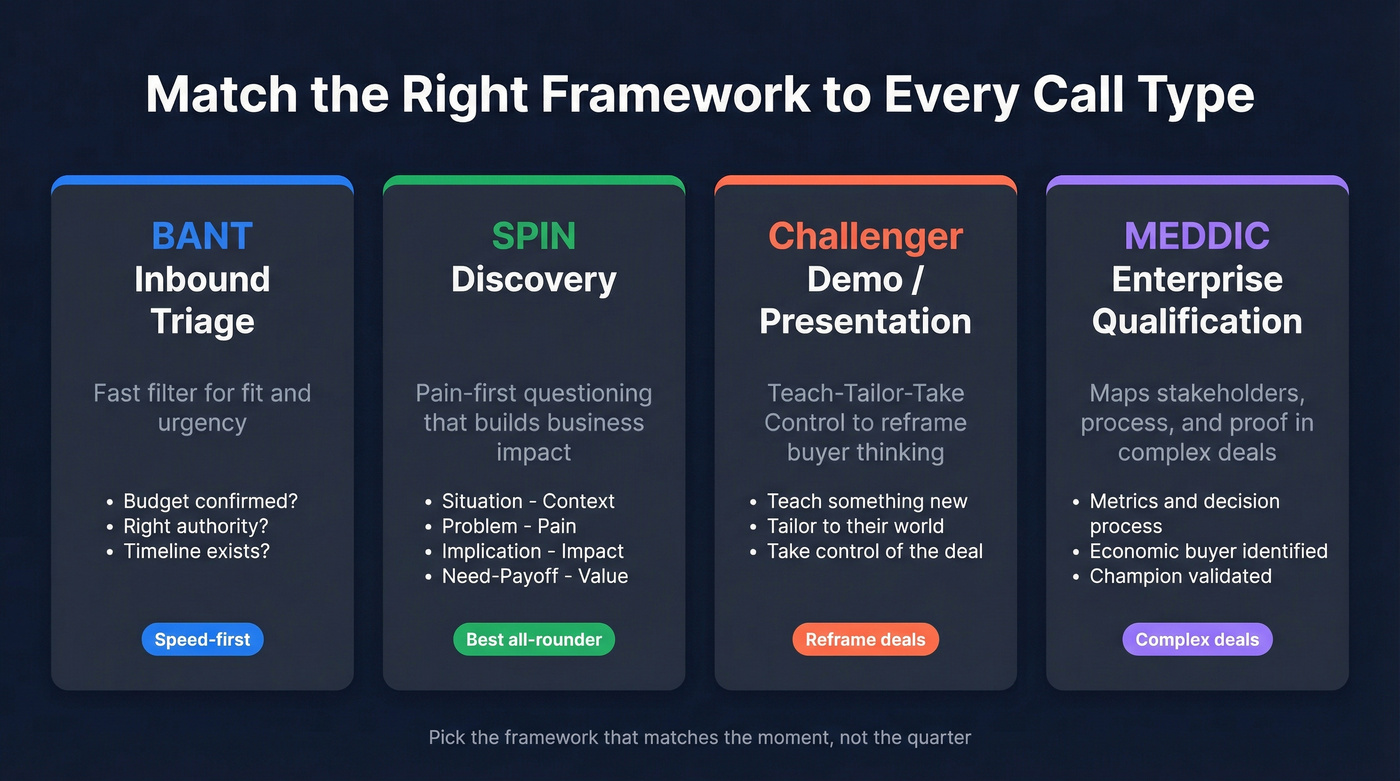
If you learn one framework, make it SPIN. Neil Rackham built it from research across 35,000+ sales calls, and it works in more situations than any other "single framework" you'll find.
Challenger is the strongest choice for demos where you need to change how the buyer thinks, not just show features. It came out of CEB's work across 6,000+ reps, and it rewards reps who can teach without turning the call into a lecture.
Look, BANT gets a bad rap. Some of it is deserved. But for inbound triage, it's still unbeaten because it forces speed: are we talking to the right person, is there money, and is there a reason to act now?
MEDDIC earns its complexity in enterprise deals where buying committees run deep and "we like it" doesn't mean "we can buy it." And if BANT's budget question feels too early, NEAT is a clean bolt-on: focus on need, economic impact, access to authority, and timeline without sounding like a checklist.
The point isn't to rip and replace your methodology every quarter. The point is to run the framework that matches the moment.
Cold call benchmarks for 2026
Cognism's 2025 WHAM report showed meeting-booked rates falling hard compared to 2024's 4.82% benchmark. On the ground, most teams should plan around 2%-3% meeting-booked right now, not because reps suddenly forgot how to sell, but because buyers screen harder and pick up less.
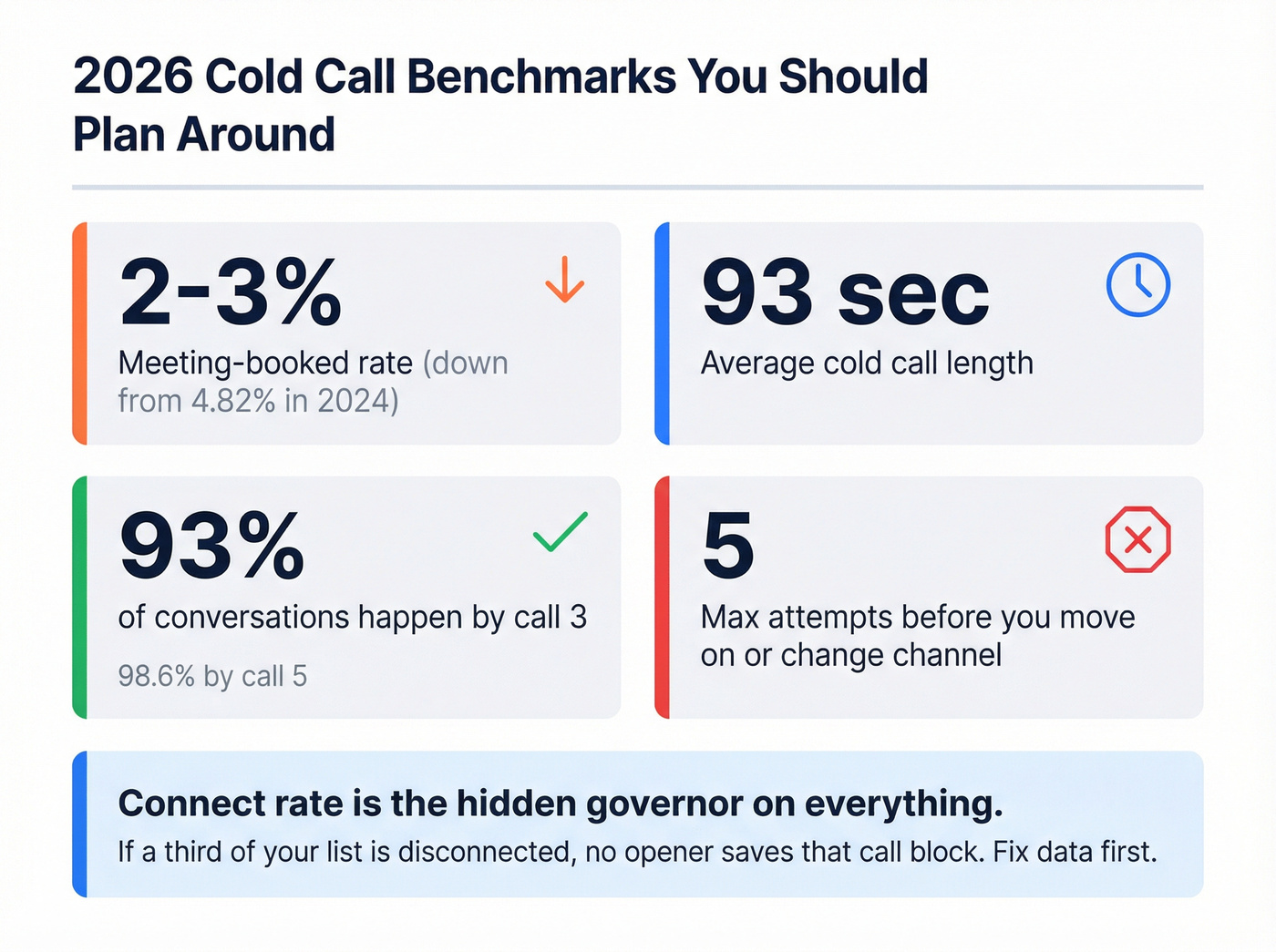
A few numbers worth building your call blocks around:
- Average cold call length: ~93 seconds
- 93% of conversations happen by call 3
- 98.6% happen by call 5
- After five attempts, move on (or change the channel), because the returns fall off a cliff
One more thing: connect rate is the hidden governor on everything. If you don't connect, your framework doesn't matter.
Here's a scenario we see all the time. A team rewrites their opener, role-plays for a week, and still books nothing. We pull a sample of their list and find a pile of dead direct dials, wrong titles, and recycled numbers that haven't been refreshed in months. That's not a coaching problem. That's a data problem.
The opener that keeps working (because it's honest)
The permission-based opener that keeps surfacing on r/sales works for a simple reason: it doesn't pretend this is a warm conversation.
"Hey [Name], caught you out of the blue - got a minute?"
[One sentence on why you're calling, specific to their role]
[Two-second pause]
"Worth a quick chat on [day] at [time]?"
Skip the "How are you?" opener. It's a weird social speed bump on a cold call, and buyers know exactly what you're doing.
Who to call first
When your list is big, sequencing matters more than people admit.
Call in this order:
- Prospects who've opened your emails 2+ times
- Mobile numbers
- Direct lines
And keep the cadence simple: four calls across two weeks, paired with four emails, is a strong baseline. Don't over-engineer it until you're sure your list quality and offer are solid.
Real talk: fix your data before you fix your script
The fastest way to improve connect rate usually isn't a better script. It's verified phone numbers.
We've watched teams double connect rate after cleaning their data, because when a third of your list is disconnected or routed to nowhere, no opener saves that call block. Prospeo is one of the quickest ways to pressure-test this: it gives you access to 125M+ verified mobile numbers with a 30% pickup rate, refreshed every 7 days, so you're not calling ghosts from last quarter.
Discovery call playbook (that doesn't turn into an interrogation)
Gong's analysis of 326,000 sales calls found a pattern most reps hate hearing: the reps who talk less win more. Closed-won deals averaged 57% talk time versus 62% for losses.
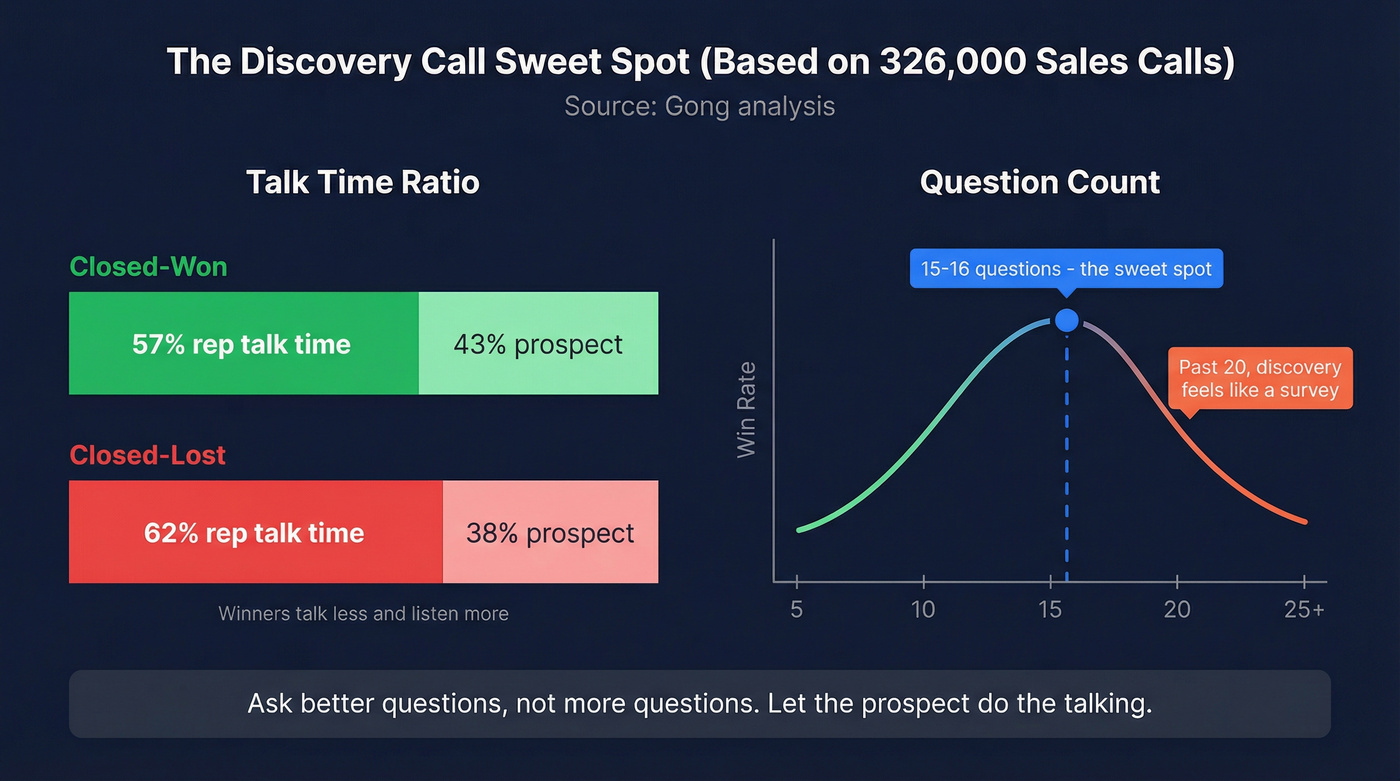
Question volume matters too. Reps who asked 15-16 questions outperformed reps who asked 20+. Past a point, discovery stops feeling like curiosity and starts feeling like a survey.
In our experience, that 15-16 range holds up across deal sizes because it forces you to ask better questions, not more questions.
A structure you can run every time
New reps ask for a "must-have" discovery structure because blank-page discovery is stressful. The closest thing to a dependable template is the four-part approach popularized by 30 Minutes to President's Club:
- Prep: 2-3 hypotheses about their pain (not "research," hypotheses)
- A note-taking template: so you don't lose the thread mid-call
- Bucketed questions: grouped by process problems and business impact
- Debrief: what you learned, what's missing, and what you need next
Here's the thing: the debrief is where deals are won. If you don't write down what's missing while it's fresh, you'll "remember it later" and then wonder why the next call feels fuzzy.
SPIN questions that actually move the deal
SPIN works because it forces a progression: context -> problem -> impact -> value.
A few that consistently work in real calls:
- "Walk me through what happens when that process breaks down."
- "How often does that happen in a typical month?"
- "If that keeps happening for another quarter, what's the impact on [pipeline, churn, cycle time, cost]?"
- "What have you tried so far, and why didn't it stick?"
That third question is the hinge. It's where you move from "annoying problem" to "business problem," and that's where urgency lives.
And yes, you should abandon your script sometimes. The best reps aren't the ones with the prettiest talk track. They're the ones who listen well enough to change direction without panicking, then come back to the goal of the call.

You just read it: connect rate is the hidden governor on every sales call metric. Bad numbers kill your call block before your opener gets a chance. Prospeo gives you 125M+ verified mobile numbers with a 30% pickup rate, refreshed every 7 days - not recycled from last quarter.
Stop calling ghosts. Start connecting with verified direct dials at $0.01 each.
Enterprise deals and objections
Multi-threading isn't optional
Gong's analysis of 1.8 million opportunities was blunt: closed-won deals involved about 2x as many buyer contacts as losses, and winning enterprise deals touched 17 contacts on average. Multi-threading boosted win rates by 130% on deals over $50K.
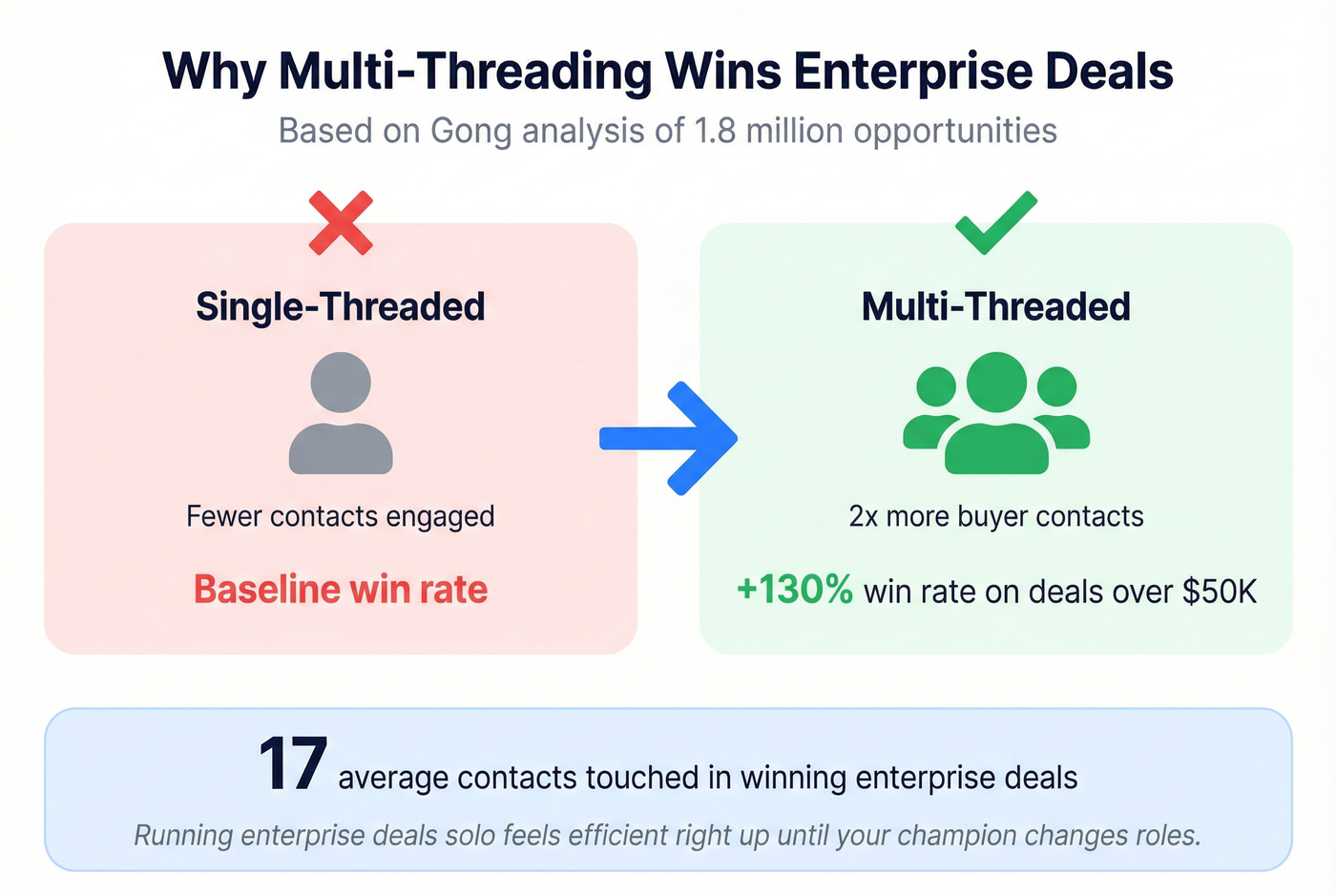
Running enterprise deals solo is one of the most expensive mistakes in B2B sales. It feels efficient right up until your champion changes roles, legal stalls, or the real decision-maker shows up at the end and resets the whole thing.
Handle objections like a conversation, not a debate
When a prospect pushes back, the instinct is to dump features. Resist it. Use a simple LAER flow: Listen, Acknowledge, Explore, Respond.
Prospect: "We already have a solution for this." Rep: "Totally fair - most teams I talk to do. Can you walk me through what's working and where the gaps are?" Prospect: "Honestly, reporting is a mess." Rep: "Got it. That's exactly what [similar company] ran into before they consolidated. Want me to show you the before-and-after of how they fixed it?"
Then confirm: "Does that cover it, or is there something else behind the concern?"
One frustration we keep seeing: reps treat objections as something to "overcome" instead of something to learn from. If you win the argument and lose the deal, you didn't win anything.
Close the call and follow up (where most deals die)
B2B buyers say the buying process is too complex. A Mutual Action Plan cuts through that by creating a shared roadmap anchored to the buyer's timeline, not yours.
End every call with a specific next step. "Can we get [stakeholder] on a call Thursday at 2?" beats "Let's circle back soon" every time.
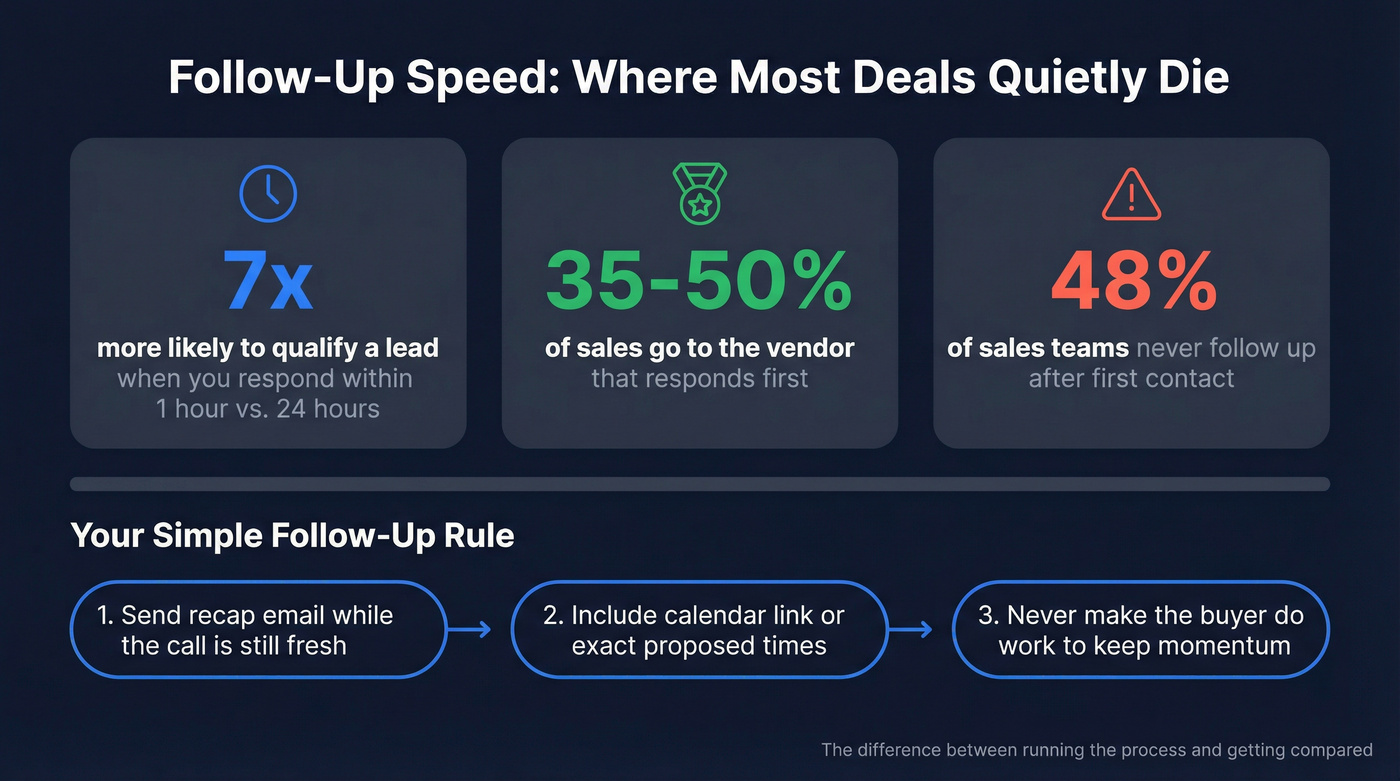
And follow-up speed isn't a nice-to-have. It's the difference between being the vendor who runs the process and the vendor who gets compared.
- Responding within one hour makes you 7x more likely to qualify a lead than waiting 24 hours
- 35%-50% of sales go to the vendor that responds first
Also: 48% of sales teams don't follow up after first contact. That's not a strategy gap. That's malpractice.
If you want a simple rule, use this: send the recap email while the call's still fresh, and include the calendar link or the exact proposed times. Don't make the buyer do work to keep momentum.
Recording compliance (don't get cute)
If you're recording calls without disclosure, you're exposed.
GDPR fines can reach up to EUR20M or 4% of global annual revenue. In the US, federal law is one-party consent, but 11 states require all-party consent: California, Florida, Illinois, Pennsylvania, Washington, Maryland, Massachusetts, Montana, Nevada, New Hampshire, and Connecticut.
The safe play is universal disclosure regardless of jurisdiction, and you need an affirmative response. Silence doesn't count.
For GDPR basics, start here: https://gdpr.eu/fines/ For US state-by-state recording rules, this is a solid reference: https://www.justia.com/50-state-surveys/recording-phone-calls-and-conversations/ For a plain-English overview of consent laws: https://www.rcfp.org/reporters-recording-guide/
Tools that support a sales call strategy (and one to skip)
Most "sales call strategy" advice ignores the inputs that make calls work: clean contact data, a tight follow-up workflow, and a place to review what happened.
- Call recording + coaching: Great if you're training a team or running high-volume outbound.
- CRM hygiene + enrichment: Boring, but it keeps your pipeline real.
- Verified contact data: If your connect rate is low, start here before you rewrite anything.
Prospeo fits in that last bucket. Our team uses it to keep lists clean with real-time email/mobile verification and a 7-day refresh cycle, so call blocks aren't wasted on disconnected numbers and stale roles.
Skip "AI script generator" tools if your fundamentals are shaky. If your ICP is fuzzy and your list is messy, a prettier script just helps you fail faster.
SPIN, Challenger, MEDDIC - none of it matters if you're reaching the wrong person. Prospeo's 300M+ profiles with 30+ filters let you build lists by job title, intent signals, and tech stack so your discovery calls land with actual decision-makers, not gatekeepers.
Build the list your sales call strategy deserves. 98% email accuracy, 75 free credits.
FAQ
What's the ideal talk-to-listen ratio?
Won deals average 57% talk time; lost deals hit 62%. Aim for 57% or less. Even a small shift changes the feel of the call and usually improves discovery quality.
How many times should I call before moving on?
Three calls captures 93% of conversations you'll ever have. Five gets you to 98.6%. After five attempts, reallocate that time to fresh prospects or switch channels.
How do I verify numbers before a call block?
Use a platform with verified mobiles and a frequent refresh cycle. Prospeo verifies 125M+ mobile numbers on a 7-day cycle, so you can spot dead numbers before they burn your best calling hours.
What's the best framework for a first discovery call?
SPIN Selling works across the widest range of discovery scenarios. Confirm context, surface problems, quantify impact, then land on what "fixing it" needs to look like. Keep yourself in the 15-16 question range so discovery stays sharp instead of exhausting.