

Sales Channels: Types, Costs, and How to Choose the Right Ones
Every sales channel you add is a bet - on your team's bandwidth, your buyers' behavior, and your ability to measure what's working. The average organization uses 10 channels to sell, and most can't tell you which three actually drive revenue. Meanwhile, 84% of reps missed quota in recent Salesforce research, which suggests more channels doesn't mean more pipeline.
Here's the thing: the problem isn't a lack of options. It's a lack of discipline in choosing.
What Is a Sales Channel?
A sales channel is any path your product takes to reach a buyer. That could be a rep on a Zoom call, a checkout page on your website, a reseller in Munich, or an Amazon listing. The mechanism doesn't matter - what matters is whether it connects your product to someone willing to pay for it.
Things have gotten more complex. Gartner projects that 80% of B2B sales interactions now happen in digital channels, and buyers themselves use 10 interaction channels on average - double what they used in 2016. The shift isn't coming. It's here.
What You Need (Quick Version)
You don't need 10 channels. You need 2-3 that work.
B2B under 50 employees: Start with outbound (cold email + cold calling) and a self-serve website. Fastest to launch, cheapest to test, easiest to measure. Add partner channels once you've nailed your ICP.
B2B scaling past $5M ARR: Layer in partner/channel sales and a digital self-serve option. 89% of sales teams already use partner selling - if you're not, you're leaving revenue on the table.
B2C / DTC: Own store plus one marketplace. Don't spread across five marketplaces before you've figured out unit economics on one.
Let's be honest about that 84% quota miss rate. It isn't because teams lack channels. It's because they're spread across too many, with no clear attribution and no channel-specific playbook. Depth beats breadth every time.
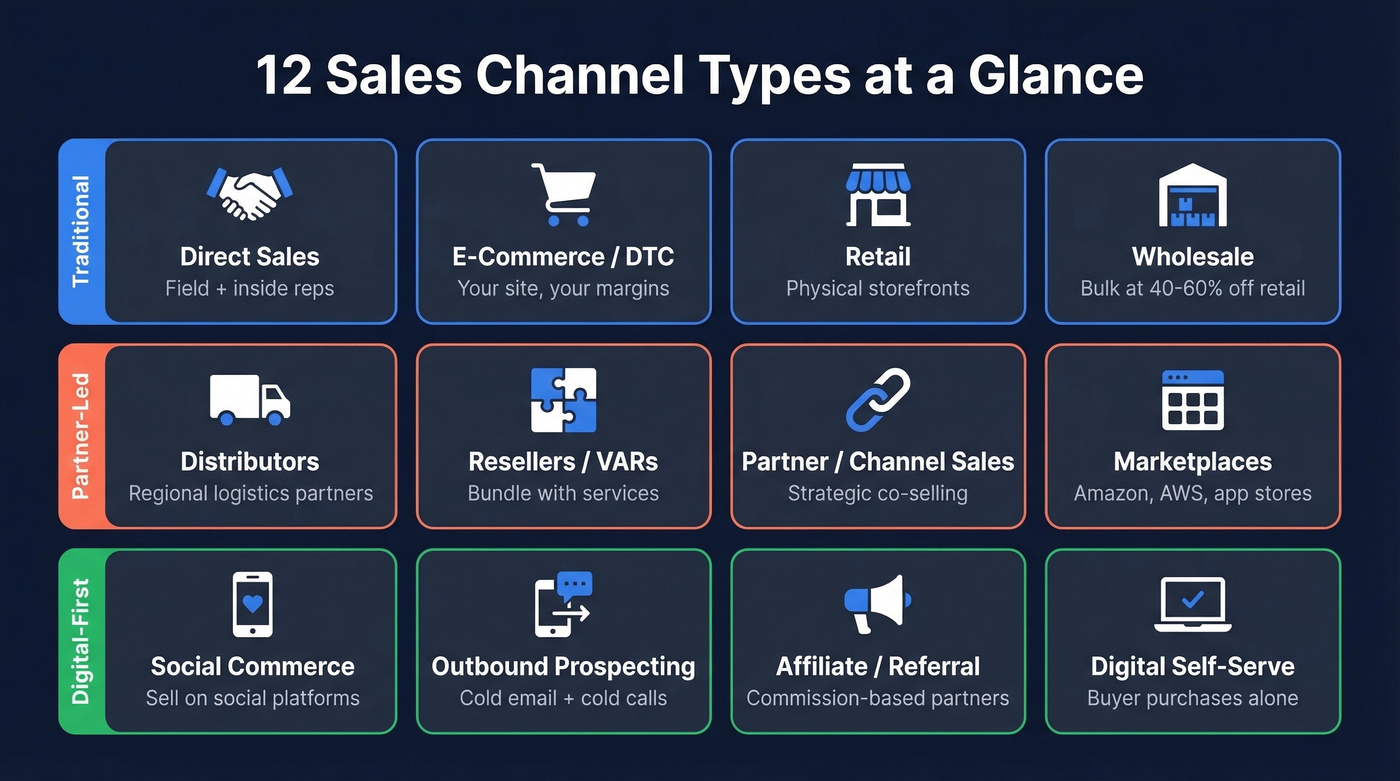
12 Sales Channel Types
Direct Sales
Field reps meeting buyers face-to-face still produce the highest conversion rates for complex, six-figure deals. Inside sales - phone and video-based selling from a central team - costs less per rep and scales faster. Most B2B companies need both, but the ratio depends on deal size. If your average contract value is above $100K, weight toward field. Between $10K-$100K, inside sales carries the load. Below that, skip both and go self-serve.
E-Commerce / DTC
Your own website, your own checkout, your own margins. You control the brand experience and keep 100% of the customer relationship. Best for B2C brands and B2B companies with self-serve products.
Retail
Skip this if you don't have a physical product with a tactile or try-before-you-buy component. For everyone else, retail isn't a standalone channel anymore - it's part of an omnichannel system. 77% of shoppers search on their phone while standing in a store. The store is a showroom now, not the whole funnel.
Wholesale vs. Distributors
These two get confused constantly. Wholesale means selling in bulk at 40-60% off retail to large buyers who handle the last mile - you trade margin for volume and cash-flow predictability. Distributors are intermediaries who warehouse, ship, and sometimes sell your product across a region, handling logistics so you don't build infrastructure in every market.
Wholesale works when your COGS are low enough to absorb the discount. Distributors work when you're entering new geographies and need boots on the ground without hiring them.
Resellers / VARs
Value-added resellers bundle your product with services, customization, or complementary tech. They own the customer relationship, which is both the upside (reach) and the risk (you lose direct feedback). Best for software and hardware that needs implementation or integration support.
Partner / Channel Sales
The definition is straightforward: strategic partnerships where another company sells your product alongside theirs. 84% of sales professionals say partner selling has a bigger revenue impact than a year ago, but here's what nobody tells you upfront - partner motions often take 12+ months to produce meaningful pipeline. We've watched teams kill promising partner programs at month six because leadership expected instant results. Give it time or don't start.
Marketplaces
Amazon, Shopify App Store, AWS Marketplace - platforms where buyers already shop. You get distribution but pay 15-45% in commissions and lose control over pricing and presentation. Best for products with strong organic demand that benefit from marketplace traffic.
Social Commerce
Selling directly through social platforms - Instagram shops, TikTok Shop, live-stream selling. Still early for B2B, but B2C brands are generating real revenue here. Best for visually compelling consumer products with a younger demographic.
Outbound Prospecting
The fastest channel to test and the most controllable. You pick the accounts, craft the message, and measure response in days, not months.
The catch: data quality is the make-or-break factor. Bad emails mean bounced sequences, burned domains, and wasted rep time. Cold email reply rates have declined from 6.8% to 5.8% year over year, which means every percentage point of deliverability matters more than ever. One underused lever: timeline-based hooks outperform problem-based hooks by more than 2x (10.01% vs. 4.39% reply rate).

Affiliate / Referral
Pay partners a commission for every customer they send you. Low upfront cost, performance-based economics. The downside is you're dependent on someone else's audience and motivation.
Digital Self-Serve
Let buyers research, configure, and purchase without ever talking to a rep. Forrester predicts that more than half of large B2B transactions ($1M+) will be processed through digital self-serve channels. 33% of all buyers now prefer a seller-free experience, rising to 44% among millennials. This isn't just for small deals anymore.
Sales Channel Costs
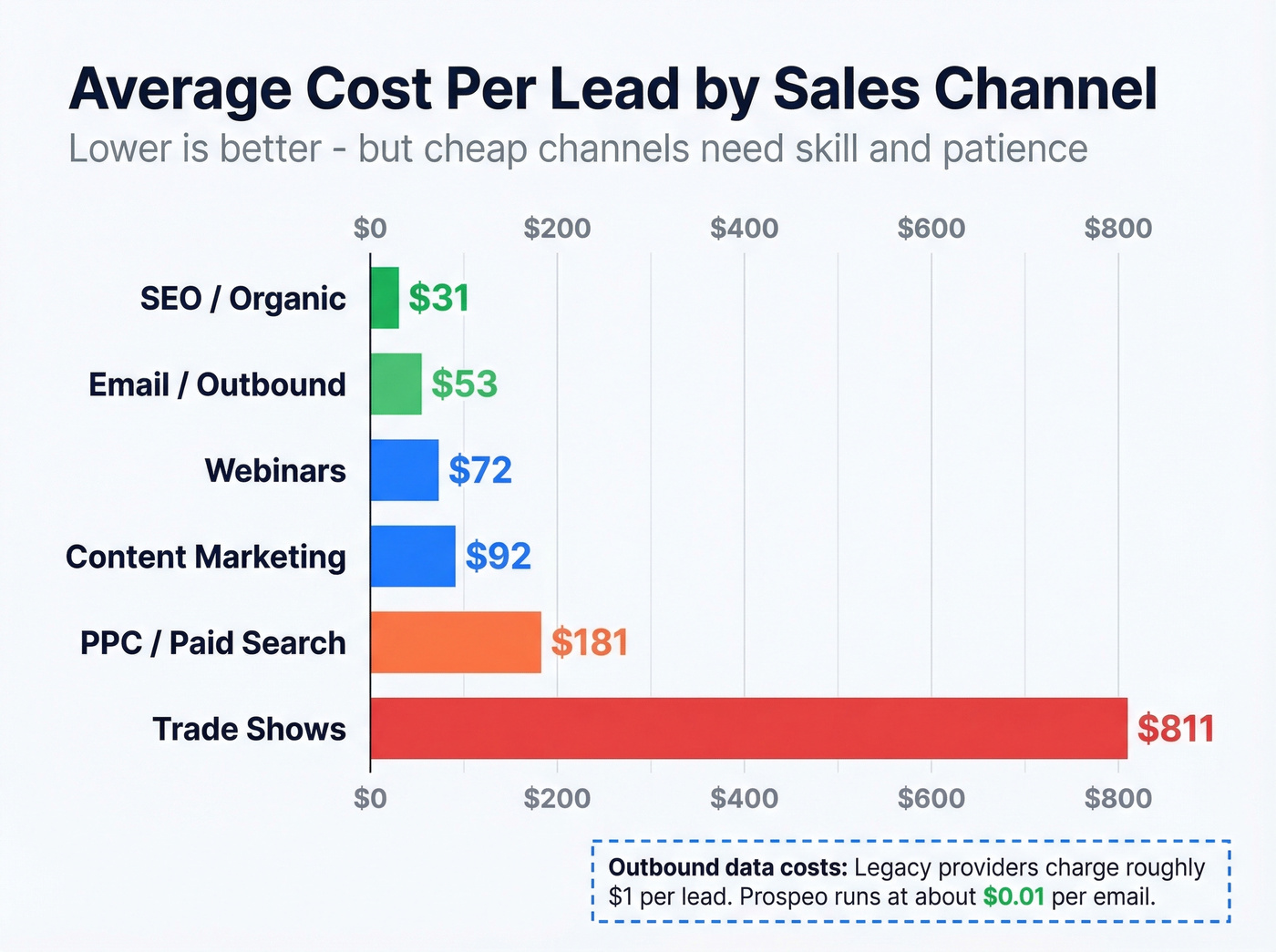
Not all channels are created equal on cost. Here's what the benchmarks show for cost per lead:
| Channel | Avg CPL | Key Cost Driver |
|---|---|---|
| SEO / Organic | $31 | Content + time |
| Email / Outbound | $53 | Data + tooling |
| Webinars | $72 | Production + promo |
| Content Marketing | $92 | Creation + distribution |
| PPC / Paid Search | $181 | Ad spend |
| Trade Shows | $811 | Booth + travel |
Those CPL numbers tell one story. The real economics depend on channel type.
Marketplace fees run 15-45% of each transaction. Amazon takes roughly 15% on most categories; app stores take 15-30%. That's margin you never see.
Wholesale discounts typically land at 40-60% off retail. The math only works if your COGS are low enough to absorb it.
Partner enablement isn't free either. Expect $5K-$20K per partner per year on training, co-marketing, deal registration systems, and support. Multiply that by 50 partners and you're looking at a real line item.
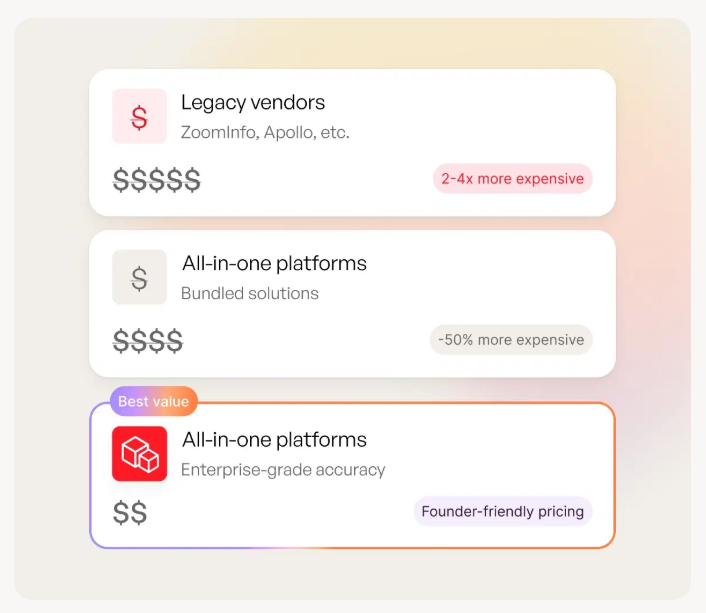
Outbound data costs vary wildly. Legacy providers charge roughly $1 per lead for contact data. Prospeo runs at ~$0.01 per email, which changes the unit economics of outbound entirely when you're running volume.
Cheap channels like SEO and outbound require skill and patience. Expensive channels like trade shows and paid buy speed but eat margin. The best channel mix balances both.
The Omnichannel Reality
Your buyers don't think in channels. They think in problems. And they'll use whatever combination of touchpoints gets them to a decision.
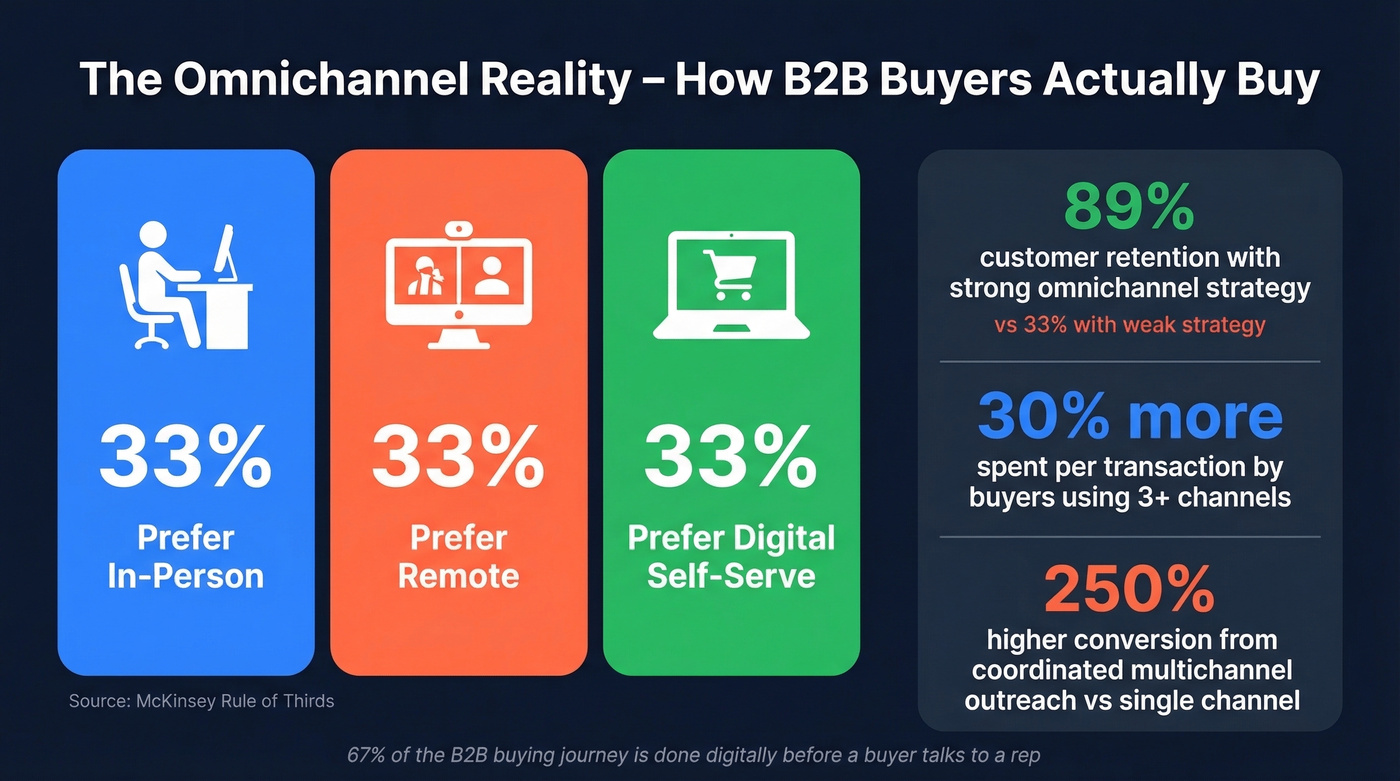
McKinsey's "rule of thirds" shows a clean split: roughly one-third of buyers prefer in-person interaction, one-third prefer remote, and one-third prefer digital self-serve. Companies with strong omnichannel strategies retain 89% of customers versus 33% for companies with weak ones. Buyers using three or more channels spend roughly 30% more per transaction than single-channel buyers, and coordinated multichannel outreach - cold email plus cold calling plus social touches - can yield 250% higher conversion rates than single-channel efforts.
67% of the B2B buying journey is completed digitally before a buyer ever talks to a rep. Your strategy needs to account for the fact that buyers are already halfway through their decision before you know they exist.
This doesn't mean you need to be everywhere. It means the channels you choose need to be coordinated. Disconnected channels create disconnected experiences, and buyers notice.

Outbound is the fastest sales channel to test - but only if your data connects. Bad emails burn domains and kill deliverability. Prospeo's 98% email accuracy and 7-day refresh cycle mean every sequence hits real inboxes, not spam traps.
Stop bleeding pipeline to bad data across your outbound channel.
How to Choose the Right Mix
87% of marketing leaders experience campaign performance issues driven by channel fragmentation - and only 12% believe their current org design will meet revenue targets. The fix isn't adding more channels. It's choosing the right ones deliberately.
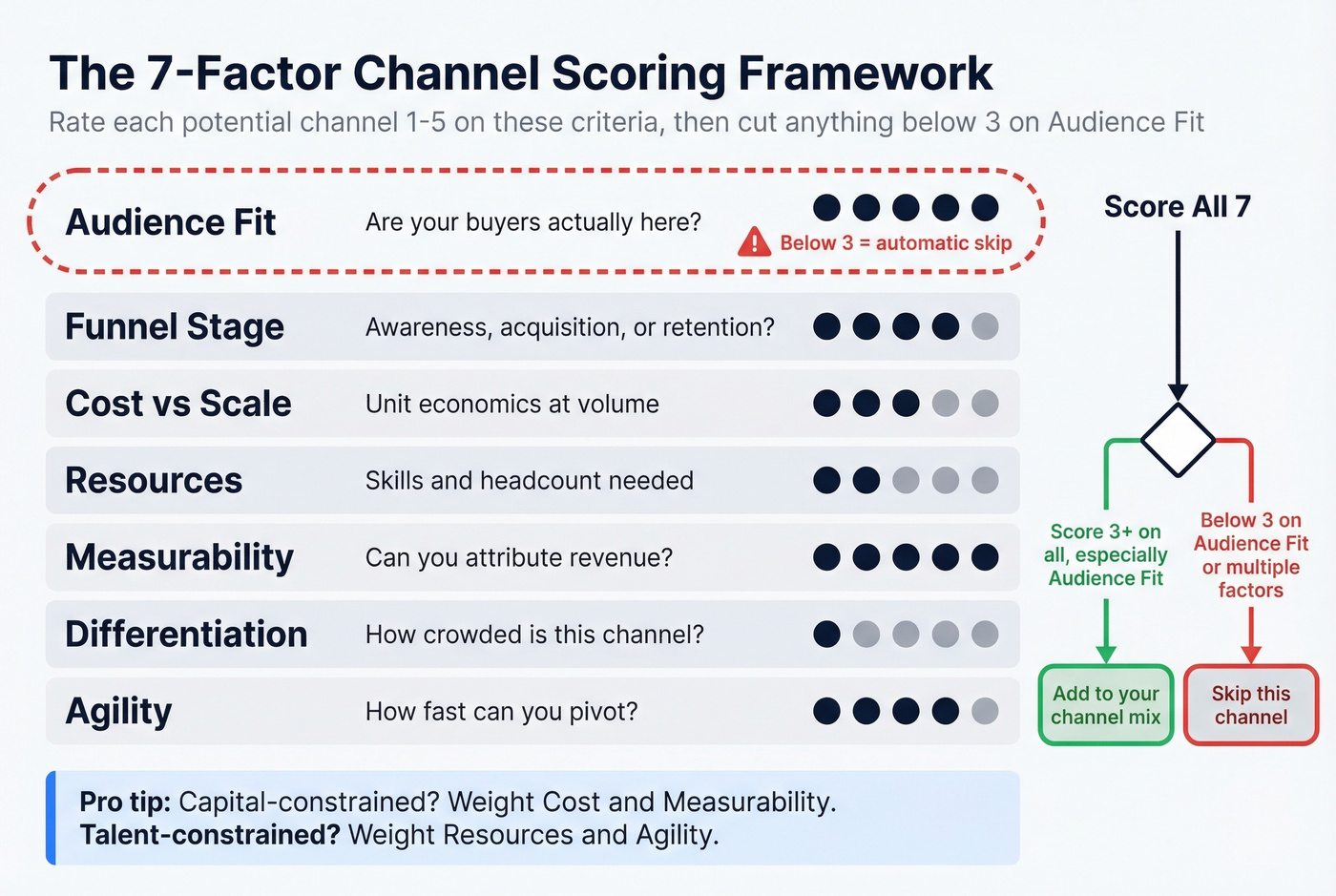
Here's a scoring framework we've used with teams evaluating their mix. Rate each potential channel 1-5 on these seven criteria:
| Factor | What You're Scoring | Weight It Higher If... |
|---|---|---|
| Audience Fit | Are your buyers here? | You're niche |
| Funnel Stage | Awareness, acquisition, or retention? | You have a specific gap |
| Cost vs Scale | Unit economics at volume | You're capital-constrained |
| Resources | Skills + headcount needed | You're a small team |
| Measurability | Can you attribute revenue? | CFO wants proof |
| Differentiation | How crowded is this channel? | You're in a red ocean |
| Agility | How fast can you pivot? | Market's shifting fast |
Any channel scoring below 3 on Audience Fit is an automatic skip - it doesn't matter how cheap or scalable it is if your buyers aren't there. After that, prioritize based on your biggest constraint. Capital-constrained? Weight cost and measurability. Talent-constrained? Weight resources and agility.
We've seen teams run this exercise and cut their channel count from eight to three. Revenue went up because reps stopped context-switching and started going deep on what actually worked.
Channel Conflict: The Hidden Tax
Adding channels is easy. Managing the conflicts between them is where most companies stumble.
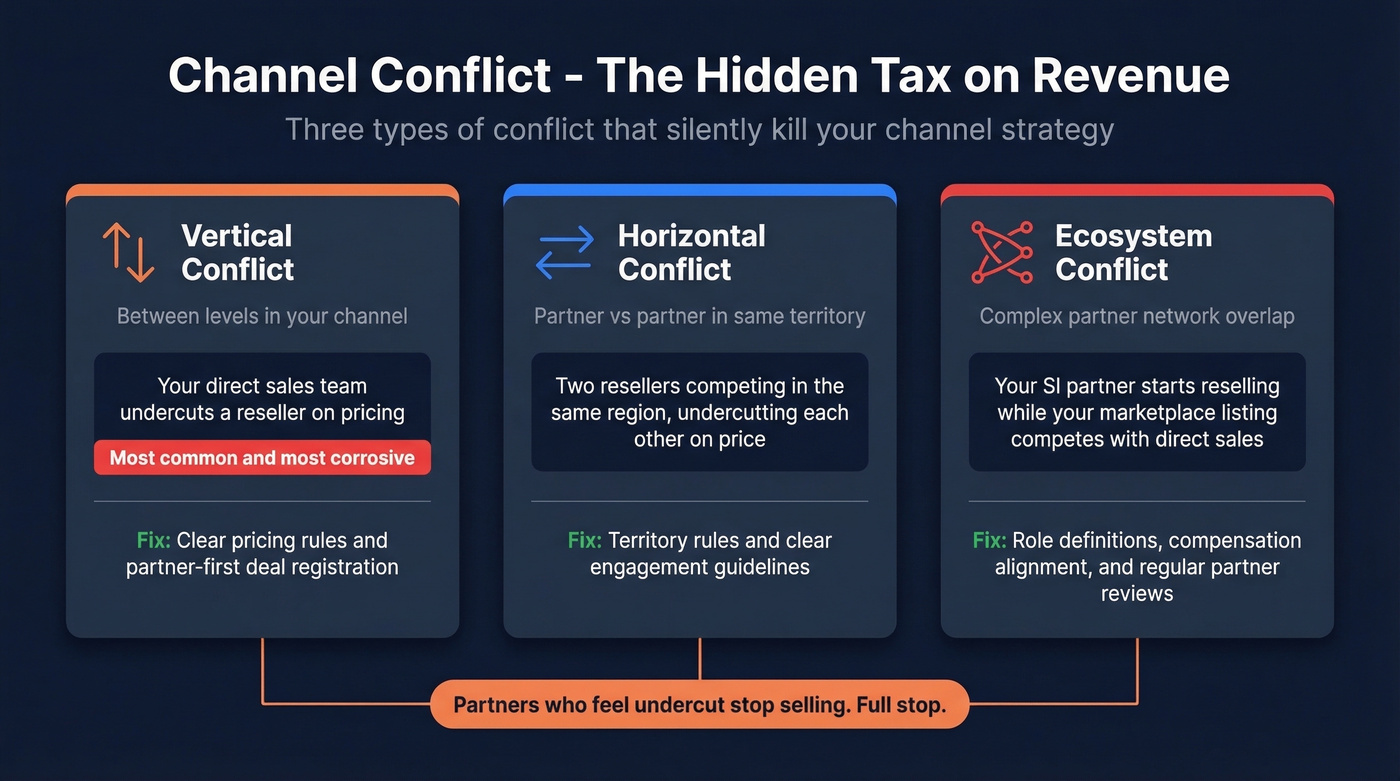
Vertical conflict happens between levels - your direct sales team undercuts a reseller on pricing, or a partner-influenced deal doesn't get credited properly. This is the most common type and the most corrosive. Partners who feel undercut stop selling. Full stop.
Horizontal conflict is partner versus partner. Two resellers competing in the same territory, undercutting each other on price, eroding margins for everyone. The fix is territory rules and clear engagement guidelines.
Ecosystem conflict emerges in complex partner networks. Your SI partner starts reselling. Your marketplace listing competes with your direct team. These get messy fast, and the consensus on r/sales is that most companies don't address them until the damage is already done.
Prevention comes down to three things. First, build a profitability model for each channel before you expand - simulate best-case and worst-case margins so you know where cannibalization starts. Second, assign each channel a distinct role: acquisition, retention, or margin extraction. Channels with overlapping roles will always fight. Third, establish pricing governance. Inconsistent pricing across channels is the fastest way to destroy partner trust.
5 Mistakes That Kill Multichannel Sales
1. Manual data entry in thin-margin operations. Omnichannel margins are razor-thin. Every hour spent on manual entry is margin you're burning.
2. Siloed apps with no integration. If your e-commerce platform doesn't talk to your CRM, which doesn't talk to your marketplace dashboard, you're flying blind. Pick an anchor system and integrate everything into it.
3. No attribution tracking. If you can't tell which channel sourced a deal, you can't allocate budget intelligently. Set up attribution before you launch a new channel, not after.
4. Letting direct salespeople manage partners. Direct reps and partner managers need different skills, incentives, and temperaments. A rep compensated on direct deals will never prioritize partner enablement. Separate the roles.
5. Unrealistic partner revenue timelines. If your board expects partner revenue in Q2 after a Q1 launch, you've already set the program up to fail. We've watched this play out at three different companies - same story each time. The program gets killed before it has a chance to work.
Tech Stack for Your Channel Strategy
Running multiple channels without the right infrastructure is building on sand. Here's what the stack looks like by layer.
CRM layer: Salesforce or HubSpot. This is your system of record - every channel's data needs to flow here. Use HubSpot if you're under 200 employees and want faster setup. Use Salesforce if you need deep customization or already have a complex tech stack.
Channel management: Deal registration, partner portals, co-marketing funds. Channeltivity or Impartner are the standard options. Skip this if you have fewer than 10 partners.
Data and enrichment: Your outbound channel, your CRM enrichment, your partner data hygiene - all depend on accurate contact data. Prospeo covers 300M+ profiles with 143M+ verified emails at 98% accuracy on a 7-day refresh cycle, with native integrations into Salesforce, HubSpot, Smartlead, Instantly, Lemlist, Salesloft, Outreach, Clay, Zapier, and Make.
Attribution: HubSpot's built-in attribution works for simpler setups. For deal cycles longer than 90 days or more than three channels, look at Dreamdata or HockeyStack instead - they're built for B2B's long, multi-touch cycles.
At ~$0.01/email vs. $1 with legacy providers, Prospeo changes the unit economics of your outbound sales channel entirely. 300M+ profiles, 125M+ verified mobiles, and 30+ filters to nail your ICP - no contracts, no sales calls.
Run outbound at 1% of the cost with higher accuracy than ZoomInfo.
Sales Channel FAQ
What is a sales channel, and why does it matter?
A sales channel is any method you use to get your product in front of a paying customer - direct reps, your website, partners, marketplaces. Each carries different costs, conversion rates, and resource requirements. Choosing the wrong ones drains budget; choosing the right ones compounds revenue over time.
What's the difference between a sales channel and a distribution channel?
A distribution channel covers how the product physically reaches the buyer - warehousing, shipping, fulfillment. A SaaS company selling through partners has a sales channel but no distribution channel in the traditional sense. Understanding this distinction helps you allocate budget to the right motions.
How many sales channels should a company use?
Start with 2-3 you can execute well, measure clearly, and staff properly. Most organizations use 10, but most don't need that many. Add channels only when existing ones are optimized and you have the resources to support expansion without degrading performance elsewhere.
What's the fastest sales channel to launch?
Outbound. Cold email and cold calling can go from zero to first replies in days. The prerequisite is verified contact data - bad emails mean bounced sequences and burned sender domains from day one.
What's the biggest risk of adding new channels?
Channel conflict. When your direct team and partners compete for the same deals, or two resellers undercut each other in the same territory, everyone loses. Build a profitability model per channel, assign distinct roles, and establish pricing governance before you expand.