

Sales Content Analytics: What to Measure, How to Attribute, and What It Costs
Your CMO just asked which decks influenced pipeline last quarter, and suddenly everyone's staring at a folder full of PDFs like it's a revenue dashboard. That's where sales content analytics comes in - and where most teams get it wrong.
Buyers still close with humans. Gartner found 72% of B2B transactions complete via a rep-led channel, and sales cycles have lengthened 32% since 2021, which means your content has to work harder across more touchpoints than ever before. Most teams track "views" and call it analytics. That's not measurement - it's decoration.
What You Need (Quick Version)
- Track 4-5 sales content KPIs, not 20. Pick a small set you'll actually review weekly.
- Pick an attribution model and accept its limits. You're choosing a consistent way to be wrong, not a truth machine.
- Clean your contact data before trusting engagement. If emails are bad, opens and clicks are fiction.
What Content Analytics Means for Sales Teams
Marketing analytics is top-of-funnel: blog sessions, ad CTR, form fills. Sales content analytics measures something different - rep-shared assets like decks, one-pagers, case studies, proposals, and deal room links sent to specific stakeholders, and whether those assets actually move deals forward.
65% of marketers struggle to understand content effectiveness, and sales content is even messier because it lives inside human workflows. Reps forward PDFs from personal email. They rename files. They share outdated versions from a folder they bookmarked six months ago. The goal isn't perfect measurement. It's learning which assets help reps win and which ones waste their time, then turning that insight into action rather than letting reports gather dust.
The Only Metrics That Matter
Four buckets that ladder from "is it discoverable?" to "did it influence revenue?"
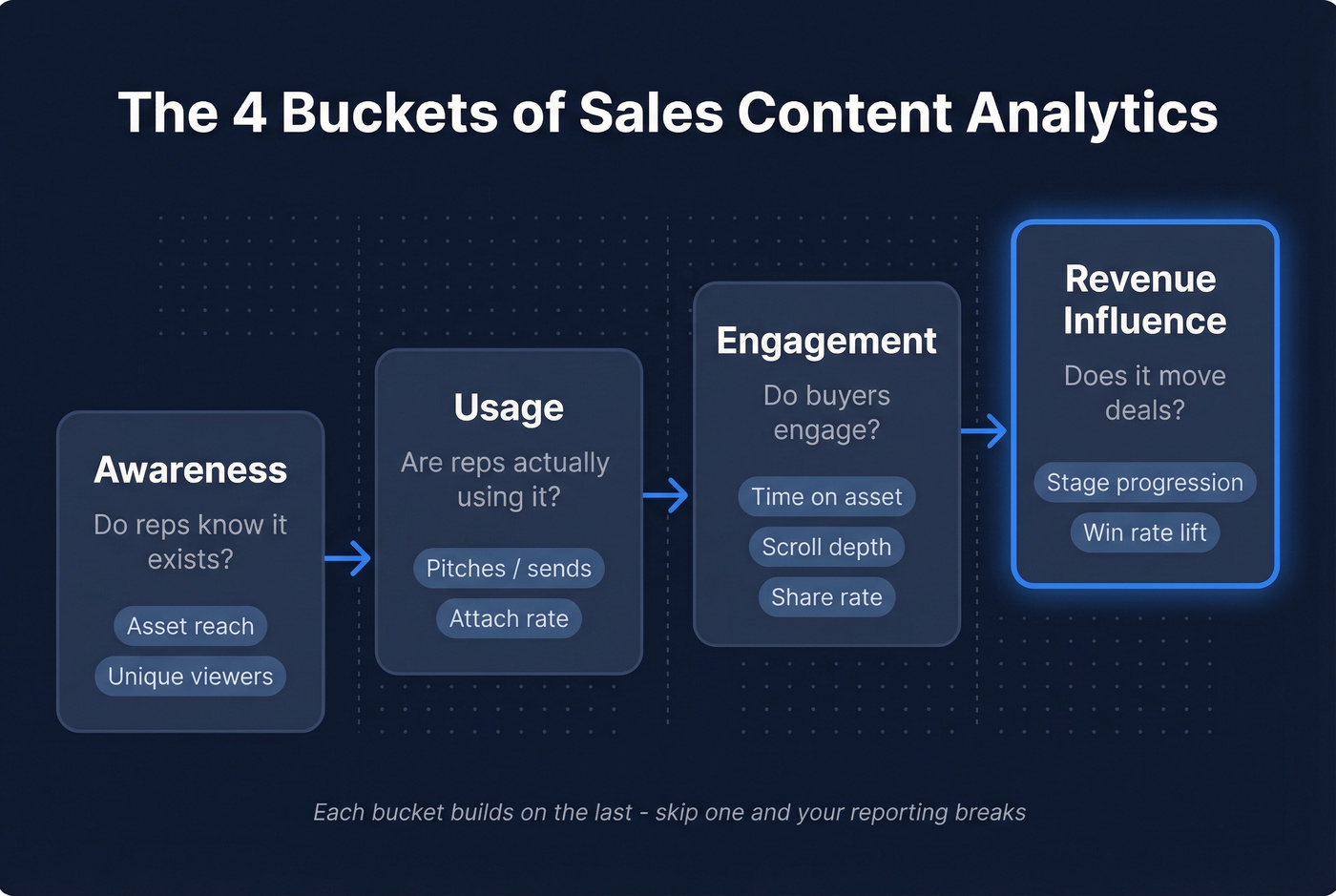
| Bucket | What it answers | Metrics to track |
|---|---|---|
| Awareness | Do reps know it exists? | Asset reach, unique viewers |
| Usage | Are reps using it? | Pitches/sends, attach rate |
| Engagement | Do buyers engage? | Time-on-asset, scroll depth, share rate |
| Revenue influence | Does it move deals? | Stage progression, win rate lift |
Here's what separates real content tracking from dashboards that just look pretty:
Usage beats views. A deck with 500 internal views but 12 sends is enablement theater. Track pitches and sends as the primary adoption signal - that's the number that tells you whether reps trust the content enough to put it in front of a buyer.
Sender engagement reveals coaching gaps. Which reps drive the most buyer interaction with shared content? Platforms like Seismic and Highspot surface this data, and it often exposes people problems, not content problems. We've seen teams discover that their "low-performing" case study was actually fine - it was just being sent by reps who never followed up.
Engagement needs context. Time-on-asset only matters when segmented by deal stage and persona. A CFO spending 90 seconds on a pricing slide beats a junior stakeholder spending 8 minutes on an overview deck. If you aren't tying engagement data to who's looking, you're measuring noise.
Revenue influence should be directional, not absolute. The best teams treat "influence" as a comparative signal: Asset A correlates with faster stage progression than Asset B for the same segment. That's actionable. Trying to assign exact dollar values to a PDF is not.
Zero-result searches are the most underused diagnostic. If reps search "security questionnaire" and get nothing, you've found the next asset to create - or the next tag to fix. Most enablement platforms track this. Almost nobody reviews it.

Your content analytics are lying if 15-30% of your CRM emails are invalid. Prospeo's 98% email accuracy and 7-day refresh cycle means every open, click, and time-on-asset metric maps to a real buyer - not a bounced address or spam trap.
Clean contact data is the foundation of every content metric that matters.
How to Attribute Content to Revenue
Let's be honest: attribution is the industry's biggest unsolved problem. Not because people are lazy, but because buying committees don't follow your funnel.
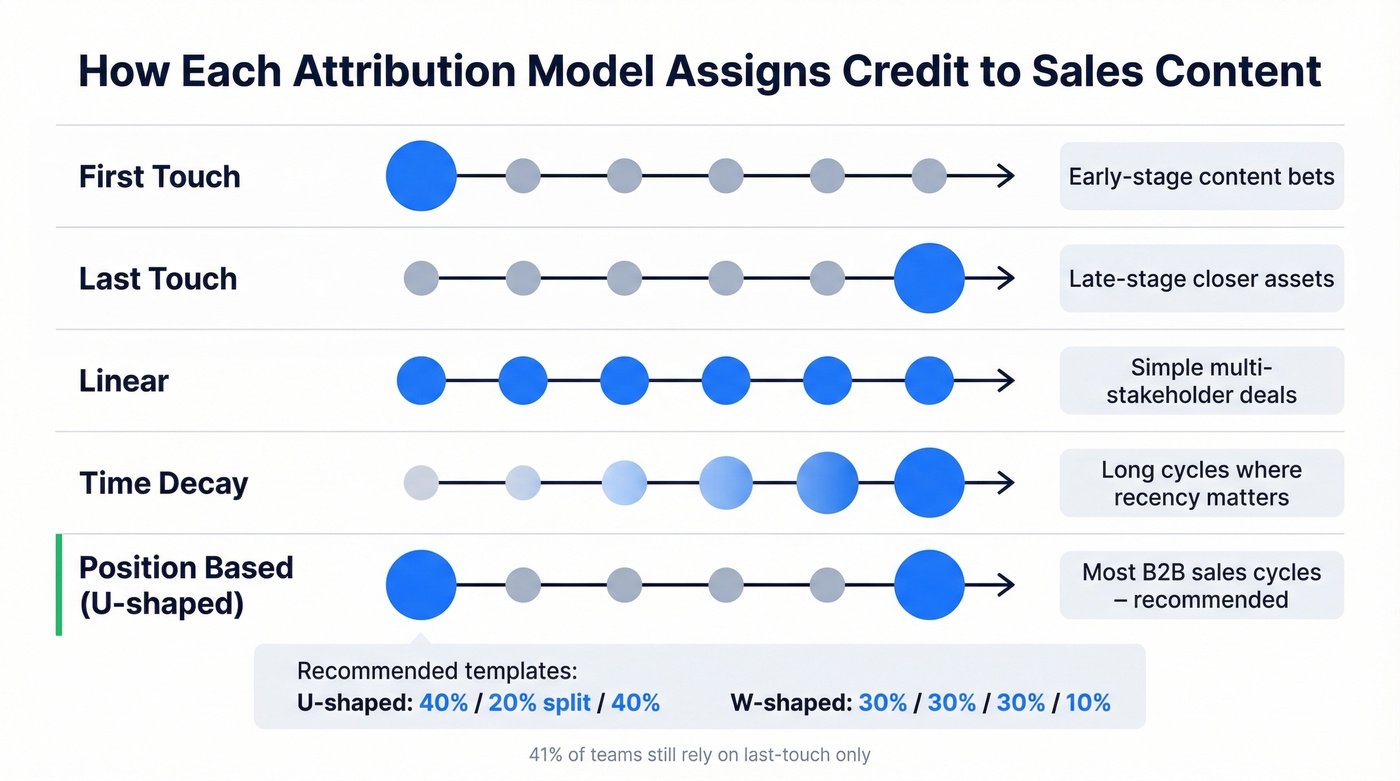
| Model | How it assigns credit | Best use |
|---|---|---|
| First-touch | 100% to first asset | Early-stage content bets |
| Last-touch | 100% to last asset | Late-stage "closer" assets |
| Linear | Equal across touches | Simple multi-stakeholder deals |
| Time-decay | More credit to recent | Long cycles where recency matters |
| Position-based | Weighted key moments | Most B2B sales cycles |
Two weighting templates you can copy straight into your reporting:
U-shaped (position-based): 40/40/20 - 40% first touch, 40% last touch, 20% split across the middle. This is our default recommendation for teams just starting with multi-touch.
W-shaped: 30/30/30/10 - 30% first, 30% middle milestone (often opportunity creation), 30% last, 10% across the rest. Better for complex deals with a clear mid-funnel inflection point.
The adoption numbers tell an interesting story: 41% of teams still rely on last-touch as their primary model, while 75% report using some form of multi-touch. The overlap reflects teams running both in parallel before committing. That's fine. Running two models simultaneously for a quarter is actually a smart way to calibrate.
A PMM in r/ProductMarketing evaluating enablement tools said demos "all start to blur together" and specifically doubted how platforms "attribute revenue to the sales content created" with six-month cycles and many stakeholders. That skepticism is earned. Algorithmic approaches like Markov chains and Shapley value modeling exist for teams with data science resources, but very few enablement teams use them in practice.
Here's the thing: most teams would get more value from fixing their input data than upgrading their attribution model. A perfect model fed garbage contacts and untracked email forwards is still fiction.
Why Your Dashboards Are Probably Lying
If you hit two or three of these, your reporting is broken:
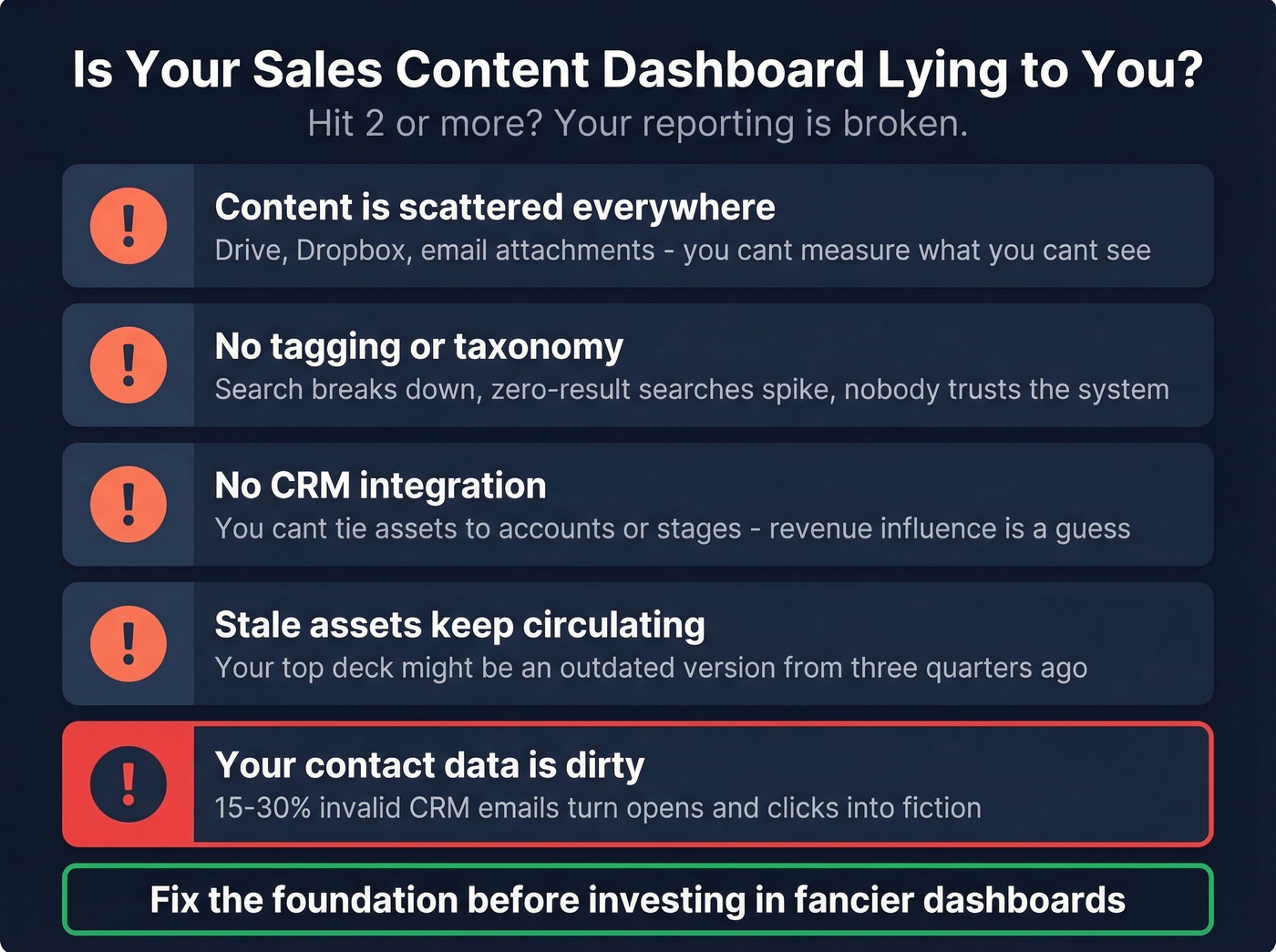
Content is scattered across Drive, Dropbox, and email attachments, so tracking is incomplete from the start. You can't measure what you can't see.
No tagging or taxonomy. Search and reporting break down, zero-result searches spike, and nobody trusts the system enough to use it.
No CRM integration. You can't tie assets to accounts, opportunities, or stages - which means your "revenue influence" metric is a guess.
Stale assets keep circulating. Without version control and expiry dates, your "top-performing deck" might be an outdated version that reps grabbed from a shared folder three quarters ago.
Your contact data is dirty. This one's the silent killer. When 15-30% of your CRM emails are invalid, your "opens" and "clicks" are a mix of bounces, spam traps, and noise. Prospeo's 98% email accuracy and 7-day refresh cycle means engagement data maps to real humans instead of dead addresses - and that distinction is the difference between analytics you can act on and analytics that mislead you.
Every one of these gaps degrades your sales content performance reporting. Fix the foundation before investing in fancier dashboards.

What Enablement Platforms Cost
A 40-rep org can go from "we just want analytics" to a mid-five-figure annual bill fast. Here are the ranges buyers consistently see:
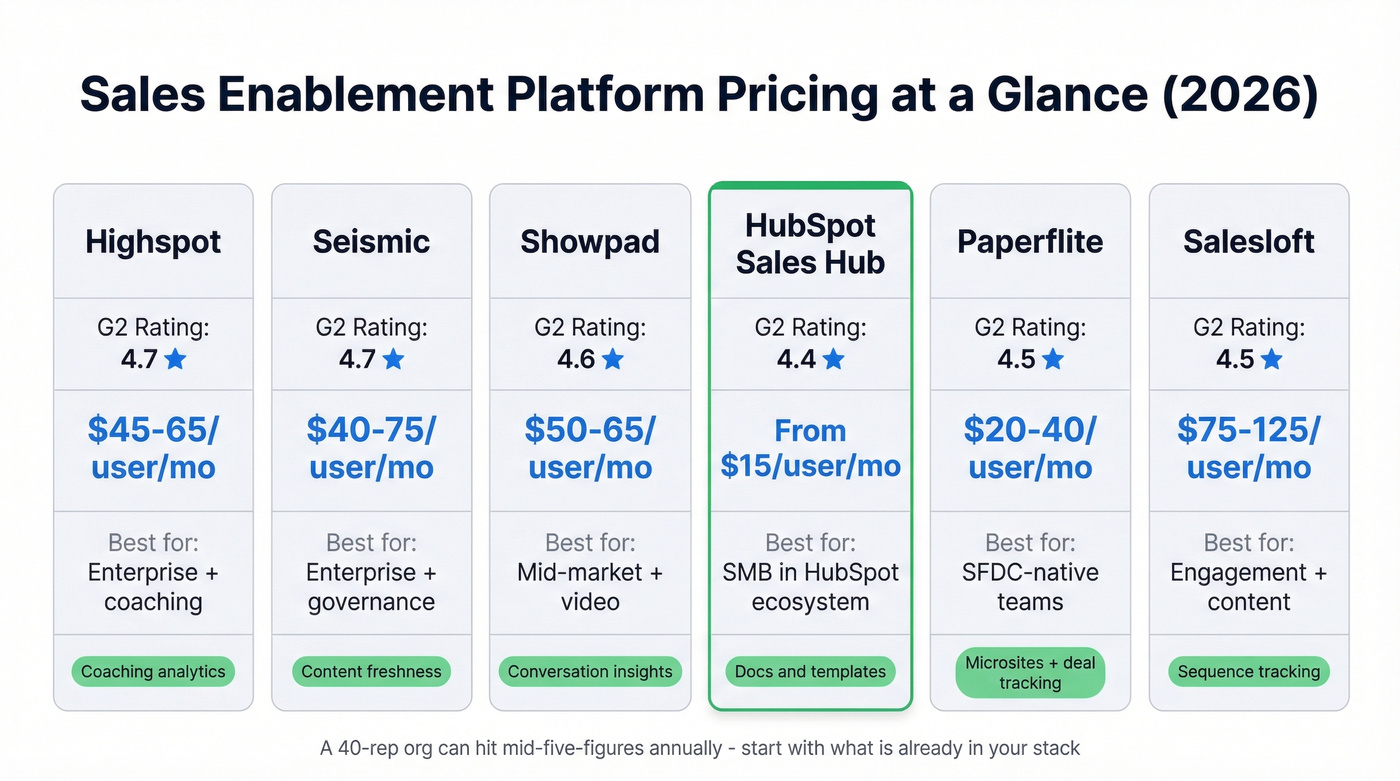
| Platform | G2 Rating | Price Range | Best For | Analytics Strength |
|---|---|---|---|---|
| Highspot | 4.7 | $45-65/user/mo | Enterprise + coaching | Coaching analytics |
| Seismic | 4.7 | $40-75/user/mo | Enterprise + governance | Content freshness controls |
| Showpad | 4.6 | $50-65/user/mo | Mid-market + video | Conversation insights |
| HubSpot Sales Hub | 4.4 | From $15/user/mo | SMB in HubSpot | Docs/templates data |
| Paperflite | 4.5 | ~$20-40/user/mo | SFDC-native teams | Microsites + deal tracking |
| Salesloft | 4.5 | $75-125/user/mo | Engagement + content | Sequence + template tracking |
Highspot pricing commonly lands at $45-$65/user/month plus roughly $5K implementation. Seismic is similar but heavier on enterprise process, and it lists 100+ integrations versus Highspot's ~70, which matters if your stack is complex. Showpad tends to be easier to roll out in mid-market teams, and its video and conversation tooling is a genuine differentiator that the other two don't match.
HubSpot is the most underrated option for teams under 50 reps. If you're already running HubSpot, its built-in content reporting gets you 70% of the value without a six-month enablement program. Skip the enterprise platforms until you've outgrown what's already in your stack.
Paperflite wins deals because it doesn't force rep workflow change - one Reddit buyer picked it specifically for native Salesforce integration and microsites. For teams where CRM adoption is already a battle, that matters more than any feature comparison chart.
Gartner publishes a Magic Quadrant for Revenue Enablement Platforms (dated November 2025), which means procurement teams will start asking for it. Plan accordingly.
Content Engagement Intelligence and Buyer Hubs
Static libraries are fading. The new default is interactive buyer hubs - deal-specific microsites where stakeholders watch, read, forward, and ask questions in one place. Tools like Trumpet and Dock come up frequently in practitioner threads.
That shift changes measurement fundamentally. "Engagement" becomes stakeholder-level interaction inside a deal room across multiple assets and revisits. Content engagement intelligence - knowing not just that someone opened a link, but which slides they revisited and who they forwarded it to - is what separates modern platforms from basic document tracking.
B2B companies now use 10 distinct sales channels on average, so your analytics has to survive a buyer journey that's everywhere, not just in email. If your tracking only covers one channel, you're seeing maybe 30% of the picture.
You can't attribute content to revenue when your CRM is full of dead emails and outdated contacts. Prospeo enriches your records with 50+ data points at a 92% match rate - so engagement signals tie to real stakeholders, not ghosts.
Stop building dashboards on dirty data. Enrich your CRM for $0.01 per email.
FAQ
What's the difference between sales content analytics and marketing analytics?
Sales content analytics measures how reps share assets with buyers and whether those assets influence specific deals. Marketing analytics measures top-of-funnel content like blog traffic and ad performance, usually aggregated rather than tied to individual opportunities.
Which attribution model works best for long sales cycles?
Position-based (U-shaped) attribution works well for 3-6+ month cycles: 40% credit to first and last content touches, 20% split across the middle. It captures both early influence and closing impact without requiring a data science team to maintain.
How do I start tracking without an enablement platform?
Tag every rep-shared asset in your CRM with custom fields and standardize naming so reporting doesn't collapse. Track opens and forwards with document links, and verify contact emails so engagement metrics reflect real recipients. Even this basic setup gives you enough performance data to identify your top assets and biggest gaps.
Can dirty contact data skew content engagement metrics?
Significantly. If 15-30% of your CRM emails are invalid, open and click rates are inflated by bounces and spam traps. Cleaning your database with a tool that verifies on a weekly refresh cycle ensures engagement signals map to real contacts, giving your sales content analytics a trustworthy foundation.