

How to Build a Sales Demo Presentation That Actually Closes Deals
Every sales team obsesses over the sales demo presentation. Then they lose the deal because the demo turned into a 20-minute monologue and a 40-minute feature tour. The fix isn't better slides. It's better structure, tighter timing, and more buyer interaction - and we've got the data to prove it.
The Three Things That Actually Matter
Based on the largest published analysis of 67,149 demos, three things separate winning demos from losing ones:
- Keep uninterrupted pitches under 76 seconds. Talk at someone longer than that and they're already checking Slack.
- Limit the core product segment to ~9 minutes. Concentrated beats comprehensive.
- Use 5-7 setup slides built around the prospect's top pain point, not your feature list.
Need a deck in the next hour? Grab a Canva or Gamma template, apply the SCR framework below, and respect the timing rules. That's it.
What Is a Sales Demo Presentation?
A sales demo presentation is a structured combo of a short slide deck plus a live product walkthrough, designed to map your product to the buyer's priorities. It's not an ad-hoc screen share where you "drive around" the UI and hope they connect the dots.
The slides set context and control the narrative. The product segment proves it.
What the Data Says About Winning Demos
Gong's analysis of 67,149 sales demos - still the largest published demo dataset - found that winning demos averaged 47 minutes vs. 36 minutes for losses. That's 30.5% longer, which surprises people who think shorter always wins.
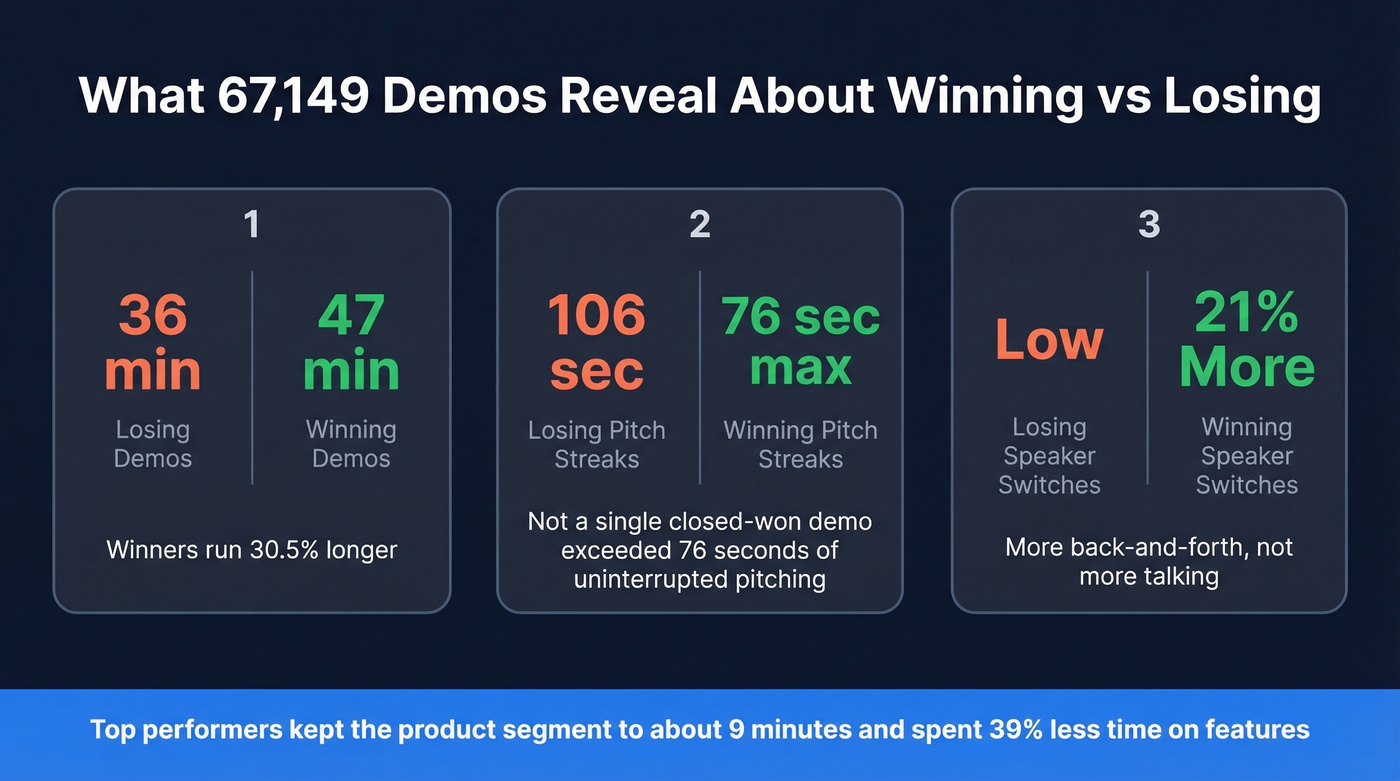
But raw length isn't the differentiator. Interaction density is. Winning demos had 21% more speaker switches per minute, meaning more back-and-forth instead of long pitch bursts. They also start with a contextual overview under 2 minutes, then move quickly into the part of the product that maps to the buyer's top discovery priority.
Here's the number that should be taped to every AE's monitor: not a single closed-won demo had more than 76 seconds of uninterrupted pitching. Unsuccessful demos ran pitch streaks up to 106 seconds. Thirty seconds of extra monologue, and you're statistically in losing territory.
In a separate analysis of 3M+ demos, top performers kept the main product segment concentrated around ~9 minutes and spent 39% less time talking about features, while buyers asked 28% more questions. Less feature narration, more buyer-led curiosity - that's the pattern every single time.
Slide-by-Slide Demo Deck Framework
Your deck's job is to earn the right to demo, then set up a clean "why this, why now" narrative. SCR - Situation, Complication, Resolution - forces you to stay buyer-centered instead of drifting into product theater.
The SCR Arc (5-7 Slides)
Slide 1 - Agenda (30 sec)
Name the flow: context, 9-minute product segment, Q&A, next steps. This reduces anxiety and stops drive-by "can you also show..." interruptions.
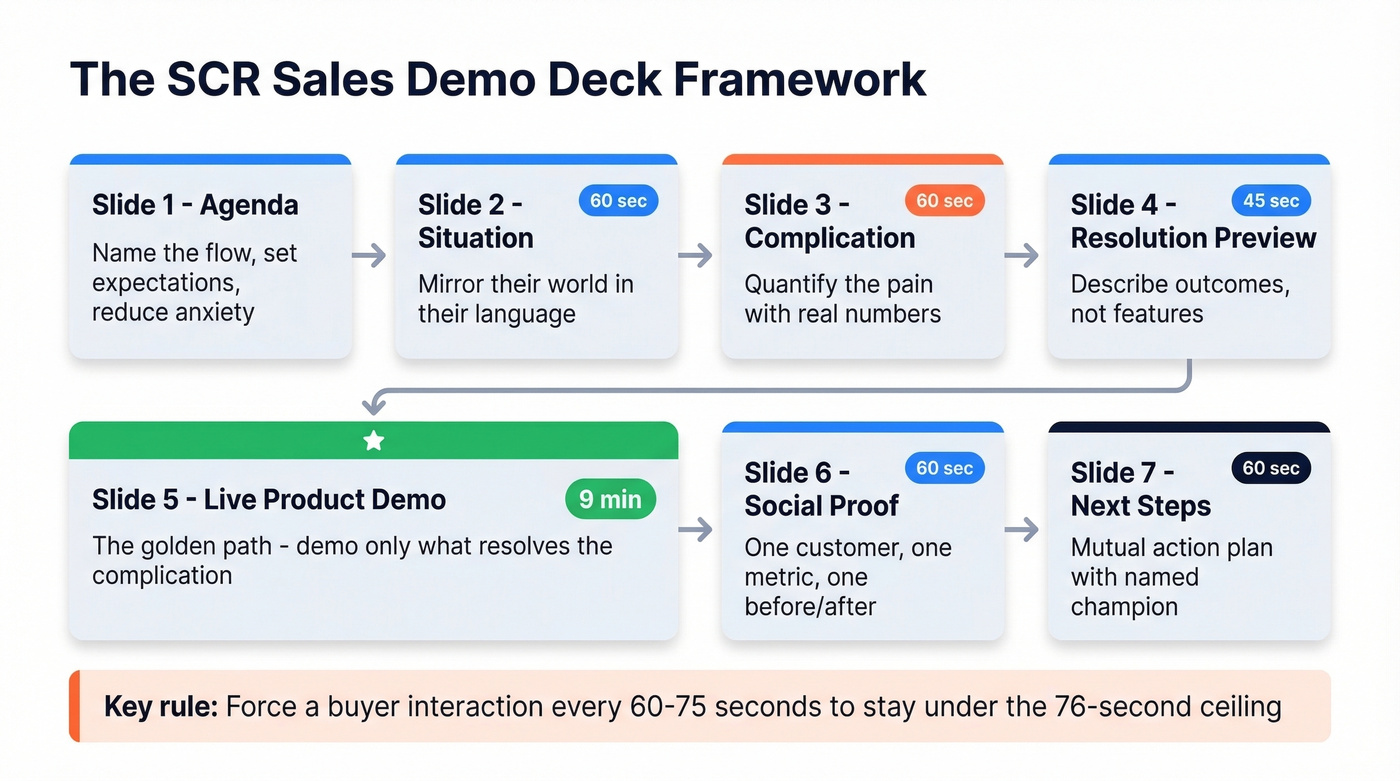
Slide 2 - Situation (60 sec) Mirror their world in their language: current workflow, tools, constraints, success metrics. Keep this under two minutes. Tighter is better.
Slide 3 - Complication (60 sec)
Quantify the pain: time leakage, missed pipeline, compliance risk, broken handoffs. This is where you earn urgency without being dramatic.
Slide 4 - Resolution Preview (45 sec) Describe the outcome in 2-3 bullets: "shorter cycle time," "fewer manual steps," "cleaner reporting." Save feature names for the live demo.
Slide 5 - Live Product Segment (9 min) This is the money slide, even though it's not a slide. Demo only the path that resolves the complication. Teams that script the 9-minute "golden path" outperform teams that freestyle - we've seen this pattern across dozens of deal reviews in our own pipeline.
Slide 6 - Social Proof (60 sec) One relevant customer story, one metric, one before/after. Same industry or same workflow beats a big logo every time.
Slide 7 - Next Steps (60 sec)
Mutual action plan: who needs to be involved, what you'll send, what success looks like in a pilot, the decision date. Name the champion and the buying committee explicitly.
Force a buyer interaction at least every 60-75 seconds - ask a question, confirm a workflow detail, or let them choose between two paths. That's how you stay under the 76-second ceiling without sounding robotic.

A perfect 9-minute demo means nothing if you're presenting to the wrong person. Prospeo gives you 300M+ profiles with 30+ filters - buyer intent, job changes, technographics - so every demo seat is filled with a qualified decision-maker, not a tire-kicker.
Stop wasting demos on unqualified prospects. Start with better data.
Mistakes That Kill Demo Presentations
Demoing on the first call. Skipping discovery guarantees you'll show the wrong thing. We've watched reps burn 45 minutes demoing a feature the prospect already had solved, because nobody asked the right questions upfront.
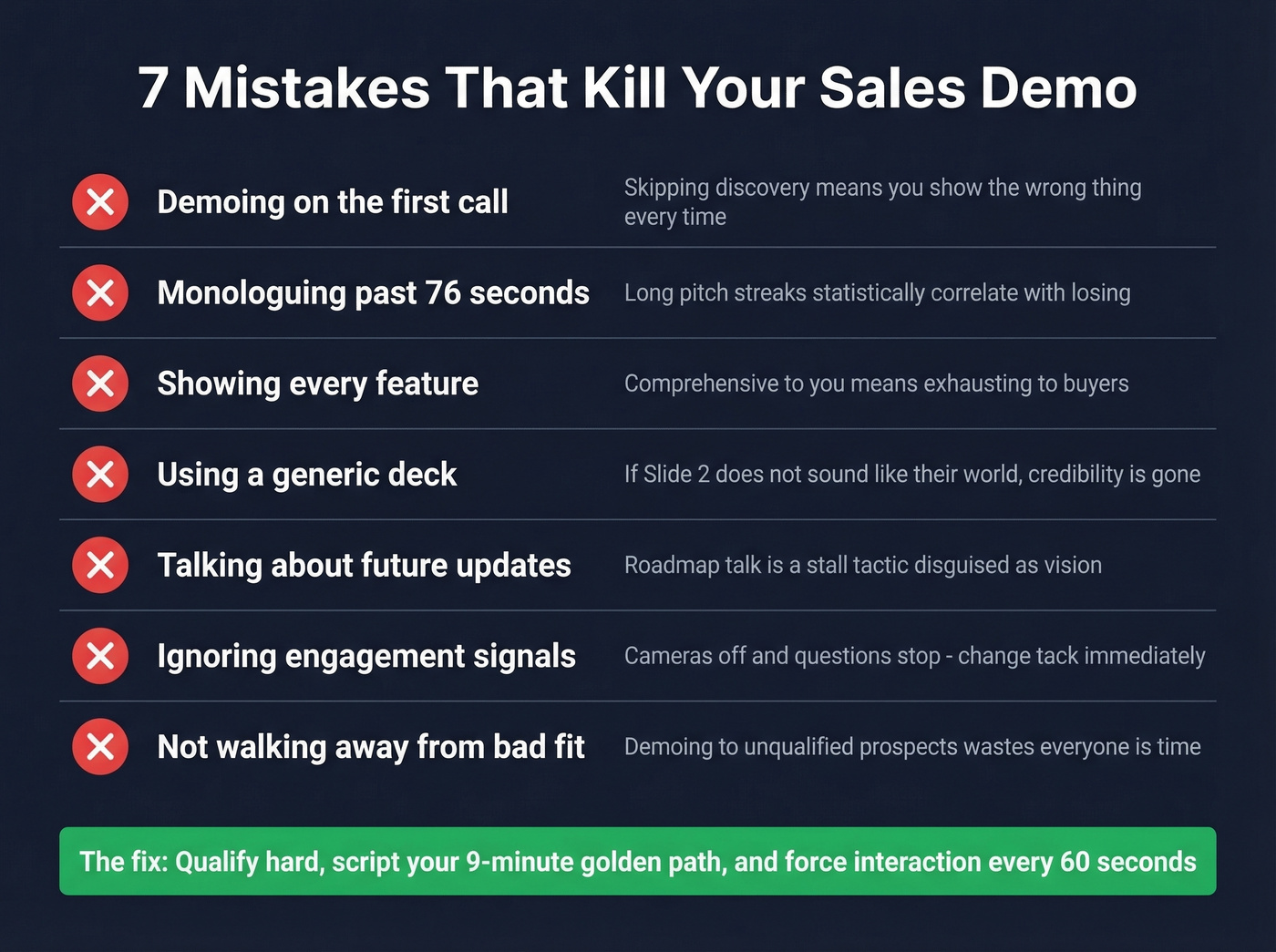
Monologuing past 76 seconds. Long pitch streaks correlate with losing. Period.
Showing every feature. "Comprehensive" demos feel thorough to sellers and exhausting to buyers. Pick the three capabilities that map to their stated pain, demo those, and stop.
Using a generic deck. If Slide 2 doesn't sound like their world, you've already lost credibility before the product even loads.
Talking about future updates. Roadmap talk is a stall tactic disguised as "vision." Sell what exists.
Ignoring engagement signals. Cameras off, questions stop, multitasking starts - change tack immediately. Ask a direct question. Pause. The silence will pull them back faster than another feature.
Not walking away when there's no fit. Skip this instinct to "demo anyway." Demoing to an unqualified prospect wastes your time and theirs. The best reps disqualify fast and protect their calendar.
Sharpening Your Delivery Skills
The framework and timing rules above only work if the person delivering the demo can execute under pressure. These skills aren't innate - they're built through deliberate practice and honest feedback loops.
Record every demo and review it weekly. Flag any pitch streak over 60 seconds and any stretch where the buyer went silent for more than 90 seconds. Practice the 9-minute golden path until it's muscle memory, to the point where you can deliver it while fielding interruptions without losing the narrative thread.
Run mock demos with peers who play difficult buyers - the ones who go off-script, ask pricing early, or challenge ROI claims mid-walkthrough. And track your speaker-switch rate. If you're not hitting at least 4-5 switches per 10 minutes, you're monologuing regardless of how engaging you think you sound.
Let's be honest: most reps treat demos as meetings to wing. The ones who close at elite rates treat demo delivery as a skill to drill.
Demo Funnel Benchmarks
Benchmarks keep you honest. Sometimes the demo is fine and your qualification is the leak.
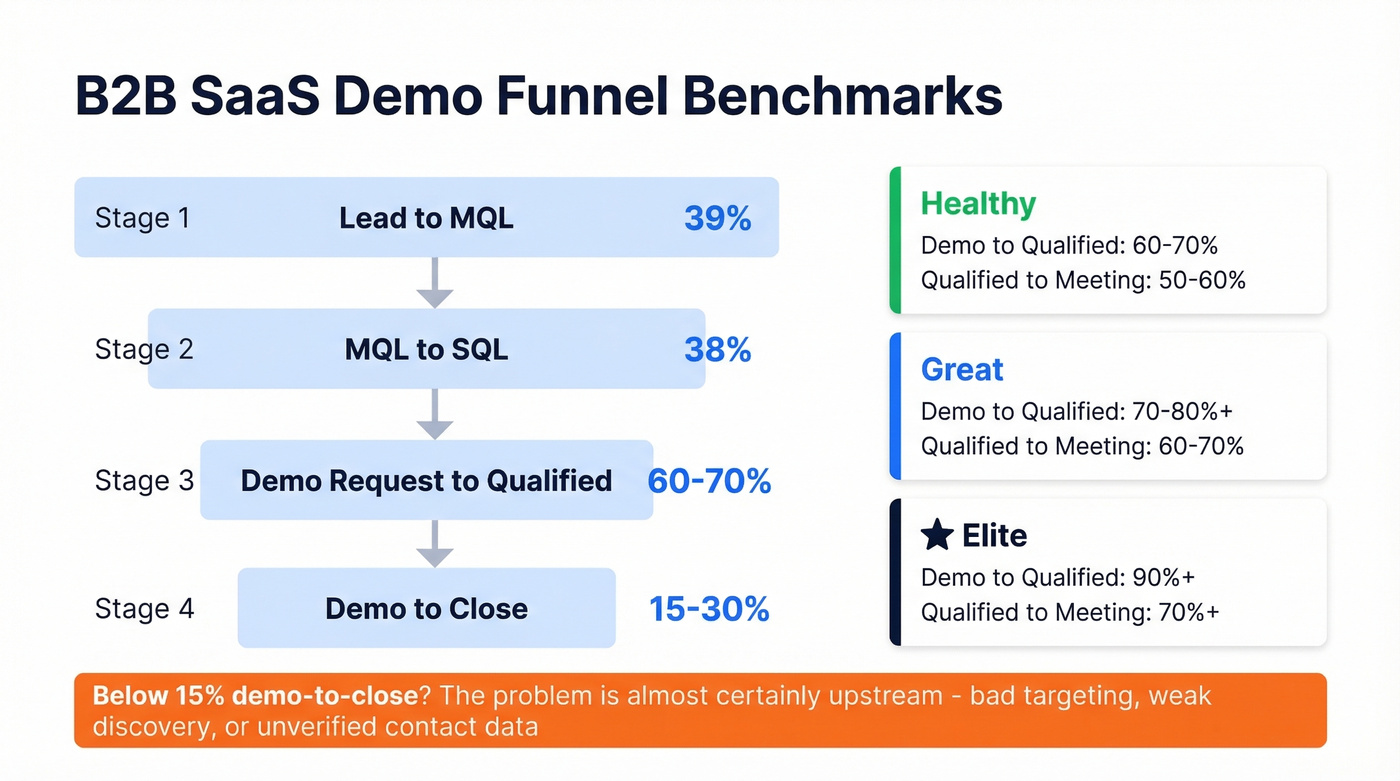
RevenueHero's inbound demo benchmarks show 60-70% demo-request qualification as healthy, and 50-60% qualified-to-meeting conversion as typical. First Page Sage's B2B SaaS funnel averages land at 39% Lead-to-MQL and 38% MQL-to-SQL. For demo-to-close, a practical mid-market SaaS range is ~15-30%, assuming real qualification and a mapped buying committee.
| Stage metric | Healthy | Great | Elite |
|---|---|---|---|
| Demo to Qualified | 60-70% | 70-80%+ | 90%+ |
| Qualified to Meeting | 50-60% | 60-70% | 70%+ |
If your demo-to-close rate is below 15%, the problem is almost certainly upstream - bad targeting, weak discovery, or unverified contact data letting junk leads into your pipeline.
Tools for Building and Delivering Demos
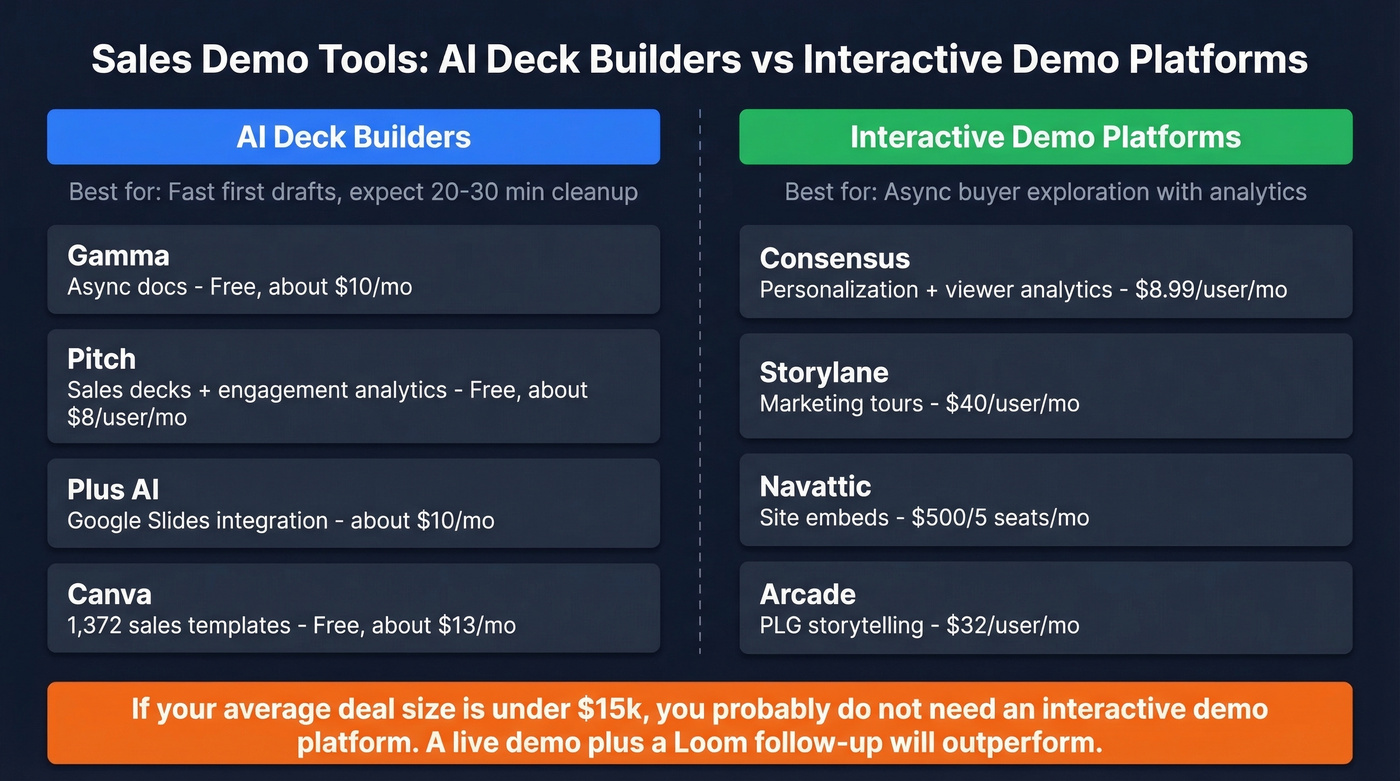
The interactive demo platform market is projected to hit $500M and growing at 25% CAGR through 2033. AI deck tools are great for first drafts, but expect ~20-30 minutes of cleanup to fix structure, visuals, and AI blandness. Interactive demo platforms are a different category entirely - they let buyers explore asynchronously with analytics baked in.
AI Deck Builders
| Tool | Best for | Starting price |
|---|---|---|
| Gamma | Async docs | Free, ~$10/mo |
| Pitch | Sales decks + engagement analytics | Free, ~$8/user/mo |
| Plus AI | Google Slides | ~$10/mo |
| Canva | Templates | Free, ~$13/mo |
Canva's template library alone has 1,372 sales presentation templates. If you're moving fast, that matters more than fancy AI generation. Pitch is worth a look if your team lives in a CRM - its engagement analytics showing views and time spent are gold for follow-up timing.
Interactive Demo Platforms
| Tool | Best for | Starting price |
|---|---|---|
| Consensus | Sales + analytics | $8.99/user/mo |
| Storylane | Marketing tours | $40/user/mo |
| Navattic | Site embeds | $500/5 seats/mo |
| Arcade | PLG storytelling | $32/user/mo |
Reddit's SalesOps community is consistent on this: Consensus wins when you need personalization and viewer analytics that sales can actually use, Navattic and Storylane shine for top-of-funnel embedded tours, and Arcade is lightweight and PLG-friendly. Don't overlook async recorded demos as a complement either - they're not a replacement for live demos, but they keep momentum between calls.
Here's the thing: if your average deal size is under $15k, you probably don't need an interactive demo platform at all. A well-structured live demo with a Loom follow-up will outperform a $500/month Navattic subscription that nobody on your team actually updates.
Before the Demo - Verify Your Prospects
I once watched a rep customize a 45-minute demo for someone who ghosted the invite. Turns out the email was fake, the title was inflated, and the "company" was a student project.
Bad contact data creates no-shows, unqualified attendees, and dead follow-up - which quietly kills your demo-to-close rate regardless of how good your deck is. Prospeo handles that upstream problem with 98% email accuracy and 125M+ verified mobile numbers on a 7-day refresh cycle, so you're demoing to real, reachable decision-makers instead of ghosts.

Your SCR deck nails the pain point. Your 9-minute golden path is rehearsed. But a 35% bounce rate on your outreach means half your demo invites never land. Prospeo's 98% email accuracy and 5-step verification keep bounce rates under 4% - so your calendar stays full of real buyers.
Book 26% more meetings with emails that actually deliver.
FAQ
How long should a sales demo be?
Winning demos average 47 minutes total, but the core product segment should be ~9 minutes. Interaction density - speaker switches and questions - matters more than raw length. Aim for 4-5 speaker switches per 10-minute block.
How many slides do you need for a demo deck?
5-7 setup slides using the SCR framework, then transition into a live walkthrough. The slides create context and urgency; the product segment proves the resolution. Avoid 20+ slide decks that push buyers into passive listening.
What demo delivery skills matter most?
The highest-impact skills are pacing (staying under the 76-second pitch ceiling), active listening (adapting the walkthrough based on buyer reactions in real time), and narrative control (steering back to the complication-resolution arc when conversations drift). Recording and reviewing your own demos weekly is the fastest way to improve all three.
How do I reduce no-shows before a scheduled demo?
Start with verified contact data and tight targeting so you're booking real decision-makers. Layer in intent signals to prioritize prospects who are actively researching solutions, and confirm reachability before the invite goes out. Bad data is the silent killer of demo conversion rates.