

The Sales Discovery Call Script Top Reps Actually Use
Your prospect just said "just send me pricing" two minutes in. The call's dead. That's what happens when you skip the opener that sets ground rules and jump straight into questions. 96% of buyers have already done their research before they talk to a rep - they don't need a product walkthrough. They need a conversation that helps them decide.
You don't need a rigid sales discovery call script. You need a structure that flexes with the conversation while making sure you walk away with the four things that actually matter.
What You Need (Quick Version)
- Set ground rules in the first 90 seconds. The "up-front contract" opener pre-negotiates next steps so you're not scrambling at the end.
- Ask 8-12 questions max. Gong's research shows 20 is too many - you lose the prospect's attention and turn discovery into an interrogation.
- Spend more time on next steps than you think. The fastest deals spend 53% more time discussing next steps in the first meeting. This is where deals accelerate or die.
Four Things Every Call Must Answer
Treat these as pass/fail. If you hang up without clear answers to all four, the call didn't work.
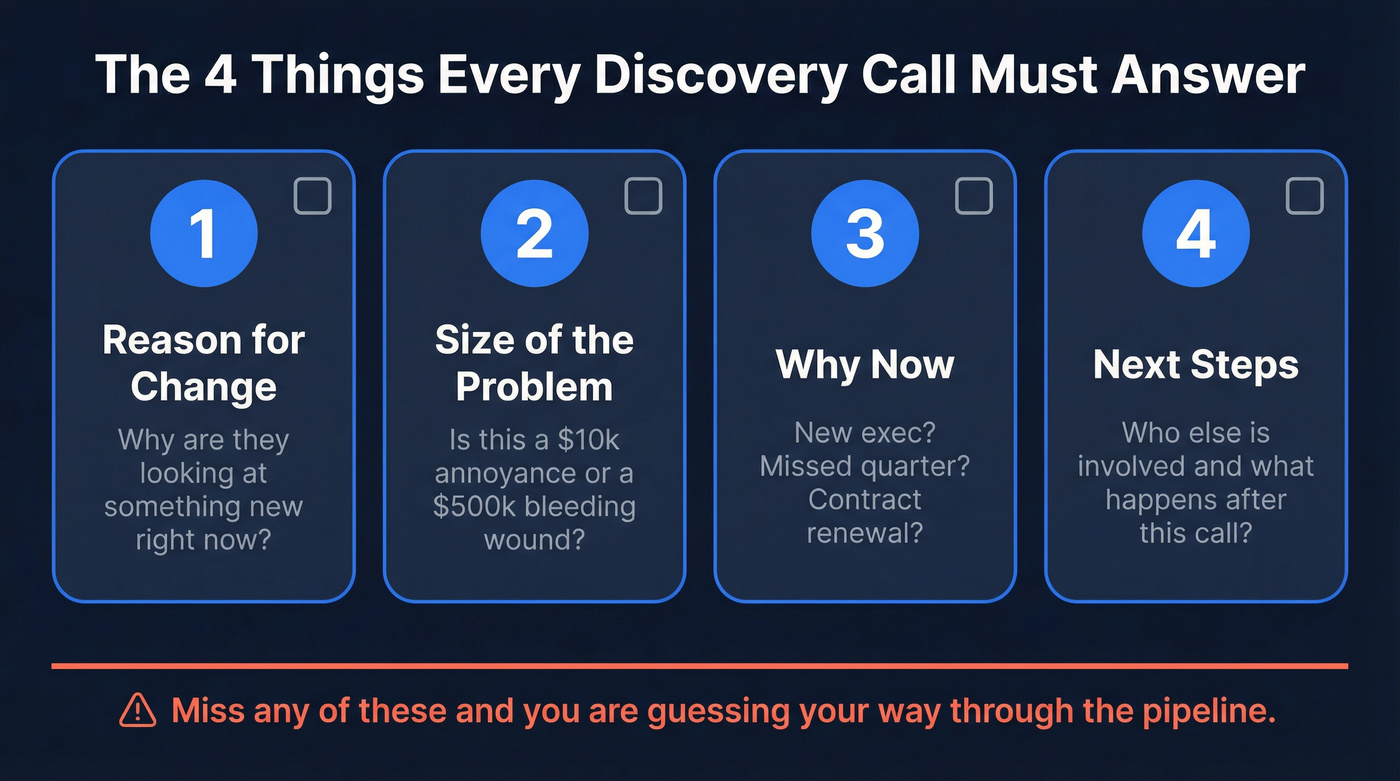
- Reason for change - Why are they looking at something new right now?
- Size of the problem - Is this a $10k annoyance or a $500k bleeding wound?
- Why now - What's the trigger? A new exec, a missed quarter, a contract renewal?
- Next steps - Who else needs to be involved, and what happens after this call?
Miss any of these and you're guessing your way through the pipeline.
Copy-Paste Discovery Call Script
The Opener (First 90 Seconds)
This is the most underrated move in sales. The up-front contract - a staple on r/salestechniques - relieves pressure, sets an agenda, and pre-negotiates what happens next.
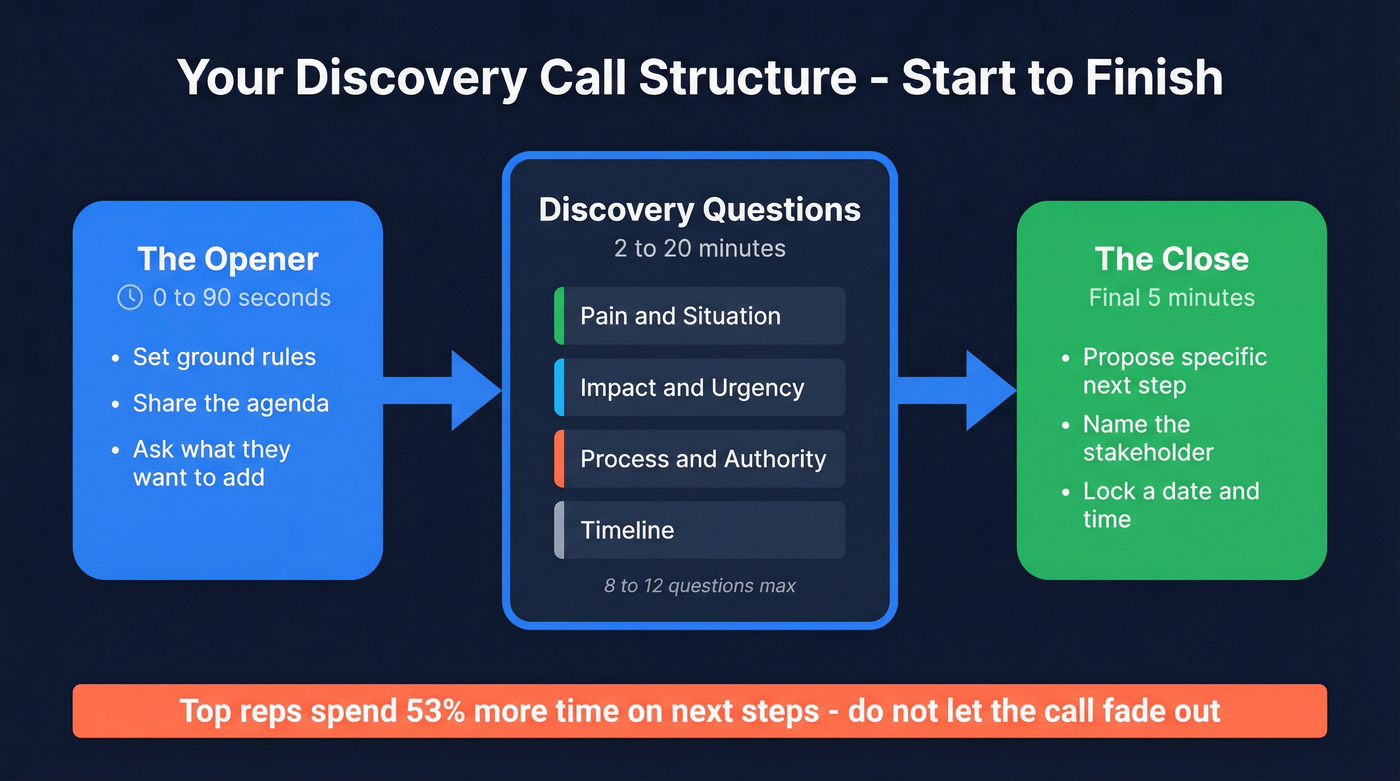
"Hey [Name], thanks for making time. Before we get into it - we're not a perfect fit for everyone. If at any point this doesn't feel like a match, please just tell me. I'd rather us both save time. Here's what I was thinking: I'll ask a few questions about [their situation], share how we've helped similar teams, and then we'll figure out if a next step makes sense. Sound good? Anything you'd like to add to that agenda?"
That last question gives the prospect ownership. They stop feeling sold to and start participating. We've seen reps go from a 30% ghost rate to under 15% just by adding this opener consistently - it's that effective at changing the dynamic of the entire call.
Discovery Questions (Minutes 2-20)
Aim for 8-12 questions. Every one should move the deal forward, not fill out a CRM field.
Pain & situation:
- "What prompted you to take this call?"
- "Where does the current process break down?"
Impact & urgency:
- "What happens if you don't solve this by end of quarter?"
- "What does this cost you - in revenue, time, or headcount?"
Process & authority:
- "Who else would need to weigh in on a decision like this?"
- "Is there budget allocated, or would this need to be carved out?"
Timeline:
- "What's driving your timeline?"
- "Is there a specific event - a renewal, a board meeting - that creates a deadline?"
For outbound calls, you need to earn attention first. Lead with the problem you solve, not your agenda. Inbound calls can qualify faster - move to impact and process questions sooner since the prospect already raised their hand.
Selling to a CFO? Swap in these:
- "What are your top financial priorities this quarter?"
- "How do you typically measure ROI on a tool like this?"
- "What's the approval process for a purchase in this range?"
CFOs want quantifiable impact and timeline to value - skip the feature talk entirely.
The Close (Final 5 Minutes)
Don't let the call fade out. In the fastest deals, sellers spend 53% more time here than in average deals, and it shows in their pipeline velocity.
If it's a fit:
"Based on what you've shared, here's what I'd recommend as a next step: [specific action - demo with the team, a technical deep-dive, a proposal review]. Does [day/time] work to get [stakeholder] on the call?"
If it's not a fit:
"Honestly, based on what you've described, I don't think we're the right solution for this. Here's why - [reason]. I'd rather tell you that now than waste your time."
If they need to loop in others:
"Totally understand. Let's get [stakeholder] on a 15-minute call - I'll send a brief recap they can review beforehand. Does [day] work?"
Disqualifying early builds more trust than any pitch ever will.
Benchmarks: Good vs. Great
| Benchmark | Top Reps | Average Reps |
|---|---|---|
| Talk-to-listen ratio | 46% talk | High 60s |
| Time on next steps | 53% more | Baseline |
| Video used at any point | 127% more likely to close | - |
| Discovery questions | 8-15 | 20+ |
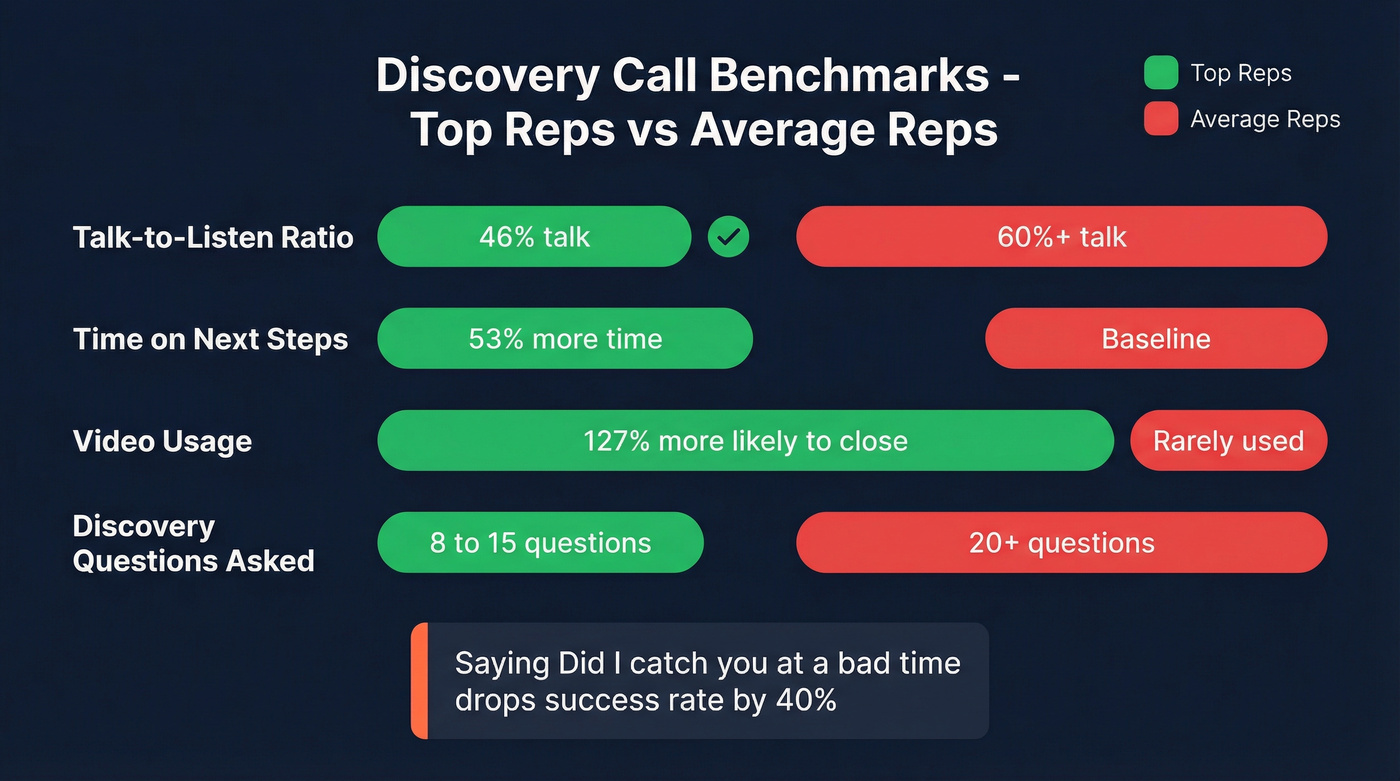
One stat worth highlighting: opening a cold call with "Did I catch you at a bad time?" drops your success rate by 40%. Kill that phrase permanently.
Here's the thing - if your talk ratio is above 50%, you're monologuing, not discovering. In our experience, the reps who track these four metrics weekly improve fastest. Top teams convert roughly 40-60% of discovery calls into next meetings. If you're below that range, the script isn't the problem. The listening is.

A perfect discovery call means nothing if you're calling the wrong person. Prospeo gives you 300M+ verified profiles with 30+ filters - buyer intent, job changes, department headcount - so you reach the actual decision-maker before you even dial.
Stop wasting discovery calls on people who can't sign the deal.
Pick Your Framework
| Framework | Best For | Core Focus | Sample Question |
|---|---|---|---|
| BANT | SMB / fast qualification | Budget, authority, need, timeline | "Is there budget allocated?" |
| SPICED | Consultative / transformation | Situation, pain, impact, critical event, decision | "What happens if you don't solve this by Q3?" |
| MEDDIC | Enterprise / procurement-heavy | Metrics, economic buyer, decision process, champion | "Walk me through your approval process." |
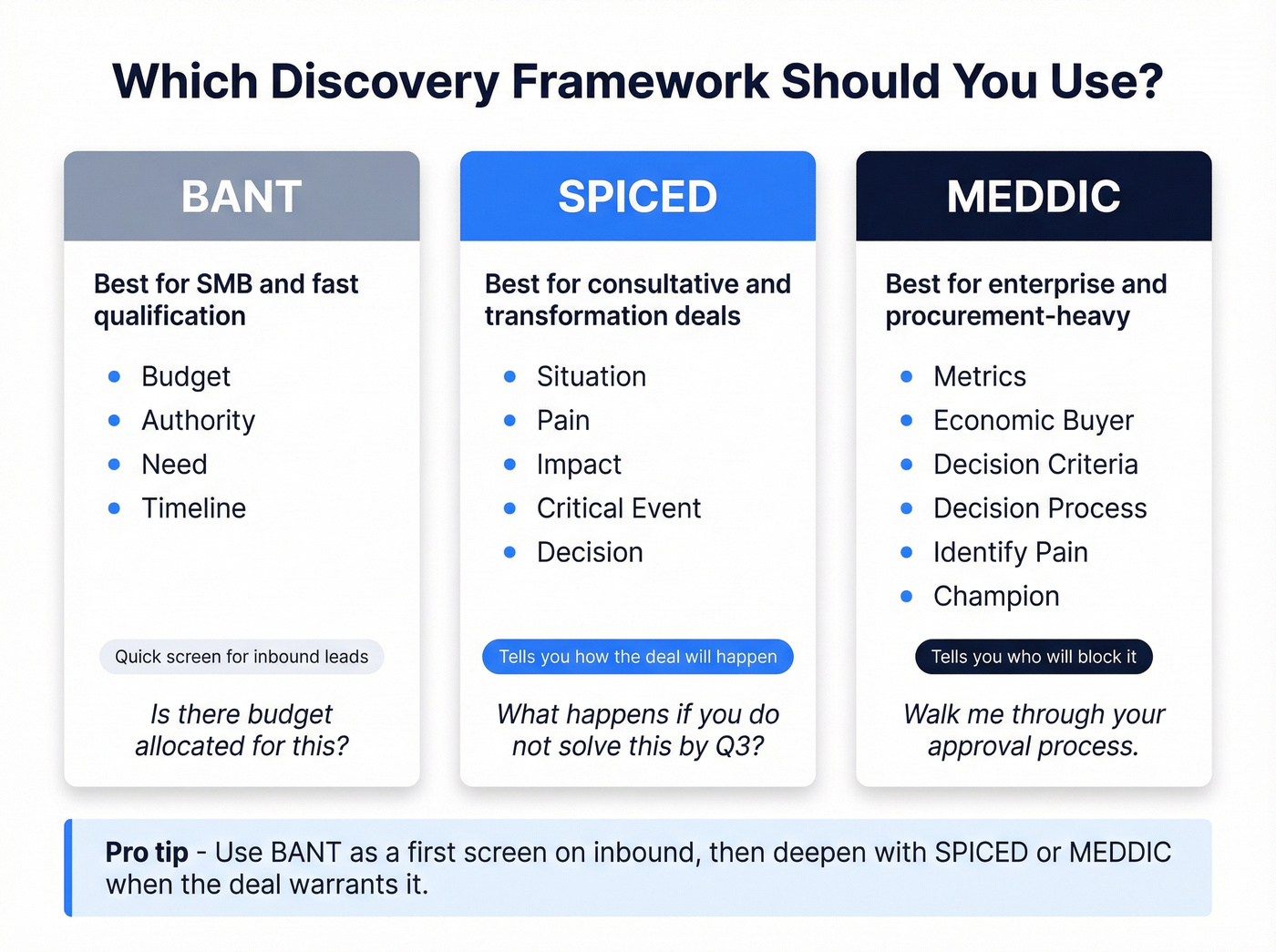
BANT is fine for SMB. If you're selling six-figure deals and still using BANT, you're leaving money on the table - it tells you whether a deal could happen, but SPICED and MEDDIC tell you how it'll happen and who'll block it. The hybrid approach works best: use BANT as a first screen on inbound, then deepen with SPICED or MEDDIC when the deal warrants it.
Let's be honest - most reps don't need a better framework. They need to stop treating discovery like a checkbox exercise. Pick one, internalize it, and spend your energy actually listening instead of mentally scanning a question list.
Mistakes That Kill Discovery Calls
Talking too much. If you're above 50% talk time, you're pitching, not discovering. The data is unambiguous here.
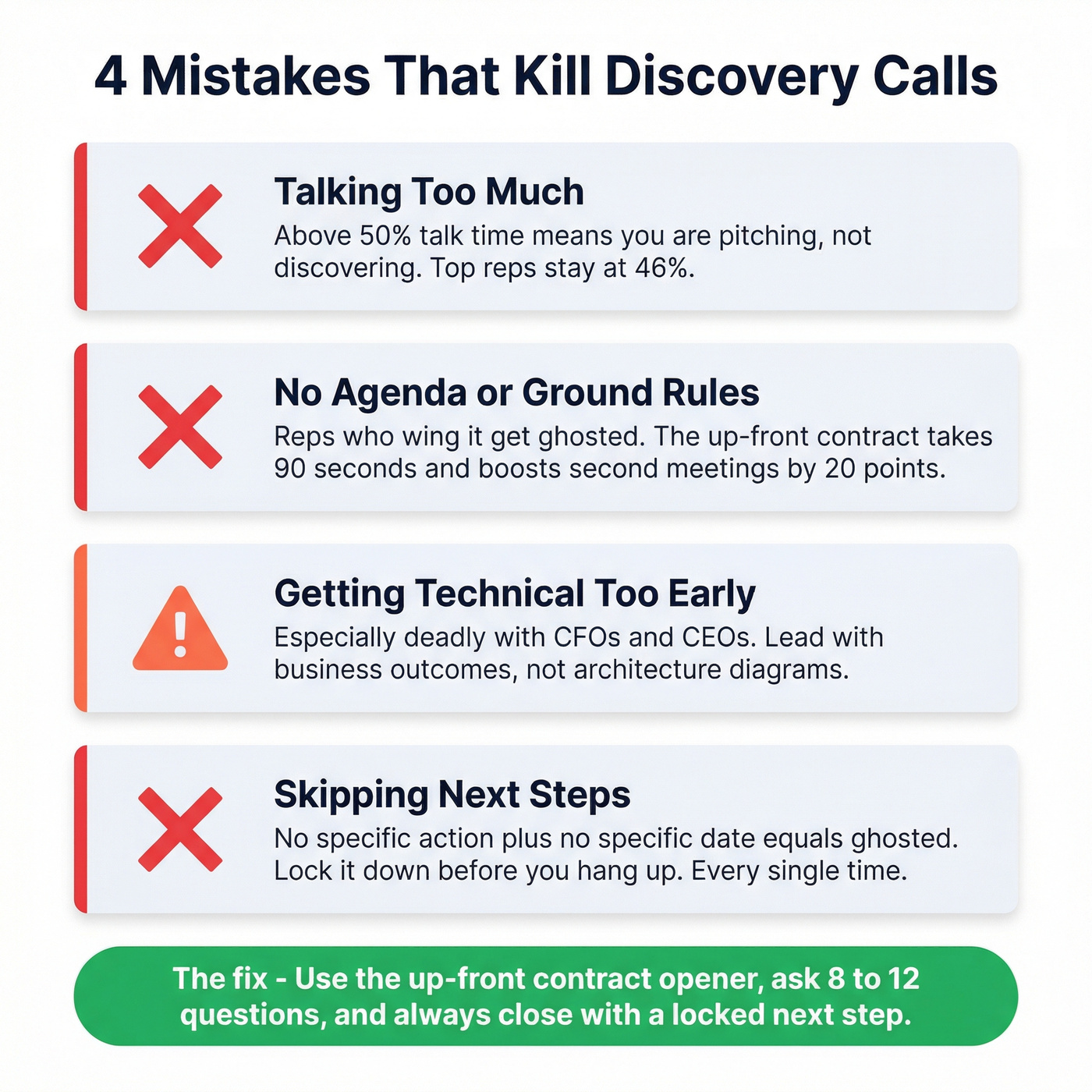
No agenda or ground rules. Reps who wing it get ghosted. The up-front contract takes 90 seconds and changes the entire dynamic of the conversation. We ran an internal test across three SDR teams last quarter, and the ones who adopted the opener saw their second-meeting rate jump by nearly 20 percentage points within six weeks.
Getting technical too early. This is especially deadly when a CFO or CEO is on the call. Lead with business outcomes, not architecture diagrams.
Skipping next steps. You hung up feeling great. Then the prospect ghosted. That's what happens when you don't lock down a specific next action with a specific date before ending the call. Every. Single. Time.
Verify Your Data Before You Dial
The best discovery call script is useless if you're calling a dead number or your follow-up email bounces. Prospeo delivers 98% email accuracy across 143M+ verified emails and 125M+ verified mobile numbers, all on a 7-day refresh cycle. The free tier gives you 75 emails per month plus 100 Chrome extension credits - enough to validate your highest-priority calls before you pick up the phone.
You just nailed the discovery call. Now you need the direct dial for the stakeholder they want to loop in. Prospeo's 125M+ verified mobile numbers have a 30% pickup rate - 3x the industry average - so your next-step call actually happens.
Turn every "let me loop in my boss" into a booked meeting.
AI Tools for Discovery Calls
Conversation intelligence - Gong runs roughly $1,600/user/year plus a platform fee between $5k and $50k. Chorus costs around $1,200/user/year, often bundled with ZoomInfo. These are powerful but best for teams of 10+ reps where coaching ROI justifies the spend. Skip these if you're a team of three - the per-seat math won't work.
AI note-takers - Fellow at $7-$25/user/month, Fathom with a free tier, and Fireflies from $0-$59/user/month handle transcription, summaries, and CRM sync at a fraction of the cost. If rapport matters to you, look for botless recording - both Fellow and Krisp offer this so there's no awkward "Notetaker Bot has joined" moment.
Pair Prospeo for verified contact data going into the call with an AI note-taker for what comes out. That covers both ends of the discovery workflow without blowing your budget.
FAQ
How long should a discovery call be?
SMB calls run 15-20 minutes. Mid-market deals need 30. Enterprise discovery often takes 45-60 minutes, especially with multiple stakeholders. Match the complexity of the deal, not a calendar default.
How many questions should I ask?
Gong's data shows 8-15 questions is the sweet spot for top-performing reps. Beyond 20, engagement drops sharply and the call starts feeling like an interrogation. Prioritize impact and timeline questions - they move deals forward faster than situational ones.
What framework works best for enterprise deals?
MEDDIC is the standard for enterprise sales with complex procurement. It forces you to identify the economic buyer, map the decision process, and build a champion - three things BANT ignores entirely. For mid-market consultative deals, SPICED offers a strong alternative.
How do I make sure my follow-up actually reaches the prospect?
Verify emails and phone numbers before the call. A great discovery call means nothing if the prospect never sees your follow-up because it bounced.