

Sales Drip Campaigns: The 2026 Playbook for Outbound That Actually Works
Every drip campaign guide tells you to "define your audience" and "set clear goals." None of them explain how to keep your emails out of spam, how many touches actually work, or what to do when nobody replies after email #3. Most of what's out there is e-commerce nurture advice dressed up with a sales label. This isn't that.
What Sales Drip Campaigns Actually Are
A sales drip campaign is a short, multi-channel outbound sequence designed to get a prospect to reply or book a meeting. It's not a 12-email marketing automation flow nudging someone toward a whitepaper download.
The distinction matters. 79% of marketing leads never convert into sales. Marketing drips optimize for opens and clicks. Sales drips optimize for one thing: a conversation. If your sequence doesn't create a path to a meeting within 5-8 touchpoints, it's noise.
What You Need (Quick Version)
- Cap email-only attempts at 3. After three unanswered emails, switch to phone, video, or another channel.
- Bounce rate under 2%, always. Verify every email before it enters a sequence. One bad upload can torch your domain.
- Go multi-channel from day one. McKinsey's research shows B2B customers use roughly 10 channels in their buying journey. Email-only sequences leave money on the table.
- Use a sales engagement tool. Mailchimp and Klaviyo aren't built for outbound. Apollo, Mailshake, or Outreach are.
Why Automation Beats One-Off Emails
Klaviyo's benchmark study across 183,000+ brands found automated flows deliver a 5.58% click rate versus 1.69% for one-off campaigns - a 3.3x improvement. Conversion rates showed a 13x gap: 2.11% versus 0.16%.
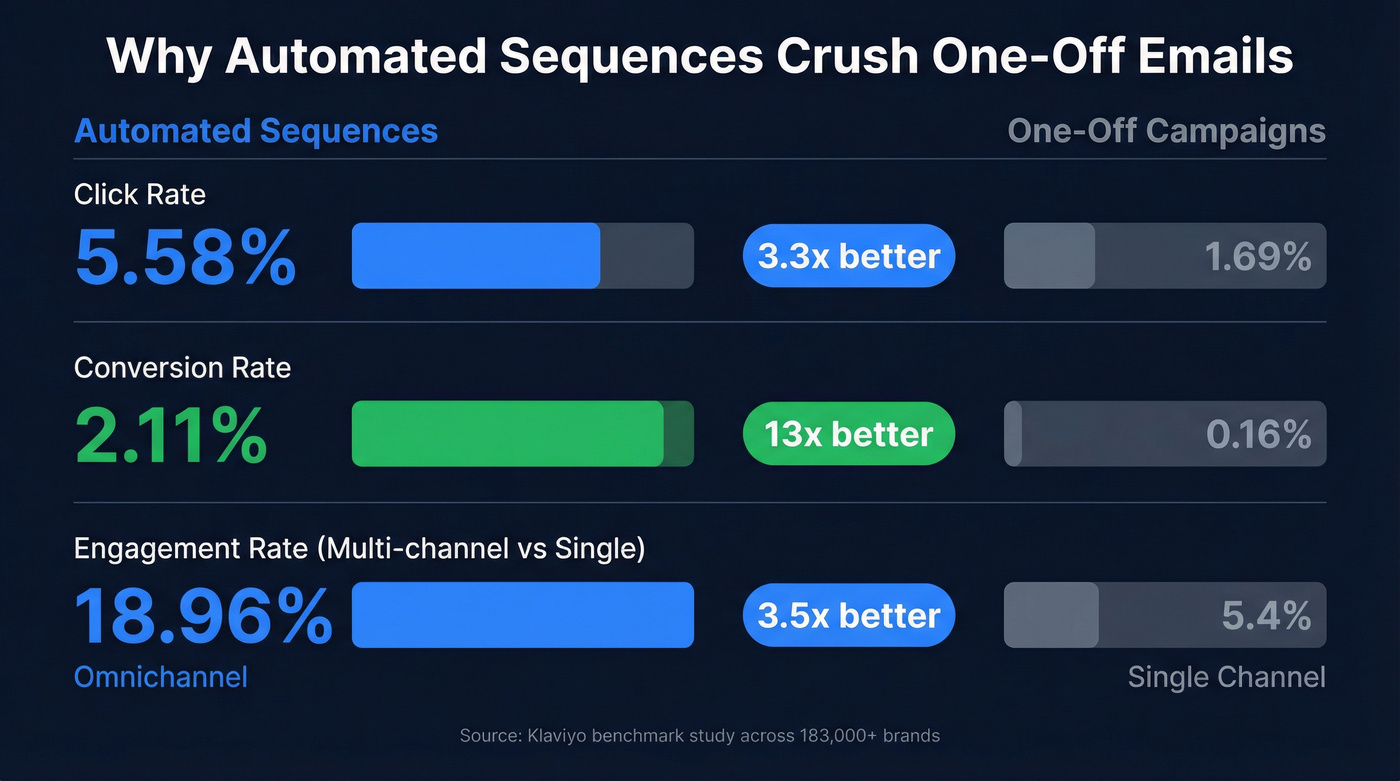
Those are e-commerce numbers. The gap is even wider in B2B outbound, where prospects ignore one-off emails but respond to structured sequences spanning multiple channels. Omnichannel engagement drives an 18.96% engagement rate versus 5.4% for single-channel approaches.
Anatomy of a High-Converting Sequence
Many platforms recommend 8-12 email sequences. Outreach recommends against this with their "3-round rule" - three email attempts, then switch channels. We've watched teams run long sequences and seen reply rates fall off a cliff after email 4. Three shots is all you get.
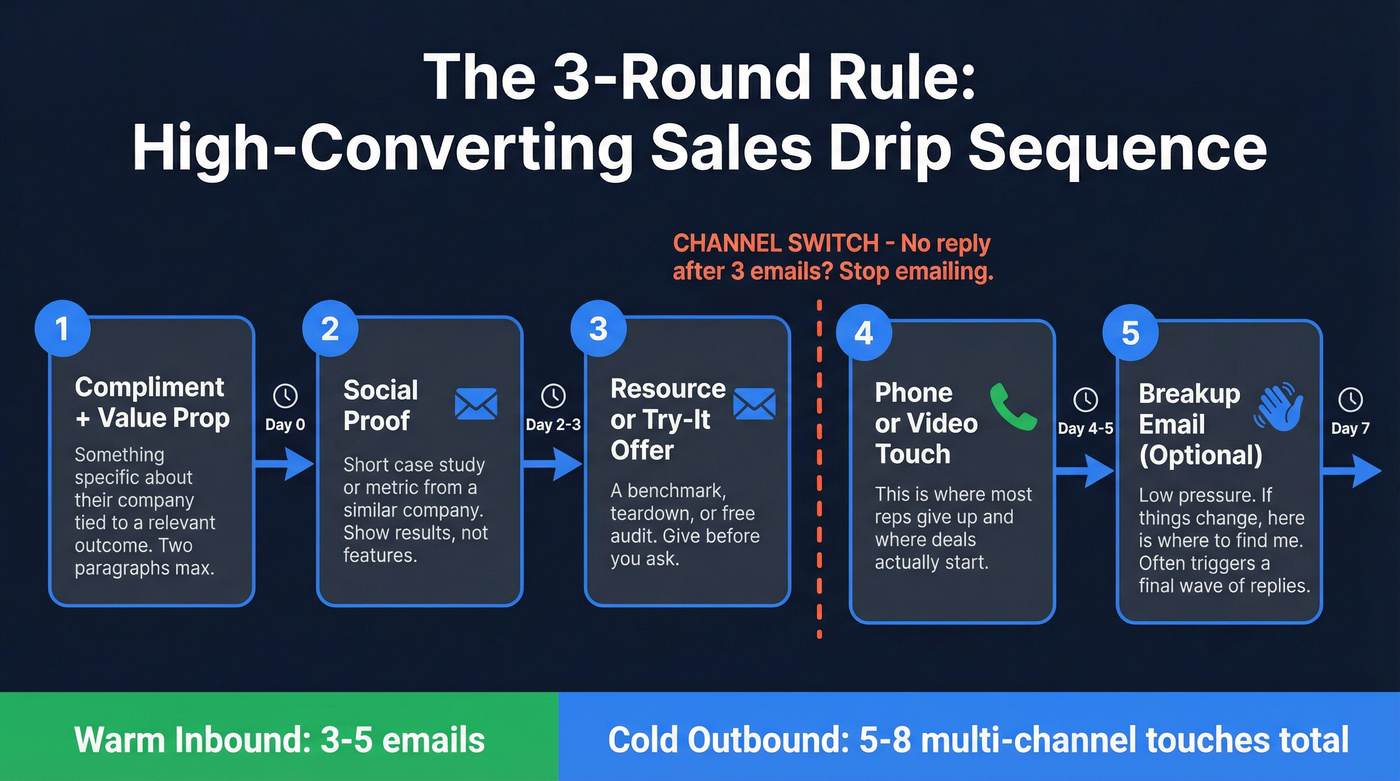
Here's what a solid cold sequence looks like:
- Email 1 - Compliment + value prop. Something specific about their company, connected to a relevant outcome. Two paragraphs max.
- Email 2 - Social proof. A short case study or metric from a similar company. "We helped [similar company] do X" beats feature lists every time.
- Email 3 - Resource or try-it offer. A benchmark, a teardown, a free audit. Give before you ask.
- Phone/video touch. No reply after three emails? Switch channels entirely. This is where most reps give up - and where deals actually start.
- Breakup email (optional). Short, low-pressure. "Looks like the timing isn't right. If things change, here's where to find me." In our experience, breakup emails often trigger a final wave of replies from prospects who'd been meaning to respond.
RAIN Group confirms B2B sales averages about 8 touchpoints, but those should span channels. Gartner found 61% of buyers prefer a rep-free experience, which means every touch needs standalone value - not just "checking in."
For warm inbound leads, 3-5 emails is the sweet spot. Cold outbound needs 5-8 multi-channel touchpoints total.

Bad data kills drip campaigns before the first email sends. Prospeo's 5-step verification delivers 98% email accuracy across 143M+ verified addresses - catching spam traps, invalid contacts, and catch-all domains. Stack Optimize built a $1M agency on it with bounce rates under 3% and zero domain flags.
Stop torching your domain. Verify every contact at $0.01/email.
Personalization Beyond {{first_name}}
If you're only swapping {{first_name}}, you're mail-merging, not personalizing. 72% of B2B customers expect personalized experiences, and that means going deeper than token merge fields.
Effective personalization draws on firmographic data like industry and funding stage, role-specific context such as title and department responsibilities, behavioral signals from content views and site visits, and intent signals showing what a prospect is actively researching. The best sequences layer two or three of these together. A cold email that references a prospect's recent funding round and connects it to a pain point their new headcount will create - that's personalization. "Hi {{first_name}}, hope you're doing well" is not.
Intent data tracking 15,000 topics lets you filter prospects by what they're actively researching before they ever enter a sequence. Layering buyer intent with job role and company growth signals means your first email already speaks to a problem they're trying to solve - not one you're guessing about.
Deliverability Checklist for 2026
Here's the thing: your SDR loaded 2,000 contacts on Monday, and by Wednesday bounce rate hit 8% and half your emails landed in spam. We've seen this exact scenario play out dozens of times. It's the #1 sequence killer, and it's entirely preventable.
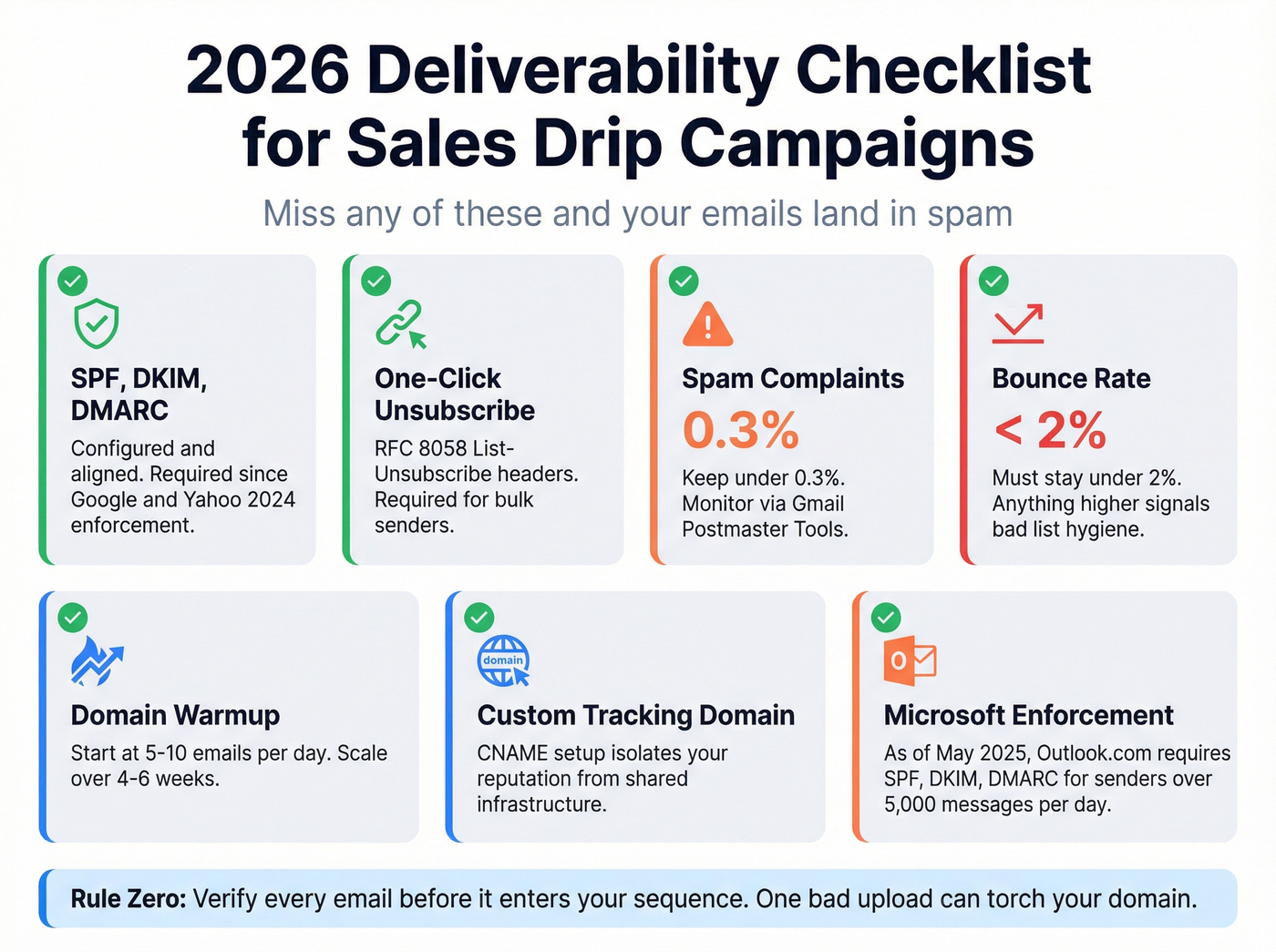
- SPF, DKIM, and DMARC - configured and aligned. Non-negotiable since Google and Yahoo's 2024 enforcement.
- One-click unsubscribe - RFC 8058 List-Unsubscribe headers, required for bulk senders.
- Spam complaints under 0.3% - monitor via Gmail Postmaster Tools.
- Bounces under 2% - anything higher signals bad list hygiene.
- Warmup ramp - start new domains at 5-10 emails/day, scale over 4-6 weeks.
- Custom tracking domain (CNAME) - isolates your reputation from shared infrastructure.
- Microsoft enforcement - as of May 2025, Outlook.com requires SPF/DKIM/DMARC for senders exceeding 5,000 messages/day.
Verify every email before it enters your sequence. Prospeo's 5-step verification catches invalid addresses, spam traps, and catch-all domains at 98% accuracy across 143M+ verified emails. Stack Optimize built from $0 to $1M ARR using verified data from the platform - client deliverability stayed above 94%, bounces under 3%, zero domain flags across all accounts.
Best Tools for Outbound Drip Teams
| Tool | Best For | Starting Price | Top Tier |
|---|---|---|---|
| Prospeo | Data verification + enrichment | Free / ~$0.01/email | Credit-based |
| Apollo.io | All-in-one prospecting + sequences | Free / $59/mo | $99-149/user/mo |
| Mailshake | SMB outbound | $29/mo | $99/mo |
| Klenty | SMB sequences | $60/mo | $119/user/mo |
| Yesware | Gmail/Outlook users | Free / $19/mo | $85/user/mo |
| Outreach | Enterprise sequences | ~$100-150/user/mo | Custom |
| Salesloft | Enterprise coaching + analytics | ~$100-150/user/mo | Custom |
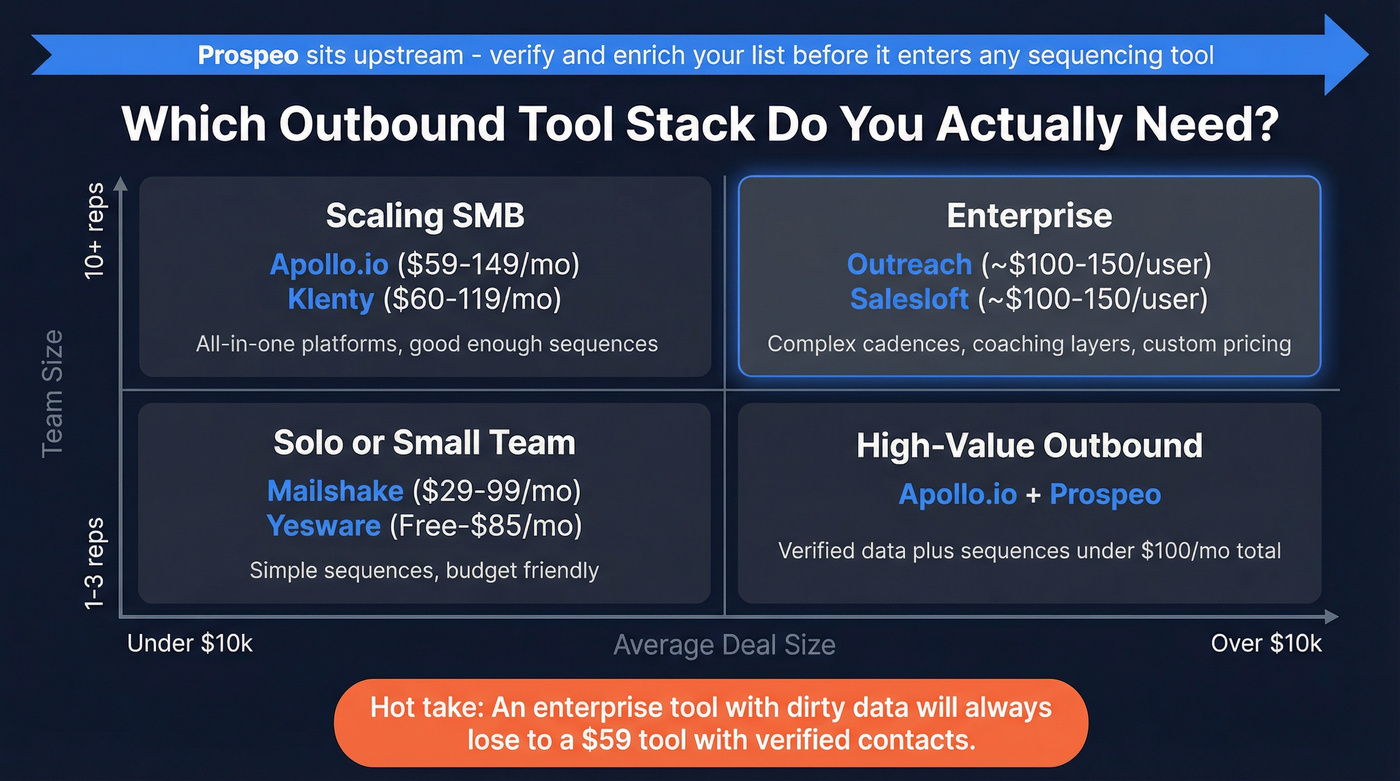
Prospeo sits upstream of your sequencing tool - it's where you build and verify the list that feeds everything else. With 300M+ professional profiles, 30+ search filters (buyer intent, technographics, job changes, headcount growth, funding), and a 7-day data refresh cycle versus the 6-week industry average, it solves the data quality problem that kills most outbound cadences before they start.
Apollo is a strong pick for teams that want prospecting and sequences in one tool under $100/mo. If you're running a 3-10 person SDR team, it covers 80% of what you need.
Hot take: If your average deal size is under $10k, you probably don't need Outreach or Salesloft. Apollo plus verified data will outperform an enterprise platform with dirty lists every single time. Skip the $150/seat tools until your deal sizes justify them.
For enterprise orgs running complex multi-step cadences with coaching layers, Outreach and Salesloft are the standard - though neither publishes pricing, which tells you who they're built for.
Mistakes That Kill Drip Sequences
Let's be honest about what actually breaks sequences, because we see the same patterns over and over:
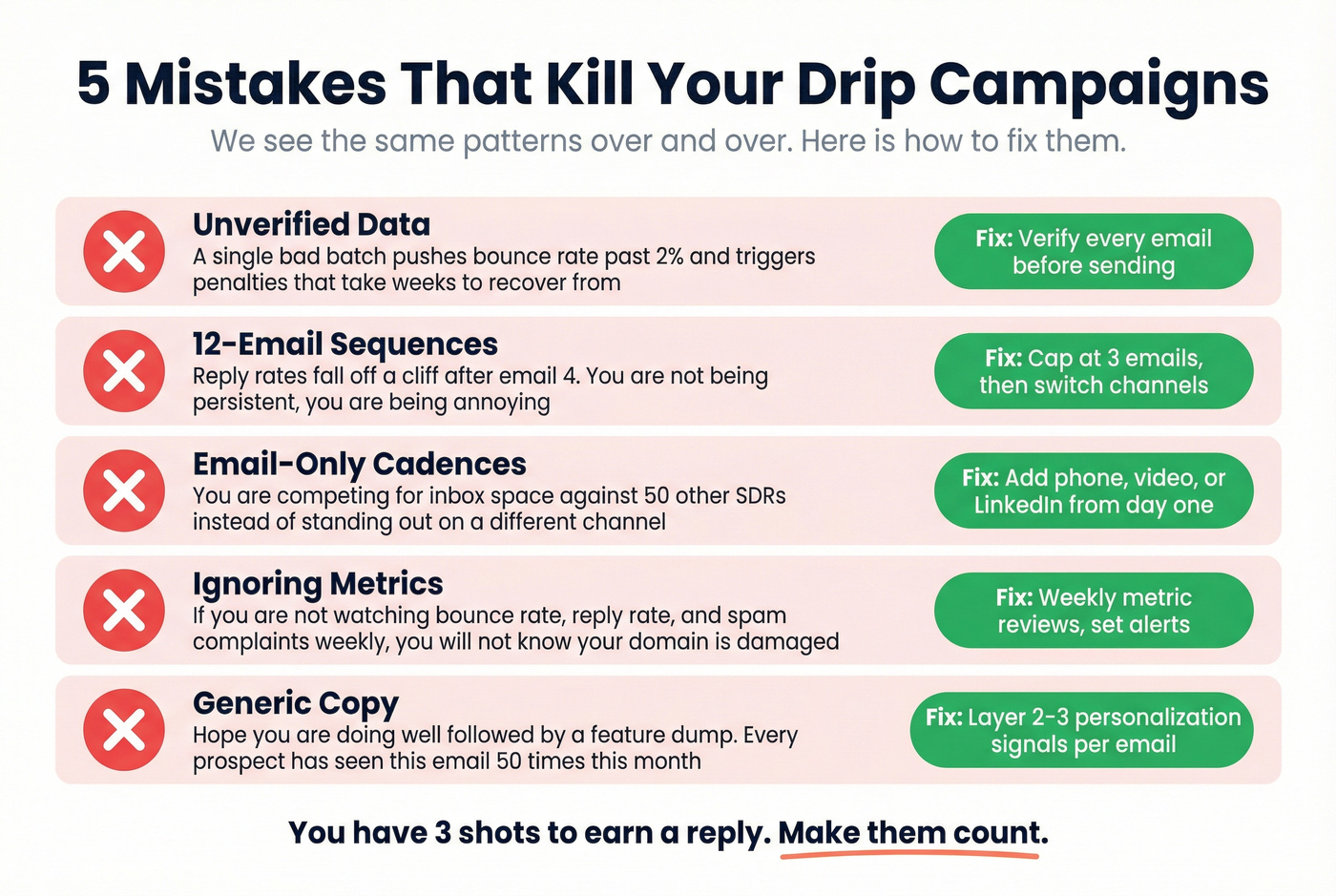
Unverified data is the fastest killer. A single batch of bad emails pushes your bounce rate past 2% and triggers inbox provider penalties that take weeks to recover from. The consensus on r/coldemail is pretty clear: verify before you send, or don't send at all.
12-email sequences are spam with extra steps. After email 4, reply rates drop sharply. You're not being persistent - you're being annoying.
Email-only cadences mean you're competing for inbox space against 50 other SDRs instead of standing out on a different channel. Phone, video, even a well-timed connection request can break through when email can't.
Ignoring metrics is flying blind. If you're not watching bounce rate, reply rate, and spam complaints weekly, you won't know your domain is damaged until it's too late. For a deeper dive, use this email deliverability guide to diagnose issues at the source.
Generic copy earns the delete, not the reply. "Hope you're doing well" followed by a feature dump - every prospect has seen this email 50 times this month. If you need proven language, start with these sales follow-up templates and adapt them to your ICP.
Stop calling it a "drip campaign." You have 3 shots to earn a reply. Make them count.
Personalization beyond {{first_name}} requires real data. Prospeo layers buyer intent across 15,000 topics with job changes, headcount growth, and funding signals - so your first email speaks to a problem prospects are actively solving. 300M+ profiles, 30+ filters, refreshed every 7 days.
Build sequences that earn replies because the targeting was right from the start.
FAQ
How many emails should a sales drip campaign have?
Three emails max before switching to phone or video. Total multi-channel touchpoints across a full cadence should be 5-8. Front-load value in those first three touches rather than spreading thin across a dozen generic follow-ups.
What's a good reply rate for a cold outbound sequence?
Cold outbound reply rates range from 1-5%. Above 5% is strong. Meeting-booked rates typically land at 1-3%. If you're below 1%, audit your list quality and subject lines first - those two factors account for most of the gap.
Do I need a separate tool for sales drip campaigns?
Yes. Marketing platforms like Mailchimp aren't built for outbound. Use Apollo.io, Mailshake, or Outreach for sequencing, paired with a verification tool that keeps bounces under 2% so your domain stays clean.
What's a good free option for verifying drip campaign data?
Prospeo's free tier includes 75 email verifications and 100 Chrome extension credits per month - enough to validate a small campaign list. Hunter offers 25 free searches monthly but caps enrichment. For teams running real outbound volume, you'll want a paid plan, but the free tier is a solid way to test accuracy before committing.