

Sales Enablement Content: Build a Library That Actually Closes Deals
Your VP just asked you to "build out enablement content" and you're staring at a shared Drive with 400 files, no naming convention, and a battlecard from 2022. Stop creating more content. Fix what you have - then build what's missing with surgical precision.
What You Need (Quick Version)
Before you disappear into a six-month content project, start here:
- Three assets first. A battlecard for your top competitor, a case study for your most common buyer persona, and an email template sequence. These cover the highest-impact moments in any deal cycle.
- Audit before you create. 65% of sales content goes unused. You probably have decent material buried under outdated decks and orphaned PDFs. Find it before you duplicate it.
- Verify before you send. Your content is only as effective as your prospect data. A perfect email template bouncing off a dead inbox wastes everyone's time.
That's the 80/20. The rest of this piece shows you how to build a system around those three principles.
What Is Sales Enablement Content?
Sales enablement content is any resource that helps reps engage prospects and close deals. That's the simple version. The useful version splits it into two categories.
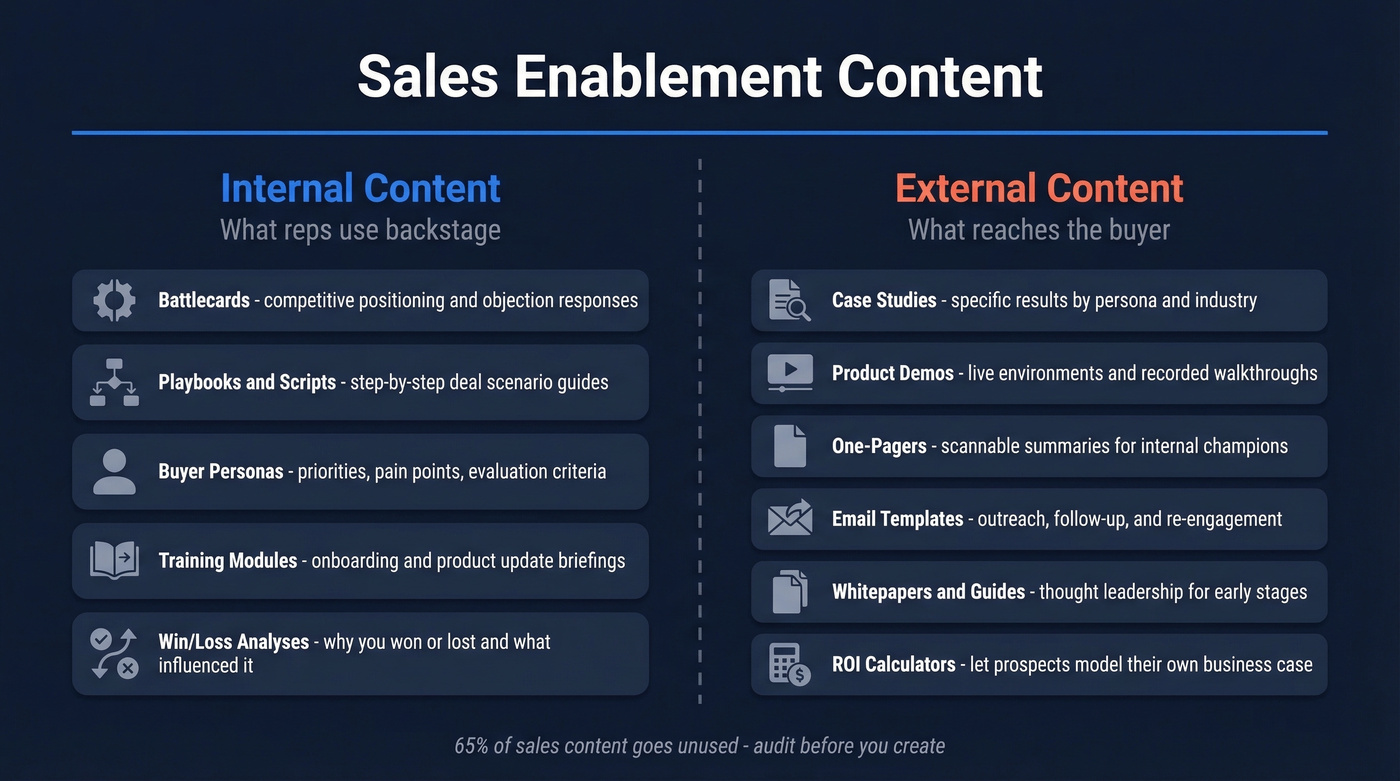
Internal content is what your reps use but buyers never see - battlecards, playbooks, scripts, objection-handling guides, training modules. It's the backstage prep that makes the onstage performance look effortless. External content is what reaches the buyer - case studies, product demos, one-pagers, email templates, whitepapers, ROI calculators. It's the material that moves a deal from "interesting" to "signed."
This distinction matters because most teams conflate enablement with content marketing. They're not the same thing. Content marketing attracts and nurtures leads at scale. Enablement arms individual reps to close specific deals. The audiences, formats, and success metrics are completely different - and the fact that 61% of organizations hired at least one dedicated enablement professional in the past year shows companies are finally treating this as its own discipline.
Why Enablement Matters More in 2026
Let's retire the "67% of the buyer's journey happens digitally" stat. That's from 2013.
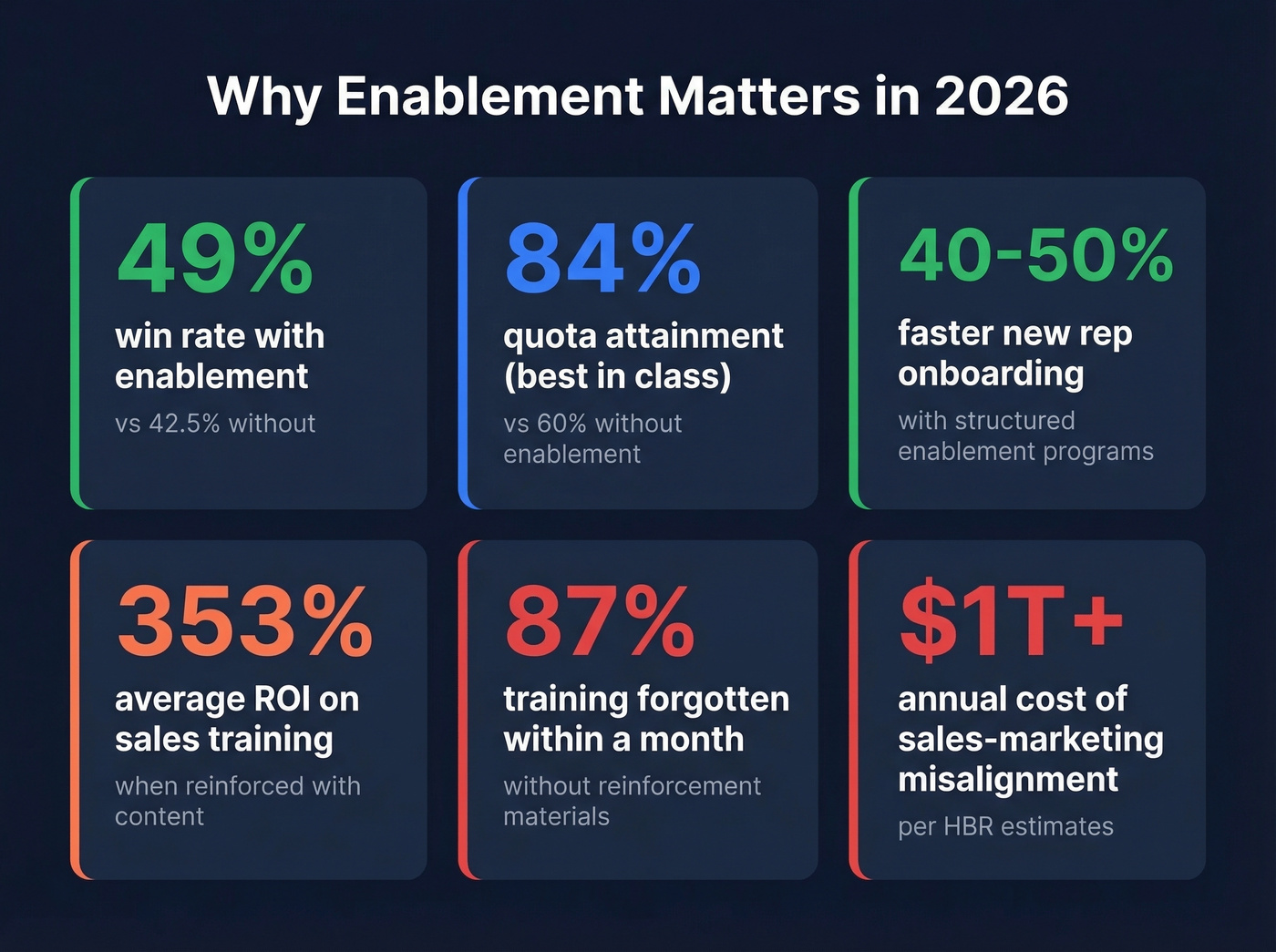
6sense data shows the average B2B sales cycle dropped from 11.3 months to 10.1 months, and the point of first contact moved from 69% of the journey to 61%. Buyers are engaging sellers roughly six to seven weeks sooner than a year ago. But they're also defining purchase requirements 83% of the time before they ever talk to a rep.
That creates a paradox Gartner nailed perfectly: 75% of B2B buyers prefer a rep-free experience, yet buyers are 1.8x more likely to complete a high-quality deal when they use supplier-provided digital tools in partnership with a sales rep. Buyers don't want to be sold to. They want to be equipped - and then guided.
The numbers back it up. Enablement programs deliver a 49% win rate vs. 42.5% without - a 6.5-point lift that compounds across every deal in your pipeline. Best-in-class enablement drives 84% quota attainment vs. 60% without it and cuts new rep onboarding time by 40-50%. Sales training alone returns 353% average ROI when reinforced properly, but training retention drops 70% within one week and 87% within a month without reinforcement.
Now the painful side. HBR estimates that sales and marketing misalignment costs companies over $1 trillion per year. Forrester found that 86% of B2B purchases stall and 81% of buyers are dissatisfied with their chosen provider - often because the content they received during the buying process failed them. Underused marketing content alone costs enterprises roughly $2.3M annually in missed opportunities. Only 25% of organizations track enablement impact at all.
The enablement platform market is projected to hit $8.79B by 2029. That's a lot of money chasing a problem that starts with content, not software.
12 Types of Enablement Assets (With Examples)
Here's the thing: 10% of your content will drive 50% of prospect engagement. The goal isn't to create all twelve types below. It's to figure out which three or four your reps actually need and make those exceptional.
Internal Assets for Your Sales Team
Battlecards are your competitive backbone - one-page summaries with positioning, objection responses, and win/loss patterns. Update these quarterly at minimum. Stale competitive intel is worse than no competitive intel because reps trust it and get blindsided.
Playbooks and scripts serve different purposes but work together. Playbooks are step-by-step guides for specific deal scenarios like enterprise upsell, competitive displacement, or new market entry - keep them under five pages or nobody reads them. Scripts aren't word-for-word monologues; they're conversation frameworks with discovery call questions, demo flow outlines, and objection-handling responses. Reps customize. The framework keeps them on message.
Buyer personas answer a question most reps can't: who are we actually selling to? These are detailed profiles covering priorities, pain points, evaluation criteria, and common objections. They should live inside your CRM - Salesforce, HubSpot, whatever you use - not in a forgotten PDF on someone's desktop.
Training modules cover onboarding content, product update briefings, and methodology refreshers. The best teams pair these with coaching, because without reinforcement, everything you taught evaporates within a month.
Win/loss analyses capture why you won or lost, what content influenced the deal, and what the buyer's actual decision process looked like. Most teams skip these. That's a mistake - they're the single best source of insight for improving every other asset on this list.
External Assets for Your Buyers
Case studies are your most powerful external asset. Build one for each major persona and industry vertical. Include specific numbers - "reduced churn by 23%" beats "improved retention" every time.
65.3% of salespeople say product demos are the most effective enablement asset. Invest in both live demo environments and recorded walkthroughs for async buyers. If you only improve one external asset this quarter, make it your demo.
One-pagers get forwarded internally by your champion to stakeholders who'll never sit through a demo. Build them for specific use cases or personas, and make them scannable in under 60 seconds.
Email templates cover outreach, follow-up, re-engagement, and deal acceleration sequences. Before you send a single one, verify your list - a beautifully crafted sequence bouncing at 5%+ destroys your domain reputation and wastes every hour you spent on copy.
Whitepapers and guides position your company as a thought leader, best used in awareness and early consideration stages. Don't gate everything - ungated content builds more trust.
ROI calculators let prospects model their own business case. These are underused and incredibly effective at the decision stage, especially for deals with multiple stakeholders who each need to justify the spend internally.
If you're starting from zero, prioritize battlecards, case studies, and email templates. Everything else is a second-phase build.
Mapping Content to the Buyer Journey
64% of buyers say the winning vendor's content significantly impacted their buying decision. But that content has to arrive at the right moment. A case study in the awareness stage is premature. A whitepaper at the decision stage is too late.
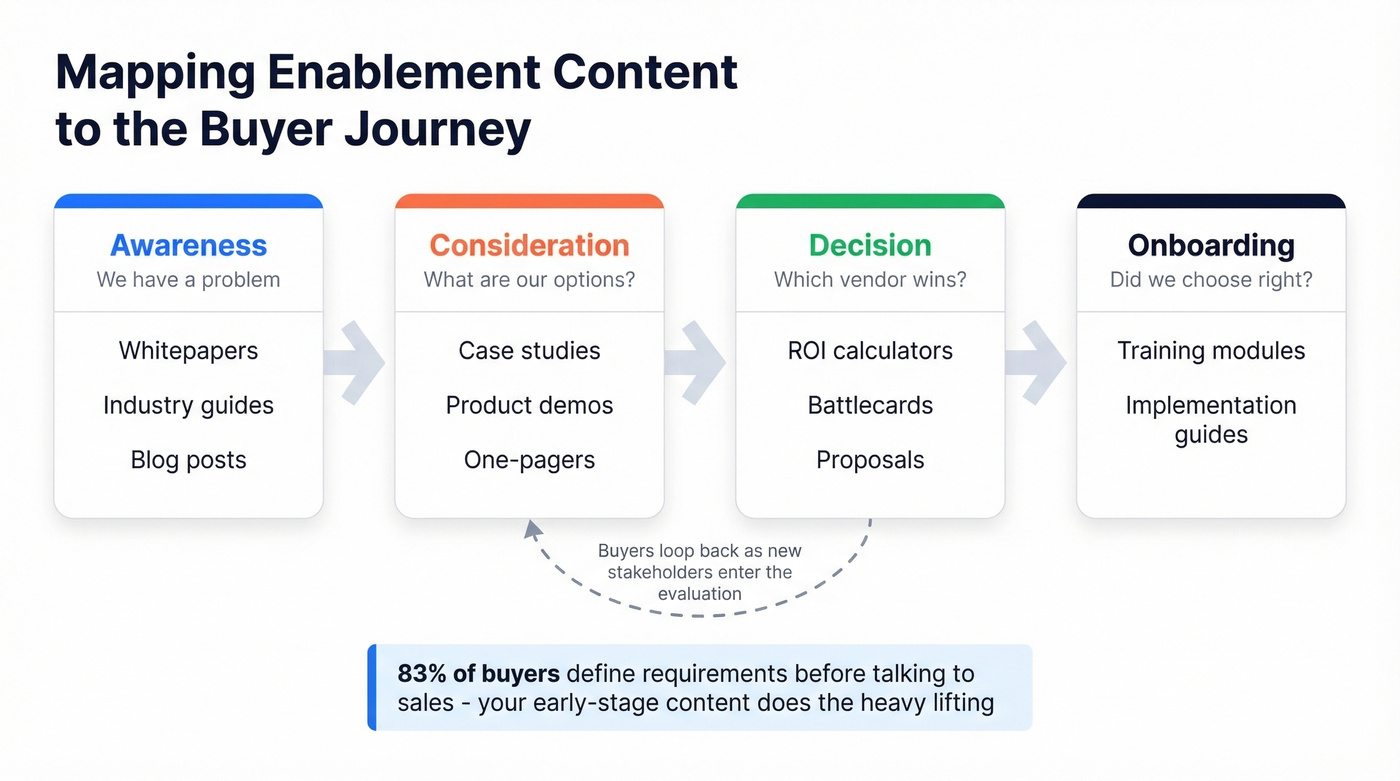
| Stage | Buyer's Mindset | Best Content Types |
|---|---|---|
| Awareness | "We have a problem" | Whitepapers, guides, blog posts |
| Consideration | "What are our options?" | Case studies, demos, one-pagers |
| Decision | "Which vendor wins?" | ROI calculators, battlecards, proposals |
| Onboarding | "Did we choose right?" | Training modules, implementation guides |
Buyers define requirements 83% of the time before talking to sales. Your awareness and consideration content is doing the heavy lifting before a rep ever gets involved. If those assets are weak, your reps inherit deals that are already half-lost.
The journey isn't linear, either. Gartner's research shows buyers loop across six buying jobs, revisiting stages as new stakeholders enter the evaluation. Your content library needs to support re-entry at any point, not just a clean top-to-bottom funnel.
Use Cases Across the Deal Cycle
Understanding where enablement fits isn't just about funnel stages - it's about the specific deal moments where reps need help. We've seen the same four scenarios come up over and over: competitive displacement (battlecards + case studies), multi-threaded enterprise deals (persona-specific one-pagers + ROI calculators), re-engagement of stalled opportunities (email sequences + fresh case studies), and new rep onboarding (playbooks + training modules). Map your content library against these scenarios and you'll quickly spot the gaps that are actually costing you deals.

You just read it: a perfect email template bouncing at 5%+ destroys your domain and wastes every hour spent on copy. Prospeo's 98% email accuracy and 7-day data refresh mean your enablement sequences actually land. At $0.01/email, verifying your entire prospect list costs less than one bad bounce.
Stop building enablement content for dead inboxes.
How to Audit Your Content Library
Ask any enablement manager on r/sales what their biggest frustration is, and "reps won't use the content we create" comes up every time. Reps waste up to 43 hours per month searching for content. Meanwhile, 70% of marketing content never gets used by sales. The fix isn't more content - it's a ruthless audit.
Build this as a spreadsheet and fill it for every asset in your library:
| Field | What to Capture |
|---|---|
| Asset Name | Exact file name + location |
| Content Type | Battlecard, case study, etc. |
| Funnel Stage | Awareness / Consideration / Decision |
| Target Persona | Which buyer this serves |
| Last Updated | Date of last meaningful edit |
| Rep Usage Rate | How often reps access it |
| Buyer Engagement | Views, shares, time spent |
| Status | Keep / Update / Retire |
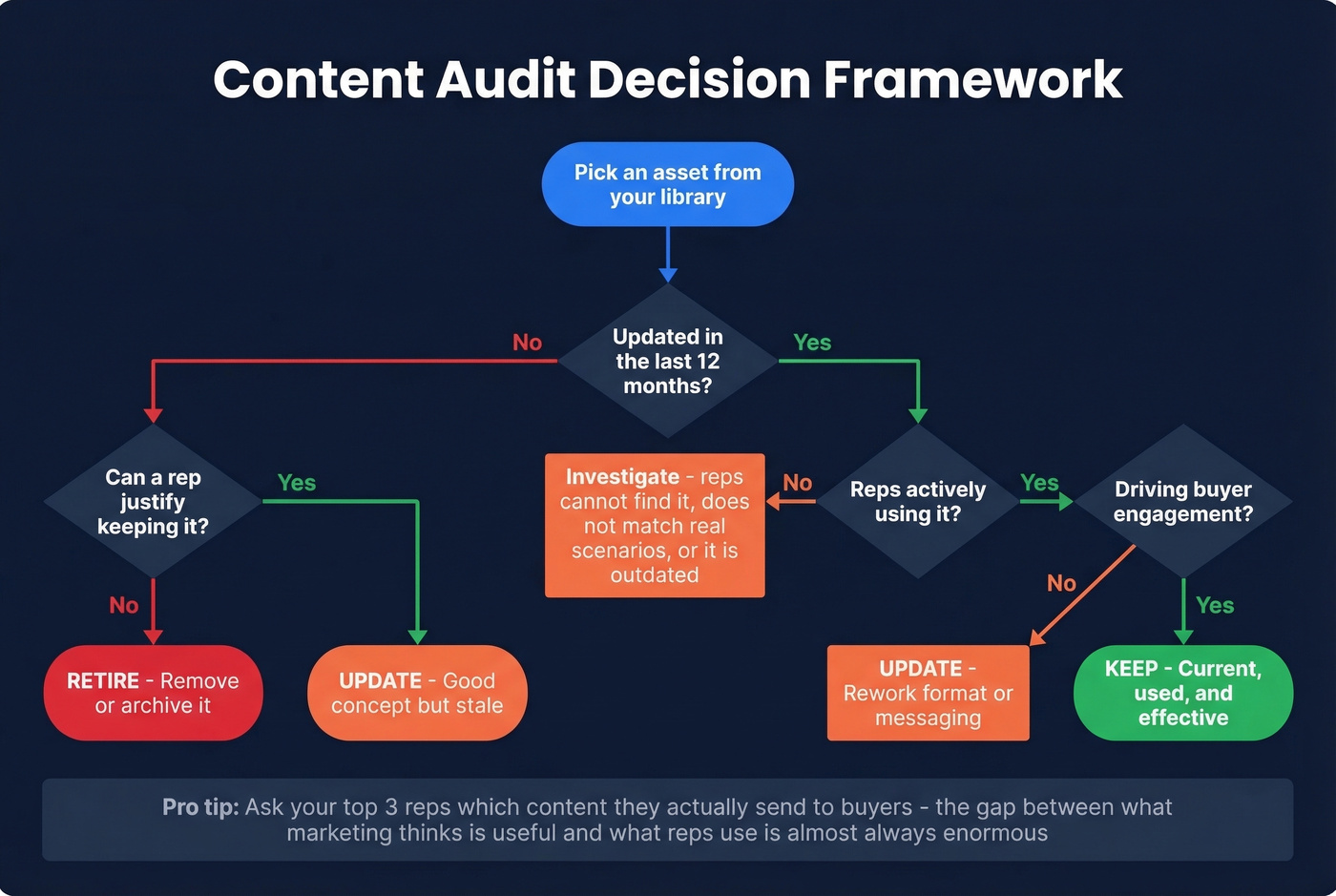
The most revealing column is "Rep Usage Rate." If reps aren't using an asset, either they can't find it, it doesn't match real deal scenarios, or it's outdated. Don't guess - ask your top three reps which content they actually send to buyers. The gap between what marketing thinks is useful and what reps actually use is almost always enormous.
Score each asset on a simple scale: Keep (current, used, effective), Update (good concept but stale or incomplete), Retire (outdated, redundant, or never used). A simple governance rule that works: if an asset hasn't been meaningfully updated in 12+ months, it goes into the Retire pile unless a rep can justify keeping it. Then track what reps are searching for but not finding - that's your content roadmap.
Five Mistakes That Kill Pipeline
1. No defined strategy. Creating content without clear goals, persona alignment, or sales input produces a library that looks impressive and performs terribly. Start with three questions: who's this for, what deal stage does it serve, and how will we measure it?
2. Content management chaos. Outdated decks circulating alongside current versions. No naming conventions. No access controls. Inconsistent brand voice across assets. We've audited libraries where three different versions of the same battlecard were floating around - each with conflicting pricing.
3. No measurement or feedback loop. Only 25% of organizations track enablement impact. If you don't know which assets influence pipeline and which collect dust, you're flying blind. Set up basic tracking before you create a single new asset.
4. Creating for volume, not for reps. 65% of content goes unused. That should embarrass every marketing team. The fix is simple: involve sales in content planning. Not a quarterly survey - actual co-creation where reps identify the moments where they need help and marketing builds for those moments.
5. Ignoring data quality. Your content can be perfect and still fail if it's reaching dead inboxes. A beautifully crafted email sequence bouncing at 5%+ destroys your domain reputation and wastes every hour you spent on content creation. Tools like Prospeo, with 98% email accuracy and a 7-day data refresh cycle, solve this at the infrastructure level - your content reaches real people at verified addresses, not abandoned mailboxes.
Building Enablement Assets for BDRs
BDRs face a unique challenge: they're the first human touchpoint in most deals, yet they're often the last to receive dedicated enablement assets.
Content for BDRs should prioritize three things - outreach templates tailored by persona, competitive one-liners for cold calls, and micro case studies short enough to paste into a message. Unlike AEs who need deep-dive materials for late-stage deals, BDRs need content that earns the first meeting. Build a "BDR starter kit" with five email templates, three call openers, and one case study per vertical, and you'll see booking rates climb before you invest in anything else.
Skip this if your team is all AEs running full-cycle deals - the BDR kit won't map to their workflow.
How to Measure Performance
Most teams measure enablement by whether reps downloaded an asset. That's like measuring a restaurant by how many people read the menu.
Internal adoption. Track rep usage rate, search behavior (what they're looking for vs. what they find), and content completion for training materials. The benchmark to watch: 10% of your content drives 50% of engagement. If that ratio is even more skewed, you have a curation problem.
Buyer engagement. Views, time spent, shares, and return visits. The share metric is underrated - when a buyer forwards your case study to their CFO, that's a buying signal. 65% of marketers struggle to understand which content is effective, usually because they aren't tracking these signals at all.
Revenue impact. Influenced pipeline, win rate correlation by content consumed, deal velocity for content-engaged vs. non-engaged deals, and content-attributed revenue. Connect your enablement platform to your CRM and start tagging deals by which assets the buyer interacted with. It takes a quarter to build enough data, but the insights are worth it.
How AI Is Changing Enablement in 2026
The shift happening right now is from push-based content libraries to pull-based intelligence. Instead of reps searching a repository for the right battlecard, AI surfaces the right talking point in real time based on deal context, competitor mentioned, or objection raised.
Leading teams use AI to tailor case studies and one-pagers to the buyer's industry, company size, and tech stack before the rep hits send. Competitive intel surfacing works the same way: AI monitors competitor moves and helps keep battlecards current. The most advanced teams combine this with intent-signal-driven recommendations, where a target account spiking on a relevant topic triggers specific content suggestions most likely to convert that signal into a meeting.
On the coaching side, platforms analyze rep conversations from call recordings and recommend specific assets based on where deals stall. The KPI evolution matters too - we're moving from "did reps open the playbook" to measuring execution consistency, decision speed, and forecast confidence. The prerequisite for all of it is data quality. AI recommendations are only as good as the contact and intent data feeding them.
Enablement Tools and What They Cost
Most enablement platforms still won't publish pricing on their website. Here's what these tools actually cost based on typical contract ranges:
| Tool | Annual Cost | Implementation | Timeline | G2 Score |
|---|---|---|---|---|
| Seismic/Highspot | $70K-$180K+ | $15K-$50K+ | 3-4 months | 4.7/5 |
| Showpad | $42K-$108K+ | ~$2K+ | 2-4 months | 4.6/5 |
| Dock | $4.2K-$70K+ | None | Days/weeks | 4.8/5 |
Seismic/Highspot suits enterprise teams with 200+ reps. Showpad fits mid-market teams of 50-200 reps. Dock is the right call for SMBs and startups under 50 reps. Mid-market alternatives like Allego and WorkRamp sit between Dock and the enterprise tier if you need more training features without six-figure pricing - expect $20K-$60K/year depending on team size.
Two major mergers reshaped this market: Seismic and Highspot merged in February 2026, and Showpad completed its Bigtincan acquisition in October 2025. The consolidation is pushing enterprise pricing higher while lighter tools like Dock capture teams that don't need a six-figure platform.
Let's be honest: enterprise enablement platforms are overpriced for most teams under 100 reps. You're paying for content management, analytics, and training features - but the content itself still has to be good, and the data behind your outreach still has to be accurate. For teams whose average deal size is under $15K, a $100K+ enablement platform is usually the wrong first spend. Invest in three great assets, a lightweight tool like Dock, and verified prospect data. That combination will outperform a bloated platform with mediocre content every time.

Great battlecards and case studies mean nothing if reps can't reach the right buyers. Prospeo gives your team 300M+ verified profiles with 30+ filters - buyer intent, job changes, technographics - so every piece of enablement content reaches the exact persona it was built for.
Arm your reps with the right content and the right contacts.
FAQ
What's sales enablement content vs. marketing content?
Marketing content attracts and nurtures leads at scale through blogs, social media, and ads. Sales enablement content arms individual reps to close specific deals - including internal assets like battlecards and playbooks that buyers never see. The audiences, distribution channels, and success metrics are fundamentally different.
How do you measure enablement content effectiveness?
Track three buckets: internal adoption (rep usage rates, search behavior), buyer engagement (views, time spent, shares), and revenue impact (influenced pipeline, win rate lift, deal velocity). Only 25% of organizations measure enablement impact well, so basic tracking already puts you ahead of most competitors.
What enablement assets should I create first?
Start with a battlecard for your top competitor, a case study for your most common buyer persona, and an email template sequence. These three assets cover the highest-impact moments in a typical deal cycle. Verify your contact data before sending any outreach - bouncing emails tank your domain reputation faster than bad copy.
How often should you update enablement assets?
Battlecards need quarterly updates at minimum - competitive landscapes shift fast. Case studies and playbooks should be refreshed every six months. Run a full library audit twice a year using a keep/update/retire framework to catch stale assets before reps send outdated material.
Does data quality affect enablement content performance?
The best email template in the world is worthless if it bounces. Bad data tanks your domain reputation and wastes every hour spent on content creation. Verify your contact data before every outreach campaign; 98% accuracy should be your minimum threshold, not an aspiration.