

Sales Enablement vs Sales Operations: What's Actually Different (and Which to Hire First)
Your CRO just told you to "figure out whether we need a sales ops hire or an enablement hire." You've got budget for one headcount, maybe two if you can make the case. The sales enablement vs sales operations question trips up even experienced leaders because every job description blurs the lines - and half your leadership team uses the terms interchangeably.
They're not the same thing. 84% of organizations now invest in a dedicated enablement function, and more than eight in ten sales professionals say ops plays a critical role in growing the business. Both functions matter. But they do fundamentally different work, they hire different skill sets, and if you build them in the wrong order, you'll waste a year.
The Short Answer
Sales ops builds the machine - CRM architecture, forecasting models, territory design, comp plans, pipeline analytics. Sales enablement teaches reps how to use it - onboarding, training, coaching, content, certifications.
Hire ops first. Break out enablement as you scale once you have enough change, hiring velocity, and ramp-time pain to justify dedicated training infrastructure. If you can only afford one, ops pays for itself faster because it directly fixes the systems, process, and data gaps that slow everything down. Sales ops teams now spend 68% of their time on non-sales functions - a signal of how much the role has expanded beyond "just supporting reps."
Both functions fail without clean data underneath them. That's the part nobody talks about until sequences start bouncing.
What Is Sales Enablement?
As one practitioner put it on r/SalesOperations, enablement is essentially the project manager for sales leadership. Your VP of Sales knows what reps need to learn, what messaging should land, and which skills separate top performers from the middle of the pack. They don't have time to build all of that into repeatable programs. That's enablement's job.
The function has evolved from narrowly scoped "sales enablement" into broader "revenue enablement" at many orgs, supporting not just sales but also marketing, CS, and account management across the full GTM motion. It's not a quota-carrying role - it exists to help revenue teams hit their targets.
High-performing enablement teams cut ramp time by 40-50%. That alone justifies the headcount at scale. Beyond onboarding, core responsibilities include training and coaching programs tied to specific skill gaps, sales content management (battlecards, case studies, competitive decks), certification programs for product knowledge and methodology, and competitive intelligence packaging for frontline use.
Here's the thing: enablement practitioners need competency in learning and development principles, not just sales experience. The best enablement leaders we've worked with came from L&D or instructional design backgrounds, not from carrying a bag.
What Is Sales Operations?
If enablement is the "people" side, ops is the "process and systems" side. Sales ops owns the infrastructure that makes selling predictable and measurable. Core responsibilities include CRM governance (data hygiene, workflow automation, field standardization), forecasting and pipeline analytics, compensation planning and quota setting, territory design and account assignment, process optimization, and sales analytics for leadership.
Strong sales ops strategies correlate with 25-30% faster deal cycles and 20-40% productivity improvements. That's not marginal - it's the difference between a team that scales and one that stalls.
The role has grown far beyond "Salesforce admin who also builds reports." Ops is increasingly responsible for cross-functional data governance, tech stack management, and sales process optimization that extends well beyond the sales floor.
Key Differences
The simplest way to think about it: enablement makes reps better; ops makes the system better. They're complementary, not competing.

| Dimension | Sales Enablement | Sales Operations |
|---|---|---|
| Focus | Rep readiness | System efficiency |
| Goal | Better sellers | Better process |
| KPIs | Ramp time, win rate, content use | Close rate, CAC, forecast accuracy |
| Tools owned | LMS, content platform, coaching | CRM, CPQ, analytics, BI |
| Reports to | CRO, CMO, HR, or CEO | CRO, CFO, or RevOps leader |
| Day-to-day | Training, coaching, content | Data, process, reporting |
| Success looks like | Reps hit quota faster | Pipeline is predictable |
| Hire when | Hiring velocity + ramp time becomes a bottleneck (~10+ reps) | VP + 3 reps (early) |
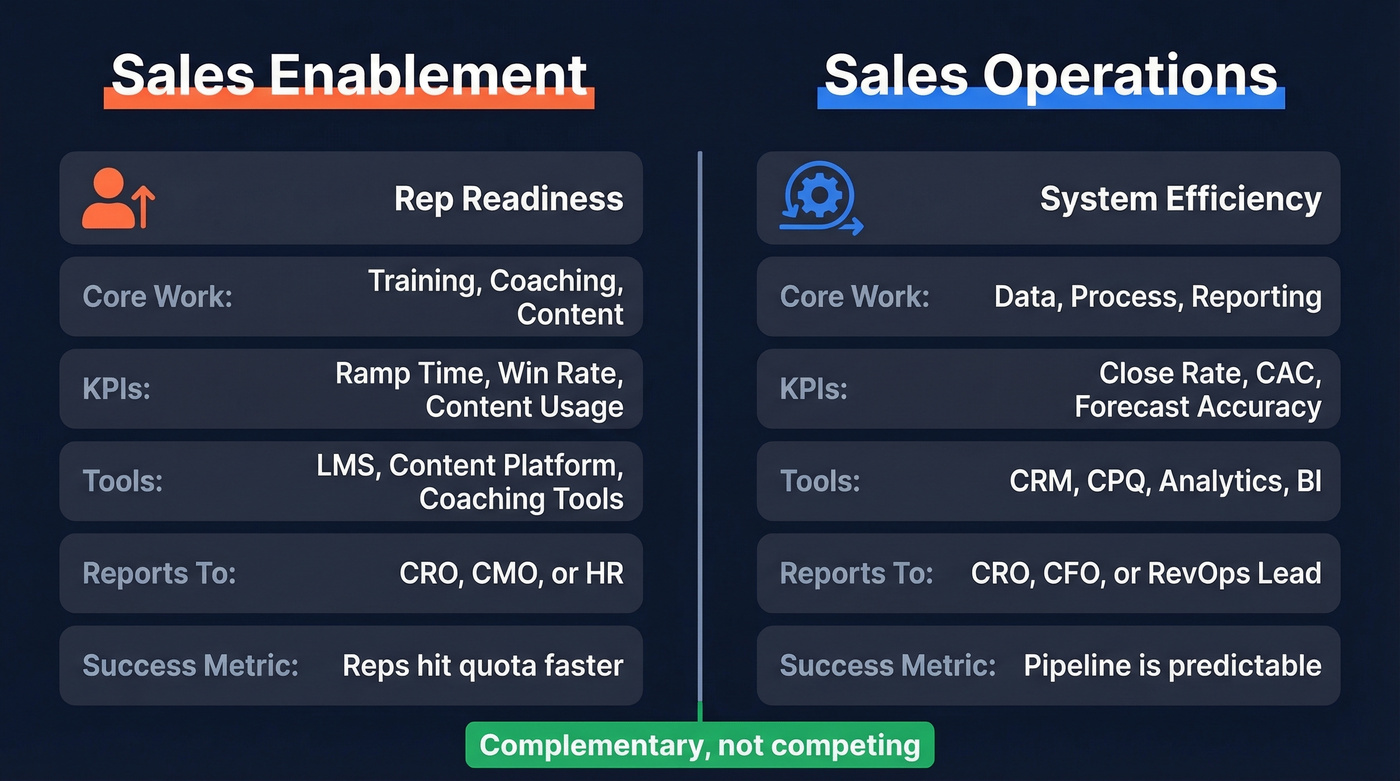
The KPI split is where the distinction gets sharpest. Enablement tracks time to productivity, selling time percentage, content usage rates, and sales confidence scores. Ops tracks close rates, customer acquisition cost, sales cycle length, SQL volume, and forecast accuracy. Different dashboards, different meetings, different definitions of "winning."

Sales ops wastes cycles on CRM cleanup. Enablement troubleshoots bounced sequences. Both problems trace back to bad data. Prospeo refreshes 300M+ profiles every 7 days with 98% email accuracy - so ops stays focused on forecasting and enablement stays focused on coaching.
Stop letting decayed data sabotage both functions at once.
How They Work Together
These functions aren't siloed. Three scenarios show how they're interdependent.
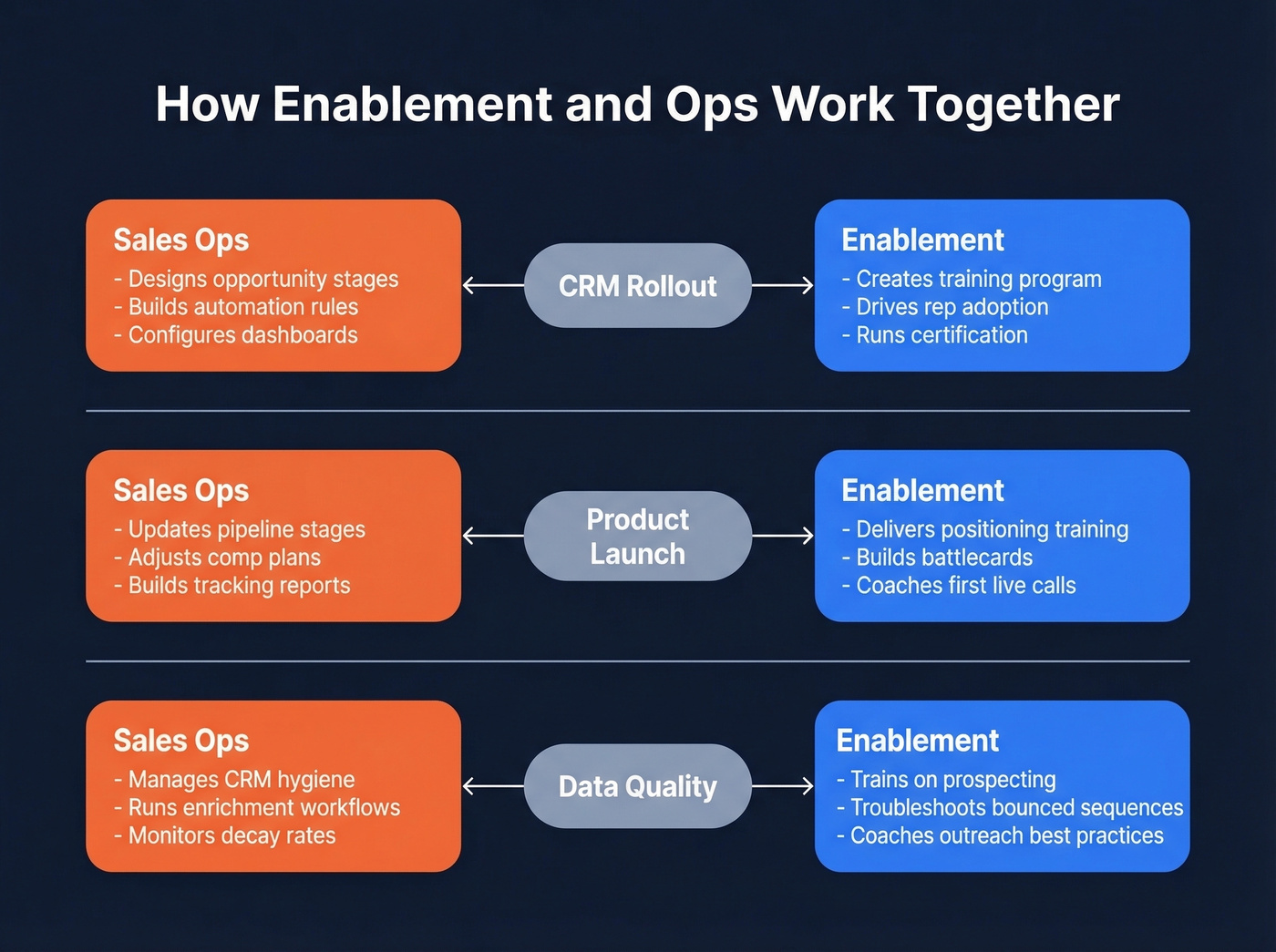
CRM rollout. Ops designs the new opportunity stages, builds the automation rules, configures the dashboards. Enablement creates the training program that gets reps actually using it correctly. Without ops, there's nothing to train on. Without enablement, the new CRM collects dust.
New product launch. Ops updates pipeline stages, adjusts comp plans to incentivize the new SKU, and builds the reporting to track adoption. Enablement delivers positioning training, builds battlecards, runs certification programs, and coaches reps through the first live calls. Organizations with a dedicated enablement strategy achieve a 49% higher win rate on forecasted deals - and product launches are where that advantage compounds fastest.
Data quality. This is where both functions break simultaneously. Ops manages CRM hygiene and enrichment workflows. Enablement trains reps on outreach sequences and prospecting best practices. When contact data decays - and it always does - ops wastes cycles on manual cleanup and enablement troubleshoots bounced sequences instead of coaching. A platform like Prospeo refreshes records every 7 days with 98% email accuracy, so ops isn't running monthly cleanup sprints and enablement isn't diagnosing why half the sequence bounced.
How to Structure Each Team
Sales Ops Structure
Three models dominate. Centralized puts one ops hub in charge of process, tech, and data governance across the entire org - clean, consistent, but can bottleneck as you scale. Federated embeds ops specialists by region or segment for speed and local relevance, but risks silos and conflicting processes. Hybrid combines central governance with embedded specialists and tends to become the right call once you pass ~200 reps.
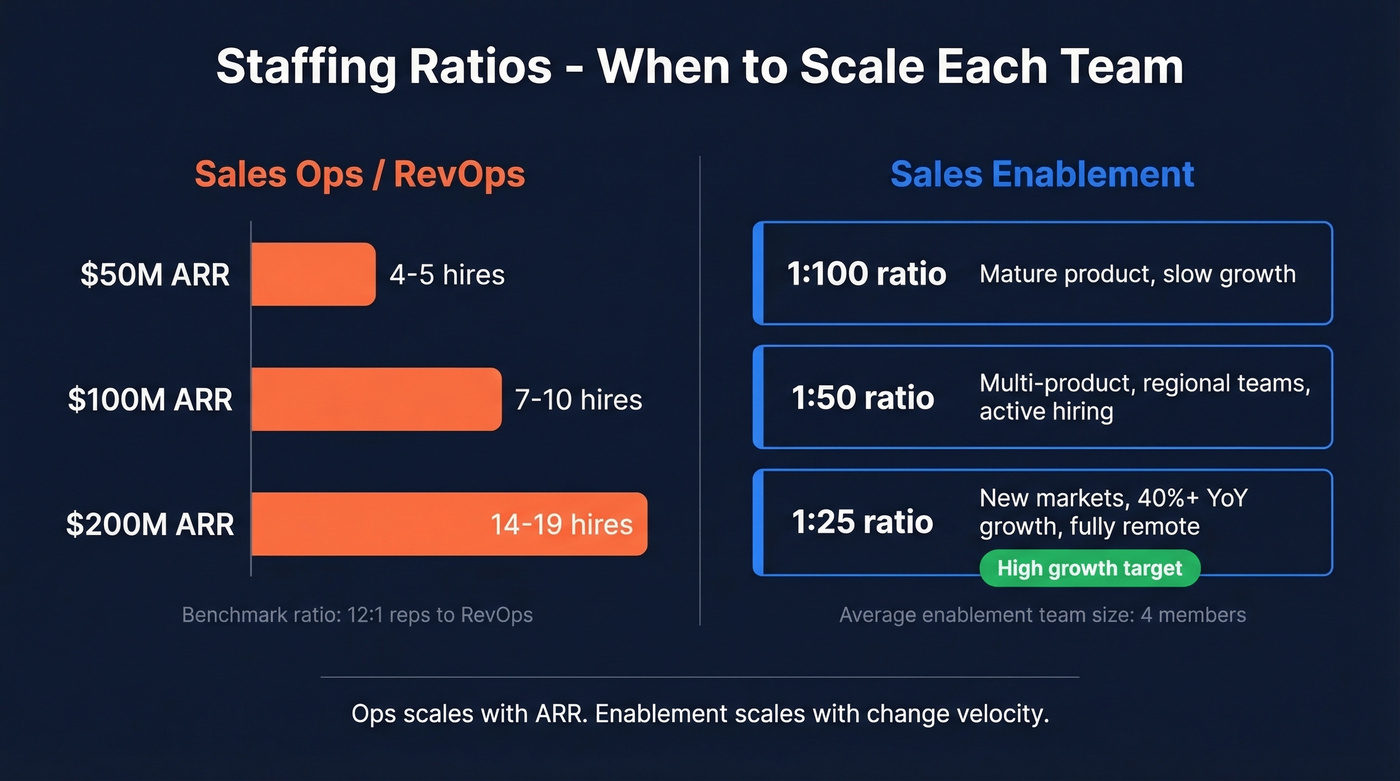
For most companies under 200 reps, centralized works. The PeerSignal benchmark puts the ratio at 12:1 sales reps to RevOps personnel. In practice, ARR-based headcount looks roughly like this: $50M ARR supports 4-5 ops/RevOps hires, $100M supports 7-10, and $200M supports 14-19.
Enablement Structure
Enablement mirrors the same three models - centralized, hub-and-spoke, and decentralized - but the scaling triggers are different. Structure selection depends on sale complexity, number of motions (SMB/mid-market/enterprise/partner), geographic spread, and the maturity of adjacent functions like RevOps and product marketing.
Staffing ratios vary more than ops because enablement workload is driven by change velocity, not just headcount. A 1:100 ratio works for mature products with slow growth. 1:50 fits multi-product orgs, regional teams, or active hiring phases. 1:25 is the right target for new markets, new products, fully remote teams, or orgs growing 40%+ YoY.
Where enablement reports matters more than most people realize. Under the CRO, enablement skews toward revenue metrics and quota attainment. Under the CMO, it drifts toward content and messaging. Under HR, it becomes an L&D function. The average enablement team runs about 4 members, so reporting line has outsized influence on a small team's priorities.
Which Should You Hire First?
Ops. Almost always ops.
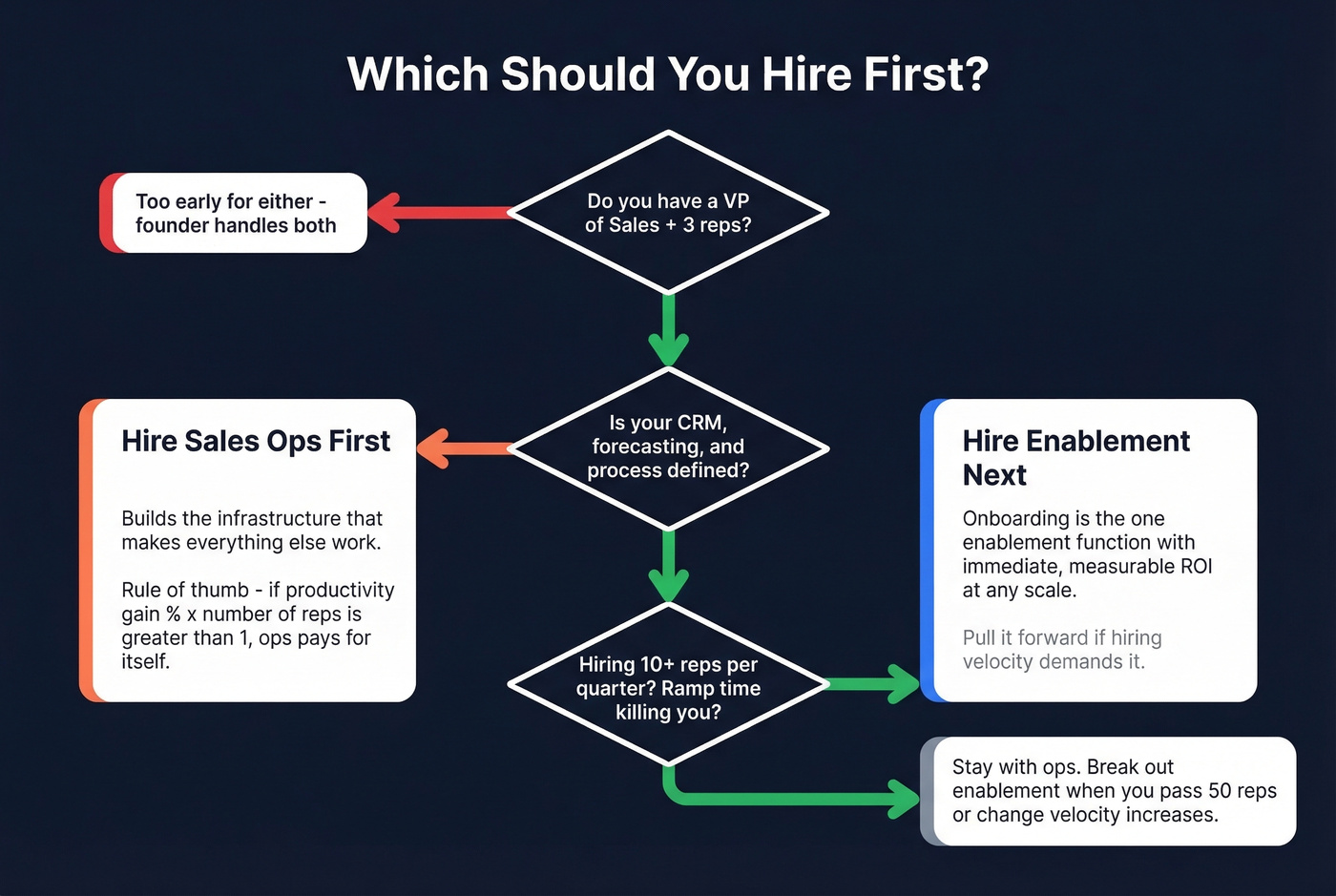
Winning by Design's guidance is to hire a sales operations professional as soon as you have a VP and 3 reps. Their rule of thumb: if productivity gain (%) x number of quota-carrying reps > 1, you can justify the ops headcount over hiring another rep. At 4 reps, even a 30% productivity improvement clears that bar.
Enablement often becomes the first specialization to break out from ops as you scale. Under 50 reps, one ops hire plus one enablement hire covers most needs. If you can only budget for one, hire ops - it creates the infrastructure that makes enablement effective later. You can't train reps on a process that doesn't exist yet.
The exception: if you're hiring 10+ reps per quarter and ramp time is killing you, pull enablement forward. Onboarding is the one enablement function that has immediate, measurable ROI at any scale.
The RevOps Factor
Let's be honest: RevOps isn't replacing sales ops - it's absorbing it. And if your org is debating "RevOps vs enablement," you're asking the wrong question entirely.
Gartner predicted 75% of the highest-growth companies would adopt a RevOps model by 2026, and the shift is well underway. Sales ops time spent on non-sales functions has climbed from 39% in 2019 to 68% today, which tells you how much the role has expanded beyond its original scope.
RevOps unifies data governance, tech stack integration, and cross-functional process mapping across marketing, sales, and CS. Revenue enablement, by contrast, aligns messaging, training, and buyer experience across those same teams. One aligns the plumbing; the other aligns the people using it.
The enablement platform market is projected to hit $8.79B by 2029. The industry isn't consolidating these functions - it's investing in both. RevOps handles the infrastructure; enablement handles the human layer. They're parallel investments, not competing ones.
Mistakes That Blur the Lines
Five patterns we see repeatedly that turn these functions into a confused mess.
No written charter for enablement. As Gong's VP of GTM Enablement put it, enablement differs from company to company - and it's enablement's responsibility to set expectations and align initiatives to business metrics. Without a charter, enablement becomes "whatever the loudest leader asks for this week."
Reactive instead of customer-journey-driven. Enablement teams that operate as a ticket queue - "can you build a deck for this?" - never build the strategic programs that actually move win rates. Skip this model entirely if you want enablement to have strategic impact.
Misallocating resources to the loudest leader. When one VP gets all the enablement attention, you create silos and an inconsistent buyer experience across segments.
Not tying enablement to business metrics. If enablement can't show its impact on ramp time, win rate, or deal velocity, it can't defend its budget. 91% of B2B companies missed quota expectations in 2023. The stakes are too high for unmeasured programs.
Treating data quality as "someone else's problem." This one drives us crazy. Ops blames enablement for reps entering bad data. Enablement blames ops for not maintaining clean records. Meanwhile, contact data decays at 2-3% per month and nobody owns the fix. Self-serve data platforms with real-time verification and auto-refreshed records eliminate the finger-pointing entirely - ops gets clean CRM data, enablement gets outreach sequences that actually land.
You're building ops infrastructure and enablement programs to scale your team. Neither works if reps prospect with stale contacts. Prospeo's CRM enrichment returns 50+ data points per contact at a 92% match rate - giving ops clean pipelines and enablement sequences that actually land.
Give your ops and enablement teams data worth building on.
FAQ
Is sales enablement just training?
No - training is one pillar. Enablement also owns onboarding, coaching, sales content, competitive intelligence, and certification programs. Reducing it to "training" is how you end up with docs reps never open and skills that never transfer to live calls.
Do I need both sales ops and enablement?
Under 10 reps, one person can cover both. Beyond that, the roles diverge fast - ops needs a systems thinker who lives in data, while enablement needs someone who can build and deliver training programs. Start with ops, add enablement when hiring velocity or ramp time becomes a bottleneck.
What tools should ops and enablement share?
Core shared tools typically include a CRM (Salesforce or HubSpot), a data enrichment platform for verified contacts, and a conversation intelligence tool like Gong. Everything else - LMS, CPQ, BI dashboards - can be function-specific.
When should I split enablement from ops?
Split when you're hiring 5+ reps per quarter and ramp time exceeds 90 days. At that point, the ops hire is buried in CRM work and can't build onboarding programs. Most orgs hit this inflection between 15 and 30 reps, depending on deal complexity and growth rate.