

What Gartner Actually Says About Sales Engagement Platforms in 2026
Most Gartner coverage of sales engagement platforms is locked behind paywalls or cherry-picked by vendors quoting a single sentence out of context. Let's cut through that.
Here's what actually matters if you're evaluating tools right now.
The Short Version
Gartner renamed the category. "Sales Engagement Applications" is now transitioning to Revenue Action Orchestration (RAO). The inaugural Magic Quadrant for RAO dropped on December 15, 2025 - 12 vendors evaluated, three named Leaders.
Gartner Peer Insights is the fastest free resource for directional data. The Magic Quadrant and Market Guide require a subscription (or vendor-sponsored access). G2 Crowd reviews can supplement Gartner's data with a larger volume of user feedback if you want a broader sample.
If you need a shortlist: Outreach for customization depth, Salesloft for mainstream reliability, Clari for pipeline-first orchestration. We'll break down why below.
What "Sales Engagement" Means on Gartner Now
Gartner's old category - Sales Engagement Applications - is giving way to Revenue Action Orchestration. The shift reflects a real convergence: engagement platforms absorbed revenue intelligence features, and revenue intelligence tools added sequencing. The old lines blurred enough that Gartner built a new box.
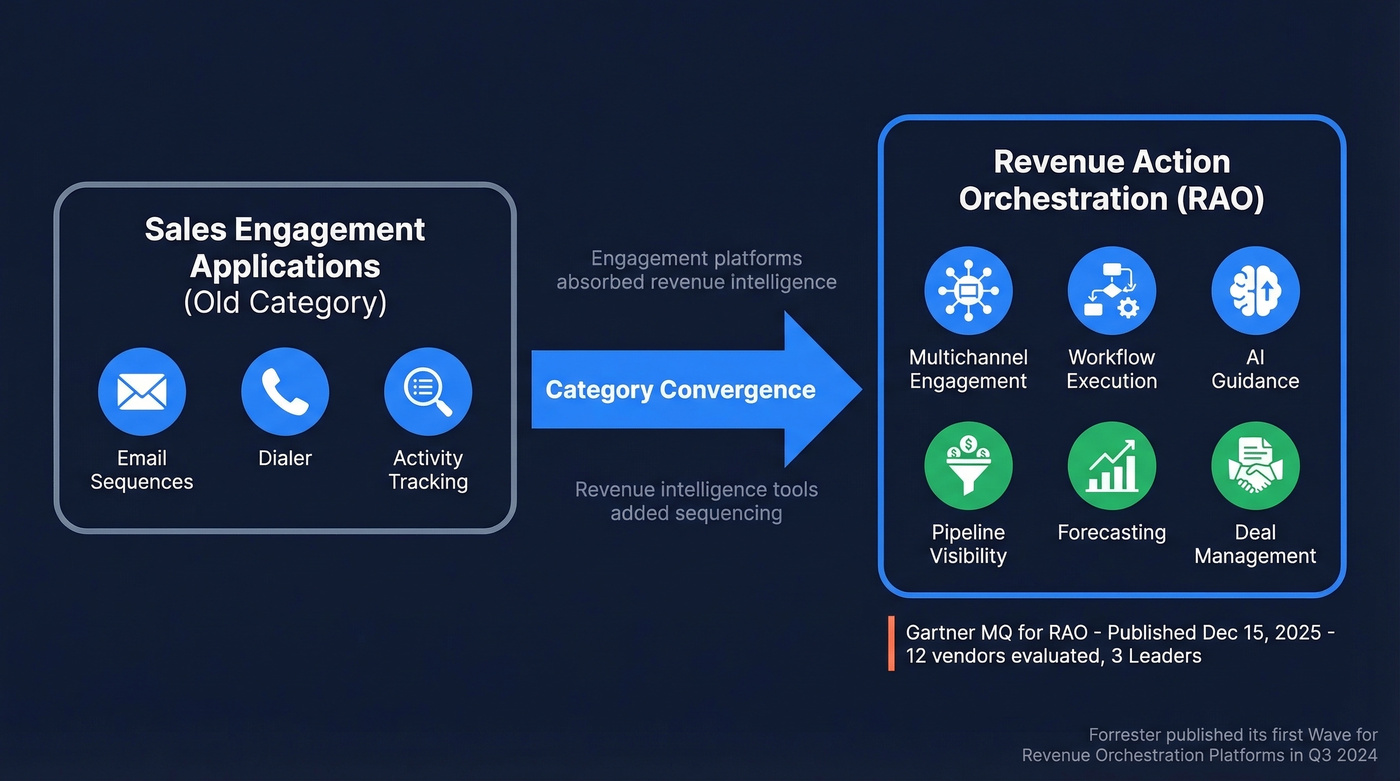
Forrester reached the same conclusion, publishing its first Wave for Revenue Orchestration Platforms in Q3 2024.
The core definition still holds. These applications streamline how sellers execute activities and deal workflows at scale across three pillars: multichannel engagement (email, voice, SMS, video, social), outbound workflow execution, and AI-driven automation and guidance. They tell reps who to engage, when, and with what messaging - while capturing activity data back into your CRM.
The "orchestration" framing matters because you're no longer buying a sequencer. You're buying a system that's supposed to guide the full cycle from first touch to closed deal. That changes what you should evaluate and what you should pay for.
Gartner Research Types Explained
| Resource | What It's For | Access | Key Detail |
|---|---|---|---|
| Peer Insights | Ratings + reviews | Free | 8+ vendors visible; roughly 29-310 ratings each among top-listed tools |
| Market Guide | Category definition | Gated | Defines vendor landscape |
| Magic Quadrant (RAO) | Vendor positioning | Gated | Published 15 Dec 2025, 12 vendors evaluated |
| Critical Capabilities | Use-case scoring | Gated | Scores vendors across: acquire new customers; retain and grow accounts; manage pipeline and forecast; coach sales talent |
One important distinction: the MQ for Revenue Enablement Platforms (published November 10, 2025) covers content management, training, and coaching - that's Highspot, Seismic, and Showpad territory. Adjacent to RAO, not the same thing. Don't confuse the two when your CFO asks what Gartner says.

Gartner evaluates platforms, not the data quality underneath them. Outreach, Salesloft, and Clari all perform better when fed verified contacts. Prospeo delivers 143M+ verified emails at 98% accuracy with a 7-day refresh cycle - and integrates natively with every major engagement platform on this list.
Stop blaming your sequencer. Fix the data feeding it.
How Gartner Rates These Platforms
Here's the current Peer Insights picture for the Sales Engagement / RAO category:
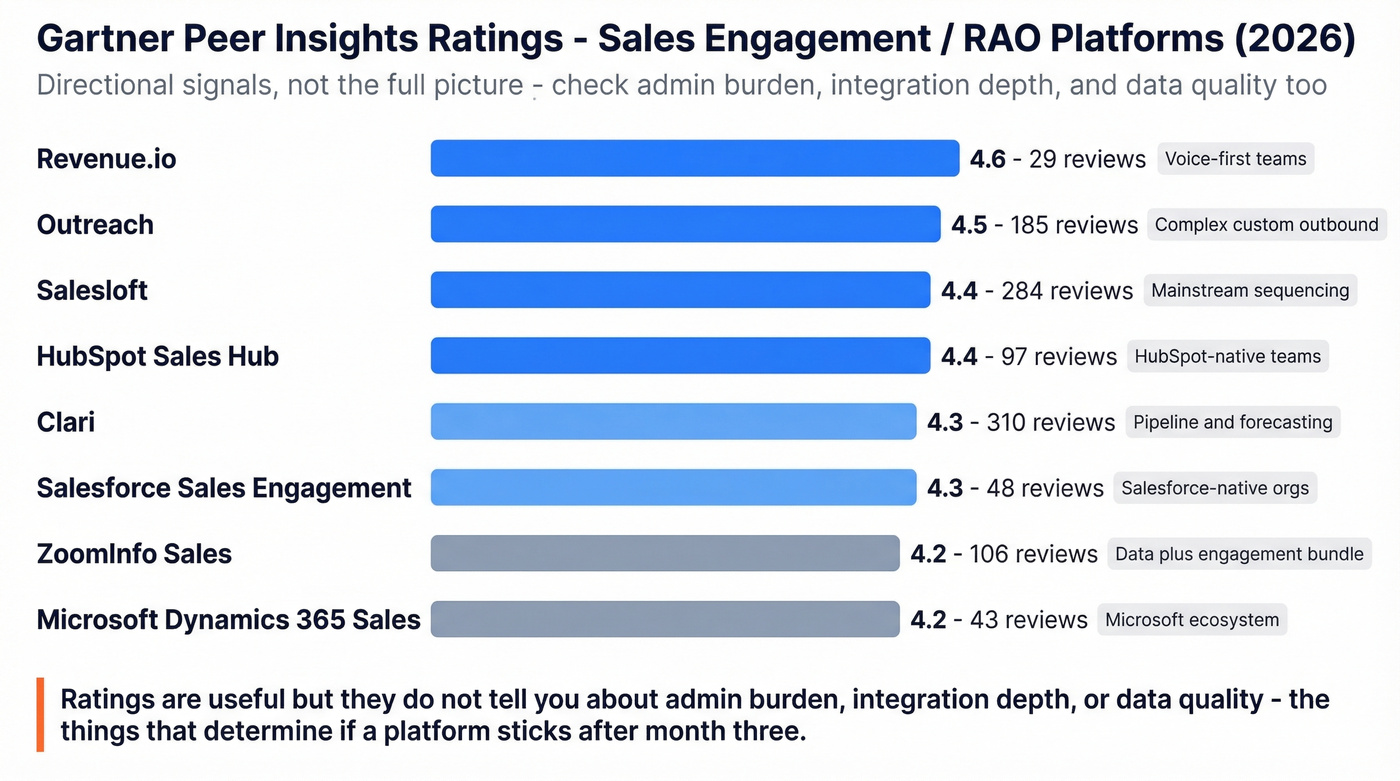
| Vendor | Rating | Reviews | Best For |
|---|---|---|---|
| Outreach | 4.5 | 185 | Custom complex outbound |
| Revenue.io | 4.6 | 29 | Voice-first outbound teams |
| Salesloft | 4.4 | 284 | Mainstream sequencing |
| HubSpot Sales Hub | 4.4 | 97 | HubSpot-native teams |
| Clari | 4.3 | 310 | Pipeline + forecasting first |
| Salesforce Sales Engagement | 4.3 | 48 | Salesforce-native orgs |
| ZoomInfo Sales | 4.2 | 106 | Data + engagement bundle |
| Microsoft Dynamics 365 Sales | 4.2 | 43 | Microsoft ecosystem |
Peer Insights ratings are useful directional signals, but they don't tell you about admin burden, integration depth, or data quality - the things that determine whether a platform sticks after month three.
The practitioner takeaways on r/sales track with this: Outreach wins on customizability, Salesloft is solid for sequencing and a step up from basic HubSpot sequences for serious outbound, and ZoomInfo is expensive but can be worth it if the data quality edge holds up for your ICP. Pick Outreach if you need granular control over complex motions and have a dedicated admin. Pick Salesloft if you want reliable sequencing without the ramp time. Pick Clari if your VP of Sales cares more about pipeline visibility than sequencing features.
Pricing and TCO Reality
None of these vendors publish straightforward pricing. That's the default buying experience, not an edge case.
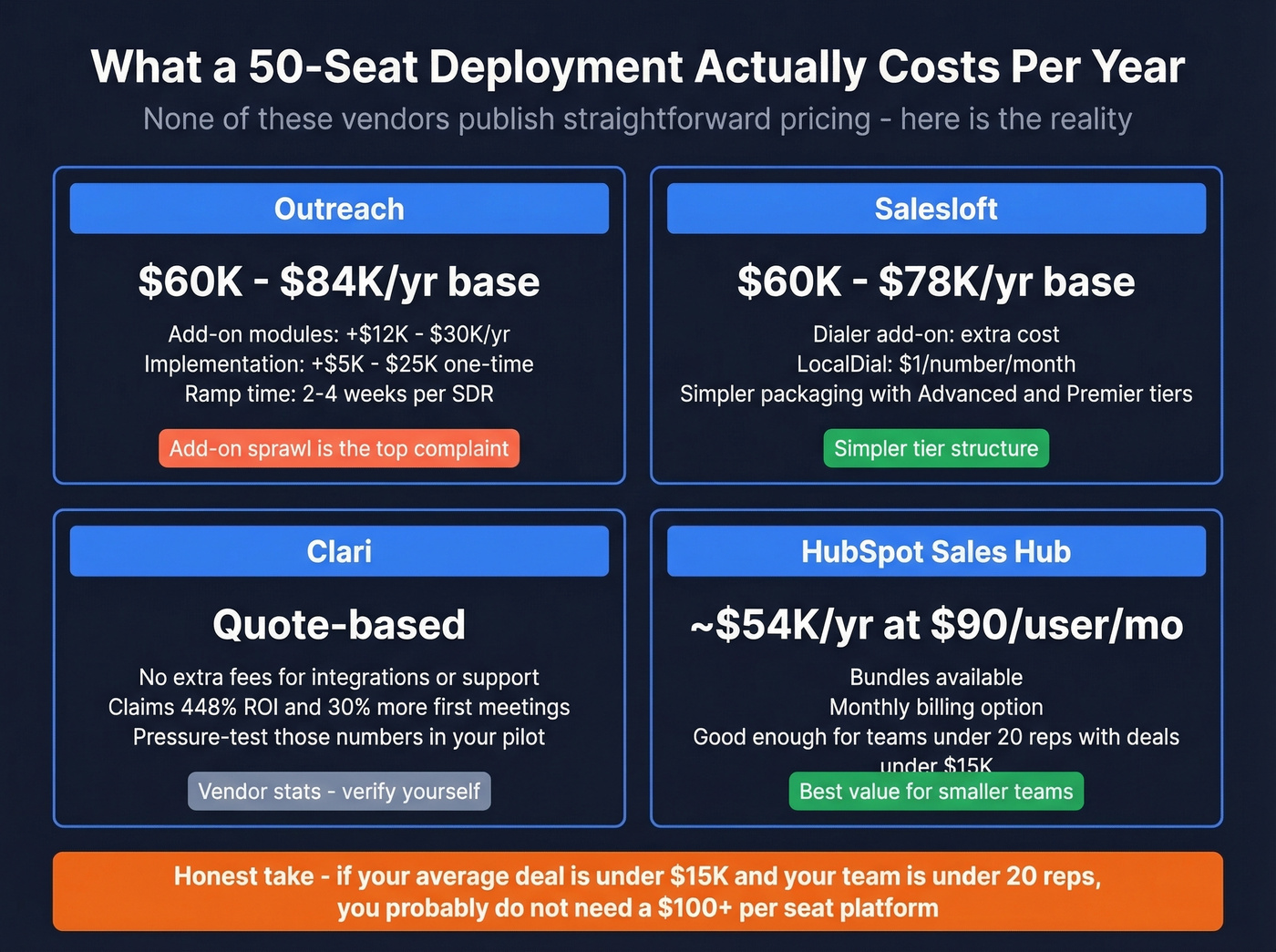
| Vendor | Base Cost | Add-Ons | Contract |
|---|---|---|---|
| Outreach | $100-140/user/mo | $20-50/user/mo per add-on module | Annual, prepaid |
| Salesloft | ~$100-130/user/mo (quote-based) | Dialer add-on, LocalDial $1/num/mo | Annual |
| Clari | Quote-based | No extra platform fees for integrations or support | Annual |
| ZoomInfo Sales | ~$15-40k/year | Modules priced separately | Annual |
| HubSpot Sales Hub | ~$90/user/mo (plan-dependent) | Bundles available | Monthly available |
| Salesforce Sales Engagement | ~$25-75/user/mo on top of Sales Cloud | Einstein add-ons extra | Annual |
| Microsoft Dynamics 365 Sales | ~$65/user/mo entry licensing | Copilot add-ons extra | Annual |
| Revenue.io | ~$50-100/user/mo (quote-based) | Coaching modules extra | Annual |
A 50-user Outreach Engage deployment runs roughly $60,000-$84,000/year before add-ons. Add-on sprawl is a common complaint - Meet/Kaia, Deal, Forecast, AI credits, and more stack up fast, plus implementation fees of $5,000-$25,000 on top. Expect a 2-4 week ramp for new SDRs, and if you're on HubSpot CRM, test the integration thoroughly before committing. Sync issues are a recurring complaint in community threads.
Salesloft keeps packaging simpler with Advanced and Premier tiers, but the dialer being an add-on catches people off guard. Clari claims 448% ROI and 30% more first meetings booked - vendor stats, but worth pressure-testing in your pilot.
Here's our honest take: if your average deal size is under $15k and your team is under 20 reps, you probably don't need a $100+/seat engagement platform. HubSpot sequences or even a tool like Instantly paired with clean data will get you 80% of the way there at a fraction of the cost. Skip the enterprise platforms until your outbound motion is complex enough to justify the overhead.
Fix the Data Before You Buy the Platform
Look, we've seen this pattern play out dozens of times. An SDR manager says sequences aren't working, leadership blames the platform, and they start evaluating replacements. But the real problem? 23% of the email list is bouncing and half the phone numbers are disconnected. No engagement platform fixes bad inputs.

Before you judge platform ROI, fix the data feeding it. Prospeo runs 143M+ verified emails and 125M+ verified mobiles at 98% accuracy with a 7-day refresh cycle - not the 6-week industry average. At roughly $0.01 per email with no contracts, it's the cheapest insurance policy against burning your domain reputation on stale data. It integrates natively with Outreach, Salesloft, Instantly, and HubSpot, so verified contacts flow straight into your sequences without manual CSV gymnastics.
One of our customers, Snyk, dropped their bounce rate from 35-40% to under 5% across 50 AEs - and saw AE-sourced pipeline jump 180%. That's the kind of lift that makes your engagement platform look like a genius purchase instead of a money pit.
A 50-seat Outreach deployment costs $60K+/year. Don't waste that budget on bounced emails and disconnected numbers. Prospeo gives you 98% email accuracy and 125M+ verified mobiles at ~$0.01/email - no contracts, no annual lock-in. It plugs directly into Outreach, Salesloft, HubSpot, and Instantly.
Protect your $60K platform investment with data that actually connects.
Where the Category Is Heading
The market sits at around $5-6B with mid-teens CAGR through 2030, per Gartner's broader CRM and sales technology forecasts. The bigger shift is from copilots to agents - AI that accomplishes parts of sellers' jobs, not just assists. Most vendors in this space are already rebranding around "autonomous" workflows.
This is also why RevOps teams are getting pulled deeper into tool selection: orchestration only works when your CRM, sequencing, and forecasting definitions are aligned.
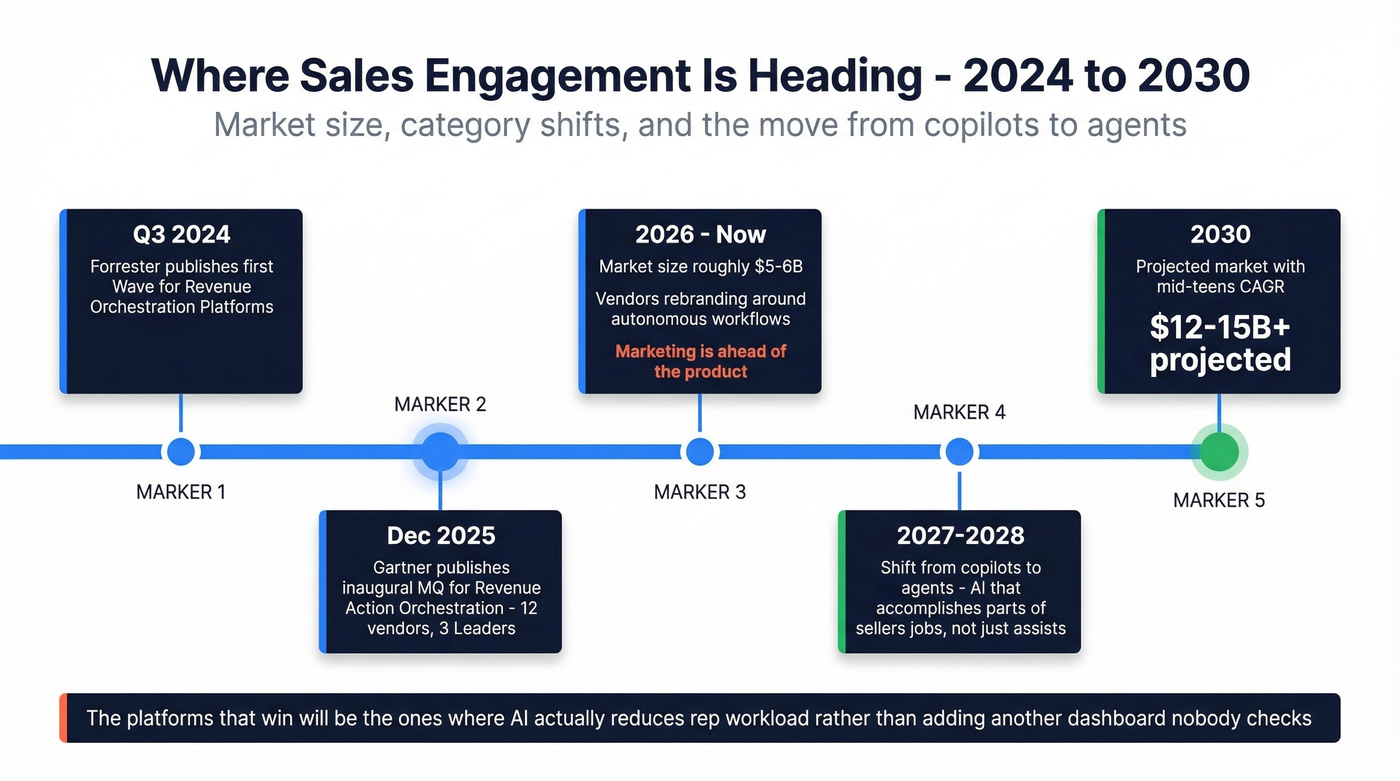
Let's be honest: the marketing is ahead of the product. The platforms that win will be the ones where AI actually reduces rep workload rather than adding another dashboard nobody checks. We're watching this closely, and so far the gap between demo and daily reality is still wide.
FAQ
Does Gartner have a Magic Quadrant for sales engagement?
Yes. Gartner published its inaugural Magic Quadrant for Revenue Action Orchestration (RAO) on December 15, 2025, evaluating 12 vendors with three named as Leaders. RAO is the successor category to Sales Engagement Applications, so this is the report to reference going forward.
What's the difference between sales engagement and revenue enablement on Gartner?
Sales engagement (now transitioning to RAO) covers multichannel outreach, workflow execution, and AI-driven seller guidance. Revenue enablement covers content management, training, and coaching. Gartner publishes separate Magic Quadrants for each - don't conflate them when building a business case.
Is Gartner Peer Insights free?
Yes. Ratings, review counts, and vendor comparisons are free on Peer Insights. The Magic Quadrant and Market Guide reports require a Gartner subscription or vendor-sponsored access. Start with Peer Insights for directional validation, then cross-reference G2 for a broader sample of user reviews.
How do I make sure my engagement platform actually works?
Start with data quality - verify emails and phone numbers before loading them into sequences. A platform running sequences against a list where a quarter of contacts are stale will tank your sender reputation faster than any feature can save it. Fix the inputs first, then optimize the workflows.