

Sales Funnel Models: Which Framework Fits Your Business?
Your CEO asks why pipeline is up but revenue is flat. Your SDR manager says outbound is "dead." Marketing measures MQLs while sales measures closed-won, and nobody agrees on what "qualified" means. The problem isn't your team - it's that you're either using the wrong sales funnel model or you don't have one at all.
Most funnel debates are about semantics, not strategy. Stop adding stages. Pick the model that matches how you get paid.
What You Need (Quick Version)
Three models cover 90% of B2B motions.
Lead → MQL → SQL → Opportunity → Closed Won is the RevOps operational standard, best for most B2B teams that need clear handoffs between marketing and sales. Bowtie is the default for any recurring-revenue business where expansion matters more than the initial close. AARRR (Pirate Metrics) was built for PLG / self-serve growth teams optimizing activation and retention.
If you can't define stage entry/exit criteria, you don't have a funnel - you have a list of vibes.
What the Term Actually Means
Most articles about sales funnel models conflate three different things.
A model is a named framework - AIDA, AARRR, Bowtie - that defines how you conceptualize the entire buyer journey from first touch to expansion. A stage is an individual step within a model: TOFU, MOFU, BOFU, MQL, SQL. And a funnel type is an implementation pattern - webinar funnel, squeeze page funnel, lead magnet funnel - that describes a specific tactical execution, not a strategic framework.
The distinction matters because picking the wrong framework warps every metric downstream. A SaaS company running AIDA is measuring the wrong things. An enterprise team using AARRR lacks the granularity they need for handoffs. The model you choose determines what you measure, who owns each stage, and where deals die.
Quick Picks by Business Motion
| Your Motion | ACV Range | Revenue Type | Recommended Model |
|---|---|---|---|
| PLG / self-serve | <$5k | Recurring | AARRR |
| Sales-led B2B | $5k-$50k | Recurring or one-time | Lead→MQL→SQL→Opp→Won |
| Enterprise ABM | >$50k | Recurring | ABM + Bowtie extension |
| Any SaaS | Any | Recurring | Bowtie as default layer |
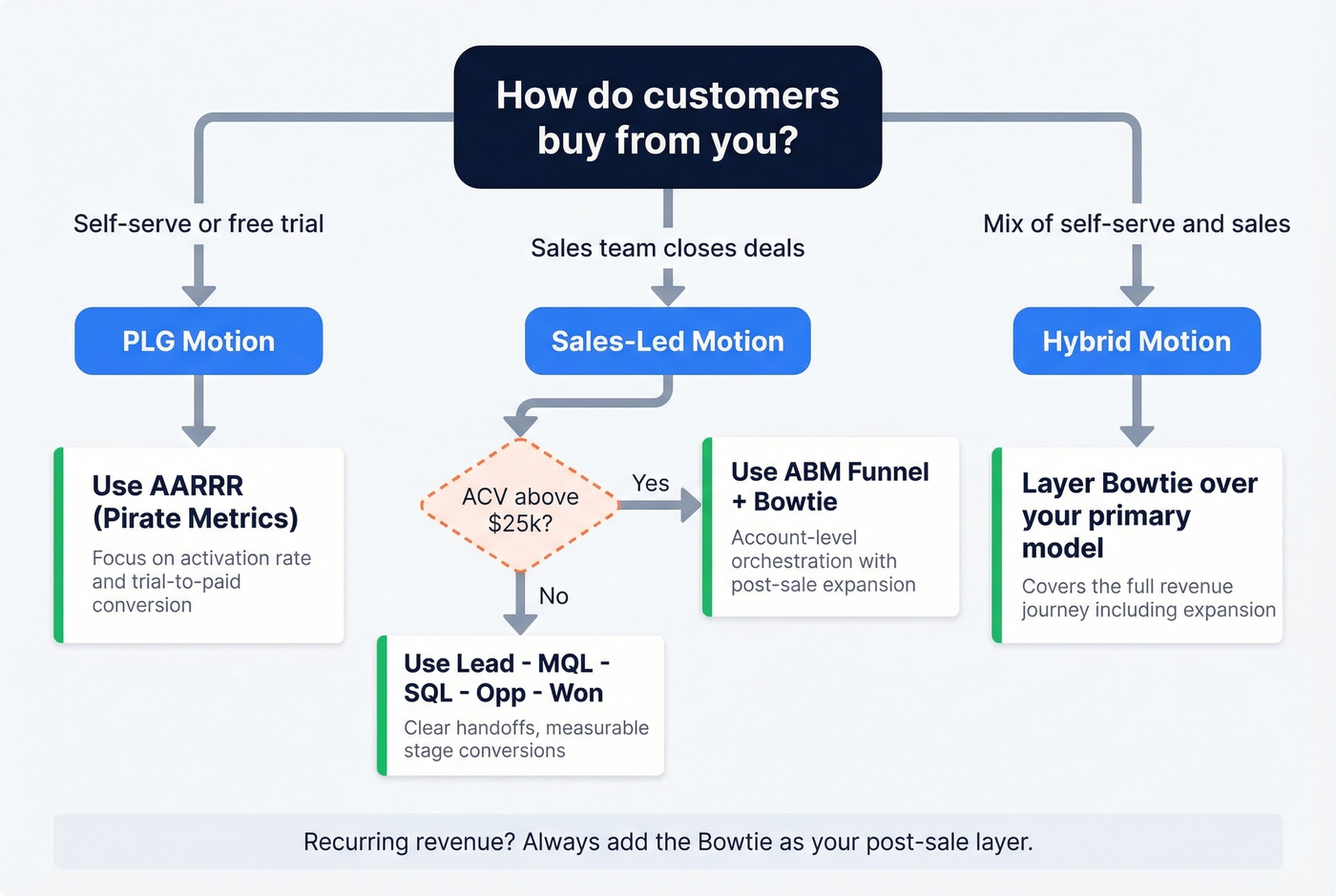
PLG teams need activation metrics. Sales-led teams need handoff accountability. Enterprise teams need account-level orchestration. And every recurring-revenue business needs to model what happens after the close.
Sales Funnel vs Marketing Funnel vs Pipeline
These terms get used interchangeably. They shouldn't.
| Dimension | Marketing Funnel | Sales Funnel | Pipeline |
|---|---|---|---|
| Owner | Marketing team | Sales team | RevOps / Sales |
| Primary KPIs | CPA, lead quality | Win rate, velocity | Weighted pipeline value |
| Ends at | Qualified handoff | Close (or expansion) | Revenue recognition |
The marketing funnel attracts, educates, and nurtures. The sales funnel qualifies and closes. The pipeline is the operational view inside your CRM - it's where deals live with dollar amounts and close dates. A healthy revenue org needs all three aligned, which is why RevOps teams increasingly own the full picture rather than letting marketing and sales run separate models with separate definitions of success.

Every funnel model breaks down at the same point: bad contact data. If your MQL→SQL conversion lags the 38% benchmark, the problem isn't your framework - it's that reps can't reach the leads marketing hands off. Prospeo's 98% email accuracy and 7-day data refresh mean your pipeline stages reflect real buyer engagement, not stale records bouncing at 35%.
Fix the data layer under your funnel before you redesign the funnel itself.
The 7 Core Frameworks Compared
AIDA (1898)
Use this if: You sell one-time purchases with a simple buyer journey - think e-commerce, event tickets, or transactional B2B services.
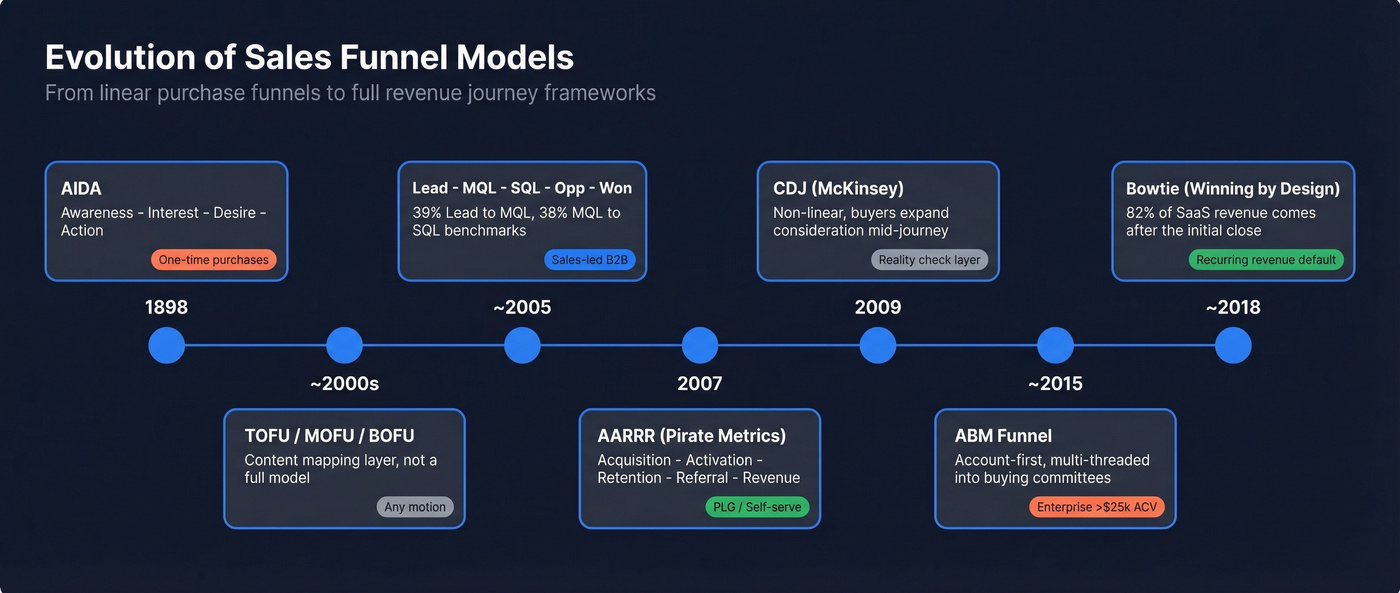
Skip this if: You sell recurring revenue. In a SaaS model, only 18% of total revenue is secured at the initial win. AIDA ends at "Action" and ignores the 82% that comes from renewals and expansion.
Elias St. Elmo Lewis created the AIDA framework in 1898 - Awareness, Interest, Desire, Action). These four stages form the grandfather of every funnel model, and they're still useful for simple purchase decisions. The limitation is obvious: it treats the sale as the finish line. For any business where customer lifetime value matters, AIDA is a starting point, not a strategy.
TOFU / MOFU / BOFU
This isn't really a model - it's stage shorthand that sits on top of whichever framework you choose. TOFU (top of funnel) maps to awareness and interest. MOFU (middle) covers consideration and intent. BOFU (bottom) handles purchase and, in modern versions, retention and loyalty.
Think of TOFU/MOFU/BOFU as a content-mapping layer. It tells your content team what to create at each stage - ebooks at TOFU, comparison guides at MOFU, demos at BOFU - but it doesn't define ownership, handoffs, or KPIs. You still need a real model underneath.
Lead → MQL → SQL → Opportunity → Closed Won
This is the RevOps operational standard, and for good reason. Each stage has a clear definition, a clear owner, and a measurable conversion rate.
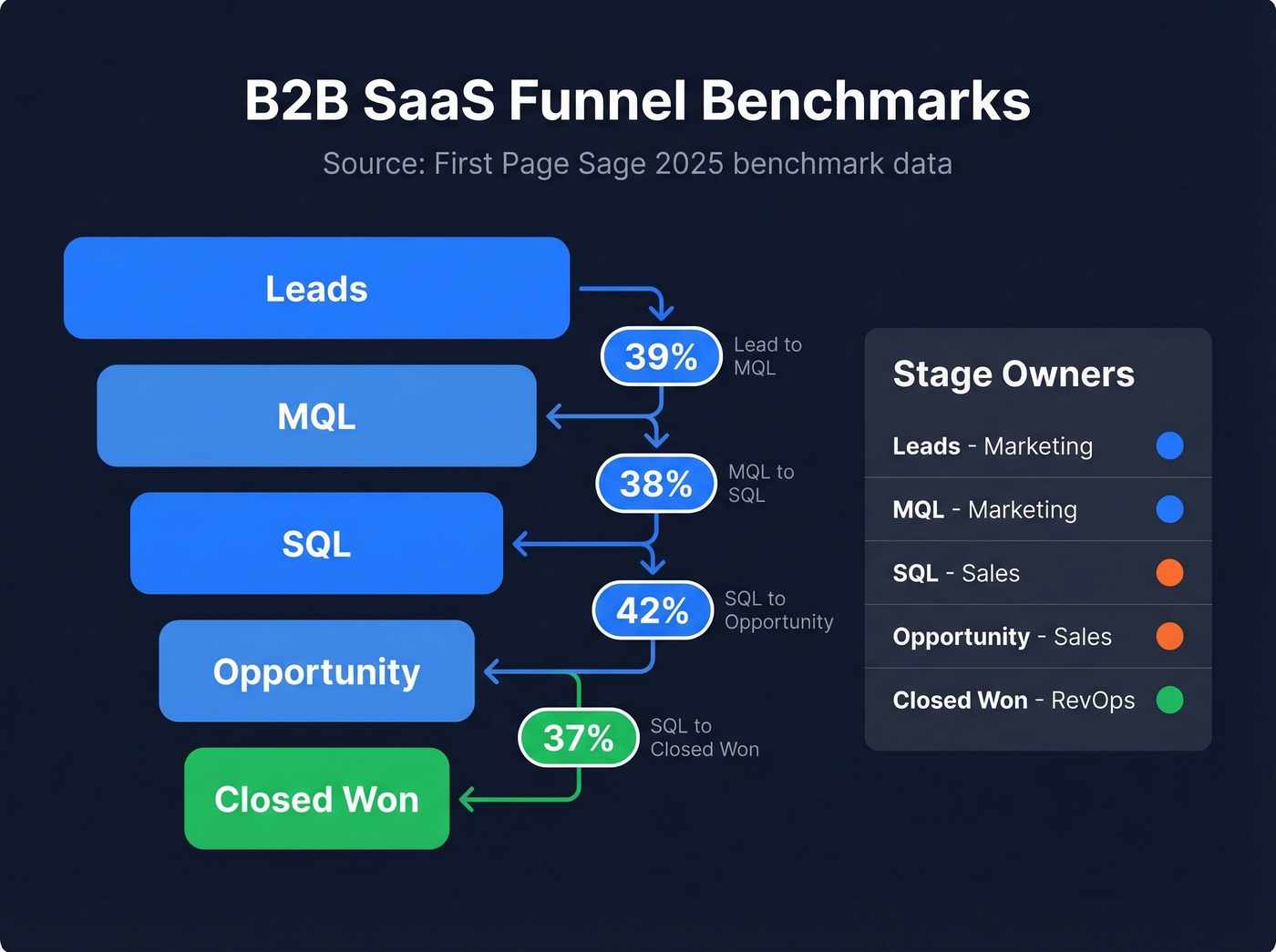
The stage definitions matter. A Lead is any contact that enters your system. An MQL meets marketing's qualification criteria - firmographic fit, engagement threshold. An SQL has been accepted by sales after discovery. An Opportunity has a defined need, budget, and timeline. Closed Won is self-explanatory.
First Page Sage's benchmark data across B2B SaaS gives you the conversion targets: Lead→MQL at 39%, MQL→SQL at 38%, SQL→Opportunity at 42%, SQL→Closed Won at 37%. Those are your baselines. If you're significantly below any of them, you know exactly where the leak is. The limitation: like AIDA, this model ends at the close, so for recurring revenue you need to bolt on post-sale stages - which is exactly what the Bowtie does.
AARRR (Pirate Metrics)
Here's the first thing you should know about AARRR: it struggles with B2B complexity.
Dave McClure created the framework in 2007 to shift startup founders away from vanity metrics. The stages - Acquisition, Activation, Retention, Referral, Revenue - force you to measure what actually drives growth. For PLG and self-serve products, it's the natural fit. Strong PLG companies hit ~56% trial-to-paid conversion; the broader benchmark sits around 20%. If your activation rate is low, nothing downstream matters - and AARRR makes that visible in a way other frameworks don't.
But "Acquisition" is too broad to capture the nuance between TOFU channels, and "Revenue" is a metric, not a stage - it doesn't tell you anything about deal progression. For enterprise sales with multi-threaded buying committees, AARRR lacks the granularity you need for handoff accountability. Use it for PLG. Don't force it onto a sales-led motion.
Bowtie (Revenue Journey)
SaaS companies don't close sales. They start relationships.
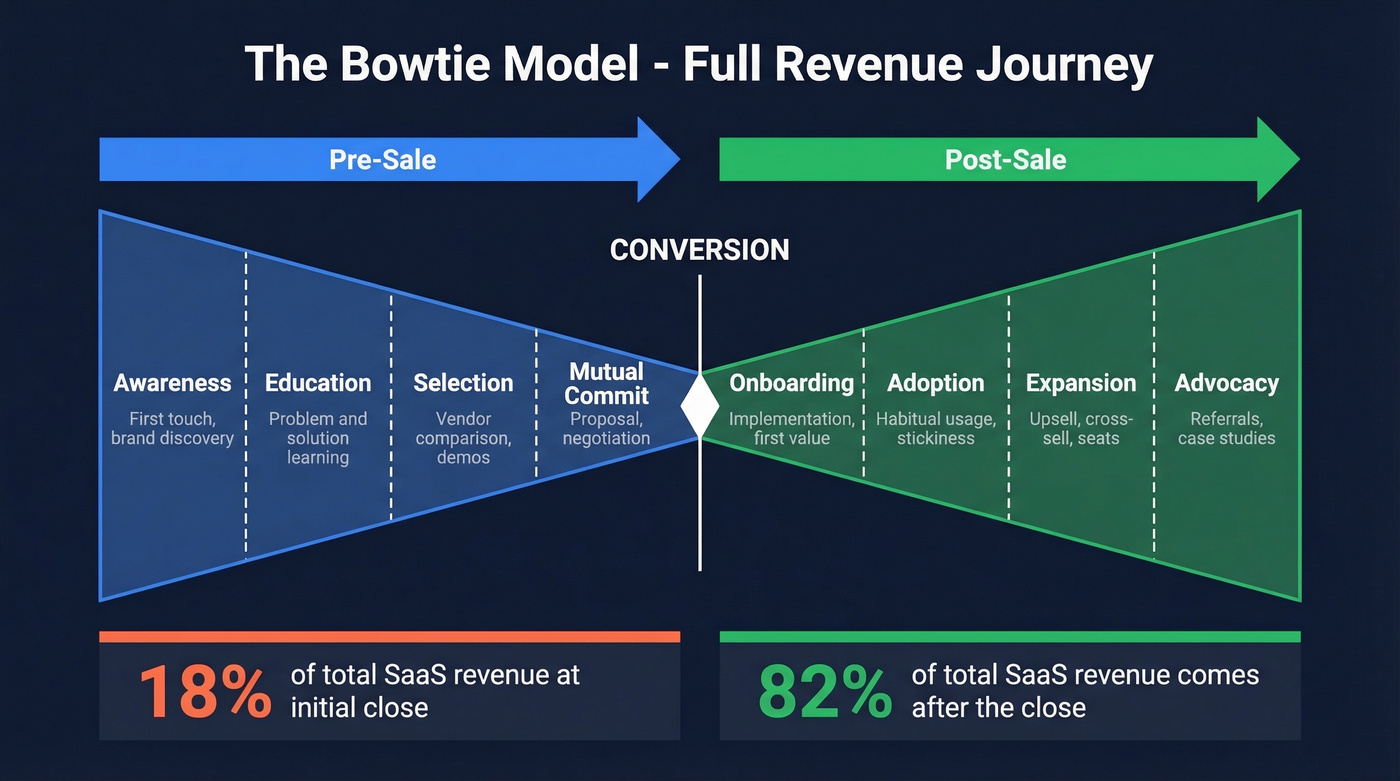
The Bowtie model, developed by Jacco van der Kooij at Winning by Design, is the most important framework shift in B2B SaaS over the past decade. The left side looks like a traditional funnel: Awareness → Education → Selection → Mutual Commit. The right side - the part most models ignore - maps the post-sale journey: Onboarding → Adoption → Expansion → Advocacy. The "knot" where they meet is the conversion point.
In a recurring-revenue model, 82% of total revenue comes after the initial win. A $100k initial deal might represent $300k-$500k in lifetime value. If your model ends at "Closed Won," you're managing 18% of your revenue and hoping the rest takes care of itself.
Best for: Any recurring-revenue business. Period. The tradeoff is that teams can over-rotate toward post-sale and slow new acquisition if resources tilt too far right.
ABM Funnel
Imagine your team spends three months building a relationship with a VP of Engineering at a target account. She's engaged, loves the product, champions it internally. Then the CFO kills the deal because nobody multi-threaded into finance.
That's the problem ABM solves.
Use this if: You're selling high-ACV enterprise contracts above $25k, with long sales cycles and multi-stakeholder buying committees.
Skip this if: You're SMB or self-serve. ABM is resource-intensive - it requires dedicated account research, personalized content, and tight sales-marketing alignment that doesn't scale for high-volume, low-touch motions.
The stages run from Target Account Selection → Engagement → Opportunity → Close → Expand. The key difference from other frameworks is that ABM starts with accounts, not individuals. You pick the companies first, then multi-thread into buying committees. With advanced scoring and alignment, teams hit ~40% MQL-to-SQL conversion - above the 38% B2B SaaS benchmark.
Non-Linear: CDJ & Loop
McKinsey's Consumer Decision Journey, built from studying almost 20,000 consumers across five industries and three continents, challenged the funnel metaphor itself. Their four phases - initial consideration, active evaluation, closure, postpurchase - revealed that buyers don't narrow linearly. They expand their consideration set during active evaluation. Brands in the initial consideration set are up to 3x more likely to be purchased.
HubSpot pushed this further with "The Loop" - a perpetual cycle of Express, Tailor, Amplify, Evolve. Their argument: the top of the funnel has scattered across TikTok, YouTube, Reddit, and podcasts. Consideration is broken by AI overviews and zero-click behavior - 60% of Google searches now end in zero clicks.
Neither the CDJ nor the Loop replaces an operational model. You still need Lead→MQL→SQL→Opp→Won or Bowtie for internal handoffs and measurement. But these frameworks are a reality check: buyers don't move in straight lines, and your model needs to account for that.
Master Comparison
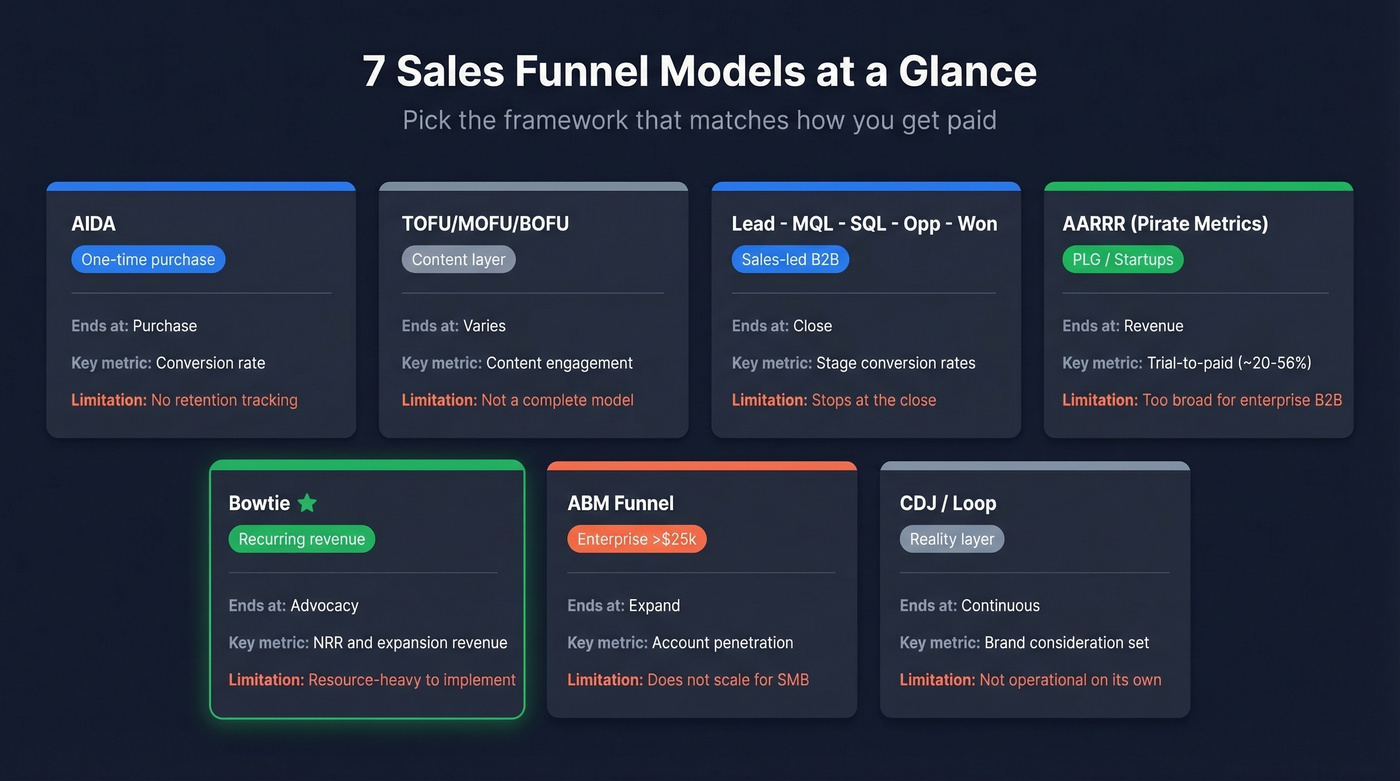
| Model | Best For | Ends At | Key Metric | Limitation |
|---|---|---|---|---|
| AIDA | One-time purchase | Purchase | Conversion rate | No retention |
| TOFU/MOFU/BOFU | Content mapping | Varies | Content engagement | Not a full model |
| Lead→SQL→Won | Sales-led B2B | Close | Stage conversion | Ends at close |
| AARRR | PLG / startups | Revenue | Trial-to-paid | Too broad for B2B |
| Bowtie | Recurring revenue | Advocacy | NRR, expansion | Resource-heavy |
| ABM | Enterprise (>$25k) | Expand | Account penetration | Doesn't scale SMB |
| CDJ / Loop | Reality layer | Continuous | Brand consideration | Not operational |
How to Choose Your Framework
The selection isn't academic - it determines what your team measures and where they focus. Here's the scenario that exposes a bad model choice: your CEO asks why pipeline is up but revenue is flat. The answer? Your framework ends at "Closed Won" and ignores retention and expansion. You're celebrating new logos while existing customers churn.
The Bowtie is the only model that reflects how SaaS actually makes money. Every other model is either a subset of it or a legacy framework from an era when the sale was the finish line. If you're running a pure PLG motion with deals under $5k, AARRR is fine. AIDA works for transactional products. Everyone else should start with the Bowtie.
A lot of teams run hybrids - AARRR for a self-serve tier and Bowtie for a sales-assisted tier - and that's often the right instinct. Models aren't religions. Mix them when your business demands it. The consensus on r/sales tends to agree: the best funnel is the one your team actually uses consistently, not the one that looks prettiest on a slide.
| Your Motion | ACV | Revenue Type | Sales Cycle | Recommended Model |
|---|---|---|---|---|
| PLG / self-serve | <$5k | Recurring | Days-weeks | AARRR |
| Sales-led B2B | $5k-$50k | Recurring or one-time | 30-90 days | Lead→MQL→SQL→Opp→Won |
| Enterprise ABM | >$50k | Recurring | 90-180+ days | ABM + Bowtie extension |
| Transactional B2B | <$5k | One-time | <7 days | AIDA or Lead→Won |
| Any SaaS | Any | Recurring | Any | Bowtie as strategic layer |
For most B2B SaaS teams, start with the Bowtie as your strategic layer and Lead→MQL→SQL→Opp→Won as your operational layer for the acquisition side. PLG? Swap the acquisition layer for AARRR. Enterprise ABM? Replace the top of the Bowtie's left side with account-level targeting.
Match the model to your revenue type, not your aspirations.
Benchmarks by Funnel Stage
Most funnel articles tell you to "track KPIs" and give you zero numbers. Here are the numbers.
B2B SaaS Stage Conversion (First Page Sage, 2017-2025 data)
| Stage Transition | Benchmark | Typical Range |
|---|---|---|
| Lead → MQL | 39% | 25-50% |
| MQL → SQL | 38% | 25-45% |
| SQL → Opportunity | 42% | 30-55% |
| SQL → Closed Won | 37% | 20-40% |
SMB vs Enterprise (Digital Bloom, 40+ studies compiled)
| Metric | SMB/Mid-Market | Enterprise |
|---|---|---|
| Visitor → Lead | 1.4% | 0.7% |
| Opp → Close | 39% | 31% |
| Median sales cycle | 84 days | 84 days+ |
| Typical win rate | 20-30% | 20-30% |
Channel Deltas
| Channel | MQL→SQL Rate | Opp→Close Rate |
|---|---|---|
| SEO / Organic | 51% | 38% |
| Events | - | 40% |
| PPC / Paid | 26% | 35% |
In our experience, the channel deltas are far more actionable than the overall averages. SEO leads convert MQL→SQL at about 2x the rate of PPC leads. Events drive the highest close rate. Median deal size for private SaaS sits around $26,265. These benchmarks apply whether you're running a basic funnel or a multi-layered enterprise model - the math is the math.
Use these as sanity checks, not gospel. If your Lead→MQL rate is 15% when the benchmark is 39%, you've got a targeting or scoring problem. If your SQL→Won rate is 50% when the benchmark is 37%, either your team is exceptional or your qualification bar is too high and you're leaving pipeline on the table.
Operationalize Your Model
A model on a slide deck is worthless. Make it operational with a Funnel Model Canvas.
Stage Name → Entry Criteria → Exit Criteria → Owner → KPI → Tool
Example row for MQL: Entry = downloads gated asset + fits ICP firmographics. Exit = SDR qualifies via discovery call. Owner = Marketing/SDR. KPI = MQL→SQL rate (target: 38%). Tool = CRM + enrichment platform. Walk every stage through this canvas. If you can't define entry and exit criteria, that stage doesn't exist yet - it's just a label in your CRM.
Let's be honest about something we've seen over and over: the SDR manager who says outbound is "dead" is usually wrong. What's actually dead is spraying unverified emails at untargeted lists. We've watched teams blame their funnel framework when the real problem was 30% bounce rates on their outbound sequences. The top of your funnel leaks when contact data is bad, and every downstream metric inherits that error.
Good data hygiene means verifying contacts before they enter your funnel, not after they bounce. Prospeo's 98% email accuracy and 7-day data refresh cycle means your stage metrics reflect reality, not stale records. When your Lead→MQL numbers are built on verified data, you can actually trust the conversion rates you're reporting upstairs.
Mistakes That Break Your Funnel
No stage entry/exit definitions. Without them, you have a list of vibes, not a funnel. Every rep interprets "qualified" differently, and your conversion rates are meaningless.
Ending the model at Closed Won when you sell recurring revenue. If 82% of your revenue comes post-sale, your model needs to cover post-sale. Full stop.
Measuring vanity metrics instead of stage-to-stage conversion. Total MQLs is a vanity metric. MQL→SQL rate is an operational metric. One tells you volume; the other tells you quality.
Feeding bad data into the top. Every downstream metric is wrong if your contact data bounces at 20%+. Enrichment and verification at the Lead stage isn't optional - it's the prerequisite for trustworthy funnel math. I've personally seen a team celebrate a "record pipeline quarter" only to discover half their SQLs were built on contacts that had changed jobs six months earlier.
Whether you run Bowtie, AARRR, or Lead→MQL→SQL→Opp→Won, every stage needs accurate contact data to convert. Prospeo gives you 300M+ profiles with 30+ filters - buyer intent, technographics, headcount growth, funding - so you fill each funnel stage with the right accounts, not just more volume. At $0.01 per email, scaling your pipeline doesn't scale your costs.
Stop debating funnel stages and start filling them with buyers who pick up the phone.
FAQ
What's the difference between a model and a stage?
A model is a named framework - AIDA, AARRR, Bowtie - that defines the entire buyer journey from first touch to expansion. Stages are individual steps within that framework. TOFU/MOFU/BOFU are stages, not a model; they're content-mapping shorthand. Pick the model first, then define your stages with entry/exit criteria.
Which sales funnel model works best for SaaS?
The Bowtie model is the default for B2B SaaS because only 18% of recurring revenue is secured at the initial close. Pair it with Lead→MQL→SQL→Opp→Won for operational handoff clarity on the acquisition side. PLG companies should layer in AARRR for activation and retention metrics.
What are the different types of funnels?
There are two categories. Strategic types include AIDA, AARRR, Bowtie, and ABM - the frameworks covered here. Tactical types are implementation patterns like webinar funnels, tripwire funnels, and lead magnet funnels. Pick your strategic model first, then build tactical funnels within it for specific campaigns.
How do I keep funnel data accurate?
Define entry/exit criteria for every stage, audit conversion rates monthly against published benchmarks, and verify contact data before it enters the funnel. Tools like Prospeo refresh records every 7 days and verify emails at 98% accuracy, so your stage metrics reflect actual pipeline health rather than stale data degrading your numbers over time.