

How to Build a Sales Growth Plan That Isn't a Wish List
Most sales growth plans are quota targets stapled to a headcount request. The board nods, finance approves the headcount, and six months later everyone's wondering why pipeline coverage is at 1.8x and half the new hires haven't closed a deal.
Ask any rep about their company's growth plan and you'll hear the same thing: it sits in a shared drive collecting dust. A real plan starts with capacity math, not aspirations.
Companies expect average revenue growth of 7.9% in 2026 - up from 6.9% projected for 2025, according to Gartner's CEO survey. The gap between expected and achieved comes down to whether the plan accounts for what the org can actually produce, or just what leadership wants.
What You Need Before Building
Nail these three numbers before you touch a slide deck:
- Capacity-adjusted quota. What your team can realistically produce given attainment rates, ramp time, and attrition - not what you want.
- Pipeline coverage ratio (3-4x). Need $5M in new business? You need $15-20M in qualified pipeline.
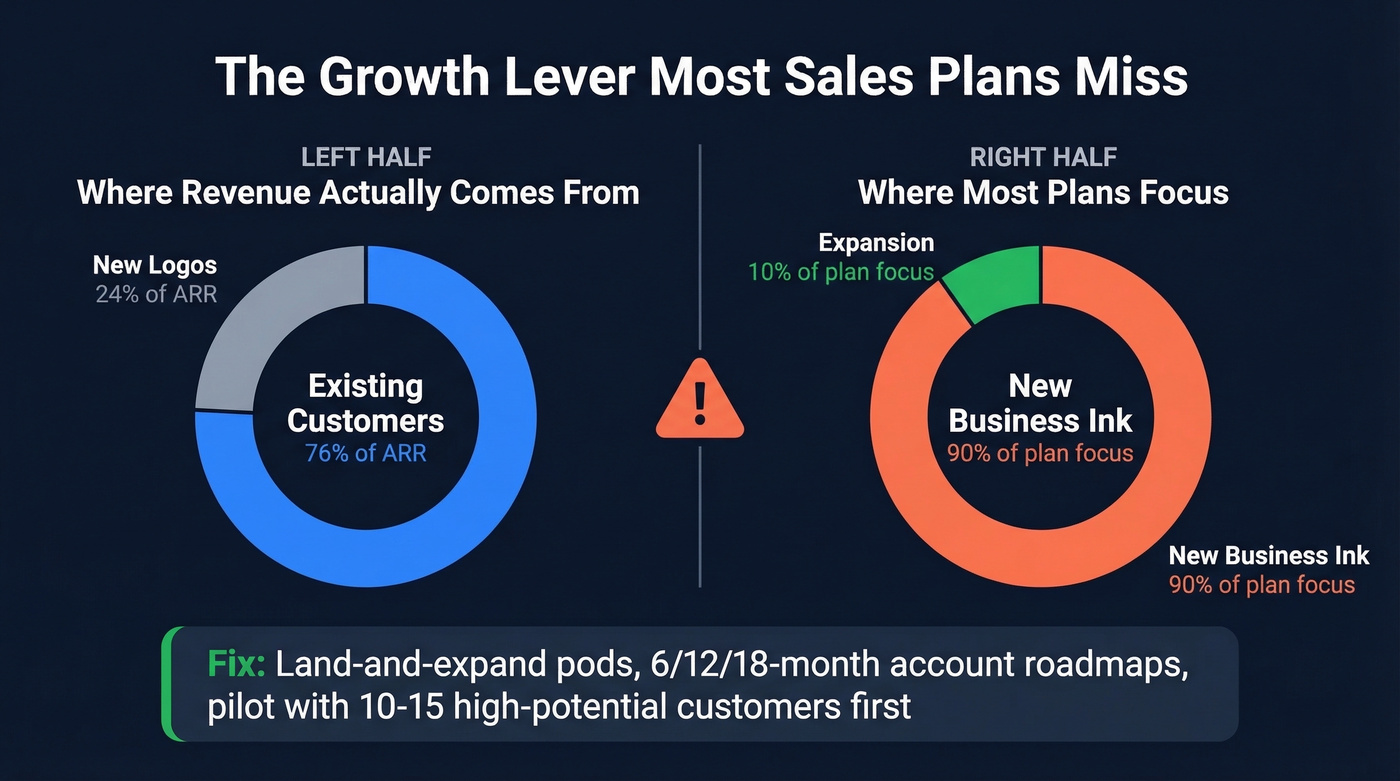
- Expansion revenue target. If your plan only covers new logos, you're planning for about 24% of ARR when existing customers drive 76% on average.
A real growth plan fits on two pages: the capacity model, the pipeline math, and the 90-day action plan. That's it.
Six Components That Drive Revenue Growth
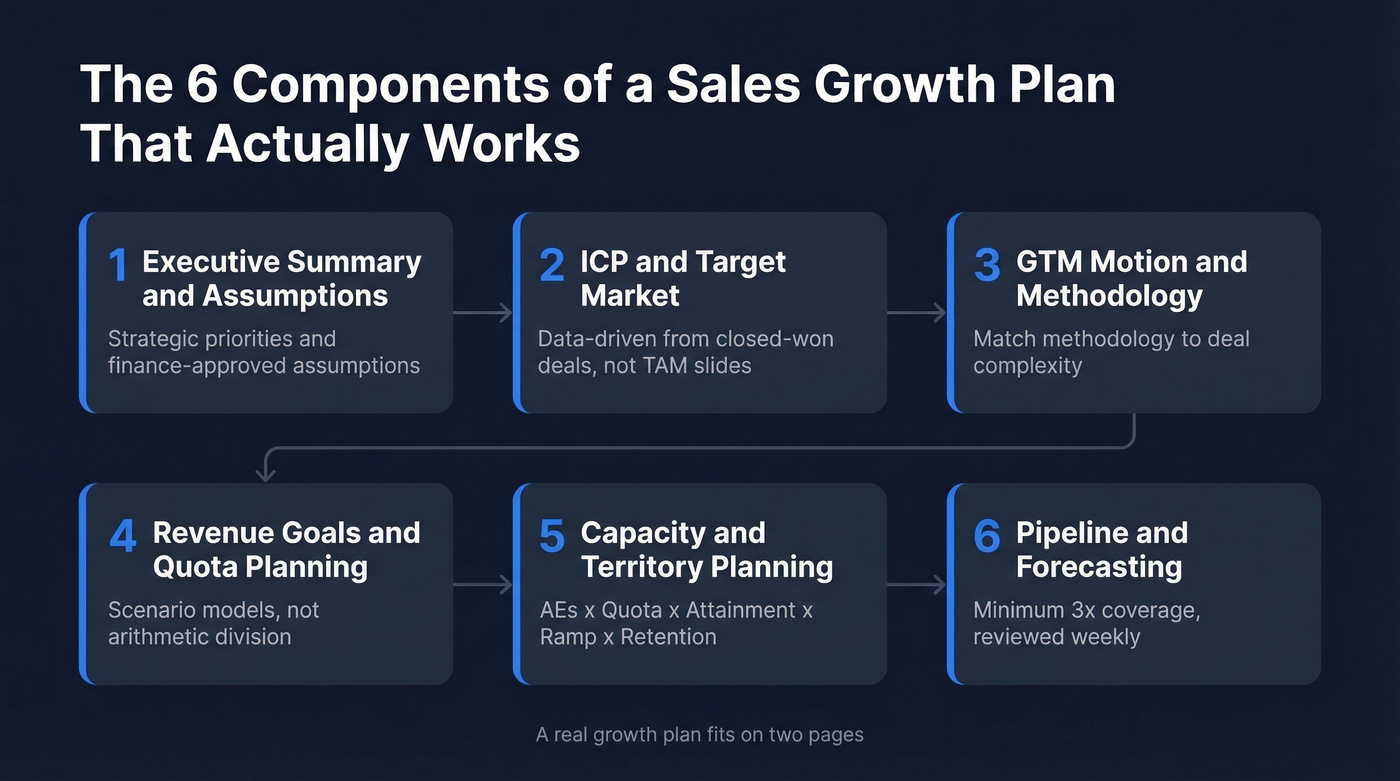
Executive Summary and Assumptions
Start with strategic priorities - expansion, efficiency, or net-new logos? Then document assumptions explicitly: market readiness, pipeline conversion behavior, operational constraints. If finance hasn't signed off on your assumptions, you don't have a plan. You have a sales deck.
ICP and Target Market
Audit the last 12-18 months before defining your ICP. Pull ACV, win rate, sales cycle length, and meeting-to-opportunity conversion. The patterns in your closed-won data tell you more about your ICP than any TAM analysis ever will.
If your best customers are 200-500 employee SaaS companies with a VP of Revenue Ops, that's your ICP - not "enterprise technology companies." We've seen teams waste entire quarters chasing a TAM slide when the CRM already had the answer.
GTM Motion and Methodology
Match methodology to deal complexity. SPIN Selling works for consultative, multi-stakeholder deals where discovery drives the sale. Challenger fits status-quo-heavy environments where reps need to teach and reframe. Short-cycle transactional deals don't need either - match methodology to your average deal complexity and number of stakeholders.
Revenue Goals and Quota Planning
Here's where most plans go wrong: they set a top-line number and divide by headcount. That's not planning. That's arithmetic.
Software companies average a 19.56% five-year revenue CAGR; the total market sits at 12.77%. Your growth target should reflect your sector, not your board's ambition. And here's the stat that should change how you model: 17% of reps generate 81% of revenue. If your plan assumes even distribution across the team, it's already wrong.
Only 43.5% of reps hit quota. Build scenario models - best case, base case, worst case - and break targets into new business, expansion, and renewals.
Capacity and Territory Planning
This formula separates real plans from wish lists:
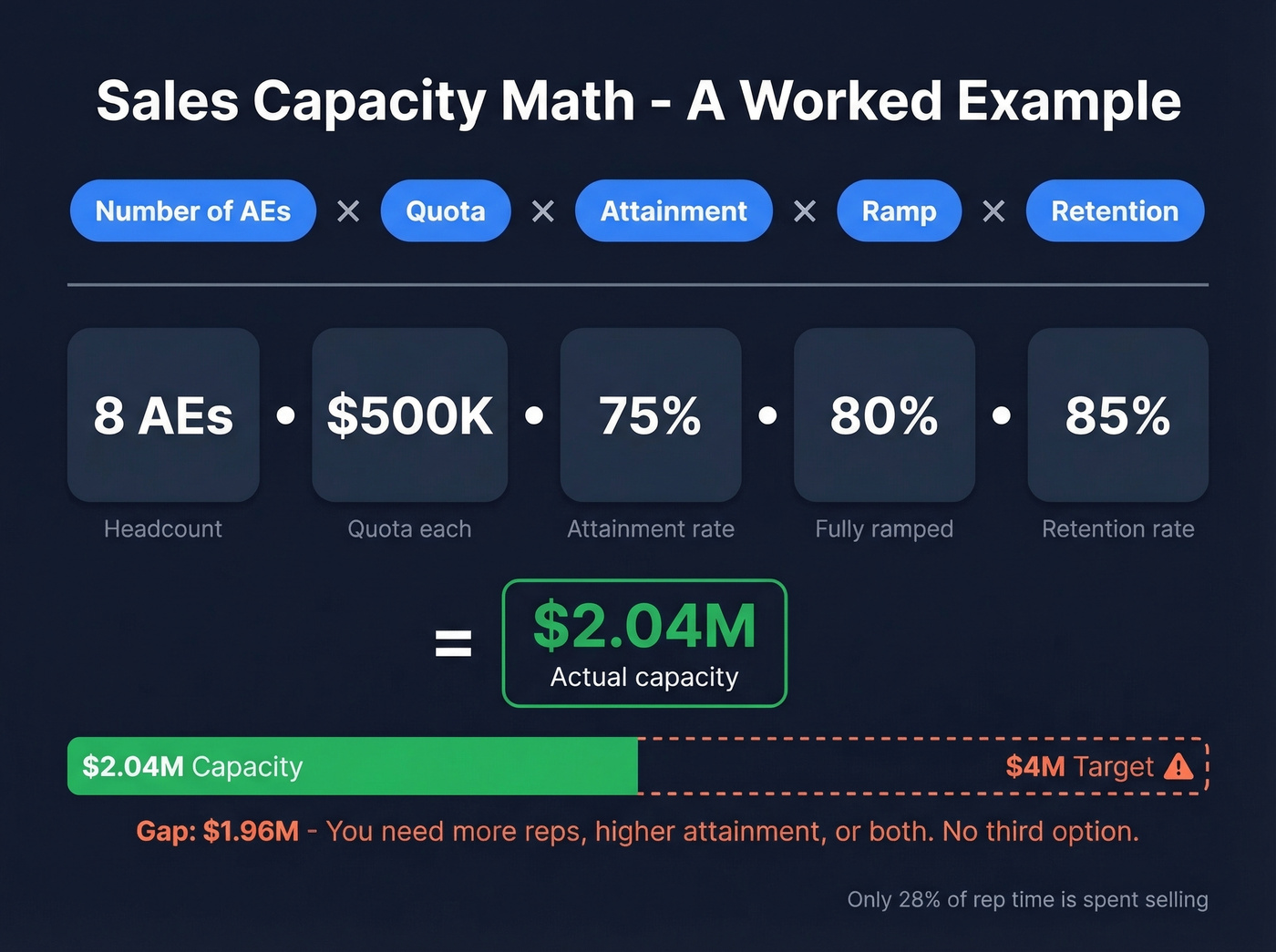
Sales Capacity = (Number of AEs x Quota) x Attainment x Ramp x Retention
Let's run the math. Eight AEs at $500K quota, 75% attainment, 85% retention, 80% ramped = $2.04M capacity. If your target is $4M, you need more reps, higher attainment, or both. There's no third option.
Reps spend only 28% of their time actually selling. Healthy capacity utilization runs 65-75%. Plan for the team you have, not the team you wish you had.
Pipeline and Forecasting
We've seen teams with 2x pipeline coverage consistently miss - 3x is the floor. If your team closes at 22%, a realistic improvement target is 28%. At that rate, you need roughly $3.50 in pipeline for every $1 you want to close.
Teams with strategic planning processes see 85% greater accuracy in predicting quarterly revenue. That accuracy comes from treating pipeline as a living number - reviewed weekly, adjusted monthly, never treated as a static spreadsheet snapshot from January.
The Growth Lever Most Plans Miss
Existing customers drive 76% of ARR on average. Yet most growth plans dedicate 90% of their ink to new business.
In our experience, plans that skip expansion modeling underperform by Q3. Every time.
The fix: land-and-expand with small Sales+CSM pods. Build 6/12/18-month expansion roadmaps for your top accounts. Start with a pilot of 10-15 high-potential customers before rolling out broadly - don't try to boil the ocean.
Track the signals that predict expansion: usage spikes, feature adoption, inbound inquiries about additional products. When a customer's usage jumps quarter-over-quarter, that's not a support ticket. That's a buying signal.

Your growth plan says 3-4x pipeline coverage. But pipeline built on stale data is fiction. Prospeo's 300M+ profiles refresh every 7 days - not every 6 weeks - so your capacity model reflects reality, not last quarter's contacts.
Stop planning around dead emails. Start with 98% accuracy.
90-Day Execution Framework
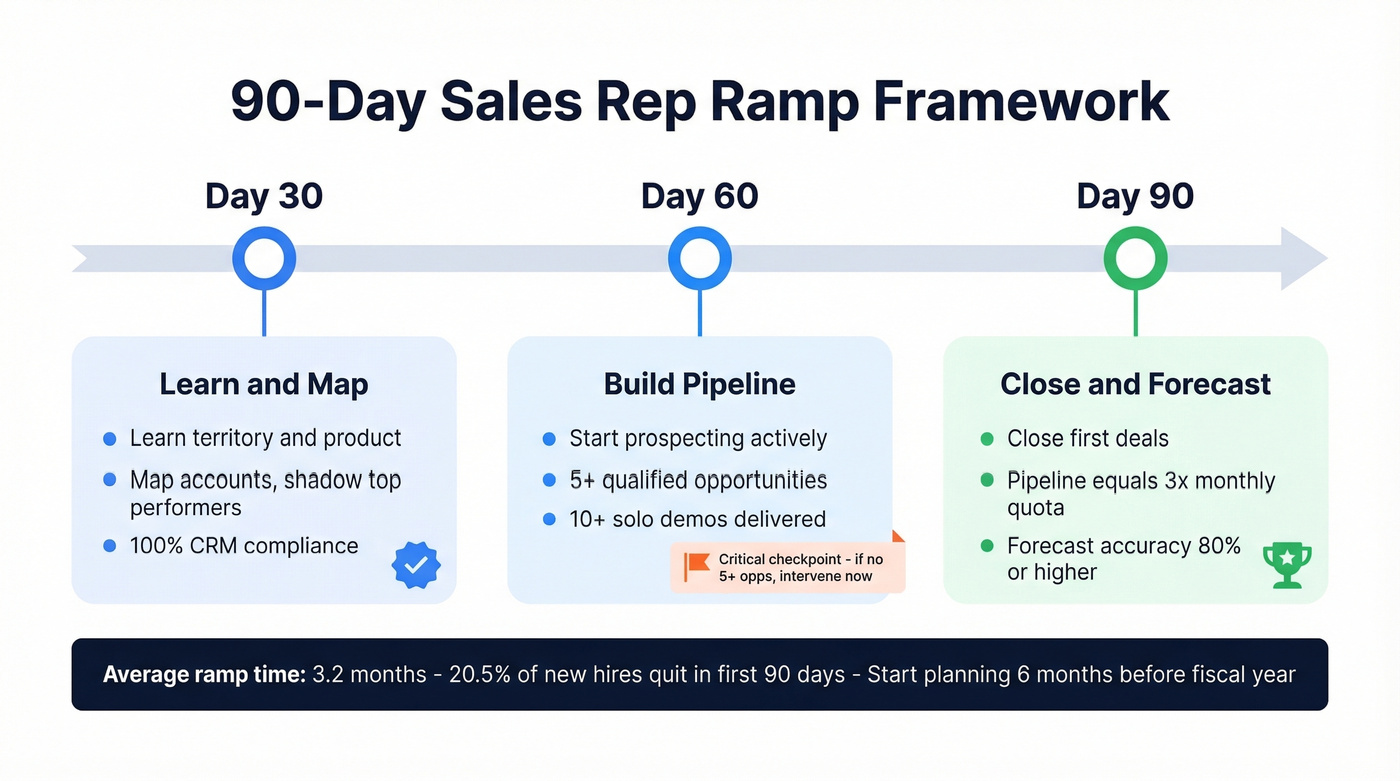
The average rep takes 3.2 months to reach full productivity, and 20.5% of new hires quit within the first three months. Start your planning at least six months before the new fiscal year - not the week before kickoff.
| Days 1-30 | Days 31-60 | Days 61-90 |
|---|---|---|
| Learn territory and product | Start prospecting, build pipeline | Close first deals |
| Map accounts, shadow top performers | 5+ qualified opportunities | Pipeline = 3x monthly quota |
| 100% CRM compliance | 10+ solo demos delivered | Forecast accuracy 80%+ |
Companies with effective onboarding see 10% higher sales growth rates. The Day 60 checkpoint matters most - if a rep doesn't have 5+ qualified opportunities by then, you've got a coaching problem or a hiring problem. Don't wait until Day 90 to find out.
Why Growth Plans Fail
No scenario planning. 47% of companies cite market uncertainty as their top challenge, but only 30% have a compensation strategy prepared for volatility. If your plan has one scenario, it's not a plan - it's a bet.
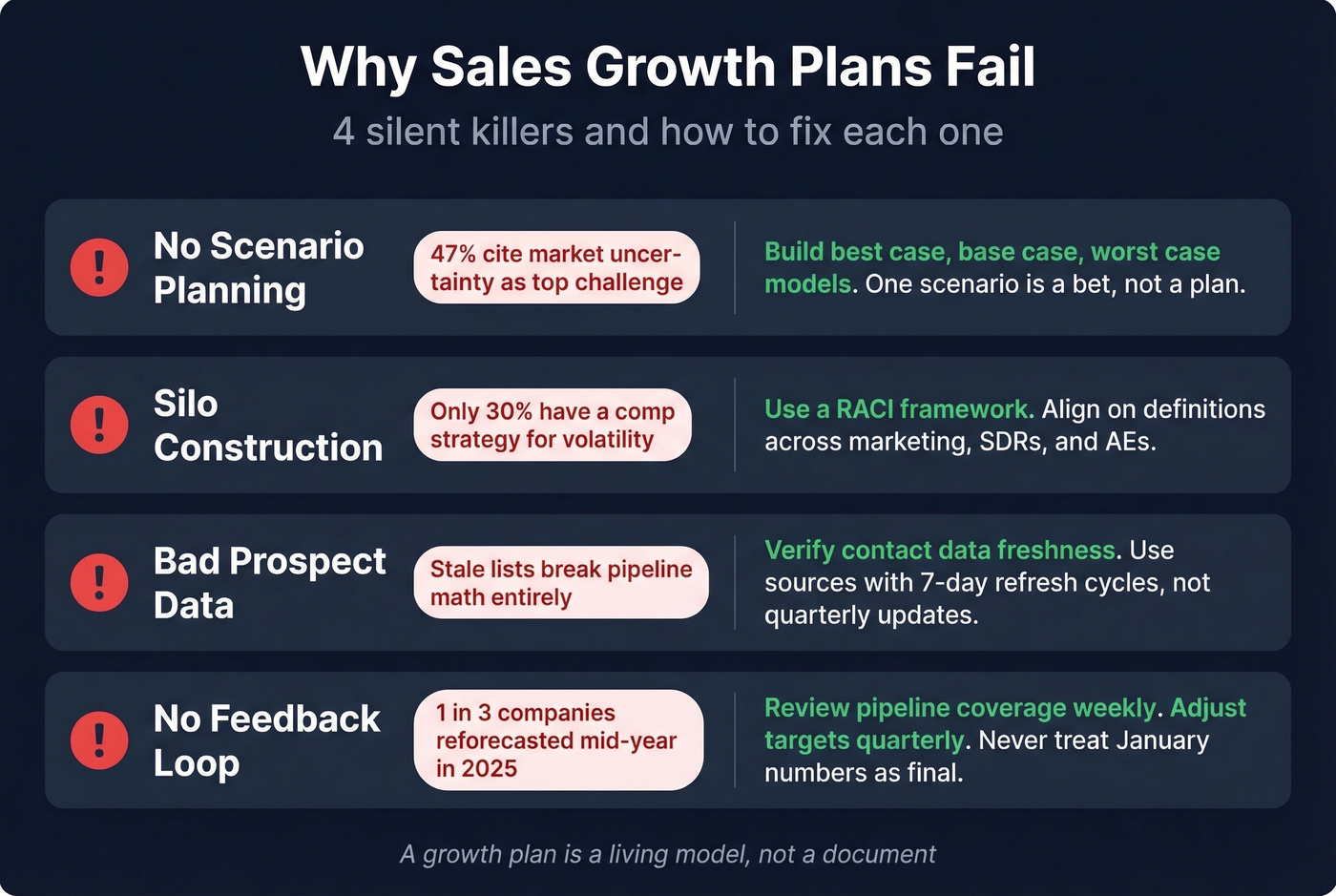
Silo construction. Plans built by sales leadership alone collapse at execution. Use a RACI framework. Get alignment on definitions - "qualified lead" means different things to marketing, SDRs, and AEs, and that ambiguity will wreck your pipeline numbers.
Bad prospect data. Here's the thing: your pipeline projections fall apart when your lists are full of dead contacts. If the data feeding your pipeline model is stale, the model is fiction. Tools like Prospeo with 98% email accuracy and a 7-day refresh cycle exist specifically to solve this, but whatever source you use, verify it's actually current.
No feedback loop. Over one-third of companies reforecasted revenues mid-year in 2025. A growth plan is a living model. Review pipeline coverage weekly and adjust quarterly, or you're flying blind.
Tools That Make the Plan Work
CRM. Salesforce or HubSpot. This is your system of record. Pick one and commit.
Enablement and forecasting. Gong for conversation intelligence and deal inspection. It turns pipeline reviews from opinion-based to evidence-based.
Pipeline data. Your sales growth plan needs pipeline. Pipeline needs outbound. Outbound needs accurate contact data. Prospeo covers 300M+ professional profiles with 98% email accuracy, integrates natively with Salesforce and HubSpot, and starts at roughly $0.01 per verified email with a free tier available.
Skip the $30K/year enterprise data platform if your average deal size is under $15K. A self-serve tool with verified data and no annual contract will outperform an enterprise suite your reps barely log into. The consensus on r/sales backs this up - most mid-market teams are overpaying for data they don't fully use.
Reps spend only 28% of their time selling. Don't waste it on bounced emails and wrong numbers. Prospeo delivers 98% email accuracy and 125M+ verified mobiles at $0.01/lead - so your 90-day ramp plan actually converts.
Hit quota targets with data your reps can actually reach buyers through.
FAQ
What's the difference between a sales plan and a sales growth plan?
A sales plan covers process, territories, and quotas for the current team. A sales growth plan starts from a revenue target and works backward through capacity math, pipeline coverage, and expansion revenue to determine what the org actually needs. It forces you to stress-test assumptions before committing resources.
How often should I update my plan?
Review monthly, adjust quarterly. Most companies adjust mid-year anyway. If your pipeline coverage drops below 3x, you need to know immediately - not at the annual offsite.
What tools do I need to execute effectively?
At minimum: a CRM like Salesforce or HubSpot, a forecasting tool like Gong, and a verified contact data source for pipeline generation. Bad contact data breaks the pipeline math your entire plan depends on.