

8 Sales Hiring Mistakes That Cost More Than You Think
You knew something was off by week three. The new rep couldn't articulate your value prop, fumbled discovery calls, and leaned on the slide deck like a crutch. But you gave them "more time" because firing feels like admitting you were wrong. That delay cost you tens of thousands more.
Most sales hiring mistakes trace back to a handful of repeatable patterns. One of the costliest - hiring before the founder has proven the sales motion - can burn $100K in six months. Below: the full list, the real math, and a scoring rubric you can steal today.
The Real Cost of a Bad Sales Hire
Direct replacement costs for a single sales rep run $97,000-$115,000. That covers recruiting, onboarding, productivity loss, and the revenue gap while the seat sits empty.
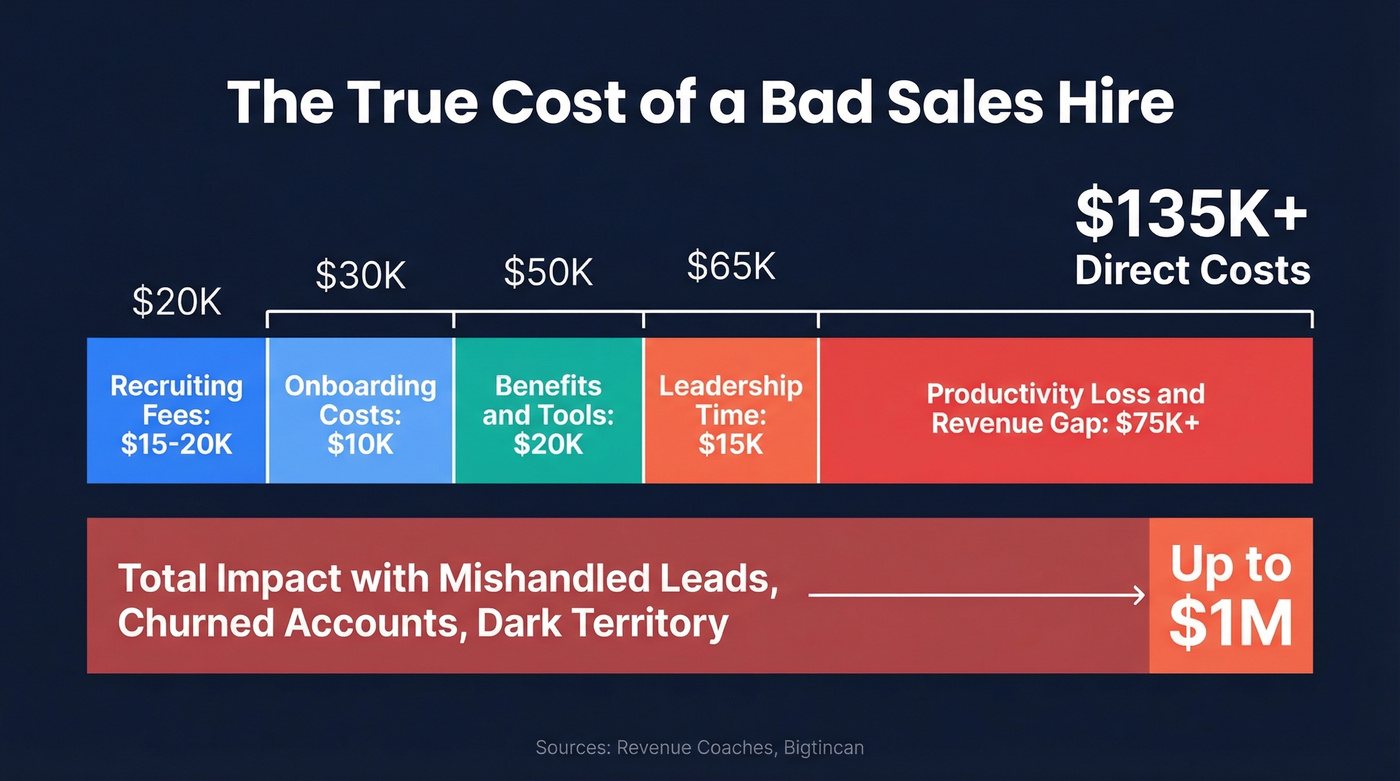
But the real number is worse. A Revenue Coaches breakdown puts it at $135K before you count a single missed deal: recruiting fees eat $15-20K, onboarding runs $10K, benefits and tools add $20K, and leadership time burns another $15K. We've watched the total impact - mishandled leads, churned accounts, a territory dark for six months - approach $1M. That's not hyperbole. It's compounding math that most hiring managers never run until it's too late.
The 8 Most Expensive Mistakes When Hiring Sales Reps
1. Hiring Before Proving the Sales Motion
If you're a founder and you haven't closed 20+ deals yourself, you aren't ready to hire a salesperson. Full stop.
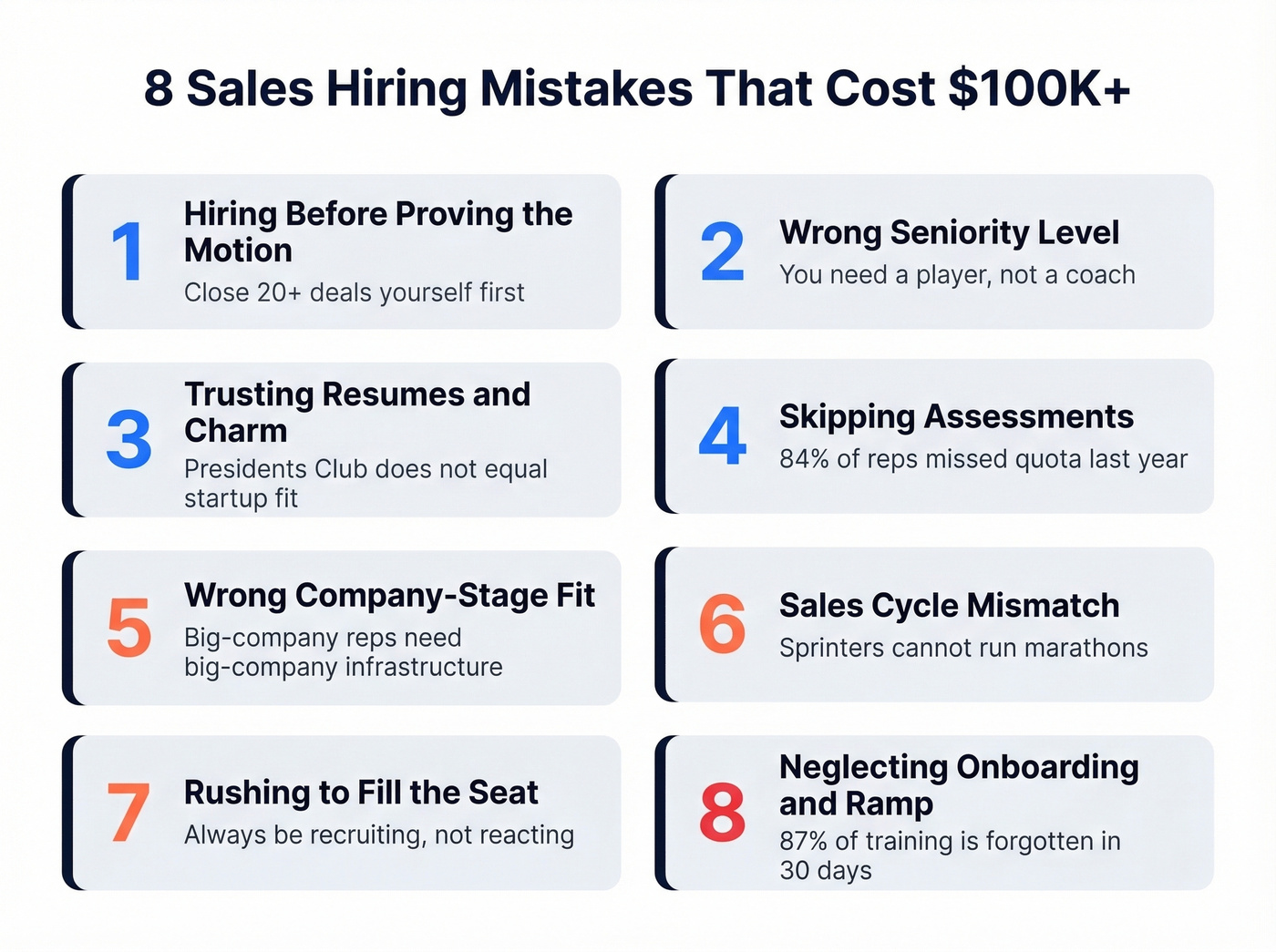
One founder on r/founderledsales burned $100K and six months on a Head of Sales who struggled without a proven lead gen system, consistent messaging, or a defined ICP. The rep missed targets by 40% and got let go. No playbook, no pipeline, no chance.
Fix: Close 20+ deals yourself. Document the motion. Then hire someone to replicate it.
2. Wrong Seniority Level
Hiring a VP of Sales as your first sales hire is one of the most common startup mistakes. Senior leaders expect structure - BDRs feeding them leads, marketing generating demand, SEs running demos. They're built to manage, not execute.
The move: early-stage companies need a player, not a coach. Save the VP hire for when you actually have a team to manage.
3. Trusting Resumes and Charm
President's Club at a Fortune 500 with strong inbound doesn't automatically translate to a startup where every deal starts with a cold email. We've seen reps with incredible interview presence who couldn't generate a single qualified opportunity in 90 days. Charisma in a conversation isn't the same as competence in a territory.
Fix: Role-plays, mock prospecting exercises, and reference checks that go beyond "would you hire them again?"
4. Skipping Assessments
84% of sales reps missed quota last year. Let that sink in. Relying on gut-feel interviews is playing terrible odds. Unstructured conversations reward charm over competence, and they're awful predictors of on-the-job performance.
Fix: Add a sales-specific assessment before the final interview. Even a simple situational judgment test filters out candidates who interview well but can't sell.
5. Wrong Company-Stage Fit
Big-company reps rely on infrastructure that doesn't exist at a startup: inbound leads, BDR teams, and brand recognition that opens doors. Drop them into an environment with none of that and they fail - not because they're bad, but because they've never had to build from scratch.
Ask every candidate: "What infrastructure did you have around you? What happened when it wasn't there?"
6. Sales Cycle Mismatch
A transactional rep in an enterprise role is a sprinter running a marathon. They'll push for quick closes, skip discovery, and alienate prospects who need a consultative approach. The reverse is equally painful - an enterprise rep in a high-velocity role will over-engineer every deal and miss volume targets by a mile.
Map your average cycle length. Match candidates whose experience aligns.
7. Rushing to Fill the Seat
Everyone talks about the cost of a bad hire. Nobody talks about the cost of a slow hire - months with an empty territory bleeding revenue. SDR tenure averages 14-18 months with turnover running ~34%. More than 1 in 10 companies see turnover exceeding 55%.
The answer isn't to hire faster. It's to always be recruiting so you're never desperate. Treat recruiting like prospecting: always-on, not reactive.
8. Neglecting Onboarding and Ramp
The average sales rep takes ~9 months to fully ramp, and 87% of sales training is forgotten within a month. Structured onboarding makes new hires 50% more likely to stay - yet most companies wing it.
Here's what kills ramp faster than anything: giving new hires bad prospecting data. A rep bouncing emails and dialing dead numbers for their first 90 days never builds momentum. They build frustration.

Build a structured 30/60/90-day plan with a clear quota ramp schedule. And give reps clean data from day one. GreyScout cut rep ramp from 8-10 weeks to 4 weeks after equipping new hires with Prospeo's verified contact data - 98% email accuracy meant reps were booking meetings in the first couple of weeks, not troubleshooting bounces.

A bad hire costs $100K+. Bad data makes it worse. GreyScout cut rep ramp from 8-10 weeks to 4 by giving new hires Prospeo's verified contacts - 98% email accuracy, under 4% bounce rates, meetings booked in week one.
Stop burning new hires on dead data. Start them with verified contacts.
A Hiring Process That Actually Works
Most of these missteps disappear when you replace ad-hoc interviewing with a repeatable process:
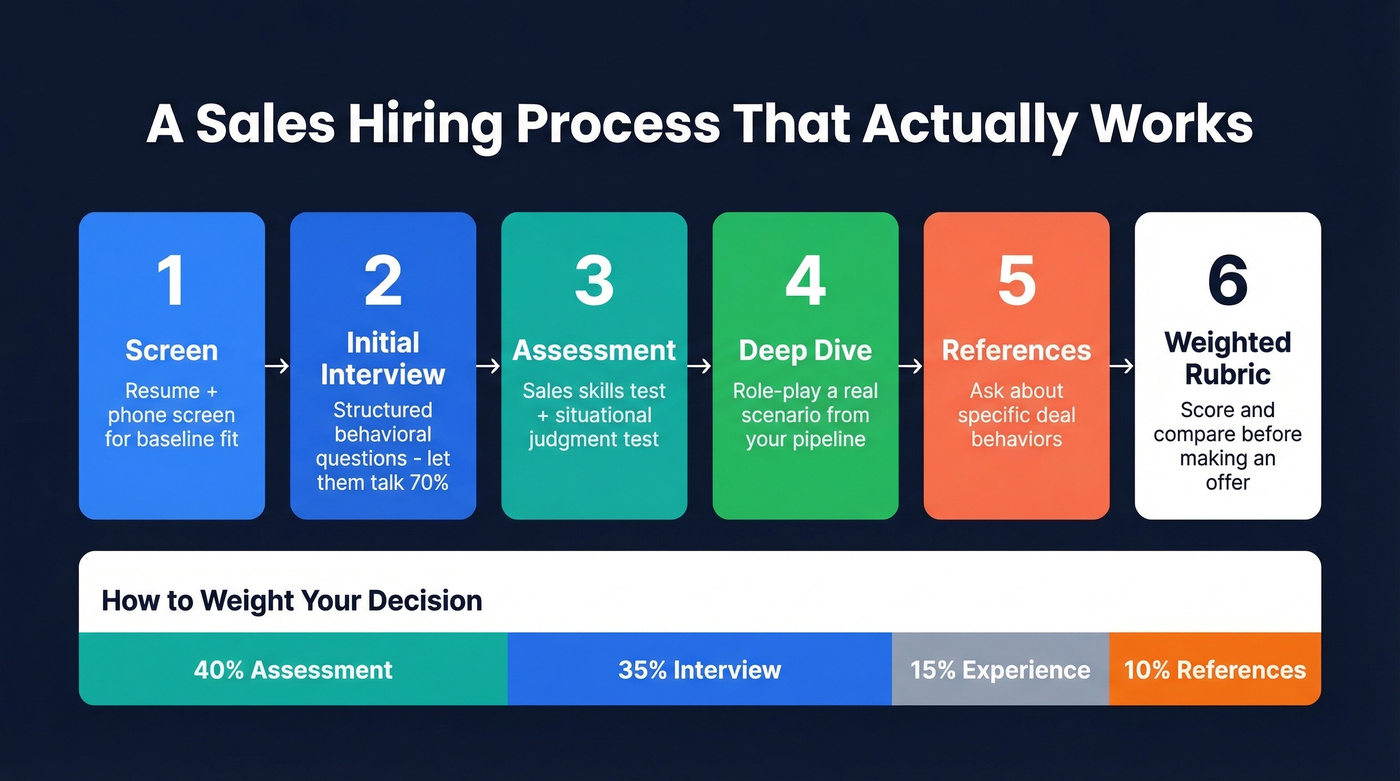
- Screen - resume + brief phone screen for baseline fit
- Initial interview - structured behavioral questions (let the candidate talk 70% of the time; you learn nothing while you're speaking)
- Assessment - sales-specific skills test + situational judgment test
- Deep-dive - role-play a real scenario from your pipeline
- References - ask former managers about specific deal behaviors
- Weighted rubric - score and compare before making an offer
Weight the inputs: 40% assessment, 35% interview performance, 15% experience, 10% references. This reflects how predictive each signal actually is. During the deep-dive, pay attention to how the candidate collaborates, asks questions, and responds to feedback - those behaviors predict whether they'll thrive on your team better than any resume line.
For assessments, the OMG Assessment runs $199-399 per test and is sales-specific. Criteria Corp offers broader cognitive and skills testing at $50-500/mo. Combine at least two assessment categories for real predictive power.
Hot take: If your average deal size is under $10K, you probably don't need a full-cycle AE. A sharp SDR with clean data and a good script will outperform a senior rep who's waiting for infrastructure you can't afford to build.
Scoring Rubric for Sales Candidates
Score every interviewer independently before comparing notes. Disagreements are where the real conversation happens - don't average them away.
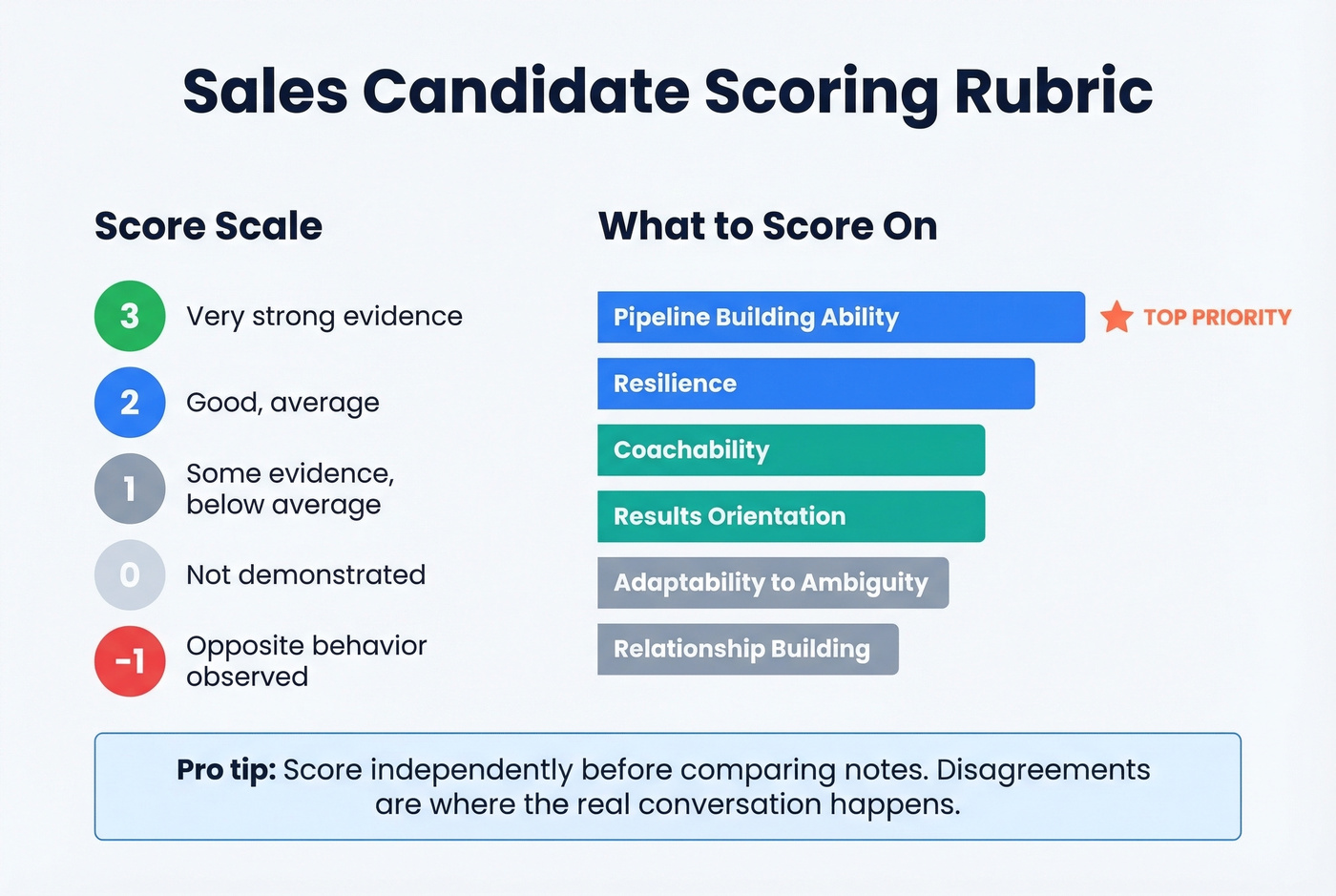
| Score | Meaning |
|---|---|
| 3 | Very strong evidence |
| 2 | Good / average |
| 1 | Some evidence, below average |
| 0 | Not demonstrated |
| -1 | Opposite behavior observed |
Score on: pipeline building ability, resilience, coachability, results orientation, adaptability to ambiguity, and relationship building. Let's be honest - if you're not scoring candidates on pipeline building as the top-weighted criterion, you're optimizing for the wrong thing.
You just built a structured hiring process. Don't sabotage it with bad prospecting data. Prospeo gives every new rep 300M+ verified profiles, 125M+ direct dials, and emails at $0.01 each - refreshed every 7 days, not every 6 weeks.
Equip your next sales hire with data that actually connects to real buyers.
Sales Hiring Mistakes FAQ
How much does a bad sales hire actually cost?
Direct replacement runs $97K-$115K including recruiting, onboarding, and the revenue gap while the territory sits empty. Factor in mishandled leads, churned accounts, and lost coverage, and total impact for a single bad hire can approach $1M.
What's the best assessment for sales candidates?
Combine a sales-specific skills test like the OMG Assessment ($199-399/test) with a situational judgment test and a structured role-play. No single assessment type is predictive alone - pairing at least two categories dramatically improves hiring accuracy.
How do I set a new sales hire up to succeed from day one?
Build a structured 30/60/90-day onboarding plan with a clear quota ramp schedule and verified prospecting data. GreyScout cut ramp time from 8-10 weeks to 4 weeks by giving new reps 98%-accurate emails - meetings started in week two, not month three.
What's the biggest red flag when interviewing sales candidates?
Candidates who can't describe their prospecting process in detail - how they built pipeline, sourced leads, and handled rejection. If every answer references inbound leads or existing accounts, they'll likely struggle in an environment that demands outbound hustle. Skip them unless you've got a mature inbound engine already running.