

Sales-Led vs Community-Led Growth: Data, Benchmarks, and the Hybrid Playbook
A founder on r/plgbuilders put it bluntly: his team was "crashing and burning trying to chase prospects who just weren't interested." He'd built a sales-led motion before he had market pull, and it nearly killed the company. In 2023, only 16% of reps hit quota. The sales-led vs community-led debate isn't about which motion is "better." It's about which one fits your deal size, your market maturity, and your team's capacity to execute.
The Short Answer
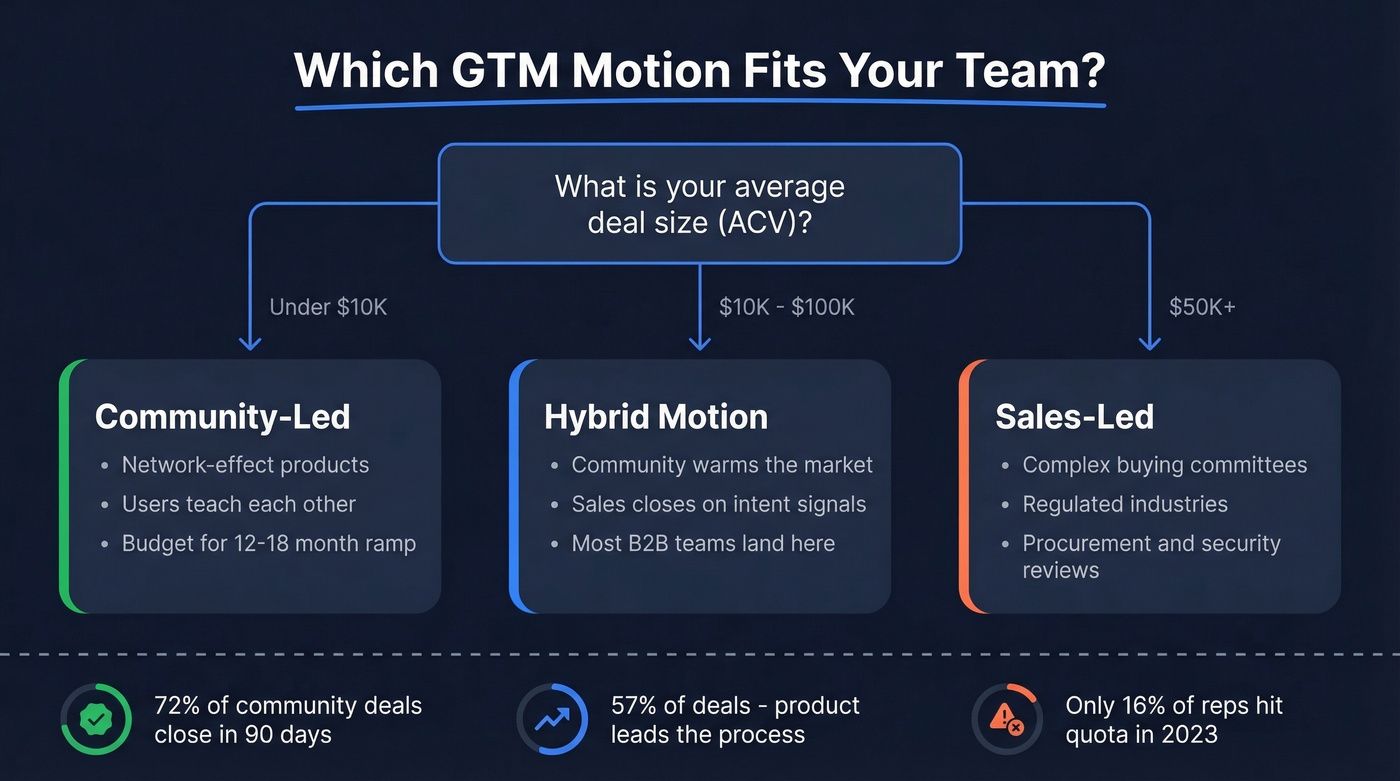
If your ACV is above $50K with complex buying committees, sales-led is typically your primary motion. If you're selling deals under $50K and burning budget on outbound with ~20% win rates, you should seriously consider community-led or a hybrid approach. Most B2B teams in 2026 need both - community to warm the market, sales to close when intent surfaces.
What Sales-Led Growth Looks Like Now
Sales-led growth isn't dying. But the environment it operates in has gotten brutally harder.
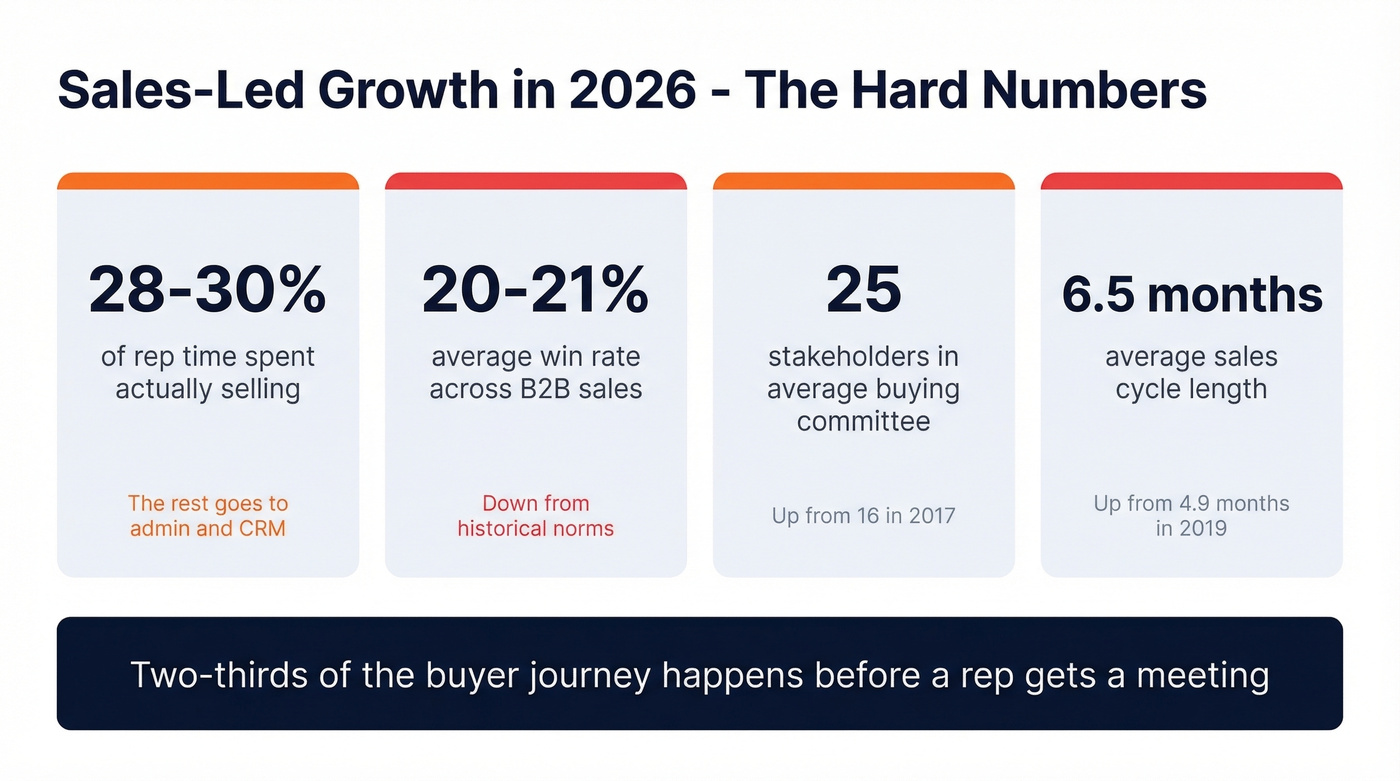
Two-thirds of the buyer's journey now happens before a rep ever gets a meeting. That single stat reshapes the entire sales-led GTM strategy. Reps spend only 28-30% of their time actually selling - the rest disappears into CRM admin, internal meetings, and chasing unqualified leads. The supporting numbers tell the same story: average buying committees have ballooned to 25 stakeholders (up from 16 in 2017), average sales cycles stretch to 6.5 months (up from 4.9 in 2019), and win rates hover around 20-21%.
We've seen teams burn six figures on outbound before realizing their ACV couldn't support it. Sales-led SaaS companies typically need ACV north of $50,000 to absorb CAC and cost-to-serve. The model fits regulated industries, complex implementations, and deals where trust and risk mitigation drive the close.
One of the clearest sales-led growth disadvantages is what happens when teams treat it like scaled lead gen - imprecise targeting, marketing/sales misalignment, or hiring reps ahead of product-market proof. If you're pushing outbound into a market that doesn't know you exist, you're burning cash and credibility at the same time.
What Community-Led Growth Actually Means
Here's a distinction most articles gloss over. "Community-supported" growth - think Salesforce Trailblazers or ServiceNow's expert communities - means a company adds community as a layer on top of an existing sales or product motion. "Community-led" growth - think early Figma, Notion, or Webflow building on Slack and Discord - means the community itself is the primary engine for acquisition, retention, and expansion. The difference matters because it changes what you measure and how long you wait for results.
True CLG works because peer trust compounds. 72% of community-influenced deals close within 90 days, compared to 42% for deals driven purely by sales and marketing. Gainsight's data shows community-engaged customers have 30% higher retention and are 2x as likely to enter upsell conversations.
The catch? Those numbers come from mature communities. Communities under five years old show lower engagement benchmarks, and most of the "3x upsells" and "92% retention" claims floating around Reddit come from people selling community platforms. Take them with a heavy grain of salt.

When reps only sell 28% of the time, every lead they touch has to count. Prospeo's 98% verified emails and 125M+ direct dials mean your sales-led motion connects with real buyers - not dead ends. At $0.01/email, your CAC stays sustainable even at lower ACVs.
Stop burning your sales team's time on bad data.
Side-by-Side Comparison
| Dimension | Sales-Led | Community-Led |
|---|---|---|
| Trust model | Rep-to-buyer | Peer-to-peer |
| Cost structure | High (reps + tools) | Low upfront, slow ROI |
| Time to ROI | Faster | ~12-18 months |
| Best-fit ACV | $50K+ | Under $50K |
| Measurement | Pipeline, quota, win rate | Engagement, attribution |
| Scalability | Linear (add reps) | Compounding (network) |
| Risk profile | High CAC if mis-targeted | Slow if engagement stalls |
| Best for | Complex deals with procurement cycles | Network-effect products where users teach each other |
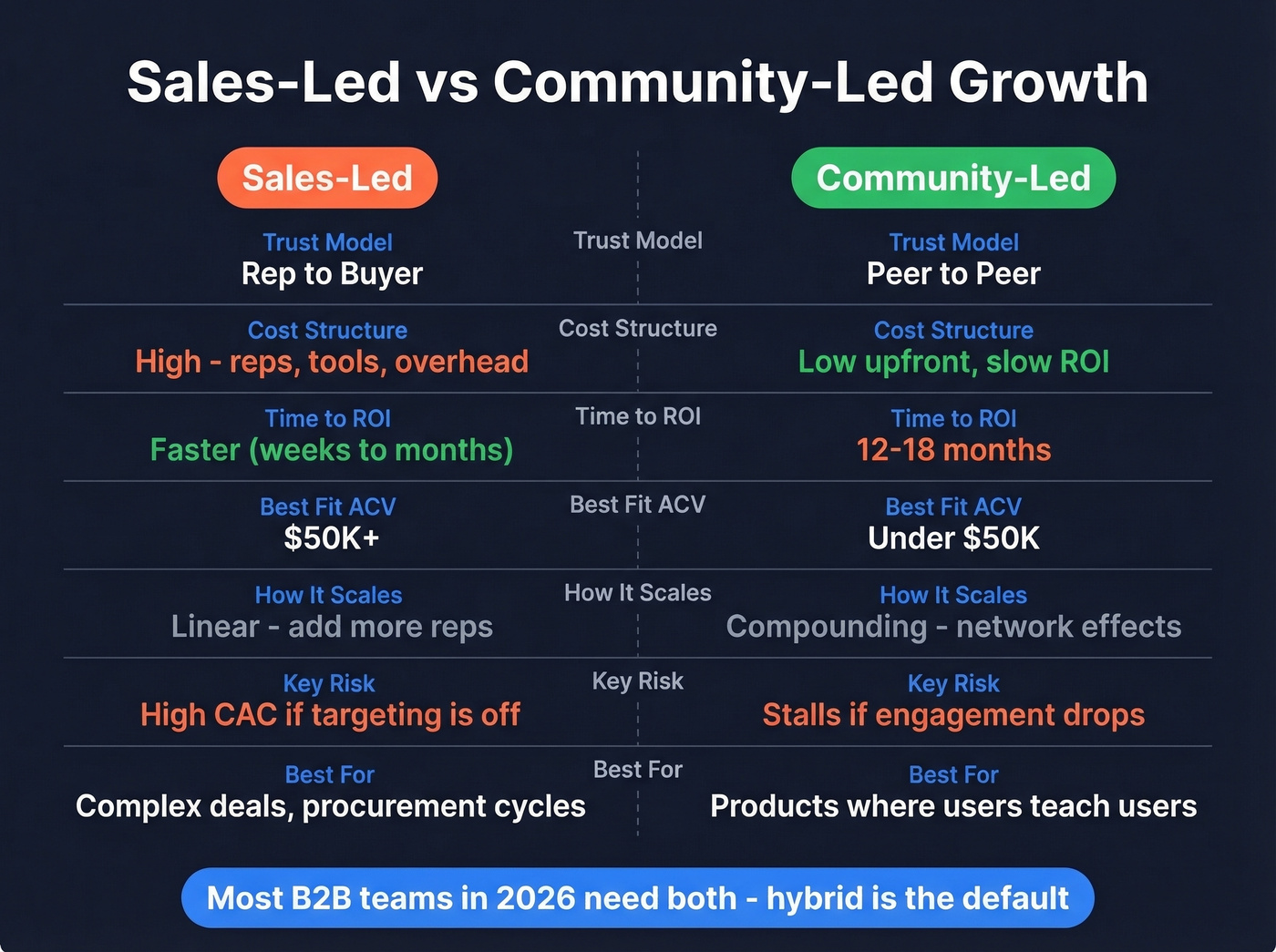
Choose sales-led for complex, high-ACV deals into buying committees that need hand-holding through procurement, security reviews, and implementation.
Choose community-led when your product has natural network effects, your users are passionate enough to teach each other, and you can invest 12-18 months before expecting meaningful pipeline.
Choose hybrid - and this is most B2B teams - when you need community to warm the market and build trust, but still need reps to close deals when intent surfaces. Gartner found the product itself leads the sales process in 57% of deals. The line between motions is already blurring, which is why a hybrid approach combining sales and community is becoming the default for mid-market SaaS.
Community-Led KPIs That Actually Matter
Most community teams track vanity metrics - member count, page views, total posts. These tell you almost nothing about business impact.
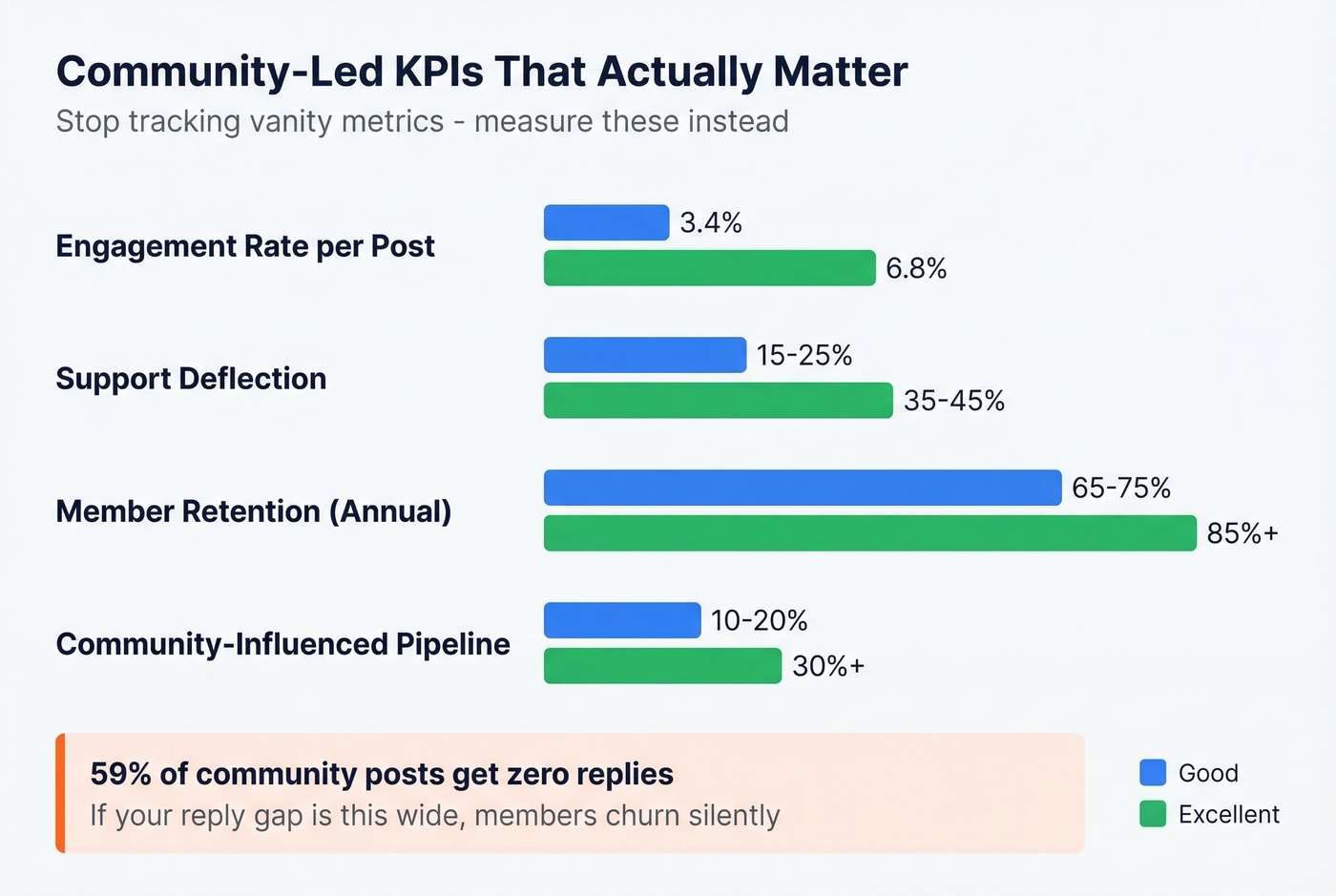
| Metric | Good | Excellent |
|---|---|---|
| Engagement rate/post | 3.4% | 6.8% |
| Support deflection | 15-25% | 35-45% |
| Member retention (annual) | 65-75% | 85%+ |
| Community-influenced pipeline | 10-20% | 30%+ |
Higher Logic's 2025 research adds critical context. The average community sees 563 unique logins and 68 contributors per month - meaning most members lurk. Email digest open rates hit 56% for daily consolidated sends, making digests one of the highest-leverage re-engagement tools available. And communities older than five years consistently outperform younger ones on engagement metrics, reinforcing that CLG is a compounding investment, not a quick win.
One stat that should alarm every community manager: 59% of community posts get no reply. If your community has a reply gap that wide, members churn silently. Engagement quality matters more than member volume - always.
The measurement framework that actually works distinguishes leading from lagging indicators. Leading indicators are things you can influence weekly: response speed, questions answered, member retention rate. Lagging indicators are what leadership cares about: CSAT, NPS, community-attributed revenue. Product-qualified leads and community-attributed leads serve as parallel measurement concepts - PQLs track product usage thresholds that signal buying intent, while community-attributed leads track members who appear in community before they become CRM opportunities. If you can't connect community identity to CRM records, you can't prove ROI for either.
Why Most Teams Need a Hybrid Motion
Let's be honest: if your average deal is under $10K, you probably don't need a sales-led motion at all. And if it's over $100K, you probably can't afford to skip one. The messy middle - $10K to $100K - is where the hybrid question actually matters, and it's where most B2B teams live.
The data supports going hybrid. That Gartner stat - product leading 57% of deals - tells you buyers want to self-educate. Community accelerates that. Teams using social selling see 16% higher win rates, and top performers create 45% more opportunities, which means the bridge between community engagement and sales execution is already being built by the best reps.
But when a community member signals buying intent, your sales team needs to act the same day. In our experience, the handoff from community signal to sales action is where hybrid motions break. Community warms the market, but when a member signals intent, your reps need a verified email and direct dial - not a connection request that sits unanswered for a week. Prospeo's 7-day data refresh cycle and 98% email accuracy mean your reps reach the right person within hours, with a phone number that actually connects.
Building a Hybrid Motion: Quick Playbook
Phase 1: Audit your current motion. Map your ACV, average cycle length, and win rate. If your win rate is under 20% and your cycle is stretching past six months, your targeting or your trust-building is broken. Community can fix the trust piece.
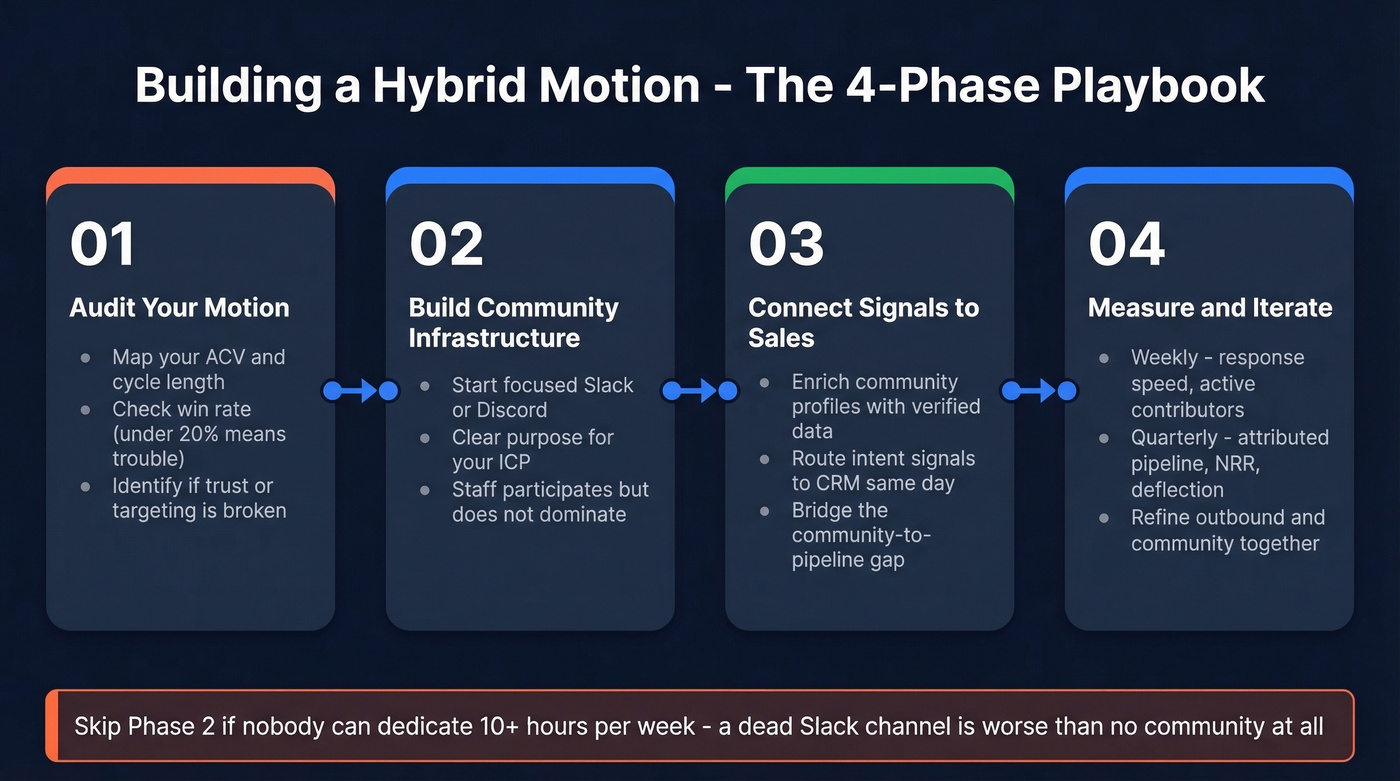
Phase 2: Build community infrastructure. Start with a focused Slack or Discord with a clear purpose - not "our community" but "a place where [your ICP] solves [specific problem] together." Create spaces for members to share work and resources. Staff should participate, not dominate.
Phase 3: Connect community signals to sales workflows. This is where most hybrid motions fail. You need to enrich community member profiles with verified contact data, then route to your CRM. Upload your community member list via Prospeo's CSV enrichment, get back verified emails and direct dials across 50+ data points, and push to HubSpot or Salesforce. Without this bridge, your community stays a nice-to-have instead of a pipeline source.
Phase 4: Measure and iterate. Track leading indicators weekly - response speed, questions answered, active contributors. Report lagging indicators quarterly - community-attributed pipeline, NRR by cohort, support deflection rate. Refine both your outbound and community metrics so the motions improve together.
Skip Phase 2 if you don't have someone who can dedicate at least 10 hours a week to community management. A dead Slack channel is worse than no community at all - it signals to your market that nobody cares.
Running a hybrid motion means community warms the market and sales closes when intent surfaces. Prospeo tracks 15,000 buyer intent topics so your reps engage the exact moment a community-nurtured prospect is ready to buy - no guessing, no wasted cycles.
Turn community engagement into closed deals with real-time intent signals.
FAQ
What's the difference between community-led and product-led growth?
Product-led growth uses the product itself - freemium tiers, self-serve trials - as the acquisition engine. Community-led growth uses peer relationships and member advocacy as the primary driver. Many companies layer both, and the broader GTM conversation increasingly treats community as a third pillar alongside product-led and sales-led motions.
How long does community-led growth take to produce pipeline?
Expect 12-18 months before community-attributed pipeline becomes meaningful. Communities under five years old consistently underperform on engagement benchmarks. If your board needs impact in 90 days, community alone won't deliver - pair it with outbound.
Can you run a hybrid motion with a small team?
Yes. Start with a low-maintenance Slack or Discord, use an enrichment tool to connect community signals to sales outreach, and keep the handoff automated. Teams of 2-5 reps can run hybrid effectively if the data workflow is tight.
When should you choose sales-led over community-led?
Sales-led wins for complex deals above $50K ACV with multi-stakeholder procurement and security reviews. Community-led wins for network-effect products under $50K where users teach each other. Most teams between $10K-$100K ACV should run both motions simultaneously.