

The Sales Manager Role: What It Actually Is, What It Pays, and Whether You Should Take It
You got the tap on the shoulder. "We want you to run the team." It sounds like a promotion, but what you're really signing up for is a career change - from closing deals to coaching humans, owning a forecast, and absorbing blame when the number comes in short. The sales manager role in 2026 looks nothing like the job description on your company's careers page.
What You Need (Quick Version)
Before we go deep, here are the three answers you're actually looking for:
- What does the job involve? A typical week is heavy on coaching and 1:1s, pipeline reviews, deal support, internal meetings, hiring, and admin. A big chunk of the role is emotional labor nobody warns you about.
- What does it pay? The BLS median is $138,060/year. SaaS sales managers typically pull $160K-$200K+ OTE. Retail and manufacturing sit lower, in the $75K-$130K range.
- Should you take it? If you genuinely enjoy developing people more than closing deals, yes. If you're taking it because it's the only path to more money, think twice. The IC-to-manager transition destroys more careers than quota misses.
What a Sales Manager Actually Does
The BLS defines sales managers as professionals who "plan, direct, or coordinate the delivery of a product or service to the customer." That's technically accurate and practically useless. Most job descriptions still read like they were written in 2015 - heavy on "developing sales strategies" and light on the actual work.
The role breaks down into three outcomes you're accountable for:
- Revenue delivery. You own the number. Not just your reps' individual quotas, but the aggregate team target. When the VP asks why you're 15% behind plan at mid-quarter, that's your conversation to have.
- Team development. Hiring, onboarding, coaching, performance-managing, and occasionally firing. Your reps' growth trajectory is your responsibility. A team of B-players who never improve is a management failure, not a recruiting one.
- Forecast accuracy. The ability to call your number within a tight margin, every quarter, is what separates good managers from great ones. It requires deep pipeline knowledge and the willingness to have uncomfortable conversations about deals that aren't real.
The day-to-day tasks - setting goals, monitoring progress, resolving escalated customer complaints, approving budgets, coordinating training - all ladder up to those three outcomes. Responsibilities scale with org size: at a 20-person startup, you're player-coaching and running deals yourself. At a 500-person company, you might manage regional managers who manage the reps. Specializations matter too. Inside sales managers, enterprise sales managers, regional managers, and e-commerce sales managers all carry the same title but run very different operations.
Here's the thing nobody puts in the job description: a huge part of this job is being an emotional shock absorber. You're managing egos, absorbing frustration from reps who missed quota, navigating politics with your VP, and having hard conversations about performance. It's real and constant.
A Typical Week of Duties
The calendar is a war zone. Every stakeholder wants a piece of your time, and the work that actually moves the needle - coaching - is the easiest to deprioritize.
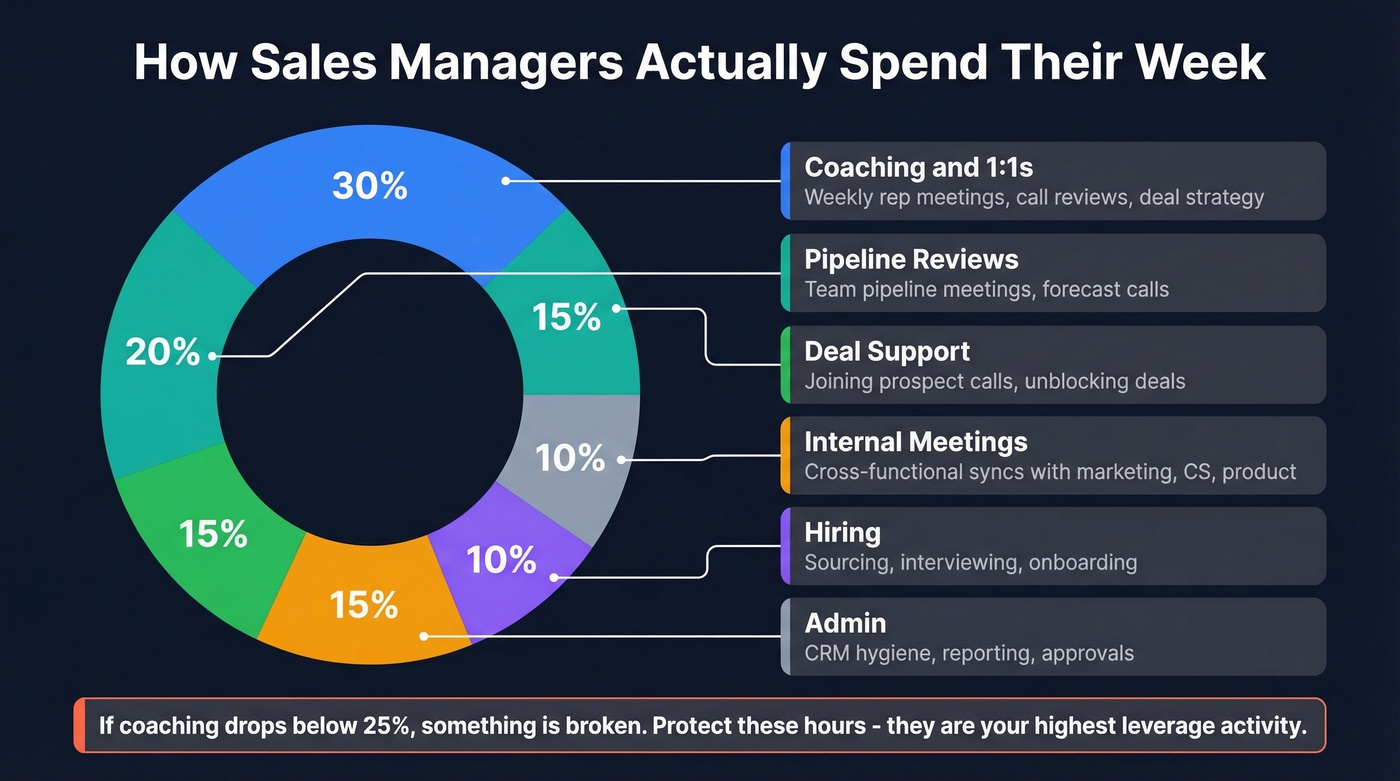
Here's a typical split we've seen across dozens of teams:
| Activity | % of Week | What It Looks Like |
|---|---|---|
| Coaching & 1:1s | ~25-35% | Weekly rep 1:1s, call reviews, deal strategy sessions |
| Pipeline reviews | ~15-25% | Team pipeline meetings, forecast calls with leadership |
| Deal support | ~10-20% | Joining prospect calls, unblocking stalled deals |
| Internal meetings | ~10-20% | Cross-functional syncs with marketing, CS, product |
| Hiring | ~5-15% | Sourcing, interviewing, onboarding new reps |
| Admin | ~5-15% | CRM hygiene, reporting, expense approvals |
If your coaching time consistently drops below 25%, something's wrong. Either you're drowning in admin that should be automated, or you're spending too much time in internal meetings that don't move pipeline. Protect the coaching hours - they're the highest-leverage activity on your calendar.
Manager vs. Director vs. VP
These titles get thrown around loosely, especially at startups. Here's how they actually break down in a well-structured org:
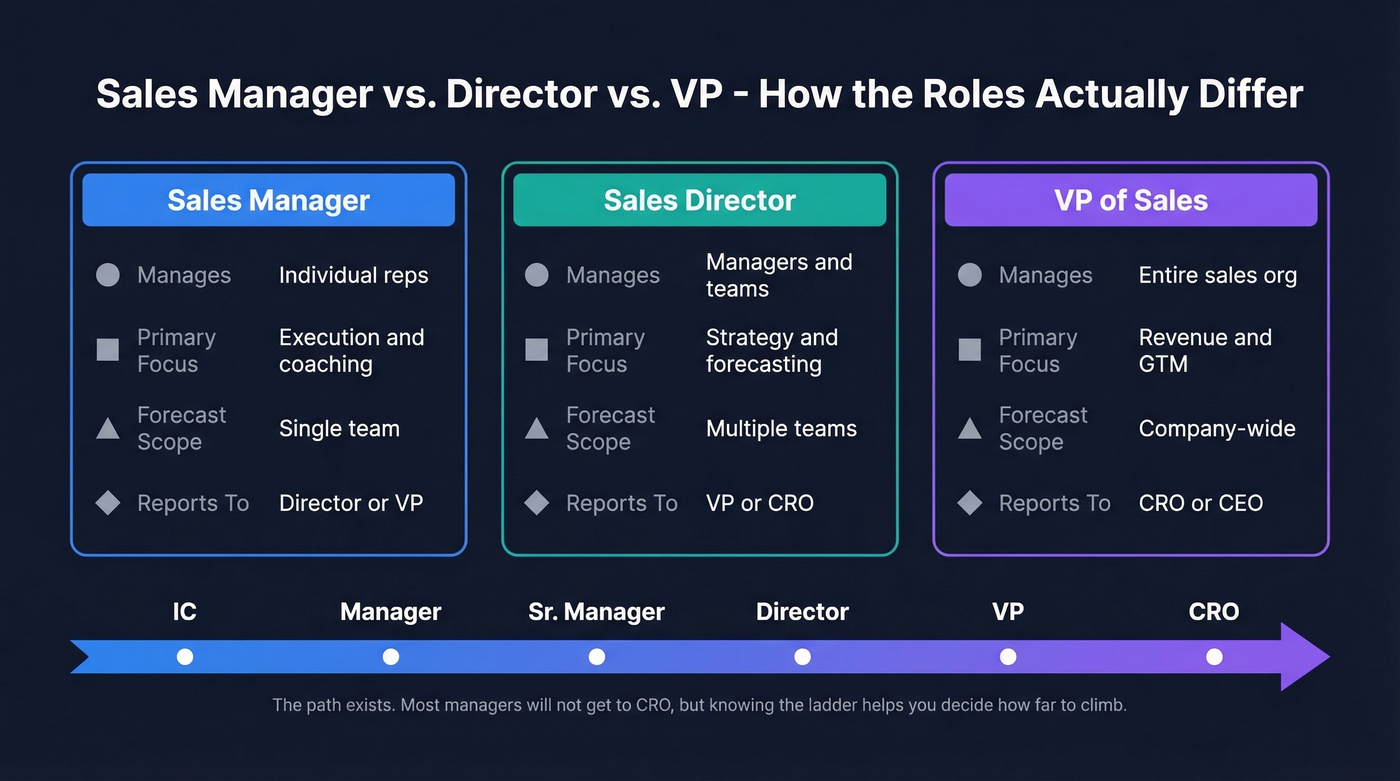
| Dimension | Sales Manager | Sales Director | VP of Sales |
|---|---|---|---|
| Manages | Individual reps | Managers + teams | Entire sales org |
| Focus | Execution & coaching | Strategy & forecasting | Revenue & GTM |
| Forecast scope | Single team | Multiple teams | Company-wide |
| Reports to | Director or VP | VP or CRO | CRO or CEO |
The clearest way to understand the difference is through scenarios. A manager notices a rep's close rate dropped and schedules weekly role-plays to rebuild their discovery skills. A director sees pipeline coverage across three teams trending below target and reallocates headcount from a mature territory to a growth segment. A VP identifies that the company's average deal size needs to increase to hit board targets and restructures the comp plan to incentivize enterprise deals.
At the top of the ladder sits the CRO, who owns the full revenue engine - sales, CS, sometimes marketing. The path exists: IC, Manager, Senior Manager, Director, VP, CRO. Most managers won't get there, but knowing the ladder helps you decide how far you want to climb.
KPIs Every Manager Owns
Not every metric is a KPI. Salesforce makes this distinction well: metrics are any quantifiable measure, while KPIs are the subset tied to significant business outcomes. As McKinsey has noted, too much data without focus makes it impossible for sales leaders to reach clear decision points. Tracking dozens of metrics in a dashboard means you can't prioritize any of them.
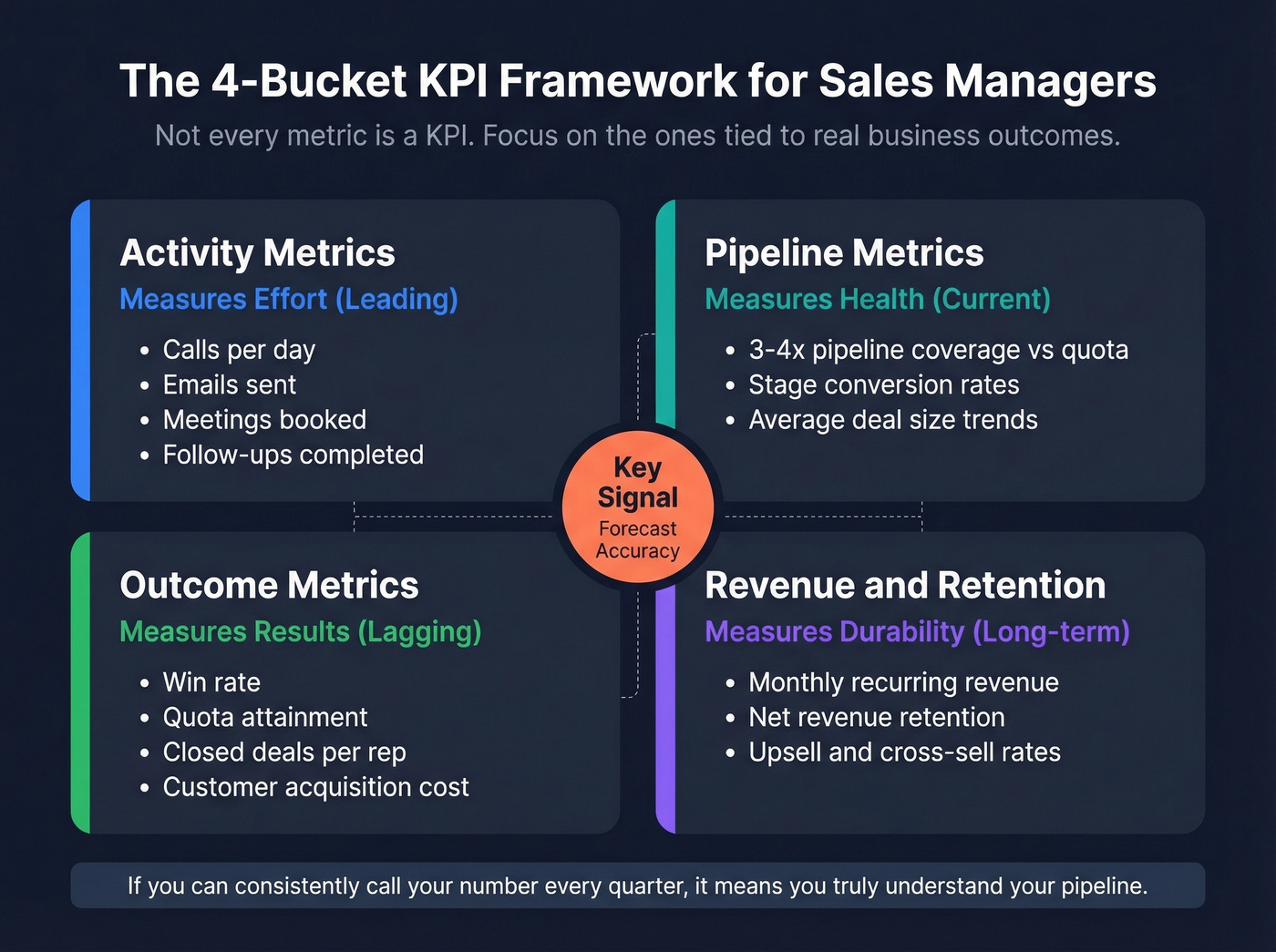
Here's the four-bucket framework that actually matters:
Activity metrics measure effort. Calls per day, emails sent, meetings booked, follow-ups completed. These are leading indicators - they tell you whether reps are doing enough work before the results show up. If your team's email bounce rate is high, that's not a rep problem. It's a data problem. Tools like Prospeo that verify emails before they enter your CRM eliminate this at the source with 98% accuracy and a 7-day refresh cycle. Fix the data before you blame the effort.
Pipeline metrics measure health. A common target is 3-4x pipeline coverage vs. quota - once you're below the low end of that range, you're hoping, not forecasting. Stage conversion rates tell you where deals stall. Average deal size trends reveal whether reps are selling up or discounting down.
Outcome metrics measure results. Win rate, quota attainment, closed deals per rep, customer acquisition cost. These are lagging indicators. By the time they look bad, the damage is done.
Revenue and retention metrics measure durability. Monthly recurring revenue, net revenue retention, upsell/cross-sell rates. These matter most in SaaS and subscription businesses where the real money is in expansion, not just new logos.
If we had to pick one KPI that separates great managers from average ones, it's Forecast accuracy. Consistently calling your number quarter over quarter means you truly understand your pipeline. Everything else - coaching, deal support, hiring - flows from that understanding.

You read it above: if your team's email bounce rate is high, that's not a rep problem - it's a data problem. Prospeo's 98% verified emails and 7-day refresh cycle mean your reps spend time selling, not chasing dead contacts. At ~$0.01 per email, it costs less than one wasted hour of rep time.
Stop coaching effort when the real problem is bad data.
How Great Managers Coach
Coaching is the most important skill you can develop in this position. It's also the skill most managers are terrible at. They default to "telling" - jumping on a call, taking over, closing the deal themselves - instead of developing the rep's ability to do it independently.
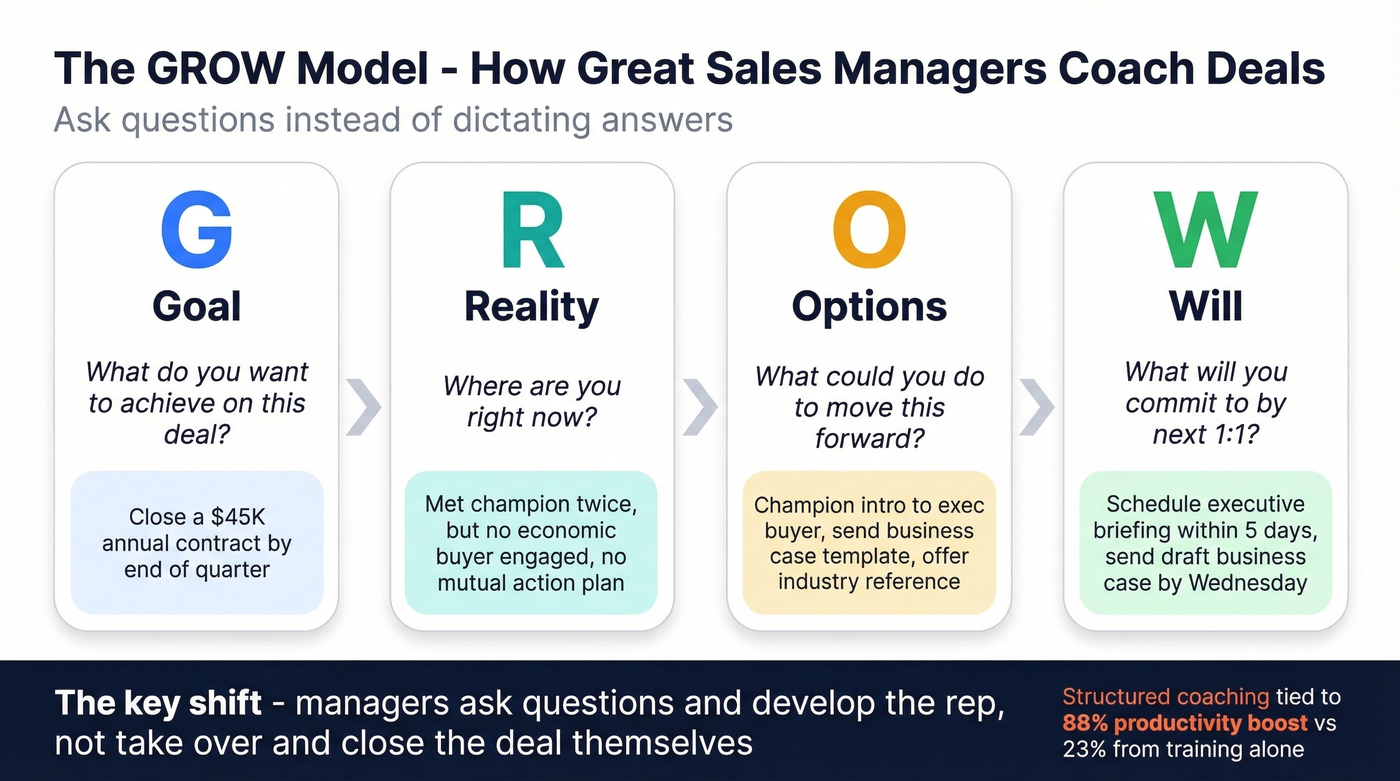
Structured coaching has been tied to an 88% boost in productivity versus 23% from training alone. Teams with a structured coaching process are also associated with stronger win rates on forecasted deals and higher quota attainment. And yet, 79% of reps say coaching or training would help them advance their careers. The gap between what reps need and what managers deliver is enormous.
The GROW model is the most practical framework for sales coaching. Let's walk through it with a real deal:
Goal: "What do you want to achieve on this deal?" The rep says they want to close a $45K annual contract by end of quarter. Good - that's specific and time-bound.
Reality: "Where are you right now?" The rep has met with the champion twice but hasn't engaged the economic buyer. The procurement team hasn't been looped in. There's no mutual action plan.
Options: "What could you do to move this forward?" Brainstorm together. Could the champion introduce the economic buyer? Could you offer a business case template? Is there a reference customer in the same industry? The manager asks questions rather than dictating answers.
Will: "What will you commit to doing by our next 1:1?" The rep commits to scheduling an executive briefing within five days and sending a draft business case by Wednesday. Now you've got something concrete to follow up on.
The AI layer is changing coaching mechanics fast. Tools now track talk-to-listen ratios, flag missed discovery questions, and generate post-call analysis with specific coaching moments highlighted. Reviewing 15 calls per week manually is doing 2015-era coaching. In 2026, AI surfaces the handful of calls that need your attention and tells you exactly where to focus.
The Tech Stack You'll Need
The first problem you'll discover when you inherit a sales team isn't rep performance. It's data. Half the contacts in your CRM bounce when reps email them. Phone numbers are disconnected. Company data is six months stale. Fixing your data layer is the first thing to do when you take over a team - everything else compounds on top of it.
The core stack breaks into five categories:
CRM. Salesforce remains the default for mid-market and enterprise, starting around ~$25/user/mo on entry tiers. HubSpot works well for SMBs - free tier to get started, with paid Sales Hub tiers that scale as you add features and seats. Pick one, configure it properly, and enforce data hygiene from day one.
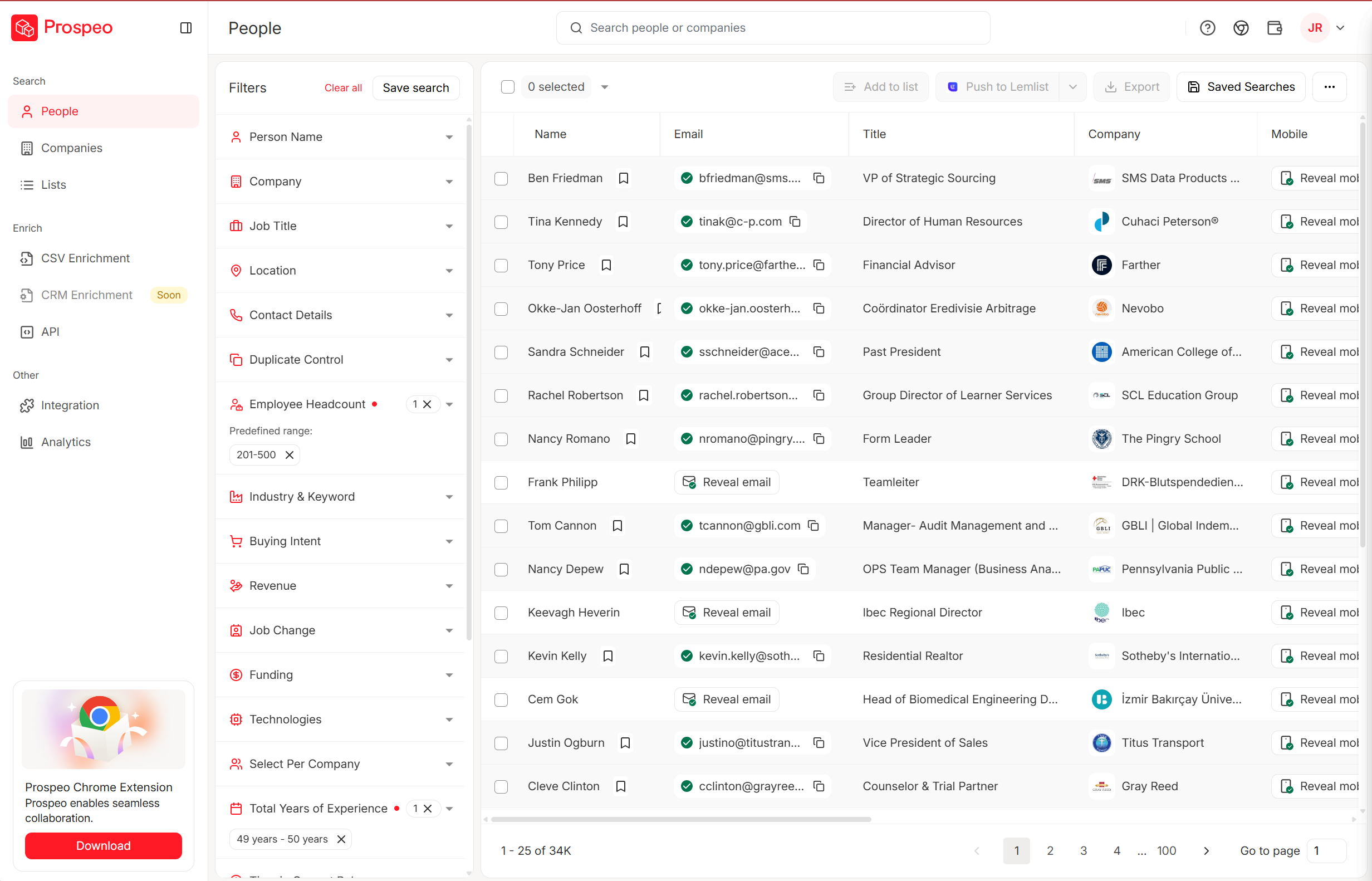
Prospecting and data. This is where most teams leak money. Prospeo covers 300M+ professional profiles with 98% email accuracy and a 7-day data refresh cycle - which matters because the industry average is six weeks. Your reps can search with 30+ filters including buyer intent and technographics, export verified contacts, and push them straight into Salesforce or HubSpot. The free tier gives you 75 verified emails per month to test before committing.
Engagement. Outreach and Salesloft handle sequencing, call tasks, and multi-channel cadences. Both typically run ~$100+/user/mo. Pick based on your CRM integration depth and whether your team runs primarily email-first or phone-first motions.
Coaching and conversation intelligence. Gong remains the category leader for call recording, analysis, and deal intelligence. Chorus, now part of ZoomInfo, is the main alternative. These tools give you the data to coach with specifics instead of gut feel.
Forecasting. Clari is the standalone leader for revenue intelligence and forecast management. Salesforce's native forecasting works for simpler orgs. The goal is a single source of truth for your commit number - not a spreadsheet that three people update differently.
Pipeline coverage below 3x? Your reps need more at-bats with real decision-makers. Prospeo gives sales managers 300M+ profiles with 30+ filters - buyer intent, headcount growth, technographics - so you can build targeted lists that actually convert. Teams using Prospeo book 26% more meetings than ZoomInfo users.
Build the pipeline your forecast depends on.
How AI Is Reshaping the Role
The sales manager role in 2026 isn't the same job it was in 2023. AI hasn't replaced the position, but it's fundamentally reshaping what you spend your time on.
The economics tell the story. A fully loaded human SDR costs $75K-$100K per year and generates roughly 15-20 qualified opportunities per month. An AI SDR platform runs $500-$2,000/month and can produce 40-60 qualified opportunities monthly. The AI SDR market is projected to grow from $4.27B to $18.19B by 2032. That's not a trend you can ignore.
What this means for managers: you're no longer just managing humans. You're orchestrating a hybrid workforce of people and AI agents. Your SDR team might shrink from eight humans to four humans plus two AI SDR tools. Your job is figuring out which leads need a human touch and which can be handled by automation.
The workflow shifts are already happening. CRM updates that used to eat 30 minutes per rep per day now happen automatically - call summaries with action items and sentiment analysis get logged without anyone typing a word. Lead scoring that relied on gut feel now runs on predictive models analyzing hundreds of signals. Email personalization that took 10 minutes per prospect now takes seconds.
McKinsey's State of AI report found that 88% of companies now use AI regularly in at least one business function. In sales specifically, 23% of companies have scaled an agentic AI system in at least one function. The manager's focus shifts from administrative oversight to strategic orchestration - less time updating spreadsheets and chasing reps for CRM notes, more time coaching on complex deals and deciding how to allocate human versus AI resources across the pipeline.
Salary and Compensation
The BLS median for sales managers is $138,060/year. That number masks enormous variation by industry, geography, and sales motion.
Most positions pay 70-85% base salary with 15-30% variable through bonuses, commissions, and accelerators. A manager earning $100K base with $25K variable has a $125K OTE. Senior managers at enterprise SaaS companies push well past $200K OTE.
| Industry | Base Range | OTE Range |
|---|---|---|
| SaaS / Tech | $110K-$140K | $160K-$200K+ |
| Financial Services | $90K-$120K | $120K-$160K |
| Manufacturing | $80K-$100K | $100K-$130K |
| Retail | $60K-$80K | $75K-$100K |
The gap comes down to variable pay mechanics. SaaS sales managers typically earn commissions at 10-12% of annual contract value. Retail commissions run 1-5% of sale price. Financial services sits in a wide 5-20% band - insurance products cluster at 5-8%, while wealth management can hit 15-20%. Manufacturing falls in the 2-10% range based on deal complexity.
Here's our hot take: if you're a top-performing IC making $180K OTE and the management position pays $160K OTE with less upside, the math doesn't work unless you genuinely want to build a career in leadership. Too many reps take the title bump without running the numbers, then spend two years earning less while working harder. Run the math before you accept.
How to Become One (and Survive Year One)
Most sales managers get promoted from individual contributor roles. A bachelor's degree is typical but not required - we've seen plenty of managers who got there on performance and experience alone. What matters more than credentials is whether you've demonstrated the ability to influence peers, think systematically about pipeline, and develop others.
The IC-to-manager transition is where careers go to die. The most common mistakes:
- Staying in "super rep" mode. You jump on every deal, close it yourself, and wonder why your team isn't developing. Your job is to make your reps better, not to be the best rep on the team.
- Weak coaching cadence. Skipping 1:1s because you're "too busy" is the fastest way to lose your team's trust and miss pipeline problems early.
- Avoiding hard conversations. That underperforming rep who's been on the team for two years? Address it in your first month, not your first year.
- Poor hiring. One bad hire costs you 6-9 months of lost productivity. Invest disproportionate time in recruiting.
The hardest part isn't learning new skills. It's unlearning the instinct to do everything yourself. That instinct is what made you a great IC. It'll make you a terrible manager.
Your First 90 Days
Weeks 1-2: Audit the pipeline. Identify what's real, what's fluff, and where the gaps are. Don't change anything yet - just listen and learn.
Weeks 3-4: Run deep 1:1s with every rep. Understand their strengths, weaknesses, deal strategies, and motivations. Map the talent.
Month 2: Fix data hygiene - this is where most inherited pipelines are rotting. Establish a consistent forecast rhythm and set CRM standards. If your team's contact data is stale, skip this if you want to keep bleeding pipeline to bounced emails and disconnected numbers. Otherwise, clean it up fast.
Month 3: Make decisions. You should now have a clear picture of who's performing, who needs coaching, and who might not make it. Act on it.
Job Outlook and Career Ladder
The BLS projects 5% growth for sales managers from 2024 to 2034, faster than average for all occupations. There are currently 619,500 positions in the US with roughly 49,000 openings per year, driven mostly by replacement demand as managers retire or move up.
Some context: about 55,000 AI-linked layoffs hit in 2025, and some of those touched sales orgs. But the World Economic Forum projects a net gain of 78 million jobs globally by 2030, with "salespersons" listed among roles with the largest absolute growth. The role isn't going away. It's evolving.
The career ladder looks roughly like this:
IC (1-3 years) -> Sales Manager (2-4 years) -> Senior Manager (1-3 years) -> Director (2-4 years) -> VP of Sales (3-5 years) -> CRO
Each jump requires demonstrating competence at the next level before you get the title. The best advice: start managing before you have the title. Mentor junior reps, lead pipeline reviews, volunteer for cross-functional projects. The promotion follows the behavior, not the other way around.
FAQ
What's the difference between a sales manager and a sales director?
Sales managers coach individual reps and run day-to-day pipeline operations - weekly 1:1s, deal reviews, forecast commits for their team. Directors set strategy across multiple teams, allocate resources, and forecast revenue at the department level. Think execution versus orchestration.
How much do sales managers make in SaaS?
SaaS sales managers typically earn $110K-$140K base with $160K-$200K+ OTE. The higher variable pay comes from commission structures pegged at 10-12% of annual contract value, plus accelerators for exceeding quota. Enterprise roles in major metros push even higher.
What skills matter most for a new sales manager?
Coaching, forecast accuracy, and hiring judgment. Closing ability - the skill that got you promoted - matters least once you're managing. The best new managers invest heavily in developing others rather than continuing to be the team's top closer.
What's the core responsibility of a sales manager?
Delivering the team's revenue number while developing the people who produce it. Everything else - pipeline reviews, forecast calls, hiring, admin - exists to support those two outcomes. If your team hits quota but nobody grows, or everyone grows but the number comes in short, you haven't done the job.
Will AI replace sales managers?
No, but AI is reshaping the role significantly. It handles data entry, lead scoring, call analysis, and routine outreach. Managers shift toward coaching, strategy, and orchestrating human plus AI resources. The managers who thrive in 2026 treat AI as a force multiplier, not a threat.