

How to Build a Sales Mentoring Program That Actually Works in 2026
There's a post on r/sales - "Where and how do I find a sales mentor?" - with zero useful replies. That pretty much sums up the state of sales mentoring advice online: everyone agrees it matters, nobody explains how to build a program that actually delivers results.
Whether you're a rep looking for guidance or a leader designing a mentorship initiative from scratch, here's the framework we wish someone had handed us five years ago.
Mentoring vs. Coaching vs. Training
These get conflated constantly. They're different levers, and confusing them is how programs get designed wrong from the start.
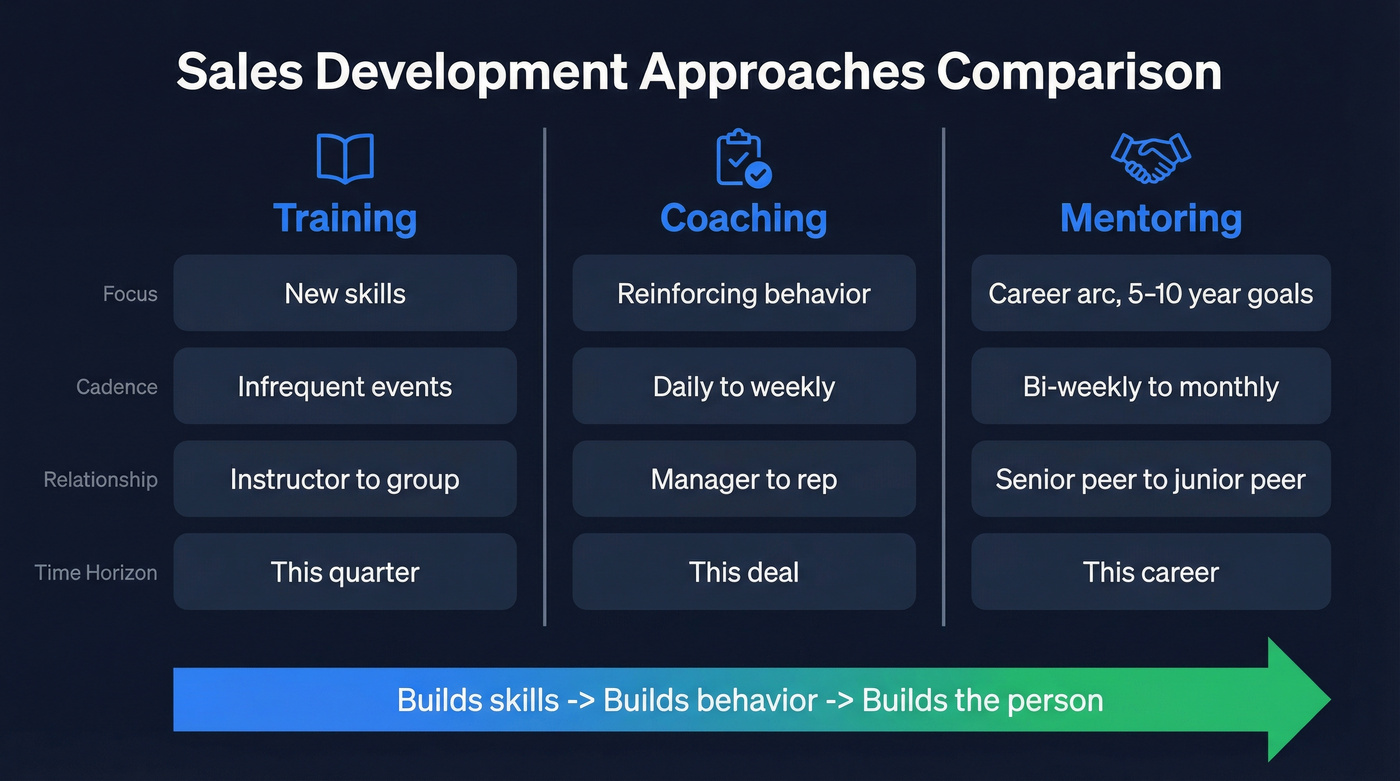
| Training | Coaching | Mentoring | |
|---|---|---|---|
| Focus | New skills | Reinforcing behavior | Career arc, 5-10 year goals |
| Cadence | Infrequent events | Daily to weekly | Bi-weekly to monthly |
| Relationship | Instructor to group | Manager to rep | Senior peer to junior peer |
| Horizon | This quarter | This deal | This career |
Training builds skills. Coaching builds behavior. Mentoring builds the person. Teams investing in both coaching and training see reps ramp 30-50% faster per Sandler's research, but mentoring is what makes that development stick long enough to show up in retention and internal mobility numbers.
The Business Case
76% of professionals say mentors are important, but only 37% actually have one. That gap between wanting mentorship and getting it is where most organizations sit - spending on development but failing to connect the dots. The global sales training market is projected to nearly double to $19B by 2032, yet most companies still can't prove their programs work.
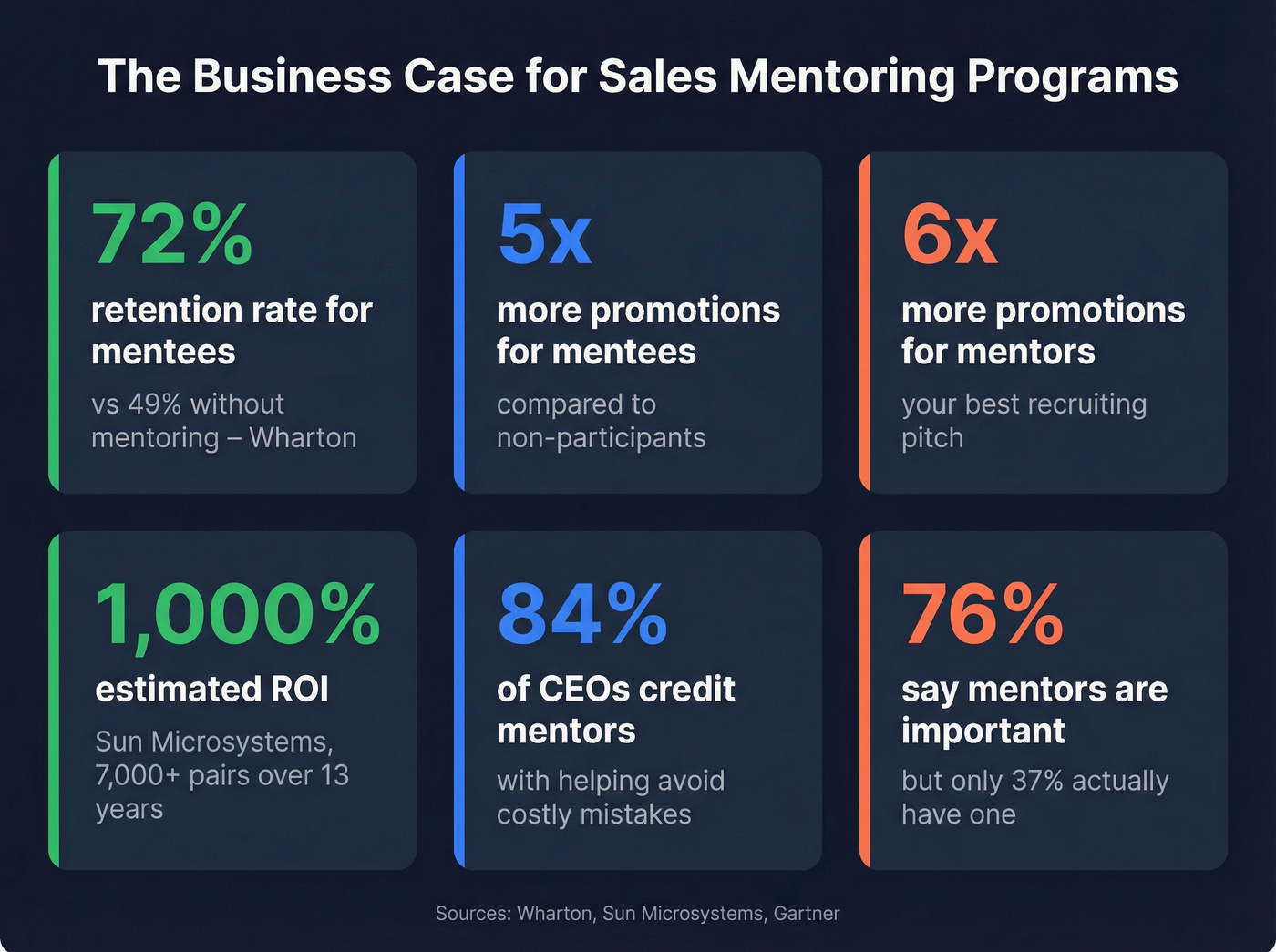
The numbers for programs that do work are hard to argue with. Wharton research shows retention rates of 72% for mentees versus 49% for non-participants. Mentees get promoted 5x more often. Here's the kicker: mentors get promoted 6x more often, which is your best recruiting pitch when asking senior reps to volunteer their time. And 84% of CEOs credit mentors with helping them avoid costly mistakes early in their careers.
Sun Microsystems ran a mentor program across more than 7,000 pairs over 13 years. Mentees saw a 33% annual promotion rate versus 15% for non-participants, and turnover dropped to 6.2% versus 7.3%. The estimated ROI was 1,000%.
Let's be honest: most sales leaders treat mentoring as a nice-to-have culture initiative. It's not. It's the single highest-leverage retention tool you have. Replacing a ramped rep costs 6-9 months of salary. A structured mentorship program costs lunch money by comparison.
How to Find a Sales Mentor
If you're an individual rep, don't overthink this.
Look backward first. Former managers, senior colleagues from past roles, people you've worked deals with. They already know your strengths and gaps, which means you skip the awkward getting-to-know-you phase and jump straight into real development conversations.
Be specific in your ask. Don't send "will you be my mentor?" That's vague and puts the burden on them to define the relationship. Instead: "I'm trying to break into enterprise sales and I'd love 30 minutes a month to talk through deal strategy. Would you be open to that?" Specificity shows respect for their time.
Try a marketplace if your network is thin. MentorCruise runs $150-500/mo for 1:1 mentoring. SCORE offers free mentoring for seller-founders. You can also approach people at industry events - a genuine compliment about their talk plus a specific question goes further than any cold DM.
Be patient. The best mentoring relationships form organically. Structure helps when you're starting from zero, but don't force a connection that isn't there.
How to Build an Internal Program
This section is for sales leaders and enablement teams. We've seen internal programs work beautifully and fail spectacularly - the difference is almost always in the design phase, not the execution.
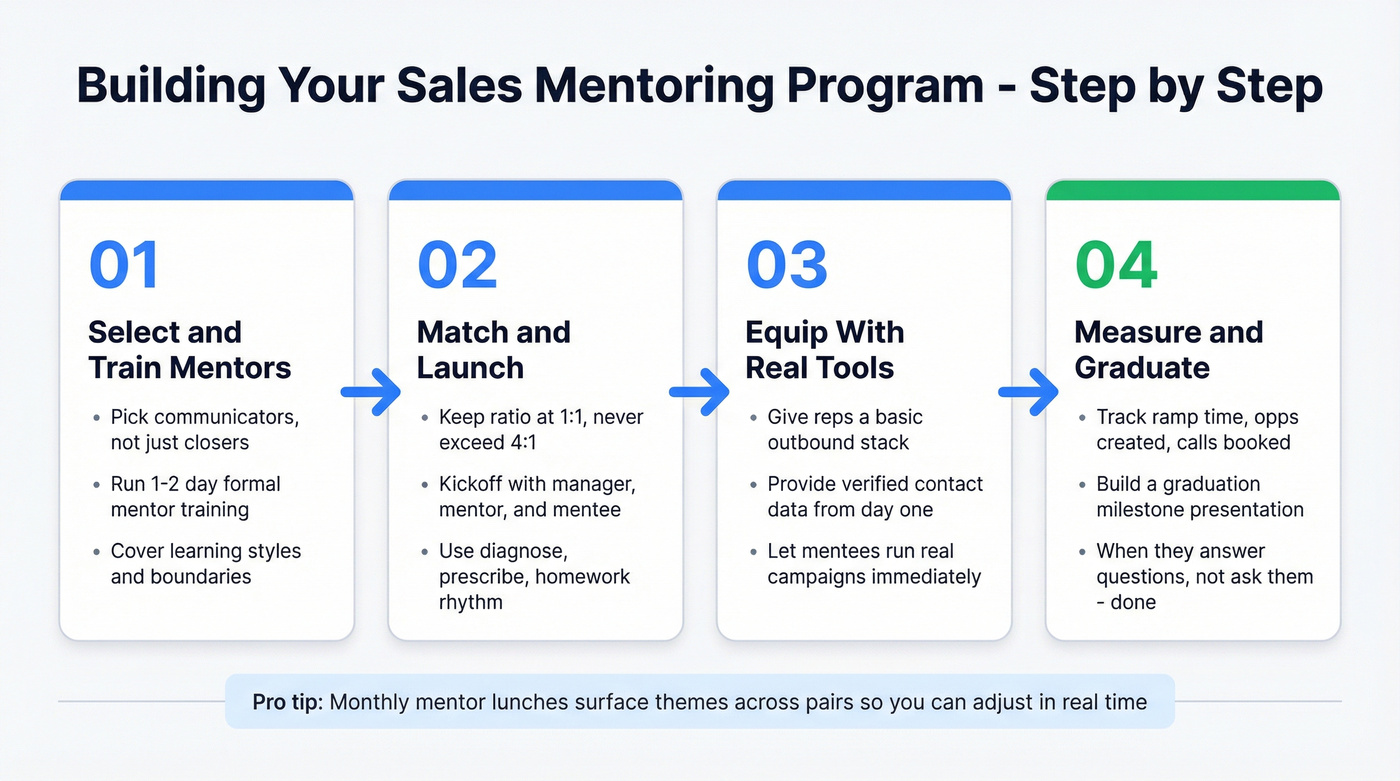
Select and Train Mentors
Don't just pick your top closer. The best mentors are senior reps with strong communication skills, leadership instincts, and the patience to teach rather than just tell. Look for people with unique techniques they can articulate, not just replicate - someone who closes big deals but can't explain how they do it won't help a mentee much.
Run a formal 1-2 day mentor training before launch. Cover learning styles, boundaries, and role-play scenarios, including what to do when a mentee becomes over-dependent. This step gets skipped constantly. It's a fast path to mentor fatigue and quiet program death.
Match and Launch
One-to-one is ideal. If you've got a large new-hire class, never exceed 4:1 - beyond that, it's group coaching by another name and you lose the accountability that makes mentoring work.
Start with a kickoff conversation that includes the manager, mentor, and mentee together. Structure the first real session around diagnosis: what's working, what's not, what's the immediate goal. End every session with a specific homework assignment. This "diagnose, prescribe, homework" rhythm keeps the relationship productive instead of drifting into casual coffee chats that feel good but change nothing.
Hand over a printed playbook with skills sequenced by day 1 versus day 90. Monthly mentor lunches help surface themes across pairs so you can adjust the program in real time rather than waiting for a quarterly review to discover half your matches aren't clicking.
Equip Mentees With Real Tools
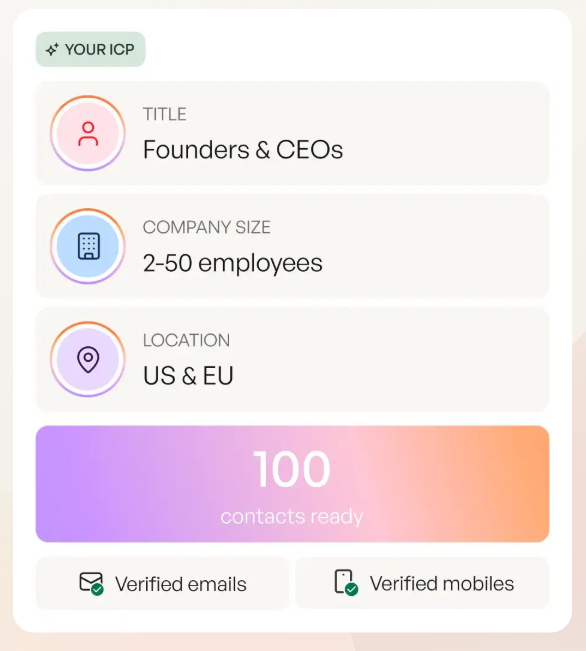
Mentoring teaches strategy, but strategy without tools is just theory. Give every new rep the basic outbound stack so they can start real prospecting immediately. A free tier from a tool like Prospeo gives mentees 75 verified emails per month - enough for real campaigns from day one without waiting for a data budget approval.
Measure and Graduate
Track ramp time, opportunities created, calls booked, time to close, and mentee feedback scores. The measurement gap is real: 90% of organizations have enablement programs, but only 25% can prove they work. If you're not tracking, you're guessing.
Without a defined exit strategy, mentees never stop leaning. Build a graduation milestone - the mentee presents what they've learned to the team. When they shift from asking questions to answering them, the program worked.

A mentoring program teaches reps how to prospect. Prospeo gives them the data to actually do it. With 98% email accuracy and 125M+ verified mobiles, your mentees stop practicing on dead leads and start building real pipeline from week one.
Every new rep gets 75 free verified emails per month - no budget approval needed.
What It Actually Costs
| Type | Price Range | Example |
|---|---|---|
| Free community | $0 | SCORE |
| Marketplace 1:1 | $150-500/mo | MentorCruise |
| Group coaching | $300-600/mo | Various |
| Placement program | $500 + $5K success fee | TechSalesMentors |
| Private 1:1 coach | $200-600/hr | Independent |
| Enterprise software | $5K-50K+/yr | Qooper, Together, Chronus |
A Reddit thread broke down the economics of group coaching bluntly: $600/mo times 100 students equals $60K/month for two hours of work. Teaching sales is more lucrative than doing sales. That doesn't mean every program is a scam, but ask hard questions about what you're getting for the money. If the "mentor" has never carried a quota, skip it.
Common Failure Modes
Here's where programs die:
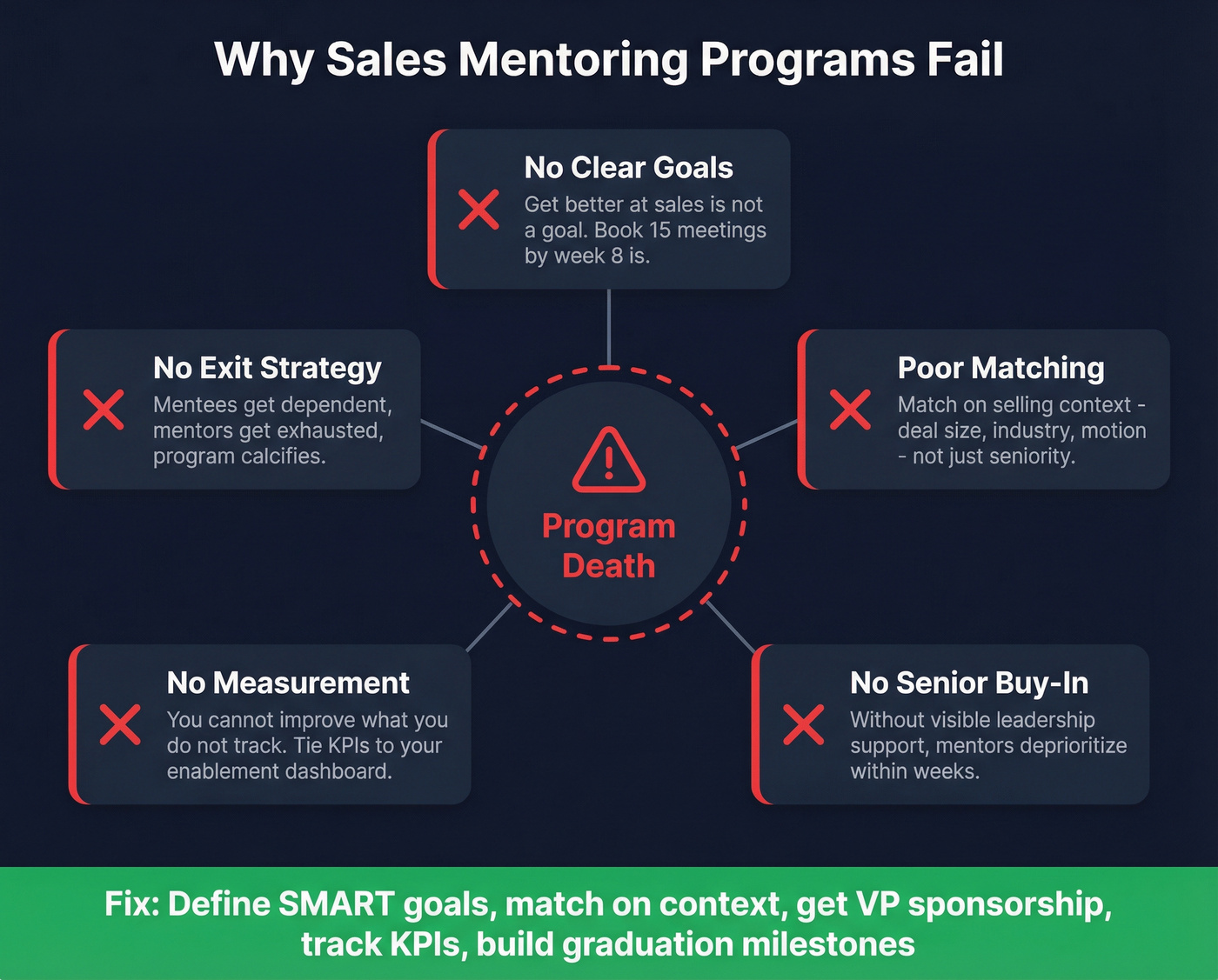
No clear goals. "Get better at sales" isn't a goal. "Book 15 meetings independently by week 8" is. Define SMART objectives before matching, and revisit them monthly.
Poor matching. A bad match is worse than no mentor at all. Match on selling context - deal size, industry, sales motion - not just seniority. An enterprise AE mentoring an SMB SDR creates more confusion than clarity.
No senior buy-in. If leadership doesn't visibly support the program, mentors deprioritize it within weeks. Have a VP sponsor who checks in quarterly and shows up to graduation events.
No measurement. You can't improve what you don't track. Tie mentoring KPIs to the same dashboard as your other enablement metrics so the program gets the same scrutiny and investment as everything else.
No exit strategy. Mentees become dependent, mentors get exhausted, the program calcifies. Build graduation milestones from day one so everyone knows what "done" looks like.
Best Practices That Keep Programs Alive
Set expectations in writing before the first session - goals, cadence, duration, and what success looks like for both parties. This sounds obvious, but in our experience, fewer than half of programs do it.
Rotate mentors after the initial program cycle so mentees get exposure to different selling styles and perspectives. A rep who only learns one approach to discovery is fragile; a rep who's absorbed three different frameworks can adapt to any buyer.
Create a feedback loop where mentees evaluate the mentoring experience quarterly, giving leadership data to iterate on. And recognize mentors publicly - promotions, awards, or simply a shoutout in the all-hands. Visibility keeps participation high when the initial enthusiasm fades.
Close the Execution Gap
The gap between "knowing what to do" and "having verified prospects to do it with" is where new reps stall. I've watched this happen too many times: a mentor spends an hour coaching a rep through a perfect cold email sequence, the rep sends 50 messages, 20 bounce, and their confidence tanks before they've even had a real conversation with a prospect.
GreyScout cut rep ramp time from 8-10 weeks to 4 weeks by pairing mentoring with accurate contact data. The lesson is simple: give every new rep a verified data source on day one. When the data works, the mentoring compounds. When it doesn't, even the best coaching in the world can't overcome a 35% bounce rate.

You're investing in ramp time, mentor hours, and enablement programs. Don't let bad data waste all of it. Prospeo's 7-day refresh cycle means mentees always prospect with current contacts - not stale records that bounce and kill confidence.
Cut ramp time and bounce rates simultaneously. Start at $0.01 per email.
FAQ
How long should a sales mentoring program last?
Six to twelve months with a defined graduation milestone is the standard. Shorter three-month programs work for onboarding-focused mentoring, but career-development mentorship needs at least two quarters to show measurable impact on pipeline and retention.
What's the ideal mentor-to-mentee ratio?
One-to-one is ideal for meaningful development. Never exceed 4:1 - beyond that, mentors can't give individualized attention and sessions turn into group coaching without the accountability structure that makes mentoring effective.
Can new reps use free tools to practice outbound during mentoring?
Yes, and they should start on day one. Free tiers from B2B data tools give mentees enough verified contacts for their first real prospecting campaigns without tanking deliverability or burning the team's domain reputation.
What are the biggest challenges in sales mentorship?
Poor mentor-mentee matching, lack of measurable goals, and absent senior leadership buy-in are the top three killers. Programs that don't address these within the first quarter rarely survive to the second. Track KPIs from week one and assign a VP sponsor who actually shows up.