

The 12 Sales Methods That Actually Matter in 2026
Your VP just announced the team is adopting Challenger. Half the reps are rolling their eyes. The other half are Googling "Challenger Sale summary" because they've already forgotten last year's MEDDIC rollout.
Here's the uncomfortable truth: 90% of new sales skills are lost within a year. That's not a methodology problem - it's a reinforcement problem.
But sales methods aren't interchangeable. Each one optimizes a different stage of the deal. Across 1,000 sales pros surveyed by HubSpot, 59.9% of teams are on track to hit or surpass targets, 91% report stable or improving win rates, and 68% say lead quality improved year over year. The bottleneck isn't pipeline volume anymore - it's execution. The common sentiment on r/sales that "they're all basically the same" misses the point. Sure, every method reduces to need, budget, stakeholders, and timeline at some level. But so does every sport reduce to "score more than the opponent." The details matter.
We sell data, not sales training, so we've got no horse in the methodology race. What follows is what we've seen work across dozens of teams, backed by current benchmarks and a decision framework you can actually use.
The Short Answer
Most high-performing teams run a three-layer methodology stack, not a single framework. Here's the combination we'd recommend starting from:
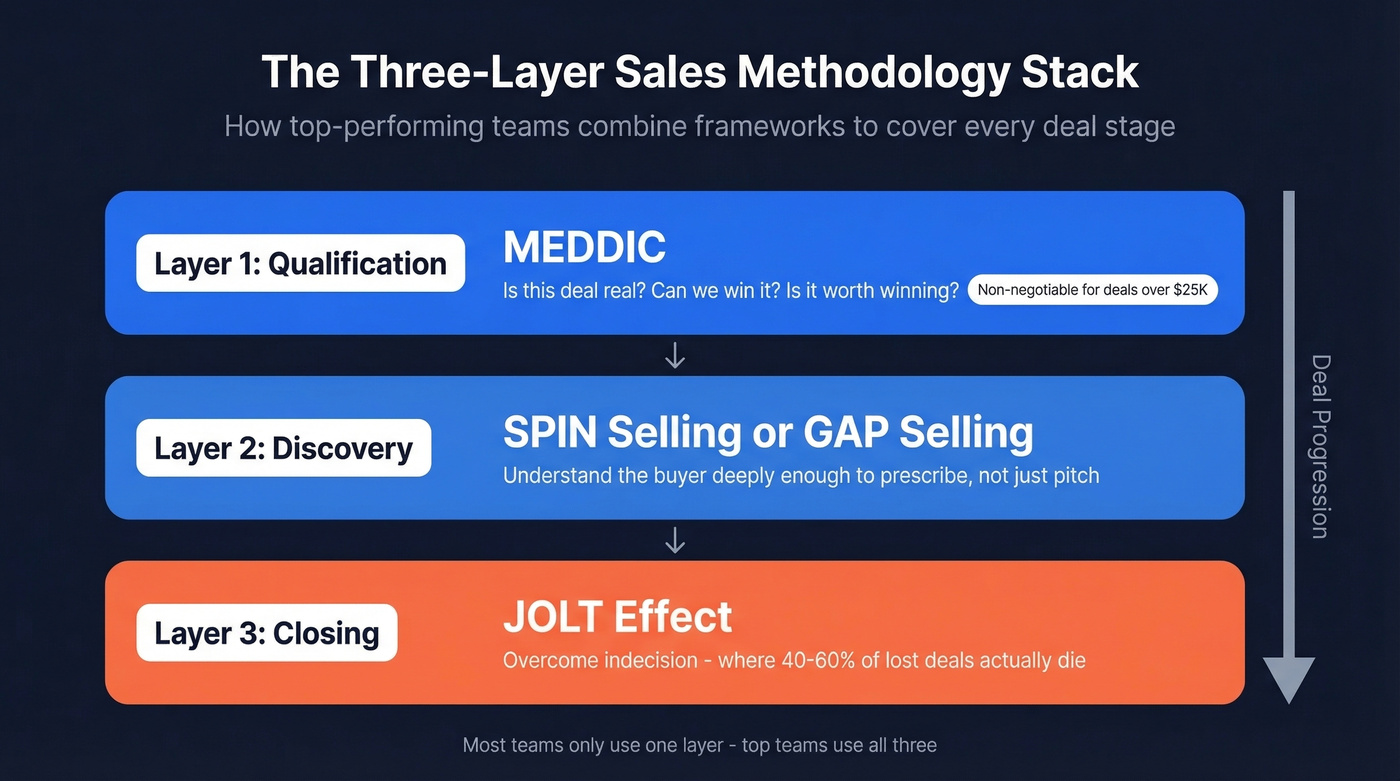
- MEDDIC for qualification. Know whether the deal is real before you invest cycles. Non-negotiable for deals over $25K.
- SPIN or GAP Selling for discovery. Understand the buyer's world deeply enough to prescribe, not just pitch.
- JOLT for closing. Overcome indecision - not just objections. This is where 40-60% of lost deals die.
The rest of this article explains why these three layers matter, covers 12 methodologies worth knowing, and gives you a framework for picking the right stack.
Sales Method vs. Sales Process
These get conflated constantly, and the confusion kills rollouts before they start.
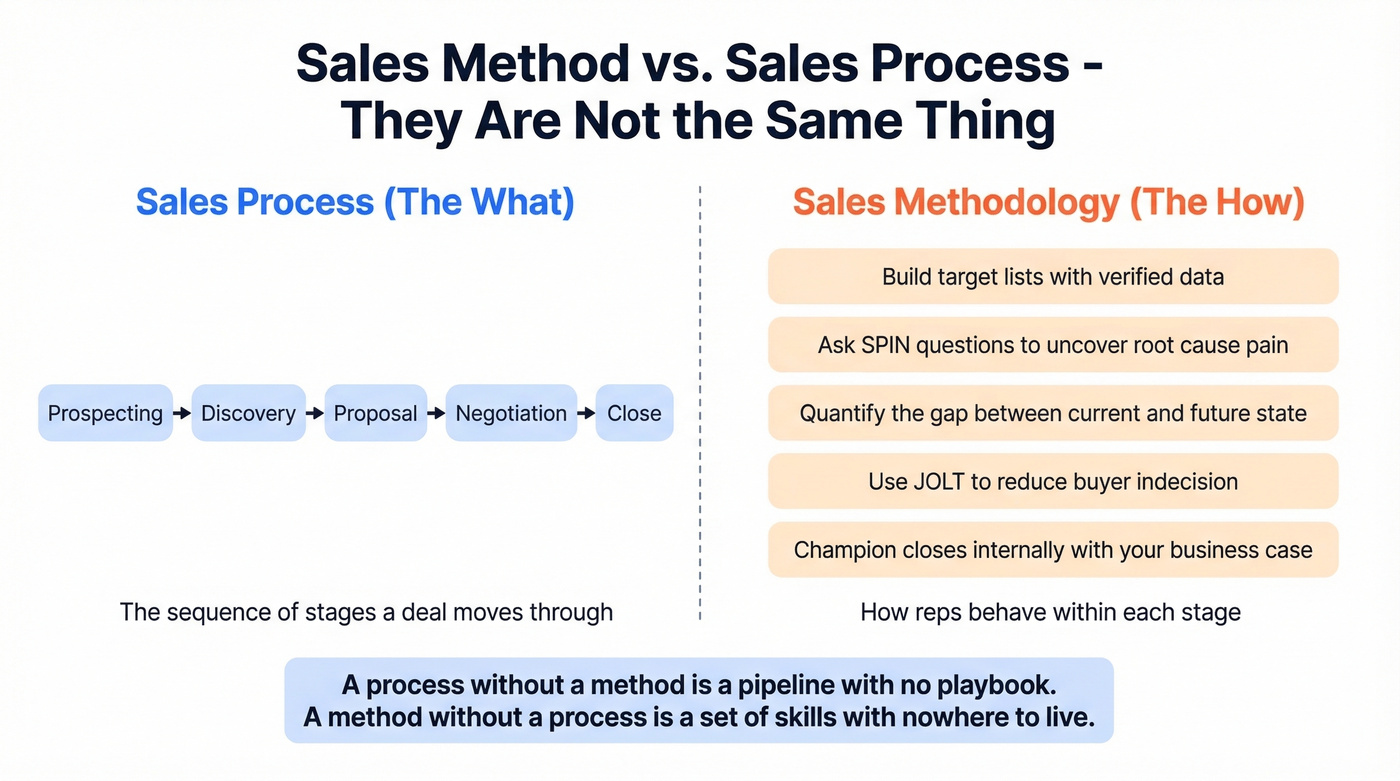
Your sales process is the sequence of stages a deal moves through: prospecting, discovery, proposal, negotiation, close. It's the what. Your methodology is how reps behave within those stages - the questions they ask, the insights they share, how they qualify and advance.
Your process says "Discovery Call." Your method says how to run it. You need both. A process without a method is a pipeline with no playbook. A method without a process is a set of skills with nowhere to live.
The 12 Selling Approaches That Matter
SPIN Selling
Neil Rackham built SPIN from observing 35,000+ sales calls - one of the largest field studies in sales history. The framework structures discovery around four question types: Situation, Problem, Implication, and Need-Payoff. Each layer pulls the buyer deeper into articulating their own pain and envisioning the solution.
SPIN remains the gold standard for complex consultative discovery. The question sequencing is intuitive enough that reps internalize it quickly, and it works across industries. The tradeoff: SPIN doesn't include a qualification framework. It won't tell you whether the deal is real, just how to understand the buyer's world. Pair it with MEDDIC and you've covered two of the three layers.
Best for: Complex consultative sales where discovery depth drives win rates.
Skip this if: You're selling transactional deals under $5K where a 45-minute discovery call doesn't make economic sense.
The Challenger Sale
Dixon and Adamson's research identified five rep personas and found that "Challengers" - reps who teach, tailor, and take control - outperform in complex B2B. The headline stat: 53% of customer loyalty is driven by the sales experience itself, not the product, price, or brand.
Powerful but overrated as a standalone. The "teach" motion requires genuine business acumen and industry expertise - you can't fake commercial insight. Most reps need months of coaching and content support to deliver a credible teaching pitch. And Challenger tells you what great reps do but gives you less guidance on how to build those capabilities systematically. Half-executed Challenger is worse than no Challenger at all.
Best for: Informed buyers in competitive markets where differentiation matters more than discovery.
Skip this if: You don't have enablement resources to support the skills ramp.
MEDDIC / MEDDPICC
Let's be direct: if you adopt one framework from this article, make it this one.
MEDDIC (Metrics, Economic Buyer , Decision Criteria, Decision Process, Identify Pain, Champion) is pipeline discipline in acronym form. Variations include MEDDICC (adds Competition) and MEDDPICC (adds Paper Process and Competition). Every letter forces reps to answer a specific question about deal viability before advancing it.
It's non-negotiable for any team selling deals over $25K. Without it, your pipeline is fiction - reps will forecast deals where they can't name the economic buyer, haven't confirmed the decision process, and don't have a champion. We've watched teams cut their pipeline in half after a MEDDIC audit and then increase closed revenue the following quarter because what remained was real. The limitation is scope: MEDDIC won't help your reps run better discovery calls or deliver commercial insights. That's why it pairs so well with SPIN or GAP for discovery and JOLT for closing.
Best for: Enterprise deals with complex buying groups, long cycles, and multiple stakeholders.
Skip this if: Your average deal closes in one or two calls. MEDDIC adds overhead that doesn't pay off for transactional motions.
GAP Selling
How well can your reps articulate the buyer's current state? If the answer is "not in 60 seconds," your methodology isn't working.
Keenan's GAP Selling framework is built on a simple premise: the "gap" between a buyer's current state and their desired future state is the only thing worth selling. His most quoted line: "Never sell to need." Instead, diagnose the problem, quantify its impact, and trace it to root cause. Keenan suggests spending roughly 25% of the sales cycle learning the buyer's current and future state - their environment, problems, impact, root cause, and the emotions attached to each. That's a significant time investment, but it produces discovery conversations that competitors can't match.
GAP Selling is the most diagnostic of the modern approaches. It produces reps who sound like consultants rather than pitch machines.
Best for: Complex B2B with custom solutions where diagnosis drives deal size and win rate.
Skip this if: You're running high-velocity sales where spending 25% of the cycle on diagnosis doesn't pencil out.
The JOLT Effect
Dixon and McKenna analyzed 2.5 million recorded sales conversations and found something that should change how every sales leader thinks about pipeline: 87% of deals show medium-to-high buyer indecision, and 40-60% of lost deals aren't lost to competitors or status quo - they're lost to no decision at all.
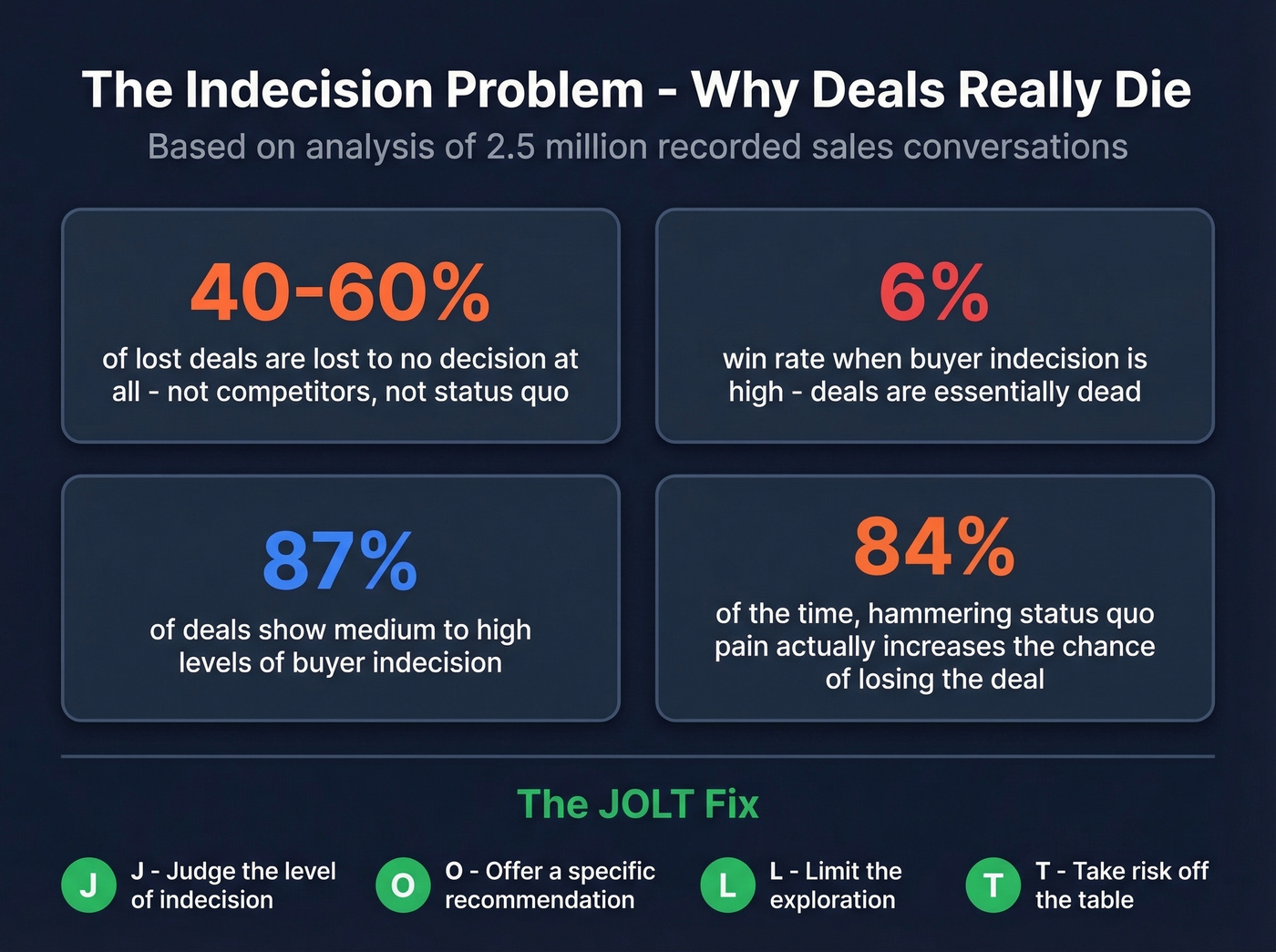
The numbers are stark. At medium indecision, win rates sit around 30%. At high indecision, they crater to 6%. And when buyers get cold feet, 73% of reps revert to hammering status-quo pain - and in 84% of those interactions, it increases the likelihood of losing the deal.
JOLT prescribes four behaviors: Judge the level of indecision, Offer a specific recommendation, Limit the exploration, and Take risk off the table with guarantees, phased rollouts, or opt-outs.
| JOLT vs. Challenger | Challenger | JOLT |
|---|---|---|
| Primary lever | Commercial insight | Risk reduction |
| Addresses | Status quo | Indecision |
| Stage | Mid-funnel | Late-stage |
| Skills barrier | High | Medium |
Best for: Late-stage stalls, enterprise deals with multiple stakeholders, and any team where "no decision" is the biggest loss category.
Skip this if: You haven't nailed discovery and qualification first. JOLT assumes you've already diagnosed the problem correctly.
Sandler Selling System
Sandler flips the traditional dynamic: instead of the rep qualifying the buyer, the buyer qualifies themselves. The system uses an "up-front contract" approach - before any meeting progresses, both sides agree on what happens next, including the option to say no. It's designed to eliminate the chase.
Best for: Teams tired of chasing unqualified prospects through endless follow-up cycles.
Skip this if: Your buyers expect a consultative, high-touch experience. Sandler's directness can feel abrupt in relationship-driven sales cultures.
Consultative / Solution Selling
Mike Bosworth's Solution Selling framework is the grandfather of needs-based selling. Diagnose the buyer's situation, map their needs to your capabilities, and co-create a solution. It's relationship-driven and works best when the "solution" genuinely varies by customer.
Best for: Services firms and any business selling custom or configurable solutions.
Skip this if: You sell a standardized product. Solution Selling adds discovery overhead that doesn't change what you deliver.
SNAP Selling
Jill Konrath designed SNAP for the modern reality: buyers are overwhelmed and drowning in vendor outreach. The framework maps three buyer decisions - whether to give you access, whether to move away from the status quo, and whether to allocate resources. Keep it Simple, be iNvaluable, always Align, raise Priorities.
Best for: Selling to C-suite or senior buyers who won't give you 45 minutes for discovery.
Skip this if: Your deal requires deep technical discovery. SNAP optimizes for access, not depth.
Value Selling
Value Selling builds the entire sales conversation around a quantified business case - ROI, payback period, total cost of ownership. It's less about relationship and more about making procurement's job easy.
Best for: Enterprise deals where procurement demands financial justification before signing.
Skip this if: Your buyers make emotional or strategic decisions. Not every deal needs an ROI spreadsheet.
Conceptual Selling (Miller Heiman)
Miller Heiman's Strategic Selling focuses on stakeholder mapping and understanding each buyer's concept of the deal. Built for multi-stakeholder enterprise sales where political navigation matters as much as product fit.
Best for: Complex enterprise deals with 5+ stakeholders.
Inbound Sales
HubSpot's inbound methodology aligns the sales process with the buyer's journey. Reps act as advisors, meeting buyers where they are in their research. Less a "selling" method, more a "not-annoying-the-buyer" method.
Best for: Product-led growth motions and content-led funnels.
N.E.A.T. Selling
Need, Economic impact, Access to authority, Timeline. Think of it as BANT's modern replacement - same bones, better framing. N.E.A.T. shifts the emphasis from "do they have budget?" to "what's the economic impact of solving this?" A solid stepping stone before graduating to MEDDIC.
Best for: Mid-market teams wanting structured qualification without full MEDDPICC overhead.
How Sales Methods Compare
Our recommended stack is highlighted below. Start with MEDDIC + SPIN or GAP + JOLT, then adjust based on your deal dynamics.
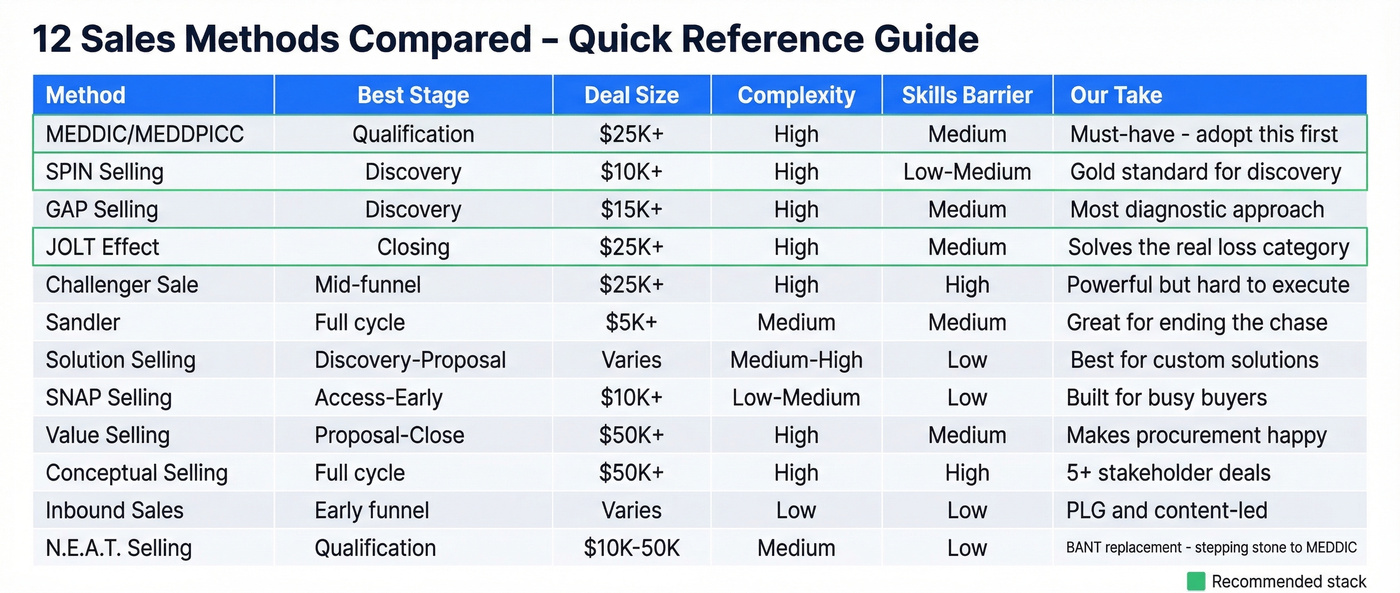
| Method | Best Deal Size | Best Motion | Core Skill | Difficulty | Pairs With |
|---|---|---|---|---|---|
| SPIN Selling | $10K-$500K+ | Consultative | Questioning | Medium | MEDDIC, JOLT |
| Challenger Sale | $25K-$1M+ | Competitive | Teaching | High | MEDDIC, SPIN |
| MEDDIC/MEDDPICC | $25K-$10M+ | Enterprise | Qualification | Medium | SPIN, GAP, JOLT |
| GAP Selling | $15K-$500K+ | Consultative | Diagnosis | High | MEDDIC, JOLT |
| JOLT Effect | $25K-$5M+ | Enterprise | Closing | Medium-High | MEDDIC, SPIN |
| Sandler | $5K-$250K | Consultative | Disqualification | Medium | MEDDIC |
| Solution Selling | $10K-$500K | Services | Needs mapping | Low-Medium | Value Selling |
| SNAP Selling | $5K-$100K | High-velocity | Messaging | Low | Sandler, N.E.A.T. |
| Value Selling | $50K-$5M+ | Enterprise | ROI modeling | High | MEDDIC, Challenger |
| Conceptual Selling | $100K-$10M+ | Enterprise | Stakeholder map | High | MEDDIC |
| Inbound Sales | $1K-$50K | PLG / Content | Advisory | Low | N.E.A.T. |
| N.E.A.T. Selling | $5K-$100K | Mid-market | Qualification | Low | SPIN, Sandler |

MEDDIC qualifies the deal. SPIN uncovers the pain. But none of it matters if your reps are reaching the wrong people. Prospeo gives you 300M+ profiles with 98% email accuracy and 125M+ verified mobiles - refreshed every 7 days, not every 6 weeks.
Feed your methodology stack with data that actually connects.
Choosing the Right Methodology
Start with data, not opinions. Pull your last 20-30 significant opportunities - wins and losses - and map where each deal stalled: discovery, qualification, proposal, or decision. The cluster tells you which methodology layer is weakest.
Recent HubSpot data identifies the top deal-killers as no product fit (37%) and poor value for money (35%). Both point to the same root cause: reps aren't diagnosing deeply enough to match the right solution to the right problem. Insight-led approaches like Challenger and GAP, along with value-led frameworks like Value Selling, directly address this.
Your sales motion matters too. Inbound-heavy teams with shorter cycles and lower deal sizes can run lighter frameworks - SNAP plus N.E.A.T. covers a lot of ground. Early-stage SaaS teams selling $5K-$15K deals can start with SPIN + N.E.A.T. and graduate to MEDDIC as deal sizes grow. Outbound enterprise teams selling six-figure deals need the full stack: MEDDIC for qualification, SPIN or GAP for discovery, and JOLT or Challenger for closing.
Here's a hot take: if your average contract value is under $8K, you probably don't need a named methodology at all. Train reps on good discovery questions, give them a lightweight qualification checklist, and spend the rest of your enablement budget on coaching. Formal frameworks pay off when deal complexity justifies the overhead.
The hybrid approach isn't optional for serious teams - those that fit methodology to deal dynamics consistently outperform one-size-fits-all shops. But elite reps often don't explicitly follow a named methodology. They've internalized the principles and freestyle. Methodologies help the other 80% of your team perform closer to that level.
Why Sales Methods Fail
You've sat through a two-day workshop, felt energized for a week, and forgotten 90% by next quarter. Sound familiar? That's a reinforcement problem, not a learning problem. Companies invest six figures in methodology rollouts that evaporate because the environment doesn't support them.
The failure pattern is predictable. Pipeline stages are vague - "Proposal Sent" tells you nothing about buyer commitment. There's no deal-review cadence tied to the methodology. Managers are too busy closing deals themselves to coach reps. And training happens as a one-time event with no reinforcement system.
The fixes are concrete:
- Redefine pipeline stages around observable buyer actions. "Champion confirmed and introduced to economic buyer" beats "Qualified" every time.
- Run weekly deal reviews through the methodology lens. If you're running MEDDIC, every review walks through each letter. No exceptions.
- Shift managers from deal rescue to rep development. If they spend 80% on deals and 20% on coaching, flip it.
- Embed the methodology into your CRM. Custom fields, required stages, playbook templates. If it's not in the workflow, it doesn't exist.
- Measure before-and-after win rates by stage. You can't improve what you don't track.
The common thread: methodology adoption is a systems problem, not a training problem. Build the system, and the methodology sticks.
AI and Selling Frameworks in 2026
45% of teams are already using hybrid AI-SDR models, and the impact on methodology execution is measurable. Outreach reports that deals supported by their AI assistant Kaia close 11 days faster on average, with up to a 10 percentage point win-rate lift on deals over $50K.
The more interesting finding comes from neuroscience. A study by Dr. Carmen Simon found that sellers receiving AI coaching feedback remembered 50% more information after 48 hours than those receiving human feedback. But human coaching improved motivation, emotional well-being, and engagement - things AI can't replicate.
The practical takeaway: let AI coach the deal, let your manager coach the rep. AI can flag when a rep skips MEDDIC qualification steps, surface JOLT signals in call recordings, and prompt better discovery questions in real time. Your manager should focus on confidence, resilience, and career development. Both matter. Neither replaces the other.
The Data Problem Nobody Talks About
The best SPIN questions in the world don't matter if your rep is calling a disconnected number. The most rigorous MEDDIC qualification falls apart when the "economic buyer" email bounces.
Methodology is the strategy. Data is the infrastructure.
The numbers back this up: opportunities closed within 50 days show a 47% win rate. After 50 days, it drops to 20% or lower. Stale data extends cycles - every bounced email, every wrong number, every outdated title adds days that erode your win rate. When Snyk rolled Prospeo out to 50 AEs, their bounce rate dropped from 35-40% to under 5%, and AE-sourced pipeline jumped 180%. That's the difference between a methodology that works on paper and one that works in practice.

You just read that 40-60% of deals die from indecision. Don't let another chunk die because reps couldn't reach the economic buyer. Prospeo's 30+ filters - including buyer intent, job changes, and department headcount - put the right decision-makers in front of your reps before discovery even starts.
Stop losing deals before the first conversation happens.
FAQ
What's the difference between a sales method and a sales process?
A sales process is the sequence of stages a deal moves through - prospecting, discovery, proposal, close. A sales method is how reps behave within those stages: the questions they ask, the insights they deliver, and how they qualify. You need both. A process without a method is a pipeline with no playbook.
Which sales method works best for small teams?
SPIN Selling or Sandler for teams under 10 reps - both are learnable without expensive training programs. Add MEDDIC as a lightweight qualification layer once deal sizes exceed $25K. Avoid Challenger until you have dedicated enablement resources to support the coaching ramp.
How do you stop a methodology rollout from dying after kickoff?
Embed it into your CRM with custom fields and required stages, run weekly deal reviews through the methodology lens, and measure stage-conversion rates before and after. The biggest killer is treating rollout as a one-time event. Pairing methodology adoption with a data cleanup helps too - accurate contacts mean reps actually practice the framework on live deals instead of chasing bounced emails.
Do AI tools replace the need for a formal selling framework?
No. AI accelerates execution but doesn't replace structure. Tools like Gong and Outreach's Kaia can flag missed MEDDIC steps or surface indecision signals, but reps still need a framework to interpret those signals. Think of AI as methodology enforcement, not methodology replacement. Teams using AI coaching remember 50% more after 48 hours, but only when there's a framework to reinforce.