

Sales Objection Role Play: Scripts, Drills, and Frameworks for 2026
A rep on r/sales put it perfectly: "I have nobody to role-play with. My manager just says 'knock more doors.'" They tried ChatGPT - "no pushback, no emotion." That's the gap most sales teams live in. They know practice matters, but the practice itself is broken or nonexistent.
The data backs this up: active practice like role-play drives 75% learning retention versus 5% for lectures, and sellers who regularly role-play objections see 20-45% higher win rates. You don't have a skills problem. You have a practice problem. Let's fix it.
The Three-Minute Version
If you only take three things from this article:
- Learn the LAER framework - it's the most versatile objection-handling structure across cold calls, demos, and negotiations.
- Drill the 10 scripts below until they're muscle memory. Keep every response under 3 sentences. A community experiment analyzing 300+ objection responses found short responses outperform long ones.
- Run 15-minute focused sessions with one skill per drill, not open-ended improv.
Why Most Objection Practice Programs Fail
If your team groans when you say "role-play," the problem isn't role-play. It's how you're running it.
Unrealistic scenarios. Generic personas, scripted exchanges, a partner who plays a "closed off, quiet customer" - none of this resembles a real call. Reps learn to perform in practice, not on the phone.
Low psychological safety. Fear of looking stupid kills learning faster than anything else - that's the consistent message from reps on Reddit and in practitioner communities. When reps feel judged, they memorize lines and try not to embarrass themselves. That's performance theater, not practice.
Vague goals and vague feedback. "Work on your closing" isn't coaching. It's a wish.
The fixes are straightforward. Managers go first - model vulnerability by doing the role-play yourself before asking reps to. Set ground rules explicitly: learning beats judgment, say it out loud before every session. And narrow to 1-2 skills per session. Handle price objections or recover from "not interested" - not both.
Objection-Handling Frameworks
Three frameworks cover 90% of what your team needs.
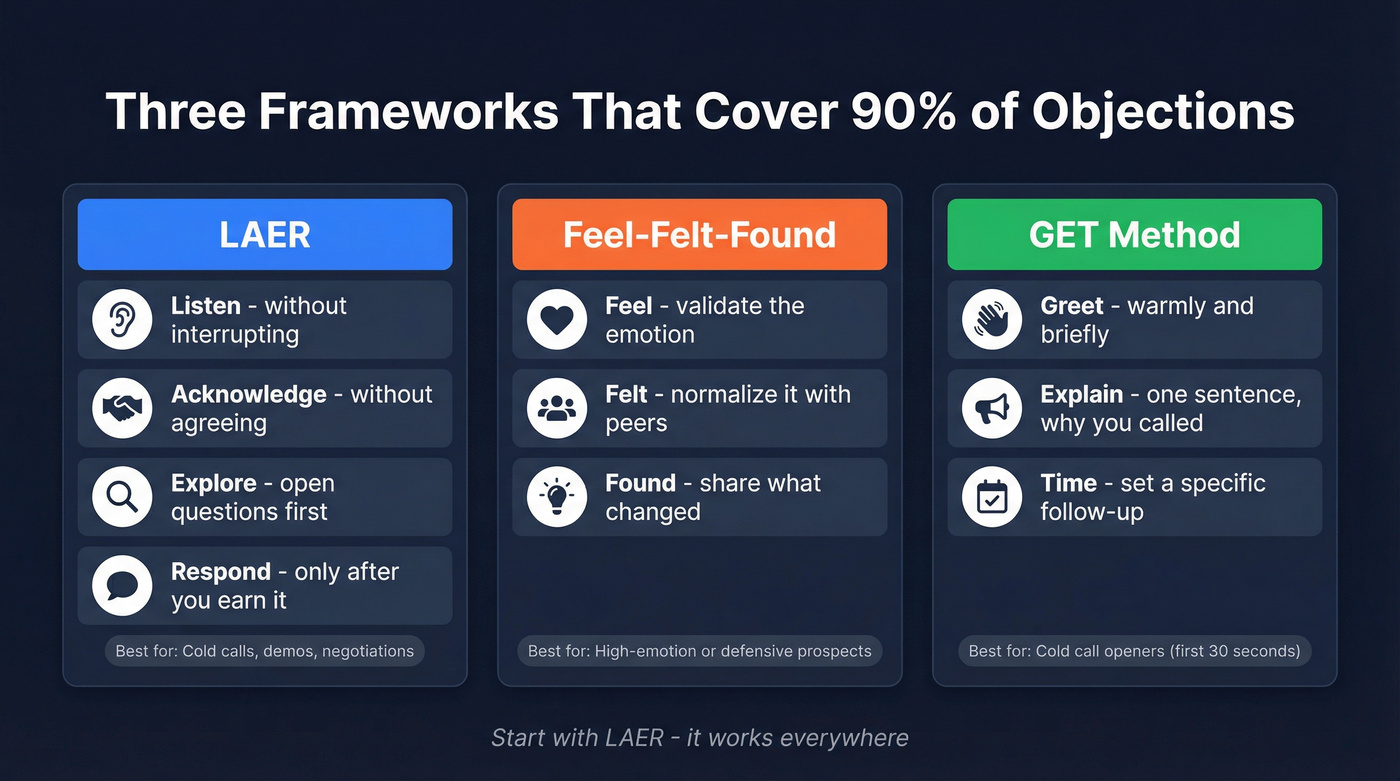
LAER (Listen, Acknowledge, Explore, Respond)
This is the go-to. LAER keeps reps out of "solution mode" too early - the single biggest mistake in objection handling.
Listen without interrupting. Acknowledge without agreeing - make the prospect feel heard, not concede the point. Explore with open questions before you respond: "Can you tell me more about that?" or "Which aspect concerns you most?" These surface the real objection hiding behind the stated one. Respond only after you've earned the right to.
For "too expensive," it looks like this: Listen. Acknowledge - "Budget matters." Explore - "So the concern is whether ROI justifies the spend this quarter? What would the cost of not solving this look like over six months?" Respond - tie your answer to what they just told you.
Feel-Felt-Found
Best for high-emotion objections where the prospect is frustrated or defensive. Feel validates the emotion. Felt normalizes it. Found shares what changed their mind.
The step most people skip: ask permission before pushing back. "Would you mind if I walked through how other teams approached this?" That permission ask drops defensiveness dramatically.
GET Method (Greet, Explain, Time)
GET is specifically for cold call openers. Greet warmly. Explain why you're calling in one sentence. Time - set a specific follow-up rather than asking "when works for you?" The coaching line that sticks: "You have 30 seconds to earn another 30 seconds."

Your reps can handle every objection perfectly - but it won't matter if they're calling wrong numbers and bouncing emails. Prospeo gives you 98% verified emails and 125M+ direct dials with a 30% pickup rate. More live conversations means more chances to use those scripts.
Stop practicing on ghosts. Reach real decision-makers.
10 Objection Scripts to Drill This Week
These span five categories - Price, Timing, Authority, Need, and Trust. Drill them until responses are automatic, then layer in unpredictability.
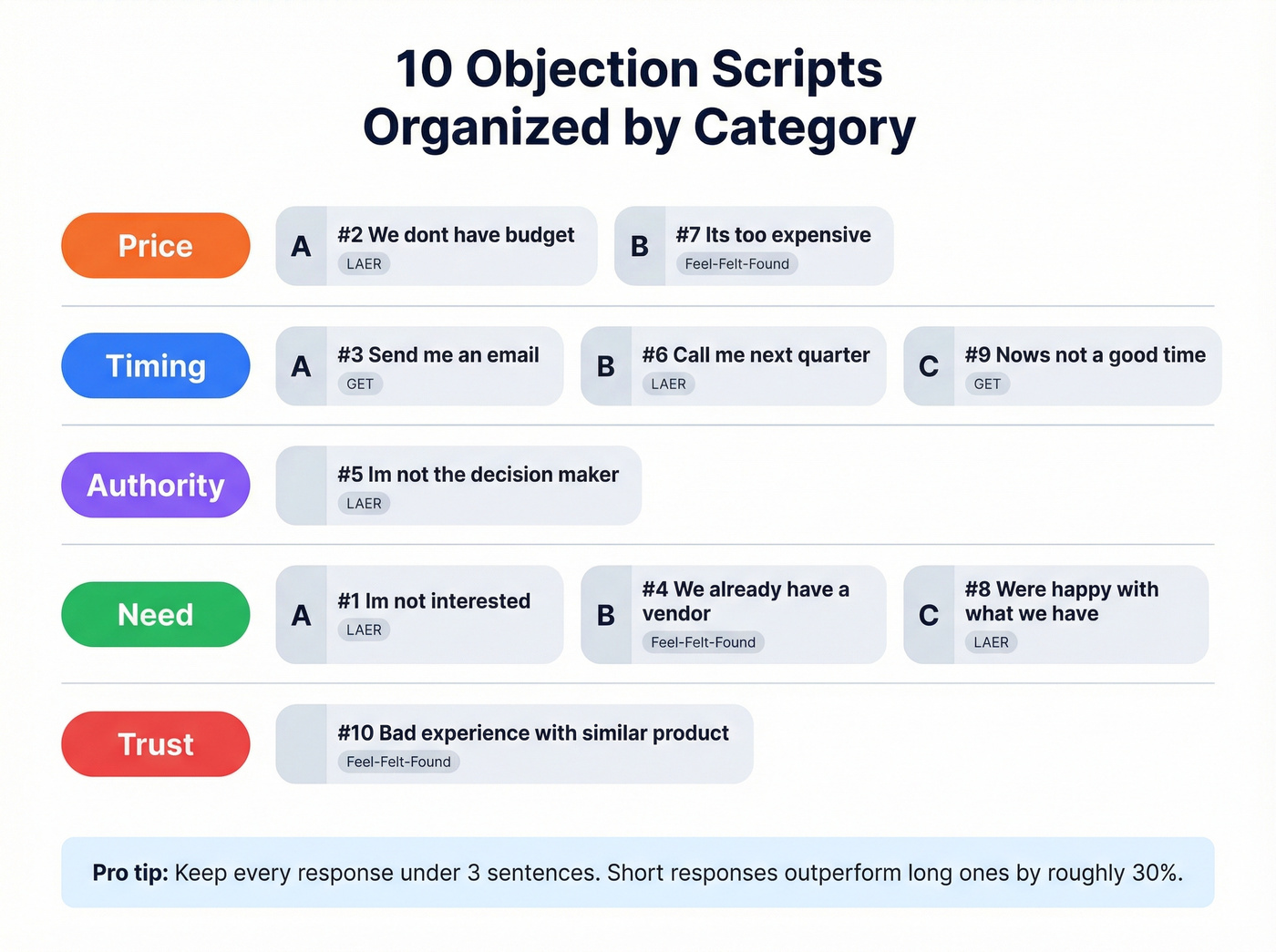
1. "I'm not interested." (Need)
Framework: LAER Response: "Totally fair - most people aren't until they see how [benefit] changes [metric]. Can I ask one quick question?"
2. "We don't have budget." (Price)
Framework: LAER Response: "Makes sense. When budget opens up, what would need to be true for this to be a priority?"
3. "Send me an email." (Timing)
Framework: GET Response: "Happy to. What specifically should I cover so it's actually useful?"
4. "We already have a vendor." (Need)
Framework: Feel-Felt-Found Response: "Good - that tells me you value this. Other teams using [competitor] found gaps in [area]. Want me to show you where?"
5. "I'm not the decision maker." (Authority)
Framework: LAER Response: "Appreciate the honesty. Who handles [area] decisions? I'd love to make sure the right person gets this."
6. "Call me next quarter." (Timing)
Framework: LAER Response: "Absolutely. What's changing next quarter that makes the timing better?"
Tests whether it's a real delay or a polite brush-off.
7. "It's too expensive." (Price)
Framework: Feel-Felt-Found Response: "I hear you. Teams in your space felt the same - then found the cost of not fixing [problem] was 3x higher. Want me to walk through that?"
8. "We're happy with what we have." (Need)
Framework: LAER Response: "Great. If you could improve [metric] without disrupting your current setup, would that be worth a conversation?"
9. "Now's not a good time." (Timing)
Framework: GET Response: "Understood. Would a 10-minute call on [specific day] work? I'll keep it tight."
10. "Bad experience with a similar product." (Trust)
Framework: Feel-Felt-Found Response: "That's frustrating. What specifically went wrong? I want to make sure we're not repeating that."
What Good Responses Look Like
High-performing responses averaged under three sentences. Soft prompts like "Would it help if...?" outperform directive language like "You should..." Emotional reframes outscored logic-based responses by roughly 30% in one scenario in the r/sales community experiment.
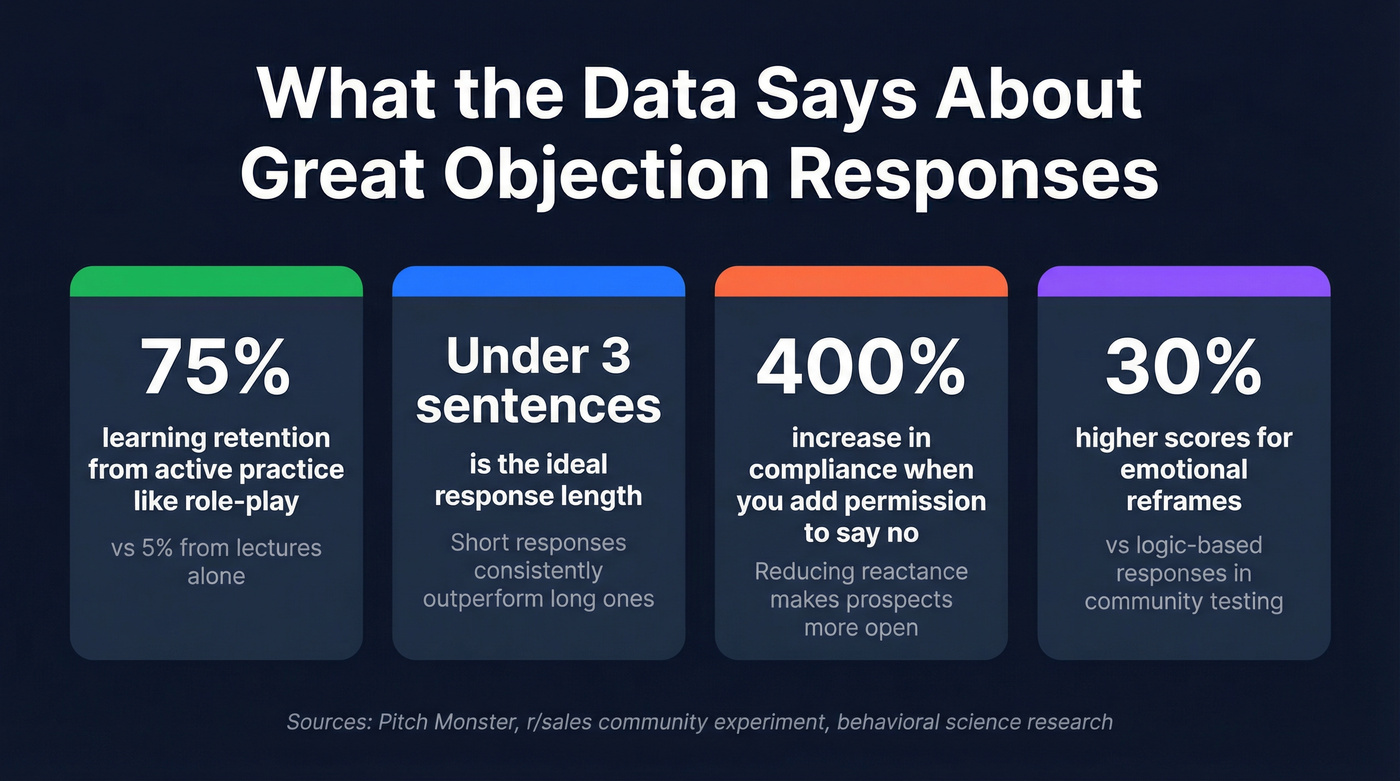
Here's the thing: the "permission to say no" principle is one of the most powerful tools in cold calling. Adding "you're free to accept or refuse" increased compliance by 400% in behavioral science research. Sounds counterintuitive, but reducing reactance makes people more open. Drill this into your scripts.
7 Role-Play Exercises for This Week
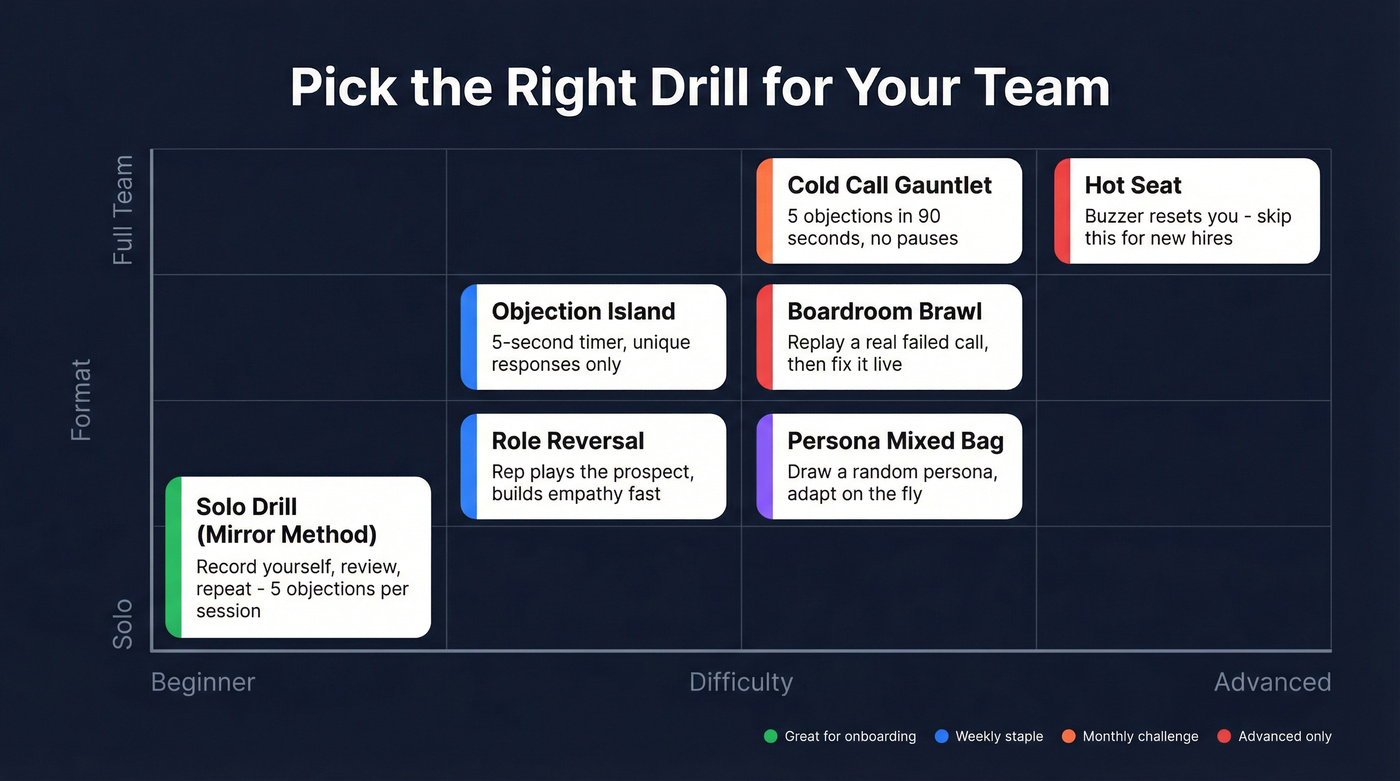
Pick one per week and rotate. Don't try to cram them all into a single session - that's how you burn out a team and teach nothing.
Objection Island
Five-second response timer. Rep gets an objection, must respond in 5 seconds or gets "voted off." Responses must be unique - no repeating what someone else said. The time constraint forces reps to internalize frameworks rather than think through them step-by-step. Use this with competitive teams who thrive on pressure.
Hot Seat (Extreme Conditions)
A buzzer resets the rep for any deviation from the ideal response path. The next rep picks up exactly where the last one left off. Builds composure under pressure and forces reps to listen to teammates' work. Skip this for new hires - it's brutal for beginners and can torch confidence before they've built any.
Persona Mixed Bag
Draw a persona from a hat: CXO, gatekeeper, "analytical buyer," "in a hurry." The rep doesn't know who they're talking to until the role-play starts. Debrief by asking "what signals told you which persona you were facing?" Perfect for discovery and demo prep.
Boardroom Brawl
Replay a real call that went poorly - use an actual recording if you have one. Then immediately role-play the same scenario to correct the mistakes under group observation. In our experience, this works best in weekly team meetings where the stakes feel real and the lessons are fresh.
Solo Drill (Mirror Method)
This one's for the rep who posted on Reddit about having nobody to practice with. Read an objection card aloud, respond aloud, record yourself, then review the recording. Do five objections per session, three sessions per week. AI role-play tools (typically $30-150/seat/month) add variety for scenario generation, though they still lack the emotional pushback of a real human partner.
Role Reversal
Put the rep in the prospect's chair and the manager in the rep's. When reps experience objections from the buyer's side, they stop treating objections as attacks and start treating them as information. We run this monthly - it's the single fastest way to build empathy on a sales floor.
Cold Call Gauntlet
Five objections in 90 seconds, rapid-fire. No pauses, no resets. This is the best onboarding exercise we've found for SDRs - it compresses weeks of call experience into minutes of deliberate practice. One r/sales commenter called rapid-fire drills "the only thing that made me stop freezing on real calls."
Running Sessions That Actually Transfer to Real Calls
The gap between "good at role-play" and "good on real calls" is where most programs die. Here's the facilitation checklist that closes it:
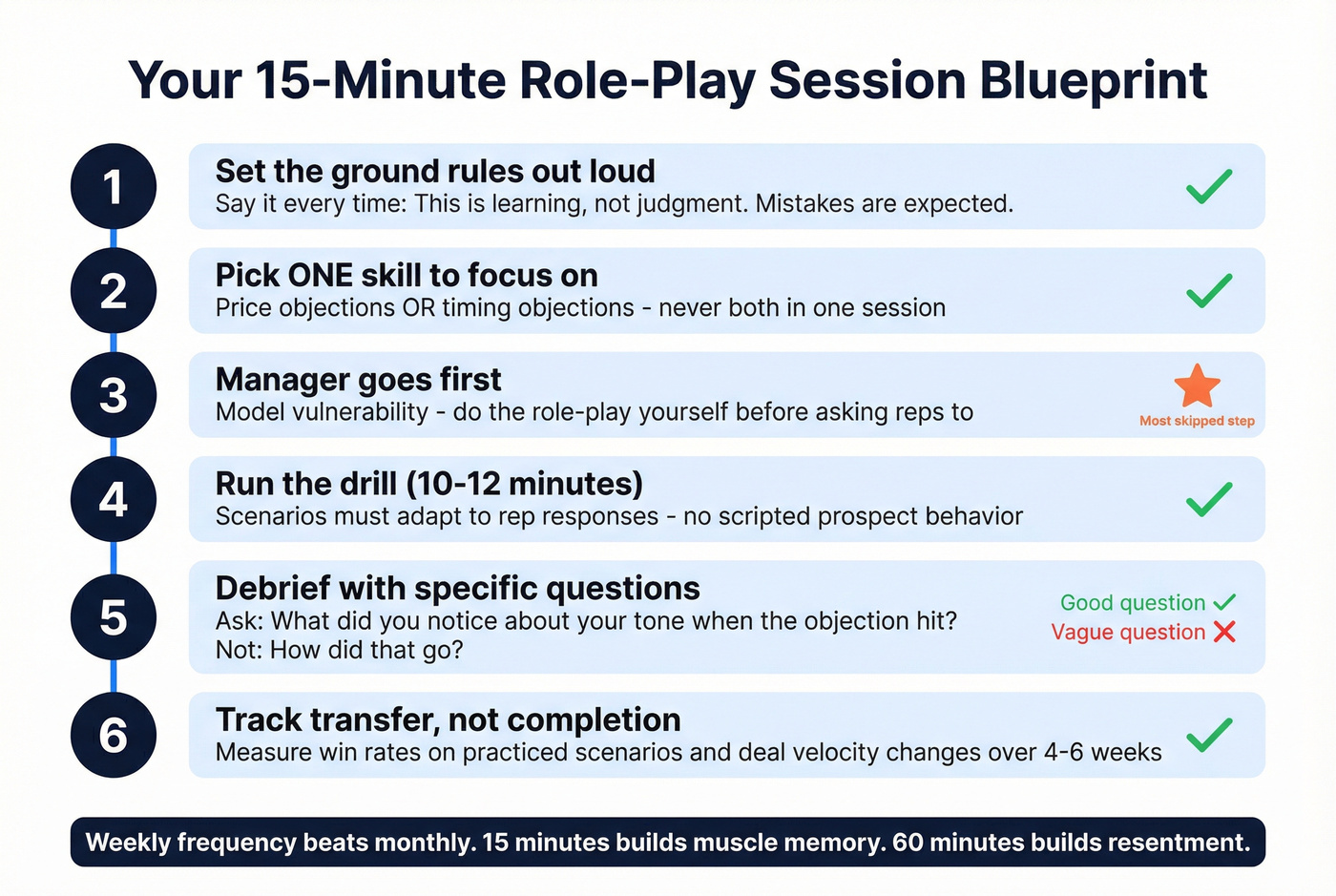
- 15-20 minutes, weekly. Frequency builds muscle memory. Monthly hour-long sessions build resentment.
- One skill per session. Don't cover price objections, discovery, and closing in the same drill.
- Scenarios must adapt to rep responses. If the "prospect" follows a script regardless of what the rep says, you're training for a world that doesn't exist.
- Say the ground rules out loud. "This is learning, not judgment. Mistakes are expected." Then enforce it by giving positive feedback before corrective feedback.
- Debrief with specific questions. "What did you notice about your tone when the objection hit?" beats "How do you think that went?"
- Measure transfer, not completion. Track whether win rates on practiced scenarios go up and whether deal velocity changes. That's the only data that matters.
The Data Problem Nobody Talks About
Look - if your average deal size is under $10k, you probably don't need better objection scripts. You need a better list.
When most of your team's "objections" fall into the Need or Trust buckets, but the actual issue is they're calling the wrong person at the wrong number, no amount of practice fixes that. "Not interested" from someone who was never your ICP isn't a real objection - it's a data failure masquerading as a skills gap.
We've seen teams drill objection scripts for months while their call lists had 30%+ bad numbers and outdated titles. Every wrong number burns rep confidence and wastes the practice you invested in. Fix the list first, then drill the scripts. Prospeo covers 300M+ professional profiles with 98% email accuracy and 125M+ verified mobile numbers at a 30% pickup rate, refreshed every 7 days. When your reps dial a verified number and reach the actual decision-maker, the objections they face are real ones worth practicing for.
The 'I already have a vendor' objection hits harder when your data provider is the problem. Teams using Prospeo book 35% more meetings than Apollo users - because 7-day data refresh means you're calling people who still work there.
Fresh data turns objection-ready reps into pipeline machines.
FAQ
How often should teams practice objection handling?
Weekly 15-20 minute sessions consistently outperform monthly hour-long sessions. Rotate exercises each week - Objection Island one week, Cold Call Gauntlet the next. The goal is making responses automatic, not exhausting your team.
Can I practice objection handling alone?
Yes. Use the Solo Drill: read an objection aloud, respond aloud, record yourself, review. Do five objections per session, three sessions per week. AI tools add scenario variety, though they lack real emotional pushback from a live partner.
What's the fastest way to improve at handling objections?
Drill 3-5 objections with word-for-word scripts until responses are automatic, then layer in unpredictability. Short responses under 3 sentences with emotional reframes outperform long, logic-heavy answers by roughly 30%.
What tools help with sales objection role play prep?
AI coaching platforms ($30-150/seat/month) generate varied scenarios but lack emotional realism. For the data side, verified mobile numbers ensure reps reach real decision-makers - so practice sessions map to actual call conditions instead of hypothetical ones.