

33 Sales Objections Examples (+ What 67,149 Calls Reveal About Handling Them)
It's 2pm on a Tuesday. You're 40 dials into a call block, you've hit nine brush-offs in a row, and the next prospect opens with "not interested" before you finish your first sentence.
The problem isn't your pitch. It's that 7.4 decision-makers are now involved in a typical B2B purchase, roughly 70% of the buyer's journey is done before a rep gets involved, and 57% of sales professionals say the cycle is getting longer every year. More people, more research, more friction - and your reps are catching the worst of it on the phone.
We've organized the sales objections examples below by stage, but first: the data that should change how you respond to all of them.
What 67,149 Sales Calls Reveal
Across two studies drawing from databases of 1M+ and 5M+ recorded calls, Gong used machine learning to isolate 67,149 meetings and pinpoint the behaviors that separate top performers from everyone else. The findings aren't what most sales trainers teach.
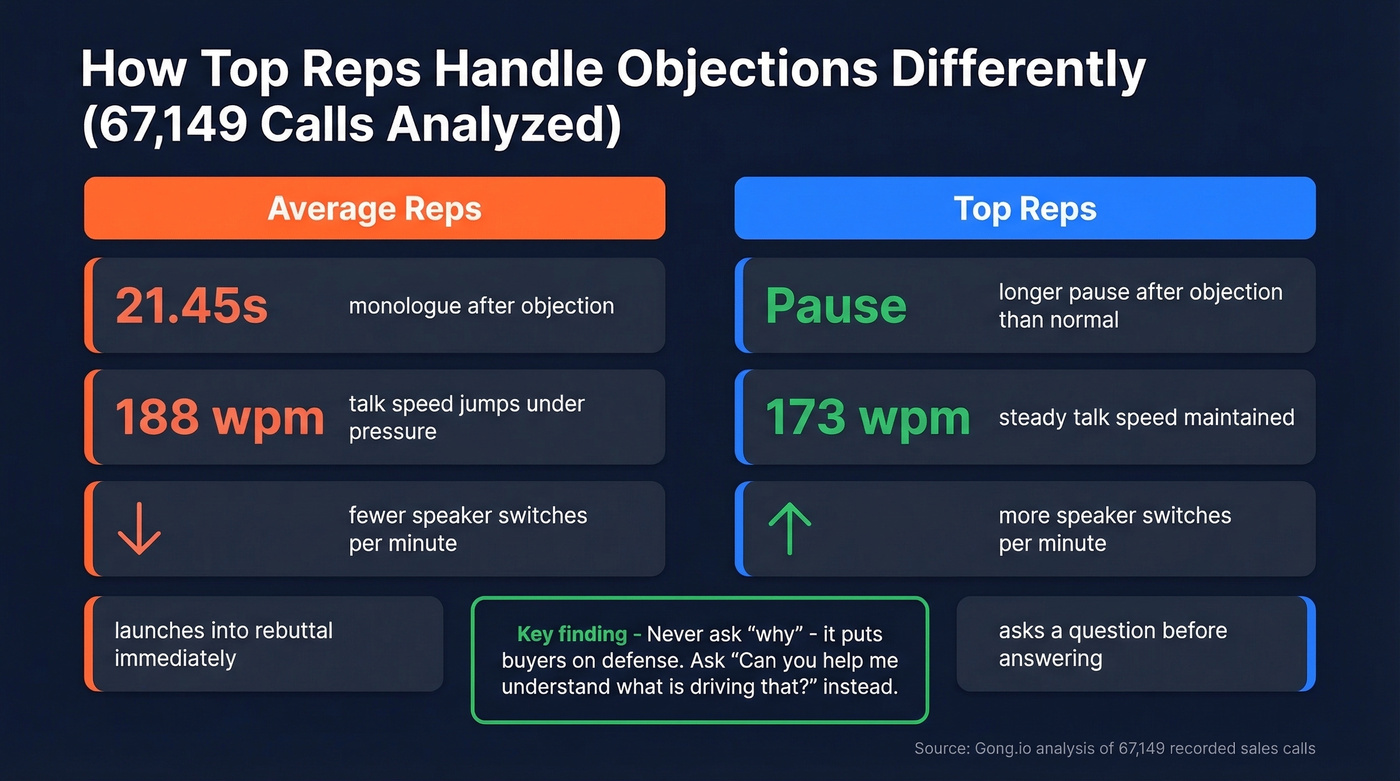
Average reps hear an objection and launch into a 21.45-second monologue. Their talk speed jumps from a normal 173 words per minute to 188 wpm - a subtle but measurable panic response. Their back-and-forth pace drops. They start lecturing instead of conversing.
Top reps do the opposite. They pause longer after an objection than during normal conversation, maintain steady speaker switches per minute, and keep the dialogue flowing rather than turning it into a pitch. They ask a question before they answer - because a strong answer to the wrong objection makes the objection worse.
Two specific techniques stood out. First, mirroring - repeating the prospect's last few words with an upward inflection. Chris Voss popularized this in Never Split the Difference, and the call data confirms it works in sales conversations too. Second, top reps close the loop with some variation of "Does that make sense?" after addressing a concern. Sounds simple. Most reps skip it.
The research is also explicit about one thing: never ask "why." Saying "Why is that a concern?" puts the buyer on defense. "Can you help me understand what's driving that?" gets the same information with a completely different emotional register.
5 Objection-Handling Frameworks
Every objection-handling article lists frameworks. Most don't tell you which one to actually use. Here's the thing: the right framework turns common objections and responses into repeatable, coachable conversations instead of improvised monologues.
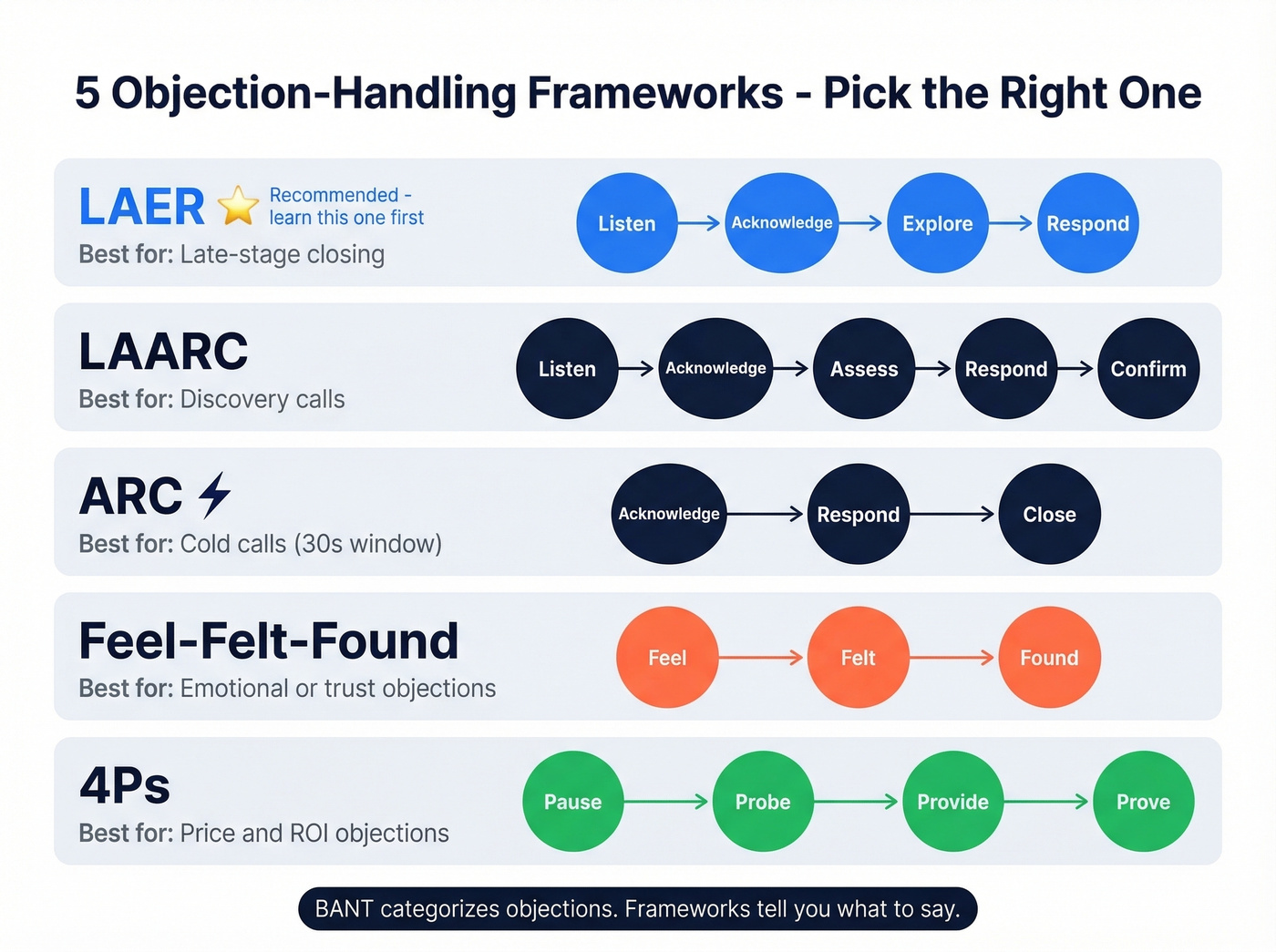
| Framework | Steps | Best For |
|---|---|---|
| LAER | Listen, Acknowledge, Explore, Respond | Late-stage closing |
| LAARC | Listen, Acknowledge, Assess, Respond, Confirm | Discovery calls |
| ARC | Acknowledge, Respond, Close | Cold calls (30s window) |
| Feel-Felt-Found | Feel, Felt, Found | Emotional / trust objections |
| 4Ps | Pause, Probe, Provide, Prove | Price / ROI objections |
If you only learn one, learn LAER. Developed by Carew International, it's built around the idea that objection handling is a bonding process, not a rebuttal exercise. Listen without interrupting. Acknowledge without agreeing. Explore the root cause with questions. Then - and only then - respond.
LAARC adds a confirmation step at the end, making it ideal for discovery where you need to verify the concern is actually resolved before moving on. ARC is the stripped-down version for cold calls where you've got 30 seconds before they hang up. Feel-Felt-Found works best for emotional objections - insurance, high-stakes purchases, anything where trust is the real barrier. The 4Ps are purpose-built for price conversations: pause before you discount, probe to find the real concern, provide context, prove ROI.
Some trainers call brush-offs "obstructions" - reflexive blocks vs. genuine concerns. The handling technique differs, and the frameworks above are designed for real objections. Brush-offs need pattern interrupts, which you'll see in the cold call scripts below.
BANT is fine for categorizing objections. It's terrible for responding to them. Knowing an objection is "budget-related" doesn't tell you what to say. Frameworks do.
33 Objection Examples by Stage
Cold Call Objections
Cold callers talk about brush-offs like "not interested" and "send me an email" constantly - and they're two of the ones reps handle worst. In our experience, "not interested" also responds best to a simple pattern interrupt.
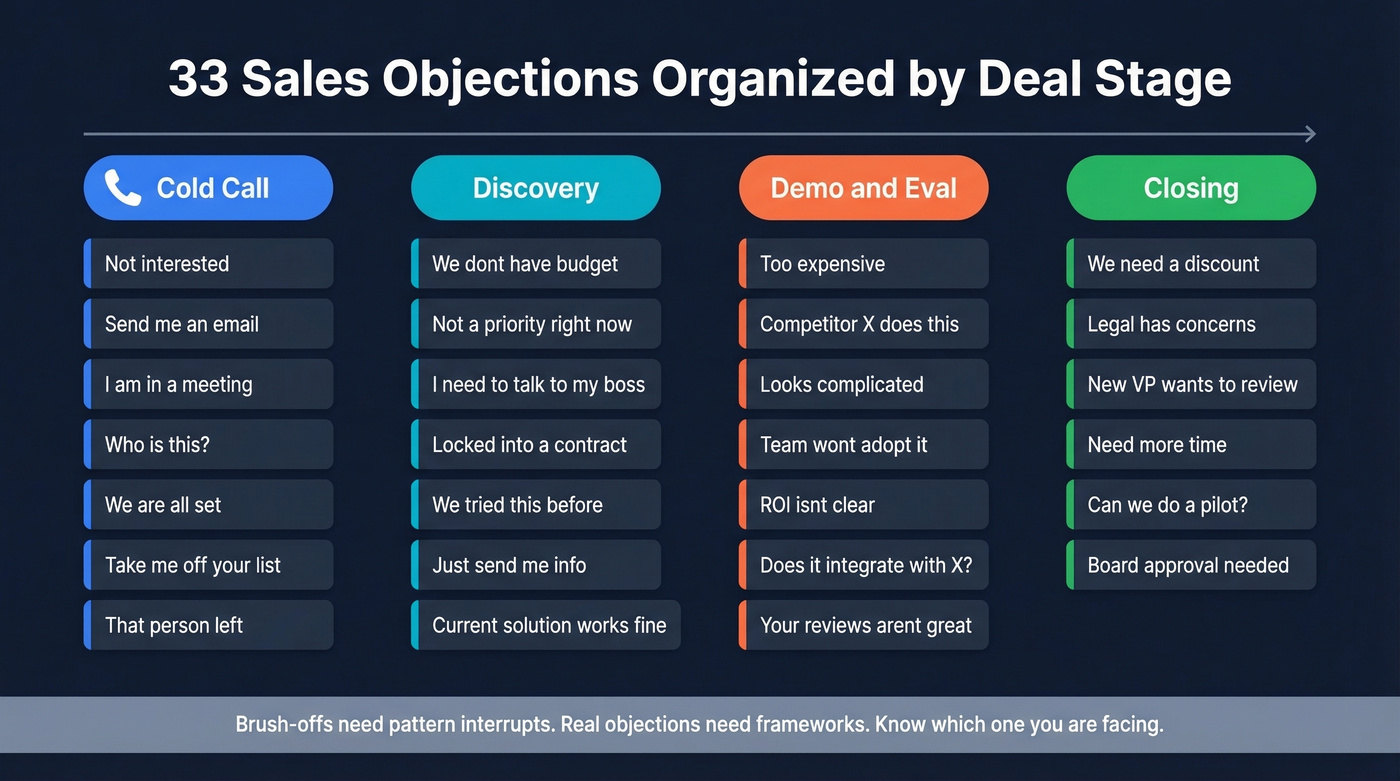
"Not interested." This isn't an objection - it's a reflex. The prospect hasn't heard enough to be genuinely uninterested. Don't argue. Pattern-interrupt instead.
"Totally fair - you weren't expecting my call. Quick question before I let you go: how are you currently handling [specific problem]?"
Do this: acknowledge and pivot with a question. Don't do this: repeat your pitch louder.
"Send me an email."
Translation: "I want you off the phone." Sometimes genuine, usually a brush-off.
"Happy to. So I send you something relevant - what's the biggest challenge your team's dealing with around [topic] right now?"
"I'm in a meeting." Respect it. Don't squeeze in a pitch.
"Completely understand. When's a better 2-minute window - tomorrow morning or Thursday afternoon?"
"Who is this?" / "How did you get my number?" Stay calm and transparent. "[Name], with [Company]. We help [their industry] teams [specific outcome]. Your info is in our business database - I'm reaching out because [specific reason tied to their role]. If this isn't relevant, happy to remove you."
"We're all set." They're set with something. Your job is to find out what.
"Glad to hear it. Most teams I talk to who are 'all set' are still spending [X hours] on [problem]. Is that true for you, or have you actually solved it?"
"Take me off your list." Do it. Immediately. No argument, no "but before I do..." Just comply and move on.
"That person doesn't work here anymore." This is a data problem, not a sales problem. Verify contact data before every call block - Prospeo refreshes records every 7 days with 98% email accuracy, so you're calling the right person instead of burning dials on outdated records.
Discovery Objections
"We don't have budget." Rarely means zero dollars. Usually means "I don't see enough value to fight for budget."
"I hear you. If we could show a 3x pipeline increase like we did for a mid-market SaaS team, would it be worth a conversation with your finance team?"
Do this: tie value to a specific outcome. Don't do this: immediately offer a discount.
"Not a priority right now." Timing objections are real. Don't force it - anchor a future conversation. Remember: 80% of sales require 5+ follow-ups, but 92% of reps quit after 4 attempts.
"Makes sense. When does planning for next quarter start? I'd rather catch you at the right time than waste yours now."
"I need to talk to my boss." You're either not talking to the decision-maker, or the prospect needs ammunition to sell internally.
"Of course. What do you think their biggest concern will be? I can put together a one-pager that addresses it directly."
Do this: arm your champion. Don't do this: ask to go over their head.
"We're locked into a contract." Find out when it ends. That's your real timeline.
"When does that come up for renewal? We usually start conversations 60-90 days out so there's no scramble."
"We tried something like this before." Past failure creates strong resistance. Acknowledge it directly.
"What went wrong? Seriously - I'd rather know now so I can tell you honestly whether we'd have the same problem."
The remaining discovery objections - "just send me info," "I don't see the need," and "our current solution works fine" - share a common root. The prospect doesn't yet believe you understand their world well enough to help. For all three, the move is the same: ask what their current workflow looks like and listen for the gap they've gotten used to. "What would 'great' look like compared to what you have now?" works every time.
Demo and Evaluation Objections
"It's too expensive." The most common objection across nearly every sales study. Use the 4Ps: Pause first. Don't immediately discount.
"Compared to what? Help me understand what you're benchmarking against."
Do this: anchor to value. Don't do this: lead with a discount. In insurance, "too expensive" often masks confusion about coverage levels - compare deductibles and limits side by side before discussing price. In SaaS, it usually means the prospect is comparing you to a tool that does half of what you do.
"Competitor X does this too." Don't trash the competitor. Differentiate on what matters to them.
"They do. Where we're different is [specific differentiator]. For your use case, that distinction matters because..."
"It looks complicated" / "Our team won't adopt it." Complexity fear and adoption anxiety are the same objection wearing different clothes. Both require you to show, not tell - walk through the exact day-one workflow in three steps. For adoption specifically, ask what drove low adoption with previous tools and build onboarding around those friction points. In regulated industries, compliance and implementation risk dominate these concerns, so address the regulatory angle before the UX angle.
"The ROI isn't clear." This is your fault, not theirs. You haven't connected your solution to their numbers.
"Let's build the business case together. What does [specific problem] cost you per month in hours, revenue, or churn?"
"Does it integrate with [tool]?" Either it does or it doesn't. Be honest. If it doesn't, explain the workaround.
"We need feature X." Determine if it's a dealbreaker or a nice-to-have. "How critical is that to your workflow? If we solve your core problem without it, does that change the equation?"
"Your reviews aren't great." Don't get defensive. Ask which reviews and address them specifically. "Which ones caught your eye? I'd rather address the specific concern than give you a generic 'we've improved' answer."
Closing and Negotiation Objections
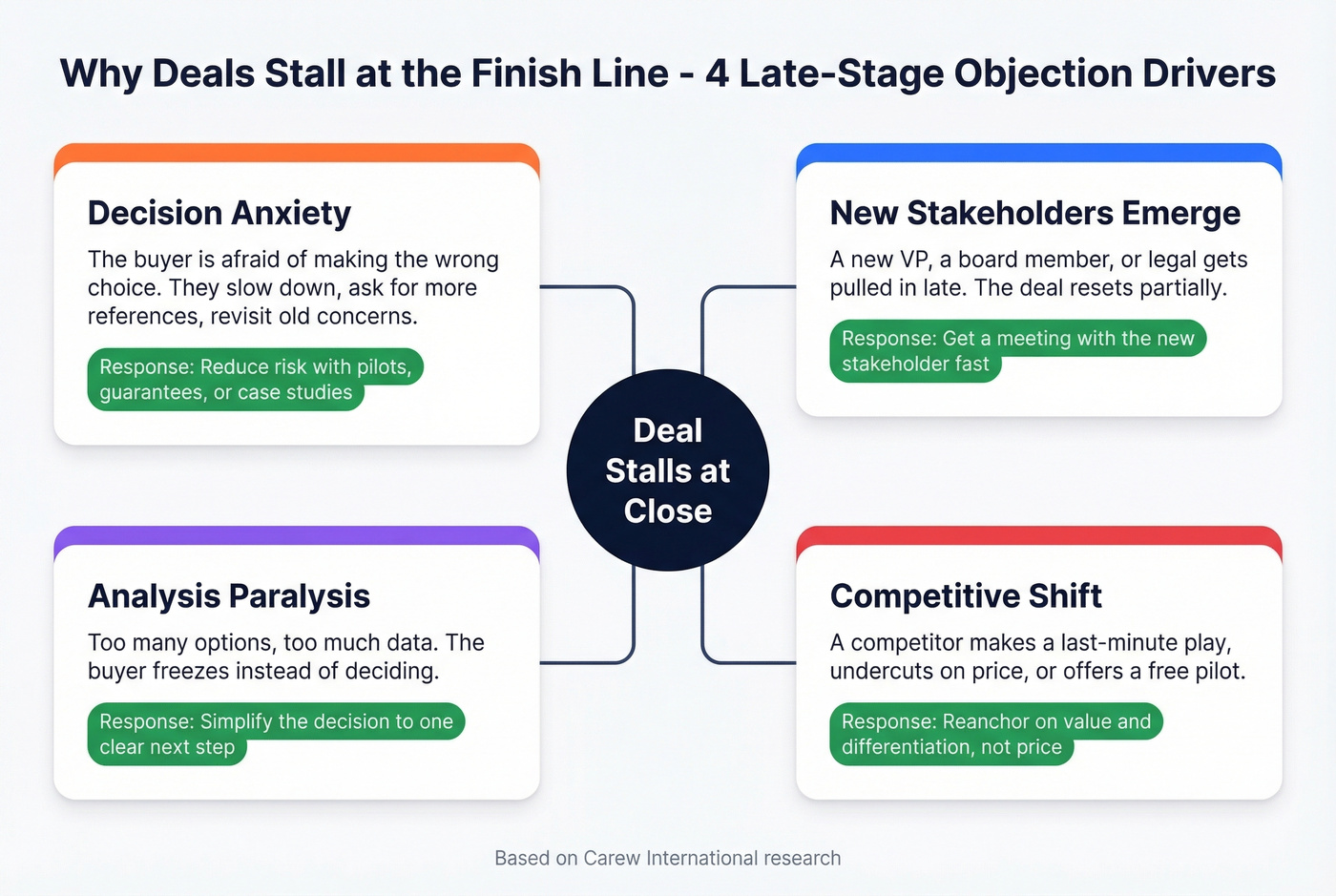
Late-stage objections are different animals. Carew International identifies four drivers: decision anxiety intensifies, additional stakeholders emerge, analysis paralysis develops, and competitive dynamics shift. Knowing which one you're facing changes your response entirely.
"We need a discount." Don't lead with price cuts. Lead with value adjustment.
"I can look at pricing - but first, which parts of the package are most critical? Sometimes we can restructure rather than discount."
Do this: restructure scope. Don't do this: cave immediately. Discounting before you understand the objection devalues your product and erodes margins.
"Legal has concerns." Get specific. "Legal has concerns" is vague enough to stall a deal for months.
"Can you share the specific redlines? I'll loop in our legal team - usually takes 48 hours."
"A new VP wants to review this." The classic late-stage stakeholder emergence. Don't panic.
"Makes sense. Can we set up a 20-minute call with them this week? I'd rather address their questions directly than play telephone."
"We're going with the other vendor." Sometimes you've lost. Sometimes there's still a window. And 35-50% of sales go to the vendor that responds first - speed matters even at this stage.
"I respect that. Can I ask what tipped the decision? If it's final, no hard feelings - but if there's something we missed, I'd rather know."
"We need more time." Time kills deals. Create urgency without being pushy.
"What specifically needs to happen before you're comfortable moving forward? Let's map that out so we're not just waiting."
"What if it doesn't work?" This is fear, not logic. Respond with risk mitigation, not features. Offer a pilot, a guarantee, a phased rollout - whatever reduces the perceived downside.
Those scripts will get you through most conversations. But scripts can't save you from these five structural mistakes.

"That person doesn't work here anymore" kills more cold calls than any objection on this list. Prospeo refreshes 300M+ profiles every 7 days with 98% email accuracy - so you're calling real decision-makers, not ghosts.
Eliminate bad data objections before you ever pick up the phone.
5 Mistakes That Kill Deals
Treating the first objection as the real one. As Marcin Pienkowski, Head of Salesforce at Think Beyond, puts it: "The classic mistake? Believing the first objection is real. It rarely is." Dig deeper before you respond.
Rushing past the root cause. Jehann Biggs describes a deal where "price" was the stated objection, but the real concern was durability. The rep who slowed down and asked won the deal.
Arguing or getting defensive. Arjun Narayan at SalesDuo nails it: arguing increases resistance and undoes every ounce of rapport you've built. The moment you push back, you've lost the frame.
Offering discounts too soon. Also from Narayan: discounting before you understand the objection devalues your product and erodes margins. It's surrender disguised as flexibility.
Answering too quickly. Dávid Breitenbach points out that reps respond with logic while the buyer's objection is driven by fear or risk. Pause. Let the silence work. Then respond to the emotion, not just the words.
How to Train Your Team
Sales reps spend 60% of their time on non-selling tasks. Training has to be efficient or it won't happen. We've found these four exercises work in 30 minutes or less and produce measurable improvement within two weeks.
Rapid-fire drill (5-10 minutes). One rep plays the prospect and fires objections every 15 seconds. The other responds with a framework - not a script. This builds calm under pressure and forces reps to internalize frameworks instead of memorizing lines.
"Why behind the objection" exercise. Take "too expensive" and have reps brainstorm five possible root causes: budget constraints, perceived value gap, comparison to a cheaper competitor, internal politics, fear of making the wrong choice. Then practice a clarifying question for each one.
Competitor objection role-play. One rep plays a prospect already using a competitor. The other runs discovery, finds differentiation angles, and reframes value - all without trashing the competitor.
Call review workshop. Pull a real recorded call. Pause at the objection moment. Have the team workshop a better response before playing what actually happened. This is where frameworks become muscle memory.
If you're using conversation intelligence software, tag objection types across calls and you'll spot patterns within a quarter - maybe 40% of your discovery objections are "not a priority," which means your targeting or timing is off. That's a strategy problem, not a skills problem. Many teams also compile their best responses into an internal playbook, a living document that new hires can reference from day one. The consensus on r/sales is that these internal playbooks outperform any generic PDF you can download.
Tools That Reduce Objections Before They Happen
Look - a lot of the objections reps face are avoidable. They exist because of bad data, missing context, or poor preparation, not because the prospect has a genuine concern. And 73% of B2B buyers actively avoid sellers who send irrelevant outreach. When your data is wrong, you're not just wasting dials. You're actively repelling prospects.
Conversation intelligence is the obvious investment. The call data referenced throughout this article comes from recording and analyzing thousands of conversations. That analysis lets you spot objection patterns across your team and coach to them systematically.
CRM objection tagging costs nothing and pays for itself. Tag objections by type in your CRM. After a quarter, the patterns become obvious. If you're standardizing your process, it helps to document sales activities alongside the tags so reps know what “good” looks like.
Data verification eliminates an entire category of wasted calls. Teams often see a sharp drop in "wrong number" and "wrong person" objections just by verifying data before a call block. Prospeo checks emails and phone numbers in real time with 98% accuracy and refreshes data every 7 days - the free tier gives you 75 email verifications per month to start.
Skip conversation intelligence if you're a team of three. Start with CRM tagging and clean data - those two alone will cut your avoidable objections in half. If you want a more systematic approach, use a cold calling system so reps aren’t improvising every block.
Half these objections disappear when you reach the right person at the right time. Prospeo's intent data tracks 15,000 topics so you call buyers who are actively researching - not prospects who genuinely "don't have budget."
Stop overcoming objections that better data would have prevented entirely.
FAQ
What's the difference between an objection and a brush-off?
An objection signals a genuine concern - price, timing, authority, or need. A brush-off like "not interested" is a reflex to end the conversation before it starts. Brush-offs require pattern interrupts; objections require frameworks like LAER to diagnose and resolve the underlying concern.
How many objections should I prepare for?
Focus on the 8-10 you hear most often. Memorizing 50 scripts creates fragile knowledge that breaks the moment a prospect phrases something differently. Master LAER and the 4Ps, and you can handle almost anything - frameworks transfer across objections, scripts don't.
What's the best framework for price objections?
The 4Ps: Pause, Probe, Provide, Prove. Pause to avoid a knee-jerk discount. Probe to find the real concern behind "too expensive." Provide context on value relative to cost. Prove ROI with a specific number from a similar customer.
How do I reduce the number of objections my team faces?
Verify your contact data before every call block so you're reaching the right person with accurate info. Beyond data, tighten your ICP targeting so you're calling prospects who actually have the problem you solve. Bad targeting creates objections that no script can fix.
Is there a sales objections PDF I can share with my team?
Build your own from the 33 examples in this guide rather than downloading a generic PDF. Copy each objection, script, and "do this / don't do this" note into a shared doc, then customize the language to match your product and ICP. A living playbook updated after real calls always outperforms a static download.