

Sales Pitch Scripts: Templates, Benchmarks, and Delivery Tips Nobody Shares
It's 9:15 AM. You've made 12 dials. Zero pickups. The one person who answered told you they were "in a meeting" and hung up before you finished your opener. The average dial-to-meeting rate has dropped to 2.3%, down from 4.82% the year before. Cold calling isn't dead - but lazy cold calling without a solid sales pitch script is.
Here's the thing: most articles on this topic were written by content marketers who've never made a cold call. You deserve actual conversion numbers, frameworks that work, and scripts you can steal today. Korn Ferry's research shows that when teams hit >75% adoption of a structured sales methodology, quota attainment jumps 21% and win rates climb 15%. That's not about memorizing lines. It's about having a system.
What You Need (Quick Version)
Before you scroll through templates, absorb these three things:
- One core framework beats seven memorized scripts. SPIN for complex B2B sales, Challenger for disrupting the status quo. Pick one, master it, adapt on the fly.
- Your script dies on bad data. If 35% of your calls go to dead numbers, no opener in the world saves you. Verify your contact list before you dial.
- Delivery matters more than wording. Slow down, use a permission-based opener, and record every single call. The reps who improve fastest listen to their own recordings.
The Silent Script Killer: Data Quality
Your script can't convert if it never reaches anyone. Nobody puts this in their "best cold call scripts" article, but it's the first thing to fix.
Snyk's sales team was running a 35-40% bounce rate on their outbound - four out of every ten contacts wasted before a rep even got a real conversation started. After switching to verified contact data, bounce rates dropped under 5%, and AE-sourced pipeline jumped 180%, generating 200+ new opportunities per month. Meritt saw something similar: pipeline tripled from $100K to $300K per week once they stopped feeding reps bad data.
Fix the data first. Then worry about your calling pitch.

Script Performance Benchmarks
Before you optimize your script, you need to know what "good" looks like. These benchmarks cover SQL-to-closed-deal conversion rates during sales calls, not raw cold-call connect rates.
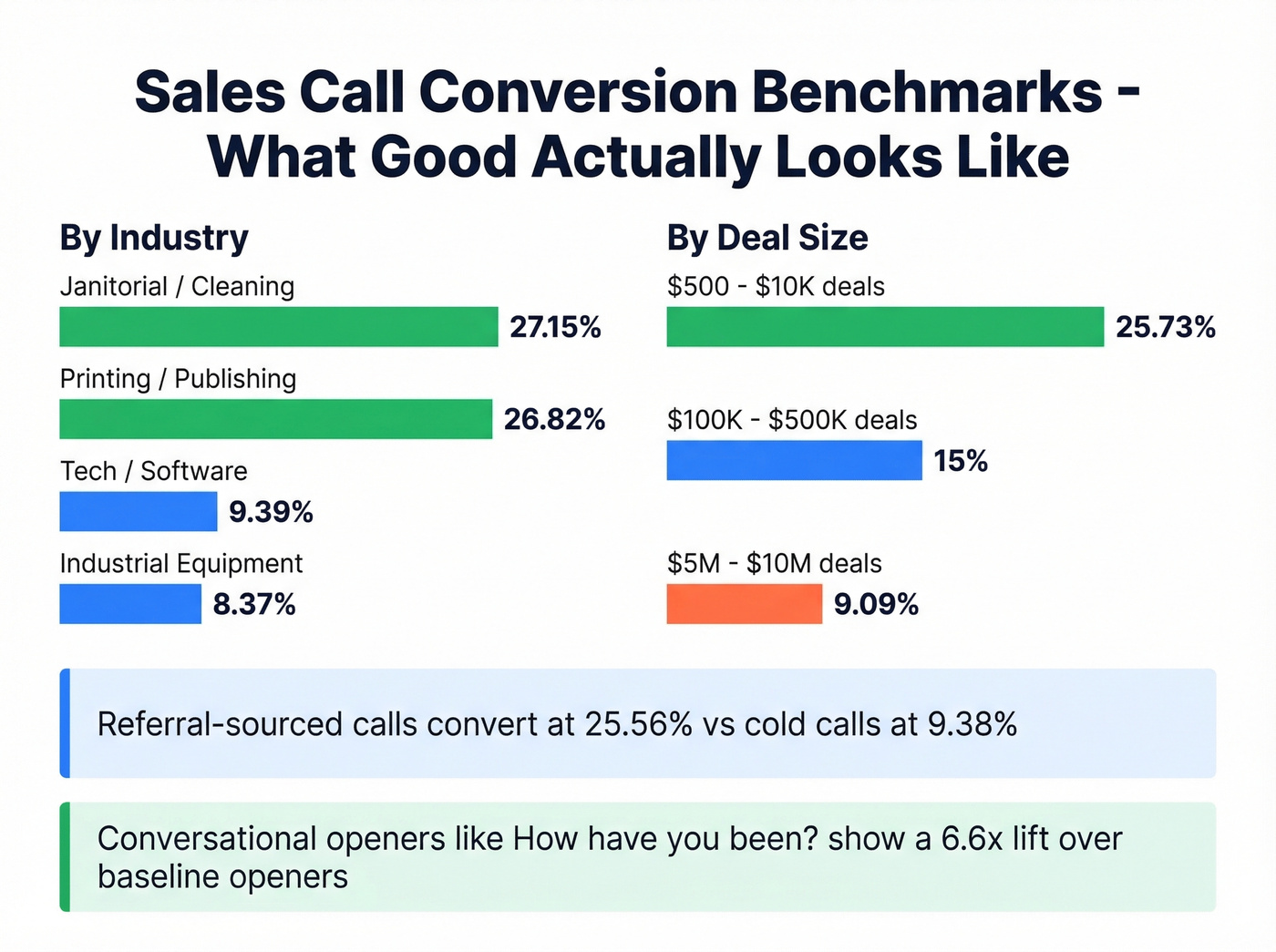
| Segment | Conversion Rate |
|---|---|
| Janitorial/cleaning | 27.15% |
| Printing/publishing | 26.82% |
| Tech/software | 9.39% |
| Industrial equipment | 8.37% |
Deal size changes everything. Deals in the $500-$10K range convert at 25.73%, while $5M-$10M deals convert at just 9.09%. That's not because enterprise reps are worse - bigger deals have more stakeholders, longer cycles, and higher scrutiny.
Channel matters too. Referral-sourced calls convert at 25.56%. Cold calling? 9.38% at the sales-call stage. And research cited by SalesHive shows that a conversational opener like "How have you been?" is associated with a 10.01% meeting rate versus a 1.5% baseline - a 6.6x lift. Your opener isn't a throwaway line. It's the highest-leverage variable in your entire call.
Anatomy of a Sales Pitch Script
Every effective sales call follows the same five-part structure, whether you're selling $5K SaaS seats or $5M enterprise contracts.
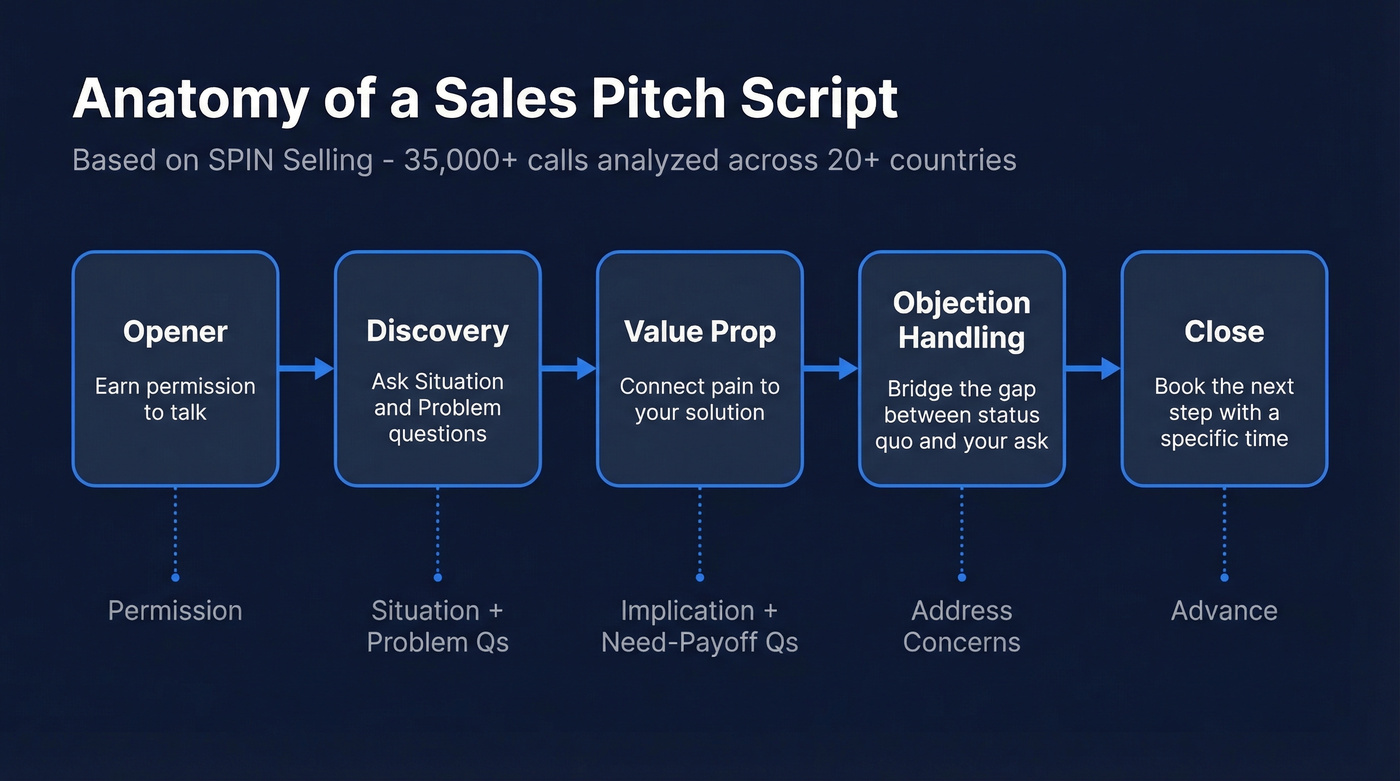
Opener -> Discovery -> Value Prop -> Objection Handling -> Close
Map this to SPIN and it clicks immediately. SPIN Selling was built from analysis of 35,000+ sales calls across 20+ countries over 12 years - it's the most battle-tested framework in B2B sales. Your opener earns permission to talk. Discovery uses Situation and Problem questions to understand the buyer's world. Your value prop connects Implication and Need-payoff questions to your solution. Objection handling addresses the gap between their current state and your ask. The close books the next step.
If you prefer the Challenger model - built from CEB research across 6,000+ sales reps - the structure maps to teach, tailor, and take control. Xerox reported a 17% increase in sales and $65M in contract value after implementing Challenger. Different language, same bones.
Cognism credits scripts as the heart of its sales strategy and grew from $0 to $4M ARR in under two years. That's the power of a repeatable framework over ad-hoc improvisation.
Here's what a bad pitch sounds like: "Hi, I'm calling from Acme Corp. We were founded in 2014 and we offer a cloud-based platform with AI-powered analytics, real-time dashboards, and enterprise-grade security. Can I schedule a demo?" Feature dump. No buyer problem, no discovery, weak CTA. The prospect has zero reason to say yes.

Snyk cut bounce rates from 35% to under 5% and generated 200+ new opportunities per month - not by rewriting their scripts, but by switching to verified contact data. Prospeo gives your reps 300M+ profiles with 98% email accuracy and 125M+ verified mobiles, refreshed every 7 days.
Stop perfecting scripts that dial dead numbers.
Copy-Paste Script Templates
You don't need seven templates. You need one great framework and the discipline to practice it. That said, different situations call for different entry points. Here are five you can steal and adapt today.
Cold Call - New Prospect
"Hey [Name], appreciate I caught you out of the blue here - you got a minute?"
(Pause. Wait for response.)
"Fair enough. I'll be quick. We help [role/industry] teams [your coolest outcome] - we're doing a lot of work with companies like [their competitor or peer]. The reason I'm calling is I noticed [specific trigger: hiring, funding, tech stack change] and figured it might be relevant."
(Discovery): "How are you currently handling [problem your product solves]?"
(After 1-2 exchanges): "Look, the purpose of my call was to set aside a half hour later this week to walk through how we've helped [similar company] with this exact challenge."
(Deliberate pause.)
"Does Thursday at 2 work, or is Friday morning better?"
The permission-based opener - straight from r/sales - keeps the tone human and lowers resistance. The SPIN Situation question gets them talking. The close offers two specific times, not an open-ended "when works for you?" This is how to pitch on a sales call without sounding robotic.
Warm Follow-Up Call
"Hey [Name], it's [You] from [Company]. You opened the email I sent Tuesday about [topic] - wanted to follow up while it's fresh."
"Quick question: [discovery question tied to email content]. Is that something your team's actively looking at?"
(If yes): "Great - let's grab 20 minutes this week. I can show you exactly how [company] solved that. Does [day/time] work?"
Prioritize calling people who've opened your emails two or more times. That's a warm signal. Don't waste it by waiting three days.
Voicemail Drop
"Hey [Name], [You] from [Company]. Quick one - we just helped [peer company] [specific outcome]. Thought it might be relevant given [trigger]. My number is [number]. I'll shoot you an email too."
Keep it under 20 seconds. One value hook, one callback CTA. Friday afternoons work surprisingly well for VP and C-suite voicemails - gatekeepers are gone and executives tend to be in a better mood heading into the weekend.
Inbound Lead Response
Speed kills here - in a good way. Chili Piper's analysis of ~4 million form submissions found that letting prospects book immediately doubles conversion from 30% to 66.7%.
"Hey [Name], this is [You] from [Company]. You just requested a demo - I wanted to catch you while you're still thinking about it."
"Before I walk you through anything, what specifically caught your eye?"
(After discovery): "Perfect. I'll send a scheduling link right now - you should see it in about 10 seconds."
Don't pitch on the inbound call. Qualify, confirm interest, and book the real meeting.
Breakup / Final Attempt
"Hey [Name], [You] from [Company]. I've reached out a few times and haven't connected - totally understand you're busy."
"I don't want to be that person who keeps calling, so this'll be my last attempt. If [problem your product solves] becomes a priority, I'm here. Otherwise, no hard feelings."
This fits at the end of a 4-call, 4-email, 2-week sequence. We've seen breakup messages generate callbacks days or even weeks later - people respect the honesty.
Objection Handling Frameworks
There's a useful distinction most reps miss: an objection is uncertainty about your product or value. An obstruction is an excuse to end the conversation. "We're happy with our current vendor" is an objection. "I'm busy" is usually an obstruction. Handle them differently.
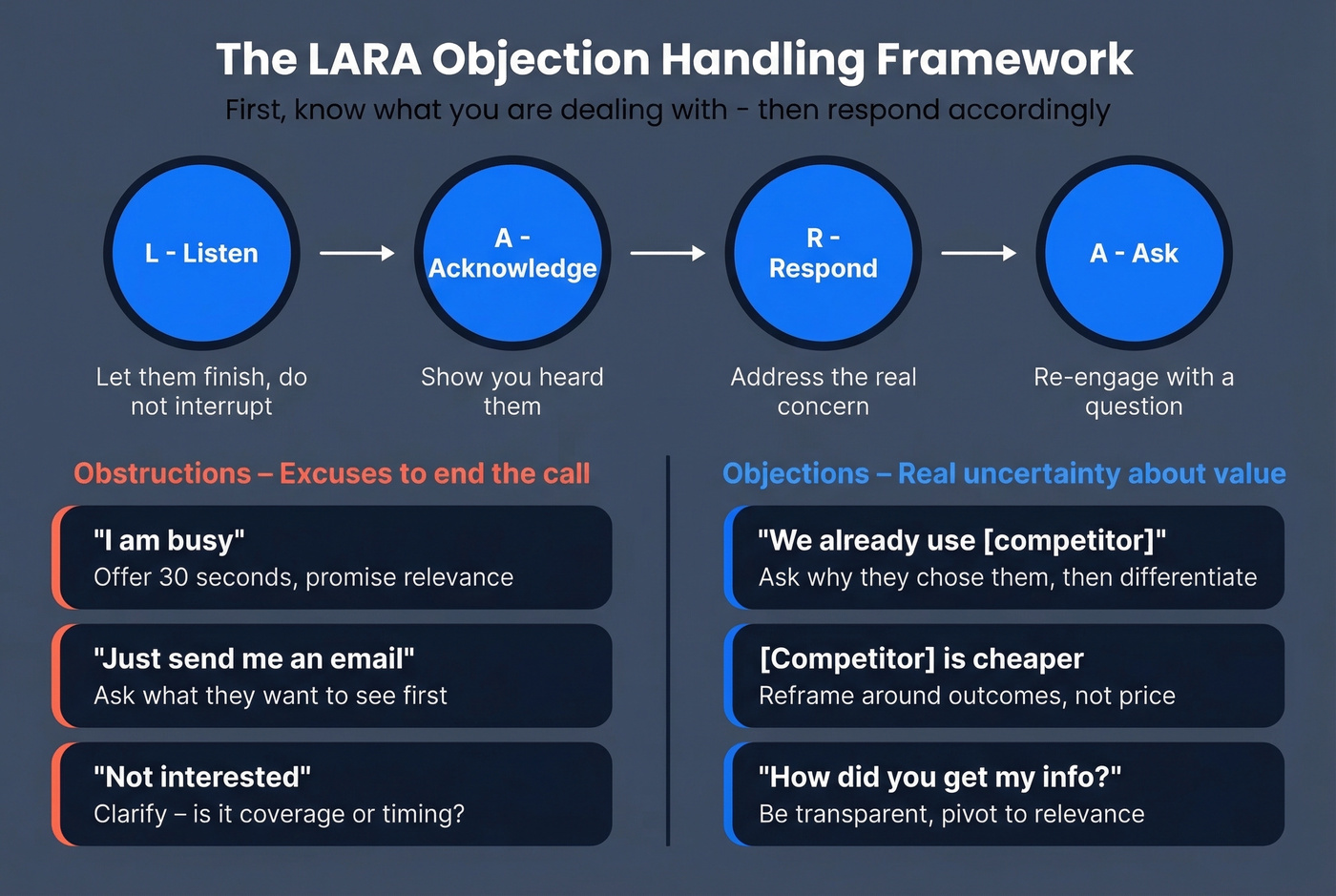
Use the LARA framework - Listen, Acknowledge, Respond, Ask - and don't interrupt. Here are six common objections with word-for-word responses:
"I'm busy." (Obstruction) "Totally get it - I'll be quick. Give me 30 seconds. If it's not relevant, I won't call again."
"We already use [competitor]." (Need) "Good to hear you're investing in this. What made you go with them? (Listen.) The reason I'm calling is we've been helping teams like yours with [specific differentiator] - worth a 15-minute comparison?"
"[Competitor] is cheaper." (Budget) "They might be. Is the cheaper option giving you [specific outcome]? Sometimes the cheaper tool costs more in missed pipeline."
"How did you get my information?" (Trust) "I came across your company while researching [industry/trigger] and thought there might be a fit. Does [problem] resonate with what your team's dealing with?"
"Just send me an email." (Obstruction) "Absolutely. So I don't waste your time with a generic email, what's the one thing you'd want to see?"
"Not interested." (Need) "Fair enough. Is that because you've got this covered, or because the timing's off?"
Delivery Tips That Actually Matter
The consensus on r/sales - and in every cold-calling training we've sat through - is that delivery beats wording every time. The most upvoted advice in r/sales cold calling threads: "Stop trying to sound perfect. Sound human."
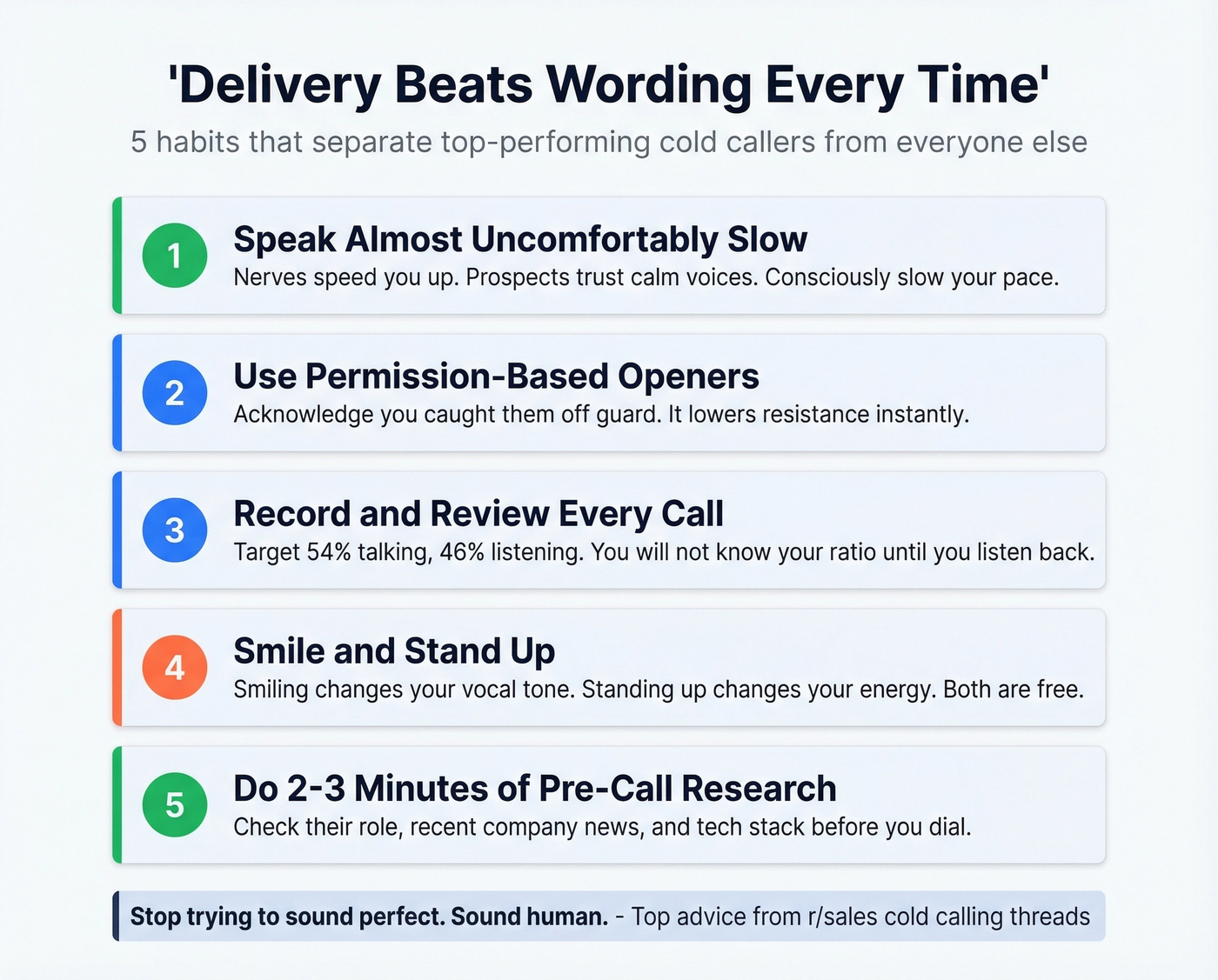
Speak almost uncomfortably slow. Nerves speed you up. Consciously slow down. Prospects trust calm voices.
Use permission-based openers. "Appreciate I caught you out of the blue" acknowledges reality and keeps the conversation natural.
Record and review every call. The talk-to-listen benchmark is roughly 54% talking, 46% listening. You won't know where you land until you listen back.
Smile. Literally. It changes your vocal tone. Stand up if you can - posture affects energy more than you'd think.
Do 2-3 minutes of pre-call research. Check their role, recent company news, hiring patterns, funding. Cognism's sales coaches call this the single biggest differentiator between reps who book meetings and reps who don't. AI tools can compress this research from 45 minutes to 15 seconds, but even without AI, a couple minutes of manual research puts you ahead of 90% of reps.
How to Test and Optimize
Let's be honest: most teams never test their scripts at all. They write one, use it for six months, and wonder why conversion rates drift downward. If your average deal is under $15K, you probably don't need a complex multi-script system. You need one solid framework, tested ruthlessly, with verified data behind it.
Change one variable at a time - opener, value prop, close, or discovery question. Control for rep skill, list quality, and time of day. Run each variant across 50-100 live conversations before drawing conclusions. Your primary KPI is meetings booked per 100 live connects, not dials or talk time.
Nobody would've guessed that "How have you been?" produces a 10.01% meeting rate versus 1.5% baseline without actually measuring it. AI-powered call analysis tools let teams review 95% of calls versus 3% with manual coaching. Set a monthly cadence: 15-30 minutes reviewing recordings, identifying what's working, and making one targeted adjustment. Small, consistent iterations compound faster than quarterly script overhauls.
Tools to Sharpen Your Scripts
You don't need a dozen tools. You need the right three or four, each covering a distinct function.
| Tool | Category | Starting Price | Key Stat |
|---|---|---|---|
| Prospeo | Contact data & verification | Free / ~$0.01/email | 98% email accuracy, 30% mobile pickup |
| Gong | Conversation intelligence | ~$100+/user/mo | 4.8/5 on G2 |
| Lavender | Email script optimization | Free / $29/user/mo | 4.8/5 on G2 |
| Apollo.io | Sales engagement | Free / $49/user/mo | 4.7/5 on G2 |
| Sybill | AI call analysis | Free / $30/user/mo | Saves 4-6 hrs/week on CRM |
| HubSpot Sales Hub | CRM + sequences | Free / $15/seat/mo | Native script + call tracking |
Prospeo handles the data layer - 300M+ professional profiles, 143M+ verified emails, and 125M+ verified mobile numbers refreshed every 7 days. Its 5-step verification process with catch-all handling and spam-trap removal means you're not burning dials on dead numbers. Gong and Sybill handle coaching, reviewing calls at scale so you can spot patterns human managers miss. Lavender optimizes written outreach. Apollo and HubSpot handle sequencing and CRM.
If you’re building a full outbound stack, start with your sales prospecting techniques, then pick from the best SDR tools based on your motion.
FAQ
How long should a sales pitch script be?
Your opener and value prop should take 30-45 seconds. Total first-touch call: 2-5 minutes max. Save the deep dive for the booked meeting - the goal of the first call is earning the second one.
Should I read my script word for word?
No. Internalize the structure, then speak naturally. Teams using structured methodology see 21% higher quota attainment - not from memorizing lines, but from having a repeatable system they can adapt in real time.
What's a good cold call conversion rate?
Average dial-to-meeting sits at 2.3% in 2026. Above 3% is strong. Above 5% means your list, script, and delivery are all firing - and your contact data is verified, not stale.
How do I make sure I'm calling verified numbers?
Use a data provider with weekly refresh cycles and multi-step verification. Prospeo refreshes every 7 days versus the 6-week industry average and returns 98% accurate emails alongside 125M+ verified mobiles with a 30% pickup rate - which eliminates the dead-number problem that kills most outbound campaigns before they start.
A 6.6x lift from a better opener means nothing if a third of your list bounces. Prospeo's 5-step verification and 7-day refresh cycle ensure every dial reaches a real person - at $0.01 per email, with no contracts.
Feed your reps clean data and watch connect rates triple.