

Sales Probing Questions: A Data-Backed Guide (2026)
You're eight minutes into a discovery call. The prospect is giving you one-word answers. You're burning through your question list like a census worker, and you can feel the deal slipping. The problem isn't your sales probing questions - it's how many you're asking and when.
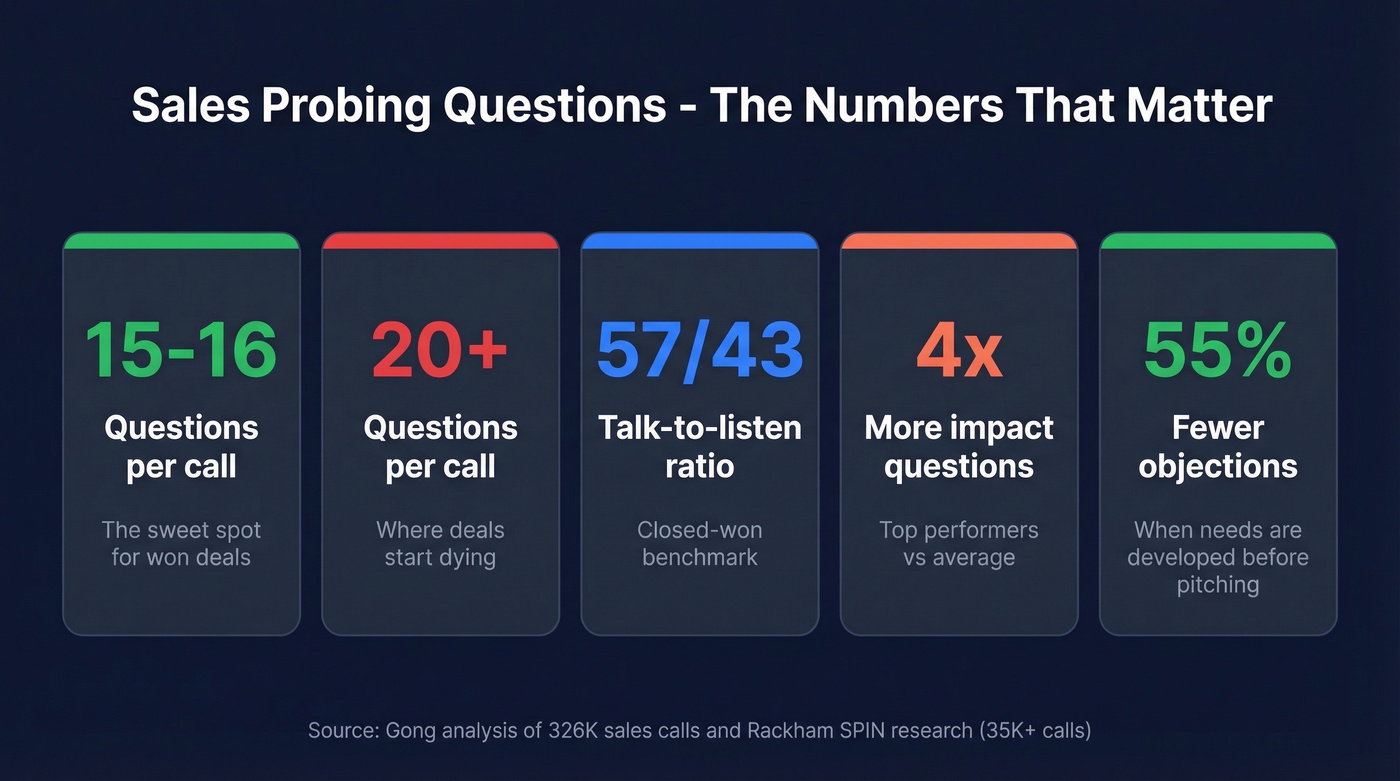
[Gong's analysis of 326K sales calls](https://www.gong.io/blog/talk-to-listen-conversion-ratio) found that won deals average 15-16 questions. Lost deals average around 20. More questions don't mean better discovery - they mean interrogation. Meanwhile, nearly a quarter of sellers say discovery call questions are their top weakness.
You've probably read five articles that gave you 50-100 questions with zero guidance on when to use them. That's a word bank, not a probing strategy.
The Short Version
- 15-16 questions per call is the sweet spot. Beyond 20, you're hurting conversion.
- Talk less. Closed-won calls run a 57/43 talk-to-listen ratio. Lost calls hit 62/38.
- Pick a framework: SPIN for mid-market, MEDDPICC for enterprise. Don't wing it.
- Follow-up skill matters more than question volume. Ten killer questions with strong follow-ups beat 30 surface-level ones every time.
- Spread questions throughout the call. Frontloading them like a checklist is an anti-pattern.
What Are Probing Questions in Sales?
Probing questions are follow-ups that dig deeper into a prospect's initial response. They're the difference between "What challenges are you facing?" and "You mentioned onboarding takes three weeks - what's the downstream impact on your Q1 pipeline?"
The concept traces back to Socratic questioning: systematic inquiry designed to surface fundamental truths. In a sales context, probing means you don't accept the first answer at face value. You clarify intent, surface hidden details, and help the prospect articulate problems they haven't fully thought through.
Open-ended probing questions ("Can you walk me through how that process works today?") generate the depth you need. Closed-ended ones ("Is that handled by your team or outsourced?") confirm specifics. You need both, but the ratio should skew heavily toward open-ended during discovery.
What 326K Sales Calls Reveal
The 326K-call dataset is one of the largest public analyses of what separates winning calls from losing ones.
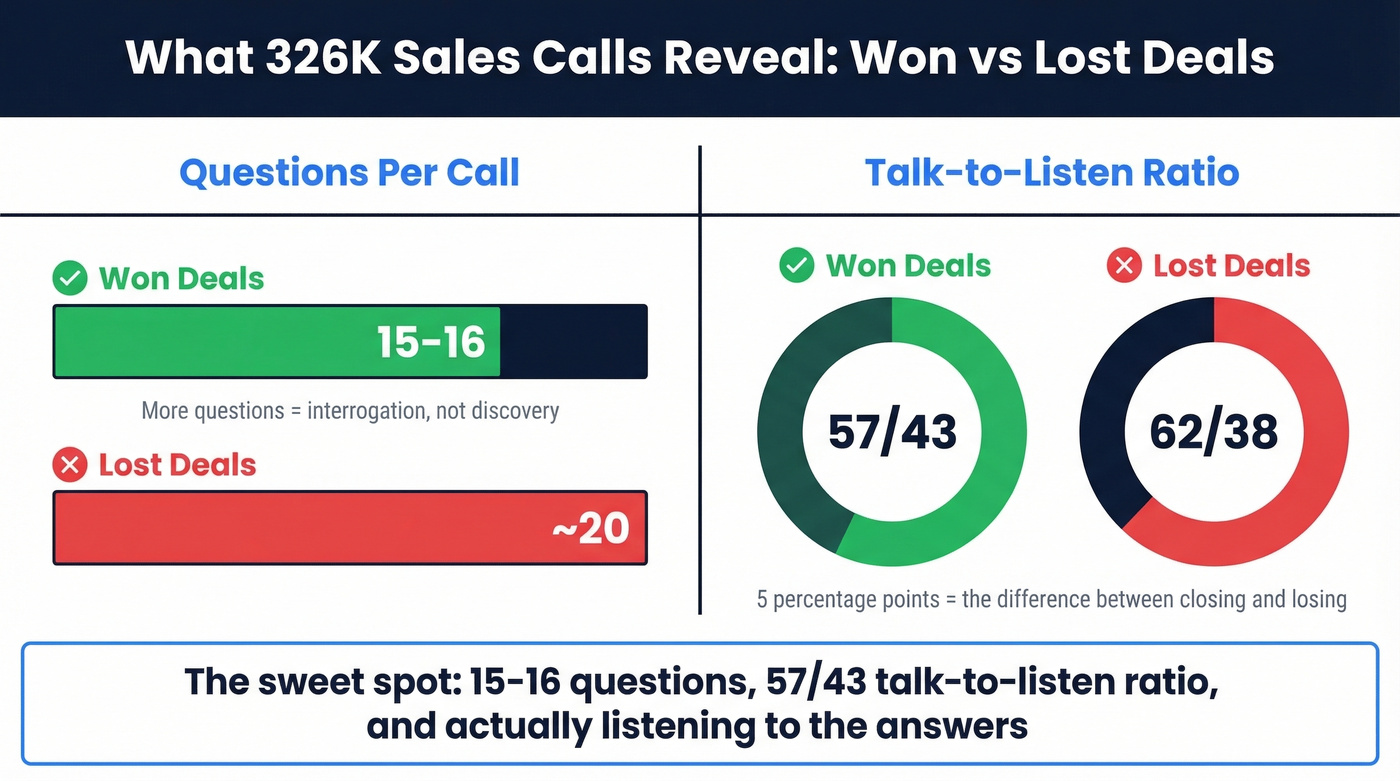
The average sales call runs a 60/40 talk-to-listen ratio - already too much talking. Closed-won deals shift to 57/43. Lost deals swing to 62/38. Five percentage points doesn't sound like much until you realize it's a meaningful jump in seller airtime, time the buyer could've used to explain what's really going on.
Here's the thing: high performers are remarkably consistent in their talk ratio regardless of outcome. Low performers swing roughly 10 points between won and lost calls (54% talk in wins vs. 64% in losses). That inconsistency signals reactive behavior - they talk more when they're nervous, which is exactly when they should be listening more.
The question volume data tells the same story. Won deals averaged 15-16 questions. Lost deals averaged around 20. The extra questions created an interrogation dynamic that killed conversational back-and-forth. Successful calls show more interactivity, more natural dialogue. Lost calls feature longer seller monologues punctuated by rapid-fire questions.
The takeaway isn't "ask fewer questions." It's ask better questions and actually listen to the answers before moving on.
60+ Best Questions by Stage
You don't need 100 questions. You need the right question for the right moment. Here are 60+ organized by where they fit in the conversation, drawing from practitioner frameworks and real rep language.
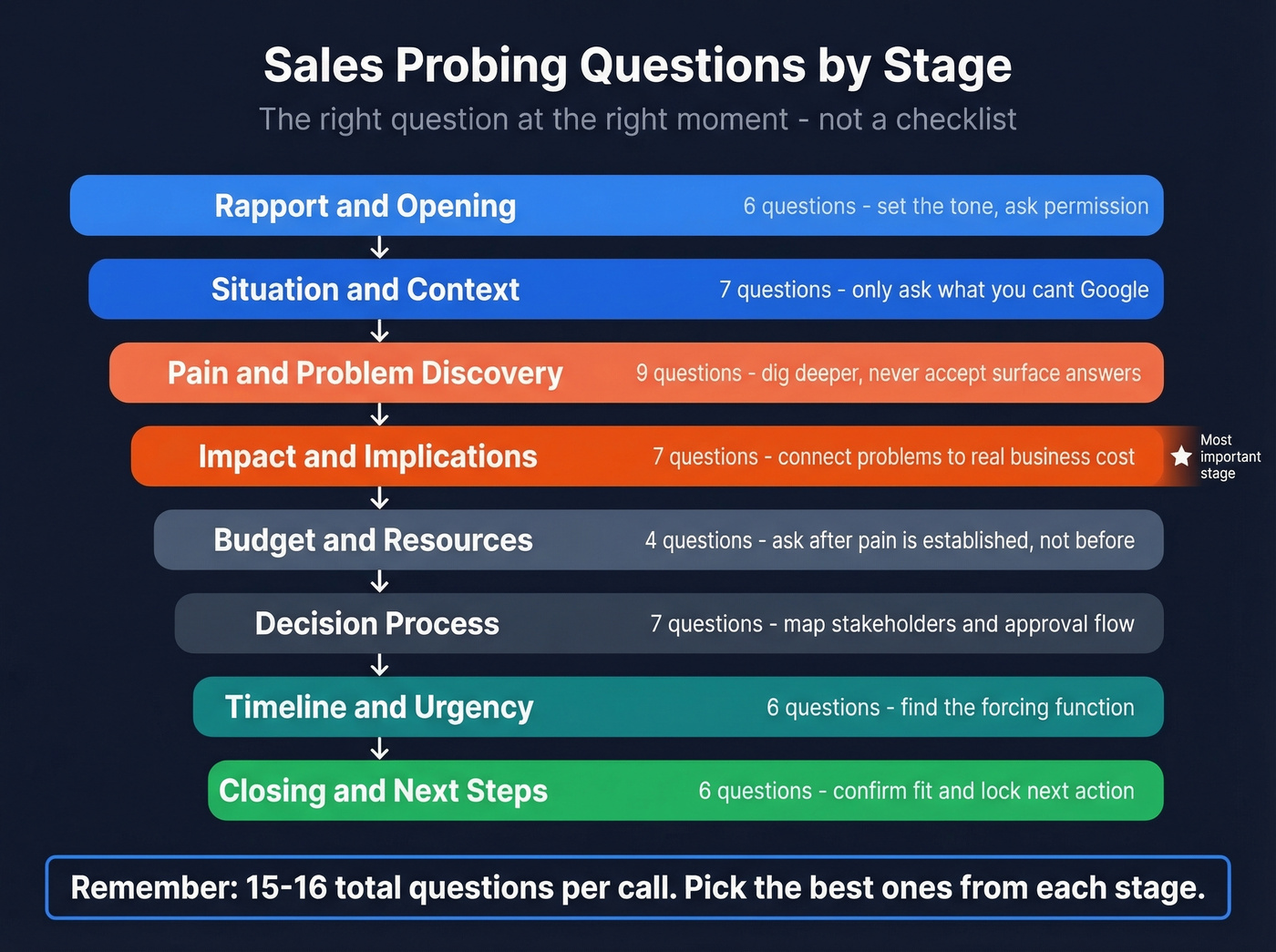
Rapport and Opening
Start with permission and context. The prospect needs to know this is a conversation, not a survey.
- "I'm going to ask you a series of questions so I can understand your situation - is that okay?"
- "What made you say yes to this meeting?"
- "What were you hoping to get out of this conversation?"
- "How's your team structured right now?"
- "What's on your plate this quarter that's keeping you up at night?"
- "Before we get into it - what would make this 30 minutes worth your time?"
Situation and Context
These establish baseline understanding. Don't overdo them - too many situation questions feel like an interrogation, especially when the answers were available on their website. We've watched reps burn five minutes asking questions they could've answered with 30 seconds of pre-call research. The good questions here are the ones you genuinely couldn't answer from public information.
- "Walk me through how your team handles [process] today."
- "How long have you been using your current solution?"
- "How many people touch this workflow end to end?"
- "What does your tech stack look like for [function]?"
- "Tell me about your business - what's the growth trajectory right now?"
- "How do you currently measure success for [initiative]?"
- "What does a typical deal cycle look like on your end?"
Pain and Problem Discovery
This is where probing earns its name. Don't accept surface-level answers. And just as important - don't ask leading questions that hand the prospect your preferred answer. "Are you struggling with pipeline velocity?" is a trap. "Where does your pipeline slow down?" is a probe.
- "You mentioned [problem] - how long has that been going on?"
- "What have you tried in the past to fix this? Why didn't it work?"
- "When specifically does this become a problem?"
- "Outside of price, what else is important when you evaluate solutions?"
- "What's the gap between where you are and where you need to be?"
- "If nothing changes in the next 12 months, what happens?"
- "How much time does your team spend working around this issue?"
- "What's the most frustrating part of the current process?"
- "Who else on your team is affected by this?"
Impact and Implications
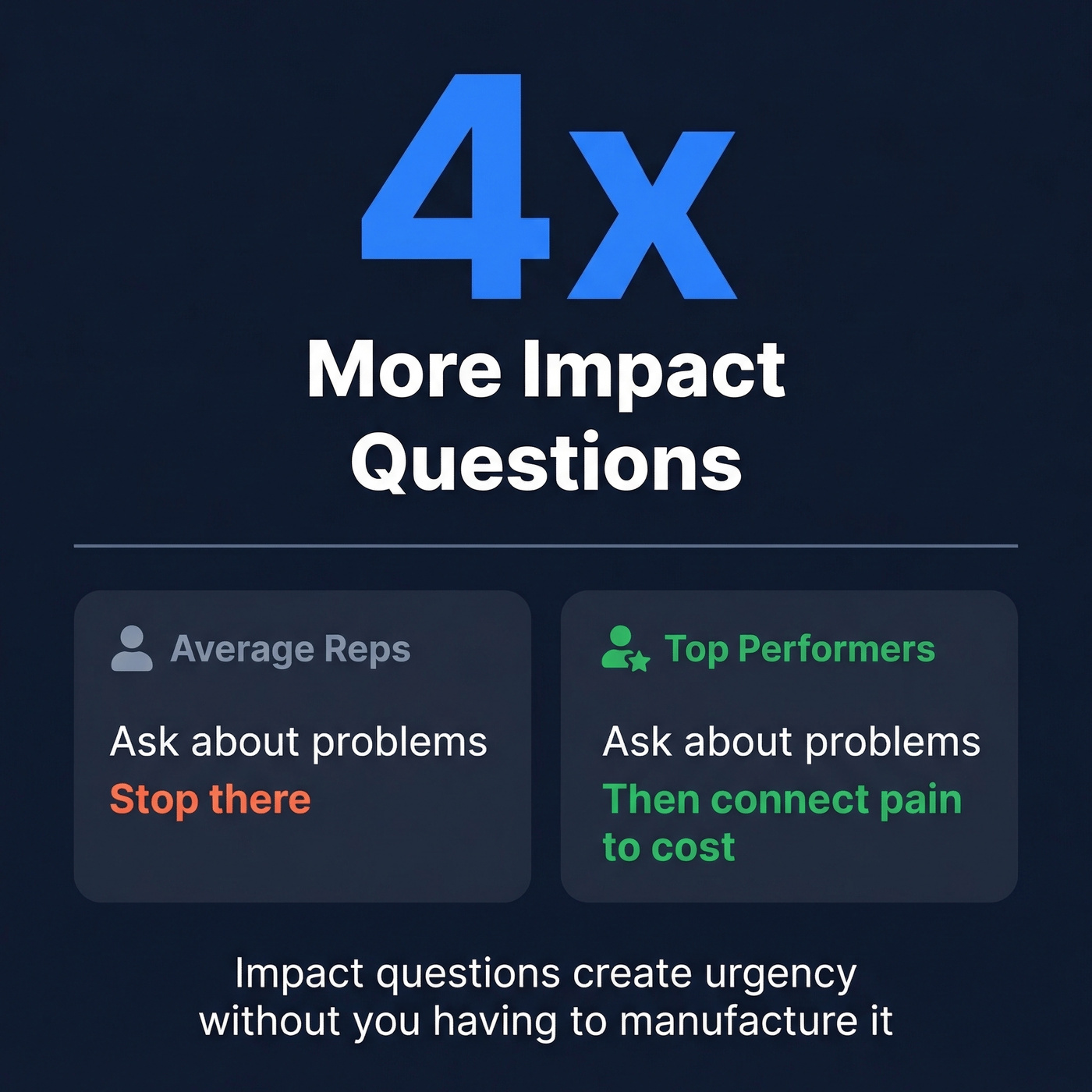
Top performers ask these 4x more often than average reps. That single stat should reshape how you prepare for calls. Impact questions connect problems to consequences - and consequences create urgency without you having to manufacture it. These are the bold discovery questions that separate closers from note-takers.
- "What's the revenue impact of that bottleneck?"
- "How does this affect your ability to hit your number this quarter?"
- "If your team keeps losing [X hours/week] to this, what does that cost over a year?"
- "What happens downstream when [process] breaks?"
- "How does this problem affect your relationship with [customers/leadership/board]?"
- "If you could wave a magic wand and fix this, what impact would that have on the business?"
- "What's the cost of doing nothing for another six months?"
Budget and Resources
Budget questions work best after you've established pain and impact - not before. Lead with budget and you'll get a deflection. Lead with cost-of-inaction and the budget conversation becomes a natural next step.
"Have you allocated budget for solving this, or is this exploratory?" is a fair opener once the prospect has articulated the problem's cost. From there, "What did you spend on the last solution you evaluated?" and "Is this coming out of an existing line item, or does it need new approval?" map the financial landscape. Close with "What's the ROI threshold that would make this a no-brainer?" to anchor the value conversation.
Decision Process and Stakeholders
Understanding how decisions get made is as important as understanding the problem.
- "Who else needs to weigh in on this decision?"
- "Walk me through how your team made the last purchase like this."
- "Who has final sign-off, and will I be able to meet with them?"
- "Are there any legal, security, or compliance checks we should anticipate?"
- "What would need to be true for your team to move forward this quarter?"
- "Is there anyone who might push back on this? What would their concerns be?"
- "How are the evaluation criteria weighted? What are the top three must-haves?"
Timeline and Urgency
- "What's driving the timeline on this?"
- "Is there a specific event or deadline that makes this urgent?"
- "What happens if this slips to next quarter?"
- "How quickly do you need to see results after implementation?"
- "Where does this rank against your other priorities right now?"
- "Is there a board meeting, renewal date, or fiscal deadline creating pressure?"
Objection Handling
These aren't reactive - they're proactive questions that surface objections before they become deal-killers. In competitive selling, some reps use landmine questions: questions designed to expose a competitor's weakness without naming them directly. "How does your current vendor handle [known gap]?" plants a seed of doubt that's hard to ignore.
- "What concerns do you have about making a change?"
- "What would make you hesitant to move forward?"
- "How much business do you currently do with [competitor]? What keeps you there?"
- "What's the biggest risk you see in switching?"
- "If you were advising me, what would you say is the weakest part of our pitch?"
Closing and Next Steps
- "Based on what we've discussed, does this feel like it solves the right problem?"
- "What would you need to see in a pilot to feel confident?"
- "What's the next step on your end?"
- "Is there anything we haven't covered that would change your thinking?"
- "What's changed since the last time we talked?"
- "Can we get [economic buyer] on the next call?"

You only get 15-16 questions per call. Don't waste them on the wrong prospect. Prospeo gives you 30+ filters - buyer intent, technographics, headcount growth - so you walk into every discovery call knowing exactly who you're talking to and why they should care.
Stop probing unqualified leads. Start with the right ones.
The SPIN Framework
SPIN is nearly four decades old and still one of the most validated questioning frameworks in sales. If you're not using it, you're improvising - and the data says improvising costs you deals.
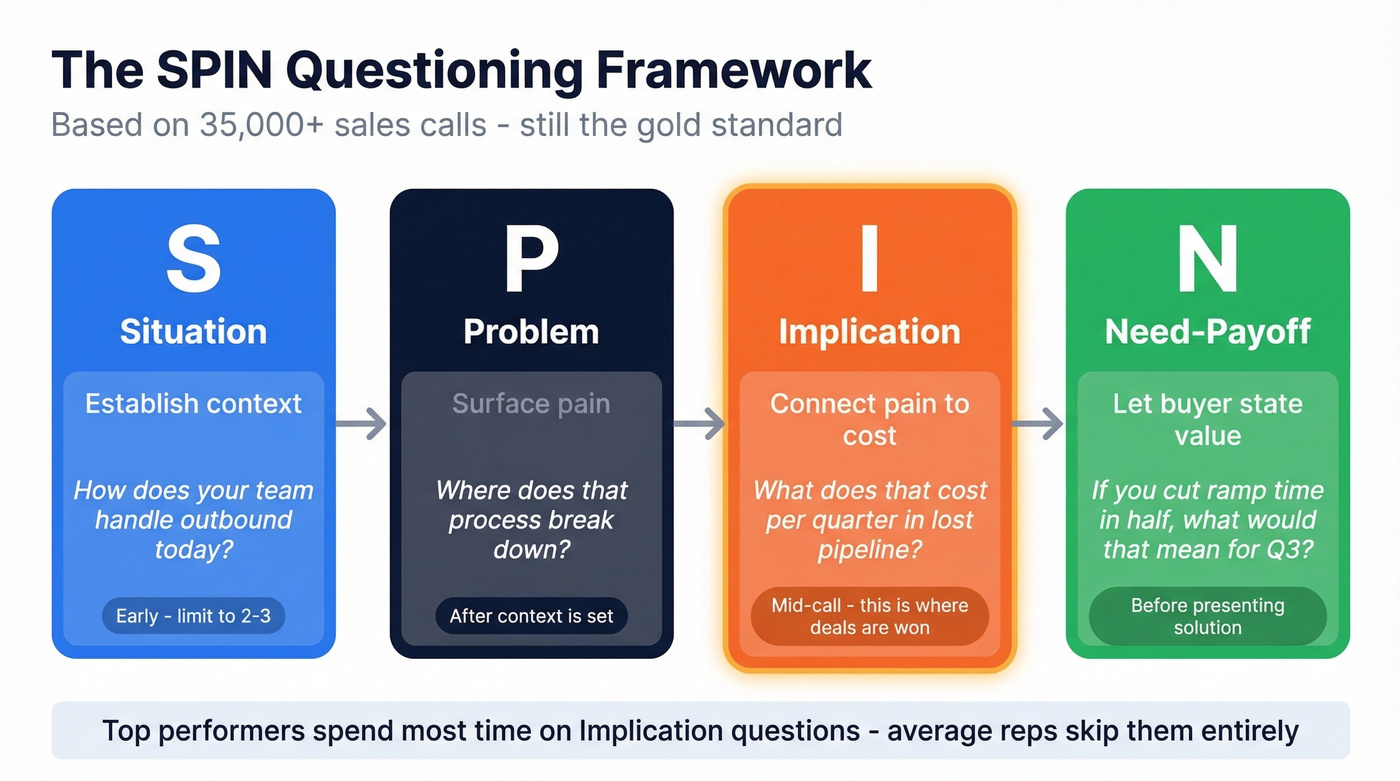
Neil Rackham's research covered 35,000+ sales calls. Improving investigation skills can increase sales volume by 20%+ in enterprise deals. When sellers develop explicit needs before pitching solutions, objections per selling hour drop by 55%. IBM, Xerox, and AT&T all trained on it. Half the Fortune 100 has at some point.
| Question Type | Purpose | Example | When to Use |
|---|---|---|---|
| Situation | Establish context | "How does your team handle outbound today?" | Early - limit to 2-3 |
| Problem | Surface pain | "Where does that process break down?" | After context is set |
| Implication | Connect pain to cost | "What does that cost per quarter in lost pipeline?" | Mid-call - this is where deals are won |
| Need-Payoff | Let buyer state value | "If you cut ramp time in half, what would that mean for Q3?" | Before presenting solution |
In our experience, the Implication questions are where most reps freeze up. They can ask about situations and problems all day, but connecting pain to business cost on the fly requires preparation. That's why 60-70% of SPIN implementations fail - reps relapse to old habits and struggle to plan Implication questions before the call.
Let's be honest: if your average deal size is under $15K, you probably don't need MEDDPICC-level qualification rigor. SPIN alone will carry you. Save the eight-element framework for deals where a lost quarter of pipeline actually hurts.
Enterprise Probing with MEDDPICC
For six-figure deals, SPIN alone isn't enough. You need qualification rigor. 73% of SaaS companies selling above $100K ARR use some version of MEDDPICC. Full adoption correlates with 18% higher win rates and 24% larger deal sizes.
The framework originated at PTC in 1996, where it helped the company grow from $300M to $1B in four years. The key principle from Hyperbound's breakdown: MEDDPICC should be your internal compass. The prospect should never feel like you're running a checklist.
| Element | What It Qualifies | Example Probing Question |
|---|---|---|
| Metrics | Success criteria | "What KPIs will measure ROI?" |
| Economic Buyer | Final authority | "Who signs off on this?" |
| Decision Criteria | Eval requirements | "What are the top 3 must-haves?" |
| Decision Process | How they buy | "How did the last purchase get approved?" |
| Paper Process | Legal/procurement | "Any compliance reviews to plan for?" |
| Identify Pain | Core problem | "What's the impact if this isn't solved this year?" |
| Champion | Internal advocate | "Who's most invested in making this happen?" |
| Competition | Alternatives | "What else are you evaluating?" |
The Paper Process element is often overlooked - 28% of deals fail when buyers can't secure internal approval. Don't save that conversation for the end.
One stat that should change how you sequence these conversations: early economic buyer involvement boosts win rates by 55%. Delayed engagement reduces win rates by 113%. Get the decision-maker into the conversation early - don't save that question for call three.
How to Sequence and Deliver
Discovery is a process, not an event. Top performers spread their probing across the entire sales cycle, not just the first call.
Mirror, don't move on. When a prospect says something interesting, repeat their last one to three words with an upward inflection. The prospect elaborates without you asking another question. This is one of the highest-leverage techniques we've seen reps adopt - it costs nothing and immediately deepens every conversation.
Frame for depth. "Can you help me understand..." signals that you want a real answer, not a one-liner. It gives the prospect permission to think out loud.
Use personalized questions. Generic questions get generic answers. Reference the prospect's industry, recent company news, or role-specific pain points to show you've done your homework - and to unlock answers they wouldn't give a rep reading from a script.
Re-open on follow-ups. Start subsequent meetings with "What's changed since last time?" It surfaces new information and shows you're tracking the conversation across calls.
Skip "why" when possible. A former FBI negotiator flagged this: "why" sounds accusatory. "What led to that decision?" gets the same information without putting the prospect on the defensive.
None of this matters if you're calling a dead number or emailing someone who left the company six months ago. Tools like Prospeo verify emails at 98% accuracy and cover 125M+ verified mobile numbers, so every discovery call actually reaches the right person.
5 Probing Mistakes That Kill Deals
1. Answering your own questions
"Are you struggling with pipeline velocity - because a lot of teams we talk to are seeing slower cycles this quarter?" You just handed the prospect an easy out. We've watched reps do this hundreds of times. It's the single most common probing mistake in sales. Ask the question. Then shut up.
2. Rapid-fire interrogation
The 326K-call analysis is clear: 20+ questions per call correlates with lost deals. When you fire questions without pausing to process answers, the call feels like a deposition. Space your questions. Let silence do the work.
3. Overusing "why"
"Why did you choose that vendor?" sounds like a challenge. "What led you to that decision?" gets the same intel without the defensive reaction. Reserve "why" for genuine clarifying follow-ups where the tone is clearly collaborative.
4. Value dumping before developing needs
You hear a problem and immediately launch into your pitch. This is the "doctor prescribing surgery before running tests" anti-pattern. Develop the explicit need first - let the prospect articulate the cost and urgency. Then your solution lands with ten times the impact.
5. Frontloading like a checklist
Cramming every discovery question into the beginning of the call and then switching to a demo is a structural mistake. Discovery should be woven throughout the entire conversation - and across multiple calls. The data confirms it: discovery is ongoing, not a phase. Skip this pattern if you want your calls to feel like conversations instead of intake forms.
Adapting by Industry and Persona
The frameworks stay the same. The language changes.
For MSPs and cybersecurity sellers, Cynomi's research highlights a critical anti-pattern: getting too technical too early. A CEO doesn't care about your SIEM architecture. They care about risk, cost, and compliance. Lead with business-first probing: "What regulatory pressures does your organization face?" and "What would be the financial and reputational impact of a security event?"
For SaaS, adapt the vocabulary to the buyer. A VP of Sales responds to "How many hours per week do your reps spend on manual data entry?" A CFO responds to "What's your current cost per qualified opportunity?" Same SPIN scaffolding, different entry point.
The stakeholder matters as much as the industry. Champions need questions about internal politics ("Who might push back, and what would their concerns be?"). Economic buyers need questions about ROI thresholds and budget cycles. End users need questions about daily workflow pain. Don't ask the same questions to all three - the consensus on r/sales is that this single mistake tanks more multi-threaded deals than any other.
FAQ
What's the difference between probing and discovery questions?
Discovery questions are the broad category covering everything you ask to understand a prospect's situation. Probing questions are specific follow-ups that dig deeper - clarifying intent, surfacing hidden details, and quantifying impact. All probing questions are discovery questions, but not all discovery questions probe.
How many questions should I ask per sales call?
Won deals average 15-16 questions per call based on Gong's 326K-call analysis. Beyond 20, conversion drops measurably. Focus on fewer, higher-impact questions with strong follow-ups rather than trying to cover every angle in one sitting.
Which questioning framework works best?
Start with SPIN Selling - it's backed by 35,000+ calls of research and works from mid-market to enterprise. For deals above $100K, layer MEDDPICC on top for qualification rigor. For smaller deal sizes, SPIN alone delivers strong results.
How do I make sure I'm reaching the right prospects?
Verified contact data is the prerequisite. Prospeo covers 300M+ professional profiles with 98% email accuracy and 125M+ verified mobile numbers, so your discovery calls reach actual decision-makers instead of outdated contacts. The free tier includes 75 email credits per month.
Pre-call research separates great probing from lazy interrogation. Prospeo's Chrome extension gives you 40+ data points per contact - role, tech stack, company growth signals - so you skip the situation questions and go straight to impact.
Walk into every discovery call with unfair context advantage.