

Sales Quota: The 2026 Guide to Setting & Hitting It
It's January. Leadership just handed down quotas 20% higher than last year. No new territories, no additional headcount, no explanation beyond "we need to grow." Half the team is already updating their resumes. The other half is doing math on a napkin, trying to figure out if the number is even possible.
Sound familiar?
What You Need (Quick Version)
If you're setting a sales quota, you need three numbers: your historical win rate, your average deal size, and your pipeline coverage by segment. If you're living under one, you need to know two things - whether it's mathematically achievable and whether it's fairly compensated.
Pipeline coverage check: Total Qualified Pipeline / Quota. If your win rate is 25%, you need at least 4x coverage. Not 3x. The 3x rule is a myth.
Quota-to-OTE ratio check: Annual Quota / On-Target Earnings. Healthy range is 4:1 to 6:1. If your ratio is 8:1 or higher, the number isn't aggressive - it's broken.
Jump to [Pipeline Coverage](#pipeline-coverage - the-feasibility-check) for the full math, or [Quota-to-OTE Ratio](#quota-to-ote-ratio - is-it-fair) for the comp diagnostic.
What Is a Sales Quota?
A sales quota is the minimum performance expectation assigned to a rep or team over a defined period - usually monthly, quarterly, or annually. It's the number tied to your comp plan, your PIP risk, and your forecast accuracy. In practical terms, it's the line between "on track" and "on a performance plan."
Don't confuse it with a target or a goal. A target is aspirational. A goal might include stretch objectives that earn you a President's Club trip. A quota is the floor. Miss it consistently, and there are consequences.
Quotas serve three functions simultaneously: they drive revenue forecasting for finance, create accountability for individual reps, and structure the compensation model. When they're set well, they align all three. When they're not, they destroy morale and spike attrition - they're the connective tissue between strategy and execution, and getting them wrong cascades through the entire revenue org.
Quota Attainment in 2026
Here's the uncomfortable truth: most reps aren't hitting their number. Only 41.2% of software reps reached attainment in early 2025, according to RepVue data shared on r/sales. That's not a rep problem. That's a systemic one.
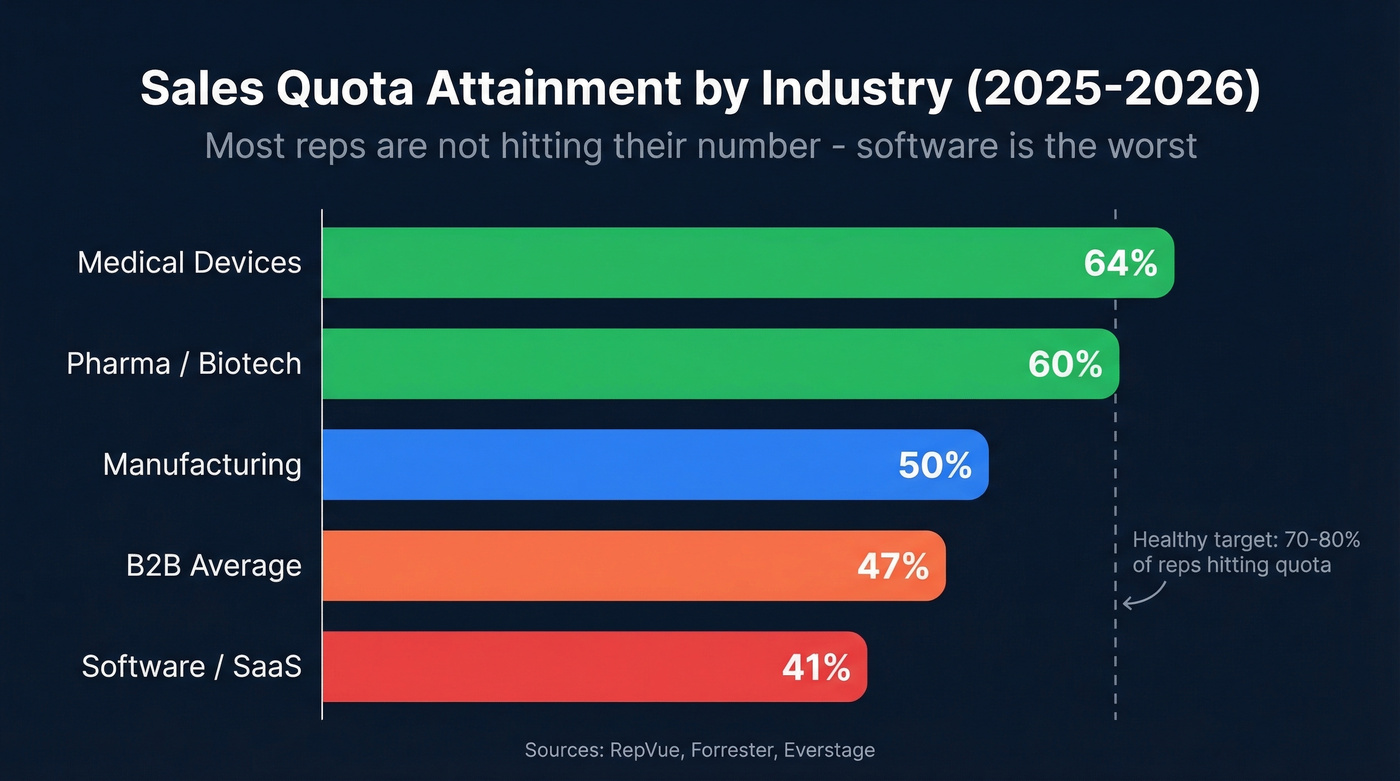
And it's not just software. Across B2B, a widely cited Forrester benchmark puts average attainment at 47%. QuotaPath reports that 91% of organizations missed expectations in 2024 - nine out of ten companies set numbers their teams couldn't reach. Meanwhile, one r/sales thread about med device quota stress captured the emotional toll perfectly: reps aren't just missing numbers, they're losing sleep over targets they never had a real shot at.
Best practice says quotas should be calibrated so 70-80% of reps can hit them. Most companies aren't even close. And here's the counterintuitive part - if 100% of your reps hit quota, your numbers are probably too low. The sweet spot for most orgs is 60-70% attainment, provided your commission structure makes the economics work for both sides.
| Industry | Quota Attainment |
|---|---|
| Medical Devices | ~64% |
| Pharma / Biotech | ~60% |
| Manufacturing | ~50%+ |
| Software / SaaS | ~41% |
| B2B Average | ~47% |
Why is software so much worse? Two forces are compounding. First, 57% of sales professionals say cycles are getting longer. Deals that used to close in 45 days now take 60-90. Second, reps spend 60% of their time on non-selling tasks - admin, CRM updates, internal meetings. That leaves roughly two days a week for actual selling.
When you combine longer cycles with less selling time and numbers that keep climbing, the math doesn't work. The question isn't why attainment is low. It's why leadership keeps pretending the numbers are reasonable.
Types of Sales Quotas
| Type | Definition | Example | Best For | Watch Out For |
|---|---|---|---|---|
| Revenue | Closed-won $ | $250K/quarter | AEs, closers | Ignores deal quality |
| Volume | # of deals closed | 15 deals/month | Transactional sales | Incentivizes small deals |
| Activity | Tasks completed | 80 calls/day | SDRs, BDRs | Rewards busywork |
| Profit | Margin-based $ | $50K gross profit/Q | Discount-heavy orgs | Complex to track |
| Forecast | Accuracy of calls | +/-10% of forecast | Sales managers | Encourages sandbagging |
| Combination | Blended metrics | Revenue + activity | Hybrid roles | Hard to calibrate |
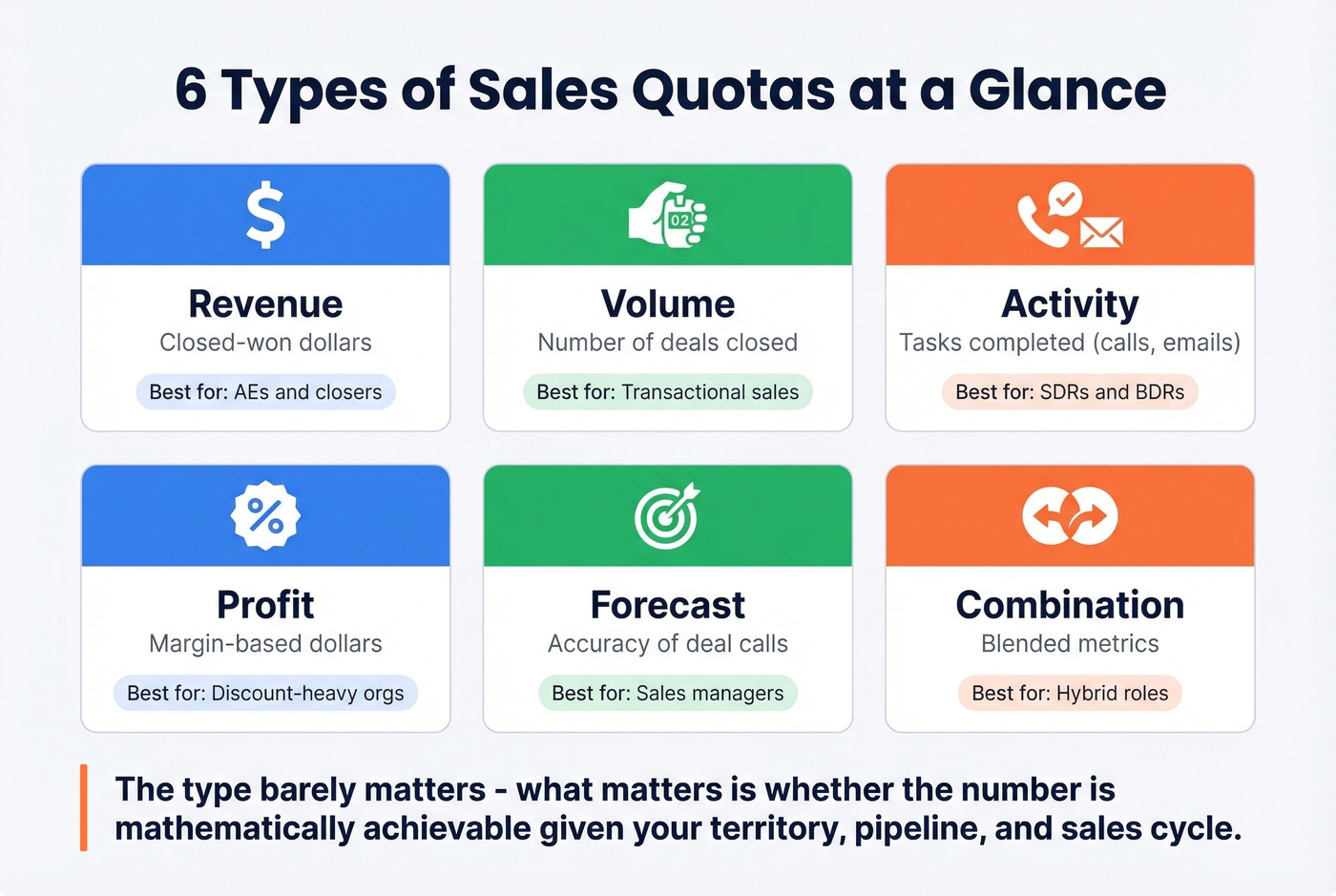
Let's be honest: stop obsessing over quota types. The type barely matters. A revenue-based number and a volume-based number can both be perfectly fair or completely delusional. What matters is whether the figure is mathematically achievable given your territory, pipeline, and sales cycle. A beautifully designed combination quota that's 40% too high is still a bad quota.
How to Set Sales Quotas
Required Inputs
Before you set a single number, you need data. 87% of sales leaders have no set method for setting quota targets. They're essentially guessing - and 58% of organizations over-assign by 20-30% to hedge against underperformance. That's not strategy. That's hope disguised as math.
Here's the minimum input checklist, adapted from Everstage's quota planning framework:
- Historical performance - last 4 quarters of attainment by rep and segment
- Conversion rates - stage-to-stage, by deal size and source
- Pipeline data - current qualified pipeline, creation velocity, aging
- Market conditions - competitive shifts, pricing changes, macro headwinds
- Sales cycle length - median and 75th percentile, not just average
- Sales velocity - deals x win rate x ACV / cycle length
- Seasonality - Q4 enterprise spikes, summer slowdowns, budget cycles
Filter out performance outliers before you build the model. One rep who closed a whale deal in Q3 shouldn't inflate everyone's Q1 number. Run what-if scenarios: what happens if win rates drop 5%? What if cycle length extends by two weeks? If the quota only works in the best-case scenario, it's not a quota - it's a fantasy.
Top-Down vs. Bottom-Up
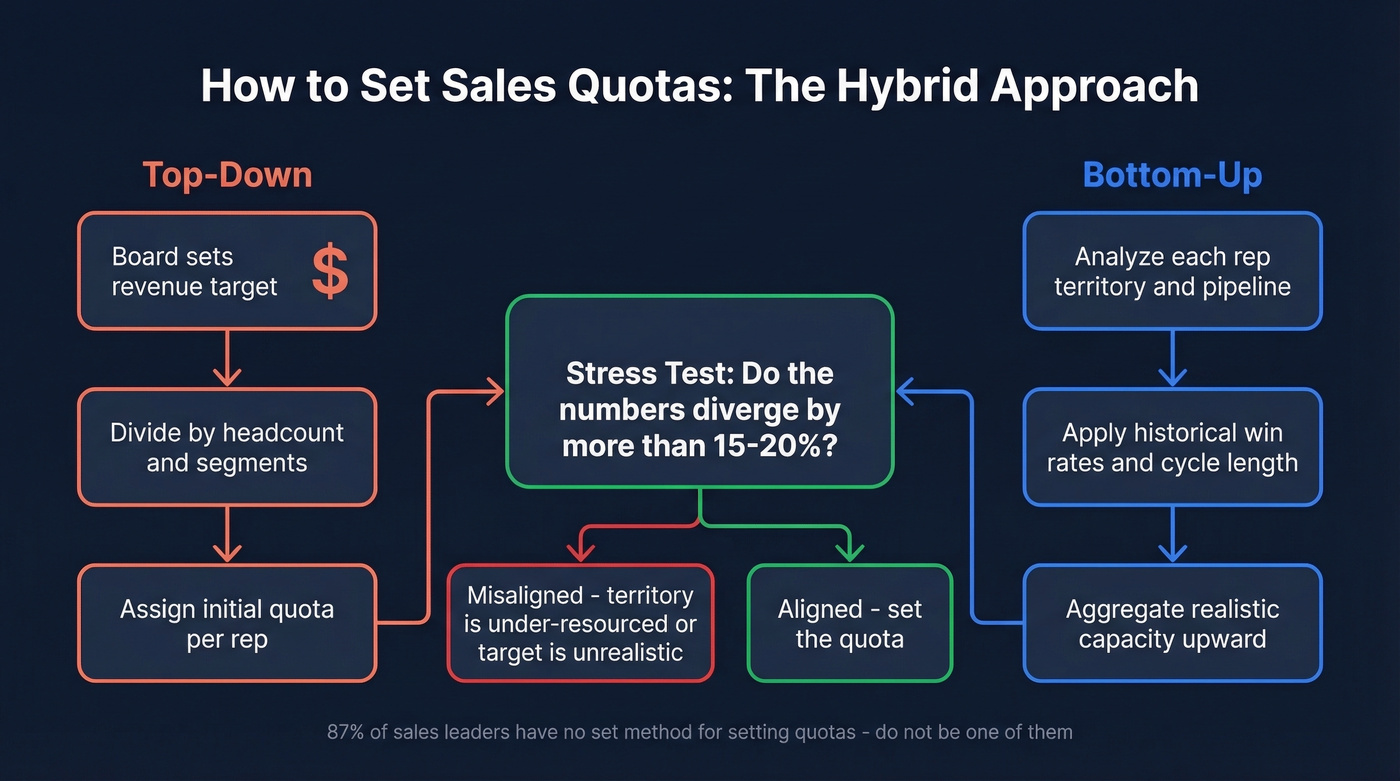
Top-down quota setting starts with the board's revenue target and divides it by headcount. Bottom-up starts with each rep's territory, pipeline, and capacity, then aggregates upward. Most companies do top-down only, which is how quotas become - as one Reddit thread put it - "investor math divided by the sales people."
The frustration is real. "Smash your target one year, then it'll just get raised" is the most common complaint in r/sales threads. And they're not wrong - pure top-down setting ignores territory differences, market shifts, and the basic question of whether the number is achievable.
Bottom-up alone has problems too. Reps will sandbag. Managers will pad. You'll end up with a number that's comfortable but doesn't hit the company's growth targets.
The answer is a hybrid. Start top-down with the revenue target, then stress-test it bottom-up against each rep's territory data, pipeline, and historical conversion rates. Where the two numbers diverge by more than 15-20%, something's wrong - either the territory is under-resourced or the target is unrealistic. 54% of reps say selling is harder than previous years. If your bottom-up math confirms that, don't ignore it.
Pipeline Coverage - The Feasibility Check
Pipeline coverage is the single best diagnostic for whether a quota is achievable. The formula:
Pipeline Coverage Ratio = Total Qualified Pipeline / Quota
If your team has $1.2M in qualified pipeline and a $400K quarterly target, that's 3x coverage. Sounds fine, right? Not necessarily.
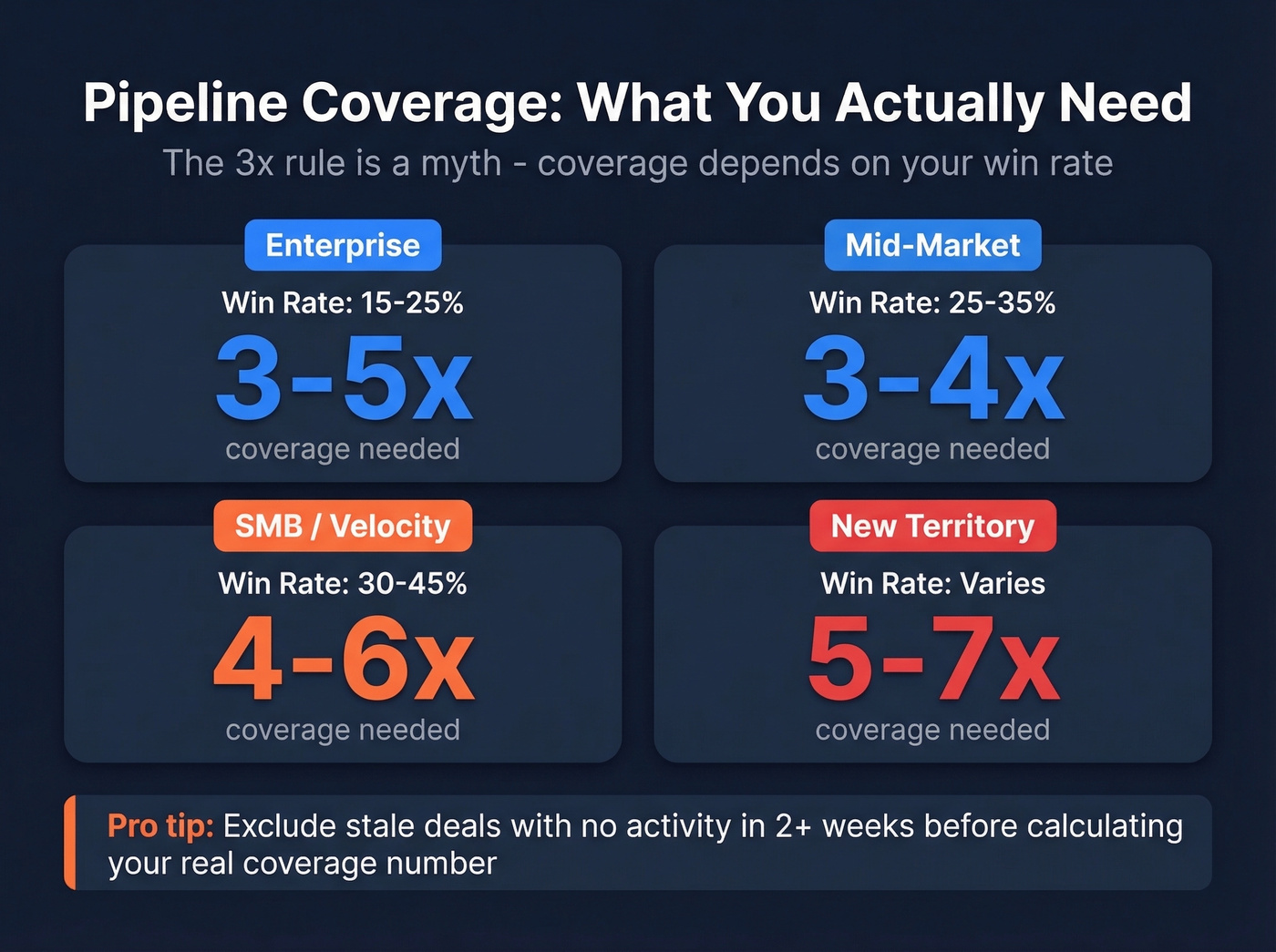
The 3x coverage "rule" is a myth. Coverage should be driven by your actual win rate, not an arbitrary multiplier. If you're closing 25% of qualified deals, you need 4x minimum. Closing 15% of enterprise deals? You need 6-7x.
Benchmarks by segment, per SalesMotion's coverage guide:
| Segment | Typical Win Rate | Recommended Coverage |
|---|---|---|
| Enterprise | 15-25% | 3-5x |
| Mid-Market | 25-35% | 3-4x |
| SMB / Velocity | 30-45% | 4-6x |
| New Territory | Varies | 5-7x |
Most teams get this wrong by counting stale deals. If you've got $1.5M in pipeline but $400K of it hasn't moved in weeks, your real coverage isn't 3.75x - it's closer to 2.75x. That's a miss waiting to happen.
We've seen teams run pipeline reviews where the "coverage looks great" on paper, but half the deals are zombies - no next step scheduled, no champion engaged, no movement since the demo. Clean your pipeline before you trust your coverage number. Exclude anything stale, apply a clear activity/recency rule, and you'll get a much more honest picture of where you actually stand heading into the quarter.
The best teams don't treat this as a quarterly exercise, either. They review coverage weekly and adjust tactics in real time - not just at QBR time. Early-quarter coverage should be high to leave room for slippage. Late-quarter, shift focus to late-stage deals and what's actually going to close in the next 30 days.

If your team needs 4x pipeline coverage to hit quota, bad data is the fastest way to blow it. Prospeo delivers 98% accurate emails and 125M+ verified mobiles - so every dial and send counts toward your number, not your bounce rate.
Stop padding pipeline with dead contacts. Build coverage that actually converts.
Quota-to-OTE Ratio - Is It Fair?
This is the comp sanity check most reps never run. The formula:
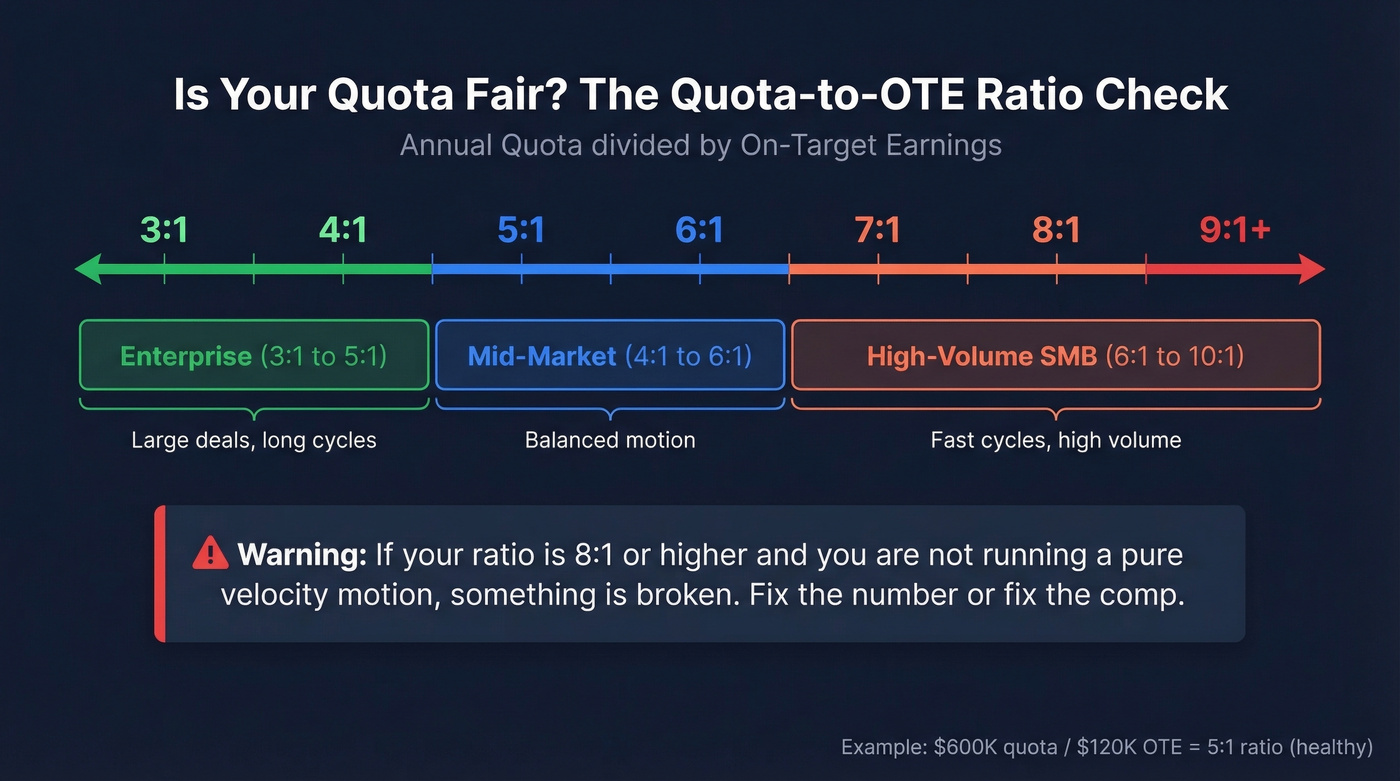
Quota-to-OTE Ratio = Annual Quota / On-Target Earnings
A $600K annual quota with $120K OTE gives you a 5:1 ratio. That's healthy. The sweet spot is 4:1 to 6:1, with nuance by motion:
- Enterprise (large deals, long cycles): 3:1 to 5:1
- Mid-market: 4:1 to 6:1
- High-volume / SMB: 6:1 to 10:1
The diagnostic question: can two-thirds of your reps hit their number? If not, the ratio is probably off. Either the target is too high, the OTE is too low, or the territory distribution is uneven.
Commission rate benchmarks add another lens. Most SaaS companies pay 11-14% of ACV at 100% attainment, with a median of 11.5%. If your commission structure pays significantly below that, you're either underpaying or over-assigning - and the result is the same: reps leave.
Here's the thing: if your ratio is 8:1 or higher and you're not running a pure velocity motion with 30-day cycles, something is broken. Either fix the number or fix the comp. Doing neither and wondering why attrition is 35% isn't a mystery - it's a choice.
Ramp Quotas - Stop Burning New Hires
Your new AE started three weeks ago. They have a 5-month sales cycle and a full quarterly quota. You already know how this ends.
Early rep churn costs well over $100,000 when you factor in recruiting, onboarding, lost pipeline, and the vacancy gap. Reps with structured ramp plans generate roughly 23% more revenue in their first year compared to those thrown into full attainment expectations on day one.
The standard ramp schedule works for most teams:
- Months 1-3: 50% of full quota
- Months 4-6: 75% of full quota
- Month 7+: 100% of full quota
The rule of thumb for ramp length: 1.5x your average sales cycle. If your typical deal takes 4 months to close, your ramp should be at least 6 months. For enterprise software with 6-month cycles, that means about 9 months - and many teams run 9-12 months depending on complexity.
For SDRs, the math is simpler. If full quota is 30 meetings per month, ramp to 10, then 15, then 20 over three months. For AEs with $100K/month targets, reduce the quarterly target by 33% during ramp and use quarterly measurement instead of monthly to smooth out the lumpiness of early deals. Give new reps clean data from day one - GreyScout cut ramp time from 8-10 weeks to 4 weeks partly by eliminating bad contact data, so new reps spent time selling instead of researching dead leads.
Five Quota-Setting Mistakes That Destroy Teams
1. "Last year + X%" with no market analysis. A cybersecurity company raised quotas 25% based purely on board expectations. Result: only 25% of reps hit their number, and rep churn increased 40% year-over-year. The market hadn't grown 25%. The quotas were fiction.
2. One-size-fits-all territories. Equal $1.5M quotas across territories with wildly different account counts and market density. One rep hit 38% despite strong effort and solid win rates - the territory simply couldn't support the number. Territory planning and quota setting are inseparable.
3. Ignoring ramp for new hires. Full expectations from month one with a 5-month average sales cycle. Only 1 in 10 new hires lasted longer than a year. The company blamed "hiring quality." The real problem was math.
4. No mid-year recalibration. A major product change and regulatory shift hit mid-year. Leadership held numbers steady. Reps missed by 46% on average. Only 29% of companies offer any quota flexibility for territory shifts or market changes - the other 71% are flying blind when conditions shift.
5. Comp misalignment. A flat 7% commission with no accelerators meant reps stopped pushing after 110% attainment - there was no incentive to overperform. A competitor offering 2x accelerators above 120% saw 30% higher rep productivity. A quota without the right comp structure is just a number on a spreadsheet.
How to Actually Hit Your Number
Protect Your Selling Time
Reps spend 60% of their time on non-selling tasks. That's three days a week on CRM updates, internal meetings, proposal formatting, and chasing approvals. If you're behind on quota, start by auditing where your hours actually go.
Time-block ruthlessly. Mornings for outbound prospecting, afternoons for discovery calls and demos. Batch your admin into one 90-minute block at end of day. Decline meetings that don't directly advance a deal or build pipeline. If you reclaim even 5 hours per week of selling time, that's 250+ hours per year - hours that go directly toward pipeline-building activity you're currently losing to busywork.
Fix Your Data Before You Blame Your Effort
An attainment lever nobody talks about in QBRs: data quality. Your reps can't close deals they can't reach. If your bounce rates are running 30-40%, you're not just wasting emails - you're burning domain reputation, tanking deliverability, and leaving pipeline on the table.

Snyk had this exact problem. Their 50 AEs were prospecting 4-6 hours per week with bounce rates of 35-40%. After switching to Prospeo - which delivers 98% email accuracy on a 7-day refresh cycle - bounce rates dropped under 5%. AE-sourced pipeline jumped 180%, generating 200+ new opportunities per month. Meritt saw similar results: pipeline tripled from $100K to $300K per week, and bounce rates fell from 35% to under 4%.
The math is straightforward. If your reps send 500 emails per week and 35% bounce, that's 175 wasted touches. Fix the data, and those 175 touches become real conversations. Over a quarter, that's thousands of additional prospects reached.
Use AI to Multiply Output
Sellers who partner with AI tools are 3.7x more likely to meet their quota, and 88% of reps using AI agents say it increases their odds of hitting targets. This isn't hype anymore - it's showing up in attainment numbers.
The key is using AI as a junior analyst working alongside you, not a replacement. AI can draft first-pass emails, research accounts, summarize call notes, and prioritize your pipeline by likelihood to close. That frees you to do the things AI can't - build relationships, handle objections in real time, and negotiate. The reps who embrace this workflow are the ones pulling ahead.
Our take: if your average deal size is under $10K, you probably don't need enterprise-grade sales intelligence platforms with six-figure contracts. You need accurate contact data, a solid sequence tool, and the discipline to protect your selling time. Skip the bloated tech stack - everything else is a distraction dressed up as enablement.
SaaS Compensation Benchmarks
For reference, here's where the market sits right now for common SaaS sales roles:
| Role | Base Salary | OTE | Implied Quota | Base/Variable |
|---|---|---|---|---|
| SDR | $55-75K | $70-95K | $350-570K | ~60/40 |
| Mid-Market AE | $75-100K | $140-180K | $700K-$1.08M | ~50/50 |
| Enterprise AE | $100-140K | $230-270K+ | ~$920K-$1.35M | 50-60% base |
Top-performing enterprise AEs clear $300K+ OTE. The U.S. average base/variable split is 44:56, though enterprise roles skew heavier on base to account for longer cycles and lumpier deal flow.
One number that should keep sales leaders up at night: vacancy cost. An average AE quota of $1.2M ARR with a 60-day vacancy means roughly $200K in lost ARR - just from the empty seat. That's before you factor in ramp time for the replacement. Hiring speed and ramp structure aren't HR problems. They're revenue problems.
Why Quotas Matter Beyond the Number
Quotas do more than measure individual performance - they're the mechanism that translates company-level revenue goals into daily rep behavior. Without them, forecasting becomes guesswork, comp plans have no anchor, and accountability evaporates. A well-calibrated sales quota aligns finance, sales leadership, and frontline reps around the same number. A poorly set one creates misalignment that cascades through the entire revenue org, from inaccurate board forecasts all the way down to reps who've mentally checked out by March because they know the number is unwinnable.
FAQ
What is a sales quota and how does it differ from a target?
A quota is the minimum performance expectation tied to compensation - miss it, and your variable pay and job security are affected. A target is a broader goal that includes stretch objectives. Quotas carry consequences; targets carry aspirations.
What's a good pipeline coverage ratio?
At a 25% win rate, you need 4x coverage minimum. Enterprise teams typically need 3-5x, SMB teams 4-6x, and new territories 5-7x. The "3x rule" is a myth - calculate from your actual conversion data and exclude stale deals from the count.
How often should quotas be recalibrated?
Run quarterly reviews with mid-year recalibration authority at minimum. Companies that never adjust after market shifts see reps miss by 46% on average. Build triggers into your policy - product changes, territory realignments, macroeconomic shifts.
How can better contact data help reps hit quota?
High bounce rates mean reps waste hours chasing dead leads instead of selling. Prospeo's 98% email accuracy and 7-day refresh cycle cut Snyk's bounce rate from 35-40% to under 5%, boosting AE-sourced pipeline 180%. Clean data is the most underrated attainment lever in sales.
Reps lose 60% of their week to non-selling tasks. Prospeo's 30+ search filters, intent data across 15,000 topics, and one-click Chrome extension put qualified prospects in front of your team in minutes - not hours. At $0.01 per email, scaling pipeline coverage doesn't require scaling budget.
Give your reps two more selling days per week.