

The Real Factors Affecting Sales Performance - And Which Ones You Can Actually Control
17% of reps generate 81% of revenue. That's not a bell curve. It's a system failure. And yet most sales orgs respond by sending the bottom 83% to training, as if a two-day workshop on objection handling will fix broken territories, dirty data, and comp plans designed on vibes.
The factors affecting sales performance aren't what most orgs think they are. Only 43.5% of sales professionals hit quota in recent benchmarks. A popular r/sales thread put it bluntly - roughly 80% of your results come from forces outside your control: economy, market, company, timing, territory. That framing is extreme, but it resonates for a reason.
The Quick Diagnostic
Most sales performance problems are systemic, not individual. Before you send anyone to training, ask three questions:
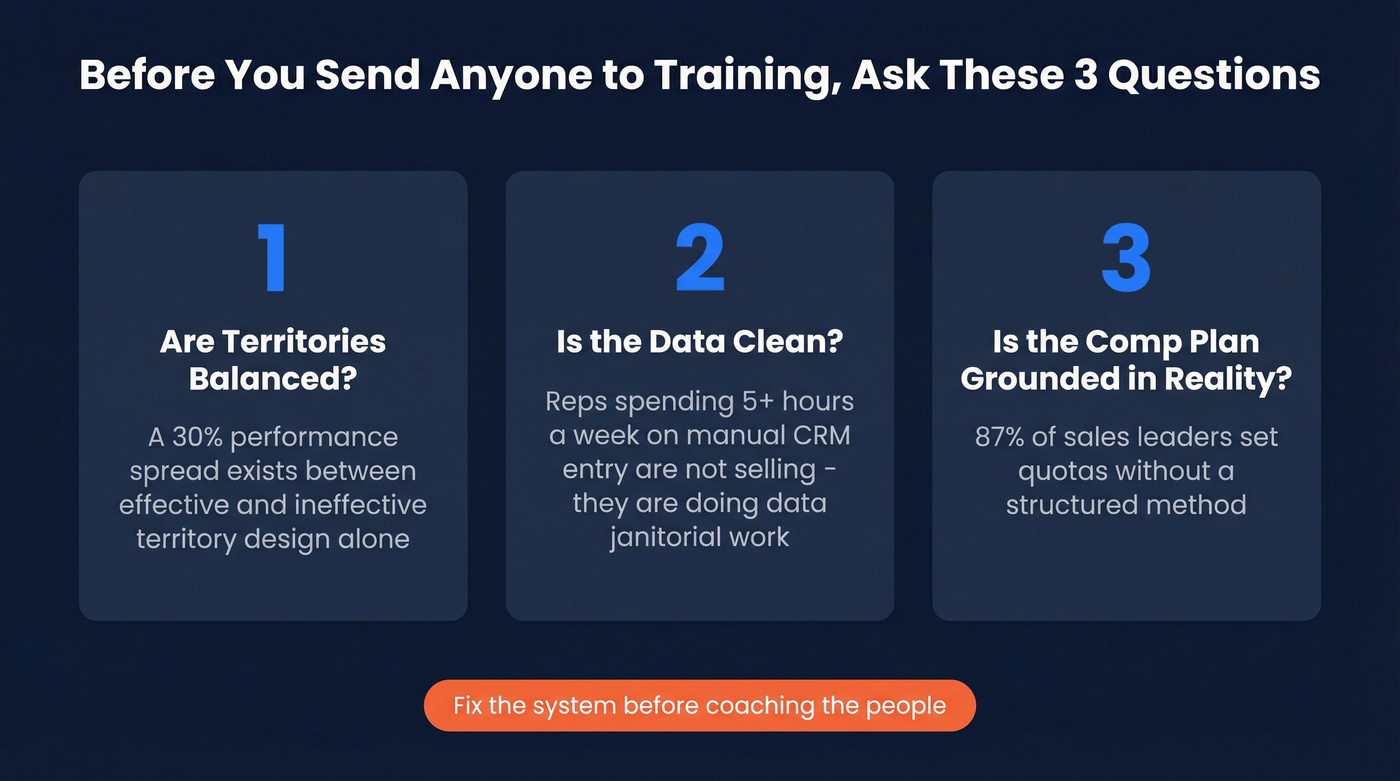
- Are territories balanced? A ~30% performance spread exists between effective and ineffective territory design alone.
- Is the data clean? Reps spending 5+ hours a week on manual CRM entry aren't selling - they're doing data janitorial work.
- Is the comp plan grounded in reality? 87% of sales leaders set quotas without a structured method. If the target is arbitrary, so is the miss.
Fix the system before coaching the people.
Factors You Can't Control
Some performance drivers are genuinely outside your influence. The economy shifts. Markets contract. Product-market fit erodes - or was never there to begin with. Territory assignments get reshuffled by someone three levels above you.
One r/sales poster captured this perfectly: a former President's Club winner went an entire year without hitting quota after their company merged existing-account and net-new roles. Same rep, same discipline, same activity volume. Completely different results.
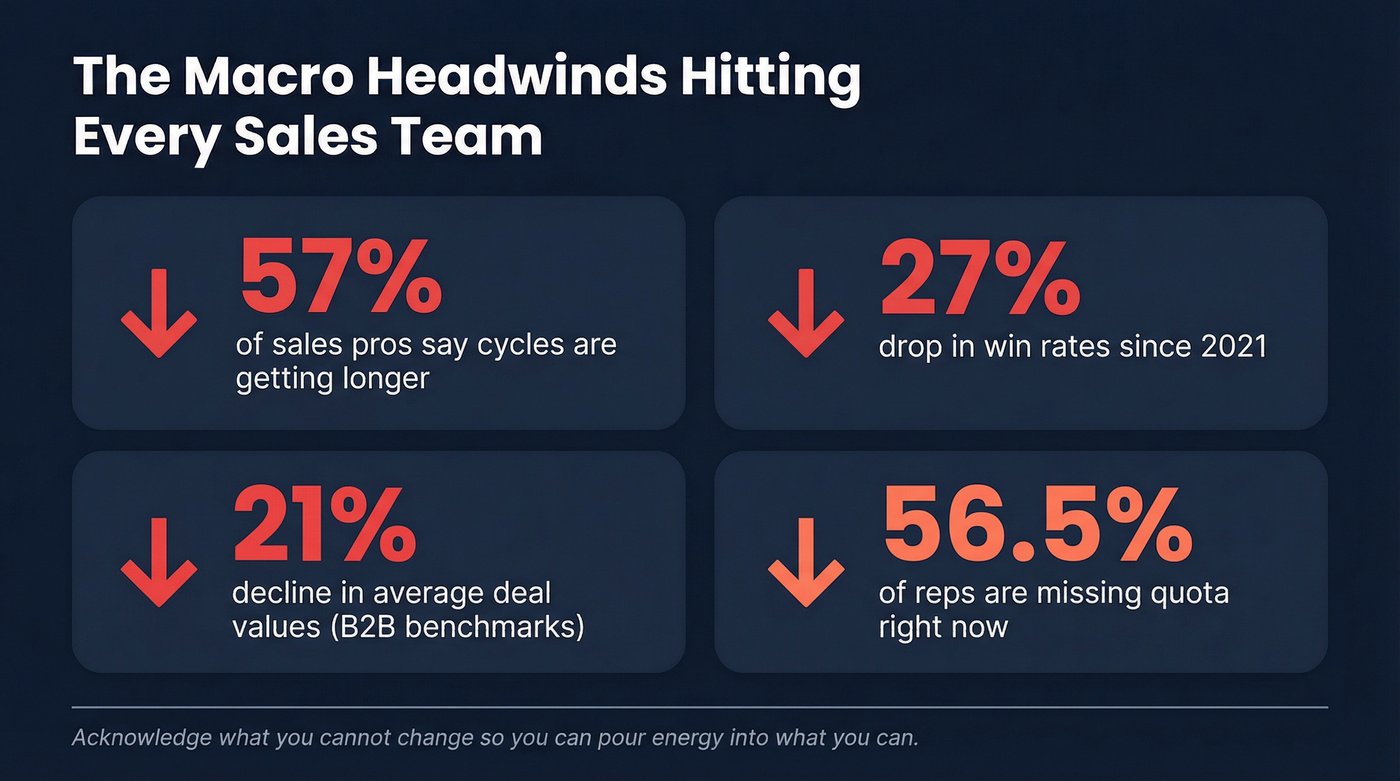
The macro trends aren't helping either. 57% of sales professionals say cycles are getting longer, win rates are down 27% since 2021, and average deal values have dropped 21% in widely cited B2B benchmark reporting. Seasonal challenges compound the problem - Q4 budget freezes, summer slowdowns, and fiscal-year resets create demand troughs that even the best reps can't outwork.
The point isn't fatalism. It's triage. Acknowledge what you can't change so you can pour energy into what you can.

You just read that reps lose 5+ hours a week to data janitorial work and 73% of buyers ignore irrelevant outreach. Prospeo eliminates both problems: 98% email accuracy, 7-day data refresh, and 30+ filters so reps reach the right buyers on the first attempt.
Stop letting dirty data be the factor that tanks your team's numbers.
Controllable Factors Affecting Sales Performance
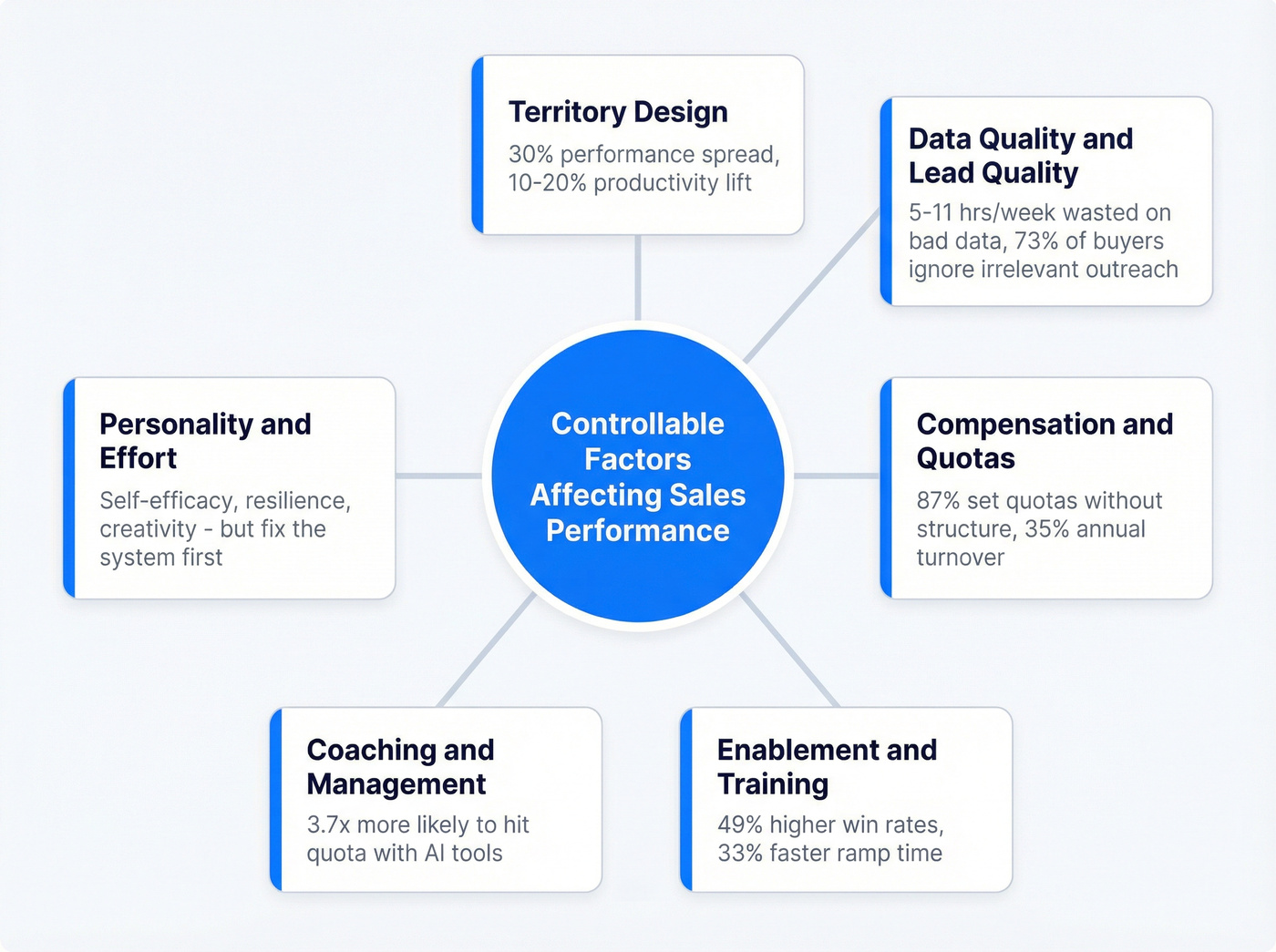
This is where your budget should go. Six clusters of controllable drivers account for a huge share of outcomes actually within your org's power to fix.
Territory Design
Territory design is one of the most under-invested levers in sales, and it's baffling how little attention it gets. An SMA survey of 100+ organizations found a roughly 30% performance spread between effective and ineffective territory design - yet 64% of orgs rate themselves as ineffective or only somewhat effective at it.
Thoughtful territory balancing can drive 10-20% productivity lifts. That's the equivalent of adding headcount without hiring. Yet 76% of companies do territory planning once a year and call it done. If you're only looking at territories annually, you're flying blind for eleven months.
Data Quality and Lead Quality
Here's the thing: 71% of field sales reps spend 5+ hours per week on manual CRM data entry. A quarter spend 11+ hours. That isn't selling time - it's data janitorial work caused by bad upstream data, and these efficiency drains quietly erode pipeline before a rep ever picks up the phone.
When reps do reach out, 73% of B2B buyers actively avoid sellers who send irrelevant outreach. Bad data doesn't just waste time; it actively damages your pipeline.
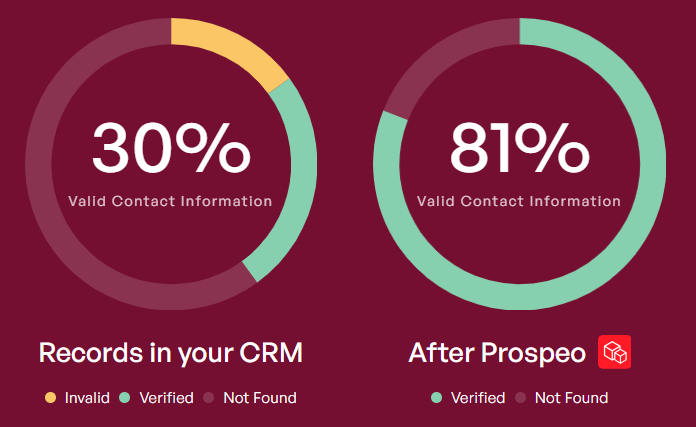
In our experience, this is the most fixable controllable factor - and the one that pays for itself fastest. Snyk's sales team saw it firsthand: bounce rates dropped from 35-40% to under 5%, and AE-sourced pipeline jumped 180% after switching to Prospeo's verified contact data. With a 98% email accuracy rate and a 7-day data refresh cycle versus the 6-week industry average, the improvement was almost immediate - 200+ new opportunities per month across 50 AEs.
Compensation and Quotas
87% of sales leaders set quotas without a structured method. Let that sink in. The single number that determines whether a rep is "successful" or "underperforming" is, in most orgs, essentially made up.
Sales turnover runs ~35% annually - about 2.7x the 13% all-industry average. The standard benchmark is a 50/50 base-variable split with a 5x quota-to-OTE ratio. If your plan deviates significantly from that without a clear strategic reason, you're creating turnover, not performance. (If you want to sanity-check your plan math, start with OTE.)
Enablement and Training
Formal enablement programs correlate with 49% higher win rates, and structured onboarding cuts ramp time by roughly 33% - from a ~10-month ramp to ~6-7 months. A Highspot survey found that AI-powered sales training makes teams 35% more likely to increase average deal size. A 2026 study based on 27 CEO and sales director interviews plus 3 case studies confirmed the mechanism: enablement platforms improve performance primarily through intra-firm collaboration and operational efficiency, not just content delivery.
Enablement is infrastructure. Treat it accordingly. (If you're building the function, see sales enablement manager and marketing enablement.)
Coaching and Management
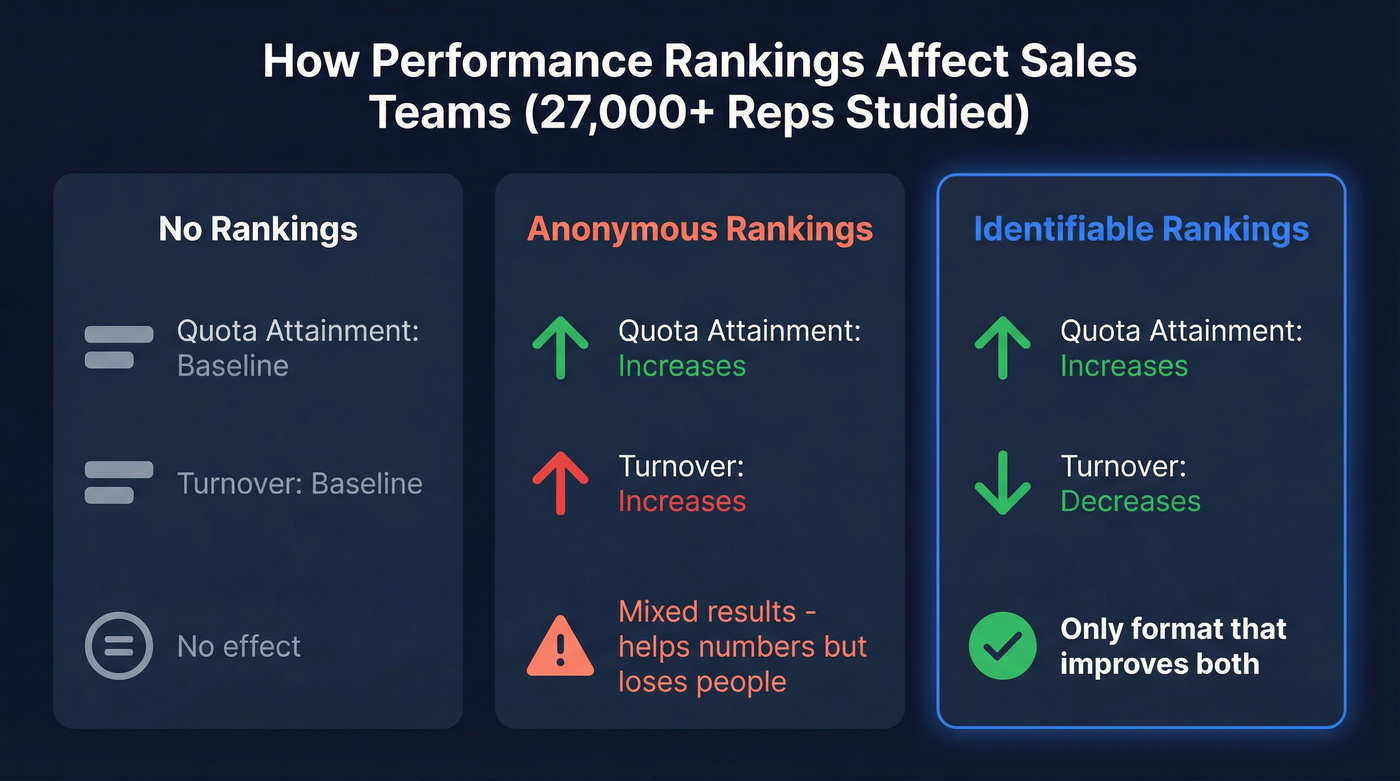
Here's a finding that surprised us: a study of 27,000+ salespeople across 170+ firms found that identifiable performance rankings - where reps can see where they stand by name - are the only format that simultaneously increases quota attainment and reduces turnover. Anonymous rankings help attainment but spike turnover. Transparency, done right, works.
Sellers using AI tools are 3.7x more likely to meet quota. The coaching multiplier isn't just about the manager's time. It's about giving reps better tools to self-correct. (For a systems view, see sales leadership.)
How Personality Affects Sales Performance
Yes, individual effort and skill matter - and so does temperament. Academic research identifies work effort and creativity as direct performance antecedents, with self-efficacy as an indirect predictor. Traits like resilience, curiosity, and coachability shape how personality affects sales performance day to day, influencing everything from discovery call quality to how quickly a rep recovers from a lost deal.
But let's be honest: if your average deal size is north of $20k and more than half your team is missing quota, the problem is almost certainly not the reps. A creative, high-effort rep in a broken territory with bad data and an impossible quota will still miss. Fix the system first. (If you want a practical playbook for the mindset side, start with resilience.)
How to Diagnose Your Bottleneck
Three methods cut through the noise.
Demand-Zero vs. Availability-Zero. Is there no market demand - wrong ICP, bad product-market fit, dead territory? Or does demand exist but your team can't reach it because of bad data, broken sequences, or insufficient coverage? These require completely different fixes, and most orgs conflate them. (Use an Ideal Customer Profile to make this concrete.)
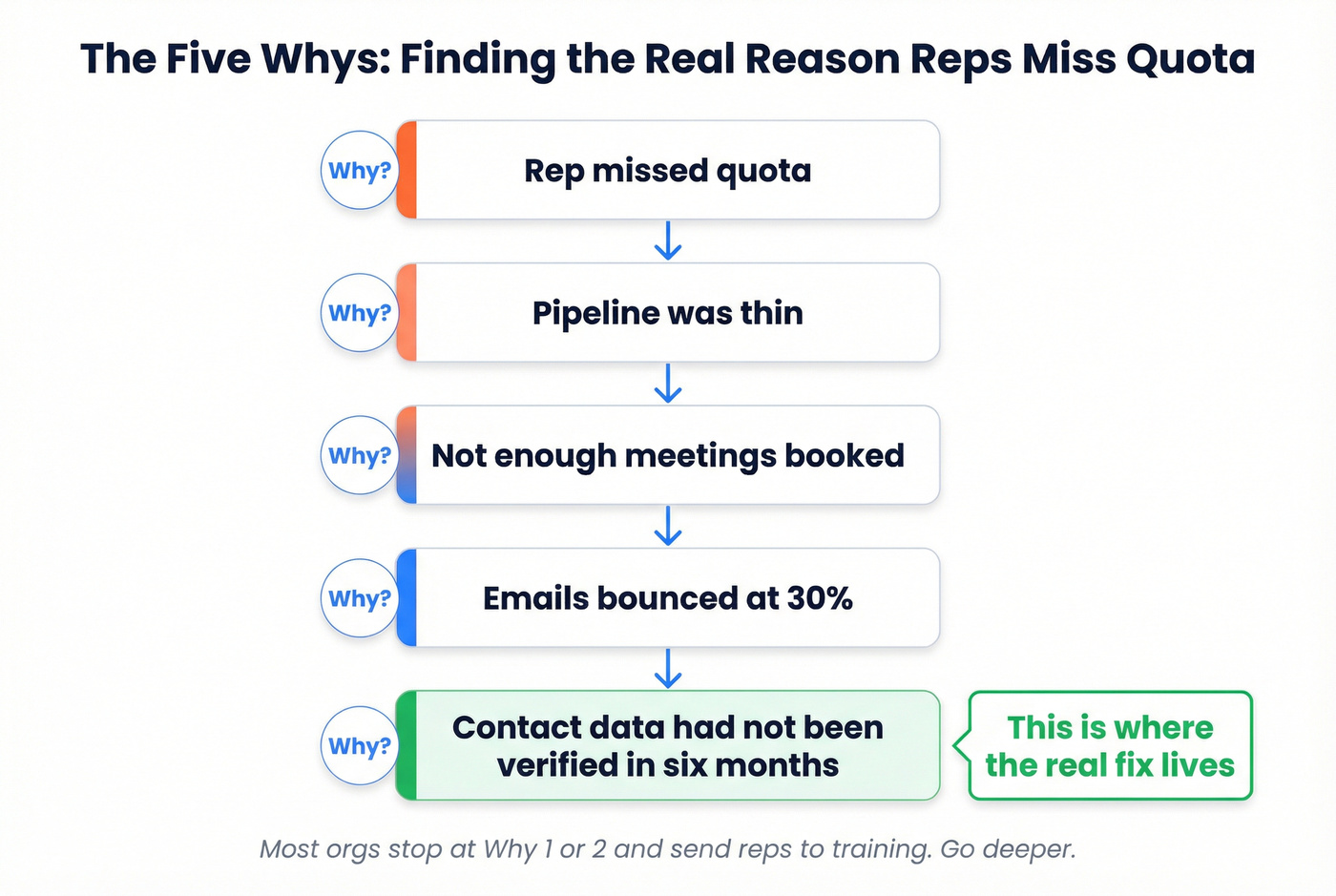
Five Whys. Rep missed quota. Why? Pipeline was thin. Why? Not enough meetings booked. Why? Emails bounced at 30%. Why? Contact data hadn't been verified in six months. That fifth "why" is where the real fix lives. (If bounces are a recurring issue, track your email bounce rate.)
Time audit in 30-minute blocks. Have reps log their actual time for one week. A common benchmark is that top performers spend 35% more time on customer-facing activities - not because they're more disciplined, but because their systems waste less of their day. (If you need a baseline, start with sales activities.)
Snyk dropped bounce rates from 35-40% to under 5% and added 200+ opportunities per month across 50 AEs. When data quality is the most fixable factor affecting sales performance, switching to verified contacts at $0.01/email is the highest-ROI move you can make.
Fix the system before you coach the people. Start with the data.
FAQ
What's the single biggest factor in sales performance?
Territory design and data quality create the largest measurable swings. Territory alone accounts for a ~30% performance spread, and verified contact data can multiply pipeline by triple digits. Most orgs under-invest in both while over-investing in rep training.
Why do top performers suddenly stop hitting quota?
Structural changes are almost always the cause: territory reshuffles, role merges, quota increases, or comp plan shifts. A President's Club winner can miss for a full year if the system changes enough. Performance is contextual, not permanent.
How does clean data improve sales team results?
Verified emails and direct dials reduce bounce rates from 35%+ to under 5% and reclaim 5-11 hours of selling time per rep per week. We've seen teams generate 200+ new opportunities per month after fixing their data foundation - it's the highest-ROI change you can make before touching anything else.
Do personality traits really matter for quota attainment?
Self-efficacy, resilience, and creativity are proven performance antecedents in academic research. But individual traits explain far less variance than territory design, data quality, and comp structure. Fix systemic factors first, then coach for mindset.