

Sales Quota Types: The Operator's Guide to Quotas Reps Can Actually Hit
It's Q1 planning. The CRO walks in with a number from the board, divides it by headcount, adds 10% "stretch," and calls it a quota. Three months later, half the team is underwater and your best AE is interviewing at a competitor. This isn't a hypothetical - 49% of AEs missed quota in 2024, up from 34% in 2022 per Bridge Group data. The problem isn't lazy reps. It's lazy quota design, and often, picking the wrong sales quota types entirely.
A common sentiment on r/sales is blunt: quotas are "mostly made up," plucked out of thin air, then reverse-engineered into activity metrics nobody believes. But quotas don't have to be fiction. The difference between a quota that motivates and one that demoralizes comes down to picking the right type, setting it with real capacity data, and building the pipeline to back it up.
Quick Answer for SaaS Teams
If you're running SDRs and AEs, start here: revenue quotas for AEs, activity quotas for SDRs, and a combination quota (70/20/10 weighting) for full-cycle reps. Layer in pipeline coverage as a leading indicator. Skip "last year + 10%" - it's the single biggest reason quotas fail.
Sales Quota vs Sales Goal
A sales quota is a metric-driven, time-sensitive performance target assigned to a rep, team, or territory for a defined period. It's not a goal. Goals are aspirational. Quotas have consequences - they determine variable comp, trigger accelerators, and drive territory decisions.
A target says "we'd love to hit $5M." A quota says "you owe $1.2M this year, and your commission check depends on it." When people ask about sales quota vs sales target, the answer is similar: quotas carry comp implications, while targets inform strategy without directly affecting pay.
Quota Attainment (%) = (Actual Sales / Sales Quota) x 100
That's the number your comp plan, your board deck, and your rep's mortgage all revolve around. Salesforce recommends setting quotas so at least half of sellers can hit target; we think that's too low. At 50% attainment, half your team is demoralized every quarter. Aim for 60-70% and use accelerators to reward overperformance. For a ready-made calculator with pipeline stage analysis, Quadratic HQ offers a free template.
8 Types of Sales Quotas Every Revenue Leader Should Know
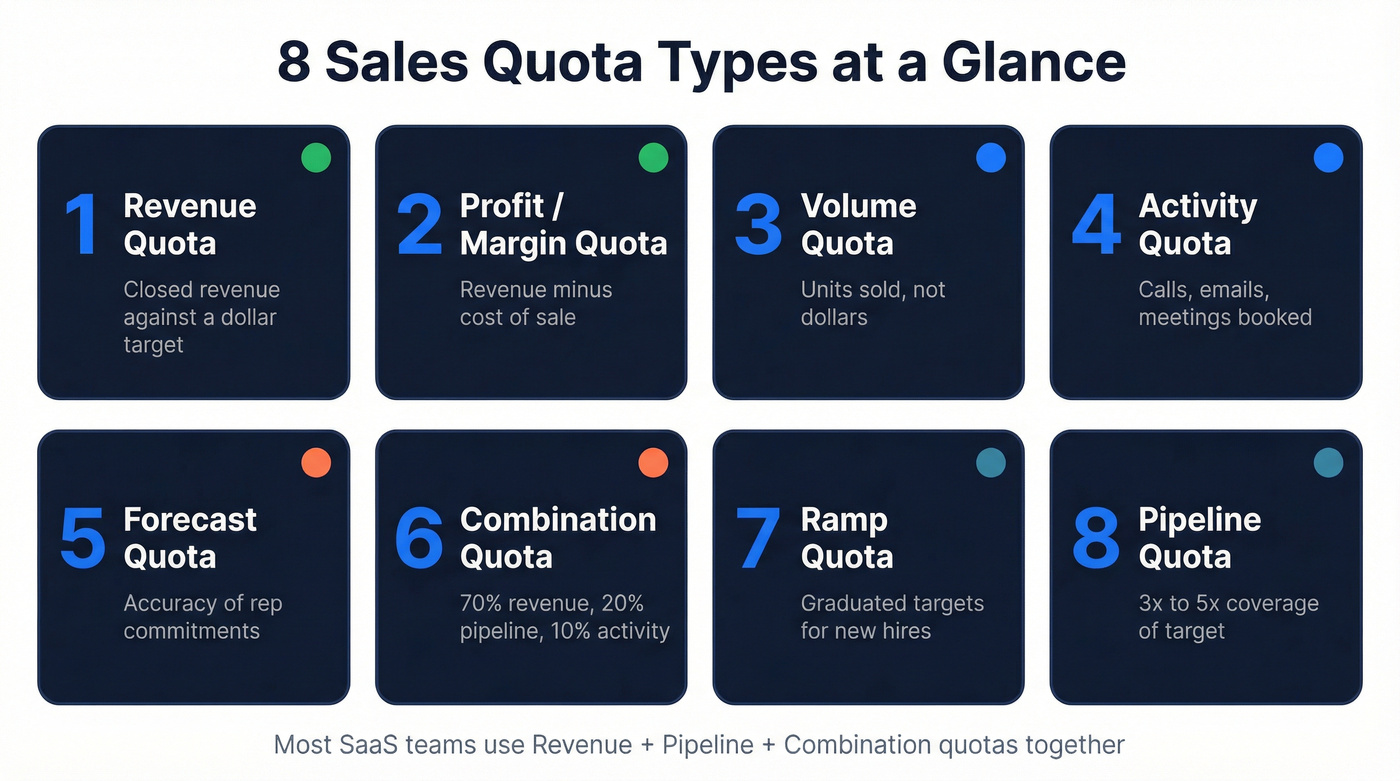
1. Revenue Quota
Your AE carries $1.2M ARR annually - $300K per quarter - and their job is to close that number. The revenue quota is the most common type and the right default for any team where closed revenue is the primary business outcome. Revenue quotas dominate SaaS because they align rep behavior directly with the metric the board cares about.
The risk: reps sandbagging deals to hit next quarter's number instead of this one. Quarterly quotas with monthly pipeline reviews keep this in check.
2. Profit / Margin Quota
An AE closes $500K in revenue but only $150K in margin after discounting. On a revenue quota, that looks fine. On a margin quota, it's a problem.
Margin quotas - sometimes called cost-based quotas because they account for the cost side of the equation - fix the "discount to close" habit and work best for product lines with variable margins: manufacturing, multi-SKU SaaS, or any business where a 40% margin deal and a 12% margin deal look identical on a revenue report.
3. Volume Quota
A medical device rep carries a quota of 200 units per quarter. No dollar amount - just units. Volume quotas make sense when unit economics are uniform and the business cares about market penetration or installed base growth. The trap: reps chase small deals to pad unit counts while ignoring strategic accounts. Pair volume quotas with a minimum deal-size threshold to prevent this.
4. Activity Quota
Here's where things get controversial. Activity quotas measure inputs - calls, emails, meetings - rather than outcomes. SDRs typically carry them: 80 touches per day, 10-15 meetings per month.
And here's the trap. Reps spend roughly 29% of their time actually selling. An activity quota that ignores this creates busywork incentives - reps log 100 dials to hit the number, but 60 are voicemails to wrong numbers. Activity quotas only work when paired with quality guardrails like meeting show rates, positive reply rates, or pipeline value generated. Skip activity quotas entirely if you don't have the ops infrastructure to measure quality alongside quantity.
5. Forecast Quota
Reps commit to a number they believe they'll close and are measured against that commitment. Forecast quotas reward accuracy, not just volume, and shine in enterprise sales with long cycles where deal-level visibility matters more than raw activity. The downside is predictable: reps under-commit to guarantee they "beat forecast" every quarter. Always pair with revenue quotas.
6. Combination Quota
This is the one we recommend for full-cycle AEs. A combination quota weights multiple metrics - typically 70% revenue, 20% pipeline generation, and 10% activity. It prevents the tunnel vision that single-metric quotas create.
A rep who closes $900K but builds zero pipeline for next quarter isn't actually performing well. Combination quotas surface that. The guardrail: if reps can't calculate their own attainment in their heads, you've over-complicated the weighting. Keep it to three metrics max, and make sure the revenue component always dominates.
7. Ramp Quota
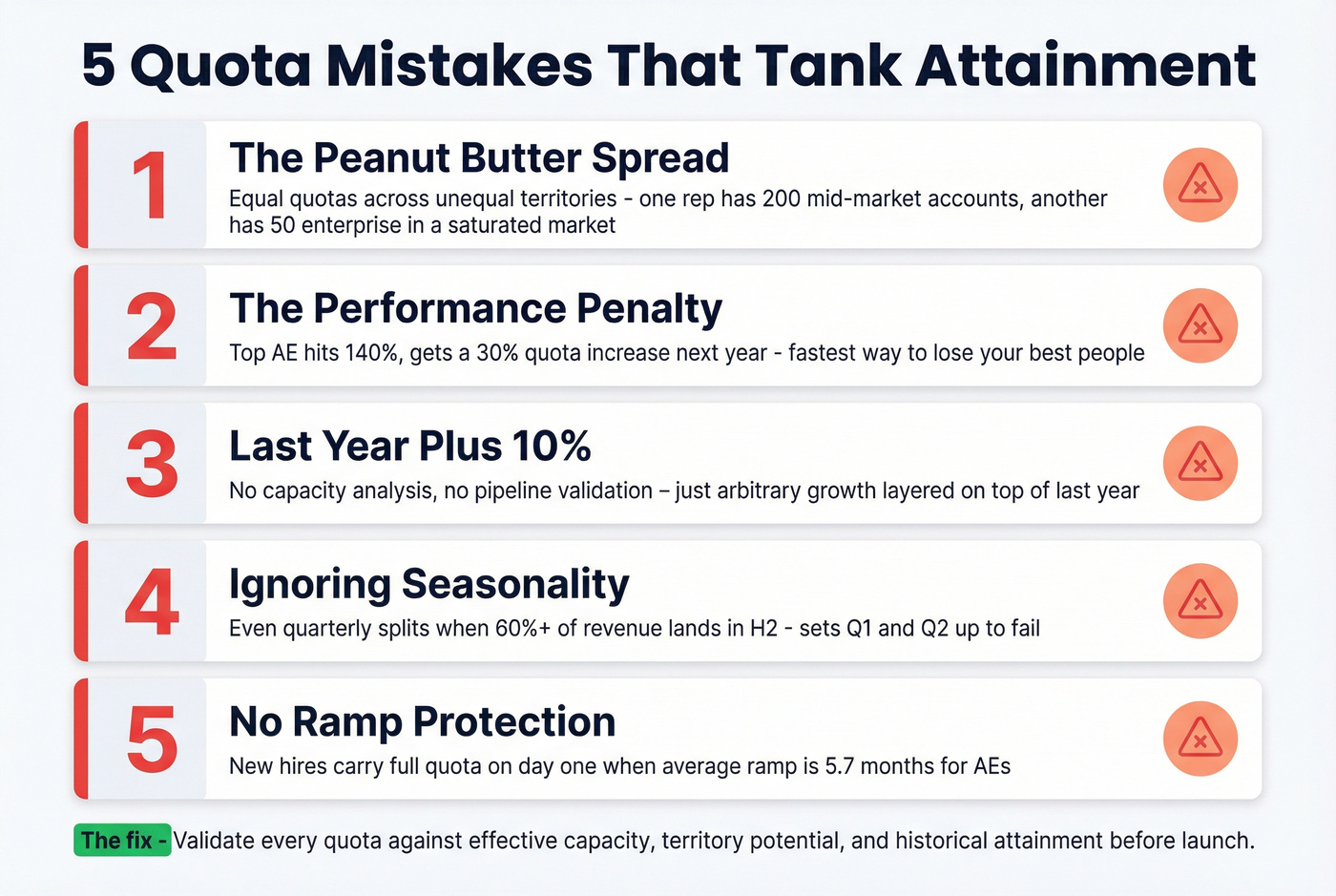
New hires shouldn't carry full quota on day one. A common schedule: 25% in month one, 50% in month two, 75% in month three, 100% by month four or five. Bridge Group data puts average AE ramp at 5.7 months and SDR ramp at 3.2 months, as cited in Knock2's ramp guide.
For SDRs, expect first meeting booked within 21 days, a positive reply rate of 8-10%, and 10-15 meetings per month by day 90. Tie ramp milestones to leading indicators - pipeline coverage by day 60, first deal by day 90 - rather than just calendar time.
8. Pipeline Quota
Rather than measuring closed revenue, a pipeline quota requires reps to maintain a ratio of qualified pipeline to their revenue target - typically 3x to 5x. If an AE carries a $300K quarterly quota, they need $900K-$1.5M in active pipeline at all times. This is one of the best leading indicators of future attainment.

The catch: pipeline coverage only works if your pipeline is real. Inflated pipeline built on unverified contacts, dead emails, and wrong numbers gives you a false sense of security. We've seen teams carry "4x coverage" that was really 1.5x once you stripped out the phantom opportunities sitting on bounced email addresses and disconnected phone numbers.
Which Quota Type Fits Your Team?
The right model depends on the role and the business motion.
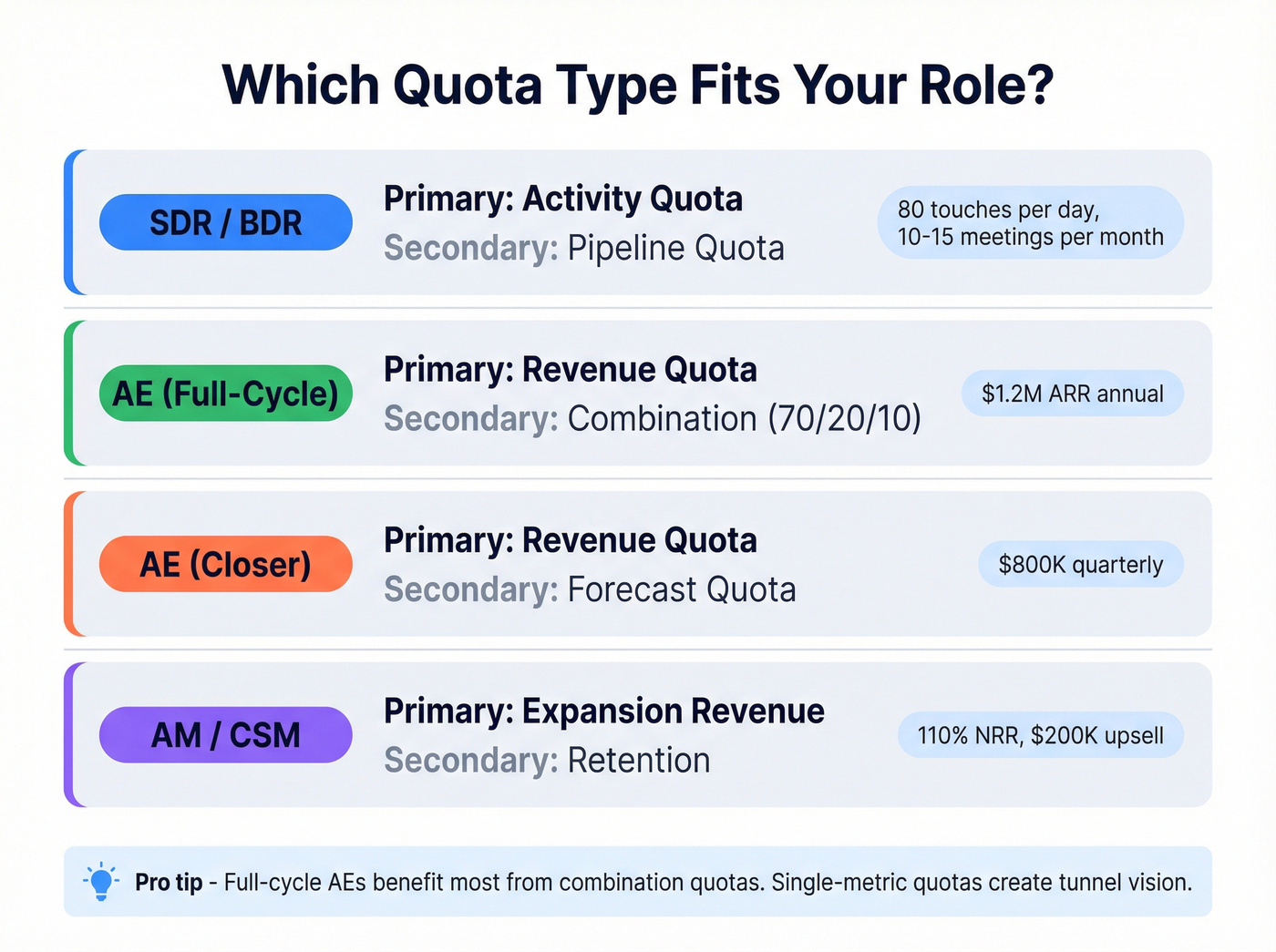
| Role | Primary Quota | Secondary | Example Metric |
|---|---|---|---|
| SDR/BDR | Activity | Pipeline | 80 touches/day, 10-15 mtgs/mo |
| AE (Full-Cycle) | Revenue | Combination (70/20/10) | $1.2M ARR annual |
| AE (Closer) | Revenue | Forecast | $800K quarterly |
| AM/CSM | Expansion Rev | Retention | 110% NRR, $200K upsell |
Industry matters too.
| Industry | Primary Quota | Why |
|---|---|---|
| SaaS | Revenue + Pipeline | Recurring revenue; pipeline is the leading indicator |
| Manufacturing | Volume + Margin | Unit economics matter; margin varies by SKU |
| Prof. Services | Revenue + Utilization | Bookings drive revenue; utilization drives delivery |
For SaaS specifically, Bridge Group benchmarks put the median commission at 11.5% of ACV at 100% attainment. That comp context should inform your quota - if you're setting quotas that make OTE unreachable at realistic attainment rates, you've got a retention problem brewing.

Pipeline quotas only work when your pipeline is real. Teams using Prospeo's 98% verified emails and 125M+ direct dials replace phantom opportunities with contacts that actually pick up - 30% mobile pickup rate across all regions.
Stop inflating pipeline coverage with dead contacts.
How to Set Realistic Quotas
Most quota-setting processes confuse three different numbers. A framework from OnlyCFO's capacity planning model makes the distinction clear:
- Capacity = the expected annualized contribution of a fully ramped AE
- Productivity = the actual average output of your ramped (and ramping) AEs over the last 4-6 months
- Quota = the comp-motivating number agreed between the CRO and CFO
Treating these as interchangeable is how you end up with quotas nobody can hit.
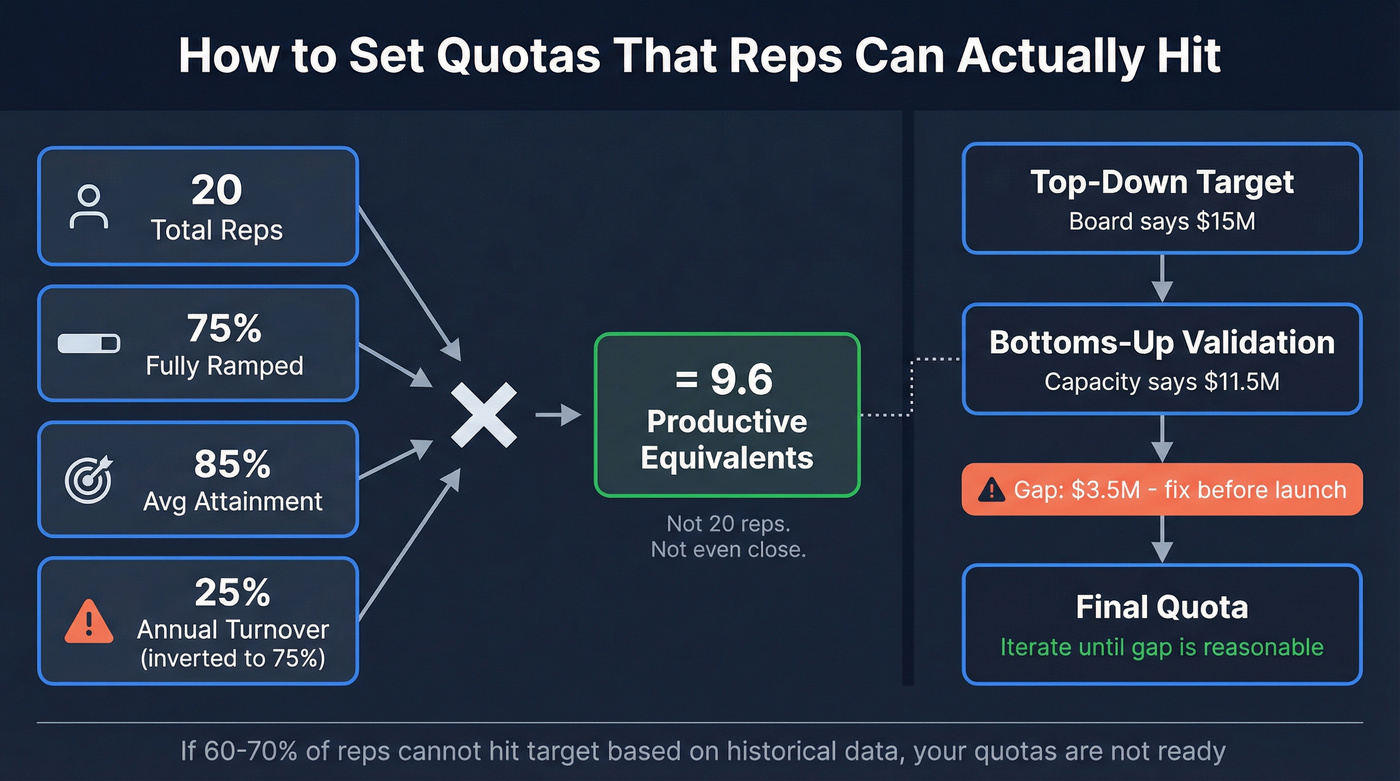
Effective Capacity = Total Reps x Ramped % x Avg Attainment x (1 - Turnover Rate)
If you have 20 AEs, 75% are fully ramped, average attainment is 85%, and annual turnover is 25%, your effective capacity isn't 20 reps - it's closer to 9.6 fully productive equivalents. That's why top-down quota setting without bottoms-up validation produces fantasy targets.
Don't assume even quarterly distribution either. Enterprise SaaS often sees 60%+ of annual revenue in H2, with a huge chunk landing in Q4. A Q3 quota might need to be set lower than Q4 to reflect this linearity, while a December quota often carries the heaviest weight of the year. Build your quarterly quotas to reflect actual seasonality, not even splits.
Let's be honest: most teams skip the bottoms-up validation because it's tedious. Do it anyway. Korn Ferry recommends incorporating both top-down and bottom-up approaches - start with the board number, validate against actual capacity, and iterate until the gap is reasonable. Set automated alerts for when pipeline coverage drops below 3x at the territory level so you catch problems before they become missed quarters.
Pre-launch checklist:
- Does effective capacity support the aggregate quota target?
- Are ramp quotas built into the plan for new hires?
- Is pipeline coverage at 3x-5x for every territory?
- Can 60-70% of reps realistically hit target based on historical productivity?
- Are accelerators in place above 100% to reward overperformance?
If you can't answer yes to all five, your quotas aren't ready.
5 Quota Mistakes That Tank Attainment
The Peanut Butter Spread
Equal quotas across unequal territories. One rep has 200 mid-market accounts in a growing vertical. Another has 50 enterprise accounts in a saturated market. Same $1.5M quota. The Reddit threads on this are brutal - reps describe territories as "a complete joke compared to my peers." Segment territories by account potential, not just account count, and weight quotas accordingly.
The Performance Penalty
Your top AE crushed 140% last year. Reward? A 30% quota increase that makes this year's number nearly impossible.
This is the fastest way to lose your best people. Keep quota increases proportional to territory growth or market expansion - not individual overperformance. Accelerators at 1.5x-2x above 120% attainment are the right tool to reward top performers, not punitive quota bumps.
The Late Delivery
Quotas communicated after Q1 has already started. Reps are flying blind, deals close without clarity on comp, and the planning team is still arguing about territory assignments. Every week of delay erodes trust. Quotas should be locked and communicated before the fiscal year starts. No exceptions.
Ignoring Territory Potential
Even when quotas aren't equal, they often ignore account-level data - firmographic signals, technographic fit, intent data, and historical conversion rates by segment. A territory with 10 healthcare accounts will outperform one with 10 manufacturing accounts in most SaaS contexts. Build quota allocation on territory scoring, not gut feel.
Raising Quotas Without Raising Capacity
Leadership raises quotas 10-15% because the board wants growth. No new reps are hired. No new territories are opened. Marketing budget stays flat. Attainment tanks. Good reps leave. Capacity drops further. One documented case showed only 25% of reps hitting quota and 40% year-over-year turnover. If you're raising quotas, you need to show reps where the incremental pipeline is coming from. Otherwise you're just printing bigger numbers on a spreadsheet.
Hot take: If your average deal size is under $10K and your team is under 10 reps, you probably don't need sophisticated quota design at all. A simple revenue quota with a 3x pipeline coverage requirement will outperform any over-engineered combination model. Complexity is a luxury for teams with the ops headcount to manage it.
Benchmarks for 2026
Attainment is falling, and quota design needs to adapt.
| Metric | 2022 | 2024 | Trend |
|---|---|---|---|
| AEs hitting quota | - | 51% | Down |
| Median SaaS win rate | 23% | 19% | Down |
| AE Ramp Time | - | 5.7 months | - |
| SDR Ramp Time | - | 3.2 months | - |
| Median AE OTE (SaaS) | - | $190K (53:47 split) | - |
The implication is straightforward: if win rates dropped from 23% to 19%, your pipeline coverage ratio needs to rise. A 3x coverage ratio that worked in 2022 needs to be 4x or 5x today to produce the same closed revenue. Quota design that ignores this macro trend is setting reps up to fail.
Build the Pipeline Your Quotas Demand
Quota design is strategy. Pipeline is execution. The gap between the two is where most revenue plans die.
If your AE carries a $1.2M annual quota and your win rate is 19%, that AE needs roughly $6.3M in qualified pipeline over the year - and it only works if the pipeline is built on contacts who actually exist, have working email addresses, and pick up the phone. In our experience, the single biggest pipeline killer isn't bad messaging or weak sequences; it's bad data. Snyk's 50-person AE team saw bounce rates drop from 35-40% to under 5% after switching to Prospeo, with AE-sourced pipeline up 180% and 200+ new opportunities per month.
Activity quotas crumble when reps waste 70% of their time on wrong numbers and bounced emails. Prospeo's 7-day data refresh and 5-step verification mean every dial and every send counts - so your 80-touch-per-day quota drives real meetings, not busywork.
Turn activity metrics into actual pipeline at $0.01 per email.
FAQ
What are the main sales quota types?
The eight core types are revenue, profit/margin, volume, activity, forecast, combination, ramp, and pipeline coverage. Most SaaS teams need just two or three: revenue quotas for AEs, activity quotas for SDRs, and combination quotas for full-cycle reps. The right mix depends on your sales motion and what behaviors you need to incentivize.
What's a good quota attainment percentage?
Aim for 60-70% of reps hitting target. If far fewer are hitting, the plan is usually the problem - territories, capacity, pipeline, or quota math. If almost everyone is hitting, you're probably not setting enough stretch and leadership will raise the bar next cycle.
How often should quotas be adjusted?
Review quarterly. Recalibrate when material changes occur - territory shifts, product launches, market disruptions, or when pipeline-to-quota ratios drop below 3x. Mid-year adjustments aren't a sign of weakness; refusing to adjust when the data says you should is.
How do I build enough pipeline to hit my quota?
Divide your quota by your win rate to get required pipeline. At a 19% win rate, a $300K quarterly quota demands ~$1.6M in pipeline. Then make sure your prospect data is accurate - bounced emails and disconnected numbers don't count as pipeline, no matter what your CRM says. Upload a CSV or search by 30+ filters in a tool like Prospeo and export verified contacts in minutes.