

Sales Representative Development: A Program That Actually Works
You hired five SDRs last quarter. Two quit before month three, one never hit quota, and the two who survived are still asking basic qualification questions on discovery calls. The problem isn't talent - it's that most companies have no real sales representative development program and wonder why reps churn.
Here's the playbook that closes that gap.
Why Rep Development Is a Revenue Problem
The average SDR takes 3.1 months to ramp and stays just 1.8 years. If your onboarding is a two-week information dump followed by "go make calls," you're burning nearly half of a rep's productive tenure just getting them to baseline competency.
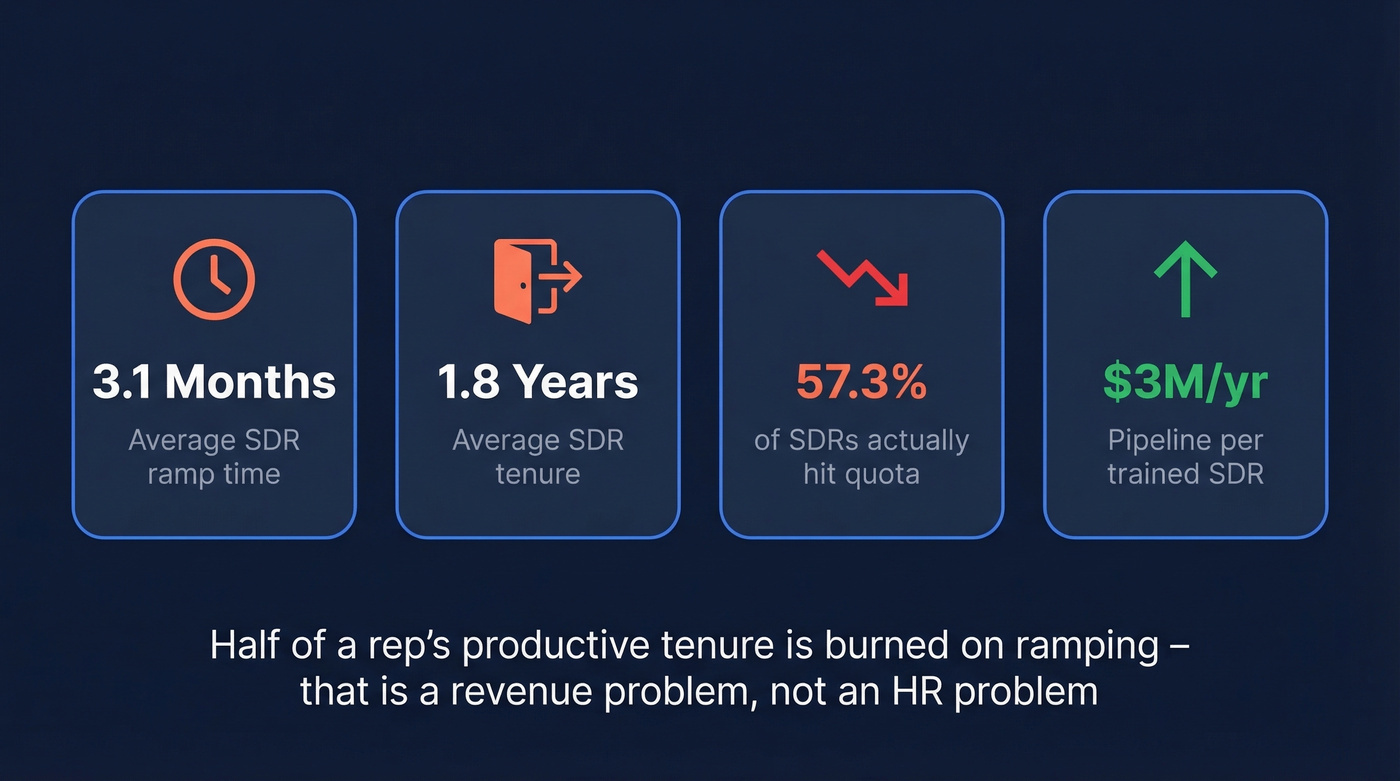
It gets worse. According to RepVue's 2026 salary data, only 57.3% of SDRs hit quota. Almost half your team is underperforming, and the instinct is to hire more reps instead of developing the ones you have. That's a ~$60K base / ~$85K OTE investment per head walking out the door or sitting idle.
The retention angle matters too. Organizations that invest in training and development retain 86% of millennial employees - when you invest in growing sales talent, you're buying tenure, and tenure compounds in ways that are hard to overstate. A rep who stays 2.5 years instead of 1.5 generates dramatically more pipeline because they've internalized your ICP, your objection patterns, and your competitive landscape.
This isn't an HR initiative. It's a revenue strategy.
What You Need (Quick Version)
Stop hiring more SDRs. Develop the ones you have. A real development program has four pillars:
- Structured 90-day onboarding - not a one-week crash course
- Qualification framework training - BANT, MEDDIC, or SPICED depending on your deal size
- Weekly coaching - actual coaching, not pipeline reviews disguised as coaching
- Clean prospect data - reps can't develop call skills if nobody picks up the phone
The average SDR produces $3M/year in pipeline. A structured program that cuts ramp time by even 30 days adds hundreds of thousands in pipeline per rep.
Jump to: 90-Day Onboarding | Qualification Frameworks | Coaching Playbook | KPIs | Compensation & Career | Tools
What "Development" Actually Means
Most sales leaders use "development," "training," and "coaching" interchangeably. They're not the same thing.
Training is structured curriculum delivered to groups - product knowledge, CRM workflows, objection handling scripts. It's the foundation. Coaching is ongoing, contextual, and rep-specific, happening in the flow of work based on real calls and individual skill gaps. Development is the umbrella that encompasses both, plus career pathing, qualification methodology, and the systems that tie everything together. This distinction is what separates organizations that consistently hit number from those that constantly backfill.
An SDR's core job is top-of-funnel work: prospecting, qualifying leads, and booking meetings for account executives. Inbound SDRs handle demo requests and marketing-qualified leads. Outbound SDRs build their own lists and cold-prospect into target accounts. Both need structured growth, but the skill profiles differ - inbound reps need speed and qualification rigor, while outbound reps need research skills, personalization, and resilience. Building all of these capabilities systematically beats leaving reps to piece it together from Slack threads and tribal knowledge.
The 90-Day Onboarding Blueprint
The biggest mistake in SDR onboarding is treating it as a one-week event. Real onboarding is a 90-day transformation, and structured programs see 50% faster ramp times and 40% better new hire retention compared to ad-hoc approaches.
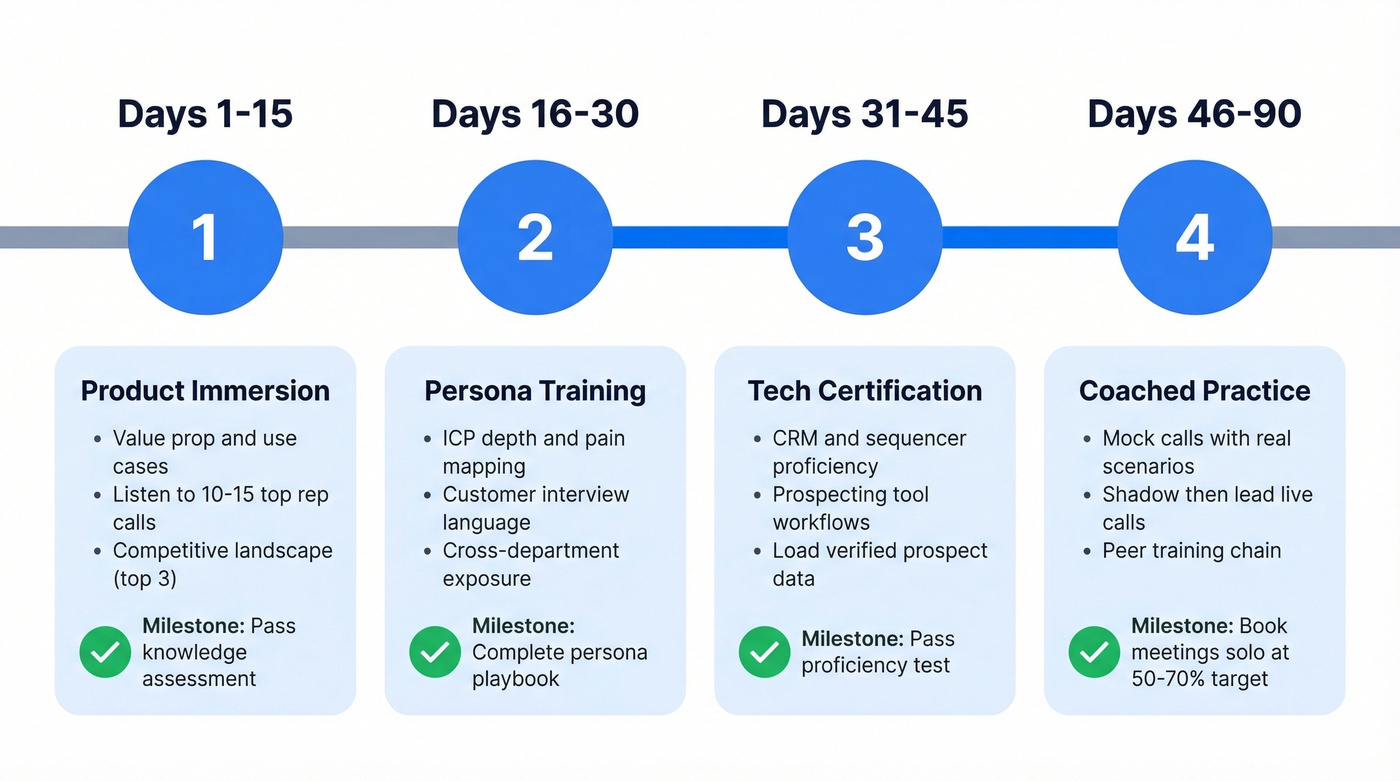
| Days | Phase | Focus | Milestone |
|---|---|---|---|
| 1-15 | Product immersion | Value prop, use cases, competitors | Pass knowledge assessment |
| 16-30 | Persona training | ICP depth, pain mapping, buying journey | Complete persona playbook |
| 31-45 | Tech certification | CRM, sequencer, prospecting tools | Pass proficiency test |
| 46-90 | Coached practice | Mock calls, shadowing, independence | Book first meetings solo |
Days 1-15: Product and Value Immersion
New reps don't need to memorize every feature. They need to articulate why your product matters to the three or four personas they'll be calling. Start with case studies, not spec sheets. Have them listen to 10-15 recorded calls from top performers. Run a value proposition workshop where they practice explaining the product in 30 seconds, 60 seconds, and two minutes.
Competitive training goes here too. Reps should know the top three competitors, their positioning, and the two or three objections they'll hear most often. Three competitors is enough for week two - don't overload.
Days 16-30: Persona and Market Training
This is where most onboarding programs fall short. Reps learn the product but never deeply understand the buyer. Dedicate two full weeks to ICP depth: what does a VP of Sales at a 200-person SaaS company actually worry about? What's their buying journey? Who else is involved in the decision?
Pain mapping exercises work well here. Have reps interview existing customers or listen to recorded discovery calls and document the specific language buyers use to describe their problems. That language becomes their outbound messaging. Also have reps sit in on customer success calls and product demos - cross-department exposure builds buyer empathy faster than any slide deck.
Days 31-45: Tech Stack Certification
Reps need to be proficient - not just familiar - with every tool they'll use daily. CRM data entry, sequencer setup, prospecting tool workflows. Run actual proficiency tests, not just "did you watch the training video."
This is also when you load verified prospect data into their accounts. In our experience, the biggest ramp-time killer is bad data, not bad reps. If new SDRs spend their first calling sessions reaching disconnected numbers and bounced emails, they're developing frustration, not skills. Get clean, verified contact data in front of them before they start dialing so they actually get live conversations to learn from.
Days 46-90: Coached Practice to Independence
The final phase is graduated independence. Start with mock calls using real prospect scenarios. Move to shadowing senior reps on live calls. Then flip it - the new rep runs the call while a manager or mentor observes and debriefs afterward.
A scalable model from Forbes: have each new hire train the next one. Train hire #1 thoroughly, then have them train hire #2 while being observed. This peer training chain reinforces learning for both parties and scales without requiring manager time for every new rep.
By day 90, reps should be booking meetings independently and hitting around 50-70% of their monthly target.
Qualification Frameworks Worth Teaching
Not every deal needs the same qualification rigor. Teaching reps the wrong framework for your deal size is a common mistake that either slows down simple deals or lets complex ones slip through unqualified.
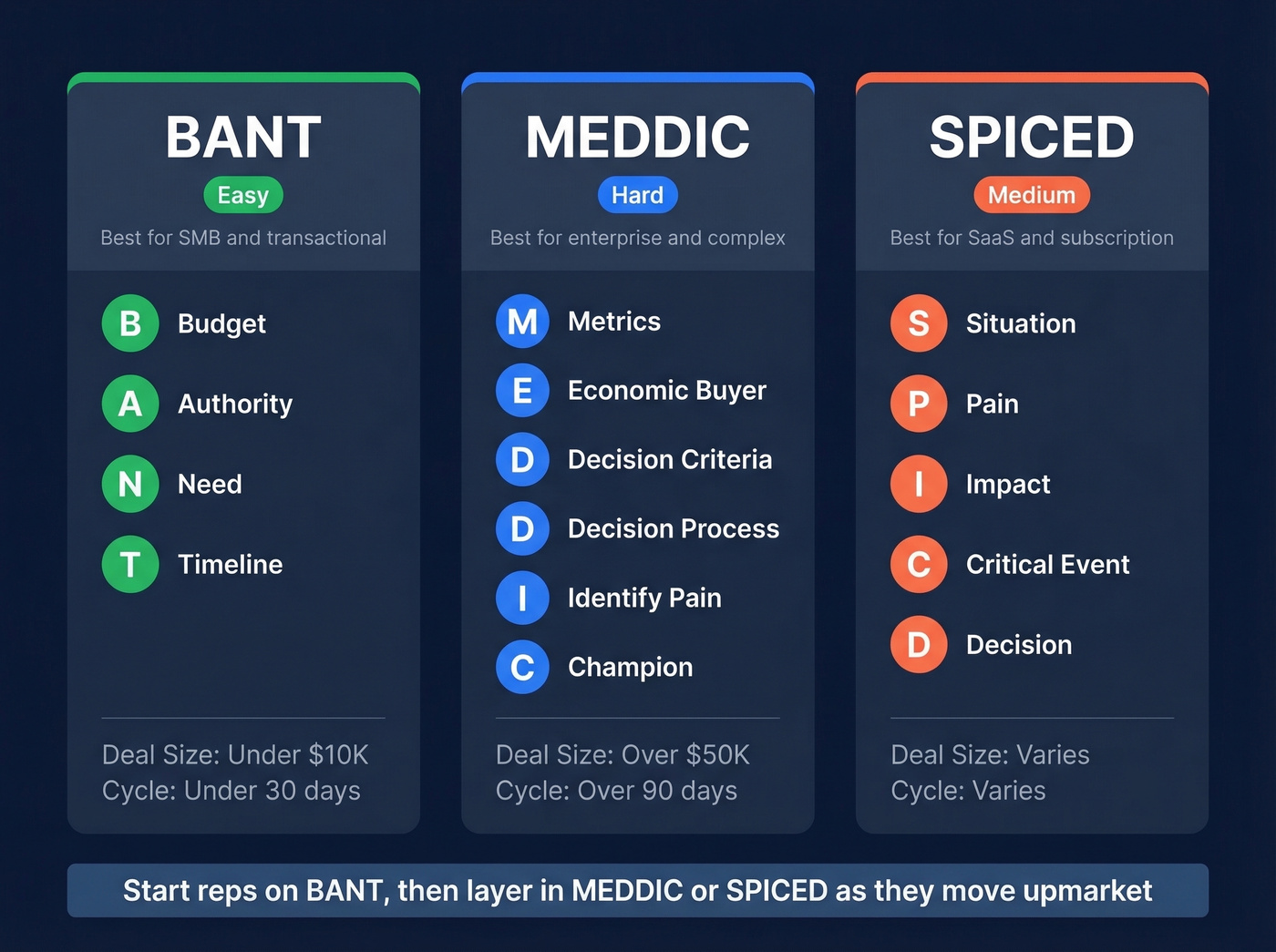
| Framework | Best For | Deal Size | Sales Cycle | Difficulty |
|---|---|---|---|---|
| BANT | SMB, transactional | Under $10K | Under 30 days | Easy |
| MEDDIC | Enterprise, complex | Over $50K | Over 90 days | Hard |
| SPICED | SaaS, subscription | Varies | Varies | Medium |
BANT (Budget, Authority, Need, Timeline) is the starting point for most SDR teams. Simple, memorable, and effective for shorter sales cycles.
But it has a real limitation: modern buying groups include 6-10+ stakeholders, and budget often gets created after you build a business case. Asking "do you have budget?" as a qualifying question can disqualify deals that would have closed. Cognism found that win rates improved by 32% when engaging more than five stakeholders - which means BANT's single-authority assumption breaks down fast on bigger deals.
MEDDIC (Metrics, Economic Buyer, Decision Criteria, Decision Process, Identify Pain, Champion) is the enterprise standard. It forces reps to understand the political landscape of a deal - who's the real champion, what metrics matter to the economic buyer, what's the actual decision process. Harder to teach, but it dramatically improves win rates on complex deals.
SPICED (Situation, Pain, Impact, Critical Event, Decision) works particularly well for SaaS and subscription models because it centers on the impact of inaction and the critical event driving urgency.
We've tested both BANT-first and MEDDIC-first approaches - BANT wins for teams with average contract values in the low five figures. Start reps on BANT for quick qualification at the top of funnel. As they mature or move upmarket, layer in MEDDIC for enterprise deals and SPICED for discovery conversations. Don't try to teach all three simultaneously. That's a recipe for reps using none of them consistently.
Here's the thing: if your average deal closes in two calls, you probably don't need MEDDIC at all. The overhead of teaching a six-part qualification framework for transactional deals is a net negative. Save it for when reps graduate to mid-market or enterprise.

Bad data is the #1 ramp-time killer for new SDRs. Prospeo's 98% verified emails and 125M+ direct dials mean your reps get live conversations from their first calling session - building real skills, not frustration.
Cut SDR ramp time by giving them data that actually connects.
The Sales Coaching Playbook
Coaching is where development either compounds or collapses. Most managers are terrible at it - not because they lack knowledge, but because they confuse coaching with pipeline reviews.
The fastest way to kill SDR motivation is predictable: bad data, shallow onboarding, and managers who treat activity metrics as a proxy for growth. Real coaching is based on actual call recordings and observable behaviors, not just whether a rep hit their meeting number this week. The minimum viable cadence is weekly one-on-ones dedicated to skill development, separate from pipeline and forecast discussions.
The 0-2 Skill Grading System
Define your "best rep profile" as a list of 8-12 core skills: pre-call research, storytelling, active listening, objection handling, discovery questioning, closing for next steps, CRM hygiene, time management, and so on. Then grade each rep 0-2 on every skill:
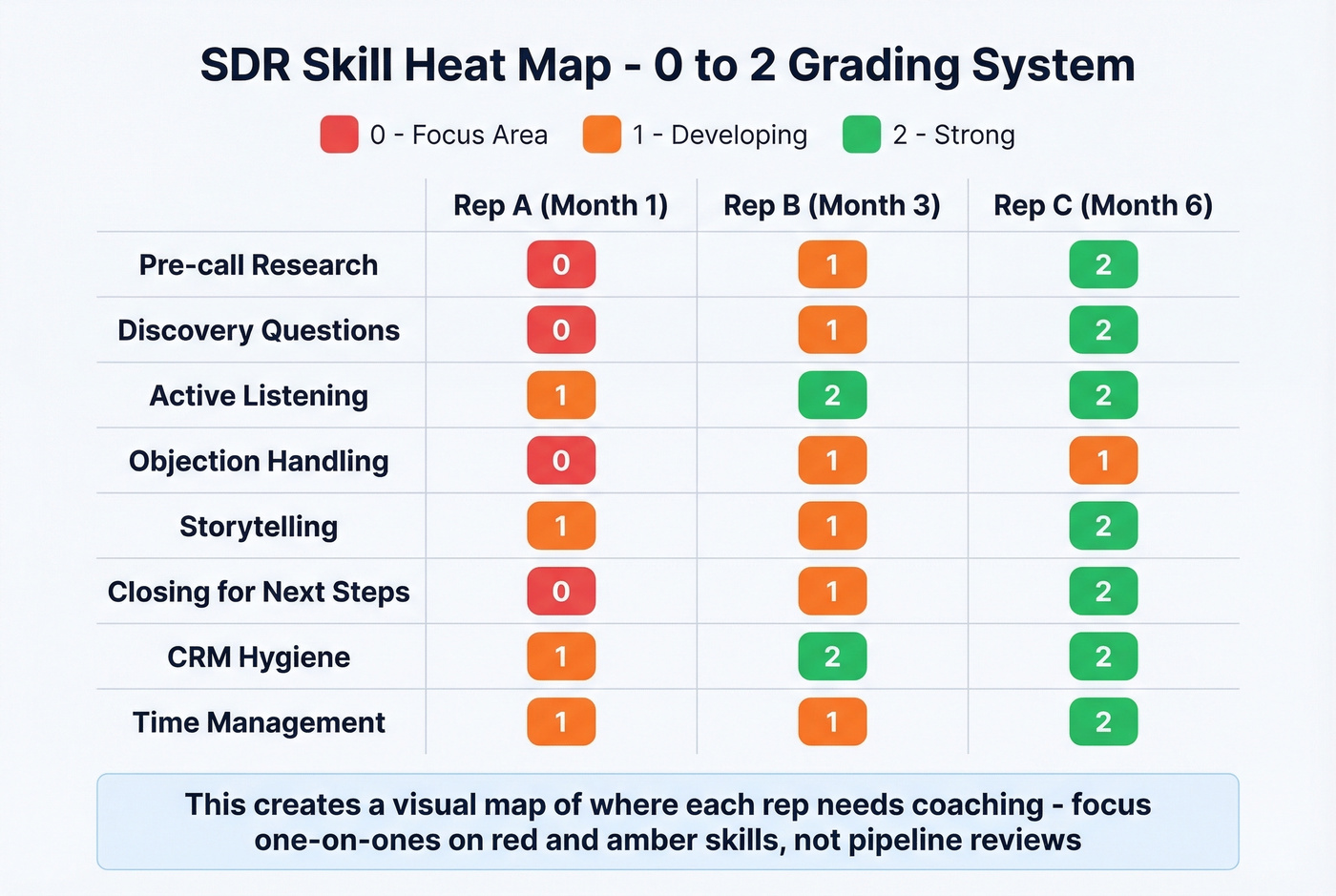
- 0 = Focus area (needs significant improvement)
- 1 = Developing (shows competence but inconsistent)
- 2 = Strong (consistently performs at a high level)
This creates a visual heat map of your team's capabilities. The critical rule: focus on one to three skills at a time per rep. Trying to improve everything simultaneously improves nothing. Pick the one or two skills with the highest leverage for that rep's current performance gap and build a coaching plan around those. Update the grading monthly so progress is visible to both the manager and the rep.
The GROW Model for Coaching Conversations
For structuring the actual one-on-one, the GROW model gives managers a repeatable framework: Goal (what does the rep want to improve?), Reality (where are they now - pull specific call examples), Options (what could they try differently?), Will (what's the commitment for next week?).
GROW works well alongside the 0-2 grading system. Use the heat map to identify the goal, then run the conversation through GROW to build a concrete action plan.
Five Coaching Mistakes That Kill Progress
Telling instead of asking. When a rep struggles on a call, the instinct is to say "here's what you should have done." Better: "What did you notice about the prospect's response when you asked about budget?" Collaborative coaching builds self-awareness; directive coaching builds dependency.
Too many priorities. "You need to work on your discovery, your objection handling, your closing, and your time management." That's a performance review, not coaching. Pick one or two high-impact gaps and go deep.
Sugarcoating feedback. "Your discovery questions are surface-level - you asked about pain but didn't dig into the business impact" is actionable. "Great call, maybe just go a little deeper next time" is not.
Taking over calls. If you're jumping in to "save" calls, you're closing deals but not developing reps. There's a difference between a joint sales call and a coaching call.
Treating coaching as a one-off. A single feedback session after a bad quarter isn't coaching - it's damage control. Weekly cadence, consistent framework, tracked progress.
How to Upskill Your Sales Team in 2026
The days of two-day classroom training followed by "go sell" are over. Let's break down what actually works.
Microlearning modules - short, focused content delivered weekly on specific skills - beat marathon training sessions for retention. A 5-minute video, an infographic, and a quick quiz on one skill per week compounds faster than a quarterly training day that reps forget by Friday.
Role-play with real CRM data is non-negotiable. Pull actual prospect records and have reps practice discovery calls using real company contexts. Generic role-plays ("pretend I'm a CFO") don't build the research and personalization muscles that matter in live conversations.
AI coaching tools like Gong and newer platforms like Proshort ($60/user/month) analyze call recordings, flag coaching moments, and provide reps with feedback on talk ratios, filler words, and question quality. We've seen these tools accelerate development for remote teams where managers can't sit next to reps.
Gamification works - especially for SDR teams where the work is repetitive and motivation matters. Keep it focused on leading indicators like quality conversations and meetings held rather than just activity volume.
Peer training chains, where each experienced rep trains the next new hire, reinforce the trainer's knowledge while giving the new rep a peer-level mentor who remembers what it's like to be new. The thread connecting all of these: practice with real-world context beats passive learning every time.
SDR Performance Benchmarks and KPIs
You can't develop what you don't measure. These benchmarks are drawn from industry research:
| Metric | Benchmark | Notes |
|---|---|---|
| Meetings booked/month | 15 SALs | Operatix study, 150 SDRs |
| Meeting attendance rate | ~80% (12 attended) | 20% drop-out is normal |
| SAL to Opportunity rate | ~50% | 1 in 2 becomes next step |
| Pipeline per SDR/year | $3M | Bridge Group, SaaS avg |
| Inbound conversion (low-intent) | 5-10% | Low-intent sources |
| Inbound conversion (high-intent) | 75-80% | Demo requests, pricing page |
| Inbound capacity | ~300 leads/month | ~15 leads/day per rep |
| Outbound calls/day | 50-100 | Varies by segment and tool |
Let's do the pipeline math. If an outbound SDR books 15 meetings per month and 80% attend, that's 12 live conversations. If half convert to qualified opportunities at a $100K average deal size, that's 6 opportunities worth $600K in pipeline per month - roughly $7.2M annually. The $3M/year benchmark is an average that bakes in the reality that not every SAL becomes revenue.
Activity benchmarks matter for rep growth because they set expectations. Cognism recommends breaking the day into 90-minute calling blocks to maintain focus and energy. A rep doing 50-80 quality dials in two focused blocks will outperform one making 120 scattered calls between email checks and Slack messages.
Track leading indicators weekly and lagging indicators monthly. Coaching conversations should focus on the leading indicators - those are the behaviors reps can actually change.
SDR Compensation and Career Path
Compensation structure directly affects development. If reps don't see a clear path forward, they leave - and all your investment in building capability walks out the door.
The 2026 market, based on RepVue's salary data:
| Level | Base | OTE | Base/Variable | Typical Tenure |
|---|---|---|---|---|
| Entry (0-1 yr) | ~$48K-$53K | $70K-$75K | 70/30 | 12-18 months |
| Mid (1-3 yrs) | ~$55K-$62K | $80K-$90K | 65/35 | 18-24 months |
| Senior (3-5+ yrs) | ~$60K-$68K | $90K-$100K+ | 60/40 | 24+ months |
The median SDR base sits at $60K with $85K OTE. Only 57.3% of SDRs hit quota, which means median actual earnings fall closer to $70K-$75K. A healthy quota-to-OTE ratio runs 4:1 to 6:1 - if OTE is $85K with a $25K variable component, quota should be $100K-$150K in pipeline or equivalent.
The standard SDR-to-AE promotion timeline is 12-18 months, with high performers ready in 10-12 months. Promotion criteria should be explicit: 90%+ quota attainment for two consecutive quarters is the most common threshold. Post-pandemic, promotion timelines have stretched about 28% - from roughly 12 months to 15-16 months on average.
The SDR role is a launching pad, not a destination. Make the career paths visible from day one:
| Path | Timeline | Typical OTE |
|---|---|---|
| SDR to AE (Mid-Market) | 12-18 months | $130K-$175K |
| SDR to AE (Enterprise) | 18-24 months | $265K+ |
| SDR to Customer Success | 15-20 months | $80K-$110K |
| SDR to RevOps | 18-24 months | $90K-$130K |
| SDR to Demand Gen | 18-24 months | $85K-$120K |
When reps can see where they're going, they invest more in their own growth. Promoting AEs from within your SDR ranks also means your closers already know your ICP, your tech stack, and your competitive landscape - a massive advantage over external hires.
Tools That Accelerate Development
The right tech stack accelerates sales representative development. The wrong one creates busywork.
| Category | Tool | Starting Price | What It Does |
|---|---|---|---|
| CRM | HubSpot | Free / ~$20-$30+ per user/month | Pipeline tracking, activity logging |
| CRM | Salesforce | ~$25+ per user/month | Enterprise CRM, customizable |
| Sequencing | Salesloft | ~$75/user/month | Multi-step email + call cadences |
| Sequencing | Outreach | ~$100/user/month | Multi-step cadences, analytics |
| Prospecting Data | Prospeo | Free / ~$39/month | Verified emails + mobiles, 30+ filters |
| Conversation Intel | Gong | ~$100/user/month | Call recording + coaching insights |
| AI Coaching | Proshort | $60/user/month | Role-play sims, personalized paths |
| Enablement | Seismic / Highspot | ~$30/user/month | Content delivery in deal context |
CRM and Sequencing
Your CRM is the foundation. HubSpot's free tier works for early-stage teams, with paid plans starting around $20-$30+ per user/month depending on edition. Salesforce starts around $25/user/month for entry tiers and scales from there. The CRM isn't a development tool per se, but CRM discipline is a core skill - reps who log activities and update stages consistently develop better pipeline awareness.
For sequencing, Salesloft (~$75-125/user/month) and Outreach (~$100-130/user/month) are the standards. Both handle multi-step email and call cadences. The development angle: sequencers provide data on which messaging works, giving managers concrete coaching material.
Prospecting Data
Look, your reps can't develop call skills if nobody picks up. This is where data quality becomes a development accelerator, not just a productivity tool.
Prospeo covers 300M+ professional profiles with 143M+ verified emails at 98% accuracy and 125M+ verified mobile numbers that deliver a 30% pickup rate. That pickup rate matters enormously for development - reps making 50 calls into verified numbers get 15 live conversations, while the same 50 calls into a stale database yield 5-6. More conversations means faster skill-building, richer coaching material, and reps who actually believe the job is doable.

The 7-day data refresh cycle means reps aren't calling people who changed jobs six weeks ago, and 30+ search filters let managers build targeted prospect lists by role, industry, company size, and buyer intent signals so new reps practice on relevant prospects from day one. GreyScout, an agency that doubled their sales team from 2 to 5 reps, cut rep ramp time from 8-10 weeks to 4 weeks after switching to verified data - their bounce rate dropped from 38% to under 4%, and pipeline increased 140%.
Pricing starts free (75 emails + 100 Chrome extension credits/month), with paid plans from ~$39/month. No contracts, no sales calls required.
Conversation Intelligence and AI Coaching
Gong (~$100-150/user/month) remains the gold standard for conversation intelligence. It records calls, transcribes them, and surfaces patterns - talk-to-listen ratios, question frequency, competitor mentions. For developing reps, the call library is invaluable: new SDRs can study exactly how top performers handle objections, and managers get timestamped coaching moments instead of relying on memory.
Proshort ($60/user/month) focuses specifically on AI-powered coaching with role-play simulations and personalized learning paths. It's a newer category but promising for teams that want structured practice without requiring constant manager involvement.
Sales Enablement Platforms
Enablement platforms like Seismic and Highspot (~$30-60/user/month depending on tier) surface the right content at the right moment in a deal - battle cards during competitive conversations, case studies during evaluation stages.
Skip these if you're under 50 reps. Start with a well-organized shared drive and graduate to Seismic or Highspot when content volume and deal complexity justify the investment.
Your development program is only as good as the conversations it produces. Prospeo delivers verified contacts refreshed every 7 days at $0.01/email - so new reps practice on real buyers, not bounced inboxes.
Stop training reps on dead leads. Start with verified data.
FAQ
How long does it take to ramp a new SDR?
The average SDR ramp time is 3.1 months. Structured 90-day onboarding with phased milestones can cut this by up to 50%. The key is graduated independence - don't throw reps into full quota expectations before they've completed coached practice with verified prospect data.
What's the difference between sales coaching and sales training?
Training is structured curriculum delivered to groups - product knowledge, methodology, tool proficiency. Coaching is ongoing, contextual, and individual, based on real call recordings and specific skill gaps. Both are essential, but coaching drives sustained improvement after initial training ends.
Which qualification framework should SDRs learn first?
Start with BANT for deals under five figures and sales cycles under 30 days. It's simple and gives reps a repeatable structure for early conversations. Graduate to MEDDIC or SPICED as reps move upmarket or handle longer, multi-stakeholder cycles where budget isn't predetermined.
How does data quality affect SDR development?
Bad prospect data wastes ramp time and kills confidence. Verified contact data - 98%-accurate emails and 30%-pickup-rate mobiles - means more live conversations per session, faster skill-building, and richer coaching material. Teams using verified data report ramp-time reductions of 40-60%.
When should an SDR be promoted to AE?
After hitting 90%+ quota for two consecutive quarters, typically at the 12-18 month mark. High performers can be ready in 10-12 months. Beyond quota, look for consistent qualification rigor, strong discovery skills, and the ability to manage a multi-step sales process independently.