

=== CURRENT ARTICLE (slug: sales-talent-assessment) ===
Sales Talent Assessment: A Buyer's Guide (2026)
A bad sales hire costs between $130K and $300K when you factor in salary, ramp time, lost deals, and cultural damage. Turnover in sales hovers around 35% - triple the cross-industry average - and roughly 40% of new sales hires fail outright. Resumes, especially AI-polished ones, don't tell you much anymore. The right assessment won't fix a broken hiring process, but it cuts bad-hire rates by 50% or more.
Quick recommendation: Hiring 1-5 reps per year? Start with SalesDrive's free DriveTest or TestGorilla's free plan. Scaling past 20 hires annually? Objective Management Group (~$2,500/yr) or SalesGenomix ($249/candidate) justify the spend. For situational judgment specifically, TeamTrait's Sales Acumen test is the most role-specific option we've found.
What These Assessments Measure
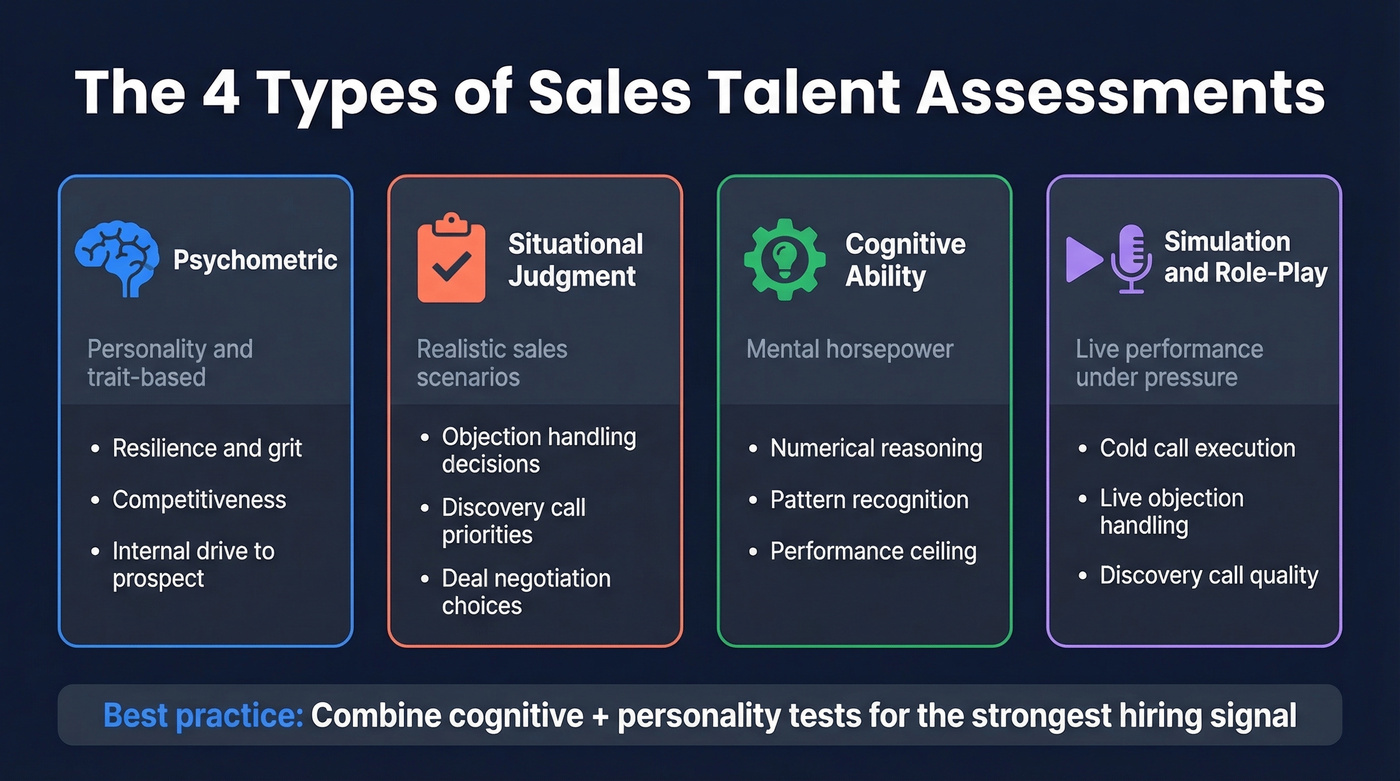
Assessments fall into four buckets: psychometric (personality traits like resilience and competitiveness), situational judgment (realistic sales scenarios), cognitive ability (numerical reasoning, pattern recognition), and simulation/role-play (live objection handling or discovery calls).
Most tools cover communication, persuasion, resilience, negotiation, and adaptability. The better ones also measure drive - that internal motor separating reps who prospect without being told from those who wait for inbound. TeamTrait scores candidates across 18 categories of sales competency mapped to 25 distinct sales role types, and it can flag any of the 13 Types of Toxic Salespeople before you hire them.
Here's the thing: methodology matters more than brand name. A cognitive ability test reveals a candidate's performance ceiling. Personality tests predict retention and cultural fit. The best hiring processes use both.
What to Look for in a Sales Hire
Before you pick a tool, clarify your sales hiring criteria. Assessments deliver the most signal for clearly defined roles - SDR vs. AE, hunter vs. farmer, transactional vs. enterprise. A rep who thrives cold-calling SMBs will often flame out in a six-month enterprise cycle, and vice versa. TeamTrait's "Four Fits" framework (Job Fit, Manager Fit, Company Fit, Customer Fit) catches these mismatches before you've burned three months of onboarding. That kind of structure is especially critical for volume hiring, where screening 50+ candidates per quarter demands a consistent baseline that gut-feel interviews can't provide.
Prioritize coachability above raw experience. Reps who absorb feedback and iterate on their approach ramp faster and stay longer. We've seen this pattern over and over: hiring for potential at the SDR and mid-market AE level outperforms credential-heavy strategies almost every time.
When to skip assessments entirely: For VP of Sales or CRO-level hires, structured interviews and reference checks give you more signal. One Reddit thread captures this perfectly - a candidate with 12 years of experience called generic personality items ("Are you quick to anger? 1-5") and basic math problems "insulting." That's not an outlier. Senior candidates have options, and a 90-minute generic test signals you don't respect their time. Use role-specific situational judgment tests under 30 minutes, or skip assessments for these roles.
Sales Assessment Tools Compared
There are over 200 talent assessment solutions on the market. Most aren't worth evaluating. If a vendor can't show you a validation study proving their assessment predicts actual job performance, walk away.
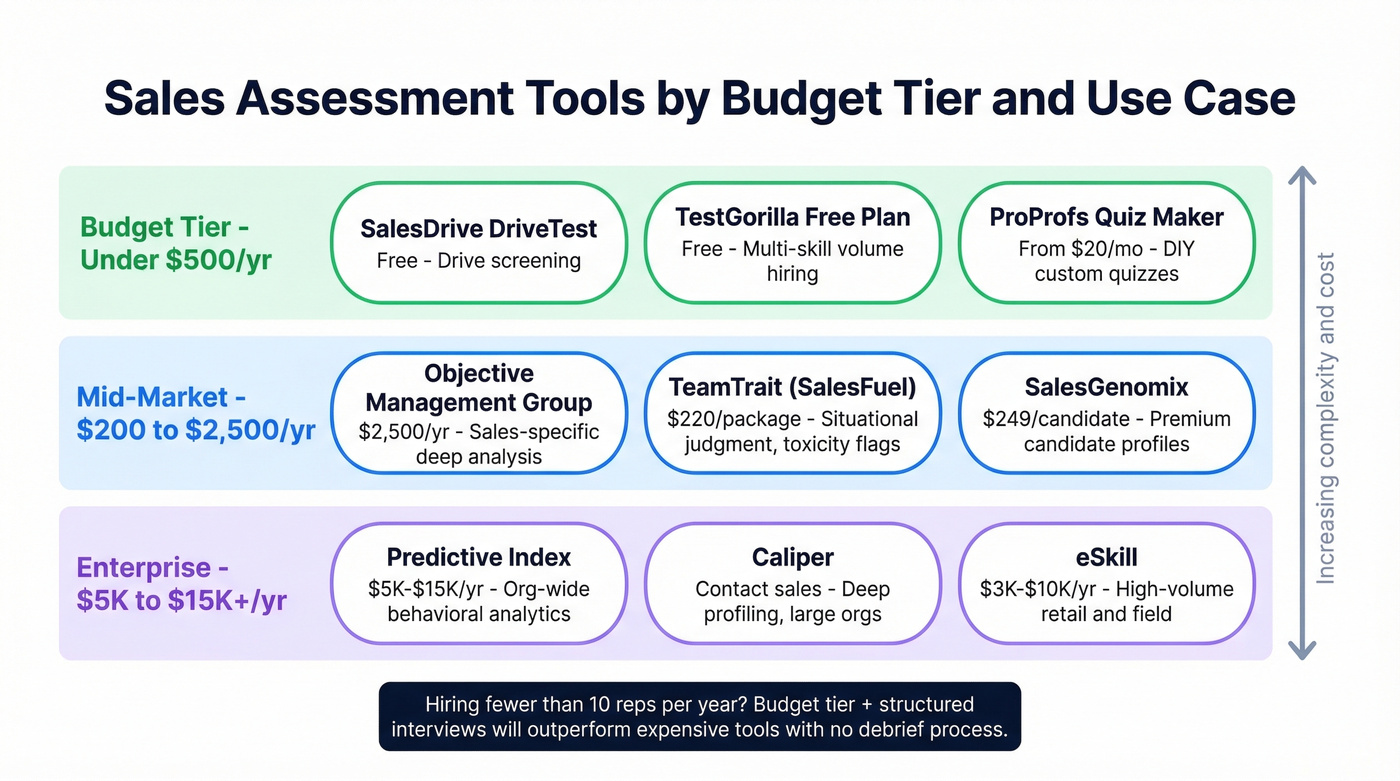
| Tool | Type | Pricing | Best For |
|---|---|---|---|
| SalesDrive (DriveTest) | Personality/Drive | Free test; paid varies | Quick screening, small teams |
| TestGorilla | Multi-skill | Free plan; from $135/mo | Volume hiring, broad testing |
| ProProfs Quiz Maker | Custom quizzes | Free (short); from $20/mo | DIY on a budget |
| Objective Management Group | Sales-specific | ~$2,500/yr + per-test | Mid-market, sales-only |
| TeamTrait (SalesFuel) | Situational judgment | $220 assessment package | Role-specific, toxicity screening |
| SalesGenomix | Comprehensive | $249/candidate | Premium candidate profiles |
| Predictive Index | Behavioral/cognitive | ~$5K-$15K/yr | Org-wide behavioral analytics |
| Caliper | Personality/cognitive | Contact sales | Deep profiling, large orgs |
| Wonderlic | Cognitive ability | ~$5-$10/candidate | Fast cognitive screening |
| eSkill | Skills testing | ~$3K-$10K/yr | High-volume retail/field |
Budget tier: SalesDrive, ProProfs, TestGorilla's free plan. Mid-market: OMG, TeamTrait, SalesGenomix. Enterprise: Predictive Index, Caliper.
A note on TestGorilla: the free plan is genuinely useful, but pricing scales with headcount. G2 reviewers consistently flag that the Starter plan jumps roughly 75% when your team grows past 100 employees, and most paid plans lock you into a one-year commitment.
Let's be honest - most teams hiring fewer than 10 reps per year don't need a $15K platform. SalesDrive's free DriveTest plus a well-designed structured interview will outperform an expensive tool that nobody debriefs properly.

You just invested $130K+ in a new sales hire. Don't let bad contact data waste their ramp time. Prospeo delivers 98% verified emails and 125M+ direct dials so your new reps connect with real buyers from week one - not bounce emails for three months.
Give every new hire a pipeline full of verified contacts on day one.
The ROI Case for Assessments
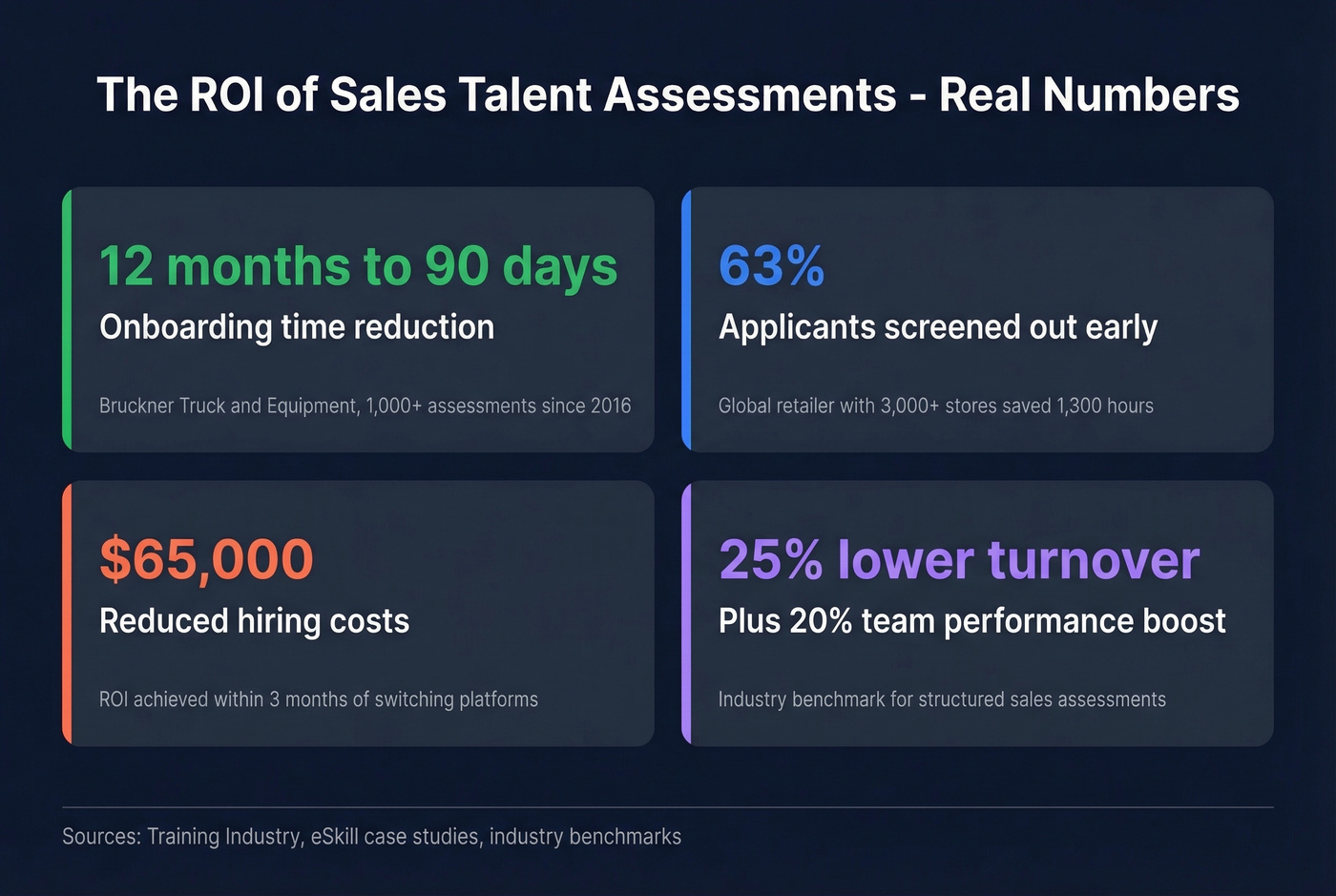
Bruckner's Truck & Equipment started using hiring assessments in 2016 and has since run over 1,000 assessments. The company grew from 9 to 45 locations during that period, and the headline result was dramatic: onboarding time dropped from 12 months to 90 days.
Their VP of Sales now reviews an assessment and makes a hire/no-hire decision in about two minutes. They also use assessment outputs as a "career-long document" for coaching - not just a screening gate. In our experience, this is where most teams leave money on the table. They treat assessments as a one-time filter instead of a development roadmap. Folding ongoing assessment-driven coaching into your process compounds ROI over years, not just quarters.
A global specialty retailer with 3,000+ stores replaced IBM Kenexa with eSkill and saw ROI within three months - 63% of applicants screened out during initial assessment, 1,300 hours saved, and $65,000 in reduced hiring costs. Broader benchmarks back this up: structured sales assessments can lower turnover by 25% and boost team performance by 20%.
Implementation Checklist
- Pilot with current top performers. Test your A-players to establish baseline scores. eSkill's 86-88% benchmark approach works: know what "good" looks like before screening anyone.
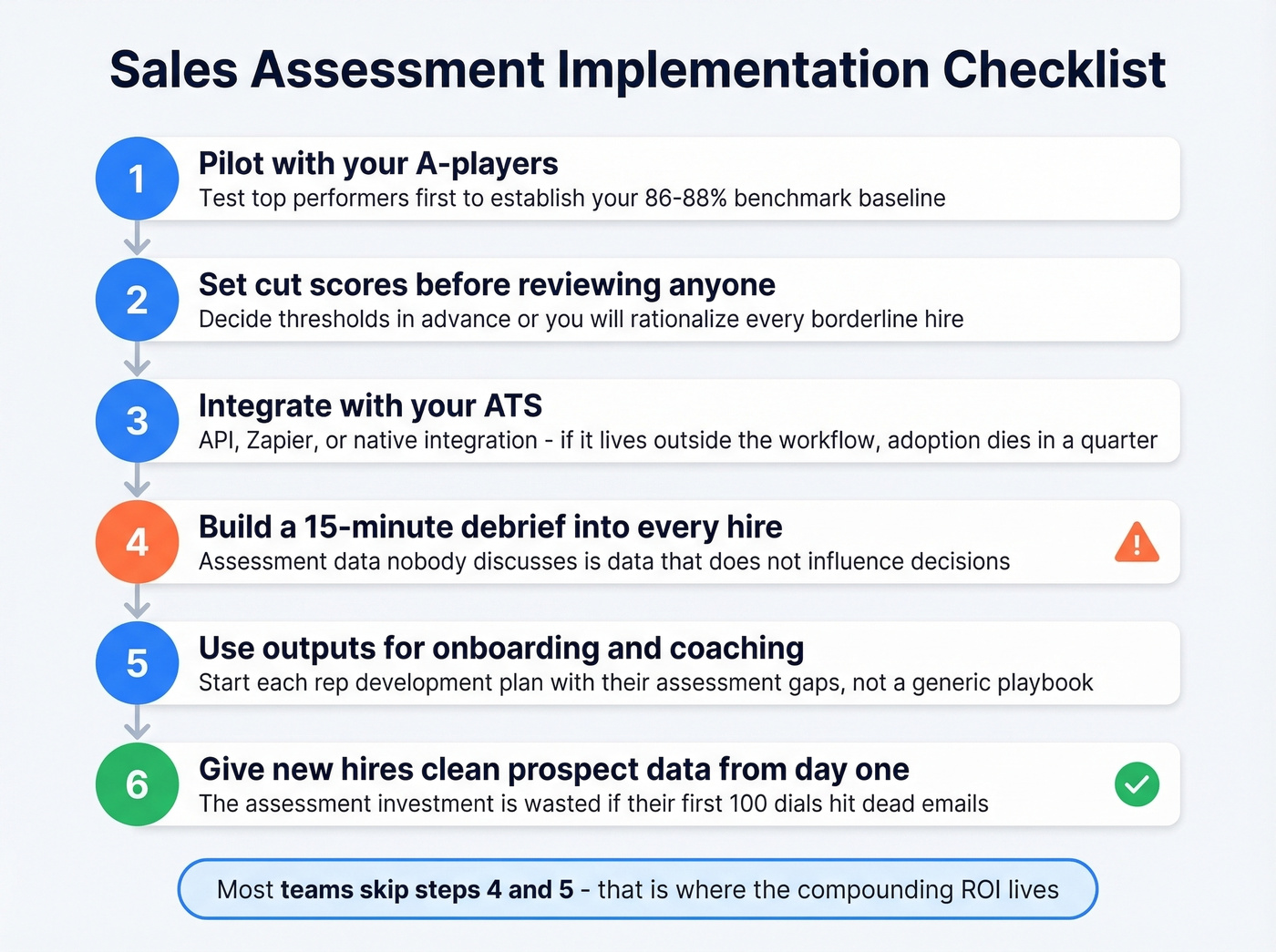
Set cut scores before reviewing candidates. Decide your threshold in advance. If you set it after seeing results, you'll rationalize borderline hires. Every time.
Integrate with your ATS. Most modern tools offer ATS integrations or API/Zapier-style connectors. If the assessment lives outside your workflow, adoption dies within a quarter.
Debrief results with hiring managers. We've seen teams waste months of assessment data because nobody built a 15-minute debrief into the hiring loop. Make it mandatory.
Use outputs for onboarding and coaching. A new rep's development plan should start with their assessment gaps, not a generic playbook.
Give your new hire clean prospect data from day one. The assessment investment is wasted if your new AE's first 100 dials hit dead emails. Prospeo delivers 98% verified emails on a 7-day refresh cycle, so reps start booking meetings during week one instead of spending their first month cleaning lists.

Legal Compliance Essentials
- Conduct a job analysis before selecting any assessment. The test must measure competencies the role actually requires.
- Require validation studies from your vendor. No validation means a legally indefensible process.
- Monitor adverse impact using the four-fifths rule: if a protected group's selection rate falls below 80% of the highest group's rate, you have a problem.
- Provide accommodations for candidates with disabilities and document every request.
- Keep records. In 2023, the EEOC recovered over $45 million from systemic discrimination claims - many involving selection procedures. The enforcement landscape shifted after the April 2025 Executive Order that directed federal agencies to deprioritize disparate impact enforcement, but Title VII remains fully enforceable. Documentation is your defense regardless of the political climate.
Five Mistakes That Kill ROI
1. Generic personality tests that repel senior candidates. Use role-specific situational judgment tests for experienced hires, and keep them under 30 minutes. A 90-minute battery of "rate yourself 1-5" questions tells a seasoned closer you don't know what you're doing.
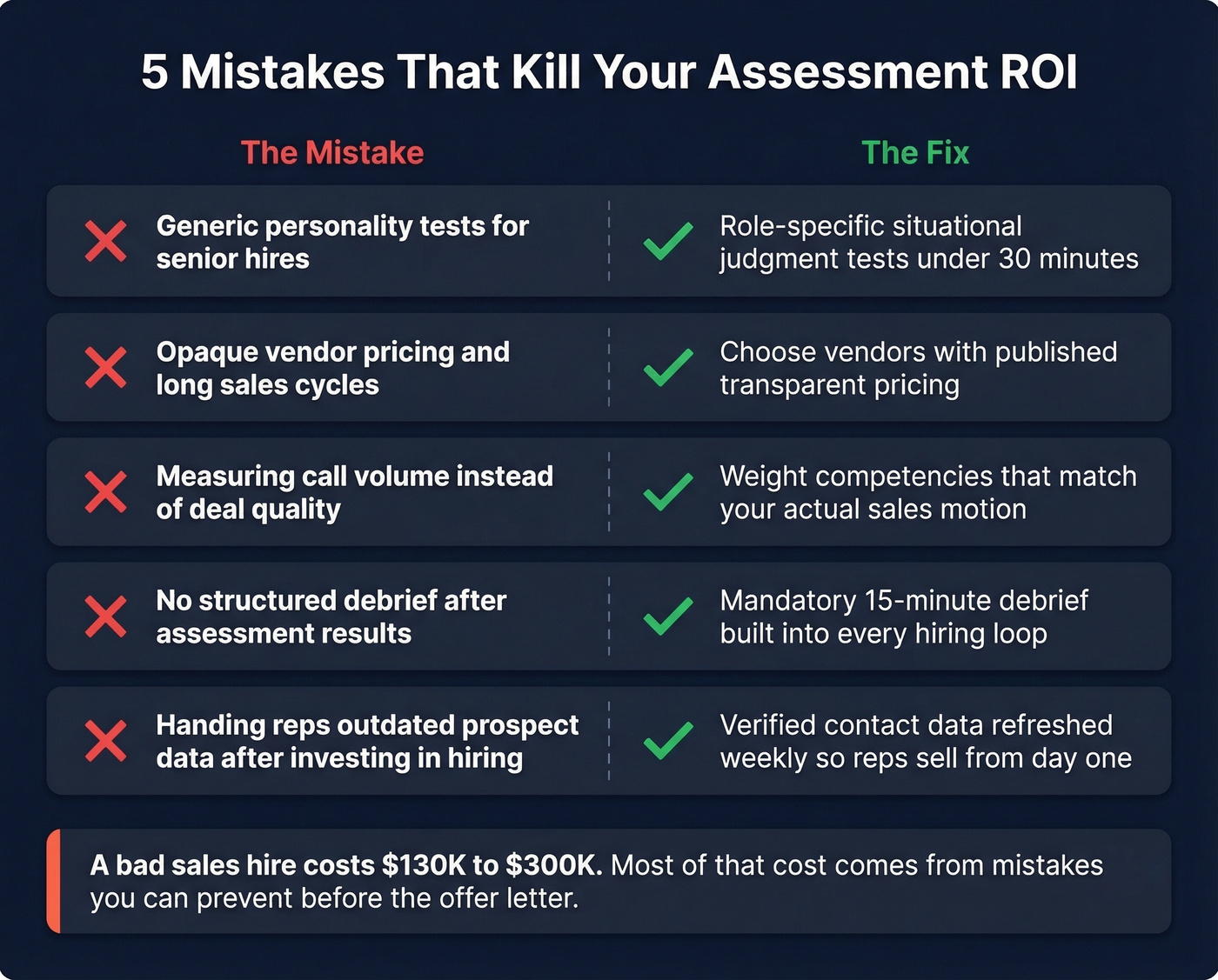
2. Opaque vendor pricing. Vendors that won't publish pricing want to price-discriminate. Transparent vendors like TestGorilla earn trust faster, and you'll waste less time in "let me check with my manager" sales cycles.
3. Outdated metrics like call volume over deal quality. Weight competencies that match your actual sales motion - discovery skills for enterprise, velocity for transactional. Aligning assessment dimensions to the deal cycle your reps will actually run isn't optional.
4. Skipping structured debrief. Assessment data nobody discusses is data that doesn't influence decisions. Period.
5. Handing reps garbage prospect data after investing in hiring science. You spent $249/candidate to find the right rep - don't give them a list of bounced emails. Clean, verified contact data is the bridge between a great hire and a productive one.
Assessments cut bad-hire rates by 50%. But even A-player reps underperform when they're prospecting with outdated data. Prospeo refreshes 300M+ profiles every 7 days - not every 6 weeks - so your top talent spends time selling, not chasing dead leads at $0.01 per email.
Stop wasting great hires on bad data. Fix the pipeline they prospect into.
FAQ
What's the difference between a sales aptitude test and a personality assessment?
Aptitude tests measure cognitive ability and job-specific skills like numerical reasoning and situational judgment. Personality assessments measure behavioral traits - resilience, competitiveness, empathy. The best hiring processes use both: aptitude predicts performance ceiling, personality predicts cultural fit and retention.
How long should an assessment take?
Twenty to 45 minutes is the sweet spot. TeamTrait's situational judgment test runs about 30 minutes. Anything over an hour risks candidate drop-off, especially for senior reps who view long generic tests as disrespectful of their time.
Can I start with a free assessment tool?
Absolutely. SalesDrive offers a free DriveTest, TestGorilla has a free plan, and ProProfs lets you build short quizzes at no cost. These are more than enough to pilot a structured screening process before committing budget to a premium platform.
What traits matter most when hiring sales reps?
Drive, coachability, resilience, and curiosity are the highest-signal traits across sales functions. Test for these systematically rather than relying on interview charisma - candidates who ask sharp questions during the process tend to run better discovery calls with prospects.
How do I ensure my new hire ramps quickly after assessment?
Pair assessment-driven coaching plans with clean prospect data so reps aren't wasting ramp time on bounced emails. Tools like Prospeo alongside your CRM let new AEs start real outbound in their first week instead of spending it scrubbing spreadsheets.