

Sales Talk Tips Backed by Data and Ready to Use Today
In Gong's analysis of 326K sales calls, closed-won calls averaged 57% rep talk time. Lost calls hit 62%. That five-point gap is the difference between a closed-won quarter and a missed number. These aren't motivational sales talk tips - the fix is structure, timing, and knowing when to shut up.
The Quick Version
- Open with a pattern interrupt. An 820-dial test showed it holds 30% of prospects past 30 seconds, versus 14% for a direct pitch.
- Talk 57% of the time, not more. That's the win-rate sweet spot from 326K analyzed calls.
- Ask 15-16 questions, not 20. More questions doesn't mean better discovery. It means interrogation.
Prepare Before You Talk
Before you dial, know the prospect's role, their company's recent funding or headcount changes, and the three challenges you think they're facing. Build a hypothesis, not a script.
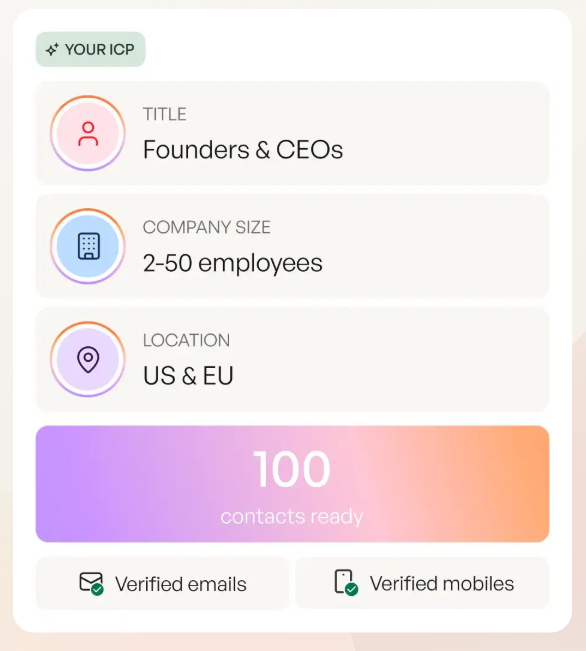
None of that matters if you're calling bad contact data. We've watched reps burn entire call blocks reaching disconnected numbers or generic inboxes - pull verified emails and direct dials from a platform like Prospeo before you touch the phone so you're actually reaching the right person.
One timing note most guides miss: in one practitioner's tracked dataset of 820 dials, Tuesday through Thursday between 10:00 and 11:30 AM delivered a 19% connect rate. Monday mornings dropped to 9%. Friday afternoons cratered to 5%. Stack your best calls mid-week, mid-morning.
The First 20 Seconds: Get to the Point
A Reddit practitioner tracked 820 dials across three opener styles. The results weren't close:
- Pattern interrupt ("Hey, this is a cold call... give me 18 seconds"): 30% stayed past 30 seconds
- Permission-based ("Did I catch you at a bad time?"): 22%
- Direct pitch (straight into the value prop): 14%
The pattern interrupt works because honesty is unexpected - and disarming. Once you've earned those 18 seconds, use what Sales Insights Lab calls the Opening Play: lead with outcomes, name three challenges in their space, then close with "Do any of those ring true?" Get to the point before your prospect's patience runs out.
Many blogs claim saying "because" makes people 93% more likely to comply, citing Cialdini. The actual study by Langer et al. showed compliance went from 60% to 93% for a trivial request - and the placebic reason stopped working for larger asks. Still useful as a bridge ("I'm calling because..."), but don't oversell it.

That 57/43 talk ratio means nothing if you're pitching the wrong person at a disconnected number. Prospeo gives you verified emails and direct dials for 300M+ professionals - 98% email accuracy, 30% mobile pickup rate - so every call block counts.
Stop burning dials on bad data. Start every call block with verified contacts.
The 57/43 Rule - Talk Less, Win More
[Gong's analysis of 326K sales calls](https://www.gong.io/blog/talk-to-listen-conversion-ratio) found the baseline across all calls is 60% rep talk, 40% prospect talk. Closed-won calls average 57%. Lost calls hit 62%.
Here's the bigger insight: it isn't the ratio itself - it's consistency. High performers maintain nearly the same talk ratio whether they win or lose. Low performers swing about 10 points, talking 54% on wins and 64% on losses. We've seen this pattern over and over. The reps who panic-pitch when a deal stalls are the ones who lose. That instinct to fill silence with features is backwards.
Question volume tells a similar story. Winners ask 15-16 questions per call. Losers ask around 20. Long seller monologues - even within a good overall ratio - correlate with lost deals. Keep the back-and-forth flowing.
Discovery Questions That Work
Copy this SPIN-based question bank straight into your call notes:
Situation: "Walk me through how your team currently handles [process]." / "What tools are you using for [workflow] today?"
Problem: "What's the biggest bottleneck in that process?" / "Where does [current solution] fall short?"
Implication: "If this continues another quarter, what's the downstream impact on [revenue/team/timeline]?"
Need-Payoff: "If you could cut [time/cost] in half, what would you do with that capacity?"
RAIN Group's framework adds a layer most sales training misses: uncover aspirations, not just pain. People buy toward a future state, not just away from a current one. Start with SPIN. Graduate to MEDDPICC when you're running six-figure enterprise deals. It almost doesn't matter which framework you pick - companies with any defined sales process are 33% more likely to be high performers.
Let Them Talk - The Neuroscience Behind It
When your prospect talks about themselves, their brain literally rewards them for it. Tamir and Mitchell's 2012 PNAS study found that humans devote 30-40% of everyday speech to sharing subjective experiences. Self-disclosure activates the same mesolimbic dopamine circuitry that lights up for food and money.
Participants in the study actually forfeited cash to keep talking about themselves.
That's why the 57/43 ratio works - you're triggering a neurological reward loop that makes the prospect associate your conversation with positive feelings. When you humanize yourself by sharing a relevant experience or acknowledging a real challenge, you deepen that loop instead of breaking it.
Integrity Solutions identifies the patterns that destroy this effect: interrupting, pitching too early, steering the conversation back to yourself, asking only closed-ended questions. Every one of these cuts off the dopamine hit your prospect was getting.
Close the Conversation, Not the Deal
Let's be honest: if your discovery was strong and your prospect talked more than you, the close handles itself. Stop obsessing over closing techniques. The deal was won or lost in the first 15 minutes.
What actually moves the needle? Multi-threading. Analysis of 1.8M opportunities shows closed-won selling teams are 67% larger than lost-deal teams. For deals over $50K, multi-threading lifts win rates by 130%.
And if a prospect misses your call, one practitioner's tracked sequence showed that a follow-up message on a professional network within five minutes got a 14% response rate - compared to roughly 1% for voicemail callbacks. Your talk track is one variable. The number of people hearing it is the bigger one.
Multi-threading lifts win rates by 130% on $50K+ deals. But you need real contact data for every stakeholder, not just one champion. Prospeo's 30+ filters let you pull entire buying committees with verified emails and direct dials, refreshed every 7 days.
Reach the full buying committee, not just one gatekeeper.
FAQ
What's the ideal talk-to-listen ratio?
Reps who won deals talked 57% of the time versus 62% for those who lost, based on 326K analyzed calls. Aim for a 57/43 split and keep it consistent - high performers barely shift their ratio between wins and losses.
How many questions should I ask on a discovery call?
Top performers ask 15-16 questions per call. Reps who ask 20+ lose more often because the conversation feels like an interrogation. Use a framework like SPIN to make each question count.
What's the best cold call opener in 2026?
A pattern-interrupt opener ("Hey, this is a cold call - give me 18 seconds") held 30% of prospects past 30 seconds in an 820-dial test. Permission-based openers hit 22%, and direct pitches only 14%. Honesty outperforms polish.
How do I get accurate contact data before sales calls?
Prospeo provides 143M+ verified emails at 98% accuracy and 125M+ verified mobiles with a 30% pickup rate, all refreshed every 7 days. The free tier includes 75 email credits per month - enough to test before committing.