

Sales Tips That Actually Work - Scripts, Cadences, and Data Included
It's Monday morning. You pull 200 prospects from your database, load them into a sequence, and by Wednesday, 30% of the phone numbers are disconnected and your bounce rate is climbing toward 6%. You didn't have a strategy problem - you had a data problem dressed up as a pipeline problem.
Most sales tips articles give you fortune-cookie advice: "build rapport," "listen more," "always be closing." That's not what you'll find here. Every tip below comes with a script you can steal, a number you can benchmark against, or a workflow you can implement this week.
The Three Things That Matter Most
If you take three ideas from this article and ignore the rest, make it these:
- Verify your contact data before every campaign. Bad emails and dead numbers waste more selling time than bad messaging. Jump to the data quality section.
- Use the Validate, Isolate, Reframe framework for objections. It works on price, timing, competitor, and authority objections - scripts below.
- Build a multi-touch sequence instead of single-channel outreach. One email isn't a campaign. Six touches across three channels over 12 days is.
Everything else is optimization.
How Buyers Actually Behave in 2026
The buyer you're selling to today isn't the buyer from 2020. They've done the research before you ever show up.
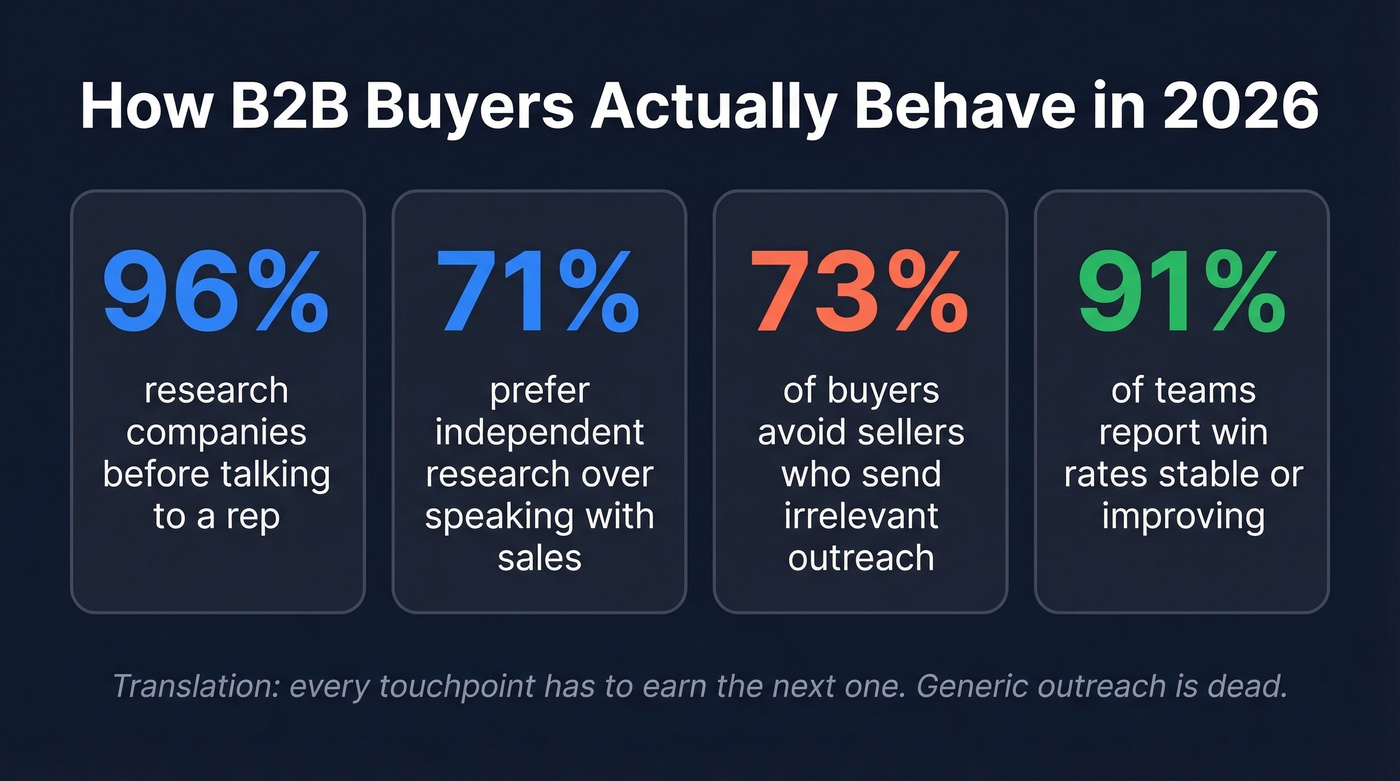
96% of prospects research companies before engaging with a sales rep, and 71% [actively prefer independent research](https://www.gartner.com/en/newsroom/press-releases/2025-06-25-gartner-sales-survey-finds-61-percent-of-b2b-buyers-prefer-a-rep-free-buying-experience) over talking to a rep at all. By the time they take your call, they've already read your case studies, checked your G2 reviews, and compared you to two competitors.
This doesn't mean outbound is dead. It means lazy outbound is dead. 73% of B2B buyers [avoid sellers who send irrelevant outreach](https://www.salesforce.com/sales/state-of-sales/sales-statistics/), and Gong research shows 81% of revenue leaders say deals are more complex than ever - more stakeholders, longer cycles, higher scrutiny on ROI. Despite the complexity, 91% of teams report win rates are stable or improving. The reps adapting to the new buyer are winning.
Translation: every touchpoint has to earn the next one. Generic "just checking in" emails don't earn anything.
Prospecting Tips That Build Real Pipeline
Define Your ICP With Surgical Precision
"We sell to mid-market SaaS companies" isn't an ICP. It's a category. A real ICP looks like this: Series A SaaS startups with under 50 employees that just hired their first RevOps lead. That level of specificity changes your messaging, your channel mix, and your timing. The more precise your ICP, the fewer prospects you need - and the more time you can spend personalizing outreach that actually converts.
Build a Multi-Touch Outbound Sequence
Single-channel outreach is a coin flip. Here's a 12-day starter cadence we've seen work across dozens of outbound teams:
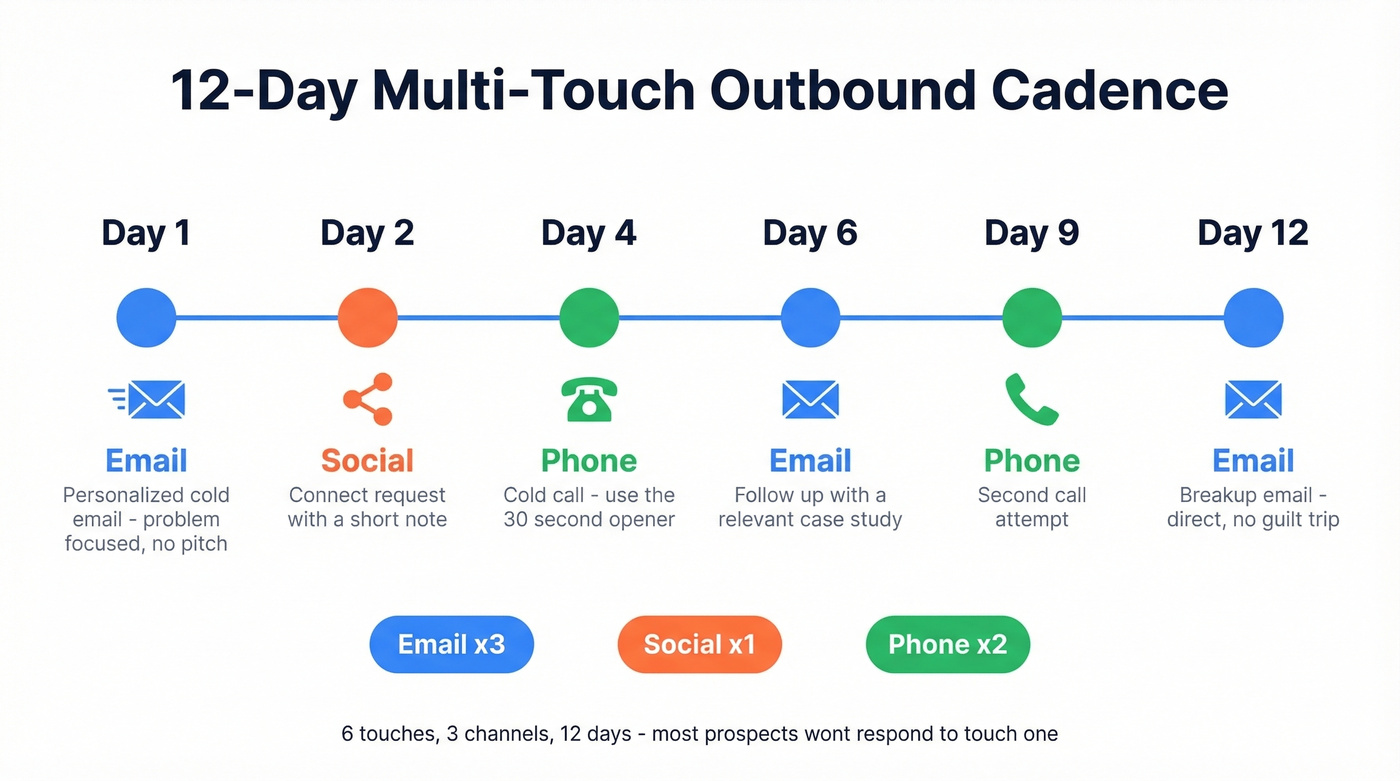
| Day | Channel | Action |
|---|---|---|
| 1 | Personalized cold email - problem-focused, no pitch | |
| 2 | Social | Connect request with a short note |
| 4 | Phone | Cold call (use the 30-second opener below) |
| 6 | Follow-up with a relevant case study | |
| 9 | Phone | Second call attempt |
| 12 | Breakup email - direct, no guilt trip |
Six touches, three channels, twelve days. Most prospects won't respond to touch one. The sequence gives you five more chances to earn their attention. Adapt the timing to your deal cycle, but keep the multi-channel structure intact.
Clean Your Data Before You Prospect
Here's the thing: your data is probably bad. Nearly half of cold email senders report bounce rates between 2-5%, and 15% exceed 6%. A huge chunk of outbound performance decline isn't about messaging - it's about bounces damaging your sender reputation before your copy even gets a chance.
If you want the benchmarks and fixes, start with bounce rates and work backward from there.
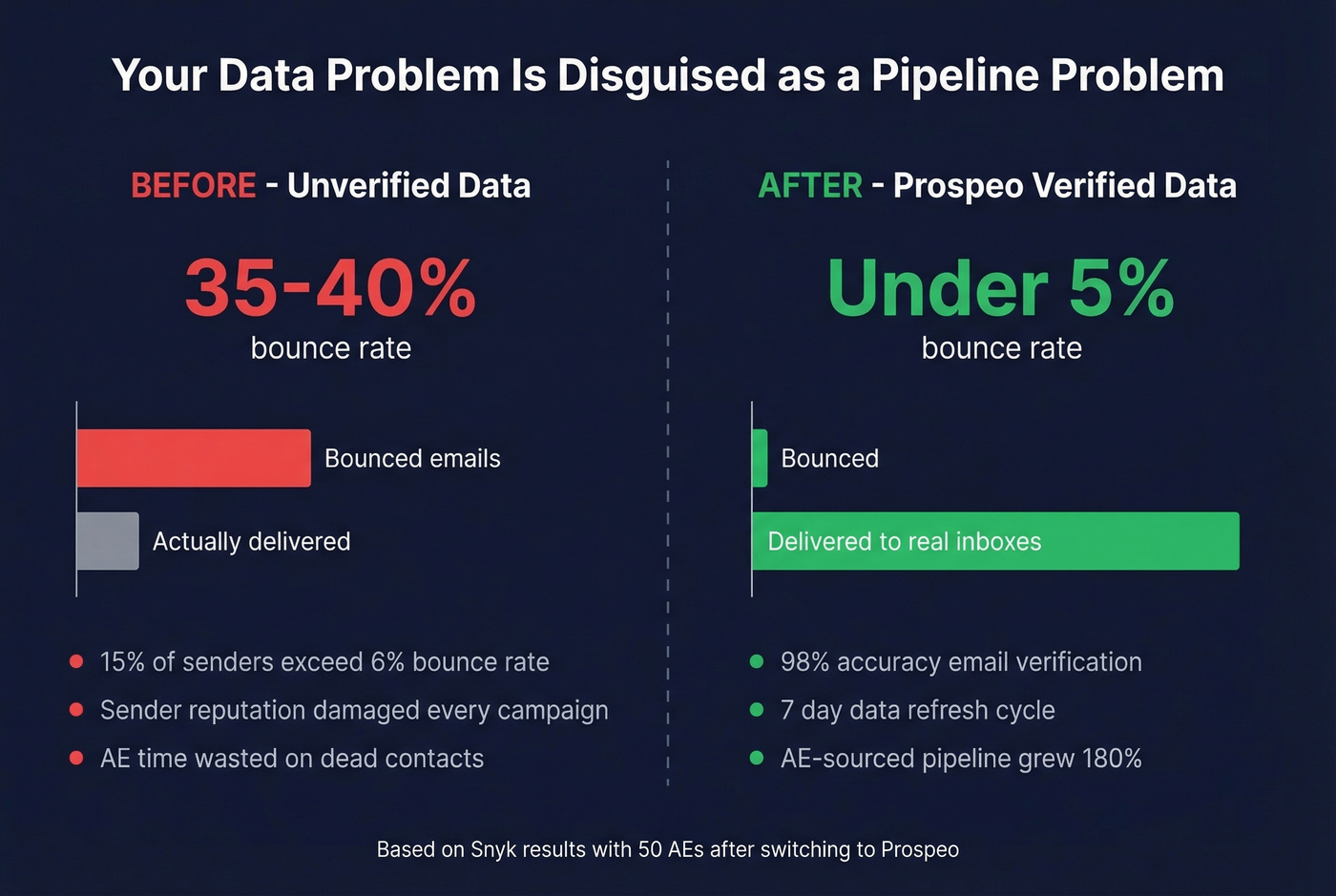
We've seen this pattern over and over. Snyk's team of 50 AEs was running a 35-40% bounce rate before switching to Prospeo's 98% accuracy verification and 7-day data refresh cycle. After the switch, bounces dropped under 5% and AE-sourced pipeline jumped 180%. That's not a messaging improvement. That's a data improvement.
If you're running sequences on unverified data, you're burning your domain reputation with every campaign. Fix the data first. (If you need the technical checklist, see our email deliverability guide.)
Block Prospecting Time Like a Meeting
Sales reps spend 60% of their time on non-selling tasks. That's not a productivity problem - it's a calendar problem. Block 60-90 minutes every morning before your calendar fills with internal meetings. Treat it like a client call: non-negotiable, no rescheduling. The reps who prospect consistently don't have pipeline problems in Q4.
Cold Outreach in the Deliverability Crisis
Personalize or Get Filtered
Only 5% of sales reps personalize every email individually. In a world where spam filters are smarter and buyers are pickier, that 5% has a massive advantage. Personalization doesn't mean writing a novel for each prospect - it means one sentence that proves you did 30 seconds of research. A recent hire, a funding round, a podcast appearance. That single line of specificity is the difference between "opened and replied" and "filtered to spam."
If you want a repeatable system, use a personalized outreach workflow instead of improvising.
The 30-Second Cold Call Opener
Most cold calls die in the first 10 seconds because the rep launches into a pitch. Morgan J. Ingram's framework flips the script by asking for permission and setting a micro-commitment:
"All I'm asking for is 30 seconds. I'll tell you why I'm calling - if it's relevant, we'll put time on the calendar. If not, you can hang up on me. Does that sound fair?"
No feature dump. No "How are you today?" The prospect gets control, which paradoxically makes them more likely to listen.
If cold calling is a core channel for you, build a repeatable cold calling system so reps don’t wing it.
Listen 70%, Talk 30%
The prospect should be talking 70% of the time. Most reps invert this ratio without realizing it. Record your next five calls and check the talk ratio - if you're above 40%, you're pitching too early. Ask one more question before you offer a solution. Among all the advice you'll read this year, mastering this ratio delivers the fastest results.
Objection Scripts You Can Steal
Validate, Isolate, Reframe
Every objection follows the same pattern, and so should your response:
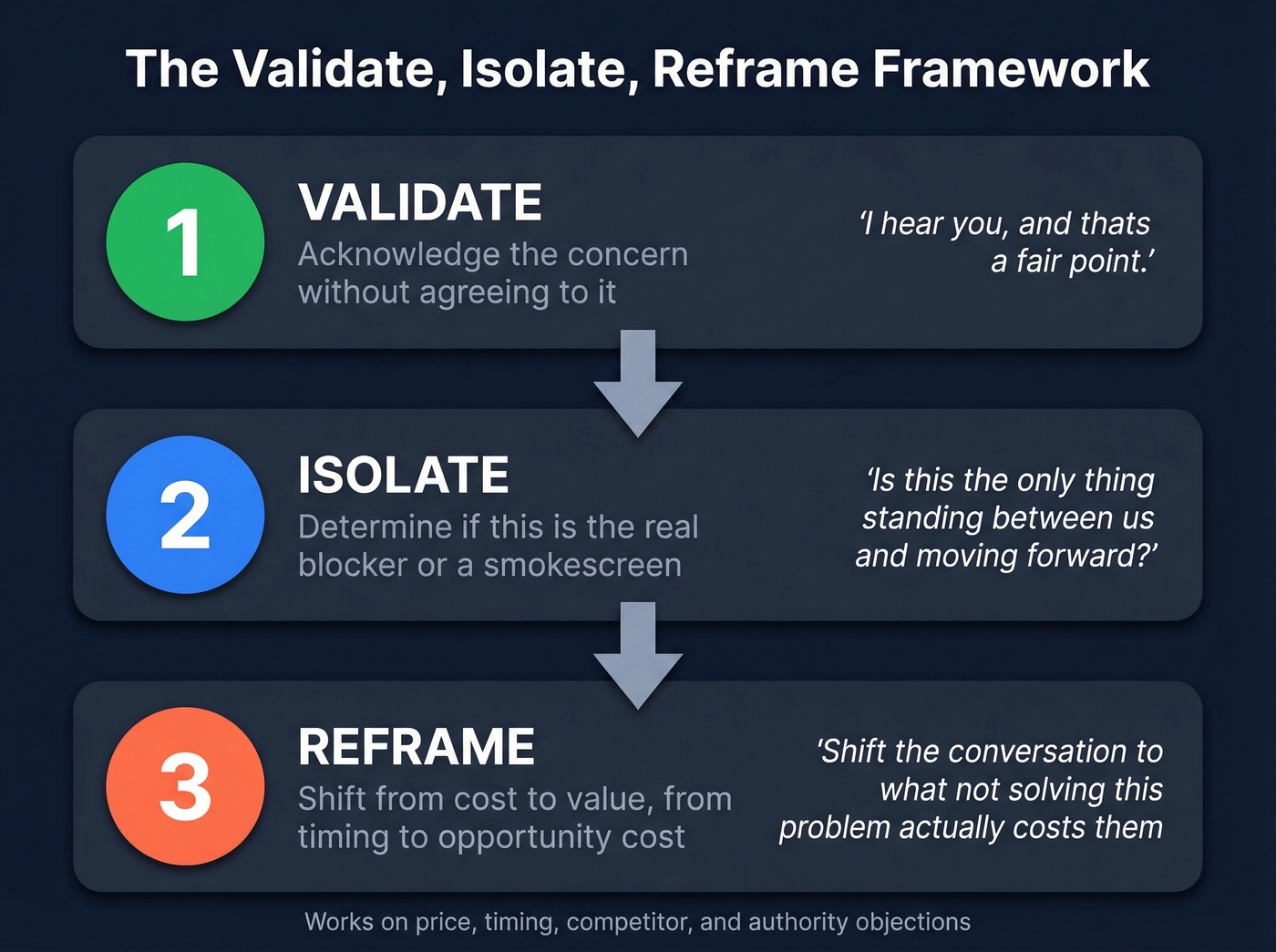
- Validate - acknowledge the concern without agreeing to it. "I hear you, and that's a fair point."
- Isolate - determine if this is the real blocker or a smokescreen. "Is this the only thing standing between us and moving forward?"
- Reframe - shift the conversation from cost to value, from timing to opportunity cost, from competitor to gap.
This isn't a trick. It's a structure that keeps you from getting defensive and keeps the conversation productive.
If you want to reduce how often objections show up in the first place, tighten qualification with a MEDDIC approach.
The 5 Most Common Objections (With Scripts)
Price:
"If price wasn't an issue, is this the solution you'd choose to solve [Problem]? ... Great. Then let's talk about what the cost of not solving [Problem] looks like over the next two quarters."
Competitor:
"I respect [Competitor] - they do [Strength] well. Quick question though: how are you currently handling [Gap they don't cover]? That's usually where our customers see the biggest difference."
Timing:
"Totally fair. What's going to change between now and next quarter that makes this a better time? ... Usually the answer is 'nothing' - which means the cost of waiting is real."
Authority:
"Makes sense - you'll need [Decision Maker] on board. What questions do you think they'll throw at you that we haven't covered yet? Let's prep you so that conversation goes smoothly."
Ghosting (the follow-up after silence):
"Hey [Name], I'm going to assume one of three things: (1) you've gone a different direction, (2) timing shifted, or (3) you got buried. If it's 1 or 2, no hard feelings - just let me know so I can close out my notes. If it's 3, I'm here when you're ready."
These work because they respect the prospect's position while keeping the conversation alive. Practice them until they feel natural, not scripted.
If you need more follow-up options, steal from these sales follow-up templates.

Snyk's 50 AEs dropped bounce rates from 35% to under 5% and grew AE-sourced pipeline 180% - not by rewriting scripts, but by switching to Prospeo's 98% verified emails and 7-day data refresh. Every tip on this page works better when your data actually connects you to real buyers.
Stop perfecting your pitch on dead emails. Fix the data first.
Closing Without Gimmicks
Fake urgency kills deals. Bryan Vasquez, Head of Sales at LinkBuilder.io, reported that replacing urgency-based CTAs with data-backed proposals and tailored value maps led to a 20% increase in win rate over two quarters. HubSpot's research confirms the pattern: the top deal-killers are no product fit (37%) and poor value for money (35%). Neither is solved by "this offer expires Friday."
Let's be honest - if your average deal size is under five figures, you probably don't need a complex closing methodology. You need faster qualification and tighter follow-up. Lock in next steps while you're still on the call. "I'll send a proposal" isn't a next step. "I'm sending the proposal by 3 PM today, and we have 30 minutes on Thursday at 2 to review it together" - that's a next step. Never end a meeting without a calendar invite for the next one.
If you want a simple, repeatable framework, follow these steps to close a sale.
Pick a Methodology and Commit
You don't need to master every sales methodology. You need to pick one that fits your deal type and get good at it.
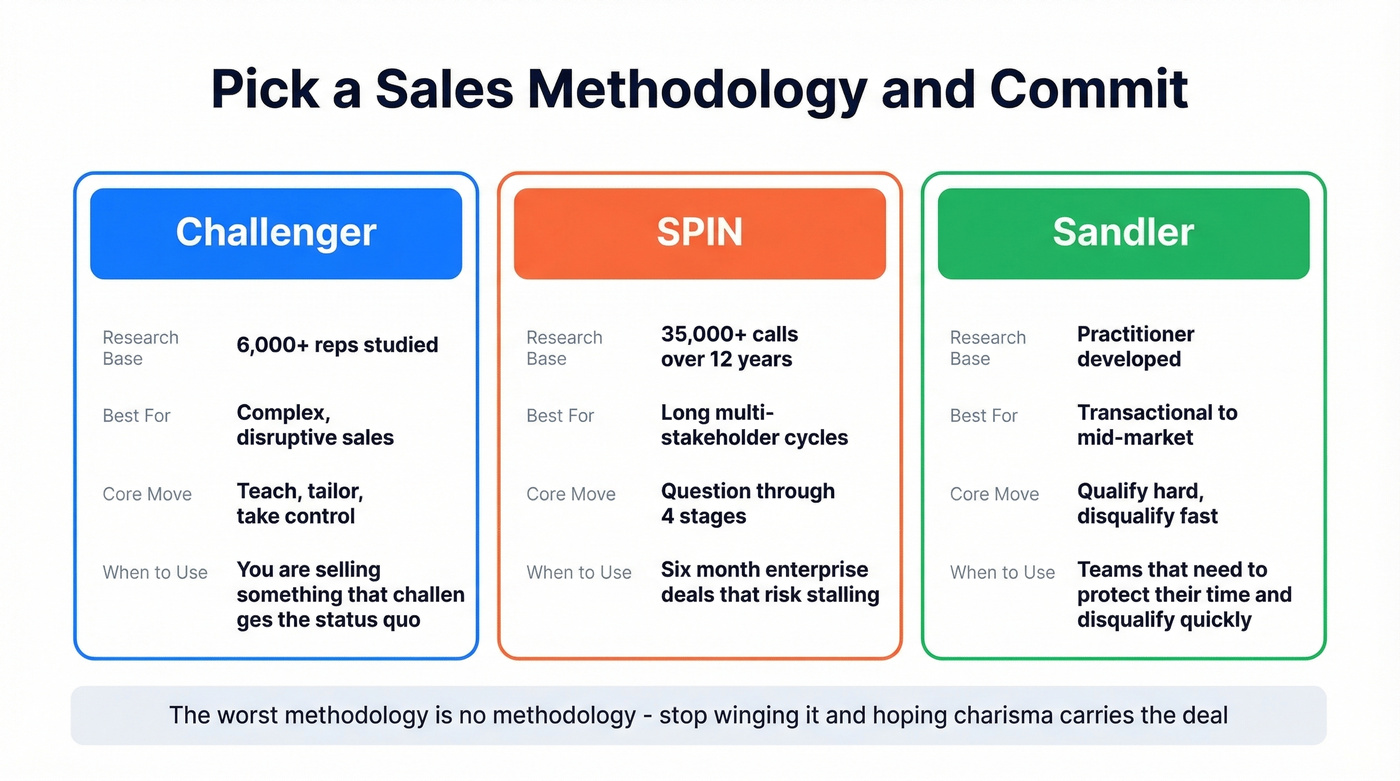
| Methodology | Research Base | Best For | Core Move |
|---|---|---|---|
| Challenger | 6,000+ reps | Complex, disruptive sales | Teach, tailor, take control |
| SPIN | 35,000+ calls, 12 years | Long multi-stakeholder cycles | Question through 4 stages |
| Sandler | Practitioner-developed | Transactional to mid-market | Qualify hard, disqualify fast |
Challenger gives you a framework for leading with insight when you're selling something that challenges the status quo. SPIN's questioning structure keeps six-month enterprise deals from stalling. Sandler works for teams that need to disqualify fast and protect their time.
There's also a simpler mental model worth borrowing: think of every pitch on a ladder from features (weakest) to benefits to solutions (strongest). If you're describing what your product does instead of what it solves, you're stuck on the bottom rung. Skip the methodology debates on Reddit - the worst approach is no methodology at all, just winging it and hoping charisma carries the deal.
Q4: Selling Through the Holidays
Q4 is where pipelines go to die - or to close at record pace. The difference comes down to preparation.
Front-load your outreach. Decision-makers disappear the last two weeks of December. Move discovery calls and proposals into early November so you're negotiating terms, not chasing meetings, when budgets freeze.
Use end-of-year budgets to your advantage. Many buyers have "use it or lose it" budget remaining. Frame your solution as a way to deploy that spend before it evaporates - this is one of the few times urgency is genuine, not manufactured.
Don't go dark yourself. Most reps ease off during the holidays. A well-timed email on December 27 can land when nobody else is sending. Less competition in the inbox means higher open rates.
Set up January pipeline now. Use Q4 conversations to book January meetings. This is the fastest way to start the new year without scrambling from zero.
Your 2026 AI-Assisted Sales Stack
High-performing reps are 1.7x more likely to use AI prospecting agents than underperformers. Salesforce reported an internal SDR agent that created 3,200 opportunities in four months by working low-score leads that human reps had deprioritized. You don't need a $50k tech stack to get the advantage. Here's a complete setup for around $250/month:
| Tool | Category | Price | Why It's Here |
|---|---|---|---|
| Prospeo | Contact data & verification | Free tier; ~$0.01/email | 300M+ profiles, 98% accuracy, 7-day refresh |
| ChatGPT Plus | Research & email drafting | $20/mo | Fast personalization at scale |
| Fathom | Call recording & intelligence | Free tier; $19/user/mo | Never miss a follow-up action item |
| Clay | Enrichment workflows | From $149/mo | Automated list building |
| HubSpot CRM | Pipeline management | Free tier | Solid free option for most teams |
| Calendly | Meeting scheduling | Free tier; from $10/user/mo | Removes scheduling friction |
Clean, verified contact data is the foundation - garbage in, garbage out applies to every tool downstream. ChatGPT drafts personalized outreach in seconds, Fathom captures every call so you can focus on the conversation instead of scribbling notes, and Clay layers in enrichment workflows for teams automating list building at scale. The right tools don't replace good selling habits. They amplify them.
If you’re building lists at scale, use a documented data enrichment process so your sequences don’t decay.
That 12-day multi-touch cadence above only works if your emails land and your phone numbers ring. Prospeo gives you 143M+ verified emails and 125M+ verified mobiles with a 30% pickup rate - at $0.01 per email. No contracts, no sales calls required.
Build pipeline that actually converts - starting at 75 free emails today.
Mistakes That Kill Deals
We asked a handful of veteran sellers what separates top performers from everyone else, and the same themes kept coming up: qualify ruthlessly, follow up relentlessly, and shut up long enough to actually listen. Here are the patterns that tank pipelines over and over:
Selling on price instead of value. The moment you lead with discounts, you've commoditized yourself. Anchor on outcomes with case studies and ROI calculations.
Talking more than listening. If your talk ratio is above 40% on discovery calls, you're pitching too early and missing the information that would help you close.
Failing to qualify. Every hour spent on an unqualified deal is an hour stolen from one that could actually close. Qualify ruthlessly in the first call. If the budget, authority, need, or timeline isn't there, move on.
Skipping objection prep. If you can't anticipate the top three objections for your product, you're not ready for the call. Use the Validate, Isolate, Reframe scripts above.
Pitching the wrong stakeholder. Buying committees are bigger than ever. If you're only talking to one person, you're one "let me check with my team" away from a stalled deal. Multi-thread early - it's one of the most underrated closing skills, and the consensus on r/sales backs this up consistently.
FAQ
What's the most important sales skill in 2026?
Discovery and active listening. With 96% of buyers researching before they ever talk to a rep, those who ask better questions and genuinely listen consistently outperform pitch-first sellers. Technical product knowledge is table stakes - the differentiator is how well you uncover what the buyer actually needs.
How many touchpoints does it take to close a deal?
Expect 7-10 touches across multiple channels for cold outbound. The cadence above uses 6 touches over 12 days as a starting sequence, but complex enterprise deals often require 15+. Most reps give up after two or three attempts - consistency is the real differentiator.
Is cold calling still effective?
Yes - 37% of reps say phone calls produce the most leads during cold outreach. The key is combining calls with email and social in a multi-touch sequence rather than relying on any single channel. Use the 30-second opener framework above to earn the first minute of conversation.
How do I keep my contact data accurate?
Use a verification tool with a fast refresh cycle. Stale data causes bounces, damages sender reputation, and wastes selling time. A 7-day refresh cycle catches bad addresses before they hit your sequences - not after they've already hurt deliverability.
What's the fastest way to increase revenue without adding headcount?
Start with the highest-leverage activities: clean your data, tighten your ICP, and build a multi-touch sequence. These three moves alone can lift conversion rates meaningfully. Layer in the objection scripts and AI tools above to shorten cycle time and improve win rates at every stage.