

How to Build a Sales Team Meeting Agenda That Doesn't Waste Everyone's Time
Monday morning. Everyone's on the call, cameras half-on, and the "pipeline review" turns into 60 minutes of verbal CRM updates you could've read in 3 minutes.
That's what happens when your sales team meeting agenda is fiction. 71% of meetings are unproductive, and ineffective meetings burn roughly $37 billion per year in the US alone. Reps spend only about 30% of their time actually selling - the rest disappears into admin, internal calls, and meetings about meetings.
Stop trying to make sales meetings fun. Make them short, data-driven, and action-oriented. Your reps will show up on time because they'll leave knowing exactly what to do.
The Quick Version
- If it takes under 10 minutes, skip the meeting - send a message.
- Use the 60-minute weekly template below, timed, with owners.
- Add a 15-minute daily huddle for teams with 10+ reps.
- Verify your CRM data before every pipeline review. Stale contacts make forecasts fiction.
Do You Even Need This Meeting?
Simple decision gate: if the topic can be resolved in under 10 minutes, it's not a team meeting. It's an async update or a quick 1:1.
One of the most common failure modes is also the simplest - status updates that should've been a Slack message. The data backs it up: clear objectives (72%) and a clear agenda (67%) are the top drivers of meeting effectiveness, with "not too many people" right behind them.
Keep the invite list tight. Meetings are most productive at 8 people or fewer. Past that, you're not collaborating - you're performing.
What Every Agenda Needs
A well-structured agenda isn't a list of topics. It's a control system for time, ownership, and follow-through.
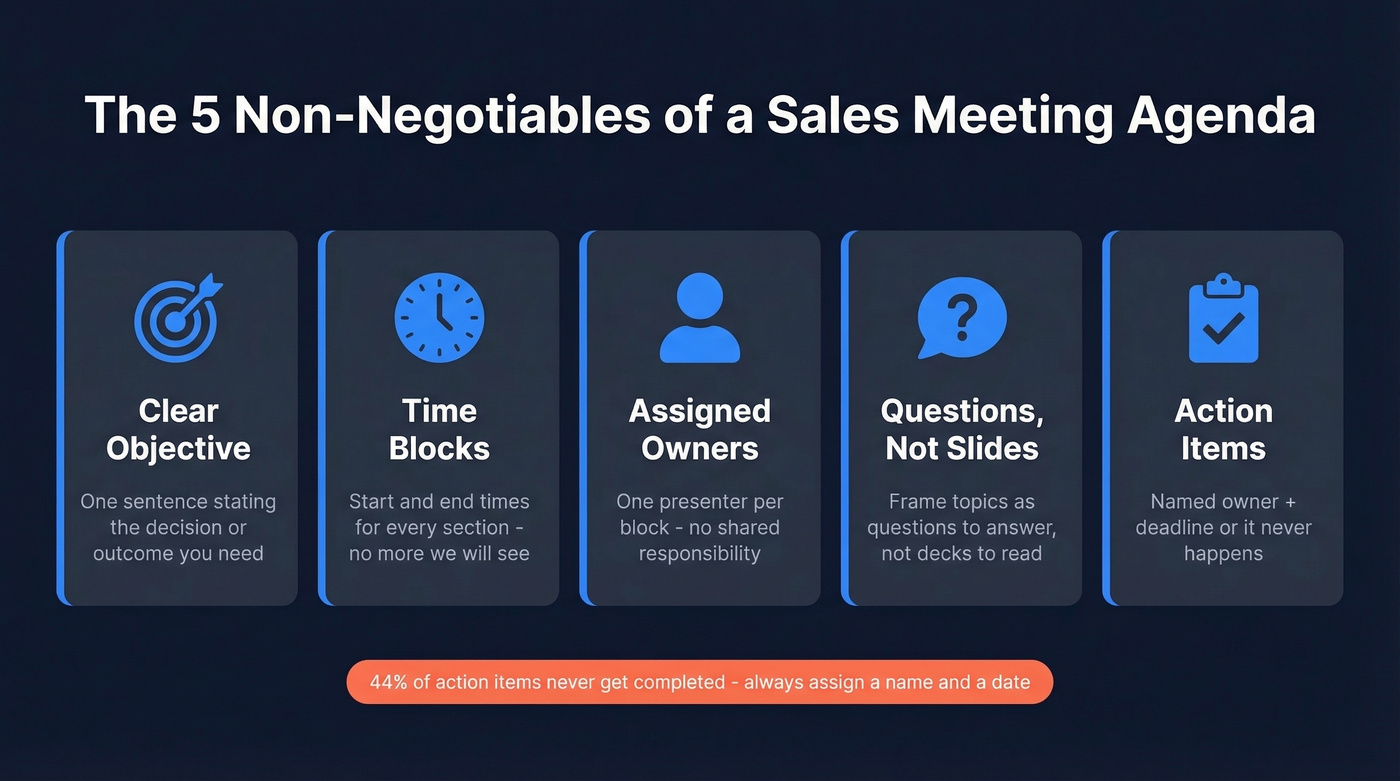
- Clear objective - one sentence stating the decision or outcome you need
- Time blocks with start and end times, not "we'll see"
- Assigned presenters, one owner per block
- Discussion topics framed as questions to answer, not slides to read
- Action items with owners and deadlines - because 44% of action items never get completed, and "we should" dies fast without a name and a date

Your weekly pipeline review is worthless if 30% of your contacts have decayed. Prospeo refreshes data every 7 days - not the 6-week industry average - so your reps coach on real opportunities, not dead emails. 98% email accuracy means your forecast reflects reality.
Clean your pipeline data before your next Monday meeting.
Weekly Sales Meeting Template (60 min)
This is where we've seen the biggest difference between high-performing teams and everyone else. RAIN Group's data shows top-performing sales managers - those with 75%+ of their team hitting goal - are 42% more likely to run effective team meetings. Their WEWIN framework forces balance between recognition, numbers, change, problem-solving, and commitments.
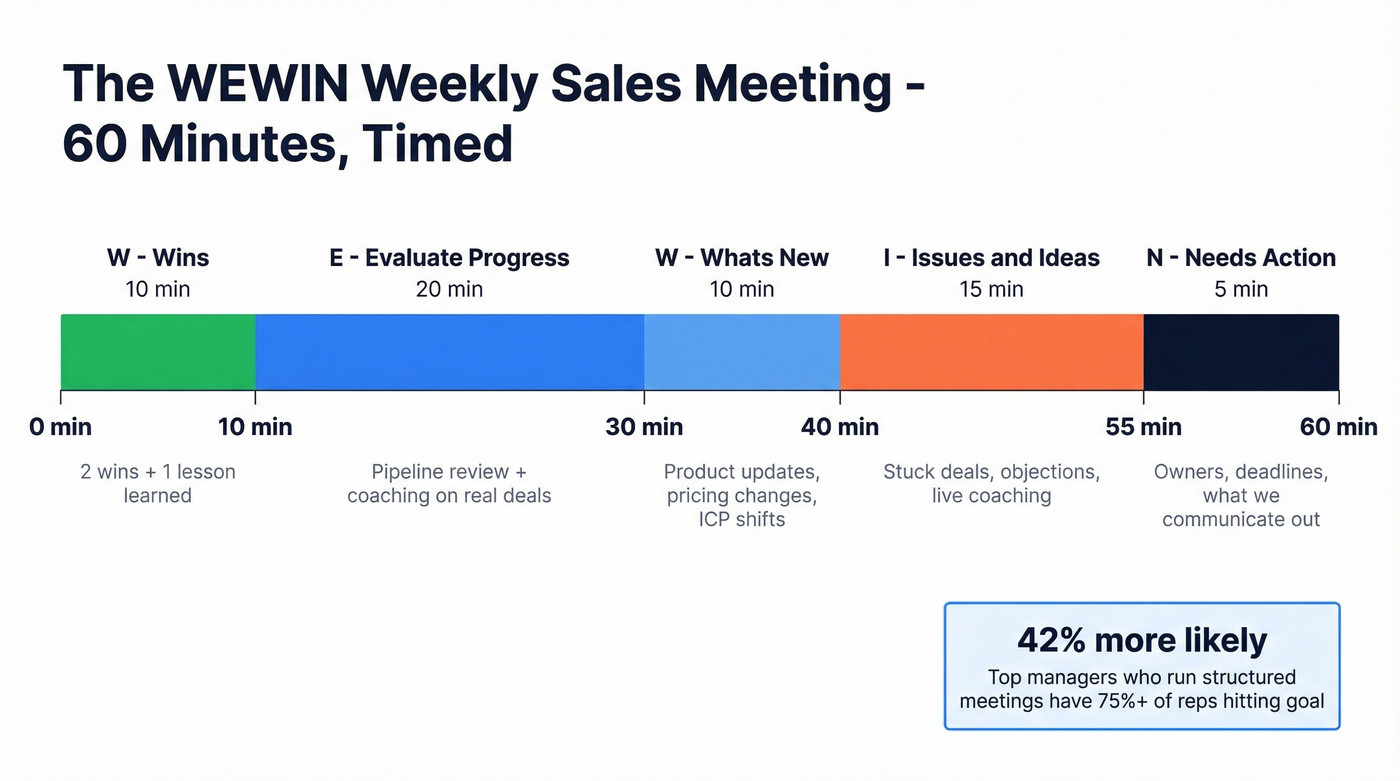
Teams with mature pipeline management see 28% higher deal closure rates and can reduce sales cycle length up to 18%. That's the ROI of a structured weekly rhythm.
| Time | WEWIN Block | Topic | Owner |
|---|---|---|---|
| 0-10 | Wins & Recognition | 2 wins + 1 lesson | Manager |
| 10-30 | Evaluate Progress | Pipeline review + next steps | RevOps/Manager |
| 30-40 | What's New | Product, pricing, ICP shifts | Enablement |
| 40-55 | Issues & Ideas | Stuck deals + objections | Top rep |
| 55-60 | Needs Action + Wrap | Owners, deadlines, recap | Manager |
Inside the pipeline review block, don't let the meeting become a data-entry session. Require CRM updates before the meeting, then use the time for coaching and decisions. Contacts decay 30%+ per year, so verify your data is current before you trust any forecast built on it. We've found that running a quick data refresh through Prospeo before pipeline reviews - 98% email accuracy on a 7-day refresh cycle - means you're coaching on real opportunities, not bounced emails.
Here's the thing: only 47% of managers coach reps for more than 30 minutes per week. The "Issues & Ideas" block is where that coaching actually happens. Protect it.
Daily Sales Huddle Template (15 min)
Daily huddles work when they replace longer meetings, not when they stack on top of them. Run it first thing in the morning, keep it standing, and never exceed 15 minutes. MIT Sloan found that cutting meetings by 40% drove a 71% productivity gain. Short huddles protect selling time.
Use the IERM mnemonic - "I Earn Real Money":
| Time | IERM | What Happens | Owner |
|---|---|---|---|
| 0-3 | Information | Today's priorities + alerts | Manager |
| 3-7 | Education | 1 micro-skill or talk track | Enablement |
| 7-10 | Recognition | Shoutouts + wins | Manager |
| 10-15 | Motivation | Targets + focus for the day | Manager |
Attention drops after roughly 15-20 minutes on a single medium. Switch formats - discussion to dashboard to whiteboard - to keep energy up, and you'll never need to run past the clock.
How Often Should Your Team Meet?
Cadence should match volatility. SDR work changes daily; AE pipeline moves weekly; leadership forecasting is slower.
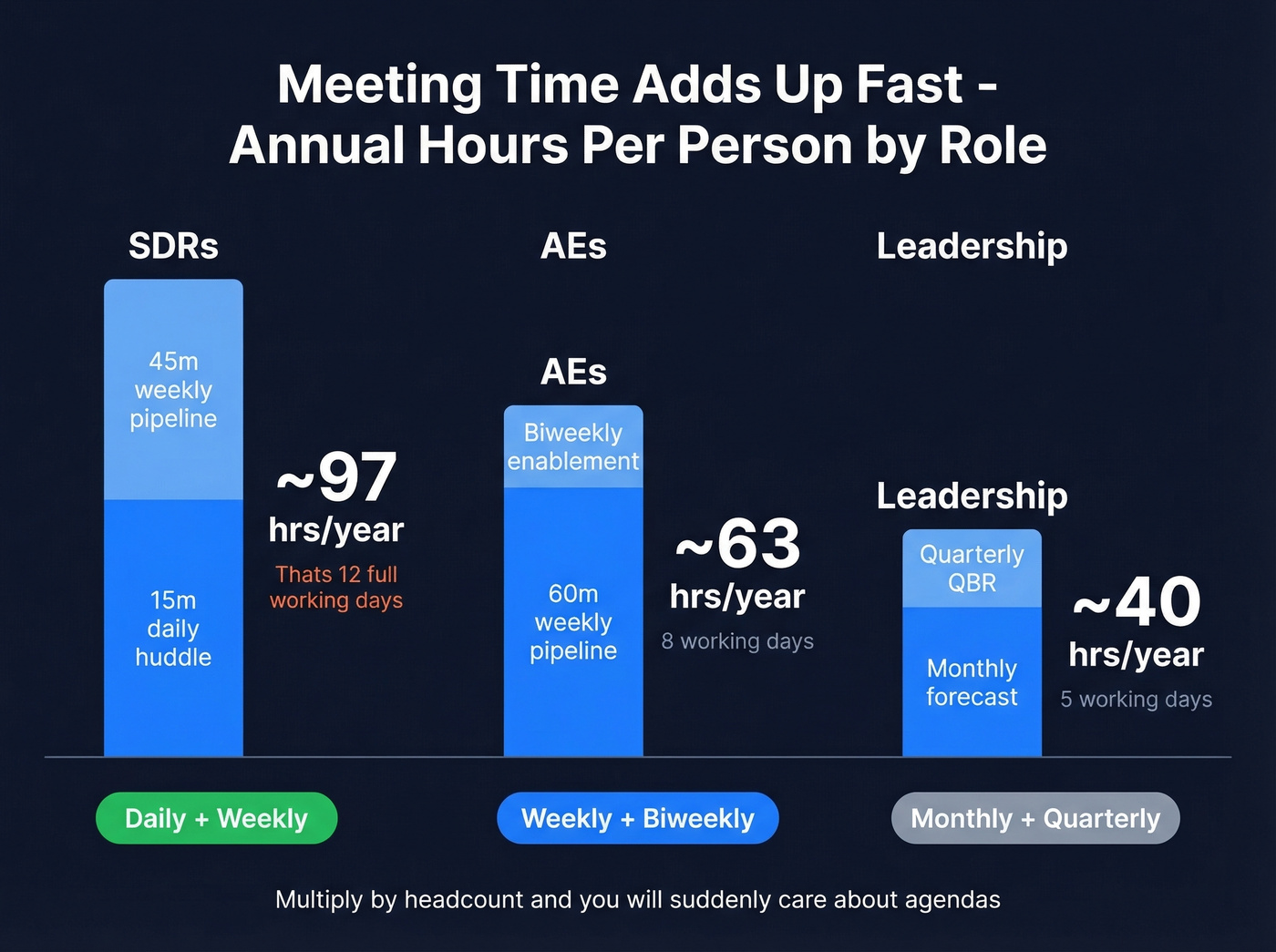
The math matters: 15 minutes daily equals 60 hours per year per person. A 60-minute weekly meeting costs 50 hours per year per person. Multiply by headcount and you'll suddenly care about agendas. Remote teams saw 13% more meetings but 20% shorter ones after 2020 - shorter is good, as long as the agenda is real.
| Role Group | Cadence | Meeting Type | Annual Hrs/Person |
|---|---|---|---|
| SDRs | Daily + weekly | 15m huddle + 45m pipe | ~97 |
| AEs | Weekly + biweekly | 60m pipe + enablement | ~63 |
| Leadership | Monthly + quarterly | Forecast + QBR | ~40 |
One-on-ones and forecast calls need their own agendas. Don't try to fold them into the team meeting or you'll blow past every time block above.
Five Mistakes That Kill Sales Meetings
Look - you already know most of these. The problem isn't awareness; it's enforcement.
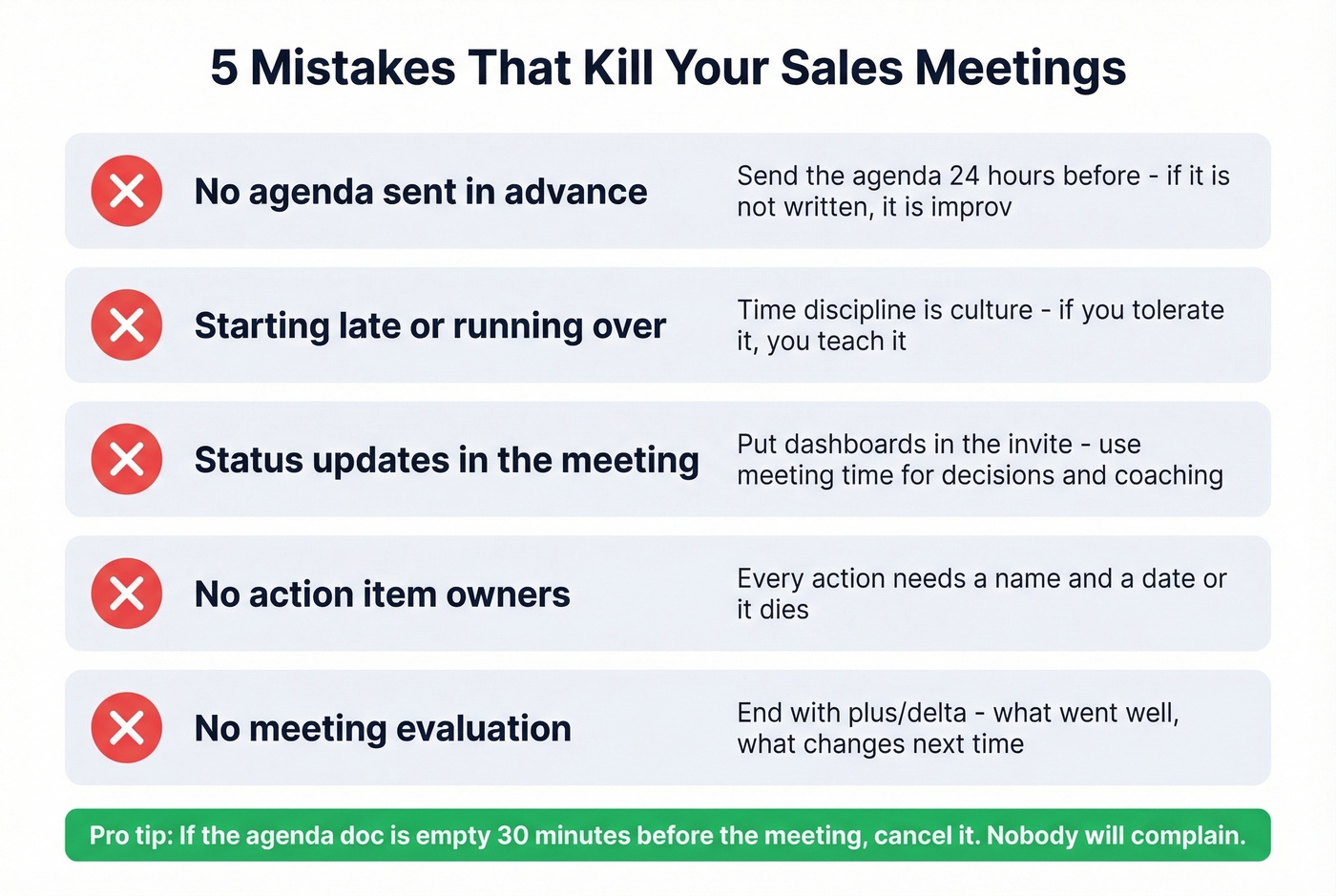
- No agenda sent in advance. If it isn't written, it's improv, and improv runs long.
- Starting late or running over. Time discipline is culture. If you tolerate it, you teach it.
- Status updates that should be async. Put dashboards in the invite. Use the meeting for decisions and coaching.
- No action-item owners. "We should" is a lie unless someone's named and there's a date attached.
- No meeting evaluation. End with plus/delta - what went well, what changes next time. Then ask Lencioni's two closers: "What have we agreed on?" and "What will we communicate to the rest of the team?"
Let's be honest: the best sales meeting you'll ever run is the one you cancel because the agenda only had status updates. Canceling a bad meeting earns more trust than running a mediocre one. Our team has a standing rule - if the agenda doc is empty 30 minutes before the meeting, it gets killed. Nobody's complained yet.
You just built a tight agenda with time blocks and owners. Now make sure the deals your team reviews are backed by verified contact data. Prospeo gives you 98% accurate emails at ~$0.01 each - so reps spend that 20-minute pipeline block on strategy, not chasing bounced contacts.
Stop wasting your best coaching block on stale data.
Frequently Asked Questions
What should a sales team meeting agenda include?
Every agenda needs five sections: wins and recognition, a pipeline review with metrics, updates or blockers, deal coaching and objection handling, and action items with named owners and deadlines. Assign a time limit to each block - without one, the meeting expands to fill the calendar slot.
How long should a weekly sales meeting be?
45-60 minutes for a full-team pipeline review. If you're consistently running over, you're covering too many topics. Move status updates to async channels and reserve meeting time for discussion, decisions, and coaching.
How often should sales teams meet?
SDRs benefit from a daily 15-minute huddle plus a weekly pipeline review. AEs typically need a weekly 60-minute pipeline meeting and biweekly enablement sessions. Leadership runs monthly forecasts and quarterly QBRs. A 60-minute weekly meeting costs 50 hours per year per person - so make each one count.
How do I keep meetings from becoming status updates?
Require reps to update the CRM and dashboards before the meeting, not during it. Use meeting time for coaching, problem-solving, and decisions. If a rep's update takes more than 90 seconds, it belongs in a 1:1 or an async thread. The consensus on r/sales is pretty clear on this: if your "pipeline review" is just reps reading their CRM out loud, you've already lost.