

Sales Team Strategy: 7 Decisions That Replace Guesswork
You're the founder, and you're still the top rep. Every deal runs through you, every proposal gets your fingerprints, and the team you hired last quarter is waiting for instructions. That's not a sales team strategy - it's a dependency. Meanwhile, 57% of sales professionals say [cycles are getting longer](https://www.salesforce.com/sales/state-of-sales/), which means the window where founder-led selling works is shrinking fast.
What You Need (Quick Version)
If you've got one afternoon, do these three things:
- Define your deal stages with exit criteria. This gives reps a shared language for where deals actually stand.
- Set a pipeline coverage target of 3-5x quota and review it weekly. If you don't know your coverage ratio, your forecast is fiction.
- Clean your contact data. Verified emails and fresh records eliminate the noise that causes 73% of B2B buyers to avoid sellers who send irrelevant outreach.
What "Strategy" Really Means Here
Not a mission statement. Not a slide deck. Strategy is the set of decisions you make about who to sell to, how to organize the team, what to measure, and how to run the week. Only 52% of CEOs actually believe in their own growth plans. The gap between plan and execution is almost always a missing operating rhythm, not a missing insight.
The 2026 Reality Check
Before you build anything, understand the terrain:
- Reps spend 60% of their time on non-selling tasks - admin, data entry, internal meetings
- Average quota attainment sits around 43%, and 17% of reps generate 81% of revenue
- 74% of AI-using sales teams prioritize data hygiene above other initiatives
If your approach doesn't address these numbers, it's wishful thinking.

Your pipeline math falls apart when 30% of emails bounce. Prospeo delivers 98% email accuracy on a 7-day refresh cycle - so the 50 opportunities your reps need are built on contacts that actually connect. Snyk's 50 AEs cut bounce rates from 35% to under 5% and grew AE-sourced pipeline 180%.
Fix your data hygiene before you hire your next rep.
The 7-Decision Sales Team OS
You don't need 10 tools and 10 strategies. You need 7 decisions and 3 weekly meetings.
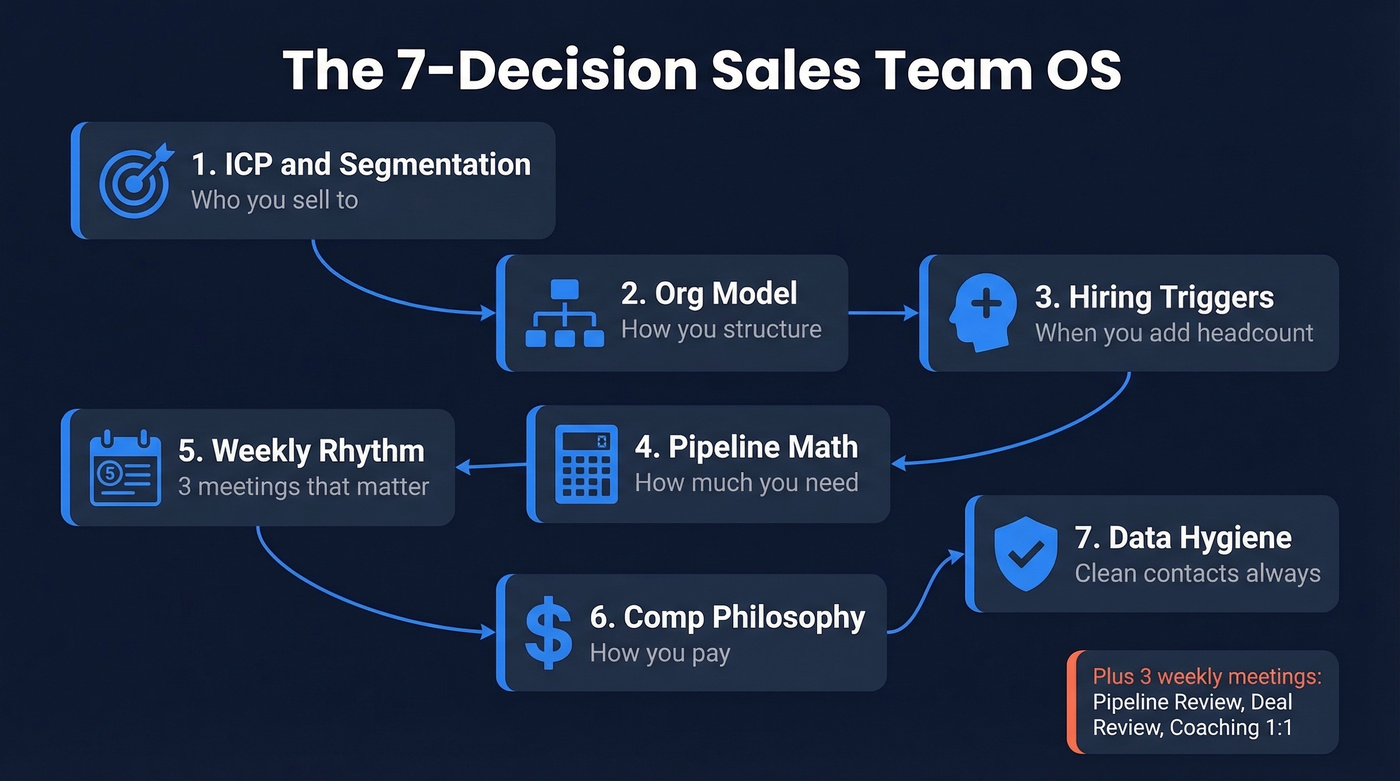
Decision 1 - ICP and Segmentation
Everything downstream - messaging, org design, hiring, comp - depends on who you're selling to. That 73% irrelevant-outreach stat isn't about bad emails. It's about sellers targeting the wrong people with the wrong message.
At minimum, define company size, industry, and tech stack. Map the buying committee - typical groups run 6-10 stakeholders, and enterprise deals can hit 15+. Identify pain triggers that create urgency, and just as importantly, set disqualification criteria for who you won't sell to. In our experience, the disqualification list does more for pipeline quality than the target list ever will.
Decision 2 - Org Model
| Model | Best For | Watch Out |
|---|---|---|
| Island (full-cycle) | Simple sales, small teams | Inconsistent process |
| Assembly Line (SDR->AE->CS) | High volume, clear stages | Handoff friction |
| Pod (cross-functional) | Complex deals, lifecycle | Coordination overhead |
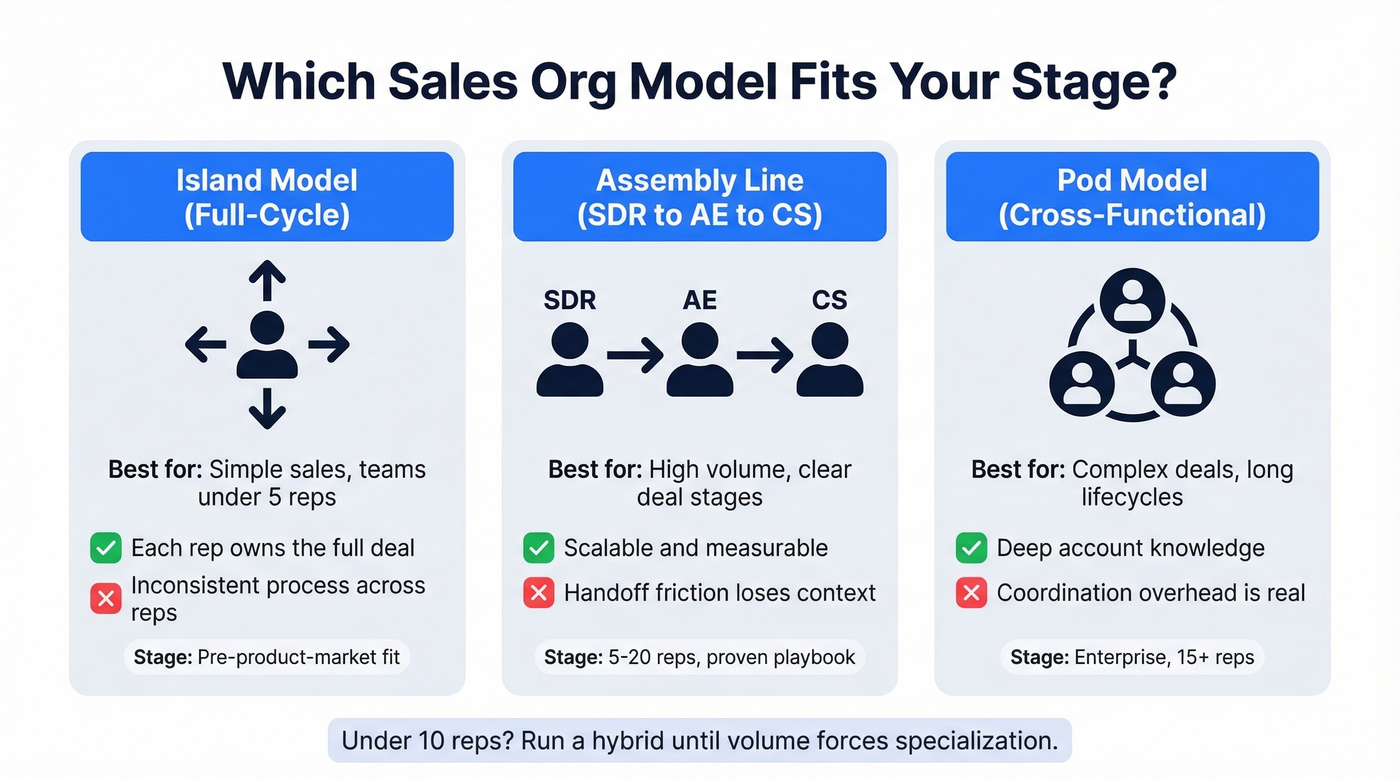
Stop copying enterprise org charts. If you're under 10 reps, run a hybrid until volume forces specialization. A solid growth strategy starts with the right structure for your current stage, not the one you hope to reach in two years.
Decision 3 - Hiring Triggers
Build systems first. Then hire.
This sequence comes up repeatedly in founder communities on Reddit, and it works because it prioritizes process over headcount: document your workflow, hire an AE once lead flow justifies it, add SDRs to build pipeline, bring on Customer Success when churn starts eating growth.
The trigger question: "If we got 10 more opportunities this month, where would we drop the ball?" When the answer is "closing," hire an AE. When it's "generating pipeline," hire an SDR.
Decision 4 - Pipeline Math
Two formulas run your forecast:
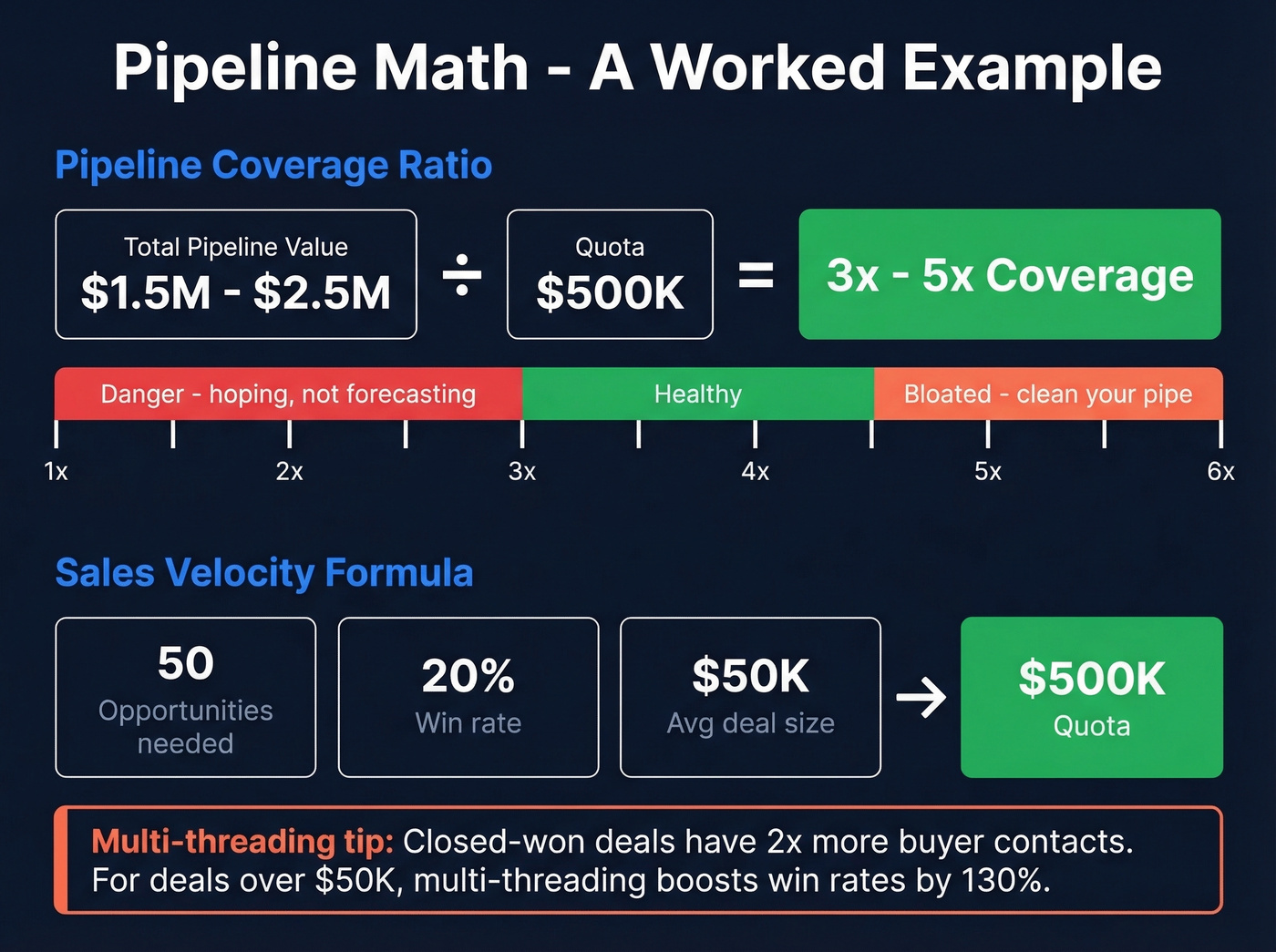
Pipeline Coverage Ratio = Total Pipeline Value / Quota. Healthy teams maintain 3-5x coverage. Below 3x and you're hoping, not forecasting.
Sales Velocity = (Deals x Win Rate x Avg Deal Size) / Sales Cycle Length.
Let's walk through a worked example. If your quota is $500K, you need $1.5M-$2.5M in pipeline. At a 20% win rate and $50K average deal size, that's 50 opportunities you need active at any given time. That number tends to shock founders who've been running on gut feel.
The fastest lever is multi-threading. Closed-won deals have roughly 2x more buyer contacts than lost deals, and for deals above $50K, multi-threading boosts win rates by 130%. If your reps are single-threaded into one champion, your pipeline math will never work.
Decision 5 - Weekly Rhythm
You need three meetings, run tight:
- Pipeline review (30 min): Coverage ratio by rep, new pipe created, pipe aged out. No storytelling - just numbers. We've found this is the single highest-ROI meeting a sales leader runs.
- Deal review (45 min): Top 5 deals per rep. What's the next step? Who else is in the buying committee?
- Coaching 1:1 (30 min): Skill development, not status updates. Listen to calls together.
Your playbook should provide in-the-moment guidance - not sit in a Google Doc nobody opens.
Decision 6 - Comp Philosophy
Design quotas so 60-70% of reps hit target. Standard splits: SDRs at 70/30 base-to-variable, AEs at 50/50.
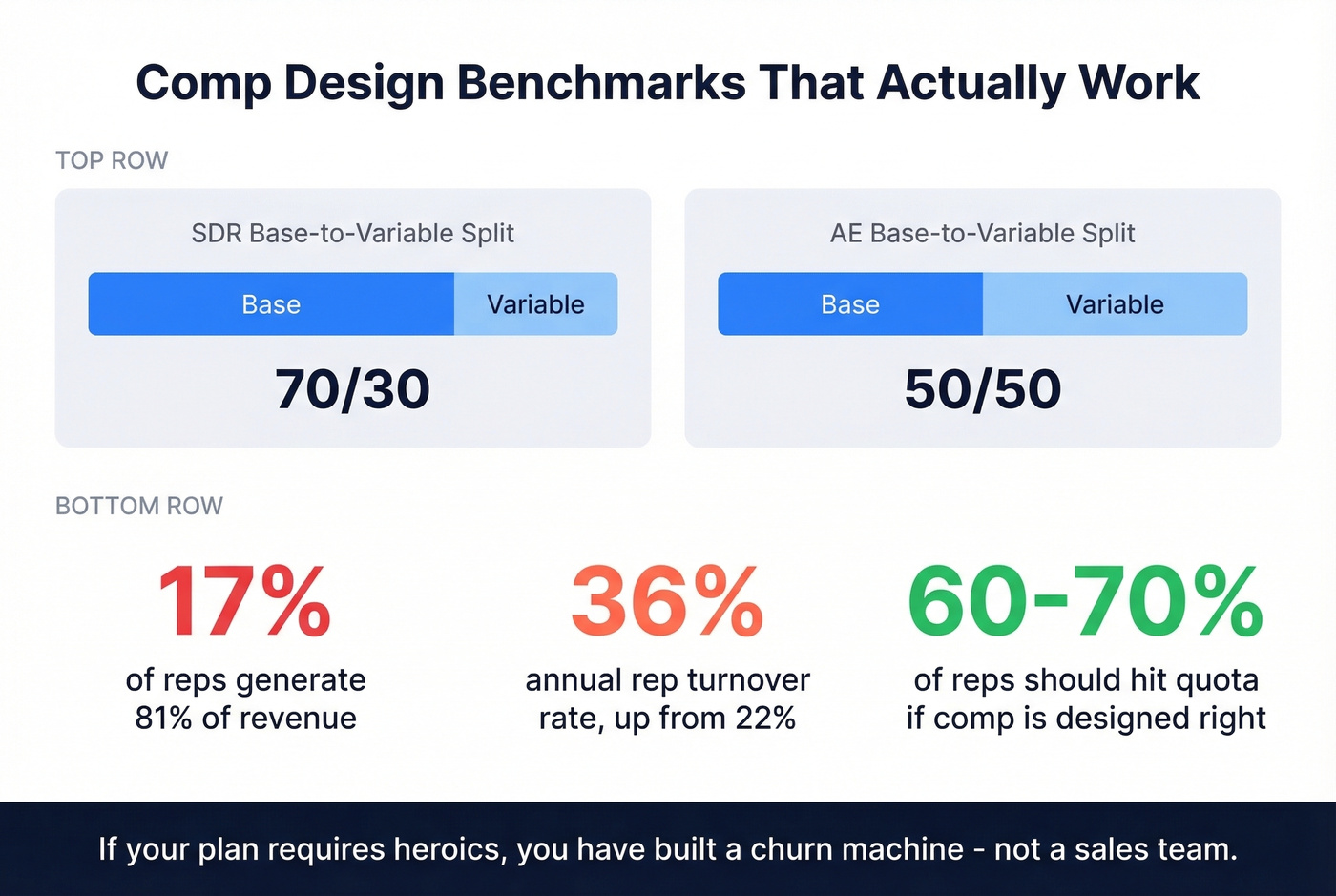
Here's the thing: if your plan requires heroics, you've built a churn machine. Remember, 17% of reps generate 81% of revenue, and bad comp design is what keeps that ratio locked in place. Rep turnover has climbed from 22% to 36%, and unrealistic sales targets are the number one reason reps leave.
If your average deal size is under $30K and more than half your reps are missing quota, the problem isn't your people. It's your comp plan subsidizing a market position that doesn't exist yet.
Decision 7 - Data Hygiene
Verify every email before it enters a sequence - bounces destroy domain reputation. Refresh contact data weekly, not quarterly. Layer intent signals so reps reach buyers who are actually in-market.
Prospeo turns this from a quarterly project into a weekly habit: 98% email accuracy, a 7-day data refresh cycle versus the 6-week industry average, and roughly $0.01 per email. Upload a CSV, get verified contacts back, push them to your sequencer. Teams like Snyk cut bounce rates from 35-40% to under 5% and grew AE-sourced pipeline by 180% after switching.

Three Mistakes That Kill It
Hiring commission-only reps to escape founder-led sales. The consensus on r/sales is clear: commission-only teams attract desperate reps, not good ones. If you aren't paying base, you aren't building a real sales org. Systems fix founder-led selling - not comp structures that shift all risk to the seller.
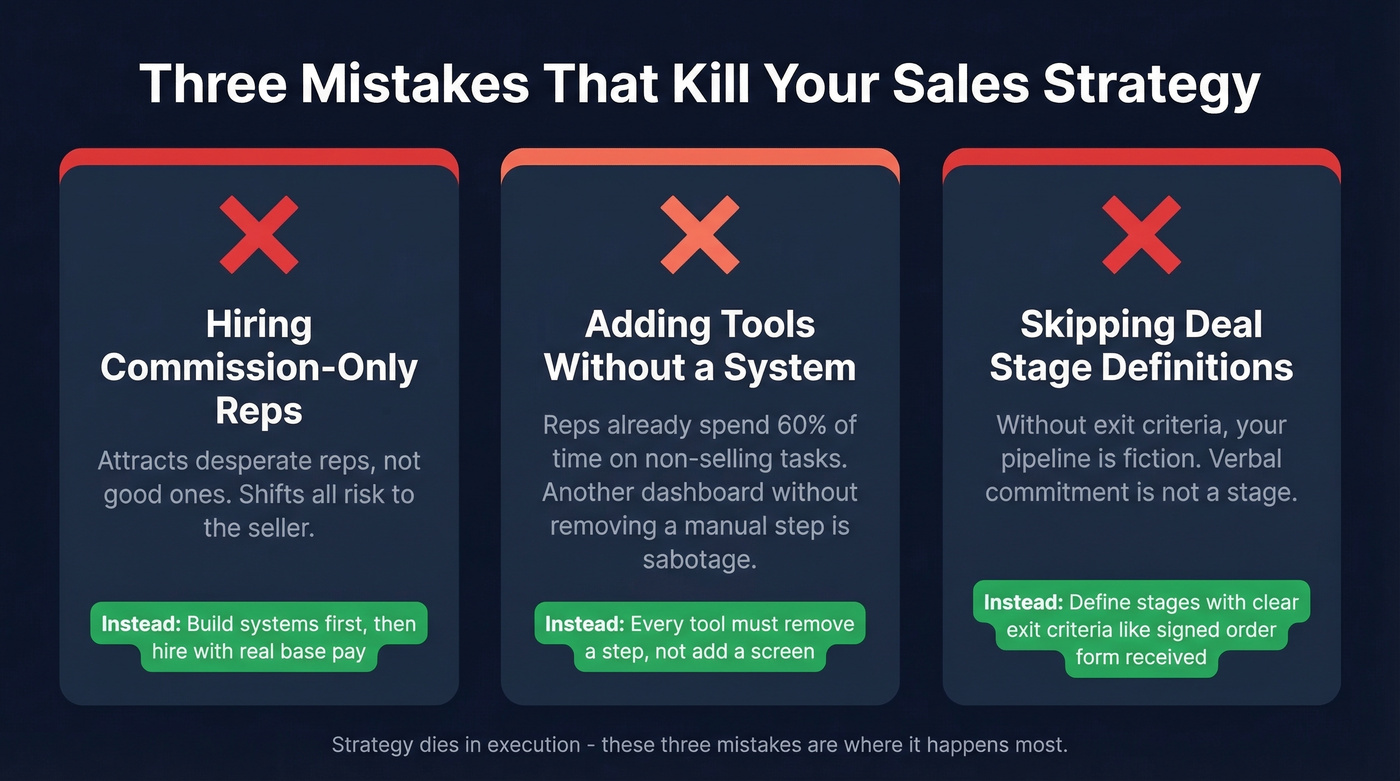
Adding tools without a system. Reps already spend 60% of their time on non-selling tasks. Every new tool that doesn't directly reduce that number is sabotage disguised as investment. Skip anything that adds another dashboard without removing a manual step.
Skipping deal stage definitions. If your stages don't have exit criteria, your pipeline is fiction. "Verbal commitment" isn't a stage - "signed order form received" is.
Activate Your Sales Team Strategy This Week
Define your deal stages with clear exit criteria. Calculate your pipeline coverage ratio and review it every Monday. Set up a data hygiene workflow so every email your team sends actually lands. Most strategies die because they stay on a slide. These three moves turn yours into a weekly operating system.
Decision 7 shouldn't be an afterthought. Layer intent data across 15,000 topics, refresh contacts weekly instead of quarterly, and push verified leads straight to your sequencer - all at roughly $0.01 per email. That's how you turn pipeline coverage from fiction into forecast.
Stop subsidizing bad data with more headcount.