

Go-to-Market Strategy for Product Managers: The Framework You Actually Need
You just got pulled into a meeting where the VP of Sales, the head of marketing, and your CEO all have different opinions about how to launch the next product. You leave with a "GTM plan" that's really three conflicting strategies stitched together - what one Reddit PMM perfectly called a "Frankenstein plan." Sound familiar?
Building a go-to-market strategy for product managers shouldn't feel like hostage negotiation. Teams with a defined GTM process hit 63% launch success versus 53% without one and see 3x higher median revenue growth. That gap is the difference between a product that gets traction and one that quietly dies on the roadmap.
What You Need (Quick Version)
You don't need a 10-step framework. You need answers to five questions:
- Who's the buyer? Not a persona deck - a list of 200 accounts you can name.
- What's the pain? Validated by real conversations, not assumptions from a strategy offsite.
- Why us? One sentence that explains why you win against the alternative, including doing nothing.
- How do we reach them? A motion that matches your deal size - PLG, sales-led, or hybrid.
- How do we know it's working? Two or three metrics you'll check weekly, with kill thresholds.
Everything below is the operational playbook behind those five questions.
What GTM Means in Product Management
Most GTM guides are written for product marketing managers. This one isn't. A go-to-market strategy is a system for turning a product into revenue - it answers who you're selling to, how you'll reach them, and how you'll measure whether it's working. It's not a marketing strategy (channel and campaign decisions) or a product strategy (what to build and why).
For PMs, GTM is the connective tissue between what you built and whether anyone buys it. You don't hand it off. You own it.
PM vs. PMM Ownership
A PM gets the cereal on the shelf. A PMM gets customers to take it off the shelf. In practice, ownership shifts by phase:
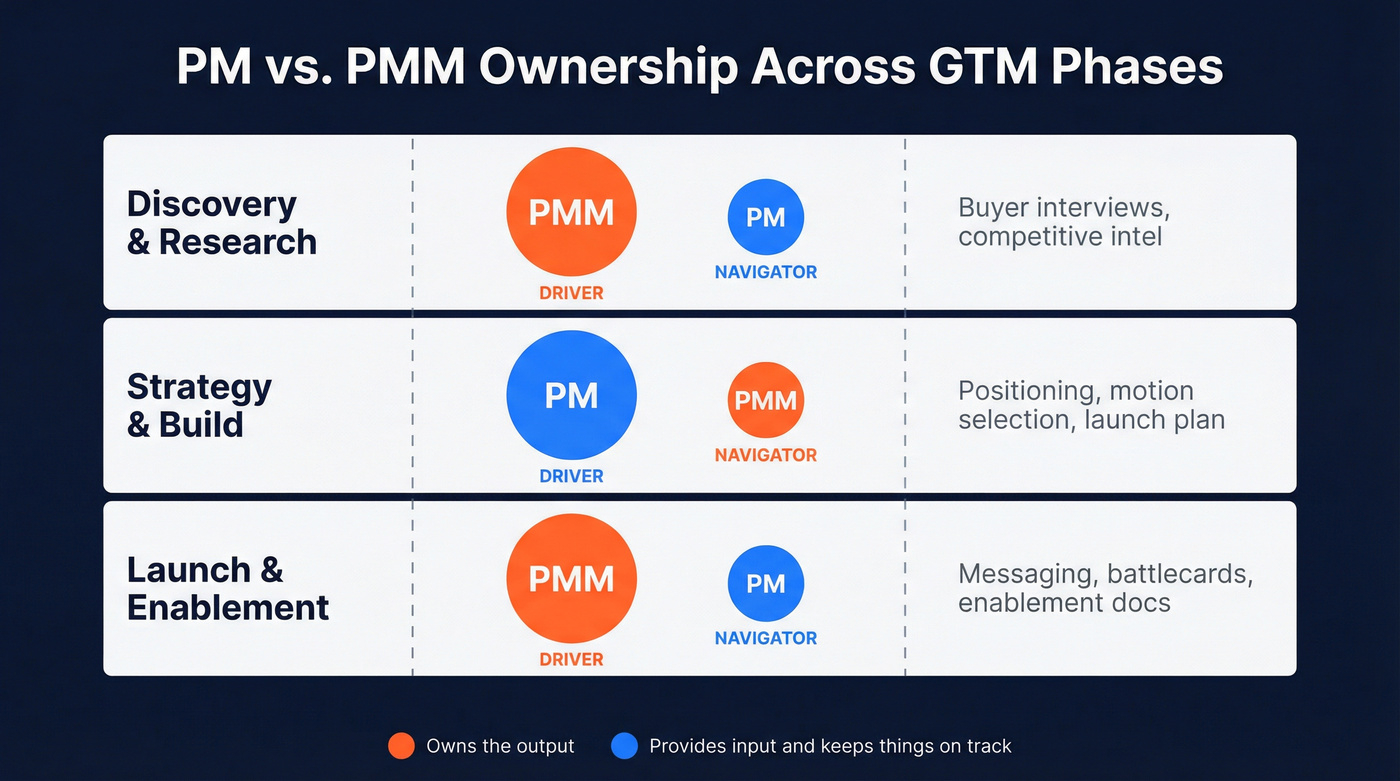
| Phase | Driver | Navigator |
|---|---|---|
| Discovery & research | PMM | PM |
| Strategy & build | PM | PMM |
| Launch & enablement | PMM | PM |
The driver owns the output. The navigator provides input and keeps things on track. PMM deliverables include messaging frameworks, battlecards, and objection-handling docs - if you're the PM doing this work yourself, prioritize the battlecard first. It's the single asset that most directly unblocks sales.
If you're at a startup without a PMM, you ARE the PMM. You're driving every phase. That's not a failure of org design; it's the reality of lean teams, and it means you need a tighter framework to avoid spreading yourself across too many launches at once.

You just defined your ICP and named 200 accounts. Now you need verified contact data to reach every buyer on that list. Prospeo's 300M+ profiles with 30+ filters - intent data, technographics, headcount growth, funding - let you build a launch list that matches your ICP card exactly. 98% email accuracy means your outbound won't torch your domain on day one.
Stop building ICPs you can't actually reach. Start with real contacts.
The 7-Step GTM Framework for PMs
Step 1 - Research the Market
49% of GTM teams can't collect consumer research fast enough, so they skip it and launch on unverified assumptions. Don't be that team.
This doesn't require a six-month research project. It requires talking to real buyers and mapping who else is solving this problem. In 2026, AI tools can accelerate competitive analysis - use them for clustering ICP signals from CRM data, monitoring competitor positioning changes, and generating message variations for testing. But AI won't replace the 15 buyer conversations you need in Step 2. A couple weeks of focused research saves months of building the wrong thing.
Step 2 - Define and Validate Your ICP
Run 15 interviews: five with existing customers, five with competitor customers, five with target-market prospects. In our experience, 15 is the minimum. Fewer than that and you're guessing. If eight or more describe the same pain in their own words, you've got signal. Fewer than eight? Your ICP isn't validated yet - widen your interview pool or revisit your segmentation.
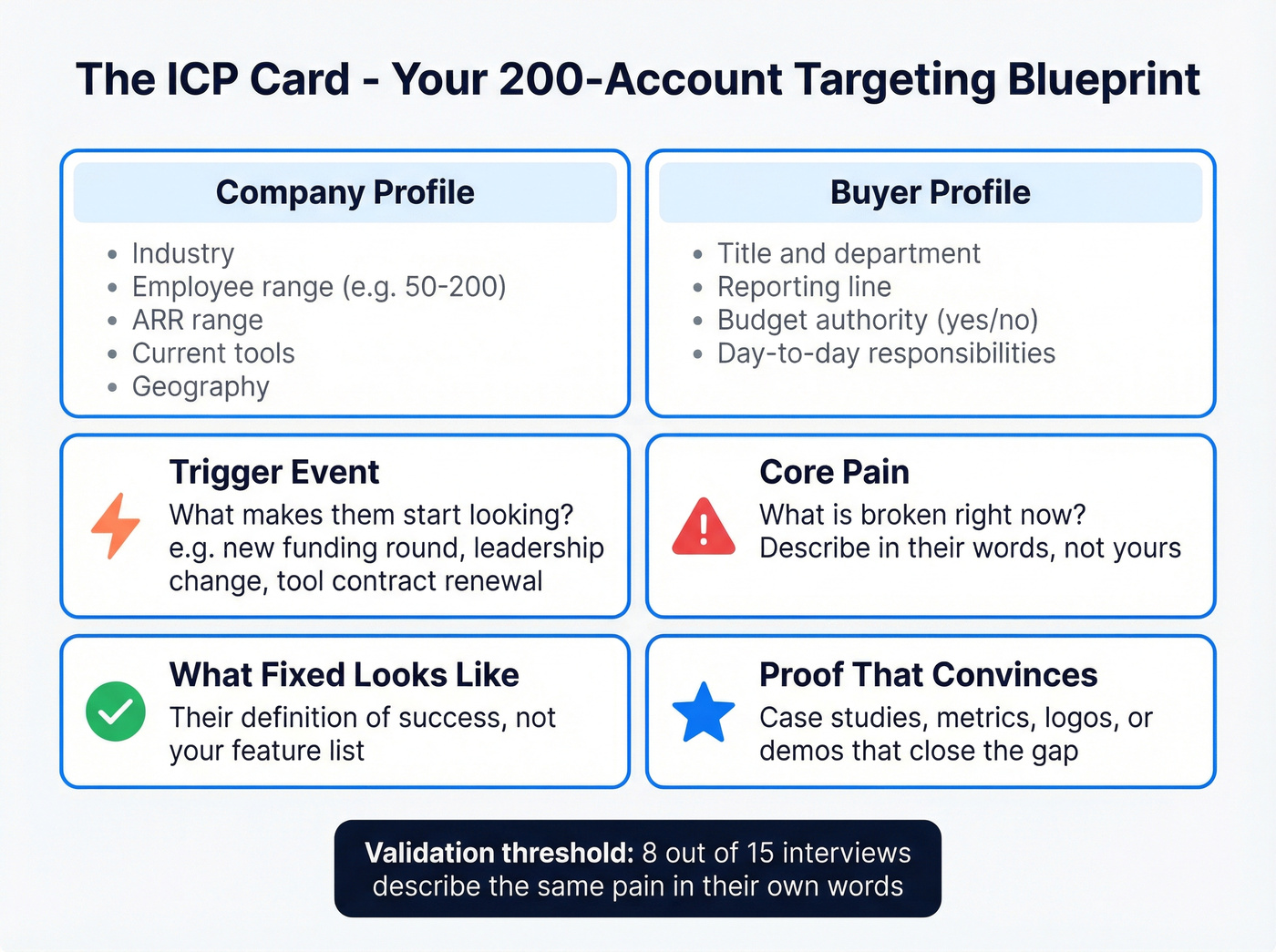
Build an ICP Card for each segment with these fields: company profile (industry, employee range, ARR range, current tools, geography), buyer profile (title, department, reporting line, budget authority), trigger event that makes them start looking, the pain that's broken right now, what "fixed" looks like, and the proof that would convince them you can deliver.
Here's the thing: most teams confuse ICP with TAM. GrowthX worked with a company that initially defined their ICP as "high schools" - they'd confused the two entirely. After working backward from their actual value driver, they narrowed to roughly 200 target accounts. An ICP isn't a persona doc. It's 200 accounts you can name.
Step 3 - Nail Your Positioning
Use this canvas and fill in every blank. If you can't, your positioning isn't ready:
For [TARGET CUSTOMER] who [PROBLEM], [PRODUCT] is a [CATEGORY] that [PRIMARY BENEFIT]. Unlike [ALTERNATIVE], we [UNIQUE MECHANISM/PROOF].
One sentence. If it takes a paragraph to explain why you're different, you haven't done the work in Steps 1 and 2. This positioning canvas is the single artifact that sales, marketing, and product should all be able to recite from memory - it doubles as your value proposition under pressure. Every PM's GTM plan lives or dies on the clarity of this statement.
If you want a deeper positioning lens, start with B2B brand positioning to pressure-test category, differentiation, and proof.
Step 4 - Choose Your GTM Motion
Most teams default to PLG because it sounds modern, then wonder why conversion stalls at 2%. PLG isn't a strategy - it's a motion. The right motion depends almost entirely on your deal size.
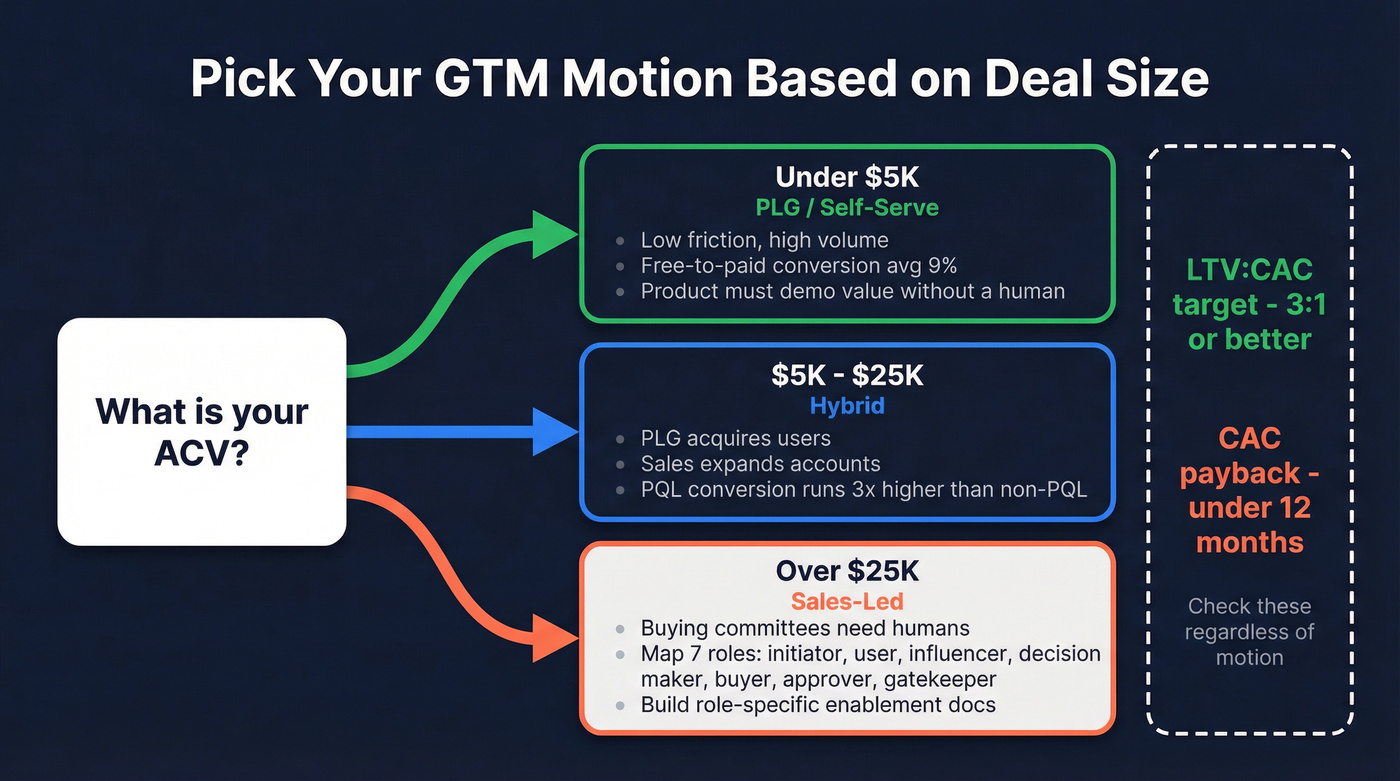
| ACV Band | Motion | Why |
|---|---|---|
| Under $5K | PLG / self-serve | Low friction, high volume |
| $5K-$25K | Hybrid | PLG acquires, sales expands |
| Over $25K | Sales-led | Buying committees need humans |
58% of B2B SaaS companies now run a PLG motion, with roughly 9% average free-to-paid conversion and PQL conversion running about 3x higher than non-PQL leads. But PLG only works when the product can demonstrate value without a demo. If your buyer needs a live walkthrough to understand the product, you're sales-led whether you like it or not.
For sales-led motions above $25K, map the buying committee: initiator, user, influencer, decision maker, buyer, approver, and gatekeeper. Your enablement materials need to address each role's concerns differently. Missing even one blocker in the committee kills deals - we've watched it happen on launches where the team nailed positioning but forgot to build a one-pager for the CFO.
If you’re tightening qualification for sales-led deals, borrow a few patterns from MEDDIC sales qualification to keep discovery consistent across reps.
Regardless of motion, check two numbers: LTV:CAC should be at or above 3:1, and CAC payback should stay under 12 months. The average B2B SaaS company now spends $2 in sales and marketing for every $1 of new ARR - up 14% since 2024. If your ratio looks similar, your motion has a leak.
If you need a clean definition and calculation walkthrough, see cost to acquire customer.
Step 5 - Build Your Launch Plan
Not every feature deserves a full GTM effort. Tier your launches - major releases get the full playbook, minor updates get a changelog and an email. Marketing needs 3-6 months of lead time for a major launch. Your technical release date isn't your GTM launch date.
For each major launch, build a one-page plan covering: target audience from your ICP Card, key message from your positioning canvas, two or three success metrics with specific targets, required assets like enablement docs and landing pages, a timeline working backward from launch date, and stakeholder owners for each deliverable.
For a more structured starting point, the GTM Strategy Blueprint on Miro offers 14 guided boards covering everything from ICP to sprint execution.
Step 6 - Build Your Prospect List
Every GTM guide tells you to define your ICP, nail your positioning, and choose a motion - then skips the part where you actually find and contact those people. Strategy without a list is just a document.
Once you've got your ICP Card from Step 2, translate those criteria directly into search filters on a B2B data platform - industry, headcount, job title, geography, tech stack, and funding stage. Prospeo covers 300M+ professional profiles with 30+ filters, including intent data tracking 15,000 topics via Bombora to surface accounts actively researching your category. Job-change and headcount-growth signals catch companies in buying windows. The output is a verified contact list with 98% email accuracy and direct mobile numbers - the operational bridge from "I know who my buyer is" to "I have 200 verified contacts in my sequencer."
If you want to systematize list creation, use this lead generation workflow as the handoff between ICP and outbound execution.

Step 7 - Measure and Iterate
Track three formulas from day one:
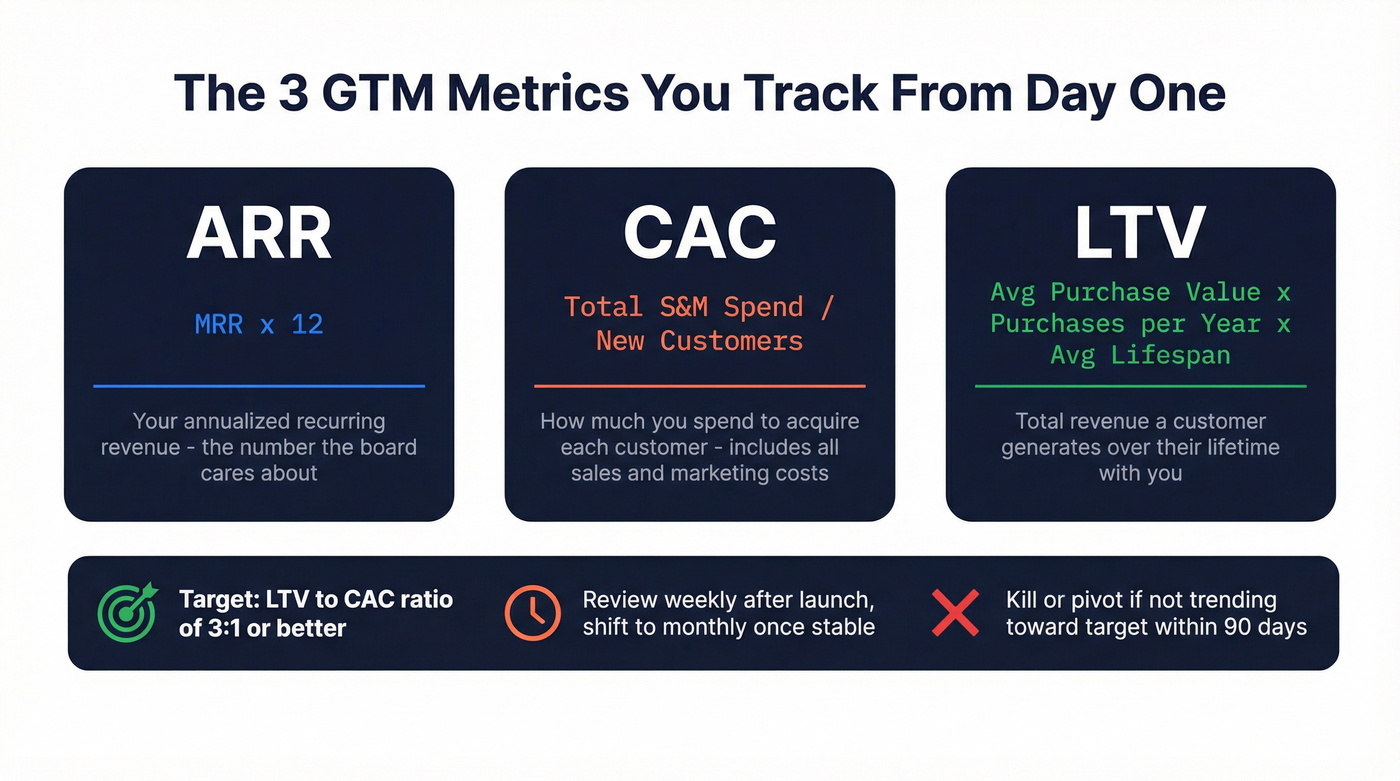
- ARR = MRR x 12
- CAC = total sales & marketing spend / new customers acquired
- LTV = average purchase value x purchases per year x average customer lifespan
Your target: LTV:CAC of 3:1 or better. Below that, either your acquisition costs are too high or your product isn't retaining well enough to justify the spend. Review weekly right after launch, then shift to monthly once things stabilize. Kill or pivot anything that isn't trending toward these thresholds within 90 days.
To diagnose retention drag, run a simple churn analysis alongside your GTM metrics.
Common GTM Failures for PMs
95% of new products fail, according to a widely cited Harvard Business School estimate. We've seen the same patterns kill launches over and over:
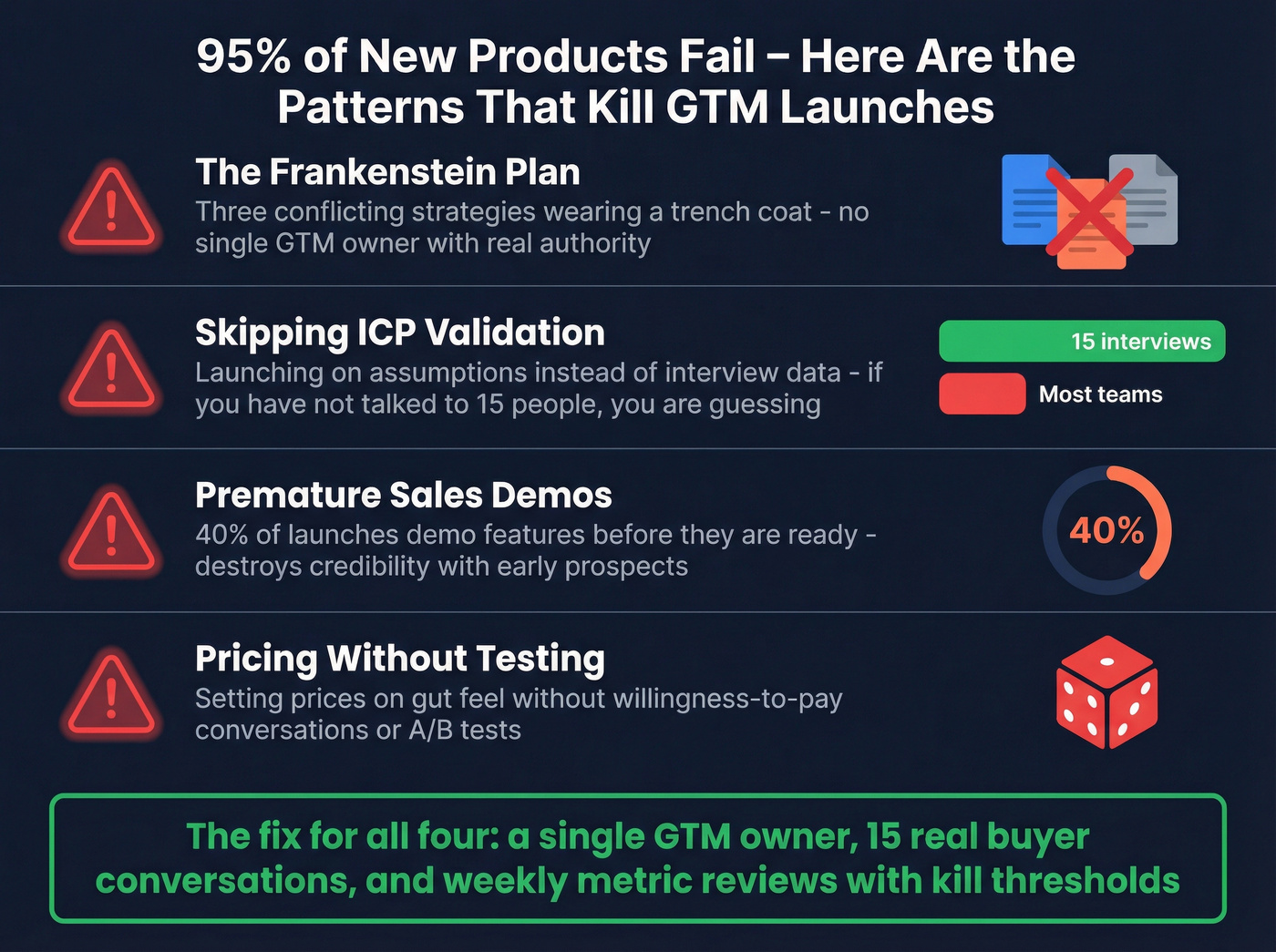
The Frankenstein plan. Leadership overrides upstream research, marketing bypasses process, and the GTM output is three conflicting strategies wearing a trench coat. This happens when there's no single GTM owner with real authority.
Skipping ICP validation. Launching with assumptions instead of interview data. If you haven't talked to 15 people, you're guessing. Full stop.
Sales demoing features before they're ready. This affects 40% of product launches and destroys credibility with early prospects. Align your buyer journey with your actual release timeline.
If your team needs a concrete enablement asset to prevent premature demos, ship sales battle cards before you ship more slides.
Pricing without testing. Setting prices based on gut feel without running willingness-to-pay conversations or A/B tests. Skip this if you want to spend six months arguing about whether you're too expensive or too cheap - or just run the tests.
Building in a silo. GTM created in one department produces mixed messages, wasted budget, and confused customers. Cross-functional alignment isn't optional - it's the whole point. A strong go-to-market plan requires input from every revenue-facing team.
Your GTM Checklist
- Run 15 ICP validation interviews (8+ matching = green light)
- Complete ICP Card with trigger, pain, dream, and proof fields
- Write one-sentence positioning canvas
- Choose motion based on ACV band (PLG / hybrid / sales-led)
- Map buying committee roles for sales-led motions
- Build one-page launch plan with timeline, owners, and metrics
- Build prospect list with verified contact data and intent signals
- Set LTV:CAC and CAC payback targets; review weekly for 90 days
Let's be honest about the tool stack: you don't need 12 subscriptions. Notion for the plan, Loom for enablement videos, Prospeo for the prospect list, and 15 customer interviews. That's genuinely all you need to launch.
If you’re building the outbound layer, start with these sales prospecting techniques to turn your list into meetings.
Sales-led motion above $25K ACV? You need direct dials to every member of the buying committee - initiator, decision maker, CFO. Prospeo delivers 125M+ verified mobile numbers with a 30% pickup rate, plus 50+ data points per contact so your reps know exactly who they're calling and why.
Map the full buying committee with verified emails and direct dials.
FAQ
What's the difference between a GTM strategy and a launch plan?
A GTM strategy is the full system - ICP, positioning, motion, channels, and metrics. A launch plan is one artifact within that system, focused on timing, required assets, and stakeholder coordination for a specific release. You need the strategy first; the launch plan executes a piece of it.
Can a PM own GTM without a PMM?
Yes - in lean teams, PMs routinely own discovery, messaging, enablement, and launch. The key is tiering your launches so not every feature gets a full GTM effort. Major releases get the full playbook; minor updates get a changelog. Without tiering, you'll burn out by month two.
How do I choose between PLG and sales-led?
Use ACV as your guide. Under $5K, go PLG. Between $5K and $25K, run a hybrid where PLG acquires and sales expands. Over $25K, go sales-led - buying committees need human conversations. Regardless of motion, check that LTV:CAC stays at or above 3:1.
What tools help PMs build a prospect list from their ICP?
Prospeo is the fastest path from ICP Card to verified contacts - 300M+ profiles, 30+ search filters including intent and technographics, and 98% email accuracy at roughly $0.01 per lead. Pair it with a sequencer like Instantly or Smartlead and a CRM like HubSpot to close the loop from strategy to pipeline.
How long should a GTM strategy take to develop?
For a major product launch, plan on 4-8 weeks from first ICP interview to launch-ready. Two weeks for research and validation, one week for positioning and motion decisions, and the rest for building assets and aligning stakeholders. Compressing below three weeks usually means you're skipping validation - and that's how Frankenstein plans happen.