

Sales Territory Plan Examples You Can Actually Copy
It's January 2nd. You just got assigned a new territory with 200 accounts, a $900K quota, and zero context. Your manager wants a territory plan by Friday. So you search for "sales territory plan examples" and get 15 articles explaining what a territory plan is - without a single filled-in example you can actually use.
That ends here.
58% of B2B sales orgs say their territory plans are ineffective, and the ones that get it right see 10-20% higher sales productivity and 20% more revenue growth opportunities. The consensus on r/sales is even harsher: reps describe territory planning as management optics - a checkbox exercise that exists for QBR slides, not for selling. The fix isn't a better framework. It's a plan with real numbers you can adapt in 30 minutes.
What You Need (Quick Version)
Jump to the example that fits your situation:
- IC building your own plan - SaaS Mid-Market Example
- Field sales / medical device - Healthcare Field Sales Example
- Manager designing enterprise territories - Strategic Account Example
- Prepping for an interview - Interview Territory Plan Example
Core Components of a Territory Plan
Every territory plan worth building covers seven components. Skip one and you've got a gap your manager will find - or worse, a gap that quietly kills your quarter.
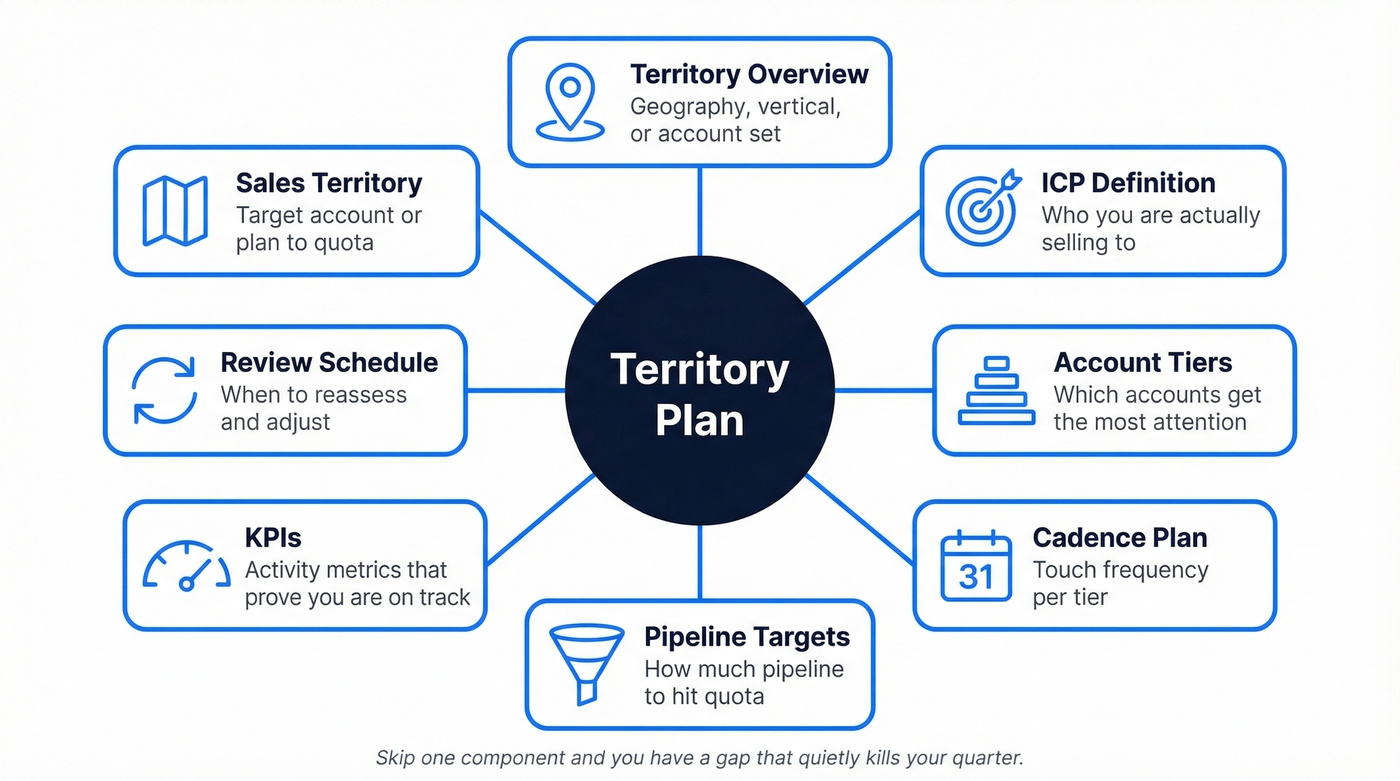
| Component | What It Answers |
|---|---|
| Territory overview | What's my geography, vertical, or account set? |
| ICP definition | Who am I actually selling to? |
| Account tiers | Which accounts get the most attention? |
| Cadence plan | How often do I touch each tier? |
| Pipeline targets | How much pipeline do I need to hit quota? |
| KPIs | What activity metrics prove I'm on track? |
| Review schedule | When do I reassess and adjust? |
How your org segments territories determines the plan's structure:
| Territory Type | Best For | Key Segmentation |
|---|---|---|
| Geographic | Field sales, regional teams | Zip codes, states, regions |
| Industry/Vertical | Specialized sellers | Healthcare, fintech, SLED |
| Account-based | Enterprise, strategic | Named accounts, tiers |
| Hybrid | Mid-market, scaling orgs | Geography + vertical + size |
Hybrid is the most common model for mid-market and enterprise orgs. Pure geographic plans are increasingly rare outside field sales - most teams layer in at least one additional dimension like company size or tech stack.
Filled-In Sales Territory Plan Examples
These aren't frameworks. They're filled-in plans with real numbers you can copy into a spreadsheet and adapt today.
SaaS Mid-Market Territory Plan
This is the plan a mid-market AE at a $30-80K ACV SaaS company would build, assuming a defined geographic or vertical territory with a mix of net-new and expansion targets. It's the most common territory plan format we see across B2B orgs.
| Field | Value |
|---|---|
| Territory | US West - SaaS/Tech vertical |
| Annual quota | $750,000 |
| Total accounts | 45 |
| Tier 1 (biweekly touch) | 8 accounts |
| Tier 2 (monthly touch) | 17 accounts |
| Tier 3 (quarterly touch) | 20 accounts |
| Pipeline target | $2,500,000 (3.3x quota) |
| Avg deal size | $38,000 |
| Close rate target | 22% |
| Net-new accounts/quarter | 5 |
| Expansion target | $150,000 |
| Review cadence | Weekly activity, monthly pipeline, quarterly tiers |
The 3.3x pipeline coverage is conservative but realistic for a 22% close rate. If your win rate is lower, push toward 4-5x. Your Tier 1 accounts should represent 60%+ of your pipeline potential. If they don't, re-tier.
Healthcare Field Sales Territory Plan
Healthcare territory planning runs on different data than SaaS. You're not segmenting by ARR bands and tech stacks - you're segmenting by facility type, procedure volume, and technology installations. Claims data like procedure codes and billing volumes, plus technology installation data such as EHR platforms and imaging systems, drive your account prioritization.
What makes healthcare different: the buying committee is clinical, the sales cycle is longer, and affiliation data matters most. One champion at a flagship hospital can open doors across the entire system.
| Field | Value |
|---|---|
| Territory | Southeast - 3 hospital systems |
| Quarterly quota | $425,000 |
| Total accounts | 60 facilities |
| Tier 1 (weekly visit) | 10 flagship hospitals |
| Tier 2 (biweekly visit) | 20 specialty clinics |
| Tier 3 (monthly check-in) | 30 outpatient/ambulatory |
| Pipeline target | $1,700,000 (4x quota) |
| Key data inputs | Procedure volume, EHR platform, affiliation network |
| KPIs | Visits/week, clinical evals started, formulary additions |
| Review cadence | Monthly territory, quarterly quota adjustment |
The higher pipeline coverage reflects the reality that hospital procurement committees can stall deals for months. Education and SLED territories follow similar logic - segmenting by district size, enrollment, and technology installations rather than procedure volume.
Enterprise / Strategic Account Plan
Enterprise territory planning is account-based by definition. You're not managing 45 accounts - you're managing 12-15, and every one needs a multi-threaded engagement strategy. The most important decision in your plan is the net-new vs. expansion split. If your product has strong land-and-expand motion, weight expansion heavier. If you're breaking into new logos, the math flips.
| Field | Value |
|---|---|
| Territory | Global - Named Strategic Accounts |
| Annual quota | $1,200,000 |
| Total accounts | 14 |
| Contacts per account | 3-5 (multi-threaded) |
| Pipeline target | $4,800,000 (4x quota) |
| Net-new target | $700,000 - 58% of quota |
| Expansion target | $500,000 - 42% of quota |
| Qualification framework | MEDDPICC |
| Avg deal size | $180,000 |
| Whitespace mapping | Quarterly per account |
| Review cadence | Biweekly pipeline, quarterly account strategy |
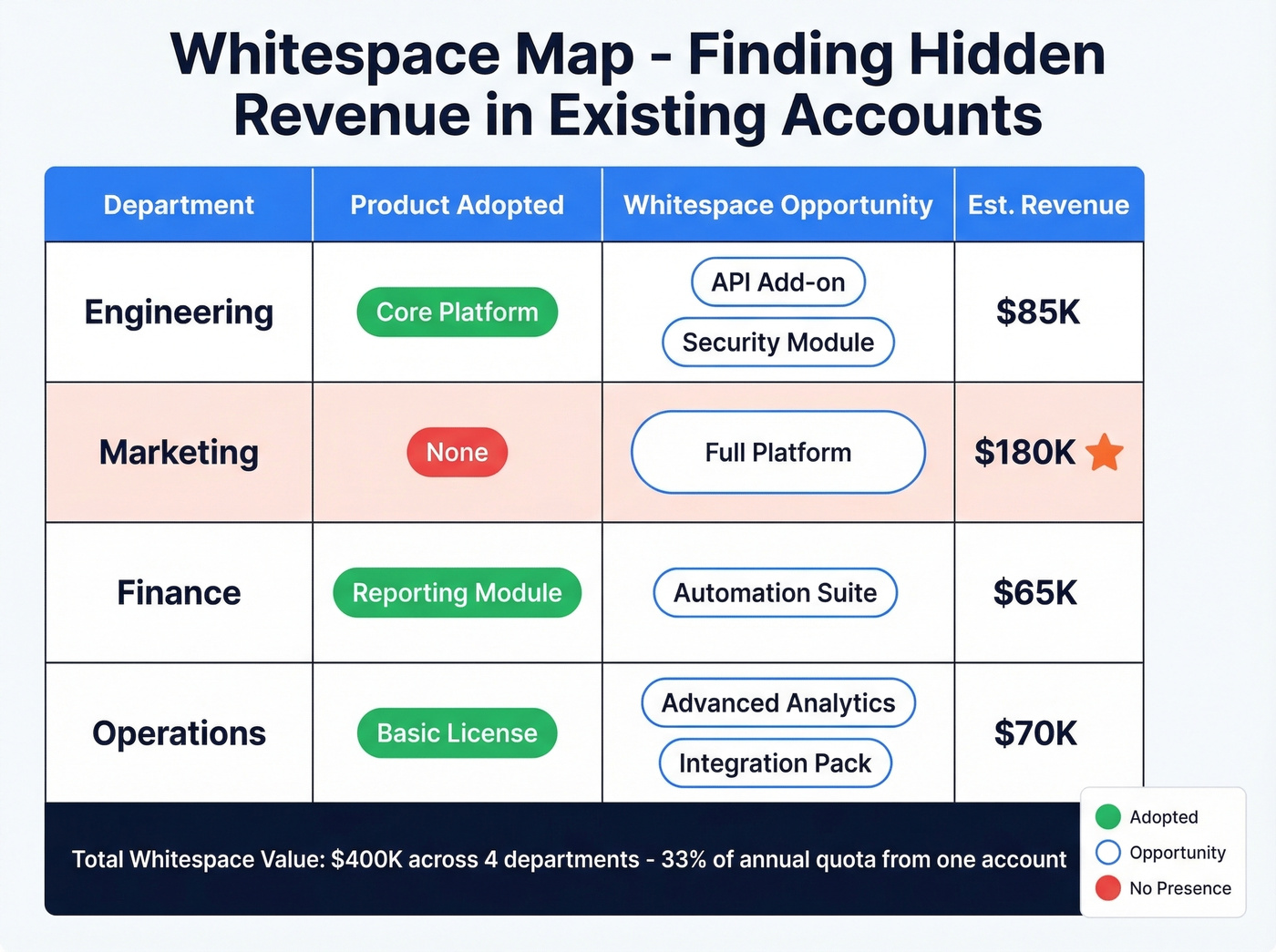
Whitespace mapping - identifying unused products, untouched departments, or unaddressed use cases within existing accounts - is where enterprise reps find the easiest revenue. Here's what a simple whitespace map looks like:
| Department | Product Adopted | Whitespace |
|---|---|---|
| Engineering | Core platform | API add-on, security module |
| Marketing | None | Full platform |
| Finance | Reporting module | Automation suite |
We've tested dozens of territory plan formats, and tables with a whitespace map consistently outperform slide decks for enterprise planning. A one-page plan beats a 20-slide deck every time.
Interview Territory Plan Example
On r/sales, candidates consistently report being asked to produce territory plans in final-round interviews - and struggling because they've never built one in-role. Here's the thing: hiring managers don't expect you to know the territory. They expect you to show how you'd learn it.
Picture this: the VP of Sales just emailed you. "Prepare a 90-day territory plan for the Northeast region. Present it in 15 minutes."
| Phase | Activities | Deliverables |
|---|---|---|
| Days 1-30 (Learn) | Research ICP, analyze CRM data, identify 25 target accounts, map competitive landscape | Account tier list, competitive matrix, initial outreach plan |
| Days 31-60 (Execute) | Launch outreach to Tier 1, book 15+ meetings, qualify 5+ opportunities | Active pipeline of $200K+, first proposals sent |
| Days 61-90 (Own) | Close first deals, refine ICP based on learnings, build referral engine | Pipeline at 3x monthly quota, forecast accuracy 80%+ |
Don't try to show you know the territory. Show you know how to learn a territory fast. Demonstrate your process: how you'd research accounts using public data, how you'd prioritize by revenue potential, and how you'd reverse-engineer your quota into daily activity. That's what gets you the offer.

A territory plan with 45 accounts means nothing if you can't reach the right people. Prospeo gives you verified emails and direct dials for every contact on your tier list - 98% email accuracy, 125M+ verified mobiles, and 30+ filters to segment by industry, tech stack, headcount growth, and buyer intent.
Stop planning territories. Start filling them with real pipeline.
The Quota-to-Activity Math
If your territory plan doesn't include this math, it's a wish list, not a plan. Let's reverse-engineer a $750K quota into a daily number:
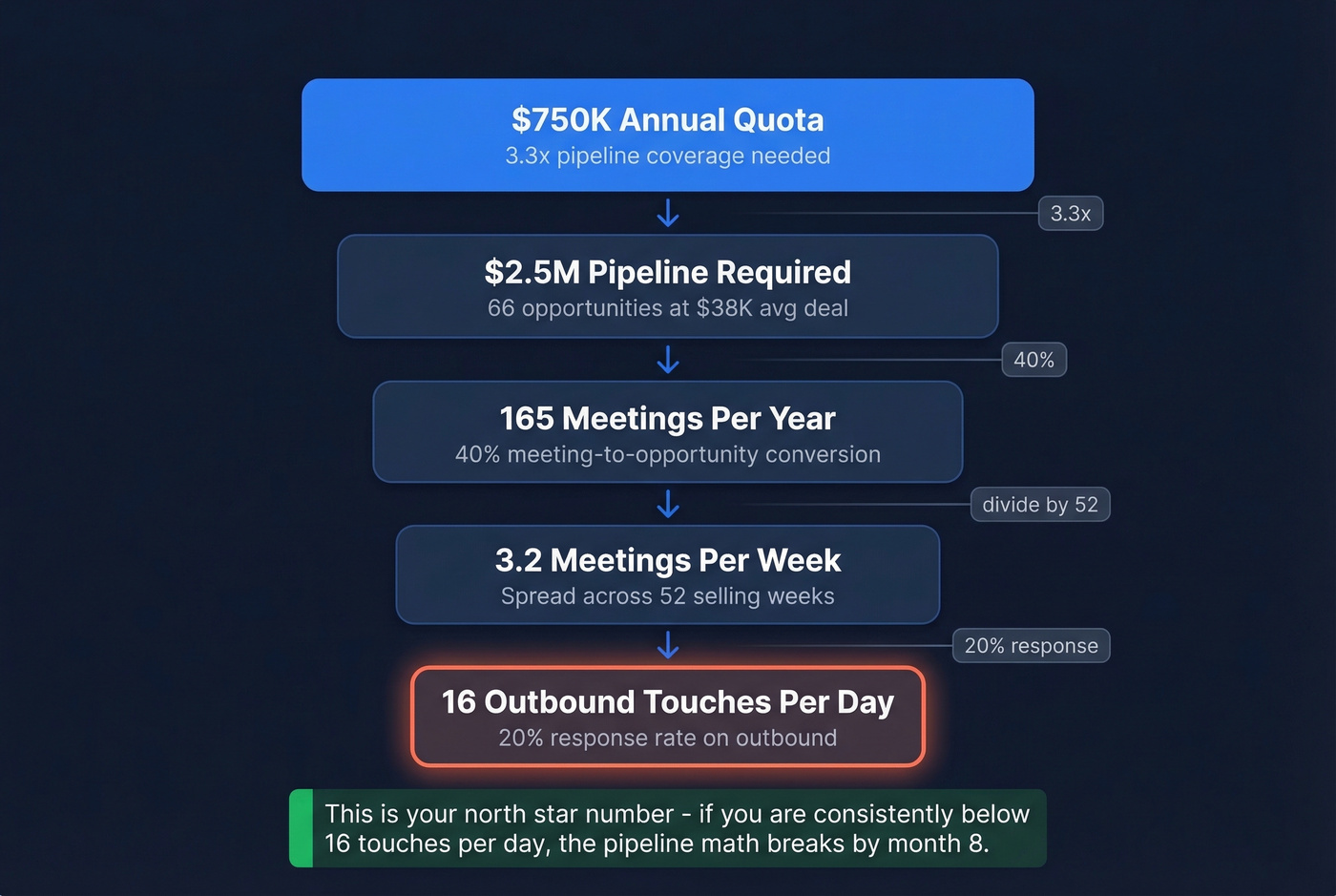
- $750K quota - need $2.5M pipeline at 3.3x coverage
- That's 66 opportunities at $38K average deal size
- At a 40% meeting-to-opportunity conversion - 165 meetings per year
- That's roughly 3.2 meetings per week
- Assuming a 20% response rate on outbound - ~16 outbound touches per day
That 16-touch number is your north star. Some weeks you'll hit it through inbound. Other weeks it's all outbound. But if you're consistently below that activity level, the pipeline math doesn't work - and you'll feel it in month 8 when there's nothing left to close.
The 3x-5x pipeline coverage benchmark isn't arbitrary. At a 20-25% win rate, 3x barely gets you to quota with zero slippage. At 5x, you've got room for deals that stall, champions who leave, and budgets that get frozen. Newer reps and complex sales cycles need the higher end.
30-60-90 Day Territory Ramp Plan
Whether you're new to a company or inheriting a territory from a departing rep, the first 90 days follow the same structure. 20.5% of new hires quit within three months, and the average sales rep takes 3.2 months to reach full productivity - so getting this right matters.
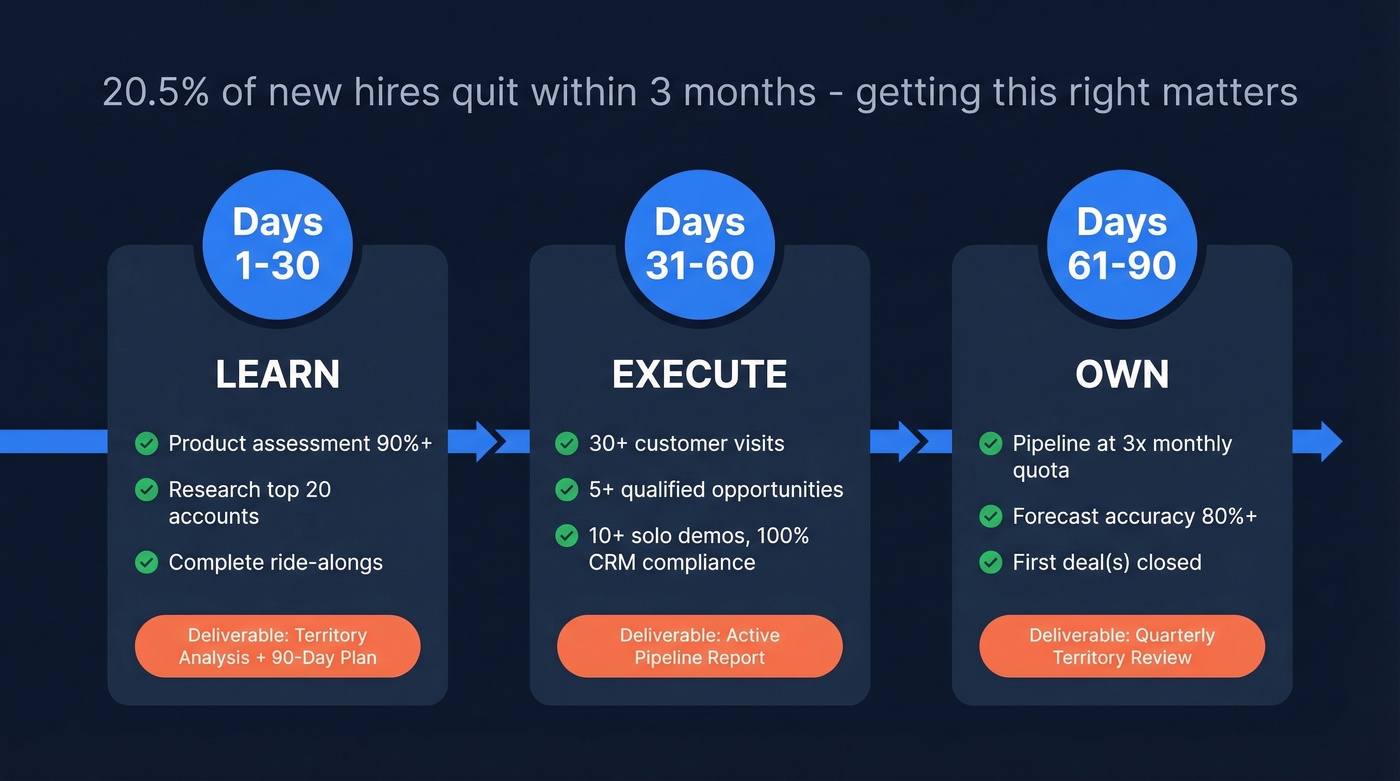
| Days 1-30: Learn | Days 31-60: Execute | Days 61-90: Own | |
|---|---|---|---|
| Focus | Product, process, territory | Outreach, meetings, pipeline | Closing, forecasting, scaling |
| Activity targets | Product assessment 90%+, top 20 accounts researched | 30+ customer visits, 5+ qualified opps | Pipeline at 3x monthly quota |
| KPIs | CRM configured, ride-alongs complete | 10+ solo demos, 100% CRM compliance | Forecast accuracy 80%+, first deal(s) closed |
| Deliverable | Territory analysis + 90-day plan | Active pipeline report | Quarterly territory review |
In our experience, the Day 30 deliverable is what separates reps who ramp fast from those who flounder. If you can present a clear territory analysis with tiered accounts and a realistic activity plan by week four, you've bought yourself credibility with your manager and a roadmap for yourself.
Why Territory Plans Fail
We've seen the same failure modes kill territory plans across dozens of organizations:
Static models. You build the plan in January and never touch it again. Markets shift, champions leave, and your Tier 1 list is stale by March. Effective territory realignment can lift revenue 2-7% without adding headcount - but only if you actually realign.
Workload imbalance. One rep has 80 accounts, another has 15. Both have the same quota. This is how you breed resentment and miss targets simultaneously.
No whitespace strategy. Your plan covers existing accounts but says nothing about where net-new revenue comes from.
Quota-territory misalignment. A $1.2M quota on a territory with $800K in total addressable pipeline isn't ambitious - it's fiction. Revenue planning fails in fragments when territories, quotas, and capacity aren't designed together.
Over-reliance on a single segmentation dimension. Field teams are especially guilty of this - segmenting by geography alone without layering in account size or business type. The result is territories that look balanced on a map but are wildly unequal in opportunity.
Building plans on stale contact data. You tier 45 accounts, build a cadence, and start executing - only to discover 30% of your contact records are outdated. This is the silent killer. Your territory coverage metrics look fine in the CRM, but half your outreach is bouncing or hitting people who left the company six months ago. Tools like Prospeo, which refreshes data on a 7-day cycle with 98% verified email accuracy, exist specifically to solve this problem.
Look, most territory plans fail not because the strategy is wrong, but because the rep never revisits the plan after week one. A mediocre plan you update monthly will outperform a brilliant plan you laminate and forget.
Tools for Territory Planning
You don't need expensive software to build a territory plan. A spreadsheet works for most ICs. But if you're designing territories for a team or optimizing field routes, the right tool saves real time.
| Tool | Use Case | Pricing |
|---|---|---|
| Prospeo | Prospect list building + verification | Free tier available; ~$0.01/email |
| Salesforce Maps | CRM-native territory design | ~$25-$150/user/month |
| eSpatial | Mid-market territory optimization | $1,295/user/yr |
| Maptitude | Desktop GIS analysis | $695 one-time |
| Badger Maps | Field sales route planning | ~$50-$100/user/month |
| HubSpot | CRM + territory tracking | Free CRM; paid plans from ~$20/user/month |
| Power BI | Territory analytics/dashboards | $10/user/month (Pro) |
| Smartsheet | Downloadable plan templates | Free templates available |
Skip Salesforce Maps if you aren't already on Salesforce - the value is in the native CRM integration, not the mapping itself. For teams under 20 reps, a spreadsheet plus a data tool is usually enough. The tool matters less than the discipline of actually using it.
Multi-threading 3-5 contacts per enterprise account? You need data that actually connects. Prospeo's 300M+ profiles refresh every 7 days - so the VP who changed roles last week already has updated info. At $0.01 per email, building contact maps for 14 strategic accounts costs less than lunch.
Map every buying committee before your next QBR.
FAQ
How do you write a territory plan for an interview?
Research the company's ICP, select 20-30 target accounts using public data, tier them by revenue potential, define a 90-day outreach cadence, and present quota-to-activity math. Hiring managers evaluate strategic thinking and prioritization - not memorized account lists. Use any example from this article as a starting framework and swap in the company's market.
What's a good pipeline coverage ratio?
The standard benchmark is 3x-5x your quota. A rep with a $750K annual quota should maintain $2.25M-$3.75M in active pipeline. Higher close rates (25%+) allow 3x coverage; newer reps or complex enterprise cycles need 4-5x to absorb deal slippage and budget freezes.
How often should you update a territory plan?
Review activity metrics weekly, pipeline health monthly, and account tiers quarterly. Trigger ad-hoc reviews when reps change, major deals close unexpectedly, or market conditions shift. Companies that realign territories quarterly see 2-7% revenue lifts without adding headcount.
What's the difference between a territory plan and a territory map?
A territory map is a geographic visualization showing which rep owns which region. A territory plan is the strategy document that includes account tiers, pipeline targets, cadence plans, and activity math. You need both, but the plan drives revenue. Most reps have a map and no plan - like having a GPS destination with no route.
How do I build accurate prospect lists for my territory?
Start with your CRM data, then enrich it. Stale records are the fastest way to tank your territory coverage metrics. Prospeo's 30+ search filters let you segment by buyer intent, technographics, headcount growth, and funding - returning 98% verified emails at roughly a penny per lead. The free tier gives you 75 emails per month, which is enough to validate your Tier 1 accounts before committing budget.