

Salesbot vs Sales Automation Systems: Which Do You Actually Need?
Reps spend roughly 25-30% of their time actually selling. The rest vanishes into data entry, follow-ups, and chasing bad contact info. That's the tension driving the salesbot vs sales automation systems debate - but the two solve different problems.
Salesbot.io is a specific tool. "Sales automation system" is a category. Let's untangle them so you don't buy the wrong thing.
30-Second Verdict
Pick Salesbot if you want AI-powered lead gen and drip campaigns from one screen and your team is 1-3 people.
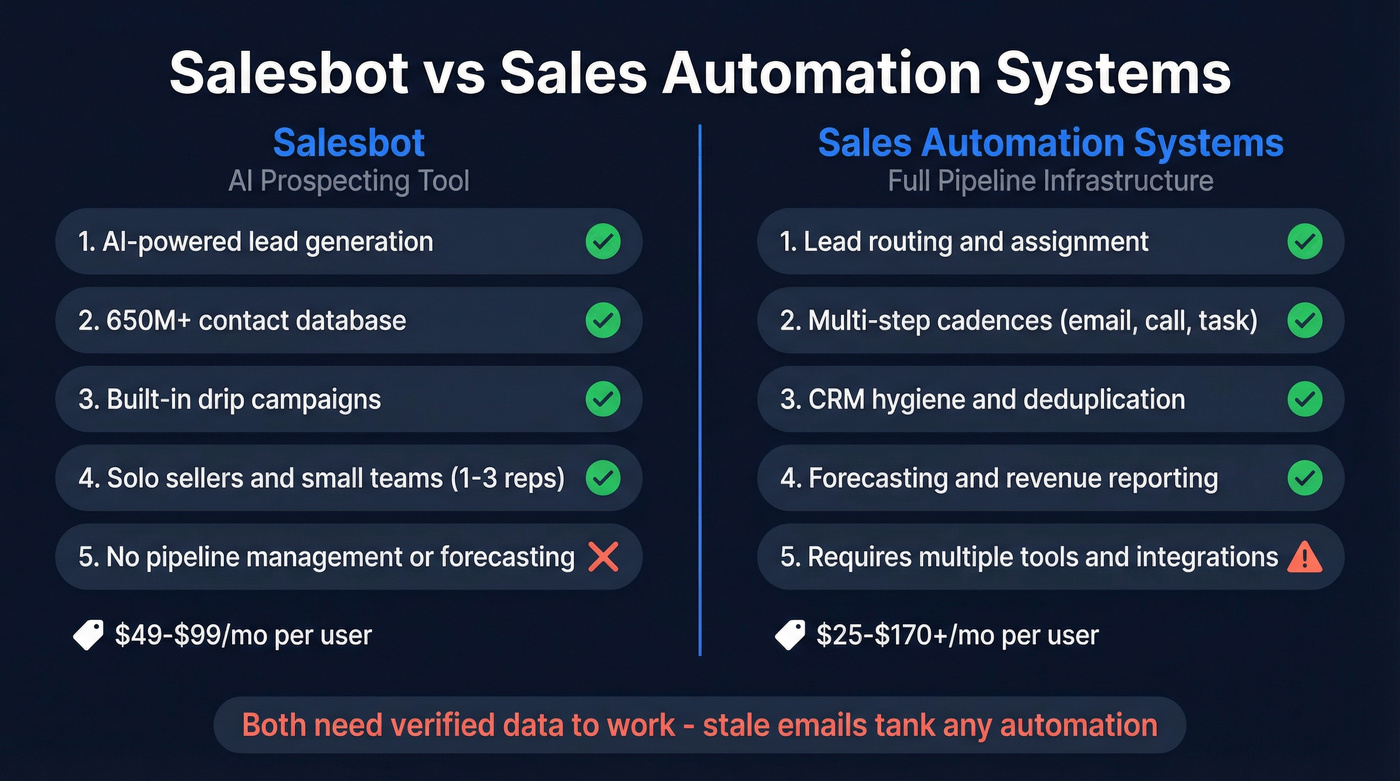
Pick a sales automation system if you already run a CRM and need workflow automation across routing, sequencing, and reporting.
Skip both if your real bottleneck is data quality. Stale emails tank any automation. Fix the data layer first, then pick your execution tool.
What Salesbot Actually Does
Salesbot launched in late 2024 as an AI prospecting and outreach platform. You describe your ICP in natural language, Salesbot generates a targeted list from its 650M+ contact database, and you launch drip campaigns without switching tools. One G2 reviewer put it well: "We're able to send 200 cold emails a day in 20 minutes." Another compared the UX to a sales navigator with built-in drip campaigns - a fair description.

Basic runs $49/mo for a single user with 12,000 verified email credits/year plus 900/year mobile phone credits. Professional is $99/mo/user and adds advanced filters, CSV matching/suppression, and automated outreach & follow-up. Enterprise is custom. A free 14-day trial is available.
Don't expect a full CRM system of record, though. Salesbot isn't built for managing deals end-to-end - no forecasting, no pipeline stages, no revenue reporting. One early G2 reviewer called the CRM integration "a hassle." With only 3 reviews and a 4.8/5 rating, the sample size is tiny and Reddit discussion is basically nonexistent so far. Promising, but young.
What Sales Automation Systems Cover
A sales automation system is infrastructure, not a single tool. It handles the repetitive work across your entire sales process: lead routing that assigns inbounds to the right rep, multi-step email/call/task cadences, CRM hygiene like deduplication and opportunity stage progression, meeting scheduling, and templated proposals triggered by deal stage.
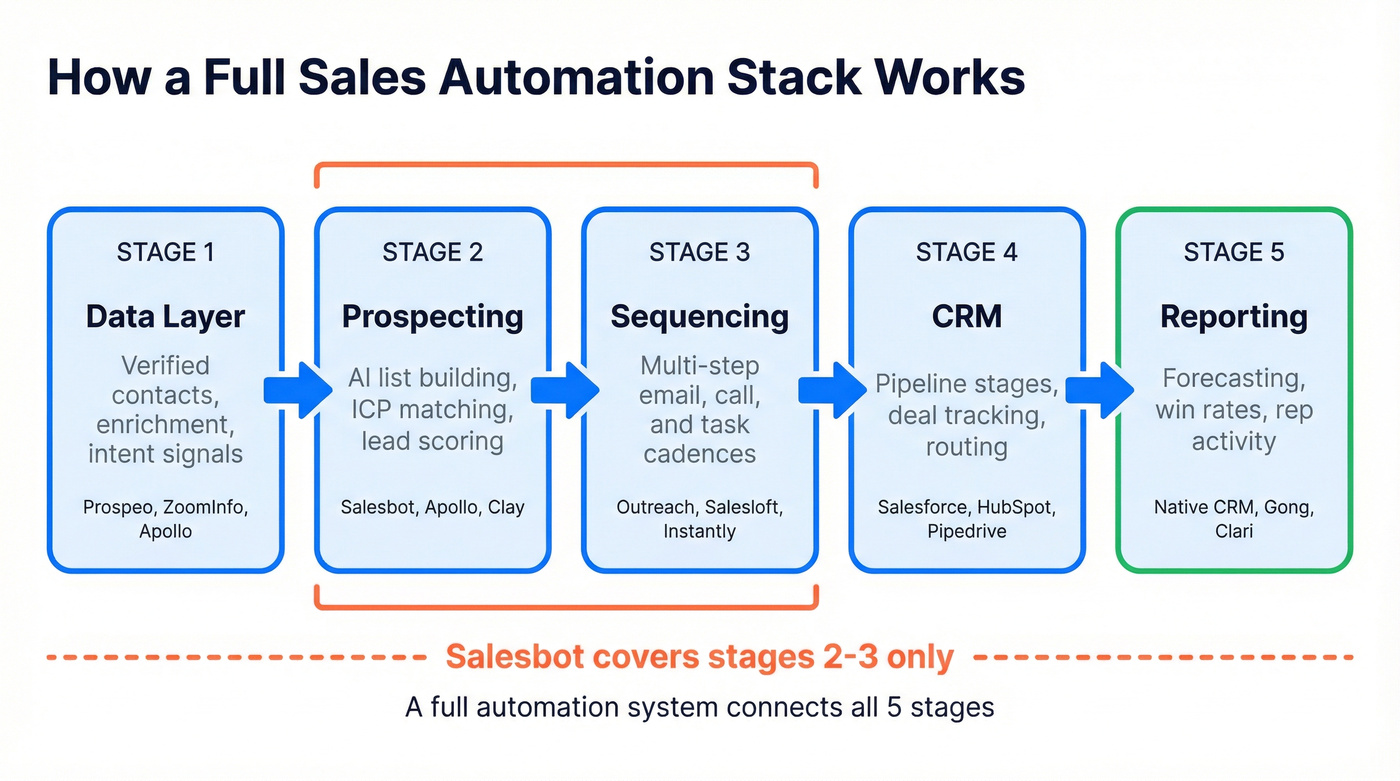
Here's the key distinction. A "salesbot" handles one slice of the workflow, usually prospecting or first-touch engagement. A full automation platform connects tools, teams, and data across the entire funnel. Salesforce draws a clear line between AI chatbots that qualify leads and AI agents that orchestrate multi-step workflows inside CRM guardrails. If you need orchestration, you need the system.

Whether you pick Salesbot or a full automation stack, stale contacts will tank your sequences. Prospeo's 300M+ profiles refresh every 7 days - not 6 weeks - so your reps hit real inboxes every time.
Stop debating tools when your data is the actual bottleneck.
Pricing Comparison
| Category | Tool | Starting Price |
|---|---|---|
| AI Prospecting | Salesbot | $49-$99/mo/user |
| CRM | HubSpot | $9/user/mo |
| CRM | Pipedrive | $14/user/mo |
| CRM | Salesforce | $25/user/mo |
| Sequencing | Outreach | ~$100-$170/user/mo |
| Sequencing | Salesloft | ~$125-$165/user/mo |
| Data + Prospecting | Apollo | $49-$119/user/mo |
| Data Platform | ZoomInfo | ~$15k-$40k/yr |
| AI SDR Agents | 11x, AiSDR | $900-$10k/mo |
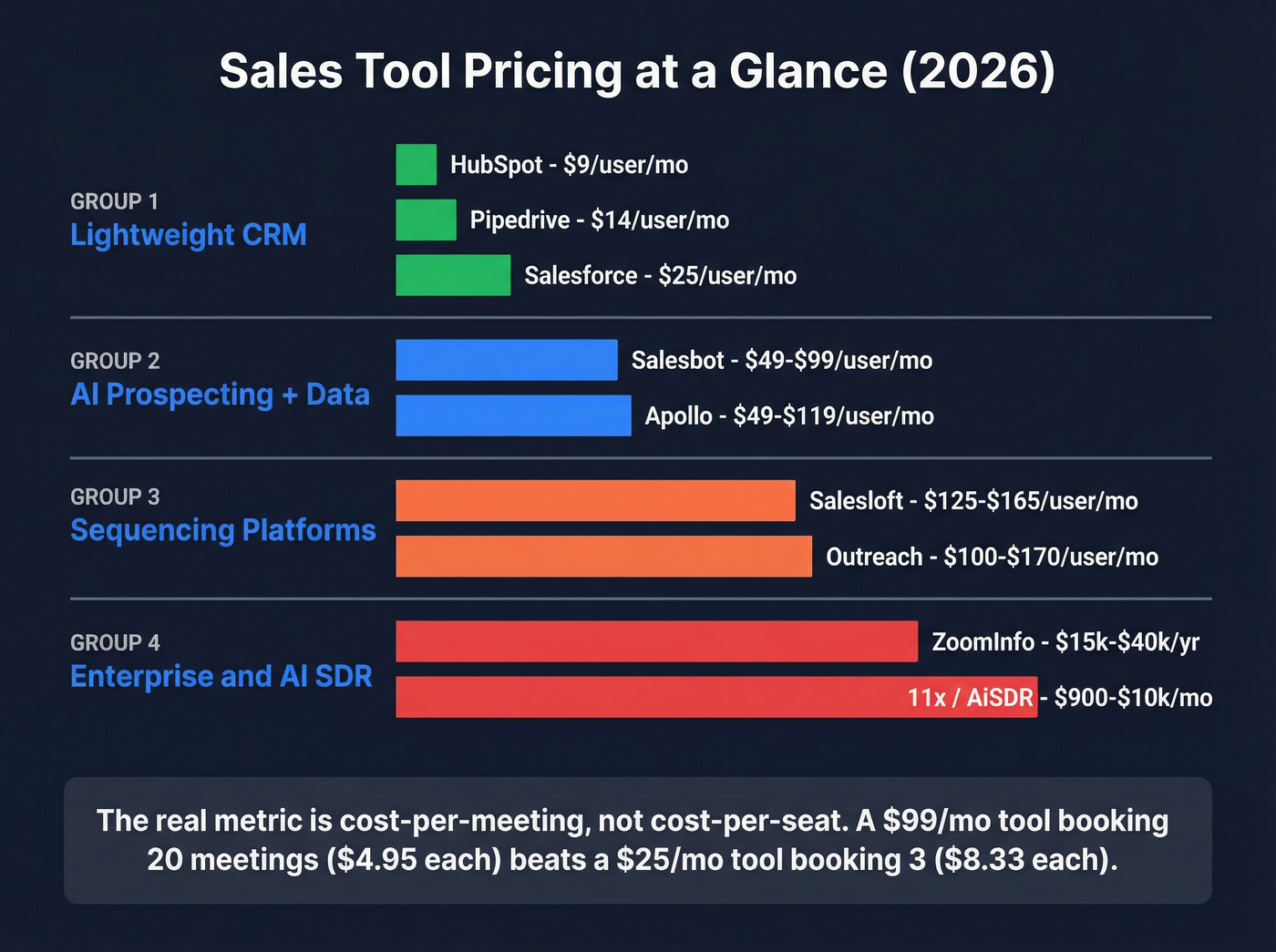
Seat-based pricing scales with headcount. Credit-based tools get expensive fast at higher export and mobile volumes. Annual contracts reduce flexibility - Apollo won't let you reduce seats mid-term.
The AI SDR agent tier is where pricing gets wild: 11x runs ~$5k-$10k/mo, which only makes sense if you're replacing headcount, not supplementing it. Most teams under 10 reps don't need a $15k+ data platform or a $5k/mo AI agent. A $99/mo tool that books 20 meetings ($4.95/meeting) beats a $25/mo tool that books 3 ($8.33/meeting). Measure cost-per-meeting, not cost-per-seat.
Which Approach Fits Your Team?

Founder-led or solo seller? Grab Salesbot or a lightweight CRM like Pipedrive. You need speed, not infrastructure. Get leads, send emails, book meetings.
SDR team of 3-10 reps? You need a CRM plus a dedicated sequencer - HubSpot or Salesforce for the system of record, Outreach or Salesloft for cadence execution. The stack costs more but gives managers visibility into pipeline and rep activity. In our experience, this is where most teams underinvest: they buy the sequencer but skip the data layer, then wonder why reply rates sit below 1%.
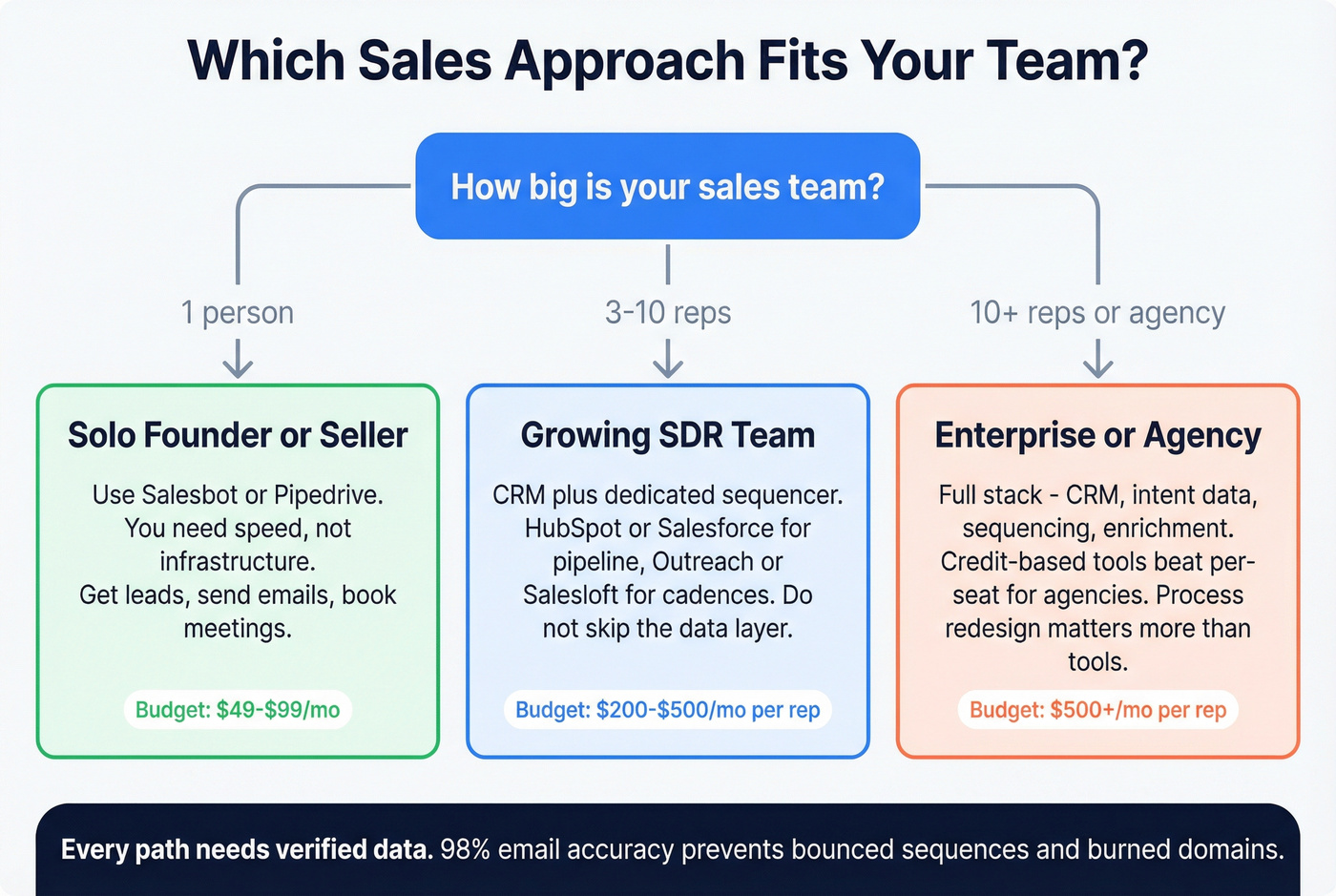
Agencies running multiple client campaigns should prioritize flexible credit-based tools over per-seat pricing. Enterprise RevOps teams are buying the full stack - CRM, intent data, sequencing, enrichment. Bain's research shows AI can drive 30%+ win-rate improvement, but only with process redesign, not just tool adoption.
The Missing Layer: Verified Data
Automation amplifies whatever data you feed it. Run a 10,000-contact sequence on stale emails and you'll torch your domain reputation fast. We've seen teams bounce 35% of their first campaign and spend months clawing back deliverability.
Look - this is where most "salesbot vs sales automation" comparisons fall short. They compare features and ignore the fuel. Prospeo's database covers 300M+ professional profiles with 98% email accuracy and 125M+ verified mobiles hitting a 30% pickup rate. The 7-day data refresh cycle is the real differentiator; the industry average is six weeks, meaning most databases are already decaying by the time you export a list. Self-serve pricing starts free at 75 emails/month, with credits at roughly $0.01 per email and no contracts. Whether you run Salesbot or a traditional CRM-plus-sequencer stack, verified data is what makes either path actually deliver.
Your cost-per-meeting depends on data quality, not which automation tool you buy. Prospeo delivers 98% email accuracy and 125M+ verified mobiles with a 30% pickup rate - at $0.01/email with no contracts.
Fuel any sales stack with contacts that actually connect.
Quick Evaluation Checklist
Before you commit to anything, run a fast bake-off. Send 200 emails and measure bounce rate - above 5% means your data source is the problem, not your copy. Call 50 mobiles and check pickup rate; below 10% means dead numbers. Time your first CRM sync. If it takes more than an afternoon, that friction compounds forever and your reps will route around the system within a week.
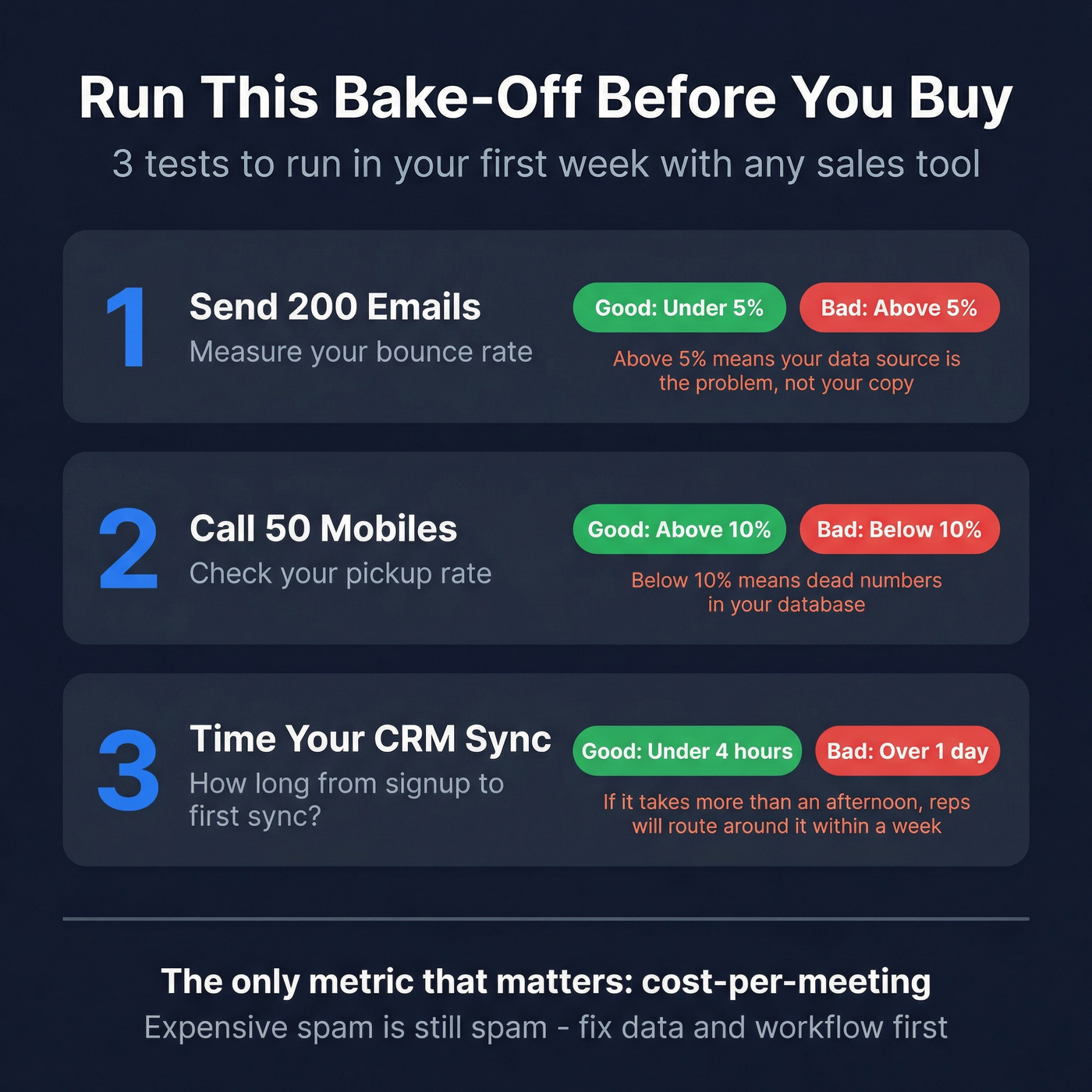
Whether you're comparing a salesbot against full sales automation systems or evaluating individual tools, the single most important metric is cost-per-meeting. A $5,000/mo AI SDR running on garbage contacts is just expensive spam. Fix your data and workflow first.
FAQ
Is Salesbot a CRM?
No. Salesbot finds contacts, builds lists, and sends drip campaigns. Your CRM - Salesforce, HubSpot, whatever you're running - remains the system of record for pipeline management, deal stages, and revenue reporting. Treat Salesbot as a prospecting layer, not a replacement for pipeline infrastructure.
Can I use Salesbot with a sales automation system?
Yes. Salesbot exports to HubSpot, Salesforce, Outreach, and Instantly. Treat it as the top-of-funnel prospecting layer and let your CRM handle routing and forecasting. Budget an afternoon for integration setup; early users report some friction there.
What if my bounce rate is high regardless of the tool?
The tool isn't the problem - the data is. A verification layer with 98% email accuracy and a 7-day refresh cycle keeps bounce rates under 5% before emails ever hit a sequencer. No amount of automation fixes stale contacts.