

B2B Lead Generation Solutions That Actually Work in 2026
You send 5,000 emails. 750 bounce. The rest land in a mix of primary inboxes and spam folders. Twelve meetings get booked. Your CEO asks why the pipeline is thin, and you're stuck explaining that the "verified" list you bought was 15% garbage.
That scenario plays out every week at companies spending real money on lead gen - and the fix isn't a better email template. It's choosing the right B2B lead generation solution and building a foundation that doesn't rot. 79% of marketing leads never convert. Not because the strategy is wrong, but because the data underneath it is bad, the handoffs are broken, and the tools don't talk to each other.
What You Need (Quick Version)
Most lead gen programs fail because of bad data, not bad strategy. Fix the foundation first: a verified data source, a sending platform, and a CRM. Three tools, not ten.
- Prospecting & sequences: Apollo - free tier, built-in sequencer
- CRM: HubSpot Starter - $15/user/mo, handles inbound capture and pipeline
Everything else - intent data, enrichment workflows, ABM platforms - is a layer you add once the foundation works.
What Is a B2B Lead Generation Solution?
It isn't a single tool. It's a stack: software that locates potential buyers, enriches their records, delivers outreach across channels, and manages the pipeline through to close.
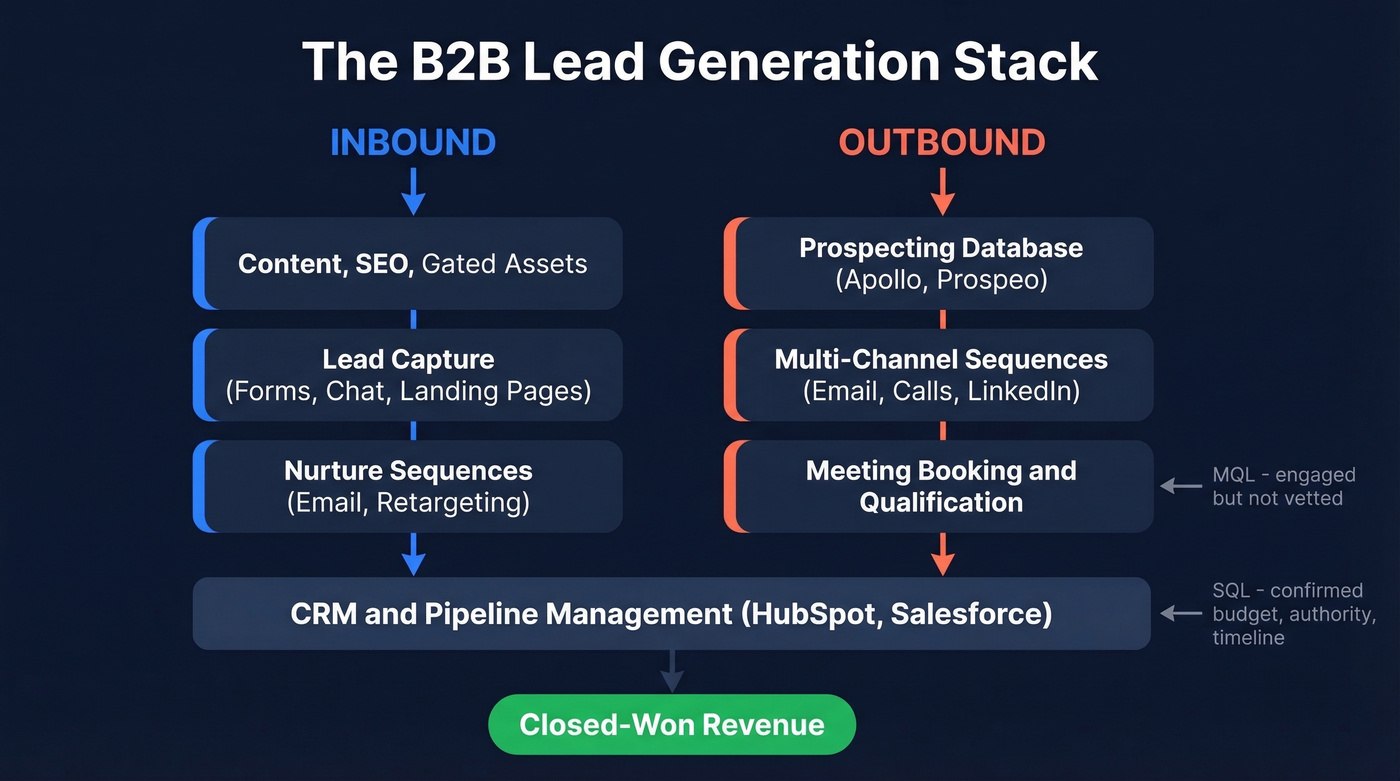
Inbound pulls prospects to you through content, SEO, and gated assets. Outbound pushes your message to prospects through cold email, calls, and direct outreach. Most teams need both, weighted differently depending on deal size and market maturity.
Two definitions worth getting right. An MQL is someone who's engaged with your content or hit a scoring threshold - they've raised their hand, but they haven't been vetted by sales. An SQL has been confirmed as a real opportunity with budget, authority, and timeline. The gap between those two stages is where most pipeline leaks. Lead generation software hit $7.4B in 2025 and is projected to reach $16.2B by 2034 at a 9.1% CAGR.
The Buying Cycle Has Changed
Your prospects aren't waiting for your cold email to start evaluating solutions. 92% of B2B buyers already have at least one vendor in mind, and 41% have a preferred vendor before they even start evaluating alternatives. The winning vendor appears on the buyer's Day One shortlist 95% of the time.
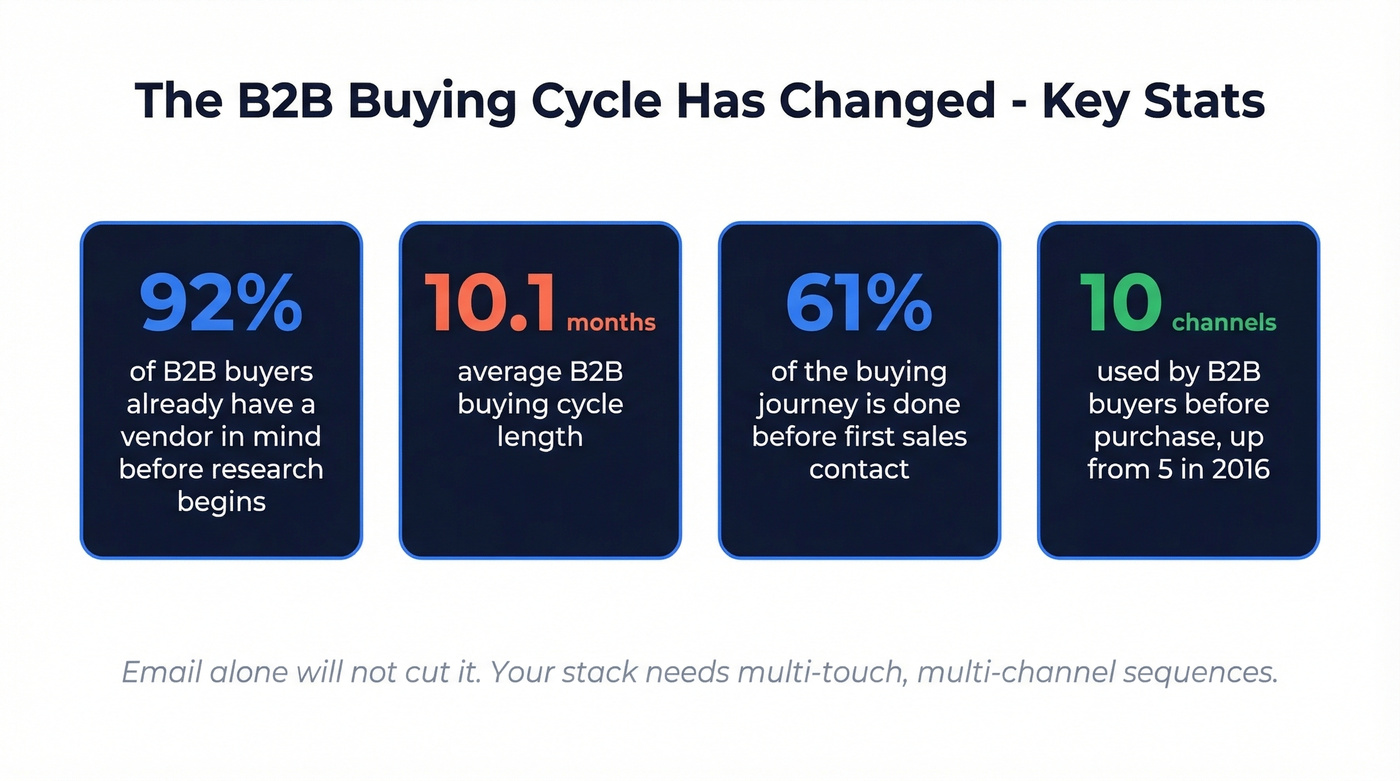
The average B2B buying cycle runs 10.1 months. First contact with a sales rep doesn't happen until 61% of the journey is complete.
Here's the thing: B2B buyers use roughly 10 channels before making a purchase - up from 5 in 2016. Email alone won't cut it. Neither will cold calling alone. Your stack needs to support multi-touch, multi-channel sequences that meet buyers where they already are.
Why Most Programs Fail
The failure usually isn't in lead capture - it's in everything that happens after. Five patterns kill programs consistently:
Misaligned handoffs. Marketing and sales don't share a definition of "qualified." No SLAs for follow-up speed. Leads sit in a queue while intent decays.
Low-quality placements. Cheap lead sources inflate volume but collapse downstream. You hit your MQL target and miss revenue by a mile.
Fragmented data. Your CRM says one thing, your MAP says another, and your intent tool doesn't sync with either. We've watched teams spend weeks reconciling contact records across three platforms that should've been sharing a single source of truth.
Slow activation. Manual routing adds hours or days to response time. Speed-to-lead is a revenue lever most teams ignore.
No scoring discipline. Most teams either over-qualify (killing volume) or under-qualify (flooding sales with junk).
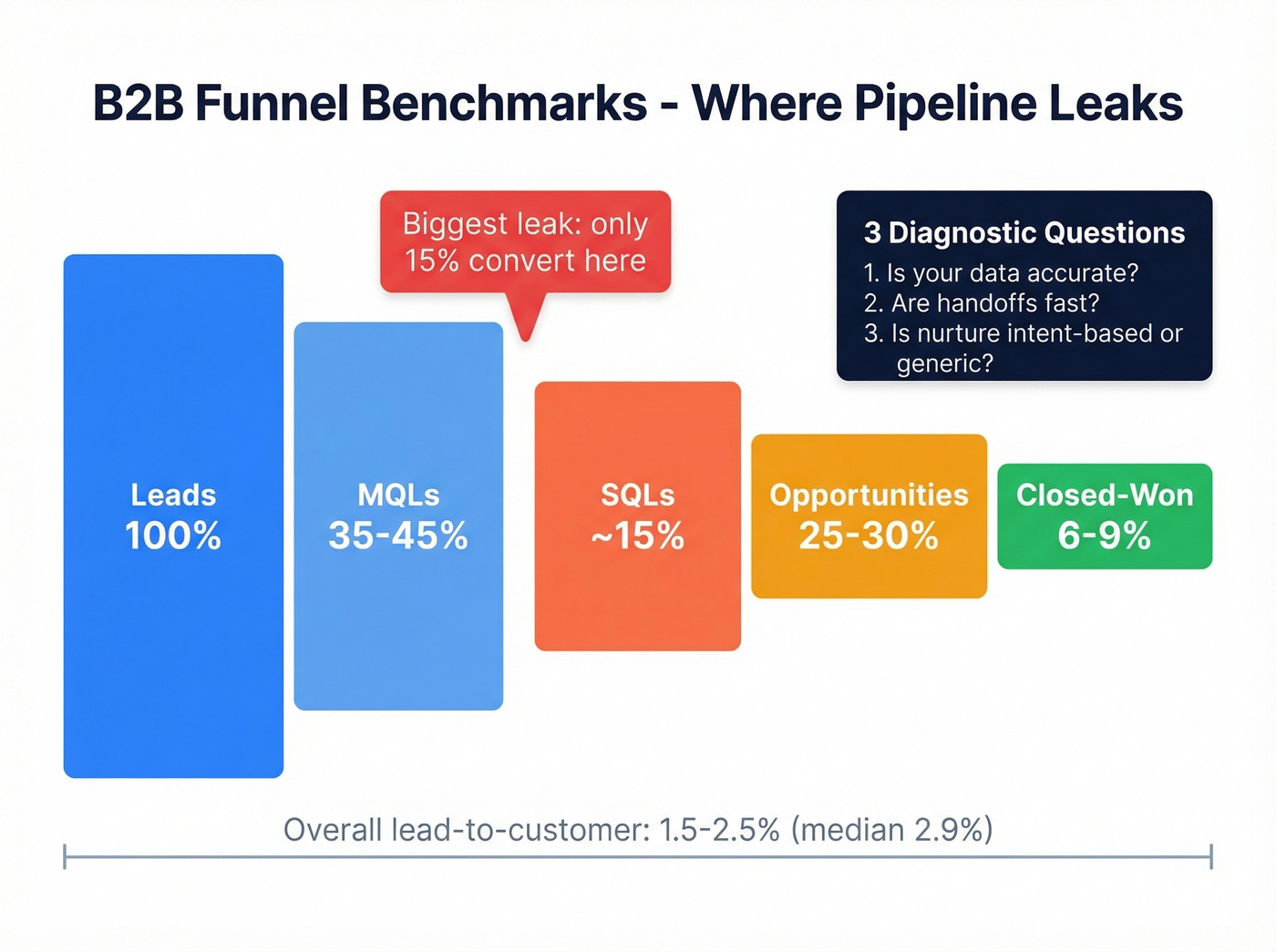
Here are the stage-by-stage benchmarks: Lead to MQL converts at 35-45%. MQL to SQL drops to roughly 15% - that's the biggest leak in most funnels. SQL to Opportunity runs 25-30%. Opportunity to Closed-Won lands at 6-9%. Overall, lead-to-customer conversion sits at 1.5-2.5%, with a median B2B conversion rate of 2.9%.
If your numbers fall significantly below those ranges, the diagnostic questions are straightforward: Is your data accurate? Are handoffs fast? Is nurture intent-based or generic?

You just read the benchmarks: MQL-to-SQL is the biggest leak in most funnels, and bad data makes it worse. Prospeo's 5-step verification delivers 98% email accuracy on 300M+ profiles - refreshed every 7 days, not every 6 weeks. Meritt tripled their pipeline to $300K/week and cut bounces from 35% to under 4%.
Stop explaining thin pipeline. Start with data that actually connects.
Best B2B Lead Gen Tools for 2026
A tool advertised at $99/mo can become $3,452 in year one once you factor in per-user fees, overages, annual contracts, and implementation costs. Let's break down what each option actually costs and where it fits.
Pricing Comparison
| Tool | Category | Starting Price | Typical Annual | Best For |
|---|---|---|---|---|
| Prospeo | Data & enrichment | Free (75 emails/mo) | ~$468-$1,200/yr | Verified data on a budget |
| Apollo.io | Prospecting | Free tier | $0-$1,788/yr per user | Free prospecting start |
| HubSpot | CRM & inbound | $15/user/mo | ~$180-$1,080/yr per user | Inbound + CRM |
| ZoomInfo | Enterprise data | ~$15K/yr | $15K-$40K+/yr | Enterprise teams, 100+ reps |
| Clay | Enrichment | $134/mo | $1,608-$8,640/yr | RevOps enrichment |
| Hunter | Email finder | Free tier | $0-$5,988/yr | Quick email lookups |
| Instantly | Cold email | ~$30/mo | $360-$1,200/yr | Cold email at scale |
| LinkedIn Sales Nav | Social selling | ~$100/user/mo | $1,200-$2,160/yr | Warm outreach via social |
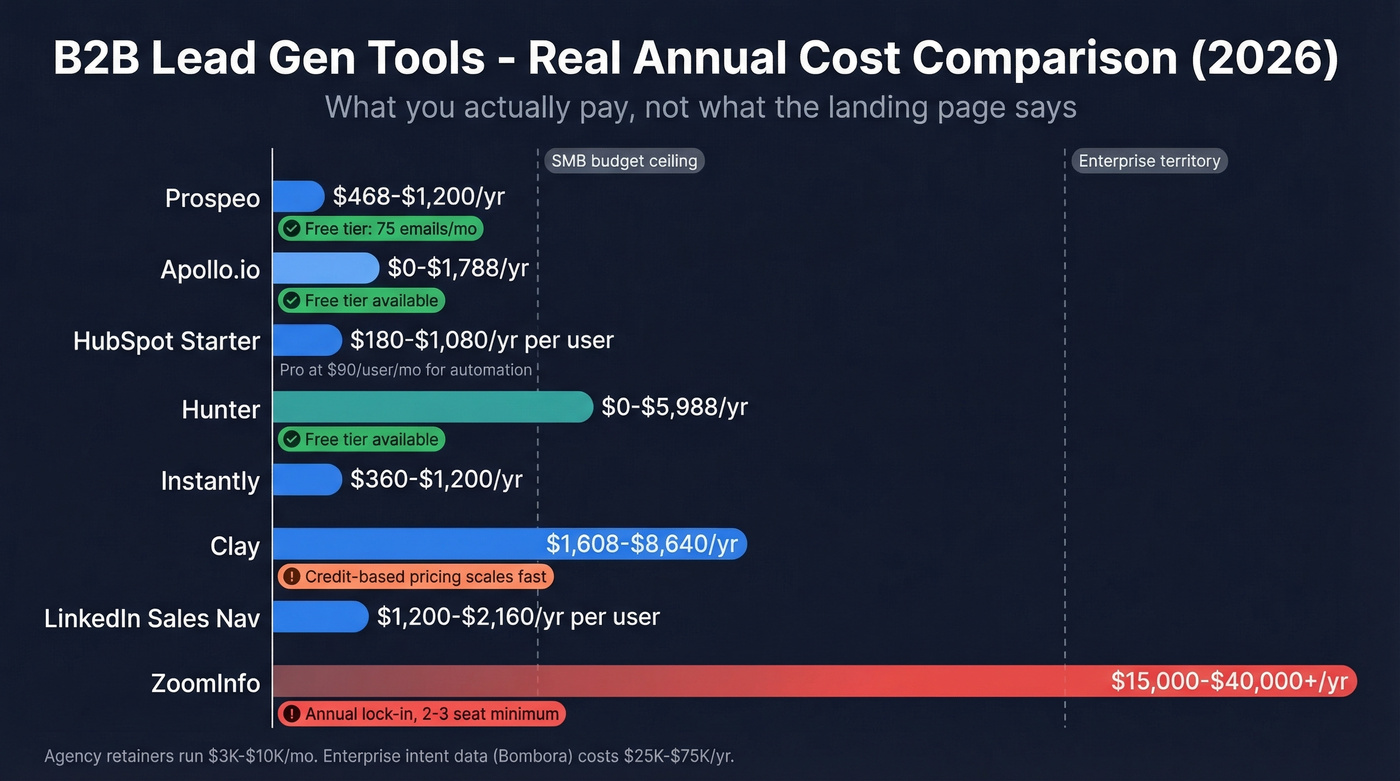
For context: agency retainers for outsourced lead gen typically run $3K-$10K/mo, and enterprise intent data from providers like Bombora costs $25K-$75K/yr.
Prospeo - Verified Data Without the Enterprise Price
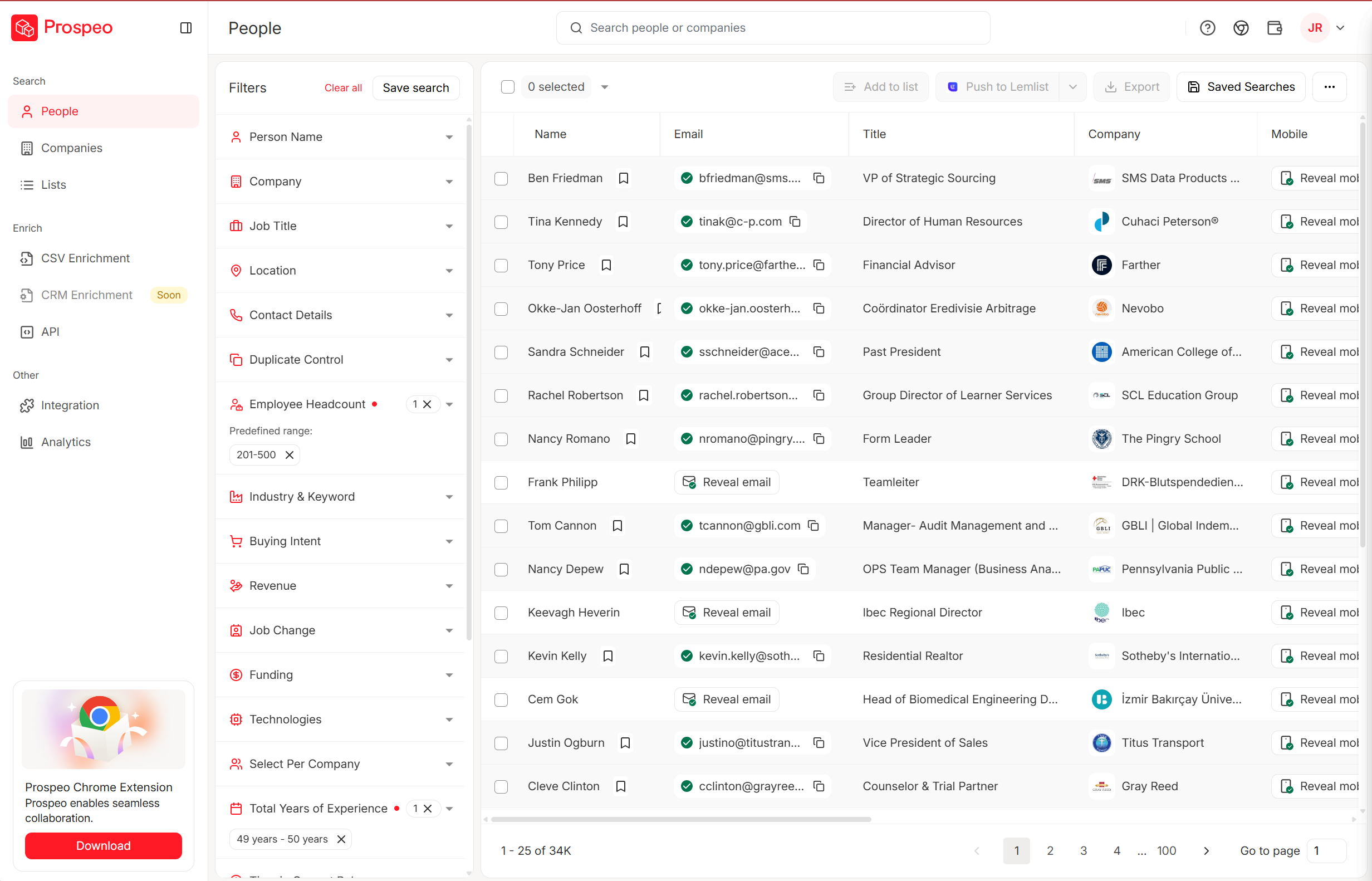
Prospeo's database covers 300M+ professional profiles with 143M+ verified emails and 125M+ verified mobile numbers. The 98% email accuracy rate comes from a proprietary 5-step verification process running on infrastructure that doesn't rely on third-party email providers. Every record refreshes on a 7-day cycle, compared to a 6-week industry average.
The search interface offers 30+ filters including buyer intent across 15,000 topics via Bombora, technographics, job change signals, headcount growth, and funding data. Pricing runs about $0.01 per email. The free tier gives you 75 emails and 100 Chrome extension credits per month - no contracts, no sales calls required.
Meritt used Prospeo to triple their pipeline from $100K to $300K per week while dropping their bounce rate from 35% to under 4%. Native integrations include Salesforce, HubSpot, Smartlead, Instantly, Lemlist, Clay, Zapier, and Make.
The difference between 98% and 80% email accuracy translates to roughly 3x more meetings booked per 1,000 sends, because at 80% accuracy on a 5,000-email campaign, you're burning 1,000 sends on dead addresses and torching your domain reputation in the process.
Apollo.io - Best Free Tier for Prospecting
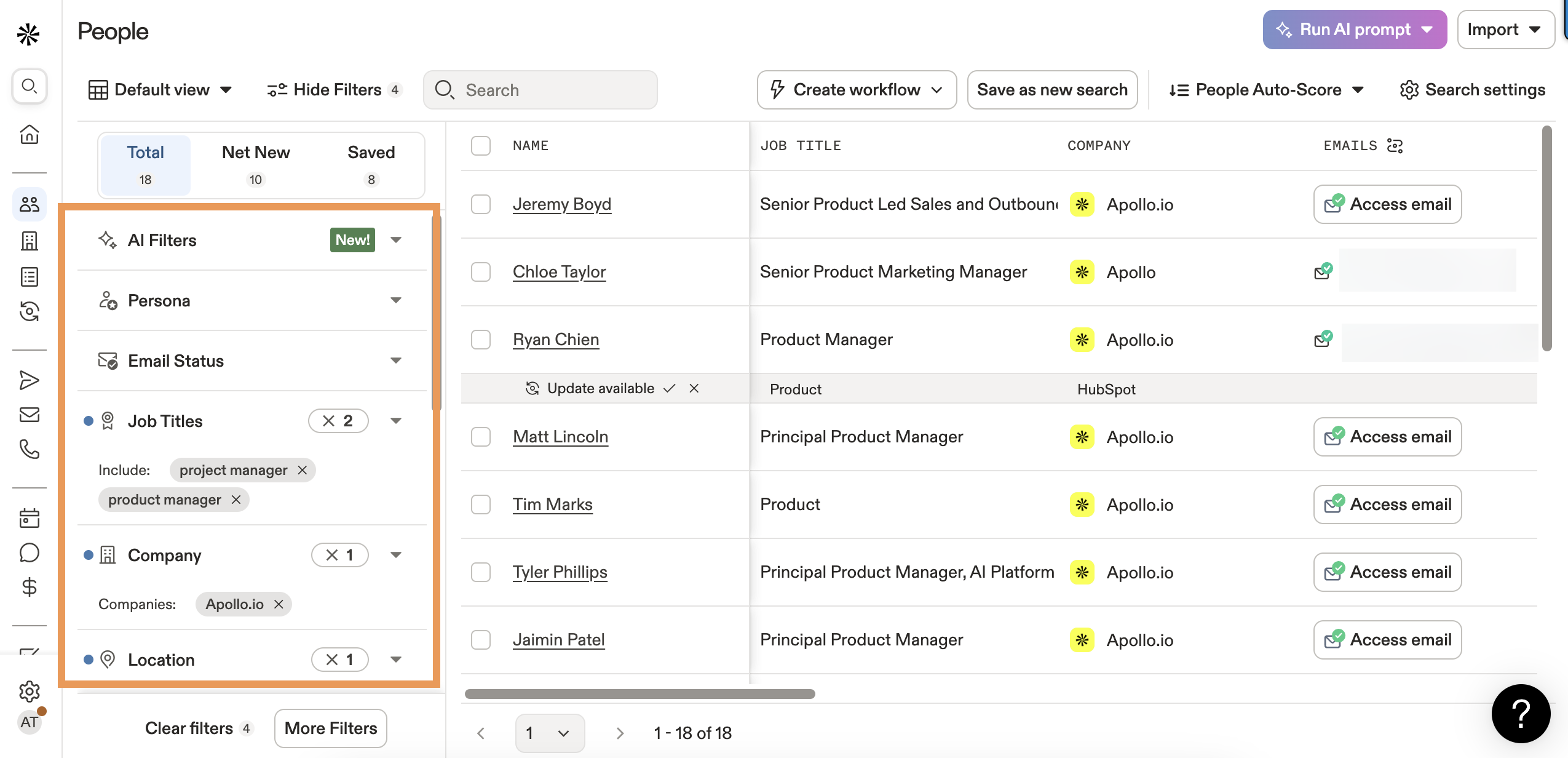
Apollo is the obvious starting point for teams that want prospecting and sequencing in one platform without paying anything upfront. The database covers 275M+ contacts across 70M+ companies, with built-in intent signals, a sequence builder, and pipeline management. The free tier is genuinely useful - enough to validate whether outbound works for your ICP before committing budget. Paid plans run $49-$149/user/mo.
Apollo's database is massive, but user-reported accuracy runs 65-80%. The consensus on r/sales is consistent: Apollo is powerful when you know how to use it, but its email infrastructure is widely criticized for deliverability issues. Use it for prospecting, verify the data separately, and push to a dedicated sending tool.
HubSpot - CRM + Inbound in One
HubSpot Starter at $15/user/mo is the easiest CRM entry point for small teams. It handles inbound lead capture, basic pipeline management, and email tracking well. Use this if you're building an inbound engine alongside outbound. Skip this if you need a prospecting database - HubSpot isn't one. Pair it with a data tool for outbound. The catch: meaningful automation requires Professional at $90/user/mo, which changes the cost equation fast.
ZoomInfo - The Enterprise Default
ZoomInfo is what you buy when you have 100+ reps and a six-figure data budget. The intent data and technographics are strong. But contracts run $15K-$40K+/year with annual commitments and minimum 2-3 seats. User-reported accuracy lands at 75-85%. The #1 complaint on Reddit and review sites is contract lock-in - auto-renewal clauses and difficult cancellation processes are a recurring theme.
If your average deal size is under $25K or your team is under 50 reps, ZoomInfo is almost certainly overkill. You'll pay enterprise prices for a fraction of the platform's value.
Quick Mentions
Clay runs on credits ($134-$720/mo) and builds powerful enrichment workflows chaining multiple data sources together. Brilliant for RevOps teams who want granular control, but costs scale fast - watch the credit-based pricing model, which is the most common "quiet tax" in this category. If you're comparing vendors, start with a clear view of data enrichment services.
Hunter covers 200M+ emails with a solid free tier and paid plans up to $499/mo. Best for simple domain-level email search rather than full prospecting workflows. If you're evaluating options, see Hunter alternatives.
Instantly handles cold email sending at scale for ~$30-$100/mo. The lead database add-on is separate. Pair it with a verified data source - Instantly is a delivery engine, not a data platform. If you're building a sending stack, compare AI bulk email senders.
LinkedIn Sales Navigator runs $100-$180/user/mo and remains the best tool for warm social selling and account mapping. It's not a replacement for email outreach, but it's the missing layer most outbound teams underinvest in.
For conversion-layer optimization, tools like Intercom (live chat) and Unbounce (landing pages) sit on top of your lead gen stack to improve capture rates - worth adding once your core pipeline is flowing.
Agency vs. Tools vs. Hybrid
| Scenario | Best Approach | Typical Cost |
|---|---|---|
| Team + no process | Tools + training | $100-$500/mo |
| Budget + no team | Agency (Callbox, Belkins) | $3K-$10K/mo |
| Scaling fast | Hybrid (tools + agency overflow) | $3K-$15K/mo |
| Enterprise, complex ICP | In-house SDR team + tools | $8K-$25K/mo fully loaded |
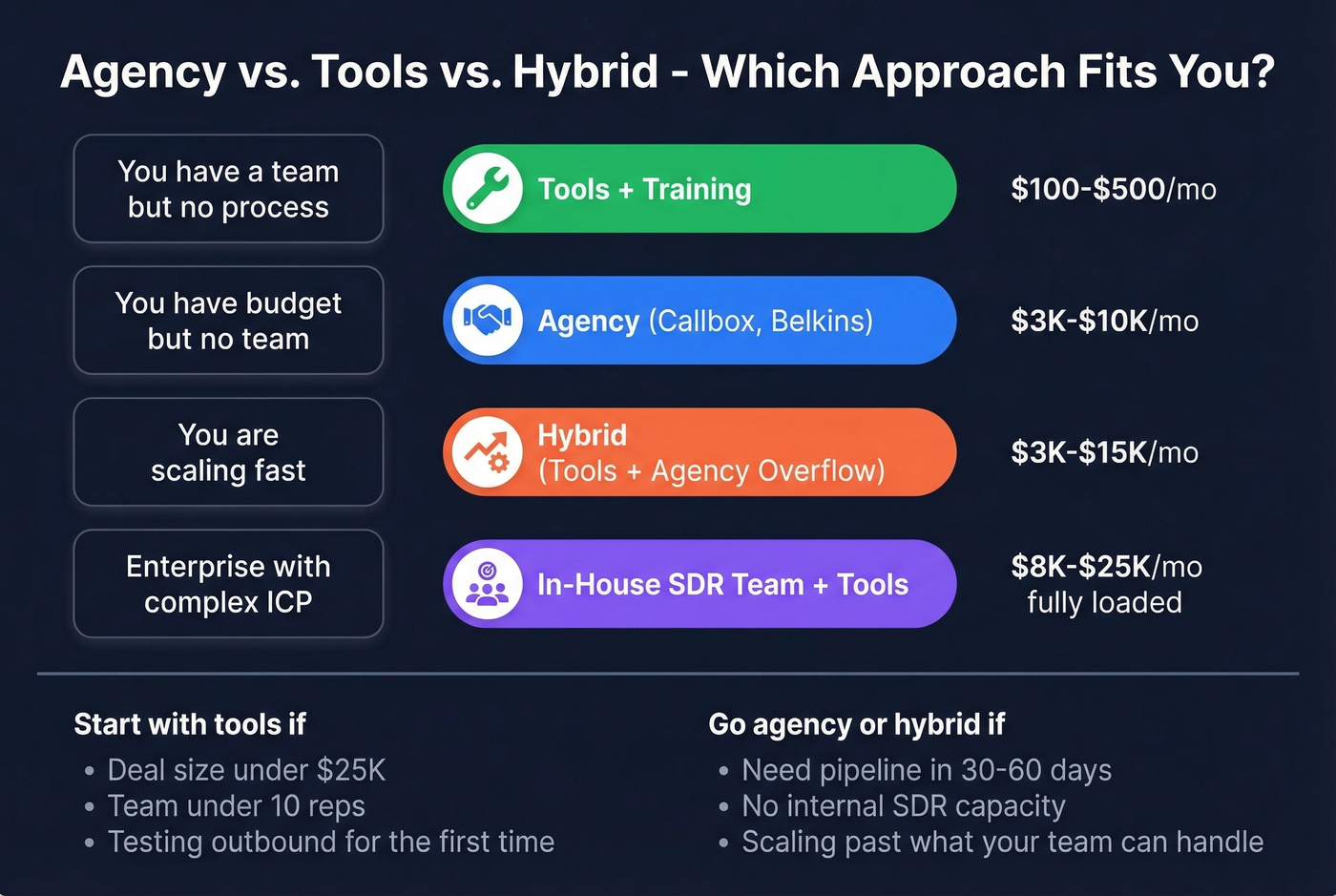
Agencies make sense when you have budget but no headcount. Providers like Callbox and Belkins handle list building, outreach, and appointment setting. The tradeoff is control - you're outsourcing your pipeline to someone who doesn't know your product as deeply as your team does. In our experience, most growing companies land on a hybrid: own the data and strategy in-house, use agencies for overflow or new market entry.
If you're building an outbound motion from scratch, start with proven sales prospecting techniques before you add more tools.
Data Quality Beats Database Size
B2B contact records decay at roughly 30% per year. People change jobs, companies get acquired, email domains rotate. A database of 500M contacts means nothing if a third of them went stale six months ago.
Database size is a vanity metric without freshness. What matters is whether the email you're about to send will actually reach a real person at their current company. If your bounce rate exceeds 5%, your data source isn't just wasting your time - it's actively hurting deliverability. (If you want the exact thresholds and fixes, see email bounce rate and the full email deliverability guide.) We've tested campaigns across multiple providers, and the downstream math is brutal: at 80% accuracy on a 5,000-email campaign, you're burning 1,000 sends on dead addresses and torching your domain. At 98%, those 1,000 sends become real conversations.
AI-Powered Lead Gen in 2026
89% of revenue organizations now use AI, up from 34% in 2023. But most of the "AI-powered" label is marketing fluff. What actually works is signals-based selling: using AI to determine who to contact, when to act, and why that moment matters.
The channel mix itself is shifting. 49% of marketers report declining traditional search traffic due to AI-generated answers, while 58% say AI referral traffic converts at higher intent. Your lead gen stack needs to account for where buyers are actually discovering solutions - not just where they were finding you two years ago.
The practical micro-workflow looks like this: build a targeted list, enrich with verified contact data and intent signals, segment by buying stage, draft personalized outreach with AI assistance, push into sequences, sync to CRM. Each step can be AI-assisted without requiring an "AI platform" that costs six figures. If you want a deeper playbook, use this AI cold email outreach guide.
When evaluating AI-native tools, run a 100-lead data quality audit before committing. Check whether the AI is operational - scoring, routing, deduplicating, summarizing - or just cosmetic. A chatbot wrapper on a basic database isn't AI-powered lead gen. It's a search bar with a marketing budget.
Choosing the Right Solution for Your Team
The market is crowded. Start with the three-tool foundation outlined above, validate that your data is clean and your sequences are converting, then layer on intent data and enrichment as pipeline demands grow. The companies that win aren't the ones with the most tools - they're the ones whose tools actually talk to each other. If you're mapping the full funnel, use a lead generation workflow to spot leaks early.
The 3-tool stack works - but only if your data source doesn't rot. At $0.01 per verified email with 30+ filters including buyer intent, technographics, and job change signals, Prospeo replaces the $15K+ enterprise platforms without the contracts or sales calls.
Enterprise-grade lead gen data at 90% less than ZoomInfo. No contracts.
FAQ
What's the difference between a lead gen tool and a lead gen service?
Tools are self-serve software you operate yourself - typically $0-$150/user/month. Services are agencies that handle list building, outreach, and appointment setting on a $3K-$10K/month retainer. Most scaling teams use a hybrid: own data and strategy in-house, outsource overflow to agencies.
How much should a B2B lead generation solution cost?
Self-serve tools range from free to $150/user/month. Enterprise platforms like ZoomInfo run $15K-$40K+/year. Agencies charge $3K-$10K/month. Start with free tiers from Prospeo (75 emails/mo) and Apollo, then scale spending based on pipeline results - not feature checklists.
What's a good bounce rate for B2B email outreach?
Under 3% is excellent. Under 5% is acceptable. Above 5% means your data provider is actively damaging your sender reputation. Prospeo's 98% accuracy keeps most campaigns well under 3%, while lower-accuracy tools routinely push teams above the 5% danger zone.
How many tools do I actually need?
Three: a verified data source, a sending/sequencing platform, and a CRM. Layer intent data and enrichment workflows on top later. We've seen teams stack eight tools and still miss quota because the base data was bad.
Is cold email still effective in 2026?
Yes. Teams using intent signals and verified contact data consistently see 3x higher reply rates than the ~2% generic cold email average. The channel isn't dead; lazy execution with unverified lists is. Verified data and personalized messaging remain the two non-negotiable requirements.