

The Sandler Sales Process: Scripts, Steps, and What Nobody Tells You
You gave a 90-minute demo. The prospect nodded along, asked smart questions, said "this looks great," and promised to loop in their VP. Then they ghosted. Reps spend just 28% of their week actually selling, per Salesforce's State of Sales research - the rest is admin, prep, and chasing people who were never going to buy. The Sandler sales process exists to kill that pattern before it starts.
The Short Version
Three techniques are worth learning even without formal training: the Up-Front Contract, the Pain Funnel, and Negative Reverse Selling. These alone will change how you run discovery calls.
Sandler is built for mid-market, 1:1 sales. Multi-stakeholder enterprise buying committees? Use MEDDIC. And you don't need $7K training to get started - the methodology is fully documented. What you need is practice discipline and accurate prospect data to actually get on calls.
What Is the Sandler Selling System?
David Sandler developed this methodology in the 1960s. The core insight was simple and radical: stop convincing people to buy and start qualifying whether they should. Sandler now operates through 250+ franchise locations across 28+ countries.
The Submarine Analogy: A submarine has sealed compartments - if one floods, you close it and move to the next. Sandler's model has seven compartments (steps). You don't advance until the current one is complete. Skip a step, the deal sinks. It's stage-gating applied to conversations, not pipelines.
The methodology also comes with 49 Rules - pithy principles like "All prospects lie" and "Don't spill your candy in the lobby," meaning stop dumping features before you've earned the right. These rules reinforce a mindset of equal business stature. You're not begging for the sale. You're evaluating mutual fit.
The 7 Steps of the Sandler Submarine
Each step builds on the last. The 70/30 listening ratio runs through all of them - you talk 30%, the prospect talks 70%.
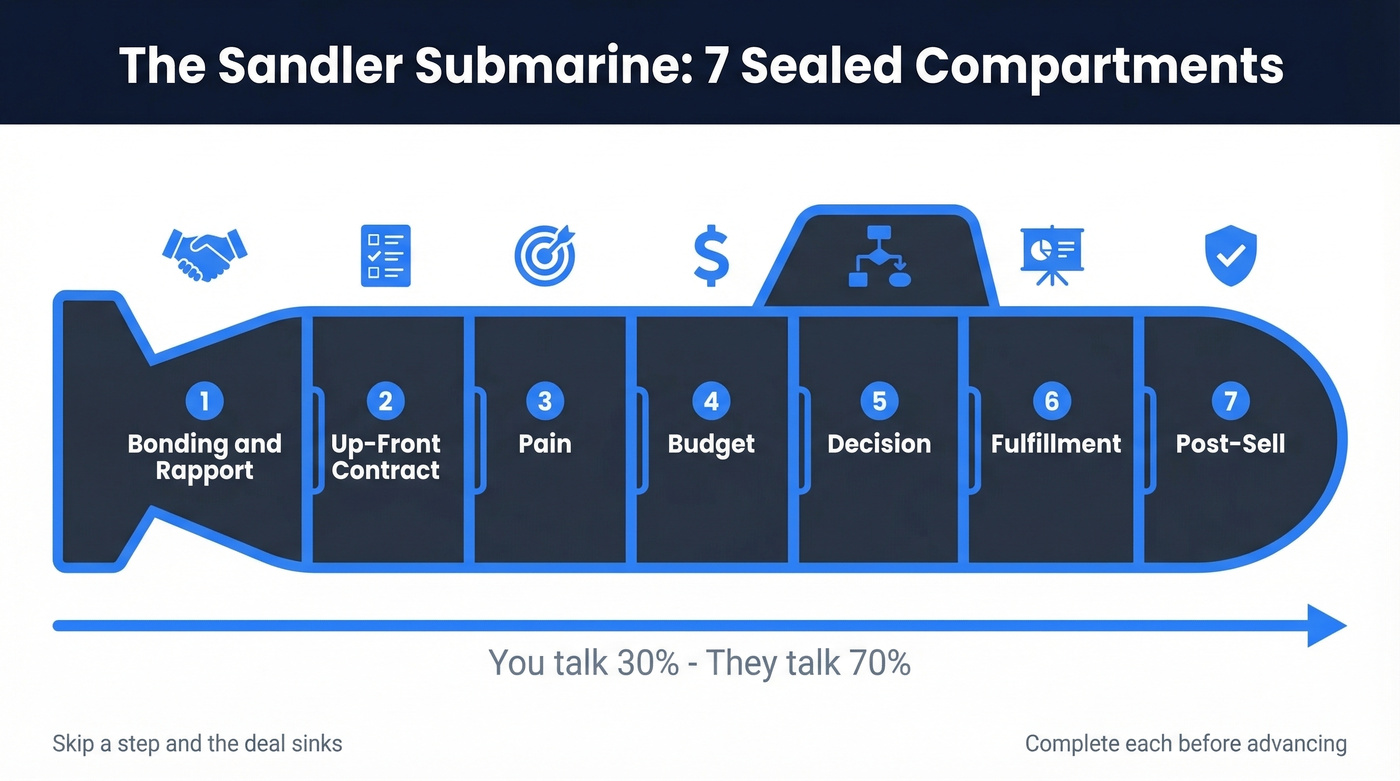
1. Bonding & Rapport
This isn't small talk about the weather. It's establishing enough trust that the prospect will be honest with you later. Match their communication style. Mirror their energy. The goal is a peer exchange, not a pitch.
- "How did you end up in this role?"
- "What made you take this call today?"
2. Up-Front Contract
The most underrated step in all of sales. Before any meeting goes deeper, set mutual expectations: what you'll cover, how long it'll take, and what happens at the end.
- "At the end of this call, it's totally fine to say 'this isn't for us.' Can we agree on that?"
- "I'll ask some questions about your current process, you ask me anything you want, and we'll decide together if a next step makes sense. Fair?"
In our experience, this single technique cuts ghosting faster than anything else we've tested. Prospects who agree to an Up-Front Contract either show up honestly or disqualify themselves - both outcomes save you time.
3. Pain
This is where Sandler earns its reputation. You don't ask "what are your challenges?" You use the Pain Funnel to uncover the real problem, its cost, and its emotional weight.
- "What happens when that process breaks down?"
- "How does that affect you personally?"
- "What have you tried so far to fix it?"
4. Budget
Don't ask "what's your budget?" Ask whether they've set aside resources to solve this. One question puts the prospect on defense. The other opens a conversation about investment priority.
- "Have you allocated resources to address this, or are we starting from scratch?"
- "Ballpark - what would solving this be worth to you over 12 months?"
5. Decision
Map the buying process before you present anything. Who else weighs in? What's the timeline? What happens if they decide not to act?
- "Walk me through how your team made the last purchase like this."
- "If we agree this is a fit, what happens between now and a signed contract?"
- "Who else would need to see this before a decision gets made?"
6. Fulfillment
Only now do you present your solution - and only the parts that map directly to the pain you uncovered in Step 3. No feature dumps. No 47-slide decks. You've already qualified the deal; this step is confirmation, not persuasion.
- "You mentioned [specific pain]. Here's exactly how we solve that."
- "Based on what you told me about [budget/timeline], here's what I'd recommend."
7. Post-Sell
Buyer's remorse is real. After the handshake, revisit the pain, the budget commitment, and the decision criteria. Reinforce why they bought. This prevents the "actually, we're going to hold off" email that arrives three days after the contract was signed.
- "Let's revisit the three problems you wanted solved - are we still aligned?"
The Pain Funnel: Sandler's Best Discovery Tool
The Pain Funnel is an eight-question sequence that moves from surface-level exploration to emotional depth. The order matters more than exact wording - Sandler trainers emphasize adapting language to your personality while keeping the progression intact.
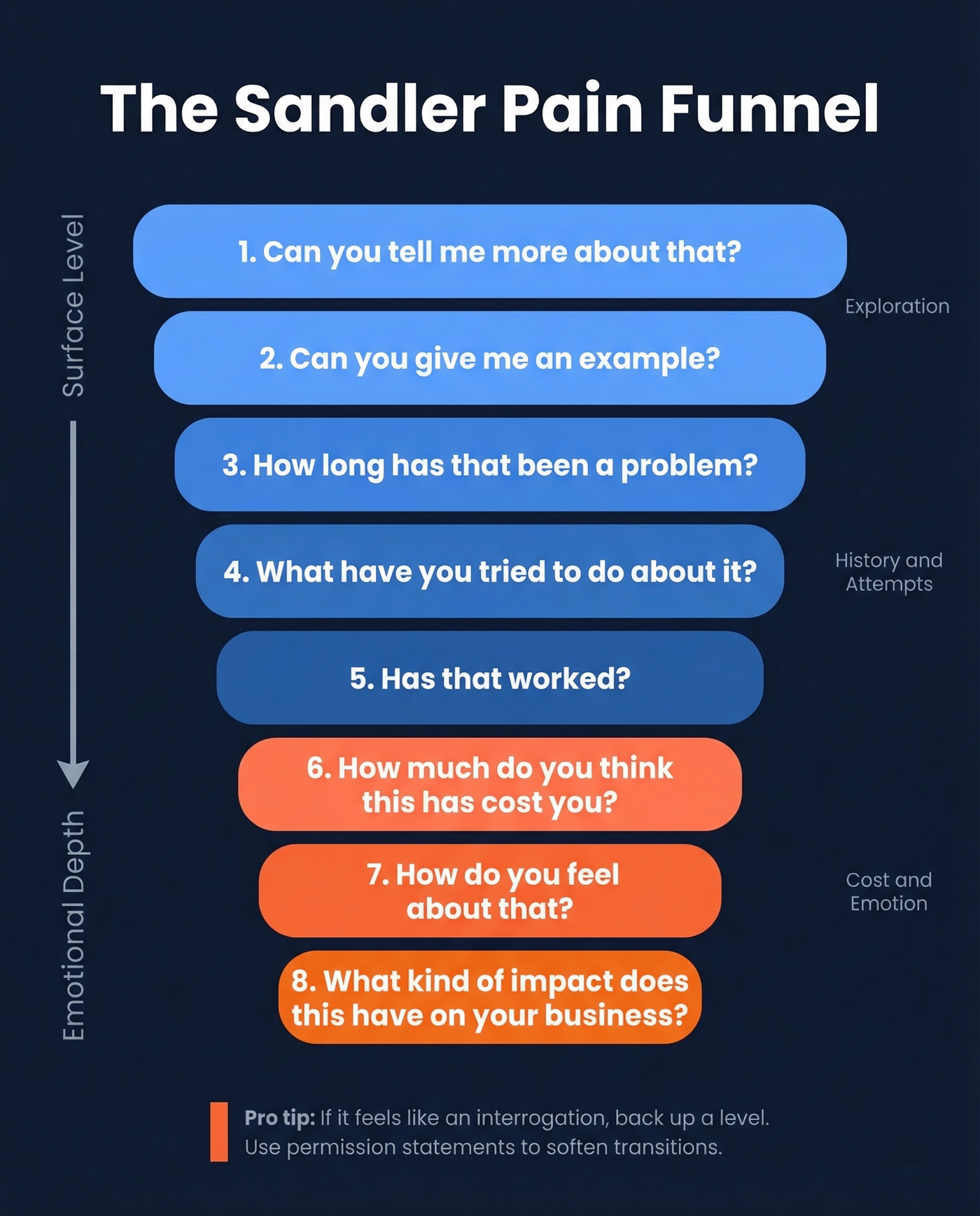
- "Can you tell me more about that?"
- "Can you give me an example?"
- "How long has that been a problem?"
- "What have you tried to do about it?"
- "Has that worked?"
- "How much do you think this has cost you?"
- "How do you feel about that?"
- "What kind of impact does this have on your business?"
Here's the thing: if it feels like an interrogation, you've already lost. Use permission statements - "Would it be okay if I asked about that?" - to soften transitions. If the prospect resists, back up a level. Pushing through resistance is the opposite of what Sandler teaches.
Negative Reverse Selling: Scripts That Work
This technique exploits psychological reactance - when people feel their autonomy is threatened, they push back. Negative Reverse Selling uses that instinct deliberately. Instead of chasing enthusiasm, you position your energy slightly behind the prospect's.
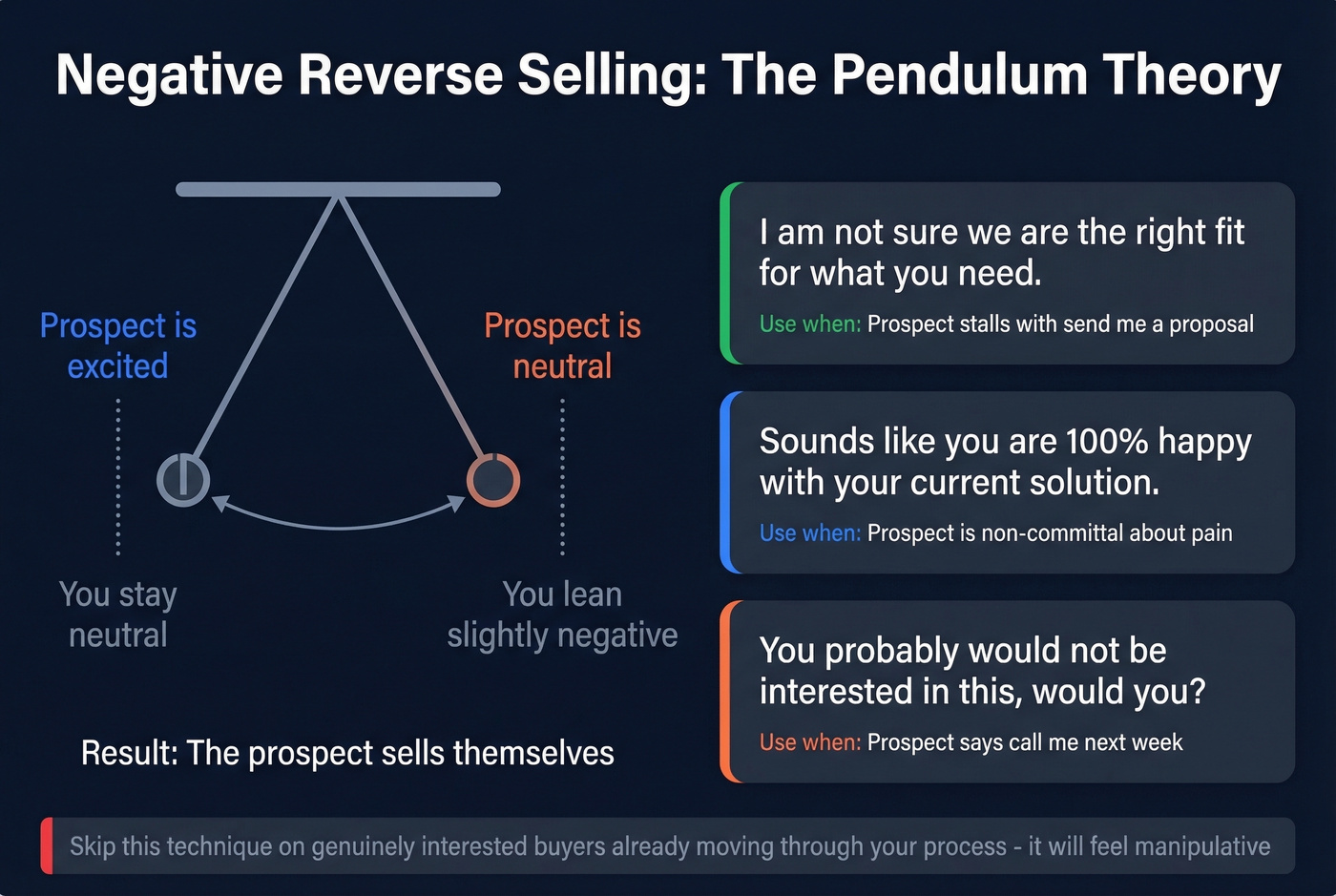
Sandler calls this "pendulum theory." If they're excited, you stay neutral. If they're neutral, you lean slightly negative. The prospect ends up selling themselves.
Three scripts that actually work:
"I'm not sure we're the right fit for what you need."
"Sounds like you're 100% happy with your current solution."
"You probably wouldn't be interested in this, would you?"
Use these when a prospect stalls with "send me a proposal" or "call me next week" - what HubSpot calls "Hope Island." These phrases force clarity. Either they defend their interest or confirm they're not buying. Both outcomes are wins.
Skip this technique on a genuinely interested buyer who's already moving through the process. On someone already engaged, it comes across as manipulative or just rude. This is a scalpel, not a sledgehammer.

Sandler's Up-Front Contract kills ghosting - but only if you're talking to the right person. Prospeo gives you 98% accurate emails and 125M+ verified mobile numbers so your Pain Funnel conversations happen with actual decision-makers, not gatekeepers.
Stop perfecting your discovery script on prospects who were never real.
Does This Methodology Actually Work?
Let's be honest - the best evidence comes from vendor case studies, not independent research. Take the exact numbers directionally.
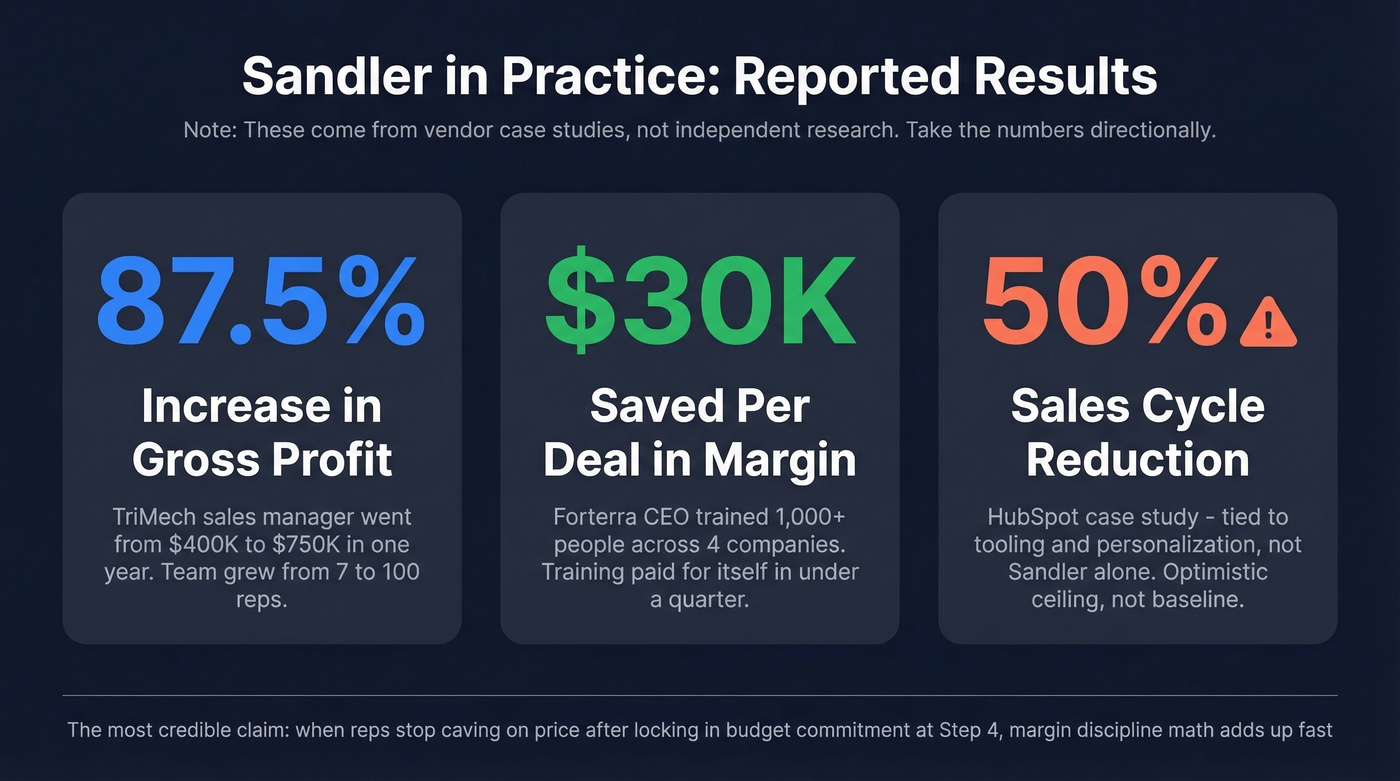
TriMech's sales manager reported going from $400K to $750K in gross profit within a year of adopting Sandler - an 87.5% increase. The team grew from 7 reps to 100, and the company scaled from roughly $2-5M to $100M over time, though that's obviously multi-causal.
Forterra's CEO trained over 1,000 people across four companies. His headline number: avoiding typical discounting saved around $30K per deal in margin, with training paying for itself in under a quarter. The margin-discipline math is the most credible claim here - when reps stop caving on price because they've already locked in budget commitment at Step 4, the numbers add up fast.
A HubSpot case study mentions a 50% sales cycle reduction tied to HubSpot tooling and personalization - not proof that Sandler training halves your cycle time. We've seen teams get meaningful cycle compression from better qualification, but 50% is the optimistic ceiling, not the baseline.
When Sandler Works (and When It Doesn't)
Sandler is the right call when:
- You're selling 1:1 to a single decision-maker or small buying group
- Your reps default to "demo first, qualify later" and you need to break that habit
- Prospects routinely ghost after presentations
Pick something else when:
- You're selling into enterprise committees with multiple stakeholders - MEDDIC handles that complexity better
- Deals require deep technical evaluations where the product sells itself
- You're doing C-suite transformation selling where Challenger's "teach-tailor-take control" approach fits more naturally
The "manipulative" criticism comes up on r/sales and in practitioner circles regularly. The difference between manipulation and skilled qualification is intent. Sandler's techniques surface truth faster. In the wrong hands, they feel like tricks - but that's true of any methodology. As one Reddit thread put it, all sales methodologies are basically the same ingredients; the difference is the sequence and the discipline you bring.
Hot take: If your average contract value is under $15K, you probably don't need a formal methodology at all. A tight discovery script and good follow-up hygiene will get you 80% of the way there. Sandler's real ROI kicks in when deals are large enough that one lost opportunity covers the cost of learning the system.
Sandler vs. MEDDIC vs. SPIN vs. Challenger
| Methodology | Best For | Deal Size | Key Mechanism | CRM Fit |
|---|---|---|---|---|
| Sandler | Mid-market 1:1 | $10K-$75K | Pain Funnel | Needs custom fields |
| MEDDIC | Enterprise committees | $100K+ | Structured qual | Maps to standard CRM |
| SPIN | Unaware buyers | $20K+ | 4-category questions | Needs custom fields |
| Challenger | Competitive markets | $50K+ | Teach-tailor-take | Maps to standard CRM |
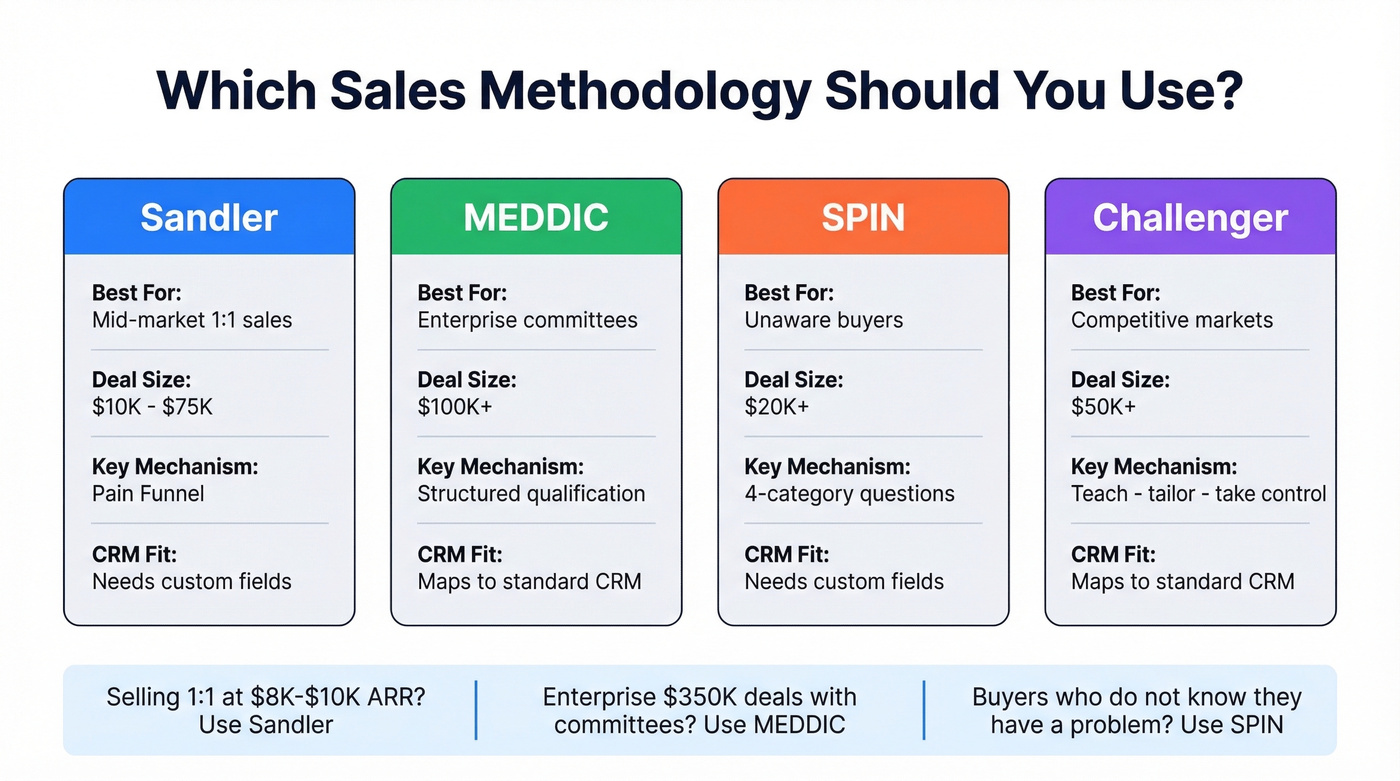
MEDDIC maps cleanly to CRM fields - economic buyer, metrics, decision criteria - which makes it stronger for AI-powered teams that want structured pipeline data. Sandler's outputs are conversational and harder to automate, though the Sandler Playmaker for Salesforce plugin helps teams operationalize the stages.
To make this concrete: a founder selling an $8K-$10K ARR product 1:1 should use Sandler. A team selling $350K ARR enterprise deals with multi-stakeholder committees needs MEDDIC or Challenger. A rep selling a $20K solution to buyers who don't yet realize they have a problem should reach for SPIN. We've watched teams waste months debating frameworks in Slack. Pick one, commit, and iterate.
How to Implement Without Training
You don't need $7K training to start. The methodology is well-documented across Sandler's own resources, books, and practitioner blogs.
Weeks 1-2: Use Up-Front Contracts on every call. Set expectations, agree on outcomes, give the prospect permission to say no. This alone will feel transformative if you've been running unstructured discovery calls.
Weeks 3-4: Practice the Pain Funnel with a peer. Role-play 15 minutes weekly. It feels awkward at first - that's normal. I still remember fumbling through my first few attempts and sounding like a therapist reading from a manual.
Month 2+: Run the full 7-step sequence on live calls. Add custom CRM fields for each Sandler stage to track where deals stall. If you're on Salesforce, look into the Sandler Playmaker plugin.
One thing every Sandler guide ignores: if your prospect data is stale, you never get to Step 1. The whole process starts with a conversation, but getting that conversation requires accurate contact data. Tools like Prospeo give you verified emails and direct dials for your target accounts - 98% email accuracy on a 7-day refresh cycle - so your qualification skills don't go to waste on bounced emails and voicemails.

What Sandler Training Costs in 2026
A methodology that teaches you to discuss budget early doesn't publish its own pricing. The irony isn't lost on anyone.
- The book (You Can't Teach a Kid to Ride a Bike at a Seminar): $15-$25 on Amazon
- Sales Mastery program (9 months, in-person): ~$6K-$7K per person, per Reddit discussions
- Team/enterprise training: $15K-$50K+ depending on team size and customization
- Sandler franchise startup: ~$100K all-in, per franchise candidates on Reddit
Quality varies by trainer - Sandler operates on a franchise model, and not every location delivers the same experience. For individual reps closing smaller deals, read the book, practice the techniques, and invest in good prospect data instead.
Step 5 says map the buying process before you present. Prospeo's 30+ filters - buyer intent, job changes, department headcount - let you identify and reach the full decision committee before your first call. At $0.01 per email, qualifying deals costs less than the coffee you drink during the demo.
Run the Sandler submarine with a crew of verified contacts, not guesses.
FAQ
What are the 7 steps of the Sandler sales process?
Bonding & Rapport, Up-Front Contract, Pain, Budget, Decision, Fulfillment, and Post-Sell. Each compartment must be completed before advancing to the next - that's the "submarine" principle Sandler is known for.
Is Sandler training worth the money?
At $6K-$7K for 9 months, yes - if your company pays and your average deal exceeds $25K. For smaller deals or solo founders, the books and free resources cover the core techniques well enough to see results.
How long does it take to learn the Sandler methodology?
Two to four weeks for the basics like the Up-Front Contract and Pain Funnel. Full internalization - where the steps feel natural on live calls - typically takes 6-12 months for experienced reps unlearning traditional habits.
What's the difference between Sandler and MEDDIC?
Sandler is a discovery-first methodology for mid-market 1:1 sales with deal sizes around $10K-$75K. MEDDIC is a qualification framework for complex enterprise deals at $100K+ with multiple stakeholders and formal buying committees. They're not competitors - some teams use Sandler for discovery and MEDDIC for pipeline qualification.
How do you find the right prospects for the Sandler process?
Start with verified contact data so you're running Pain Funnels on real decision-makers, not chasing bounced emails. Prospeo provides 98%-accurate emails and 125M+ verified mobile numbers with a 30% pickup rate - pair that with 30+ search filters to build targeted lists before your first call.