

The Sandler Sales Submarine: A Practitioner's Guide to All 7 Compartments
You just lost a deal. The prospect said "let me run it by my team," and you never heard from them again. That's not bad luck - that's Compartment 5 leaking.
David Sandler built his selling system around a WWII metaphor: crews move through compartments and seal watertight doors behind them so one breach doesn't sink the whole vessel. Submarines run silent and deep. Battleships advertise their intentions. Sandler sellers operate the same way - qualifying beneath the surface, never chasing, never begging.
Most Sandler guides list the seven steps and stop. That's like explaining chess by naming the pieces. What follows are the scripts, the diagnostic signals, the common mistakes, and the tactical breakdowns that Sandler's own marketing page doesn't give you. If you're an SDR manager or AE who just got told to adopt Sandler, bookmark this and use it on your next call.
The Submarine Model: 7 Compartments at a Glance
Three techniques are worth learning even if you never fully adopt the methodology: the Up-Front Contract, the Pain Funnel, and Negative Reverse Selling. Here's the full framework in sequence:
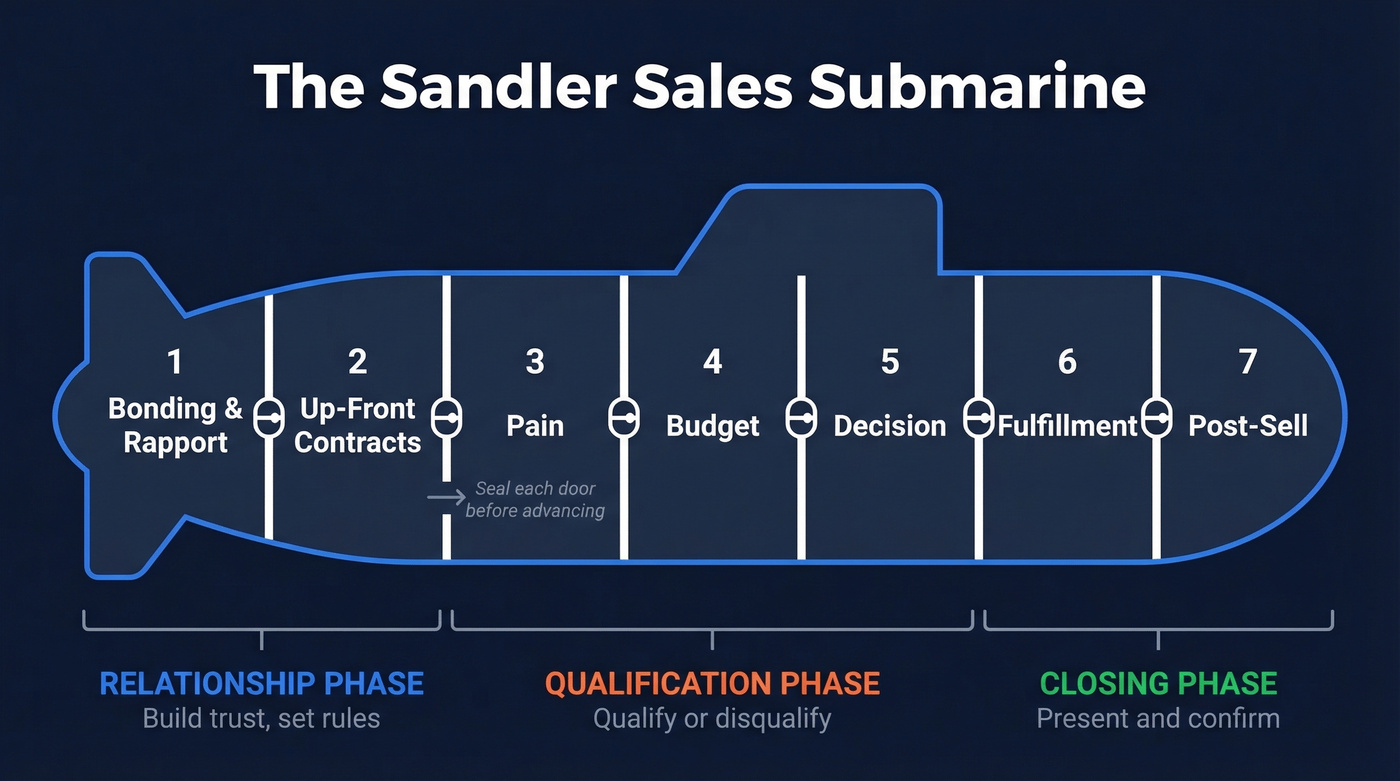
- Bonding & Rapport - Build trust so the buyer tells the truth
- Up-Front Contracts - Align on purpose, agenda, and outcomes
- Pain - Uncover the real problem and its emotional weight
- Budget - Remove money uncertainty before you present
- Decision - Map who decides and how
- Fulfillment - Present your solution tied directly to their pain
- Post-Sell - Confirm commitment and prevent buyer's remorse
These group into three phases:
| Phase | Compartments | Purpose |
|---|---|---|
| Relationship | 1-2 | Build trust, set rules |
| Qualification | 3-5 | Qualify or disqualify |
| Closing | 6-7 | Present and confirm |
The core rule: seal each compartment before advancing. Not every voyage ends in a sale, but none should end in a think-it-over.
One nuance experienced practitioners stress: you don't always follow the compartments in rigid order during a live call. Conversations meander. What matters is that all seven are sealed before the deal closes. The sequence is a mental checklist, not a railroad track - and once you internalize that distinction, the methodology feels less like a rigid script and more like a navigation system.
The 7 Compartments: A Practitioner's Breakdown
Bonding & Rapport
This isn't small talk about the weather. Bonding and rapport means building enough trust that the buyer is honest with you - about their problems, their budget, and their timeline. Sandler's Rule #14 prescribes a 70/30 listen-to-talk ratio. You listen 70% of the time. Most reps invert this.
The key questions here are open-ended and genuinely curious. "What prompted you to take this call?" beats "So I see you downloaded our whitepaper." Another strong opener: "Before we get into it, what would make this 30 minutes worthwhile for you?" You're earning the right to ask harder questions later.
Common mistake: Treating this as a checkbox - two minutes of weather chat, then launching into your pitch. Rapport isn't sealed until the prospect gives you honest, specific answers instead of polite deflections.
Diagnostic signal: If prospects give you polite non-answers - "Yeah, we're just exploring options" - rapport isn't sealed. They don't trust you enough to be direct yet.
Up-Front Contracts
This is the compartment that transforms your calls. An Up-Front Contract (UFC) is a verbal agreement at the start of every meeting that covers five elements: Purpose, Prospect's agenda, Your agenda, Time and logistics, and Outcome.
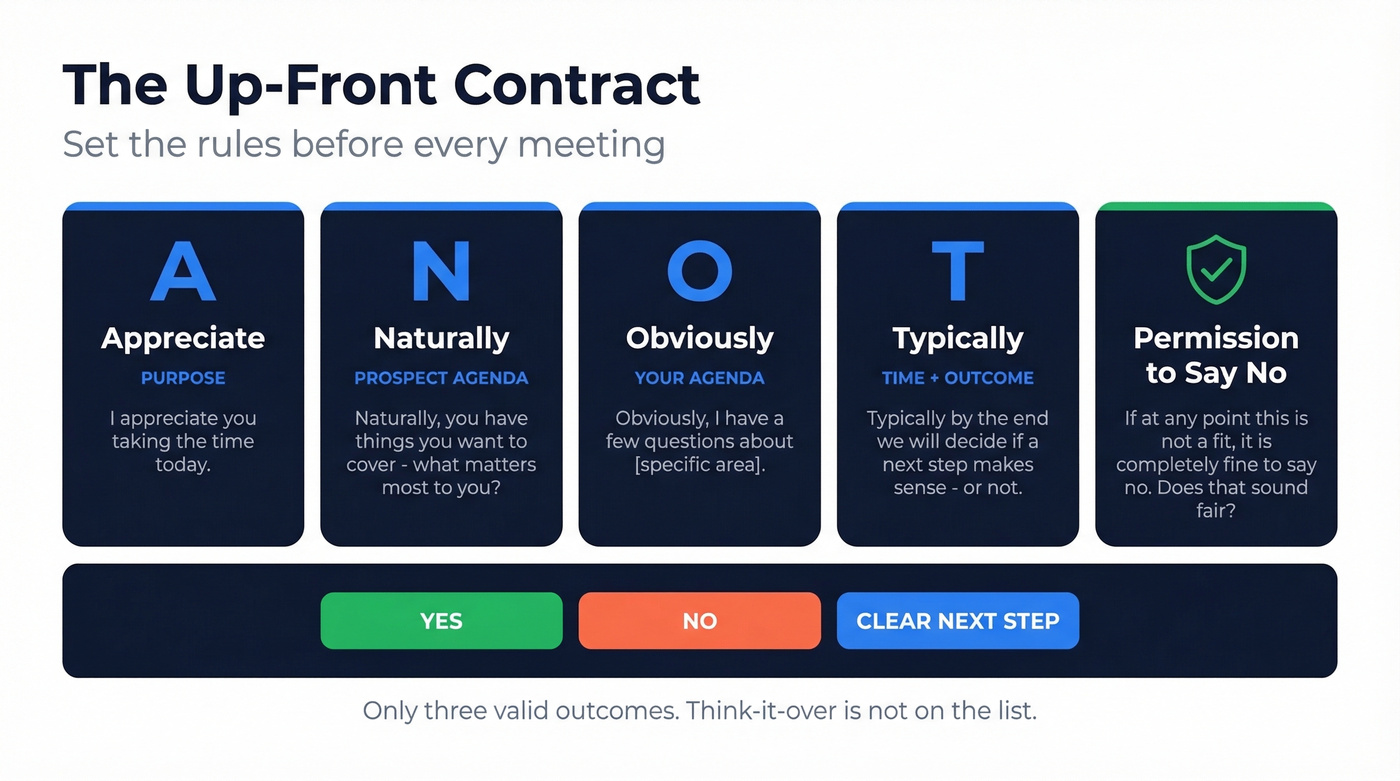
Here's a script that maps to all five:
"I appreciate you taking the time today. [Purpose] Naturally, you have some things you'd like to cover - what's most important to you? [Prospect's agenda] Obviously, I have a few questions about [specific area]. [Your agenda] We've got 30 minutes. [Time] Typically, by the end, we'll decide whether it makes sense to take a next step - or not. And if at any point you feel this isn't a good fit, it's completely fine to say no. [Outcome] Does that sound fair?"
That's the ANOT mnemonic in action: Appreciate, Naturally, Obviously, Typically. The "permission to say no" piece is what makes it powerful. It reduces pressure, builds trust, and kills the vague brush-off before it starts.
There are only three possible outcomes to any UFC: Yes, No, or a scheduled next step with a clear purpose. "Let me think about it" isn't on the list.
Common mistake: Making the UFC a monologue. If you rattle off your agenda without asking for theirs, you've turned a mutual agreement into a lecture.
Diagnostic signal: If meetings end with vague "let's circle back" language, your UFC was weak.
Pain
The Pain compartment is where Sandler earns its reputation. You're not asking about features they want - you're uncovering the business impact and emotional weight of their current problem. Surface-level pain gets you a generic demo. Deep pain gets you a closed deal.
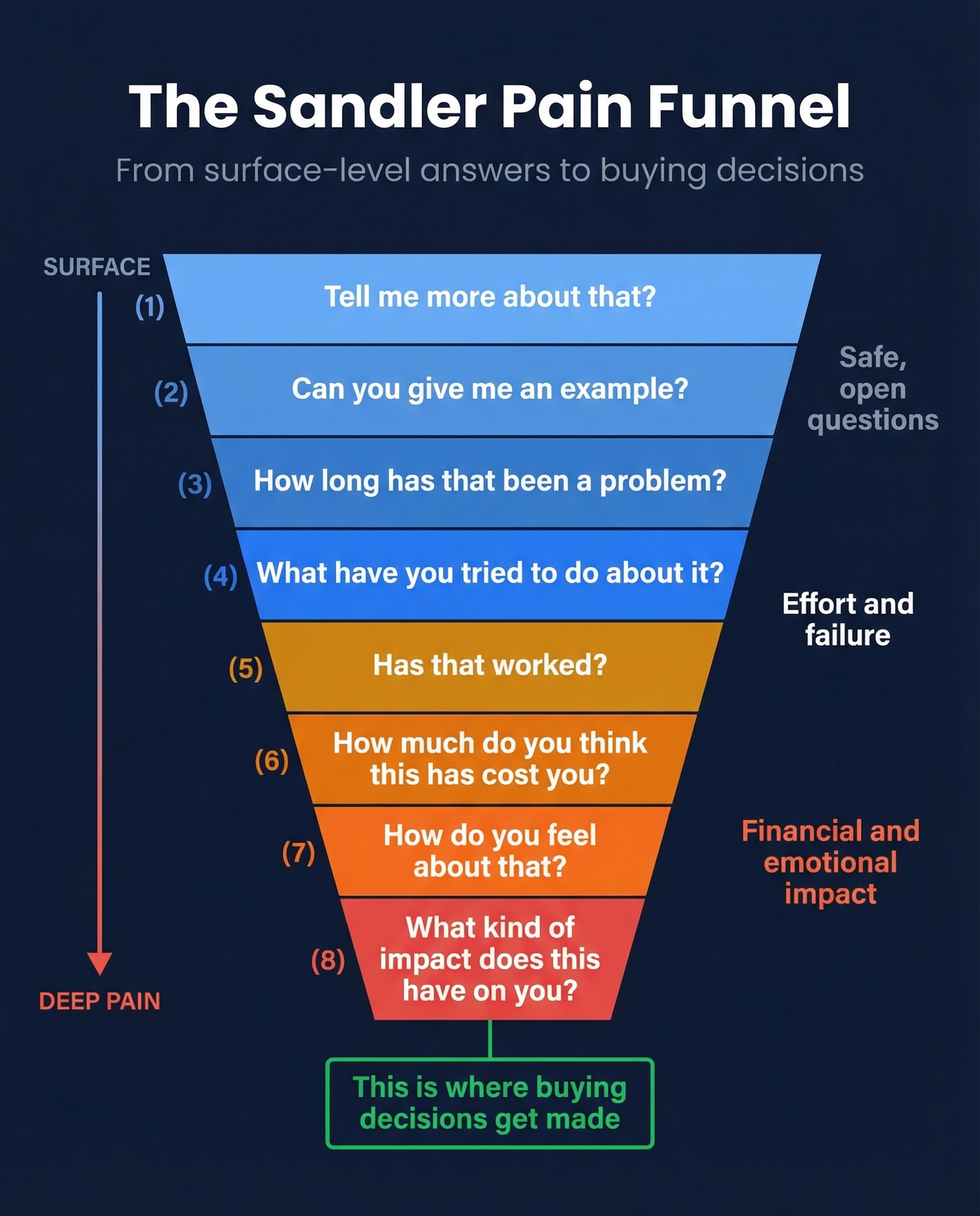
The Pain Funnel is your primary tool. Here are the core questions in order:
- "Can you tell me more about that?"
- "Can you give me an example?"
- "How long has that been a problem?"
- "What have you tried to do about it?"
- "Has that worked?"
- "How much do you think this has cost you?"
- "How do you feel about that?"
- "What kind of impact does this have on you/your business?"
The progression moves from safe, open questions toward financial and emotional impact. By question 7, you're in territory most salespeople never reach - and that's exactly where buying decisions get made.
Pacing matters. Some buyers aren't comfortable going deep immediately, so use permission statements: "Would it be okay if I asked about the financial impact?" This isn't weakness - it's the trust you built in Compartments 1 and 2 paying off.
Common mistake: Accepting the first answer. A prospect says "our current tool is slow" and you nod and move on. That's surface pain. The funnel exists to drill past it.
Diagnostic signal: If your solution presentation feels generic - if you're showing the same demo to every prospect - you didn't go deep enough on pain.
Budget
Look, most reps are more afraid of the budget conversation than the prospect is. Remove uncertainty around money before you ever present a solution. If you can't discuss budget honestly, the deal was never real.
Do this: "To make sure I'm not wasting your time - do you have a budget range in mind for solving this, or is this more of a 'figure out what it costs first' situation?"
Not this: Waiting until the proposal to reveal pricing, then wondering why the prospect ghosts you.
A second question that works well: "If we found the right solution, what would the investment need to look like for this to be a no-brainer?" This reframes budget as an investment threshold rather than a spending limit.
Common mistake: Waiting until the proposal to discuss money. By then, you've invested hours in a deal that has a $5K budget for a $50K solution.
Diagnostic signal: If you get ghosted after sending a proposal, budget was never sealed.
Decision
This is the #1 cause of deals stalling "without any obvious reason." The prospect loved your demo, said all the right things, then disappeared into a committee you didn't know existed.
Ask directly: "Walk me through how a decision like this typically gets made at your company. Who else would need to weigh in?" Then follow up: "If everyone agrees this is the right move, what happens next - is there a procurement process, a legal review, anything that could slow things down?"
If the answer to either question is vague, you haven't sealed this compartment. One of Sandler's well-known "49 Rules" is "All prospects lie, all the time." It sounds cynical, but the point isn't that buyers are dishonest - it's that they default to polite non-answers unless you've built enough trust for candor. The Decision compartment is where that rule bites hardest.
Common mistake: Taking "I'm the decision-maker" at face value. In most B2B deals, the person you're talking to influences the decision but doesn't sign the check alone.
Diagnostic signal: If the prospect says "let me run it by my team," you skipped this compartment entirely.
Fulfillment
Now - and only now - you present your solution. One of Sandler's classic rules is "Don't spill your candy in the lobby," meaning don't reveal your solution before you've earned the right. Fulfillment isn't a product demo. It's a direct connection between what you're showing and the specific pain you uncovered in Compartment 3.
Every feature you demonstrate should map to something the prospect told you hurts. Frame it explicitly: "You mentioned [specific pain from Compartment 3]. Here's how we solve that." Then show only the relevant capability. Skip everything else.
Because you sealed Pain, Budget, and Decision first, your presentation is targeted, not generic. You're not hoping something sticks. You know exactly what matters. This is where the submarine framework pays its biggest dividend - the qualification work upstream means Fulfillment is a precision strike, not a spray-and-pray demo.
Common mistake: Demoing your full product because you're proud of it. The prospect doesn't care about features that don't solve their problem.
Post-Sell
The deal isn't done when they say yes. Post-Sell is about confirming commitment and inoculating against buyer's remorse.
Two questions that work here: "Now that we've agreed to move forward, is there anything that might come up between now and implementation that could change your mind?" And: "When you tell your team about this decision, what questions do you think they'll ask?"
This feels counterintuitive - why invite doubt? Because doubt exists whether you ask about it or not. Better to surface it now than to have the deal unravel next week.
Common mistake: Celebrating the verbal yes and going silent. The gap between "yes" and signed contract is where deals die.
The Pain Funnel: Why It Deserves Its Own Section
The Pain Funnel's eight questions deserve a closer look because this technique is worth learning even if you never adopt the rest of Sandler. It differentiates you from every rep who asks "what are your biggest challenges?" and moves on after the first answer.
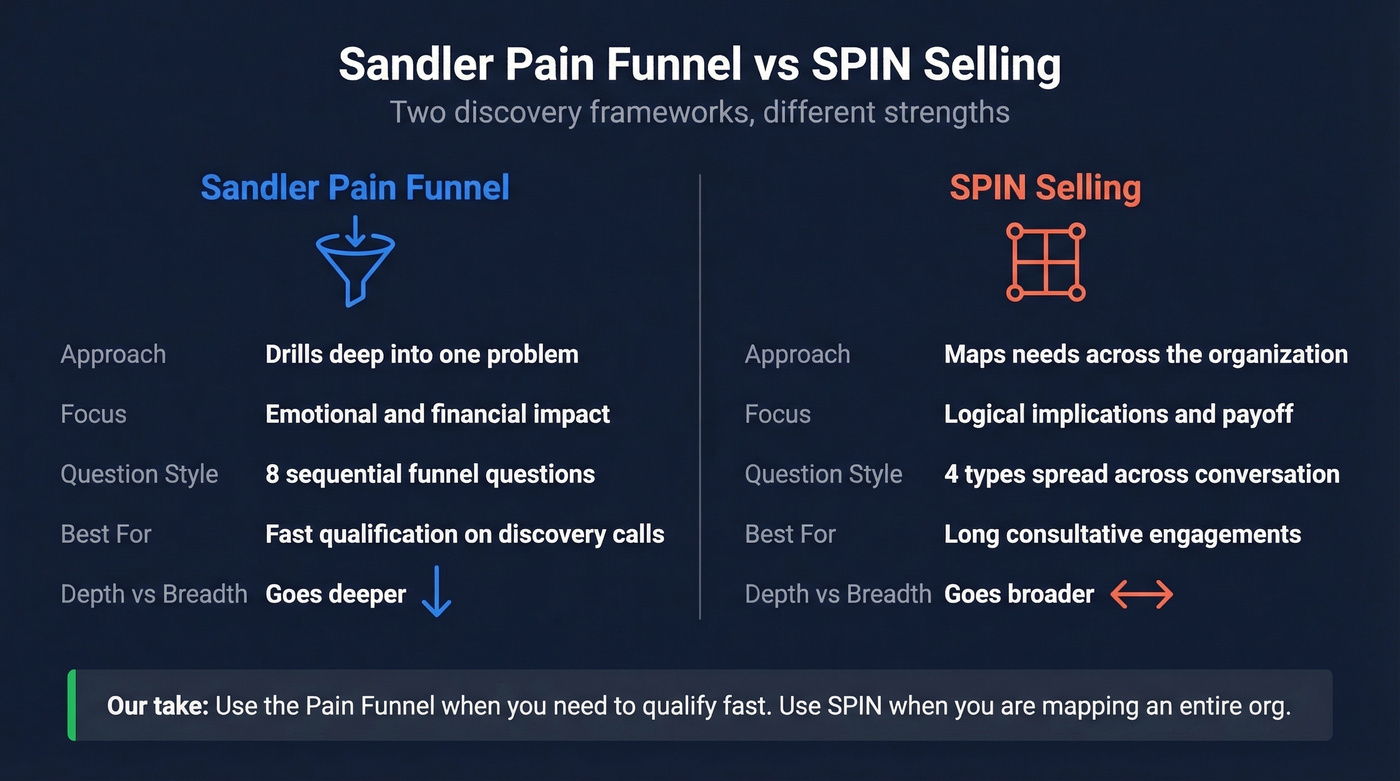
The downside: it can feel heavy-handed if you rush it or skip the permission statements. And it does slow the conversation down. But slower discovery means shorter sales cycles - you qualify harder up front so you don't waste weeks on deals that were never real.
How does it compare to SPIN? SPIN uses four question types - Situation, Problem, Implication, Need-payoff - spread across the full conversation. The Sandler Pain Funnel drills deep into one problem and emphasizes emotional impact more than SPIN does. SPIN is broader; Sandler goes deeper. Our recommendation: use the Pain Funnel for discovery calls where you need to qualify fast, and SPIN for longer consultative engagements where you're mapping an entire organization's needs.

The Sandler Submarine only works when you reach the right buyers. Prospeo gives you 300M+ profiles with 98% email accuracy and 125M+ verified mobiles - so your Pain Funnel conversations happen with real decision-makers, not gatekeepers.
Seal every compartment faster with contacts that actually connect.
Negative Reverse Selling
Here's the technique that separates Sandler practitioners from Sandler tourists.
Negative Reverse Selling is reverse psychology applied to sales conversations. You use it when you're stuck on what HubSpot calls "Hope Island" - that purgatory of vague follow-ups where the prospect says "email me," "call me back next week," or reschedules three times without committing or declining.
The move: instead of pushing harder, you pull back and agree that it might not be a fit.
Prospect: "This looks interesting. Send me some more info and I'll take a look." You: "I appreciate that. Honestly, based on what you've shared, I'm not sure this is the right fit for you. Is it fair for me to assume that's the case?"
The prospect now has two choices: agree (and you've closed the file cleanly) or push back and sell themselves on why it is a fit. Either outcome beats another month on Hope Island.
Sandler partners describe this as "strip-lining" - a bonefish fishing metaphor. When the fish bites, you don't reel in immediately. You let line out so the fish swallows the hook. Neutral prospects are the hardest because they aren't emotionally engaged. Moving them negative first - disarming them because they expect persuasion - gets them in motion.
A warning: this technique is easy to misuse. Done poorly, you sound dismissive. Apply it selectively, when you're genuinely stuck in a stall pattern. It's a scalpel, not a sledgehammer.
Does the Sandler Method Actually Work?
The most cited case study is TDIndustries, which moved from 5% to 50% conversion rates over three years using the 7-step framework with rigorous qualification gates. That's a dramatic number, and it tracks with broader patterns: teams that consistently enforce qualification gates typically see 10-25% win-rate improvement and 10-20% reduction in cycle time.
The friction is real, though. A manual Sandler scorecard - tracking 10-15 fields per deal - takes 15-20 minutes per call. Without tooling, 60-70% of that data goes uncaptured. And 32% of sales teams waste time on unqualified leads, which is exactly the problem Sandler is designed to solve.
The methodology is sound. The problem is almost always implementation. "Close the sale or close the file" is the single most valuable idea in B2B sales - but it requires discipline most teams don't have on day one.
When Sandler Works - and When It Doesn't
Sandler is best for one-on-one seller-to-buyer opportunities with relatively short sales cycles: SMB and mid-market sales where a single champion can make or influence the decision, or founder-led SaaS selling where you need fewer demos and faster decisions.
Skip it for technical, complex, or enterprise deals with five-plus stakeholders, technical evaluations, or buying committees. When you're selling to a C-suite panel, the submarine model breaks down - you can't seal compartments when different stakeholders are at different stages.
Hot take: If your average deal size is under $15K and your cycle is under 60 days, Sandler is the best sales methodology available. Full stop. MEDDIC is overkill, Challenger requires industry expertise most reps don't have, and SPIN doesn't give you enough process structure. Sandler hits the sweet spot of rigor without bureaucracy.
| Methodology | Best For | Core Mechanism | Weakness |
|---|---|---|---|
| Sandler | 1-on-1, short cycles | Mutual qualification | Struggles with committees |
| MEDDIC | Enterprise, complex deals | Forecast protection | Heavy process overhead |
| Challenger | Status-quo disruption | Reframe buyer thinking | Needs deep industry expertise |
| SPIN | Consultative discovery | Structured questioning | Less prescriptive on process |
For enterprise deals with five-plus stakeholders, use MEDDIC for qualification but borrow Sandler's Pain Funnel for discovery. The two aren't mutually exclusive.
Sandler Training pricing typically lands around $4,000-$12,000+ per rep annually depending on format and coaching cadence. The irony of a budget-first methodology that doesn't publish its own pricing isn't lost on anyone.
Making the Sandler Sales Submarine Stick
The framework is simple to explain. Getting reps to actually use it is the hard part. On Reddit, the consensus around external sales training is blunt: reps describe it as "cringy," with forced roleplay, consultants grading delivery, and close to 10 hours per week lost to training activities. That's a real adoption barrier, and ignoring it guarantees your rollout fails.
Start with just two compartments: Up-Front Contracts and Pain Funnel. These deliver the fastest ROI and the least rep resistance. Map each compartment to a CRM pipeline stage in Salesforce or HubSpot - Bonding through Decision as qualification stages, Fulfillment and Post-Sell as closing stages. Run weekly deal reviews using the diagnostic signals from each compartment: "Where is this deal leaking?" Add compartments gradually over 4-8 weeks. Don't try to transform your team's entire selling motion in a single training session.
Sandler's transactional analysis roots - the adult-child-parent ego states - can feel academic in a training room. Skip the theory with your reps. Teach the scripts and the diagnostic signals. The psychology works whether or not they know the label.
Let's be honest about something nobody talks about: the entire framework assumes you're talking to the right person. Bad contact data means you never reach Compartment 1. We've seen teams where reps bounce 30% of their emails and blame the methodology, not the list. A verified data platform like Prospeo keeps bounce rates under 4% with a 7-day refresh cycle and 98% email accuracy, so the data is current when you dial. If your reps can't reach the right prospects, no selling system saves you.
If you're diagnosing deliverability issues, start with email bounce rate benchmarks and fixes.

Compartment 5 leaks when you can't map the buying committee. Prospeo's 30+ search filters - including department headcount, job changes, and buyer intent across 15,000 topics - let you identify every stakeholder before the call starts.
Stop losing deals to people you didn't know existed.
FAQ
What are the 7 steps of the Sandler Submarine?
Bonding & Rapport, Up-Front Contracts, Pain, Budget, Decision, Fulfillment, and Post-Sell - grouped into Relationship (1-2), Qualification (3-5), and Closing (6-7). Each compartment must be sealed before advancing to prevent deals from stalling or dying in later stages.
Is the Sandler Selling System outdated in 2026?
The core framework remains highly effective for one-on-one, short-to-medium cycle deals. For complex enterprise sales with buying committees, pair Sandler's Pain Funnel and Up-Front Contracts with a multi-stakeholder methodology like MEDDIC for better coverage.
What is the Sandler Pain Funnel?
Eight questions that move from broad ("Tell me more about that") to emotionally specific ("How do you feel about that?"), designed to uncover the financial and emotional weight of a problem. The sequence matters more than exact wording - surface pain gets generic demos, deep pain closes deals.
How much does Sandler Training cost?
Expect $4,000-$12,000+ per rep annually depending on format - workshops, ongoing coaching, and certification all affect the total. Sandler doesn't publish pricing publicly, which is ironic for a methodology built on discussing budget early in every deal.
What tools help implement the Sandler methodology?
A CRM mapped to the 7 compartments for pipeline visibility, call recording software for coaching against compartment diagnostics, and a verified contact platform like Prospeo to ensure reps reach the right decision-makers before Compartment 1 even begins.