

Scrapfly Pricing, Reviews, Pros and Cons: What a Scrape Actually Costs
You ran your first 10,000 scrapes on Scrapfly's Discovery plan and burned through half your monthly credits in a day. That gap between the sticker price and what you actually pay? It's the single most important thing to figure out before you commit to any credit-based scraping API. We've dug into the real costs, benchmark data, and user feedback so you can decide whether Scrapfly fits your workflow in 2026.
Quick Verdict
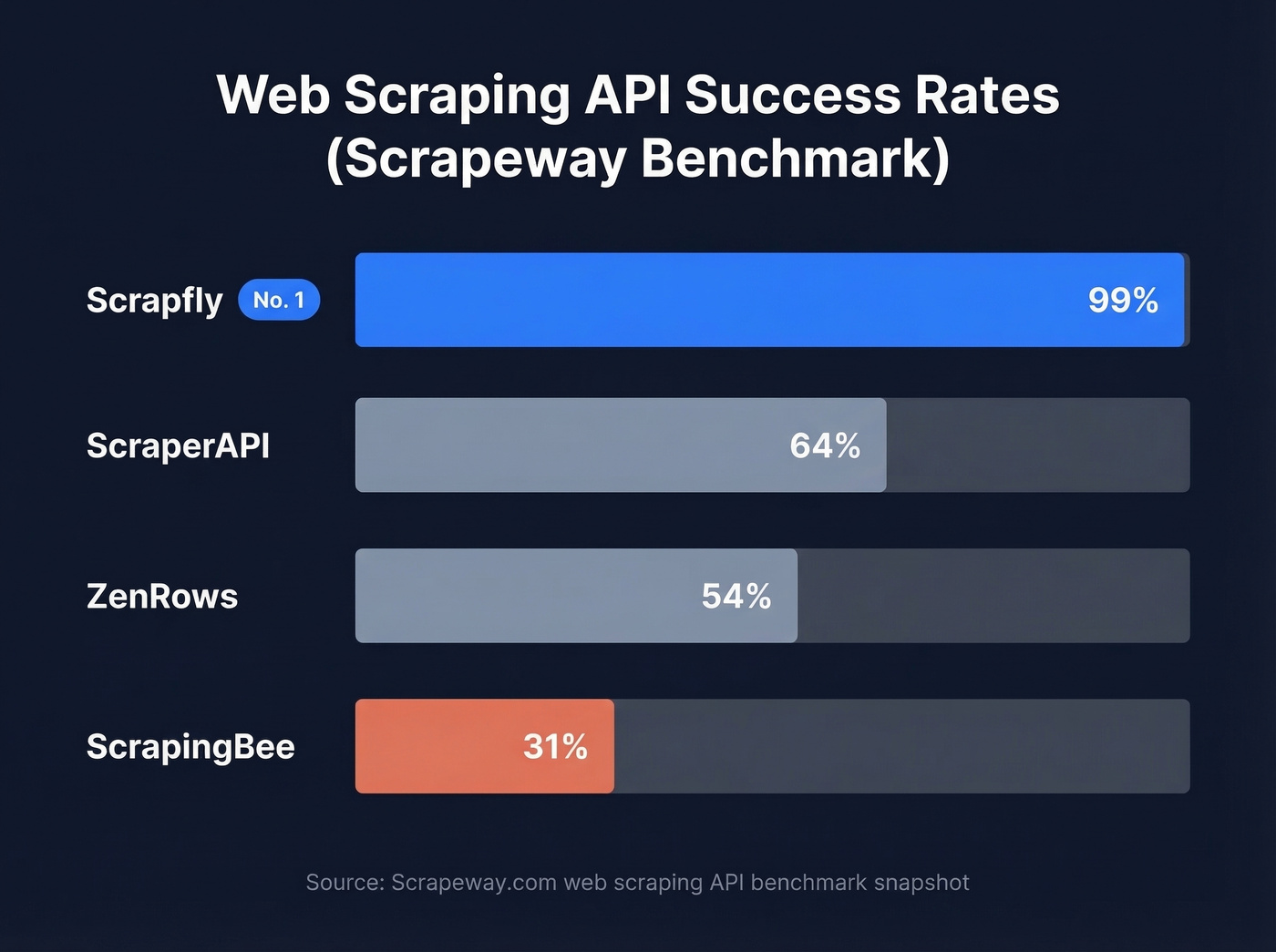
Scrapfly hits 99% success in Scrapeway's benchmark snapshot and ranks #1 overall in that data range. But credit-based pricing is deceptively complex - a "$30/month" plan can quietly cost $100+ once residential proxies and JS rendering kick in. Best for teams that prioritize reliability over budget predictability.
What Is Scrapfly?
Scrapfly is a web scraping API for developers who don't want to manage proxy infrastructure. It handles anti-bot bypass for Cloudflare, Imperva, DataDome, PerimeterX, Kasada, and Akamai, plus JavaScript rendering via cloud browsers and smart proxy rotation across datacenter and residential pools with geo-targeting. The platform serves 55,000 developers, is trusted by 15,000+ enterprises, and processes 15B+ API requests each month.
Scrapfly Pricing Plans in 2026

| Plan | Price/mo | Credits | Concurrency | PAYG / 10K | Support |
|---|---|---|---|---|---|
| Discovery | $30 | 200K | 5 | None | Basic |
| Pro | $100 | 1M | 20 | $3.50 | Standard |
| Startup | $250 | 2.5M | 50 | $2.00 | Standard |
| Enterprise | $500 | 5.5M | 100 | $1.20 | Premium |
| Custom | Contact sales | Custom | Custom | Custom | Dedicated |
The free trial gives you 1,000 credits. Discovery has no pay-as-you-go option - once you burn through 200K credits, you're done for the month.
The jump from Discovery to Pro isn't just 3x the price. It's 5x the credits, 4x the concurrency, and it unlocks PAYG overages. Pro is where the platform becomes genuinely usable for production workloads.
How Credits Actually Work
Here's the thing most people miss: a datacenter proxy request costs 1 credit. But most protected sites won't work on datacenter proxies. Switch to residential and you're at 25 credits per request. Add JavaScript rendering - necessary for any SPA or dynamically loaded page - and that's another +5 credits.
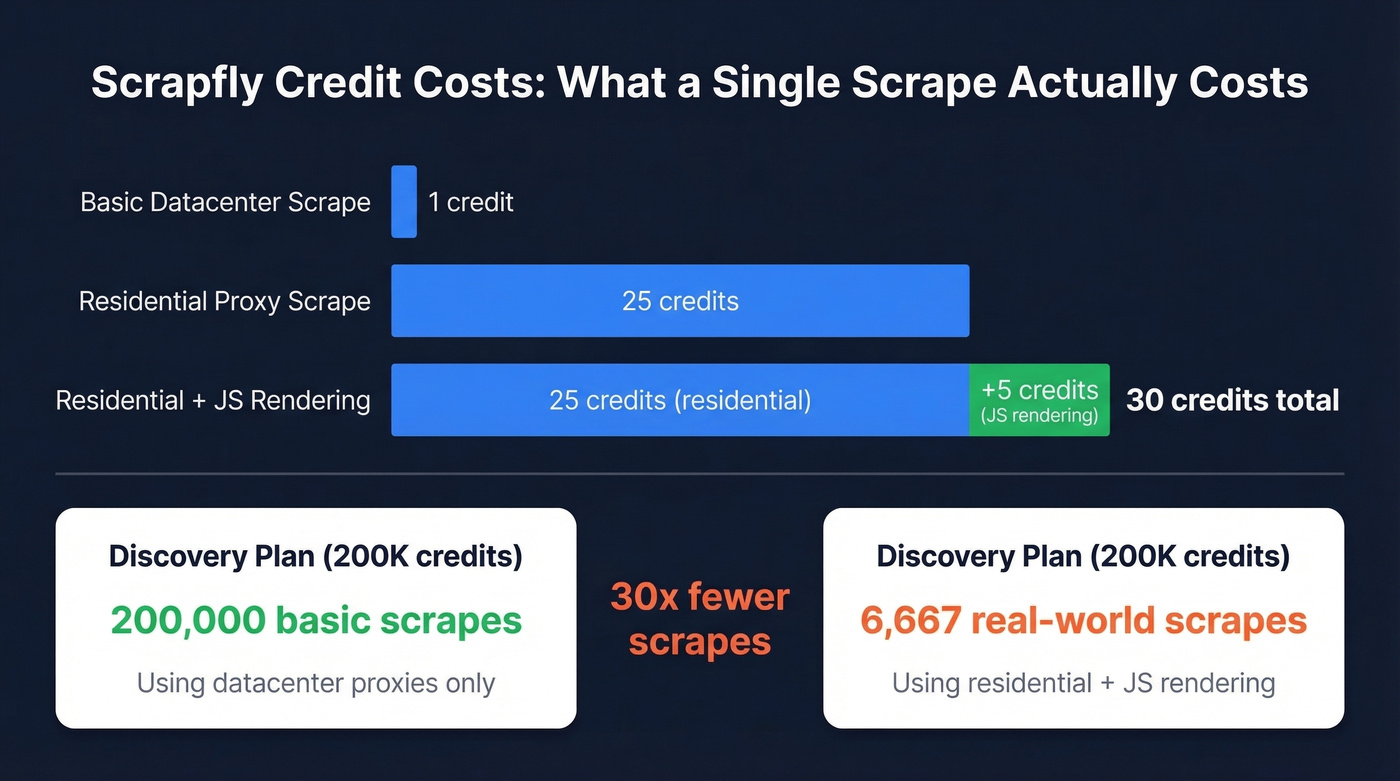
So a scrape of a protected, JS-heavy site often lands around 30 credits before any bandwidth add-ons.
On the Discovery plan, 200,000 credits cover 200,000 basic datacenter scrapes. But if your targets need residential proxies plus JS rendering, you're looking at roughly 6,667 scrapes. That's a 30x difference from the headline number, and it catches a lot of teams off guard.
Scrapfly's ASP system can dynamically upgrade your proxy pool mid-request to bypass anti-bot protection, which changes the final cost without warning. You send a request expecting datacenter pricing, and ASP switches it to residential to get the page through. That's how a 1-credit request becomes a 25-credit request.
Check the X-Scrapfly-Api-Cost response header on every request. Multiply that number by your monthly volume. That - not the plan price - is what you actually pay.
One more wrinkle: the PAYG cap defaults to 125% of your monthly quota. On a Pro plan with 1,000,000 included credits, that means up to 1,250,000 extra credits at $3.50 per 10K - a potential $437.50 overage on top of your $100 base.

Scraping credits are unpredictable. Contact data shouldn't be. Prospeo delivers verified emails from 300M+ profiles at 98% accuracy for ~$0.01 each - no credit multipliers, no surprise overages. Upload scraped domains or company names and get back emails and direct dials you can actually use.
Skip the credit math. Pay $0.01 per verified email.
Pros
- 99% success rate. Scrapeway's benchmark puts Scrapfly at 99% overall, compared to ScraperAPI at 64%, ZenRows at 54%, and ScrapingBee at 31%. In production, that gap is enormous.
- Per-target economics can be excellent. Walmart scrapes run $0.29 per 1,000. Amazon is $3.59/1K at 96% success. Even LinkedIn - notoriously difficult - comes in at $7.77/1K with 100% success.
- Cloudflare bypass that actually works. This is a recurring theme in Capterra reviews. Proxy rotation, anti-bot bypass, and JS rendering just work.
- 4.9/5 on Capterra across 221 reviews, with 4.8 for ease of use. Unusually high for developer tooling.
- Failed scrapes aren't billed. A fairness policy can disable this if failed traffic exceeds 30% within a minimum one-hour window, but under normal conditions you only pay for successful responses.
Cons
- Credit costs are unpredictable on protected sites. A request can cost anywhere from 1 credit up to 75+ credits on JS-heavy, protected pages. One Capterra reviewer reported their datacenter pool was blocked on the first API call, forcing a switch to residential at 25x the cost.
- No credit rollover, no annual plans. Unused credits expire monthly. For teams with spiky workloads, 10-30% waste is typical.
- Price increases happen. The consensus on r/webscraping is that Scrapfly works better than competitors, but one practitioner was blunt about being "pissed they decided to double our price." That's a real risk with any credit-based model where you've already built integrations.
Who Should Use Scrapfly
Use Scrapfly if reliability matters more than cost predictability, you're targeting heavily protected sites, or you need JS rendering without managing browser infrastructure. Start with Discovery for testing, but plan on Pro minimum for protected-site work.
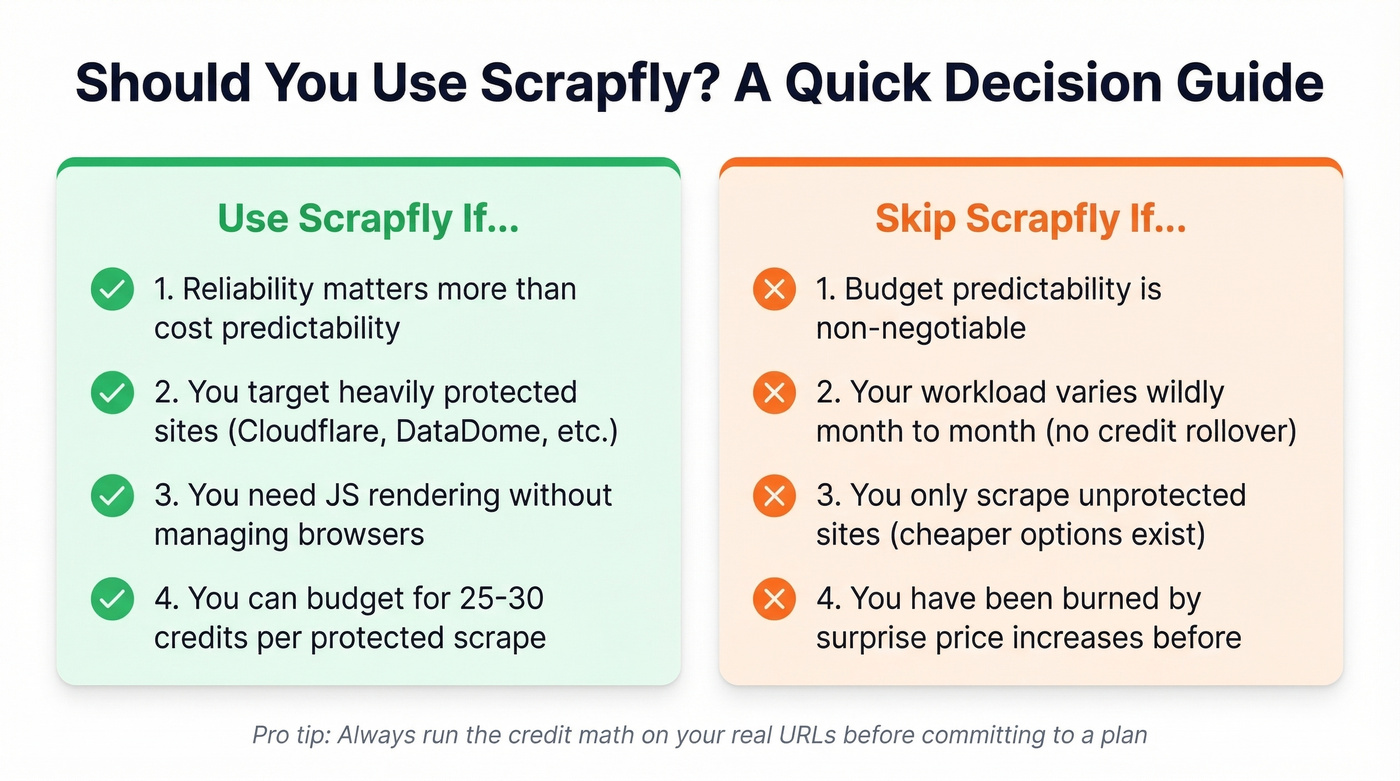
Skip Scrapfly if budget predictability is non-negotiable - Scrape.do starts around $29/mo with a more straightforward request-based allowance. It's also not ideal if your workload varies wildly month-to-month, since the no-rollover policy will burn you. And if you're only scraping unprotected sites, datacenter proxy bandwidth pricing from simpler providers is typically cheaper.
Let's be honest: Scrapfly is probably the best scraping API available right now on pure reliability. But most teams overpay because they don't model credit costs against their actual targets before committing. Run the math first.
From Raw HTML to Verified Contacts
Scrapfly gives you raw HTML. If you're scraping for B2B prospecting, you still need to turn those pages into contacts you can actually email. We've found that pairing a scraping tool with Prospeo closes that gap - upload a CSV of scraped company names or domains and get back verified emails and direct dials from 300M+ professional profiles at 98% accuracy.
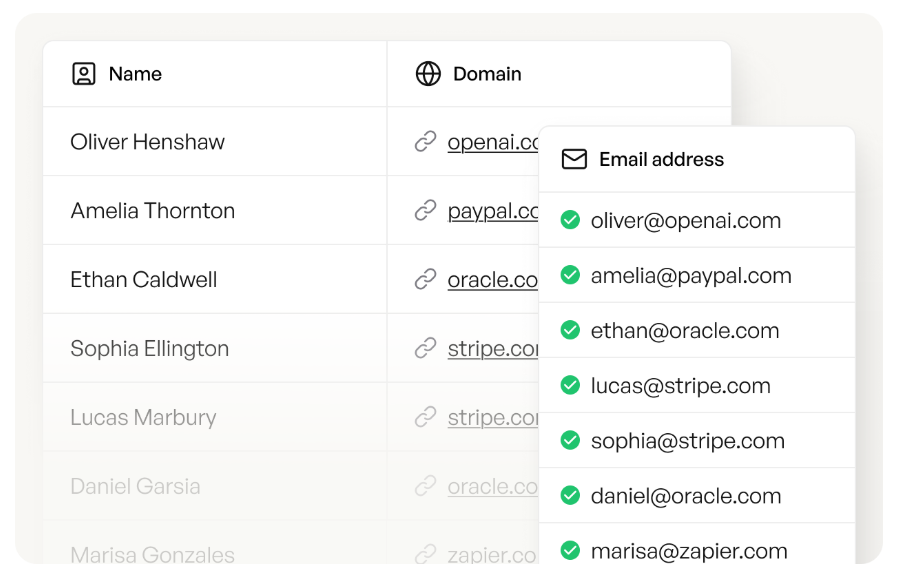
Scrapfly gets you the HTML. Prospeo gets you the people behind it. Enrich any CSV of scraped companies with 50+ data points per contact - verified emails, mobile numbers, job titles, intent signals - at a 92% match rate. No proxy costs, no rendering fees, no wasted credits.
Turn scraped pages into pipeline in one upload.
Bottom Line
Scrapfly is best-in-class on reliability and worst-in-class on pricing transparency. The 99% success rate is real - and it's hard to ignore when you're evaluating scraping APIs for production use.
But the credit math will surprise you if you don't model it first. Start with the free 1,000-credit trial. Scrape your real URLs, not test pages. Check that X-Scrapfly-Api-Cost header. That number, multiplied by your monthly volume, is the only pricing figure that matters.