

How to Search for a Valid Email Address in 2026
Roughly 1 in 6 emails never reaches the inbox. Your list decays about 23% per year. And once your bounce rate crosses 2%, ISPs start filtering you - recovery takes months, not days.
We've watched teams torch their sending reputation over a single uncleaned list. Knowing how to search for a valid email address isn't a nice-to-have; it's the difference between a healthy domain and a blacklisted one.
Quick picks:
- One-off check? Hunter Email Verifier - free to try, no signup needed.
- Bulk list cleaning? ZeroBounce - best accuracy in a widely cited 10k-email benchmark.
- Budget bulk? MillionVerifier - $0.0003/email.
How Email Verification Actually Works
Most people think verification is a single check. It's a four-layer stack, and each layer catches problems the previous one missed.
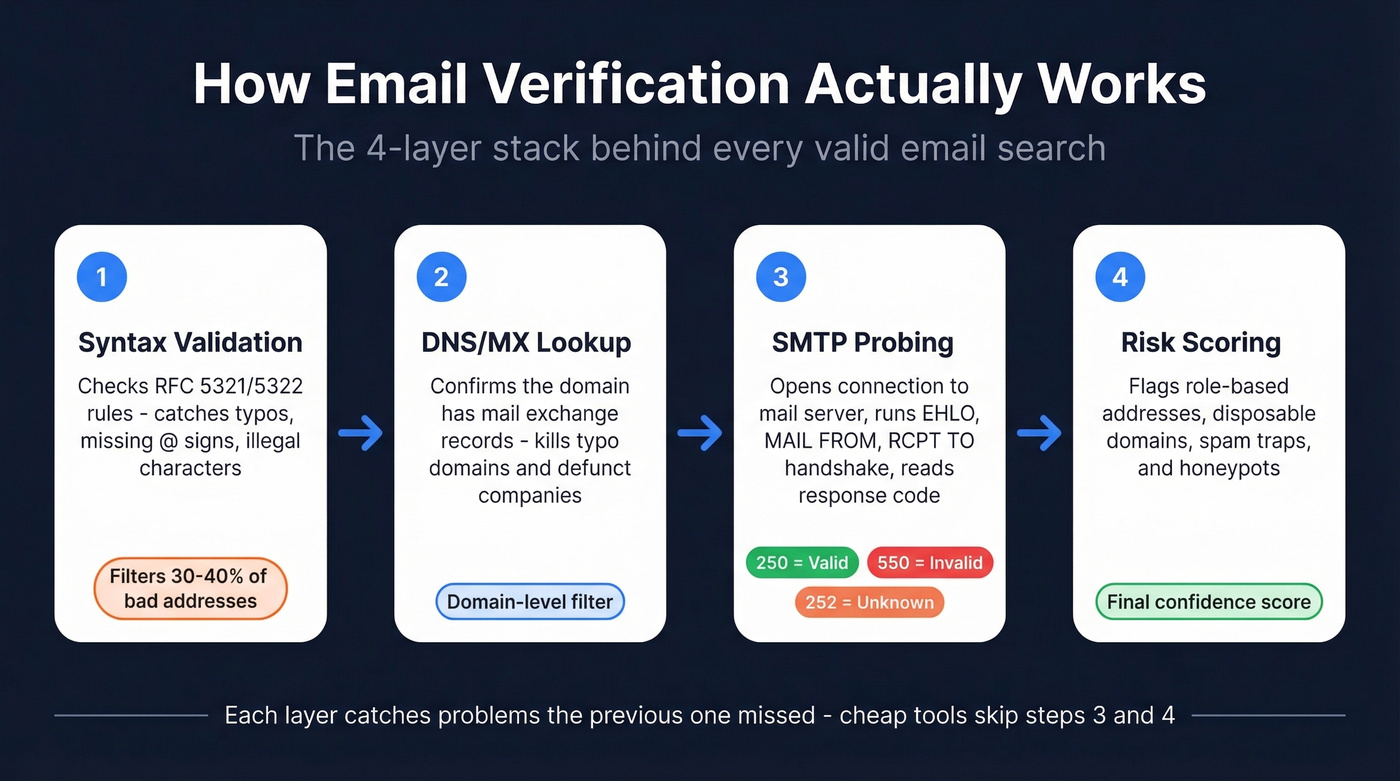
Syntax validation comes first. Does the address follow RFC 5321/5322 rules? This catches formatting garbage - typos, missing @ signs, illegal characters - but only filters roughly 30-40% of bad addresses.
DNS/MX lookup is next. Does the domain have mail exchange records? No MX record means nobody's receiving mail there. Kills typo domains and defunct companies fast.
SMTP probing is where the real work happens. The verifier opens a connection to the mail server, runs the EHLO, MAIL FROM, RCPT TO handshake, and reads the response code. A 250 means the mailbox exists. A 550 5.1.1 means no such user. A 252 is the headache code - the server intentionally says "I can't confirm this, but I'll accept the mail anyway."
Risk scoring rounds it out by flagging role-based addresses (info@, support@), disposable domains, spam traps, and honeypots. This is where cheap verifiers cut corners and expensive ones earn their keep.

Here's the thing: SMTP probing is powerful but messy. Large providers return misleading responses to frustrate mailbox enumeration. Strong verifiers mitigate this with retries across different IPs and time windows, plus pattern-based heuristics. Weak ones take the first response at face value and call it a day.
Why Tools Give Different Results
Run the same email through two verifiers and you'll get "valid" from one, "unknown" from the other. That's not a bug.
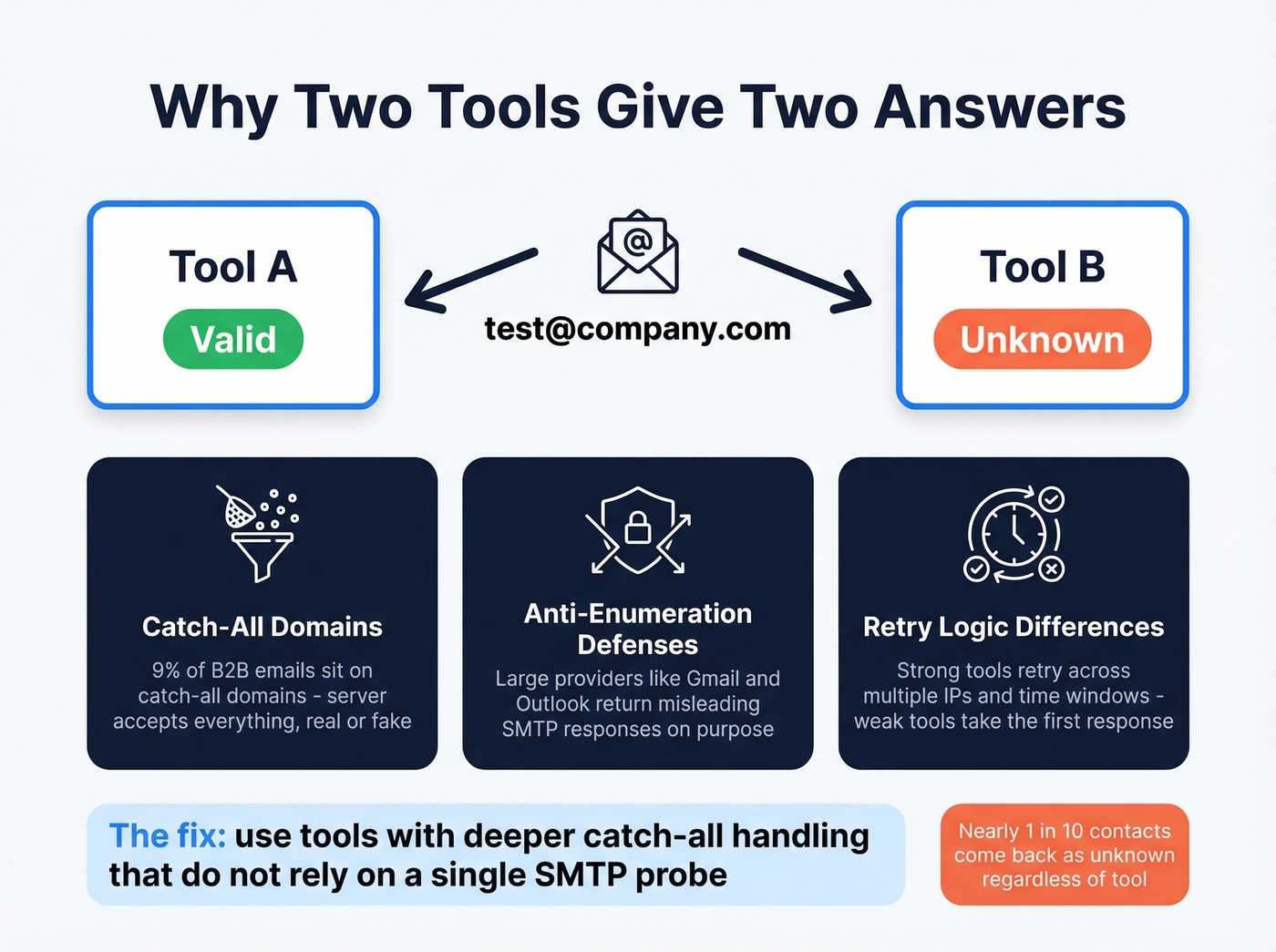
Catch-all domains are the biggest culprit. A catch-all server accepts mail to any address at that domain, real or fake. Over 9% of B2B emails sit on catch-all domains, meaning nearly one in ten contacts come back as "unknown" regardless of the tool you use.
"Unknown" shows up for a few technical reasons: true accept-all behavior, anti-enumeration defenses, and ambiguous SMTP replies like 252 where the server refuses to confirm or deny the mailbox but still accepts the message.
"Unknown" or "accept-all" means the mail server accepted the connection but wouldn't confirm the specific mailbox. The email might be valid. It might bounce.
Greylisting, anti-enumeration defenses, and differing retry logic across tools all compound the inconsistency. We see this frustration constantly in r/sales and r/coldemail threads - two tools, two answers, no clarity on which to trust. The answer is usually whichever tool has deeper catch-all handling and doesn't rely on a single SMTP probe.

Catch-all domains, greylisting, and conflicting SMTP responses make searching for valid emails a nightmare. Prospeo's 5-step verification handles all of it - catch-all resolution, spam-trap removal, honeypot filtering - on proprietary infrastructure refreshed every 7 days. 98% accuracy. No third-party email providers in the chain.
Find and verify emails in one step - pay $0.01 only when the address is valid.
Best Tools to Verify Email Addresses
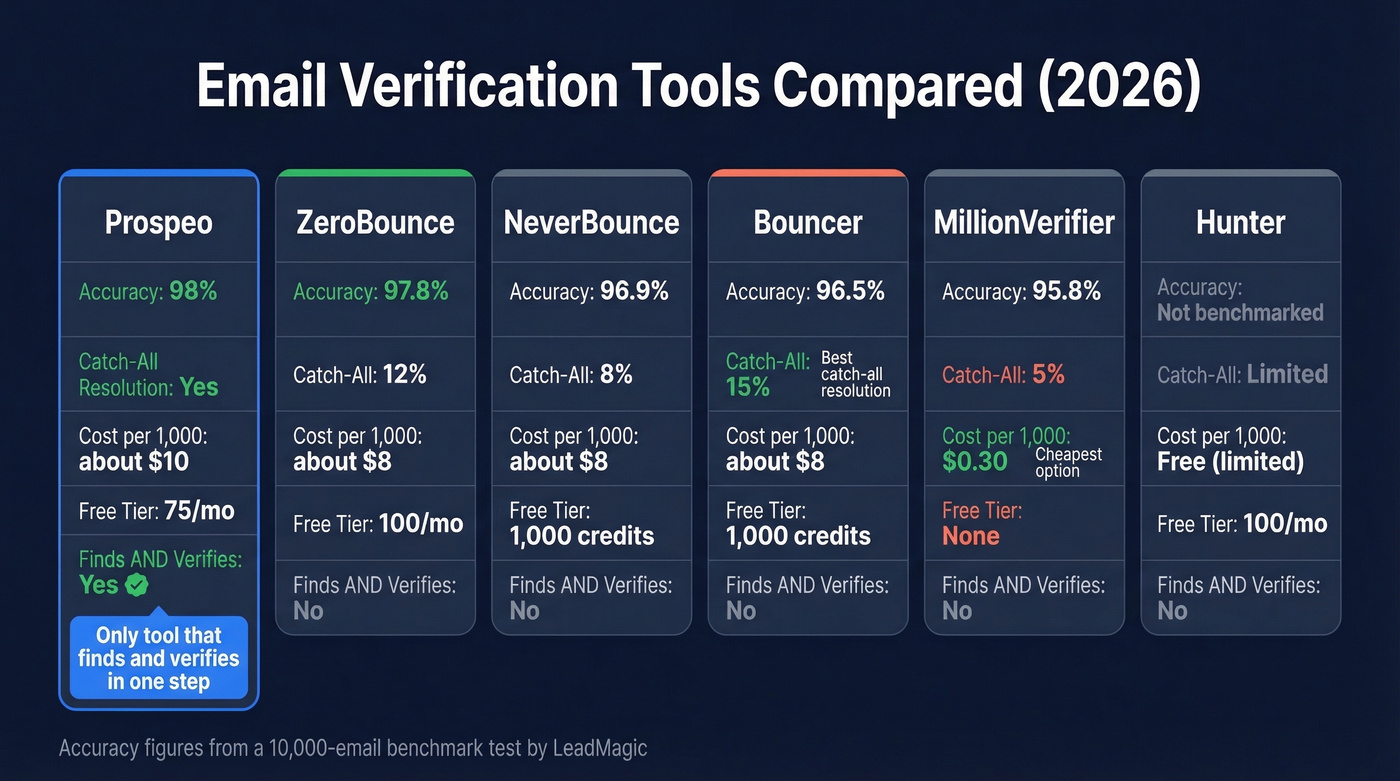
| Tool | Accuracy (10k test) | Catch-All Resolved | Cost per 1,000 | Free Tier |
|---|---|---|---|---|
| ZeroBounce | 97.8% | 12% | ~$8 | 100/mo |
| NeverBounce | 96.9% | 8% | ~$8 | 1,000 free credits |
| Bouncer | 96.5% | 15% | ~$8 | 1,000 free credits |
| MillionVerifier | 95.8% | 5% | ~$0.30 | - |
| Hunter | - | - | Free (100/mo) | 100/mo |
Prospeo
Prospeo is the only tool on this list that finds and verifies emails in a single step. Every other option assumes you already have a list - Prospeo builds it and cleans it simultaneously, which eliminates the two-tool workflow most teams run. If you need to find a valid email for a prospect and confirm it's deliverable before outreach, this is the fastest path.
The 98% email accuracy comes from a 5-step verification process: syntax and DNS checks, SMTP probing with catch-all handling, spam-trap removal, and honeypot filtering, all on proprietary infrastructure that doesn't depend on third-party email providers. Data refreshes every 7 days, compared to the 6-week industry average. Real-world results back this up - Snyk cut bounce rates from 35-40% to under 5% after switching, and Stack Optimize maintains 94%+ deliverability across all clients with zero domain flags.
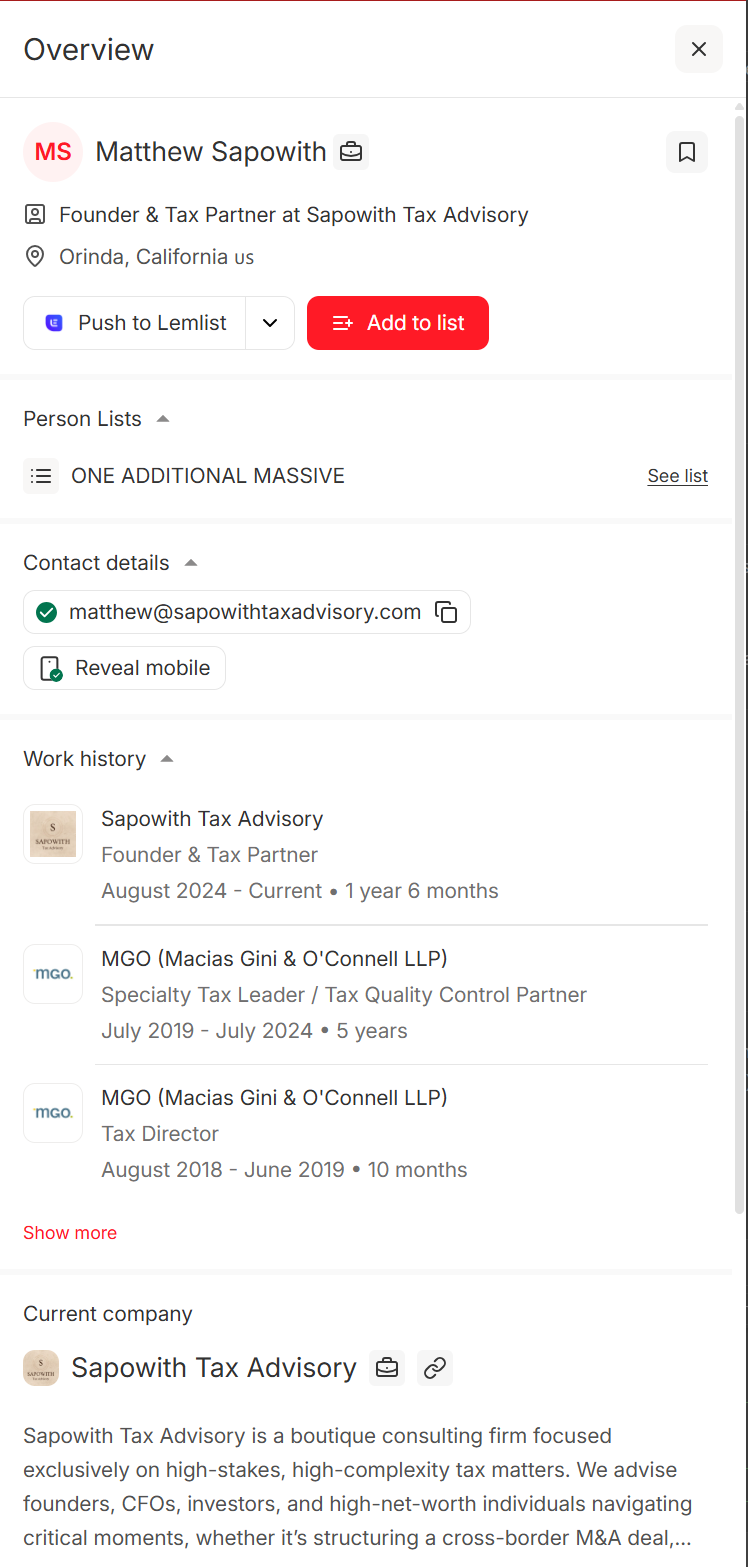
Pricing runs about $0.01 per email, and you only pay for valid results. The free tier gives you 75 emails per month - enough to test accuracy before committing.
ZeroBounce
Use this if you already have lists and need the most accurate bulk cleaning available. In a 10,000-email bake-off, ZeroBounce hit 97.8% accuracy with a 0.9% false positive rate - the best pure verifier in the test. It resolved 12% of catch-all addresses, which is solid. Pricing starts at $0.008/email, with 100 free monthly checks.
Skip this if you don't have lists yet. ZeroBounce is a verifier, not a finder.
Hunter
Hunter's the tool you reach for when you need to check one email right now and don't want to create an account. The Email Verifier is free to try with no signup, and the free plan includes 100 verifications per month. For confirming a prospect's address before a manual outreach, it's hard to beat.
Beyond that, it's limited. No meaningful catch-all resolution, no bulk processing at the free tier. Think of Hunter as your quick-check utility, not your production verifier.
Quick Mentions
NeverBounce - 96.9% accuracy, ~$0.008/email, 1,000 free credits. Reliable all-rounder with fast processing. Not the deepest catch-all resolution, but consistent.
Bouncer - The catch-all specialist. Resolved 15% of catch-all addresses in testing, the highest of any tool benchmarked. About $0.008/email. If your list is heavy on corporate domains, Bouncer earns its spot.
MillionVerifier - At $0.0003/email, absurdly cheap for bulk. Accuracy came in at 95.8% with only 5% catch-all resolution. You get what you pay for on the nuanced stuff, but for raw volume on a tight budget, nothing touches the price.
Let's be honest: if your average deal size is under $15k, you probably don't need the most expensive verifier. MillionVerifier at scale plus a manual spot-check on high-value prospects will outperform a premium tool you're underusing.
Most teams run two tools: one to find emails, another to verify them. That's double the cost, double the workflow, and still no guarantee. Prospeo combines finding and verification into a single lookup - Snyk cut bounce rates from 35% to under 5%, and Stack Optimize runs 94%+ deliverability with zero domain flags.
75 free emails per month. No signup friction, no contracts, no burned domains.
Keeping Your Emails Valid Over Time
Verification is point-in-time. Lists rot fast.
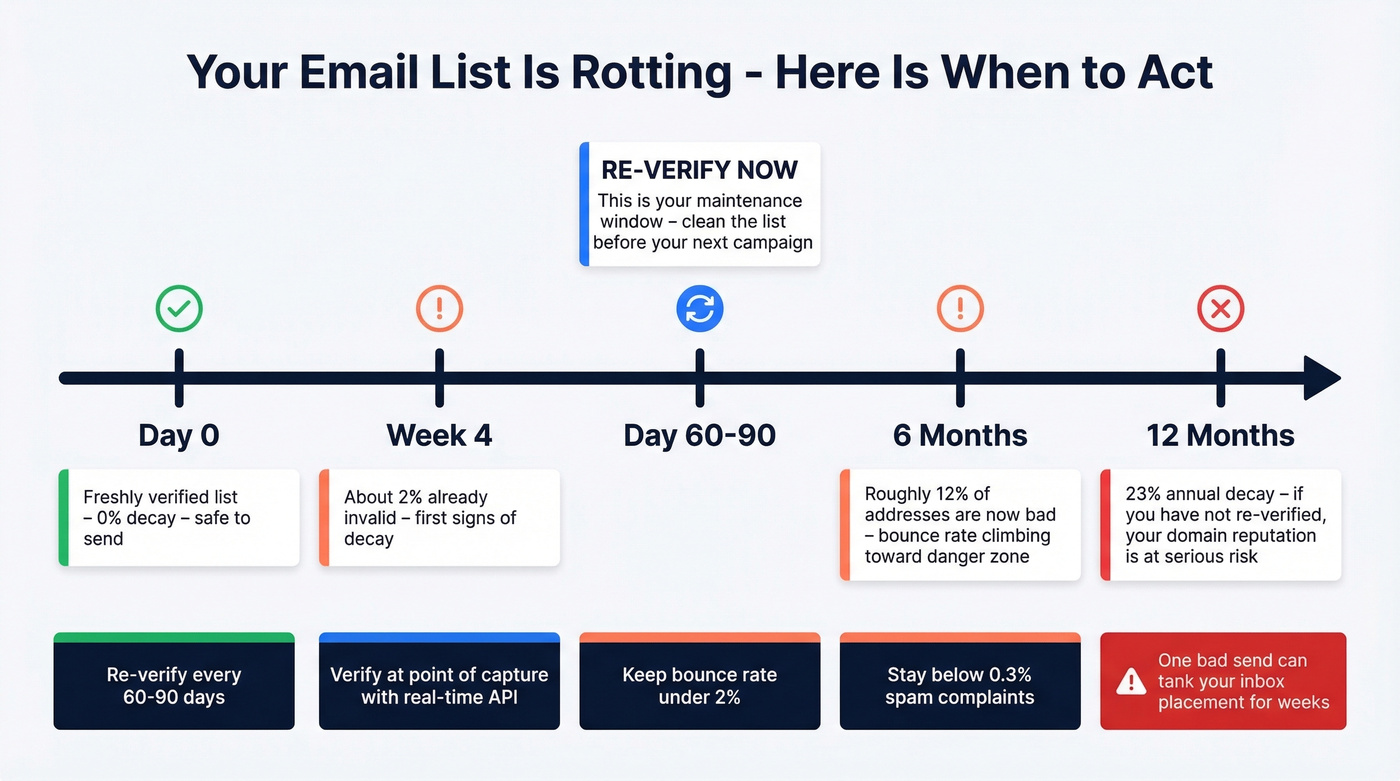
Re-verify every 60-90 days. After just 4 weeks, roughly 2% of a verified list is already invalid. In our experience, teams that skip this step are the ones scrambling to recover domain reputation three months later.
Treat accept-all results as risky. Segment catch-all results separately - don't blast them alongside verified addresses or you'll inflate your bounce rate. Keep that rate under 2%, and stay below 0.3% spam complaints. Gmail and Yahoo enforce this aggressively now. One bad send can tank your placement for weeks.
Verify at point of capture. Don't wait until your list is 10,000 deep and half-rotten. Real-time API verification on intake catches problems before they compound. We've seen teams cut their monthly bounce rate in half just by adding a verification API call to their signup forms and import workflows.
Warm new domains before blasting. Even with a perfectly clean list, a brand-new sending domain that fires 5,000 emails on day one will get flagged. Ramp up gradually over 2-3 weeks.
If you're trying to keep bounce rates down long-term, it helps to track email deliverability and monitor sender reputation as closely as you track pipeline.
FAQ
How do I check if an email address is valid?
Use a verification tool that runs the full four-layer check: syntax validation, DNS/MX lookup, SMTP probing, and risk scoring. Tools like Prospeo, ZeroBounce, and NeverBounce handle this automatically - you paste in the address, and the tool probes the mail server without actually sending a message.
How do I find a valid email address for a prospect?
Start with an email finder that combines discovery and verification. Prospeo takes a name and company domain, locates the most likely address, and verifies it in one step at 98% accuracy. Alternatively, gather addresses from company websites, then run them through a dedicated verifier before outreach.
Can I verify an email without sending one?
Yes. Verification tools probe the mail server via SMTP without delivering a message. They check syntax, DNS/MX records, and mailbox existence - nothing reaches the recipient's inbox. That's how every major validator works.
What does "catch-all" mean in verification?
A catch-all domain accepts mail to any address - real or fake - so verifiers can't confirm the specific mailbox exists. Results come back as "unknown." Over 9% of B2B emails sit on catch-all domains. Bouncer and Prospeo resolve the highest percentage of these.
How often should I re-verify my list?
Every 60-90 days minimum, and always before a major campaign. Lists decay about 23% per year - roughly 2% of verified addresses go bad within 4 weeks.