

How to Sell to Executives (Without Sounding Like Every Other Rep)
Your SDR just booked the CFO. Twenty minutes on the calendar. CRM notes say "interested in our platform." You've got one shot, and the playbook you used on directors won't cut it here.
Here's the thing most guides get wrong about selling to executives: it isn't a tips game. It's a preparation game. Do the research, and the meeting runs itself.
Why C-Suite Selling Is Harder Now
Buying groups now range from 5 to 16 people across as many as four functions, and 74% of those teams show unhealthy conflict during the decision process - based on Gartner's survey of 632 B2B buyers. That's three out of four deals where the buying committee is fighting internally before you even present.
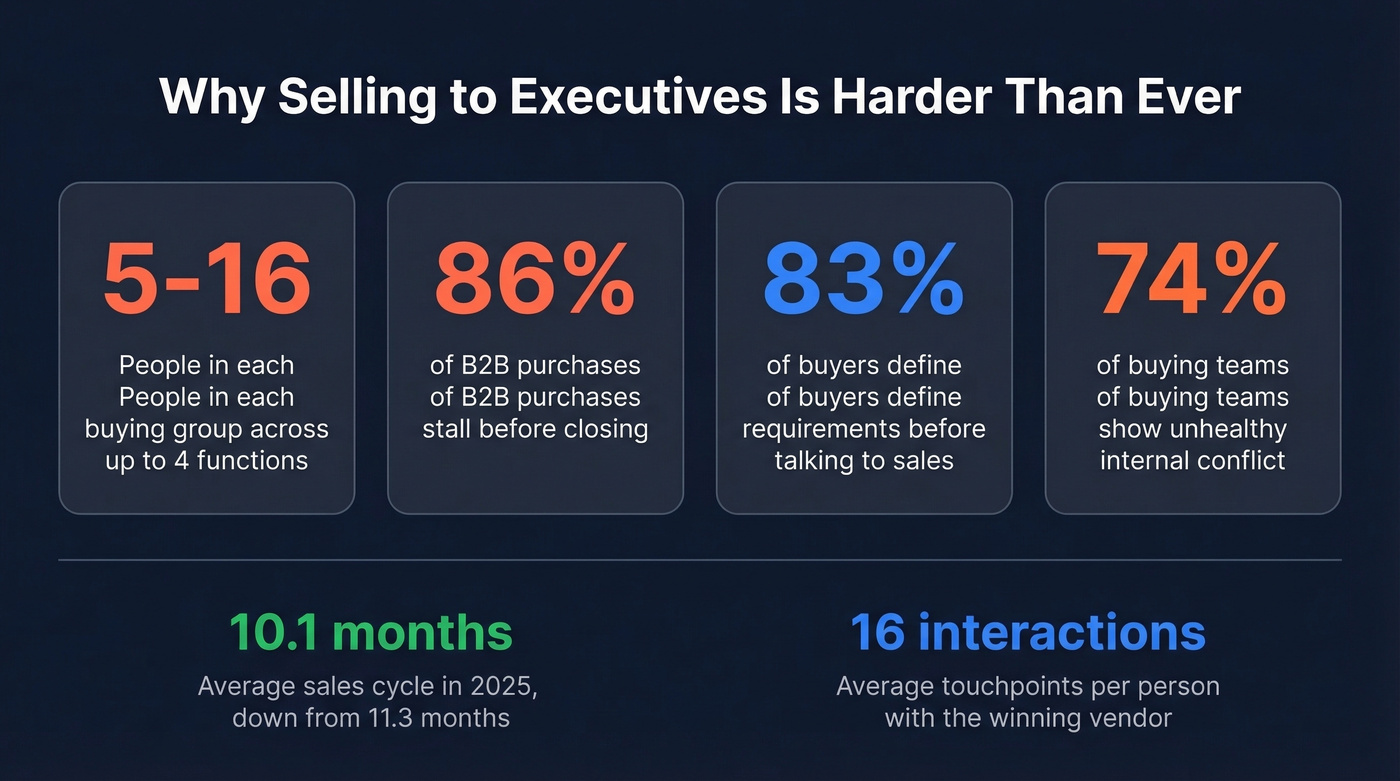
The cycle itself has compressed. Average sales cycle length dropped from 11.3 months in 2024 to 10.1 months in 2025, with 62% of buyers saying economic pressures pushed them to engage sellers earlier. Faster sounds good until you realize buyers are also doing more homework upfront - 83% mostly or fully define requirements before speaking with sales. Buyers average 16 interactions per person with the winning vendor, so every touchpoint either builds or erodes your credibility.
And the outcomes? 86% of B2B purchases stall. 85% of sales leaders report challenges from increased decision-makers per deal.
The old model - find the decision-maker, pitch the value prop, close - assumes a decision-maker exists. In most enterprise deals, they don't. There's a decision network. And 94% of buyers now use LLMs during the buying process, meaning your executive prospect has likely already AI-summarized your company before the meeting. If you're not selling to the network with that in mind, you're losing to it.
The Mindset Shift: Peer, Not Supplicant
A practitioner on r/sales put it like this: executives are "in a different stage of their career journey," not a different species. The intimidation most reps feel comes from a hierarchical lens - seeing the CFO as "above" you and unconsciously shifting into supplicant mode. That kills deals before they start.
RAIN Group's STRATEGIC framework codifies nine principles for executive selling, and gravitas and insight are two areas many reps underinvest in. Gravitas isn't about faking authority. It's about recognizing that you bring domain expertise they don't have. The CFO understands their P&L better than you ever will. But you understand how 200 companies like theirs solved the exact problem keeping them up at night. That's the trade.
Walk in as a peer offering a perspective, not a vendor begging for time. Confidence here is a skill, not a trait - you build it by doing the research, knowing the numbers, and having a point of view worth sharing.
How Executives Actually Decide
The Decision Network
Stop looking for "the decision-maker." In complex B2B sales, there's a decision network, and the person with the title often isn't the one who drives consensus. Deals don't stall because you failed to prove value. They stall because the buying group can't reach internal consensus on what problem to solve.
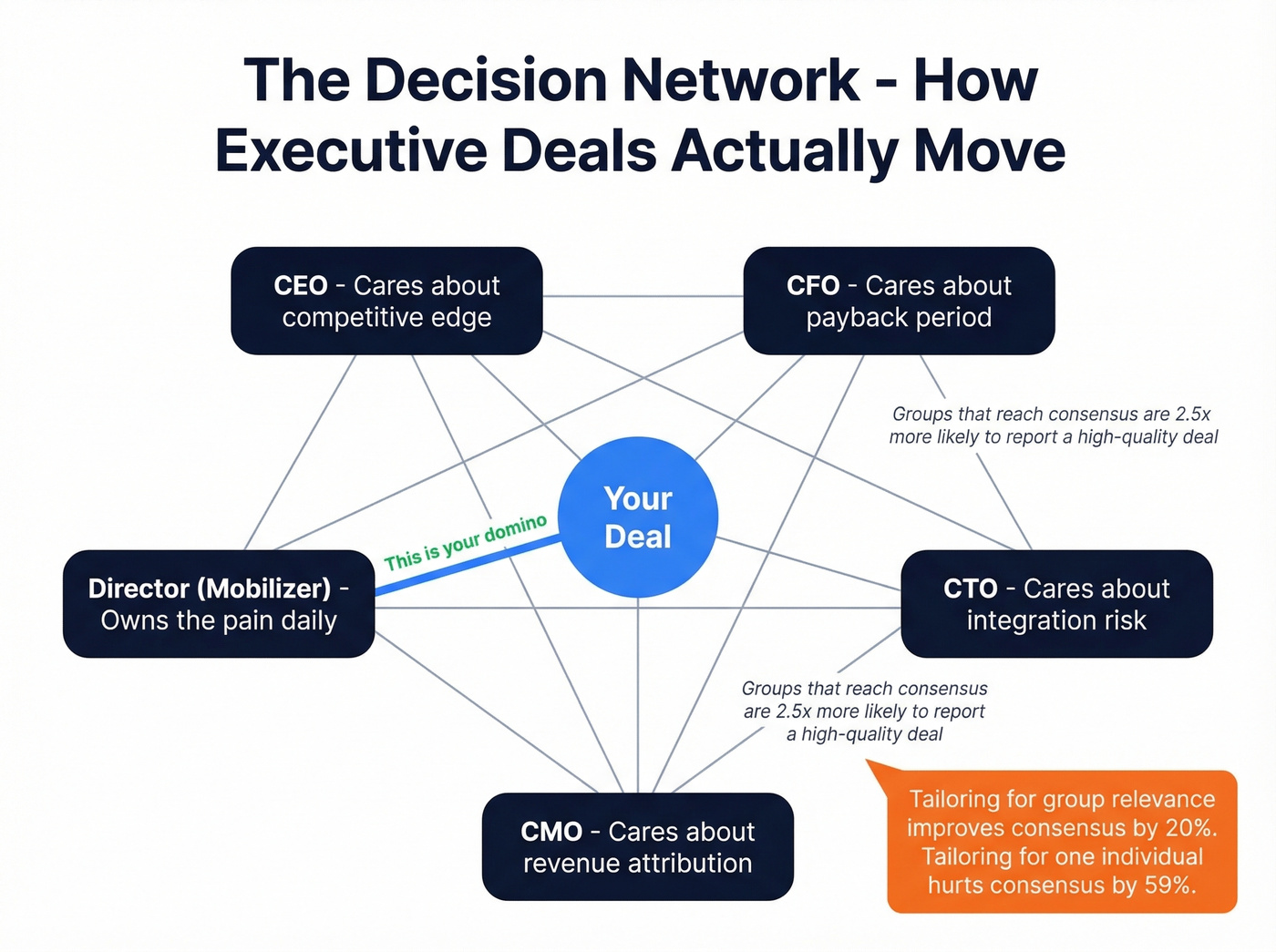
Your job is to find the mobilizer - the person inside the account who can rally cross-functional support. They're not always senior. Sometimes they're a director who owns the pain daily and has the political capital to push an initiative forward.
Look for the domino executive - the one person whose support triggers everyone else's. Find that person, and the deal moves. Miss them, and you're pitching into a vacuum.
Here's the Gartner data that should reshape how you approach selling to executives: tailoring your message for buying-group relevance improves consensus by 20%. But tailoring for individual-level relevance - making the pitch personal to one exec - has a 59% negative impact on consensus. Groups that reach consensus are 2.5x more likely to report a high-quality deal outcome, which means your job isn't just to sell. It's to help the buying group agree. Every piece of collateral, every email, every slide should be designed so your champion can pass it along and look smart doing it.
Reading the Room
Org charts tell you titles. Language tells you power dynamics. Listen for whether executives default to "I" (positional authority, likely a final approver) or "we" (collaborative decision-making, likely part of a broader network). Blockers hide behind abstractions - "process" and "policy" are their shields. Champions speak with urgency and outcomes.
One discovery prompt that consistently surfaces the real decision network: "Walk me through what happens after you recommend us. Who weighs in?" That single question reveals more about internal politics than any org chart research.
Match Their Decision-Making Style
This is the most underrated angle when selling to executives - and in our experience, the single most fixable reason reps lose C-suite deals. Korn Ferry identifies five decision-making styles: Charismatic, Thinker, Skeptic, Follower, and Controller. About 80% of sales presentations are geared toward Skeptic and Controller styles, but those styles represent only 30% of executives.
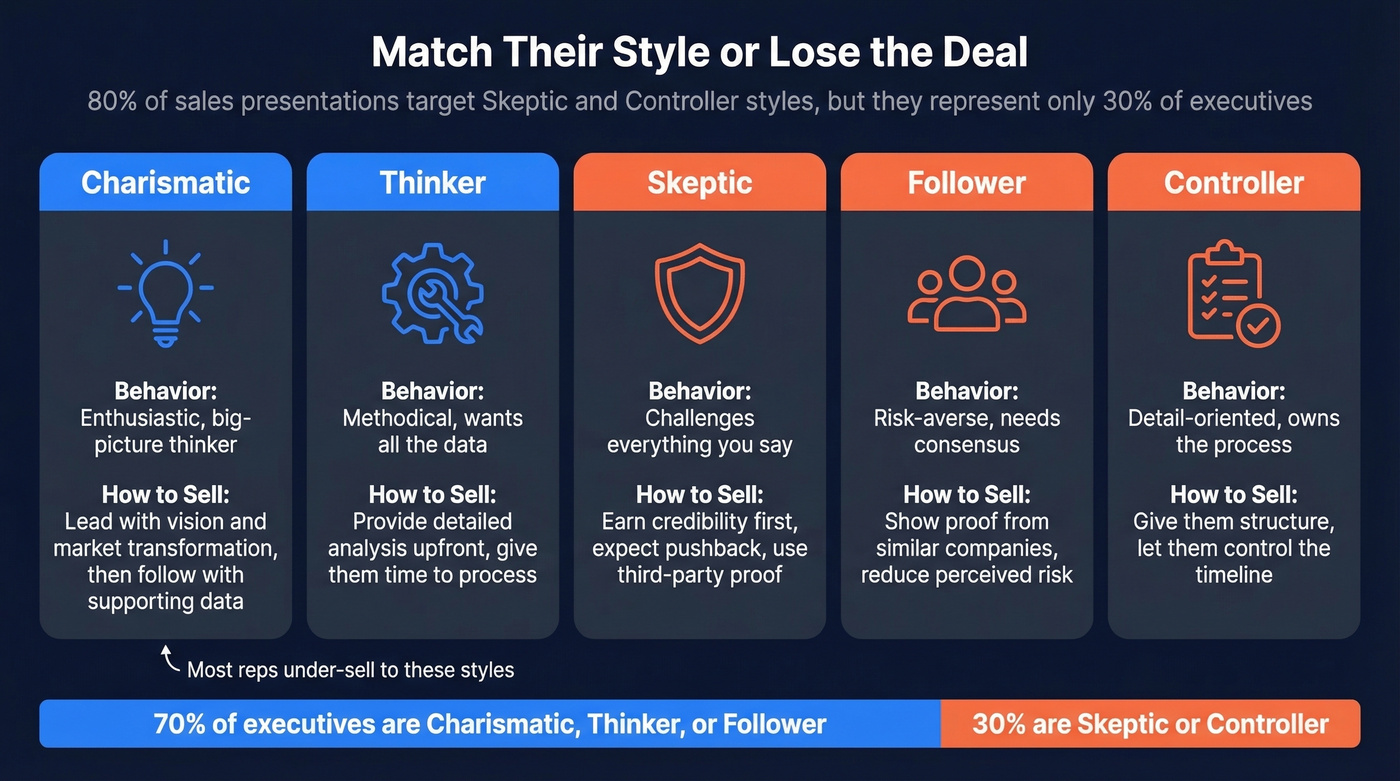
That mismatch is killing your win rate.
| Style | Behavior | How to Sell |
|---|---|---|
| Charismatic | Enthusiastic, big-picture | Lead with vision, follow with data |
| Thinker | Methodical, data-driven | Provide detailed analysis upfront |
| Skeptic | Challenges everything | Earn credibility, expect pushback |
| Follower | Risk-averse, consensus | Show proof from similar companies |
| Controller | Detail-oriented, owns process | Give them structure and control |
Research the executive's style before the meeting. Read their interviews, conference talks, and earnings call commentary. A Charismatic CEO wants to hear about market transformation. A Controller CFO wants a spreadsheet. Presenting in your style instead of theirs is one of the fastest ways to lose a deal you should've won.

You just learned that 83% of buyers define requirements before talking to sales. That means your executive outreach has to be razor-sharp from the first touch. Prospeo gives you 30+ filters - including buyer intent, funding signals, and headcount growth - so you reach the right C-suite contacts with the context that earns a meeting.
Build your executive prospect list in minutes, not hours.
Tailor Your Message by Role
Executives aren't a monolith. A CEO and a CTO care about fundamentally different things, and the message that lands with one will fall flat with the other.
| Role | What They Care About | Lead With | Avoid |
|---|---|---|---|
| CEO | Growth, competitive edge | Strategic positioning, market share | Tactical details, feature lists |
| CFO | Financial health, ROI | Cost impact, payback period | Vague "value" without numbers |
| CTO | Integration risk, complexity | Architecture fit, long-term cost | Oversimplifying tech debt |
| CMO | Revenue attribution, ROI proof | Pipeline impact, attribution data | Brand-only metrics without revenue |
The CEO wants to know how you make them more competitive. The CFO wants to know the payback period in quarters, not years. The CTO wants to know what breaks when they plug you in. Same product, four completely different conversations.
How to Get the Meeting
Channel Benchmarks
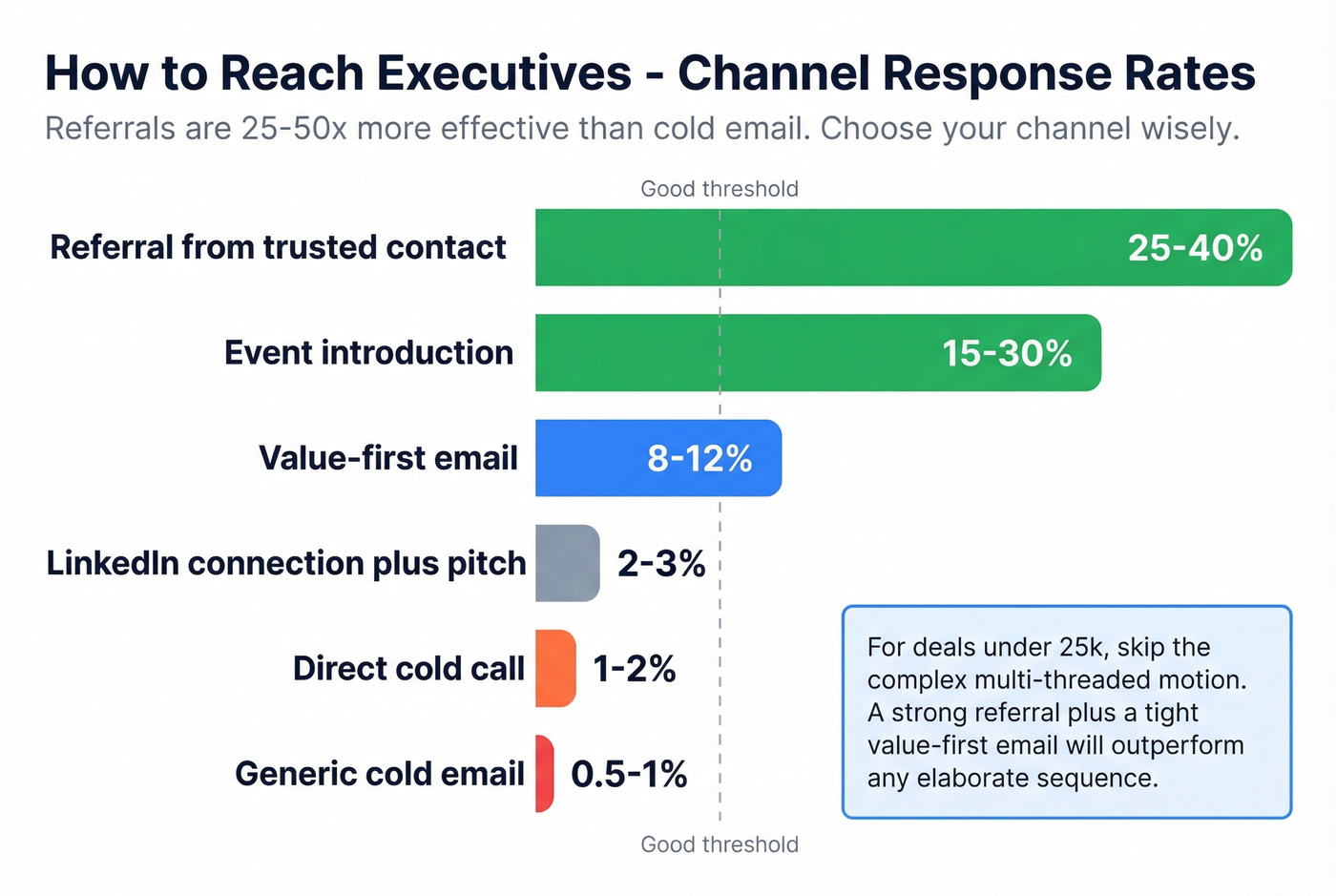
Let's be honest about the access problem. CEOs receive 120+ emails a day. The channel you choose matters more than the message inside it.
| Channel | Response Rate |
|---|---|
| Referral from trusted contact | 25-40% |
| Event introduction | 15-30% |
| Value-first email | 8-12% |
| LinkedIn connection + pitch | 2-3% |
| Direct cold call | 1-2% |
| Generic cold email | 0.5-1% |
Referrals aren't a nice-to-have. They're 25-50x more effective than cold email. If you're not building a referral strategy into every account plan, you're choosing the hardest path every time.
For teams running deals under $25k, skip the complex multi-threaded executive selling motion. A strong referral and a tight value-first email will outperform any elaborate sequence. Save the full-court press for deals that justify it.
When cold email is your only option, two things matter: the message and the data behind it. Verify the email is live before you send - repeated bounces hurt your sender reputation and deliverability. We've seen teams lose entire domains because they blasted stale executive lists without verification.
The Executive Cold Email Template
Ian Koniak's 5-step framework is the best structure we've tested for executive cold emails. The principle: SHOW ME YOU KNOW ME. Deep research plus a point of view beats a product pitch every time.
SBI's RAMP framework - Research, Access, Meet, Propose - is a useful pre-meeting checklist, but most reps skip the first two steps entirely. Koniak's template nails the Access step:
- Start warm - a personal connection or shared context
- Sincere compliment - not flattery, something specific you genuinely respect
- Observation + research link - reference an earnings call, podcast, or article
- Offer your point of view - "focused on X, help by Y, achieve Z"
- Ask for the meeting - simple, low-pressure
Here's what that looks like for a CFO:
Subject: [Company]'s margin expansion - a thought
Hi [Name],
Congrats on the Q3 results - the 200bps margin improvement stood out, especially given the headcount growth.
I noticed you mentioned on the earnings call that procurement efficiency is a priority for 2026. We've helped three similar-stage SaaS CFOs cut vendor spend 15-20% without cutting headcount or productivity.
Happy to share what we're seeing in a 15-minute call - no pitch, just perspective. Worth a look?
Keep it 50-125 words. Cold emails in that range get roughly 50% higher reply rates than longer ones. Most executives read email on their phone first - if your message requires scrolling, it's too long.
Mistakes That Kill Executive Deals
Do this: Lead with a point of view and insight from your research. Executives want to learn something they didn't know.
Not that: Ask endless questions before providing any value. Most of those questions should've been answered before you walked in.
Do this: Frame everything around business outcomes - revenue impact, cost reduction, risk mitigation.
Not that: Talk about features. "Our platform has AI-powered analytics" means nothing to a CFO. "We cut reporting cycles from 3 weeks to 2 days" means everything.
Do this: Have a conversation. Executives want a strategic dialogue, not a presentation.
Not that: Run a demo in an executive meeting. Nothing signals "wrong level" faster than pulling up a product walkthrough with a C-suite audience.
Do this: Present in their decision-making style, not yours. Remember the 80%/30% mismatch - most pitches are built for Skeptics and Controllers, but most executives aren't.
Not that: Over-prepare for objections while under-preparing for business conversations. As HubSpot's research puts it, reps are "overprepared for objections and underprepared for business conversations." That's the gap.
Before You Reach Out - Fix Your Data
You spent two weeks getting the meeting. Crafted the perfect email using Koniak's framework. Researched the executive's decision-making style. Then it bounced because the contact data was six months old.
That's not a sales problem. It's a data problem. When Snyk deployed Prospeo across their 50-AE sales org, bounce rates dropped from 35-40% to under 5%, and AE-sourced pipeline jumped 180%. That's the difference fresh data makes when you're reaching executives who change roles, companies, and email addresses constantly. The free tier gives you 75 verified emails per month - enough to test on your next executive outreach campaign without a contract.
Mapping the decision network is the hard part. Finding their verified contact data shouldn't be. Prospeo's 300M+ profiles with 98% email accuracy and 125M+ verified mobile numbers mean you reach every stakeholder in the buying committee - not just the one who showed up on LinkedIn.
Every stakeholder in the deal, every direct line - at $0.01 per email.
FAQ
How do you get past the gatekeeper to reach an executive?
Lead with referrals - they convert at 25-40% versus 0.5-1% for generic cold email. If no referral exists, send a value-first email with a researched insight tied to the executive's public priorities. Reference an earnings call, a conference talk, or a recent company announcement. Never ask the gatekeeper to "pass along a message."
What's the biggest mistake when selling to C-suite executives?
Pitching features instead of business outcomes. Executives don't care what your product does - they care what it changes. Lead with the strategic problem you solve and the financial impact of inaction. Every minute spent on a product walkthrough in an executive meeting signals you don't understand their level.
How long should a cold email to an executive be?
Between 50 and 125 words. Emails in that range get roughly 50% higher reply rates than longer ones. Open with a researched observation, offer a specific point of view, and close with a low-pressure ask. If your message requires scrolling on a phone, it's too long.
How do I identify an executive's decision-making style before the meeting?
Read their public content - earnings calls, podcast appearances, conference keynotes, and published interviews. Charismatic executives talk about vision and market shifts. Thinkers reference data and methodology. Skeptics challenge assumptions publicly. Controllers focus on process and timelines. Fifteen minutes of research here can change the entire trajectory of your meeting.