

How to Send SEO Cold Emails That Actually Get Replies
You found a local business ranking on page 4 for their money keyword. You ran a quick audit, spotted three fixable issues, and sent a thoughtful SEO cold email explaining exactly what you'd do. Nothing. No reply, no open, not even a bounce notification to confirm someone received it.
Some founders have written off cold email entirely after sending 2,000 messages and getting 6 replies. The gap between their results and 6%+ reply rates isn't talent - it's infrastructure.
Here's the thing: most SEO outreach email advice focuses on copywriting. That's backwards. We've seen agencies burn through 3-4 domains before realizing the problem was list quality and deliverability, not their pitch. Fix the pipes first, then worry about the words.
What You Need Before Anything Else
- Fix infrastructure first. Dedicated sending domains, SPF/DKIM/DMARC authentication, and a 2-4 week warm-up period. Skip this and nothing else matters.
- Verify every email before sending. Bounce rates above 2% destroy your sender reputation. One bad list can flag your domain for months.
- Keep emails under 80 words with a specific observation about their site. Generic "free SEO audit" pitches get deleted on sight.
Benchmarks Worth Knowing
The average cold email reply rate sits at 3.43%. Top-quartile campaigns hit 5.5%+, and elite senders push past 10.7%. Those numbers aren't SEO-specific, but they're the benchmark you're competing against.
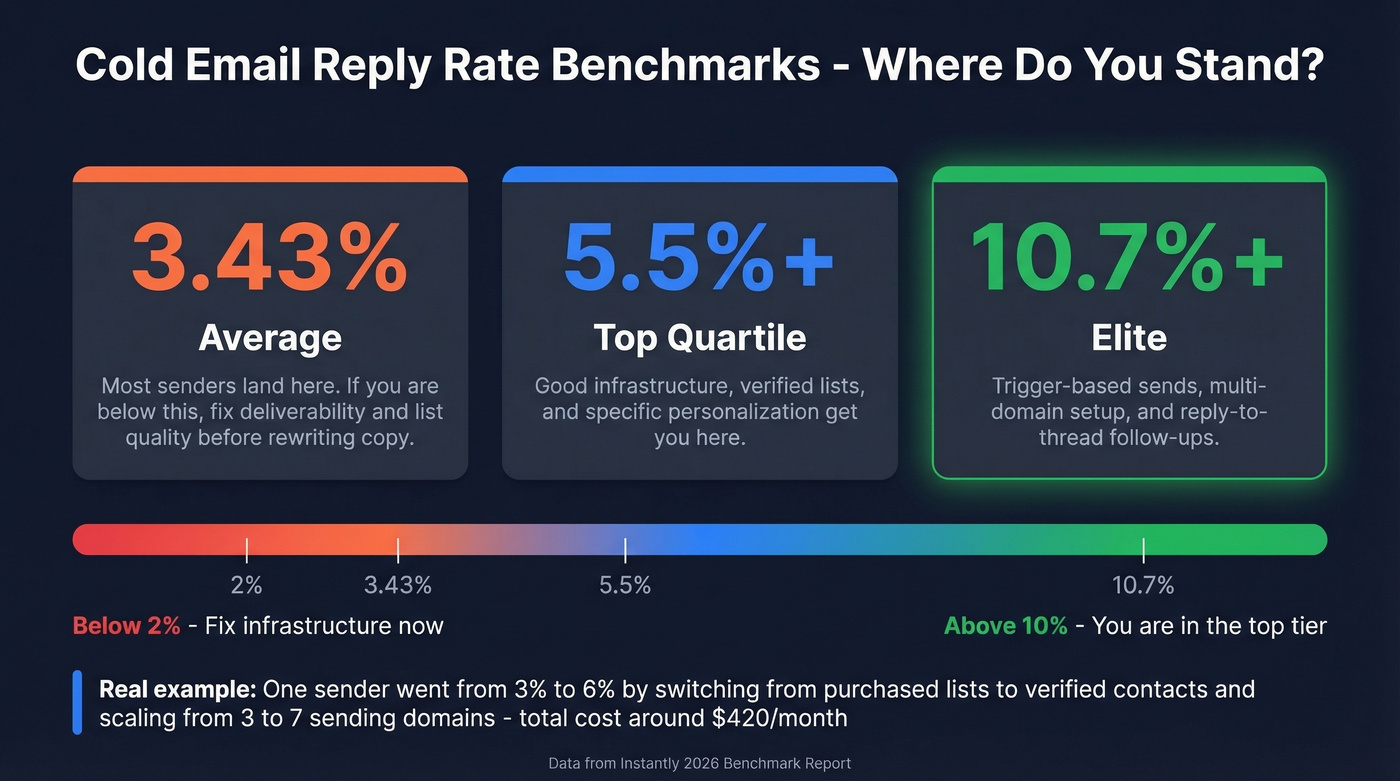
A practitioner on r/Entrepreneur rebuilt their infrastructure and went from 3% to 6% reply rates on a ~$420/month stack across 7 domains, warm-up tools, and sending software. The changes weren't copywriting tricks - they were operational fixes anyone can replicate.
Fix Your Infrastructure First
Google, Yahoo, and Microsoft's bulk sender rules require SPF, DKIM, and DMARC authentication plus one-click unsubscribe for commercial emails. If you haven't set these up, your emails hit spam before anyone reads a word.
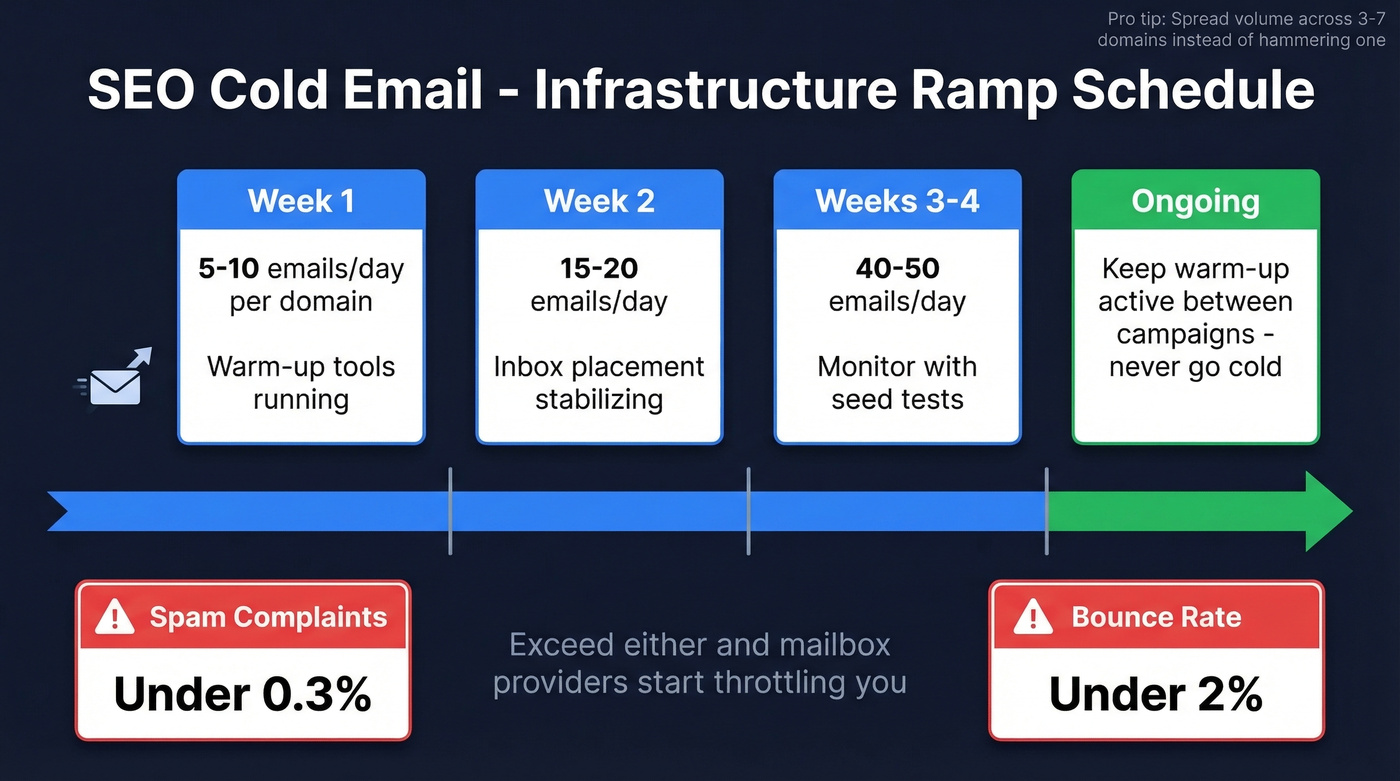
The ramp schedule that works over 4-6 weeks:
- Week 1: 5-10 emails/day per domain. Warm-up tools running in the background.
- Week 2: 15-20/day as inbox placement stabilizes.
- Weeks 3-4: Scale to 40-50/day, monitoring placement with seed tests.
- Ongoing: Keep warm-up active between campaigns. Never go cold.
That r/Entrepreneur sender scaled from 3 sending domains to 7, each capped at 26 emails/day. That's the move - spread volume across domains instead of hammering one. Your guardrails: spam complaints under 0.3%, bounces under 2%. Exceed either and mailbox providers start throttling you.
Set up a branded CNAME tracking domain (e.g., track.yourdomain.com) to isolate your reputation from shared tracking infrastructure. DNS propagation takes up to 72 hours, so do this before you start warm-up.

Bounce rates above 2% destroy your sending domains - and your SEO agency's pipeline. Prospeo's 5-step email verification catches spam traps, handles catch-all domains, and delivers 98% accuracy at $0.01/email. Stack Optimize built a $1M agency on it with zero domain flags.
Stop rewriting templates. Fix the list that's killing your deliverability.
Build a Verified Prospect List
Target the people who actually sign off on SEO spend: founders at SMBs, marketing directors at mid-market companies, heads of content at SaaS firms. Don't spray emails at info@ addresses or junior coordinators who can't approve a retainer.
Look for businesses already investing in content or PPC - they understand digital marketing's value but don't have SEO covered. A company publishing blog posts but ranking nowhere is your ideal prospect. That's the Goldilocks Zone: they get it, they just need help executing.

That same sender also stopped buying lists. Their bounce rate dropped from 11% to under 2%. That single change - verified contacts instead of purchased lists - is what kept their domains clean.
We've watched this pattern play out dozens of times: agencies blame their copy, rewrite templates for weeks, and never touch the list. Then they switch to a verification-first tool and suddenly the same "bad" copy starts getting replies. Prospeo's 5-step verification handles catch-all domains and removes spam traps, which solves the exact problem that kills most outreach campaigns. Stack Optimize built from $0 to $1M ARR running client campaigns through it - 94%+ deliverability, bounce rates under 3%, zero domain flags across all clients.
Write Emails That Convert
Email Anatomy
Every effective cold email for SEO services follows the same skeleton: observation about their site, what it's costing them, one specific fix, proof you can deliver, and a low-friction CTA. No company history, no capability decks, no "I noticed your website" filler.
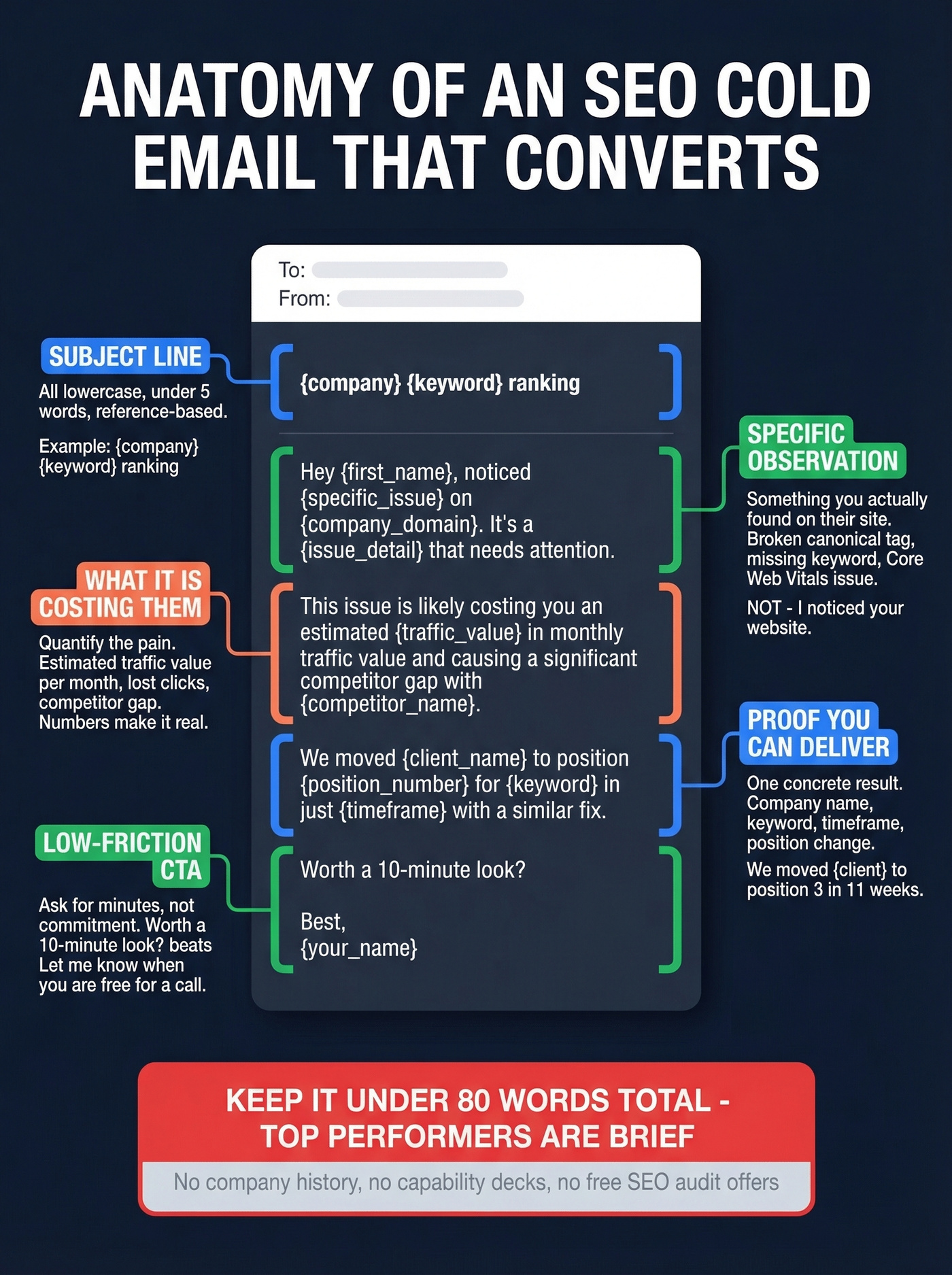
The free SEO audit pitch is dead - everyone offers it. Lead with something specific you found. A broken canonical tag. A competitor outranking them for a keyword they should own. A Core Web Vitals issue tanking their mobile rankings. Specificity is what separates "this person looked at my site" from "this is a mass email."
The same structure works for link-building outreach too - swap the service pitch for a guest post angle and keep the observation-proof-CTA flow intact.
The Instantly benchmark report confirms it: top-performing campaigns keep emails under 80 words.
Subject Lines That Work
A dataset of 10.4M emails across 2,200+ B2B campaigns breaks down what actually drives opens and replies:
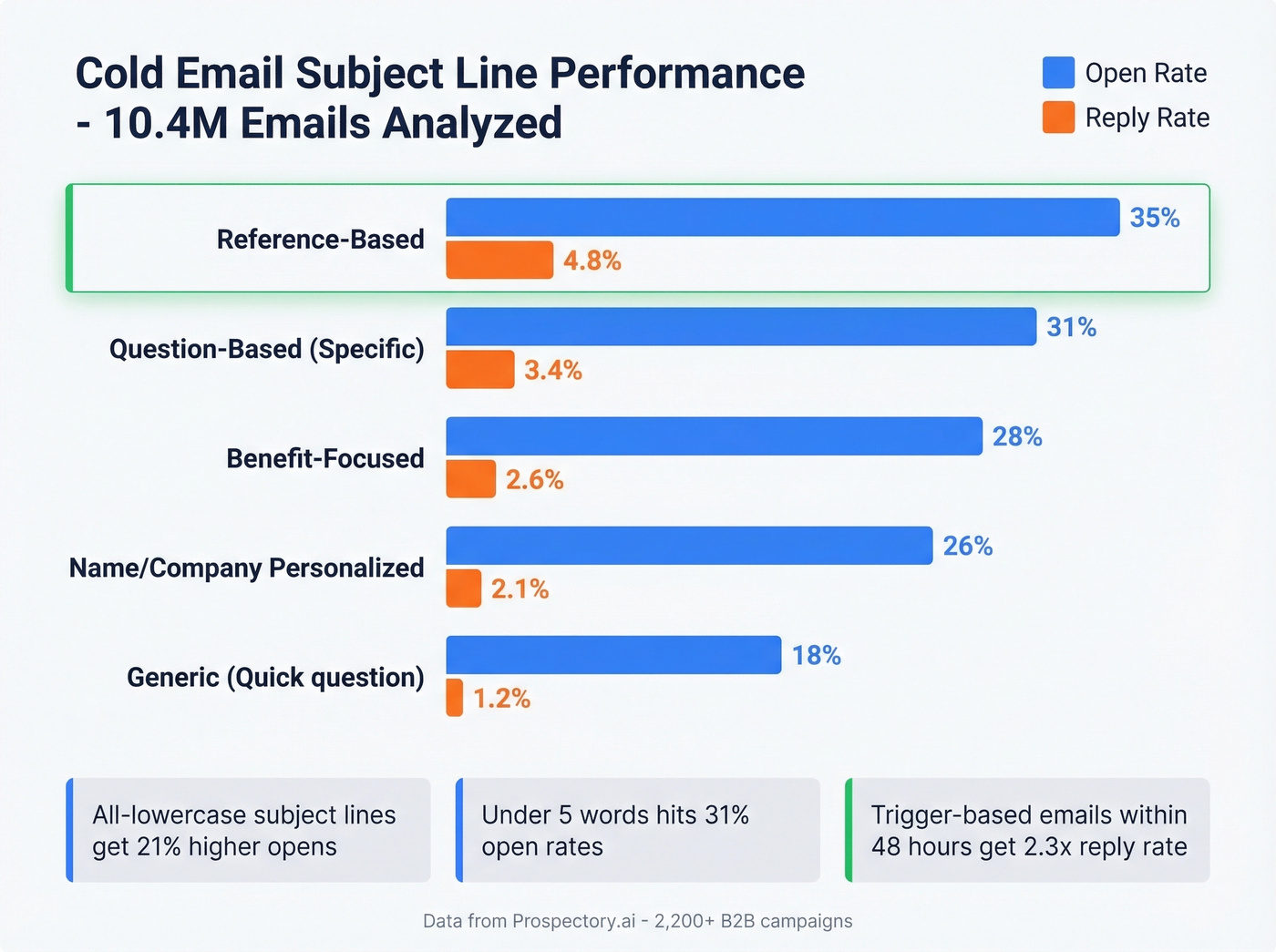
| Subject Line Type | Open Rate | Reply Rate | Meeting Conversion |
|---|---|---|---|
| Generic ("Quick question") | 18% | 1.2% | 0.3% |
| Name/company personalized | 26% | 2.1% | - |
| Benefit-focused | 28% | 2.6% | - |
| Question-based (specific) | 31% | 3.4% | - |
| Reference-based | 35% | 4.8% | 2.1% |
All-lowercase subject lines get 21% higher opens than title case. Under 5 words hits 31% open rates. And trigger-based subject lines sent within 48 hours of a site change pull 2.3x the reply rate versus waiting a week.
Two Templates That Convert
Template 1 - The Specific Observation
Subject: {company} {keyword} ranking
Hi {first name},
{Company} is ranking #14 for "{keyword}" - close enough to page 1 that one technical fix could get you there. Your {specific issue} is costing you roughly {estimated traffic value}/month in organic clicks.
We fixed this exact problem for {similar company} and moved them to position 3 in 11 weeks.
Worth a 10-minute look?
58 words - specific observation, quantified cost, concrete proof, and a CTA that asks for minutes, not a commitment.
Template 2 - The Results Pitch
Subject: {competitor} page 1
Hi {first name},
We got {competitor} to page 1 for "{keyword}" in 83 days. They're now pulling ~{traffic number} organic visits/month from that single term.
Your site has stronger domain authority - the gap is technical, not content.
Want me to send over what I'd fix first?
52 words. Leading with a competitor's success creates urgency without being pushy. I've tested both templates extensively - Template 1 consistently outperforms when you have a genuinely specific technical finding, while Template 2 wins when your case study is strong.
Finding the right decision-maker is half the battle in SEO outreach. Prospeo's database gives you 300M+ profiles with 30+ filters - target founders, marketing directors, and heads of content at companies already investing in PPC but missing on organic. Data refreshes every 7 days, not 6 weeks.
Build laser-targeted SEO prospect lists in minutes, not hours.
Follow-Up Sequence
58% of replies come from email #1, but follow-ups drive the other 42%. Don't send one email and move on.
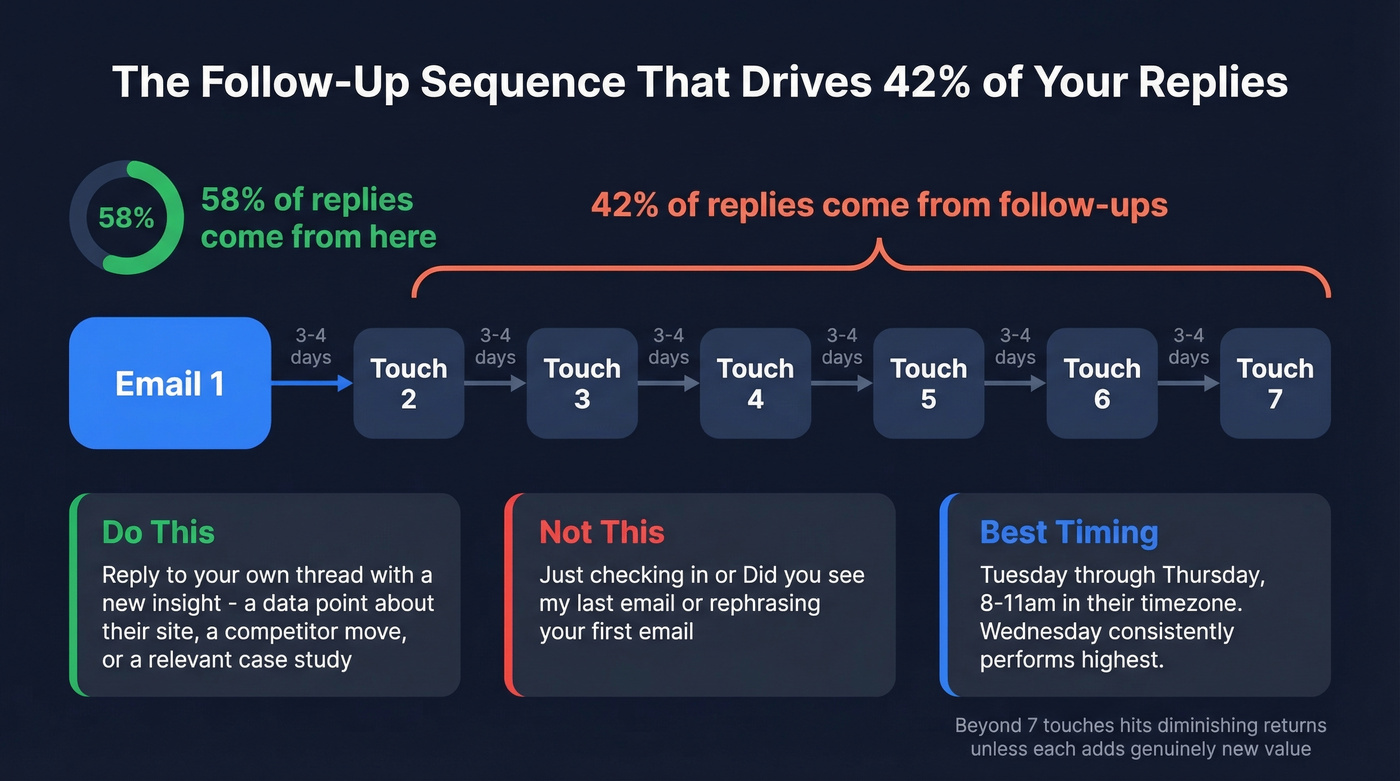
4-7 touchpoints total. Under 4 quits too early. Beyond 7 hits diminishing returns unless each touch adds genuinely new value. Space them 3-4 days apart - tighter than that feels aggressive, and longer means they've forgotten you.
The best follow-ups feel like replies, not reminders. This approach outperforms formal follow-ups by roughly 30%. Reply to your own thread with a new insight, not "just checking in." For timing, send Tuesday through Thursday, 8-11am in the recipient's timezone. Wednesday consistently performs highest.
Let's be honest about what "new value" means here. Don't just rephrase your first email. Share a new data point about their site, reference a competitor move, or link to a relevant case study. Each touch should make them think "this person is actually paying attention" rather than "this person has me on a drip sequence."
Don't Skip Compliance
CAN-SPAM violations carry penalties up to $53,088 per email. GDPR fines reach EUR 20M or 4% of global annual revenue. PECR in the UK adds up to GBP 500,000. These aren't theoretical - they're enforced.
What you need in every email:
- Accurate sender name and reply-to address
- No deceptive subject lines - don't fake "Re:" to simulate a reply thread
- Valid physical mailing address
- Visible opt-out link, honored within 10 business days
- One-click unsubscribe header (RFC 8058) for bulk sends
For EU prospects, you'll need a legitimate interest justification for B2B outreach, with clear identification of who you are and how you got their info. Skip this if you're only targeting US-based businesses, but the moment you email a .co.uk or .de domain, these rules apply.
FAQ
Is cold email legal for selling SEO services?
Yes, under CAN-SPAM in the US and legitimate interest provisions for EU B2B contacts. Include a physical address, honor opt-outs within 10 business days, and use accurate sender information. Violations carry penalties up to $53,088 per email, so compliance isn't optional.
What reply rate should I expect from SEO outreach emails?
Average is 3.43%, top performers hit 5.5%+, elite senders exceed 10.7%. Below 2%? Fix deliverability and list quality before rewriting copy - infrastructure problems cause more low reply rates than bad messaging.
How do I find verified emails for SEO prospects?
Use a verification-first tool with catch-all handling and spam-trap removal. Prospeo's 5-step verification delivers 98% email accuracy at ~$0.01/lead, with a free tier of 75 emails/month. Sending to unverified lists pushes bounce rates above 2%, which flags your domain and can take months to recover from.
How many cold emails should I send per day?
Cap each sending domain at 25-50 emails/day after a full warm-up period. Spread volume across 3-7 domains rather than overloading one. The sender who hit 6% reply rates used 7 domains at 26 emails/day each - roughly 180 daily sends with clean reputation across every domain.