

Signal Stacking: Which Signals to Combine, How to Score Them, and What Actually Works
A rep I know ran 400 touchpoints a week for months - 11 active sequences, 0.8% meeting rate. When he finally audited his Salesforce data, 94% of closed-won deals came from accounts that had shown at least one buying signal before outreach. He wasn't bad at selling. He was reaching out blind.
Signal stacking would've changed everything.
The Short Version
The concept is simple: require two or three buying signals before routing an account to a rep. The strongest signals in a 1M-purchase dataset were AI adoption (+46%), headcount growth (+38%), and recent software purchases (+38%) - not funding rounds (+25%). Start with three signal categories (company, people, intent), layer verified contact data on top, and use a 30-day freshness rule as your default.
What Is Signal Stacking?
At its core, this means tracking multiple buying-intent clues across an account until your confidence is high enough to act. One signal is a lead. Two signals are a pattern. Three signals are a case worth pursuing.
Good reps have always triangulated before picking up the phone. What's changed is the infrastructure - you can now monitor dozens of signal types programmatically and score them in real time. OpenFunnel's data shows that deals sourced from three or more stacked signals close 4.6x faster than single-signal deals.
Why This Matters Right Now
Outbound has gotten brutally harder. UserGems analyzed 4.2M target accounts and 2.28M opportunities and found that outbound meeting activities have quadrupled compared to five years ago. It now takes 3x longer to create a new opportunity versus 2020, and reps need to contact 1.5x more prospects just to generate one.
The old playbook - pull a static list, blast a sequence, hope for replies - doesn't survive here. That's why 91% of revenue leaders are now using or planning to use signal-based targeting.
Which Signals Actually Matter
Here's the thing: funding rounds get all the attention in GTM circles, but they're a middling signal at best. That same analysis of 1M B2B software purchases ranked signal types by their correlation with actual buying behavior in 200-1,000 employee companies:
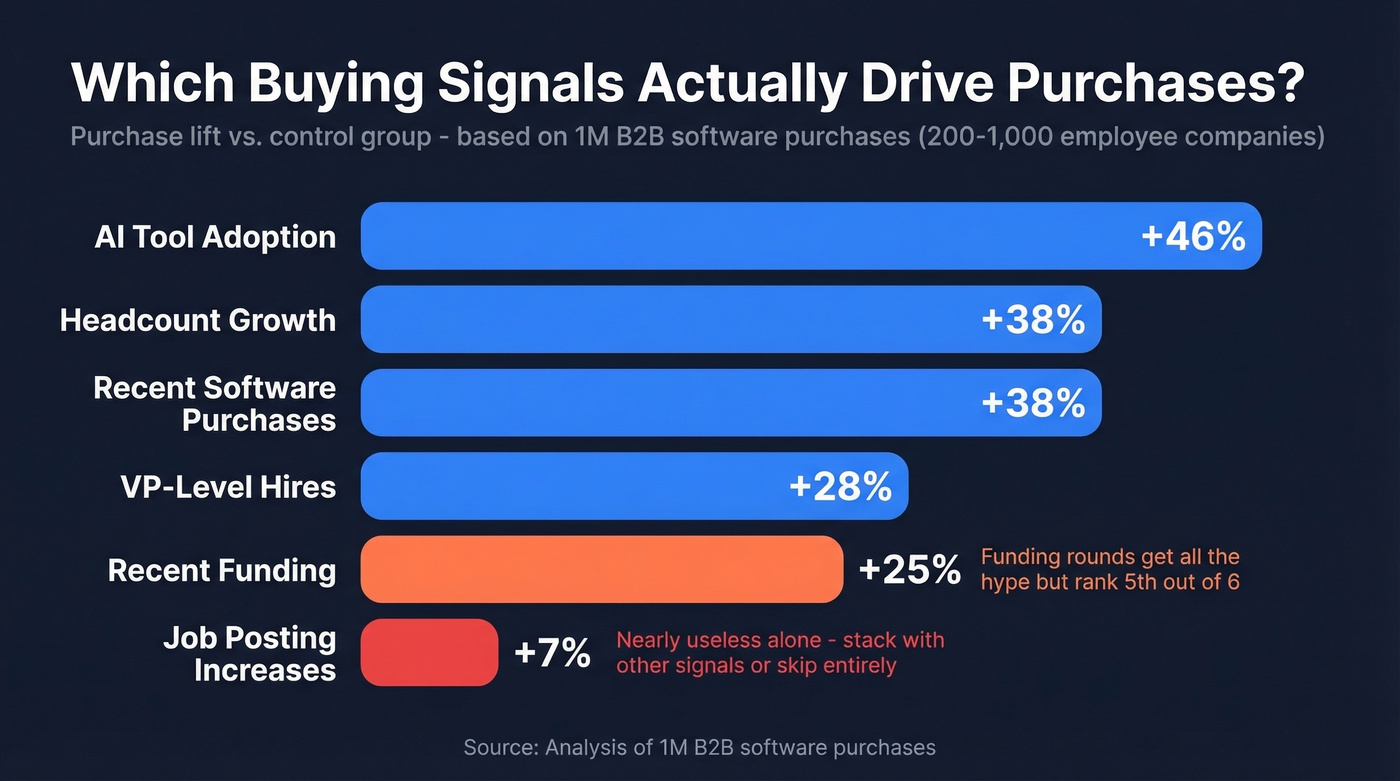
| Signal Type | Purchase Lift vs. Control |
|---|---|
| AI tool adoption | +46% |
| Headcount growth | +38% |
| Recent software purchases | +38% |
| VP-level hires | +28% |
| Recent funding | +25% |
| Job posting increases | +7% |
A company that just raised a Series B is interesting. A company that just raised, hired a VP of Sales, and adopted a new CRM - that's a company actively spending. Job postings alone are nearly useless. Stack them with something else or skip them entirely.
If your average deal size is under $30K, you probably don't need expensive intent platforms. Two free signals stacked with verified contact data will outperform a $50K Bombora contract that nobody on your team actually uses.

Signal stacking only works if the contact data underneath is accurate. Prospeo gives you 30+ filters - including buyer intent, headcount growth, technographics, and job changes - so you can stack signals directly inside your prospecting workflow. Then layer on 98% verified emails and 125M+ direct dials.
Stop stacking signals on top of bad data. Start with Prospeo.
A Signal Taxonomy
Common Room's framework recommends optimizing within each category first, then combining across categories for prioritization.
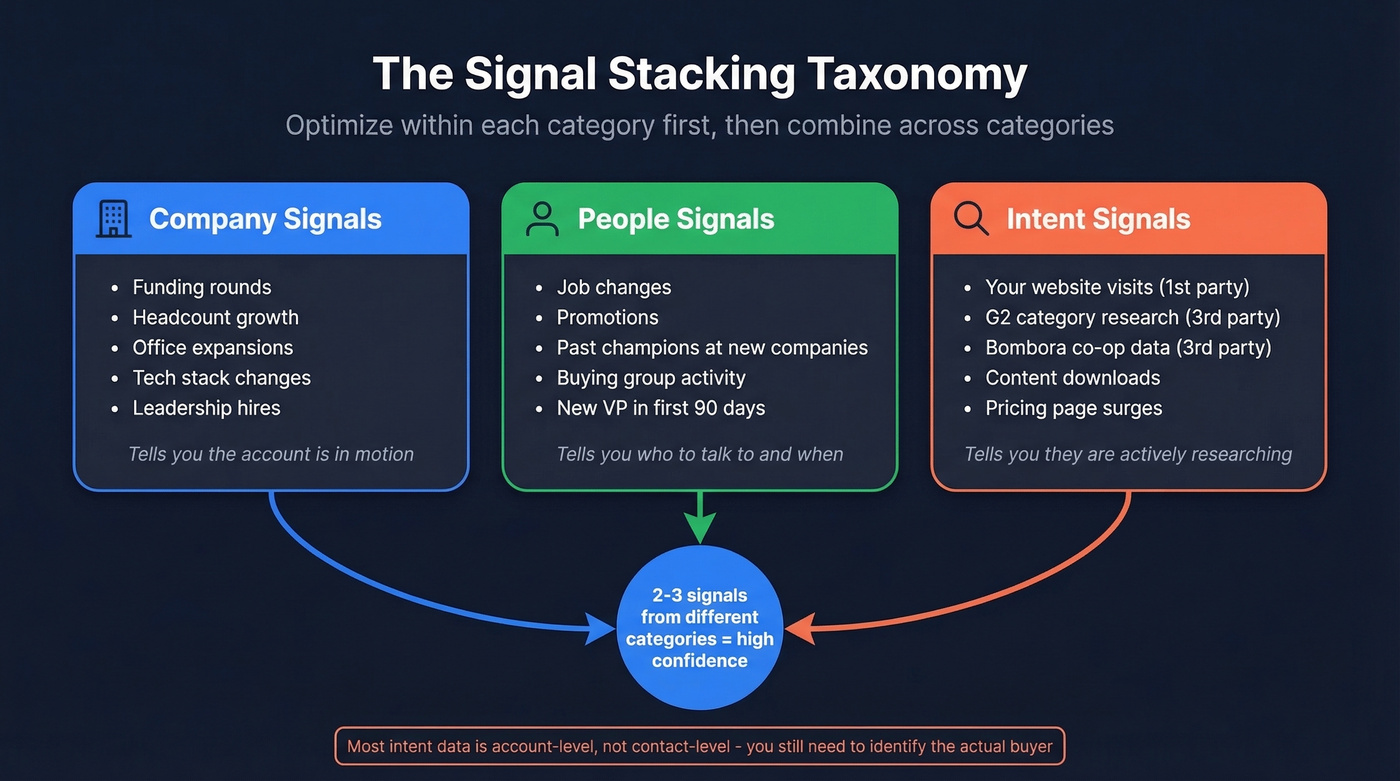
Company signals include funding rounds, headcount growth, office expansions, tech stack changes, and leadership hires. These tell you the account is in motion.
People signals cover job changes, promotions, past champions moving to new companies, and buying-group activity. These tell you who to talk to and when they're most receptive - a new VP of Marketing in their first 90 days is 3x more likely to evaluate new tools than one who's been in the seat for two years.
Intent signals break into first-party (your own website visits and content downloads), third-party (Bombora co-op data, G2 category research), and co-op models that pool anonymized consumption data across publisher networks.
The critical distinction: most intent data is account-level, not contact-level. You know "someone at Acme visited pricing pages" but you still need to figure out who is actually researching.
How to Score Your Stack
Categorize your available signals into company, people, and intent buckets. Optimize within each category before combining.
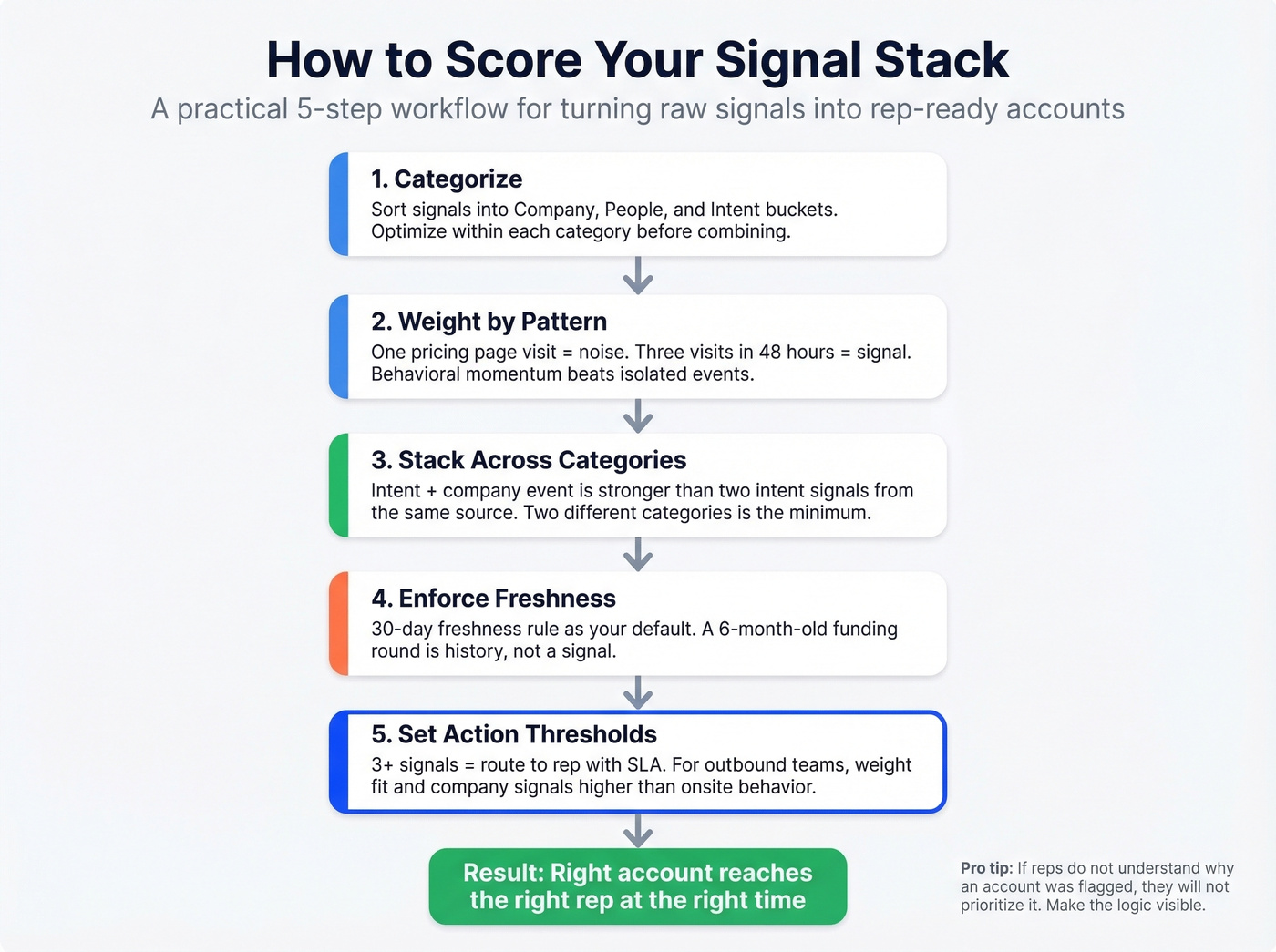
Weight by pattern, not single actions. A single pricing page visit is noise. Three pricing visits in 48 hours is a signal. The GTM Strategist scoring model gets this right: behavioral momentum matters more than isolated events.
Stack across categories. Intent + company event is stronger than two intent signals from the same source. In our experience, two signals from different categories is the minimum worth investigating.
Enforce freshness. Use a 30-day freshness rule as your default. A funding round from six months ago isn't a buying signal - it's history.
Set action thresholds. Three or more signals means route to a rep with an SLA on response time. For outbound-heavy teams, weight fit and external company signals higher than onsite behavior - this is the single most overlooked scoring mistake I see. You can't rely on website visits from accounts that don't know you exist yet.
From Scoring to Orchestration
Getting the scoring right is only half the battle. The real gains come from signal orchestration - automating how signals are collected, evaluated, and routed so the right account reaches the right rep at the right time without manual triage.
0.8% to 8% Meeting Rate
The practitioner case from the intro is worth unpacking. After discovering that 94% of closed-won had prior signals, the rep rebuilt his targeting from scratch. Every account needed a signal from the last 30 days - a new CFO hire, a Series B/C round, a revenue accounting job posting. He layered tech stack filters with a revenue threshold above $50M and tightened ICP to Series B/C companies with $15M-$120M ARR.
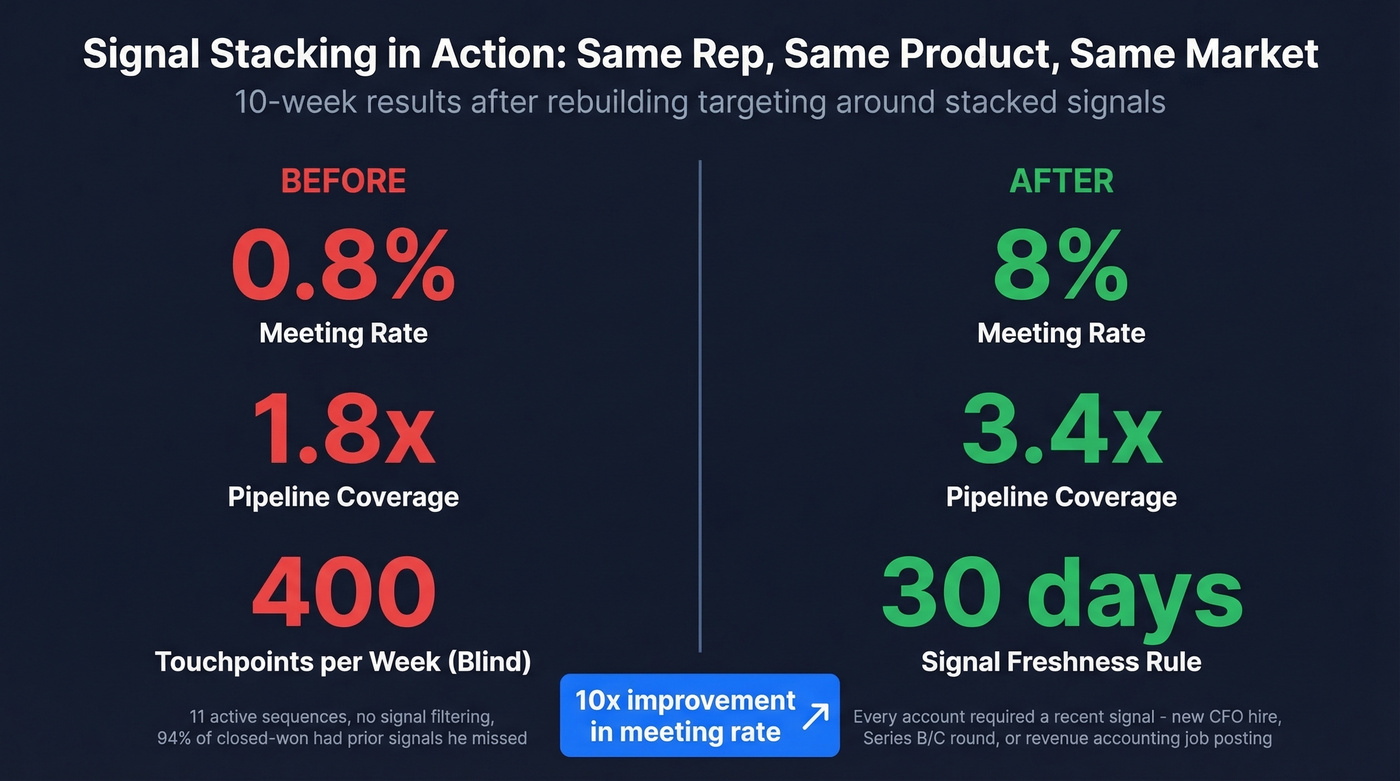
Results over 10 weeks: pipeline coverage jumped from 1.8x to 3.4x. Meeting rate went from 0.8% to 8%. Same product, same market, same rep.
How Real Companies Stack
Vanta monitors SOC 2 announcements, compliance website changes, funding rounds, and CISO job postings - four signals across three categories before triggering outreach. Rippling enriches job changers, filters by ICP, then uses location data for direct mail. The pattern is always the same: layer signals, wait for convergence, act fast.
Tools for Building a Signal Stack
Building a reliable stack isn't one tool - it's a workflow spanning three layers.
Intent providers like Bombora, 6sense, Demandbase, and G2 Buyer Intent deliver account-level signals showing which companies are researching your category. Expect $25K-$100K+/year. They're the "who's in-market" layer, and they're worth it for enterprise deal sizes. For teams running smaller deals, skip to the DIY options below.
Orchestration platforms like Clay act as the glue - connecting 130+ data providers, building signal tables, and routing scored accounts to Slack, CRM, or email. Free tier available, paid plans from ~$149/mo. If you're serious about signal orchestration, Clay is where the logic lives.
DIY options exist too. SignalForce is an open-source engine that monitors GitHub, ArXiv, job postings, funding rounds, and professional-network activity. Free - your costs shift to API keys.
Contact data and verification is the layer everything else depends on. Signals are worthless if you can't reach the right person with a valid email. We've tested most of the major providers, and Prospeo is what we run internally - 300M+ professional profiles, 143M+ verified emails, 98% email accuracy, and a 7-day data refresh cycle. It also doubles as a signal source with 15,000 intent topics via Bombora, plus 30+ search filters including job change, headcount growth, funding, and technographics.
Mistakes That Kill Your Stack
Stacking without fit checks. Signals on non-ICP accounts are wasted effort. Always gate on fit first - industry, size, geography - before layering signals.
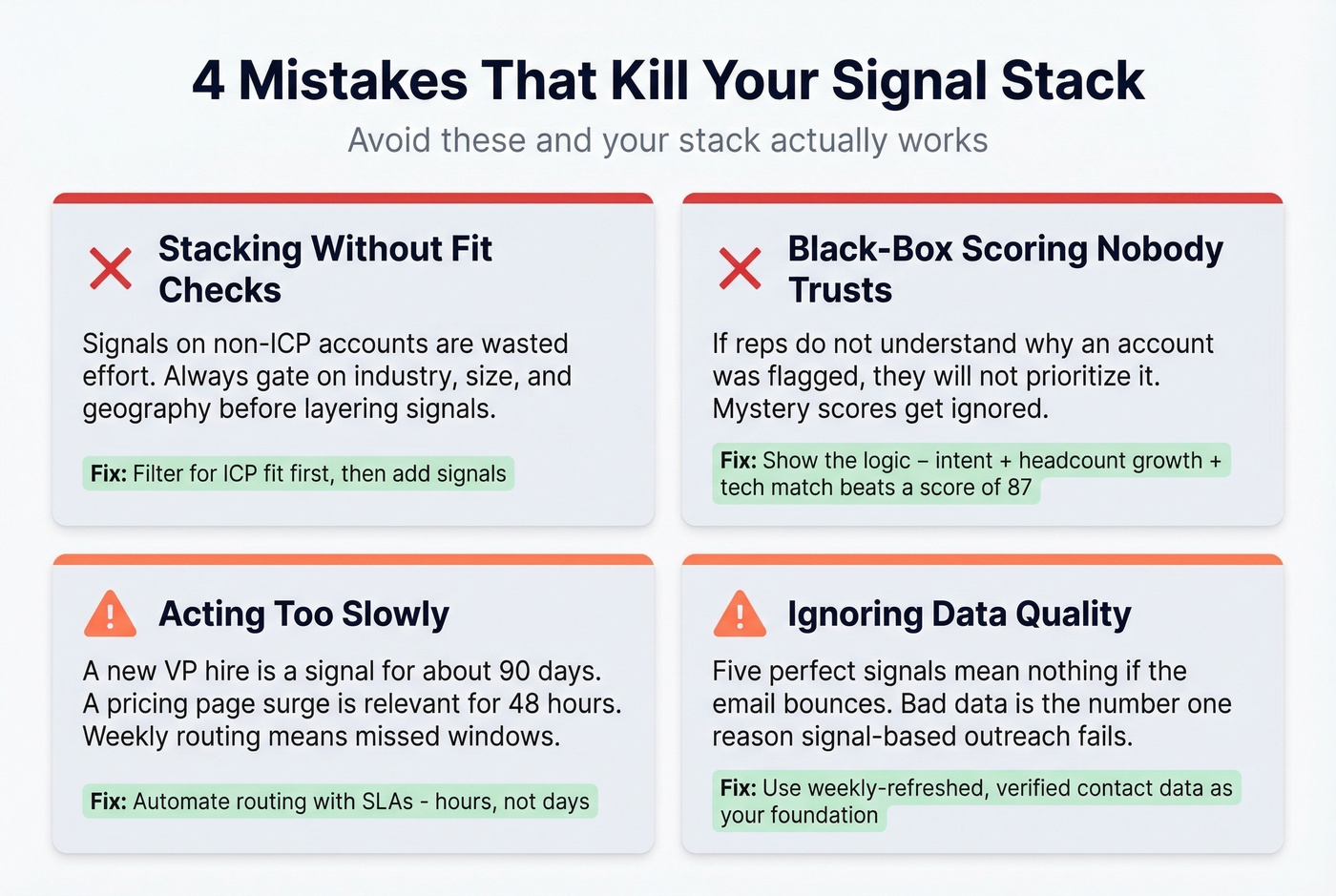
Black-box scoring nobody trusts. If reps don't understand why an account was flagged, they won't prioritize it. We've seen teams get far better adoption with a simple "intent + headcount growth + tech match" explanation than a mystery score of 87. Make the logic visible.
Acting too slowly. A new VP hire is a buying signal for about 90 days. A pricing page visit surge is relevant for 48 hours. If your routing takes a week, you've already lost the window.
Ignoring data quality. Let's be honest - five perfect signals mean nothing if the email bounces. Weekly-refreshed, verified contact data isn't optional. It's the foundation the entire stack sits on, and the consensus on r/sales is that bad data is the number one reason signal-based outreach fails to deliver.
That 0.8% to 8% jump happened because the rep combined fresh signals with verified contact data. Prospeo refreshes every 7 days - not 6 weeks - so your signals and contacts stay in sync. At $0.01 per email, you spend less on data than a single Bombora seat and reach the right person faster.
Fresh signals deserve fresh data. Prospeo refreshes every 7 days.
FAQ
How many signals should you stack before reaching out?
Three from different categories (company, people, intent) is the practical minimum for high-confidence outreach. Below that you're guessing; above five you're over-filtering and shrinking your addressable pipeline to nothing.
Is signal stacking the same as lead scoring?
No. Stacking layers signal types across categories to build conviction that an account is in-market. Scoring assigns numerical points to individual actions. Stacking feeds scoring - not the other way around.
What's the cheapest way to start?
Combine G2 buyer intent (free tier) with a company event feed from Clay's free plan and verified contact data from Prospeo's free tier (75 emails/month). Total cost: $0. That gives you intent, company signals, and deliverable emails - enough to test the approach before investing in premium tools.