

SPIFFs: The Complete 2026 Guide to Sales Incentive Programs
It's the last week of Q2. Your team's 15% behind target. The VP of Sales walks over and says, "Let's run a SPIFF this week - $500 per closed deal." Reps perk up. Activity spikes. But does it actually work, or does it just pull forward deals that were closing anyway?
The majority of B2B sales reps still miss quota. The temptation to throw money at short-term incentives is real, and the difference between a program that generates $30K in net ROI and one that produces a pile of junk pipeline comes down to design.
Here's the short version: a SPIFF is a short-term incentive rewarding specific sales behaviors or outcomes - think days or weeks, not quarters. Typical payouts land between $50-$500 per activity and $500-$2,000+ per closed deal. The number that matters is a 22-24% average sales lift when the program is designed correctly. But poorly designed programs actively destroy pipeline quality. Keep reading before you launch one.
What Does SPIFF Actually Mean?
A SPIFF is a short-term sales incentive that rewards reps for specific behaviors or outcomes within a defined window - usually a few days to a few weeks. Unlike commissions baked into the comp plan or bonuses tied to quarterly targets, SPIFFs are tactical. They're the surgical strike of sales compensation: deploy fast, hit a specific objective, pull back.
You'll see "SPIFF" written as an acronym for "Sales Performance Incentive Fund." That's a backronym - someone reverse-engineered words to fit the letters after the fact. The actual term dates to 1859 British retail slang, where drapers used it to incentivize clerks to move undesirable stock. The related term "spiv" shows up in some organizations as a similar concept, sometimes positioned as more team-oriented, but in practice most sales floors just say "SPIFF" and everyone knows what it means.
Rewards are usually cash, but they don't have to be. Gift cards, event tickets, experiences, extra PTO - anything that motivates behavior change in a compressed timeframe qualifies.
Do They Actually Work?
The short answer: yes, dramatically - when the design is right.
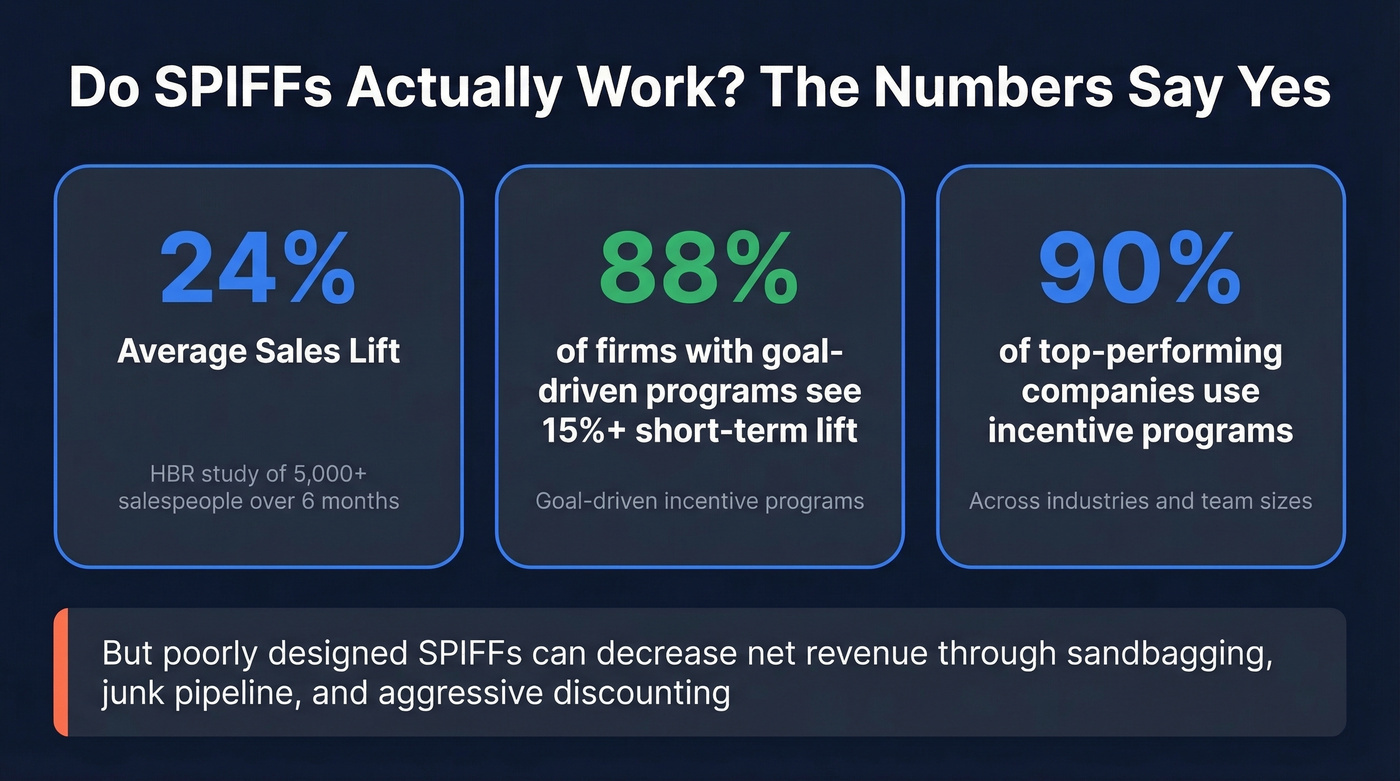
An HBR analysis studying over 5,000 people across six months found that bonus-type incentives produced roughly a 24% increase in sales. The Incentive Research Foundation puts the average performance increase from incentive programs at 22%. And 88% of firms with goal-driven programs see a 15% short-term sales lift. Ninety percent of top-performing companies use incentive programs of some kind.
Those numbers are compelling, but they come with a massive asterisk. Poorly designed programs produce sandbagging where reps hold deals until the incentive starts, junk pipeline where reps book unqualified meetings to hit activity targets, and toxic competition that erodes team culture. We've seen teams where a hastily launched incentive actually decreased net revenue because reps discounted aggressively to close deals within the window. The lift only materializes when you get the design right.
Types of SPIFFs
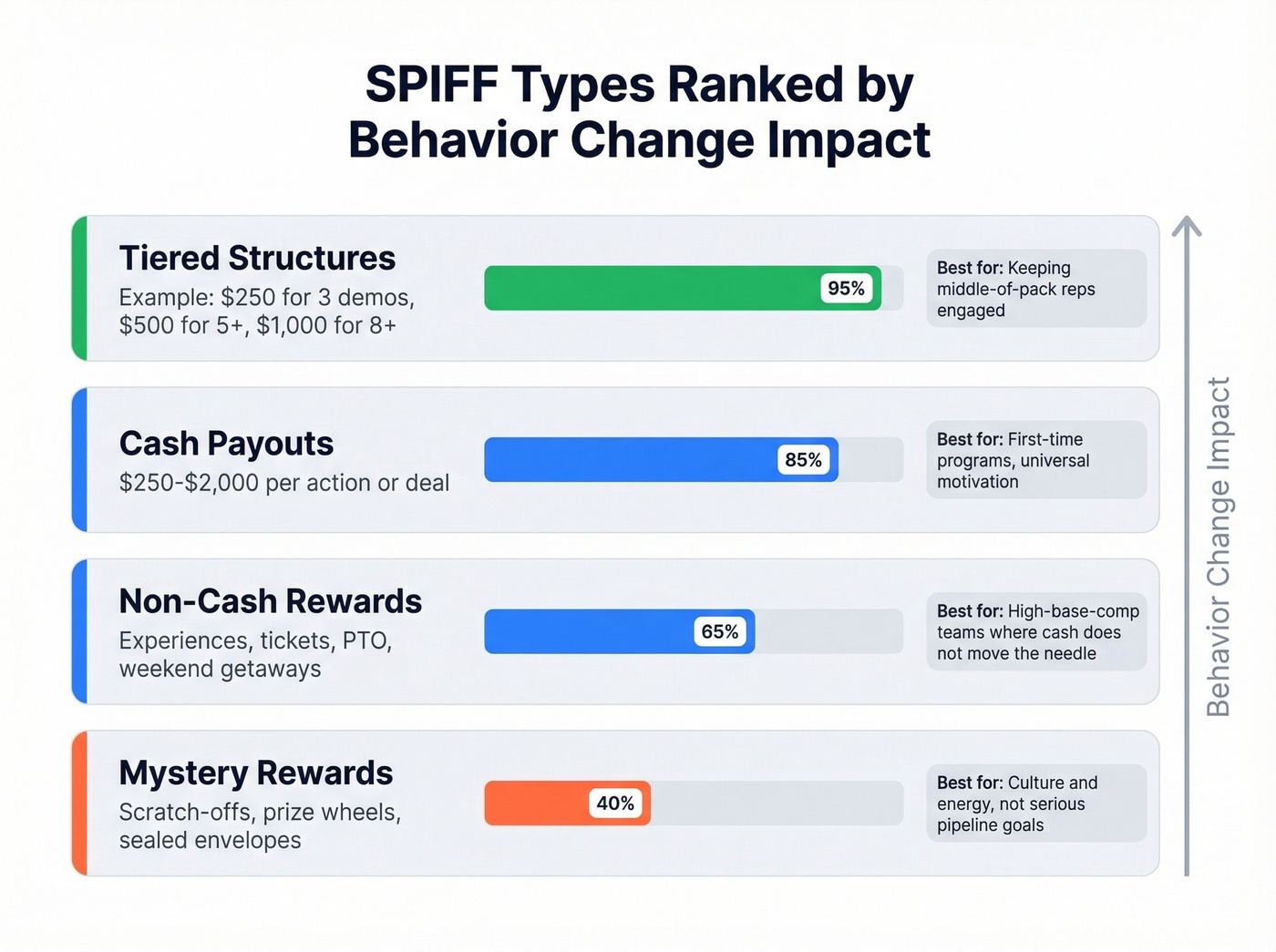
Not all incentive structures are created equal. Here's how the main types stack up, ranked by how well they actually change behavior.
Cash Payouts
The most universally effective format. A flat dollar amount per qualifying action or closed deal - $250 for a demo booked, $1,000 for a new logo closed. Cash is simple, instantly understood, and motivates across demographics. If you're running your first program, start here.
Tiered Structures
These drive the most incremental effort. Instead of a flat payout, the reward escalates: $250 for hitting 3 demos, $500 for 5+, $1,000 for 8+. This structure prevents reps from coasting after hitting the minimum threshold. The top tier should be achievable by your 75th-percentile rep, not just the top performer.
In our experience, tiered structures outperform flat-rate ones by a wide margin because they keep middle-of-the-pack reps engaged all the way through. The rep who books their third demo and sees $500 waiting at five doesn't stop - they pick up the phone again.
Non-Cash Rewards
These work best for teams with high base compensation where an extra $200 doesn't move the needle. Think concert tickets, weekend getaways, or premium experiences. The key is knowing your team - survey them before picking the reward, because assumptions about what motivates people are wrong more often than right.
Mystery Rewards
Fun but unreliable. Scratch-off cards, prize wheels, sealed envelopes - the gamification element creates buzz, but the variable reward makes it harder for reps to calculate whether the extra effort is worth it. Use them for culture and energy, not for serious pipeline objectives.
Payout ranges vary by what you're incentivizing. Activity-based programs typically run $50-$500 per qualifying action. Deal-based programs range from $500-$2,000+, with enterprise deals sometimes hitting higher.
SPIFF vs Bonus vs Commission
These three get conflated constantly.
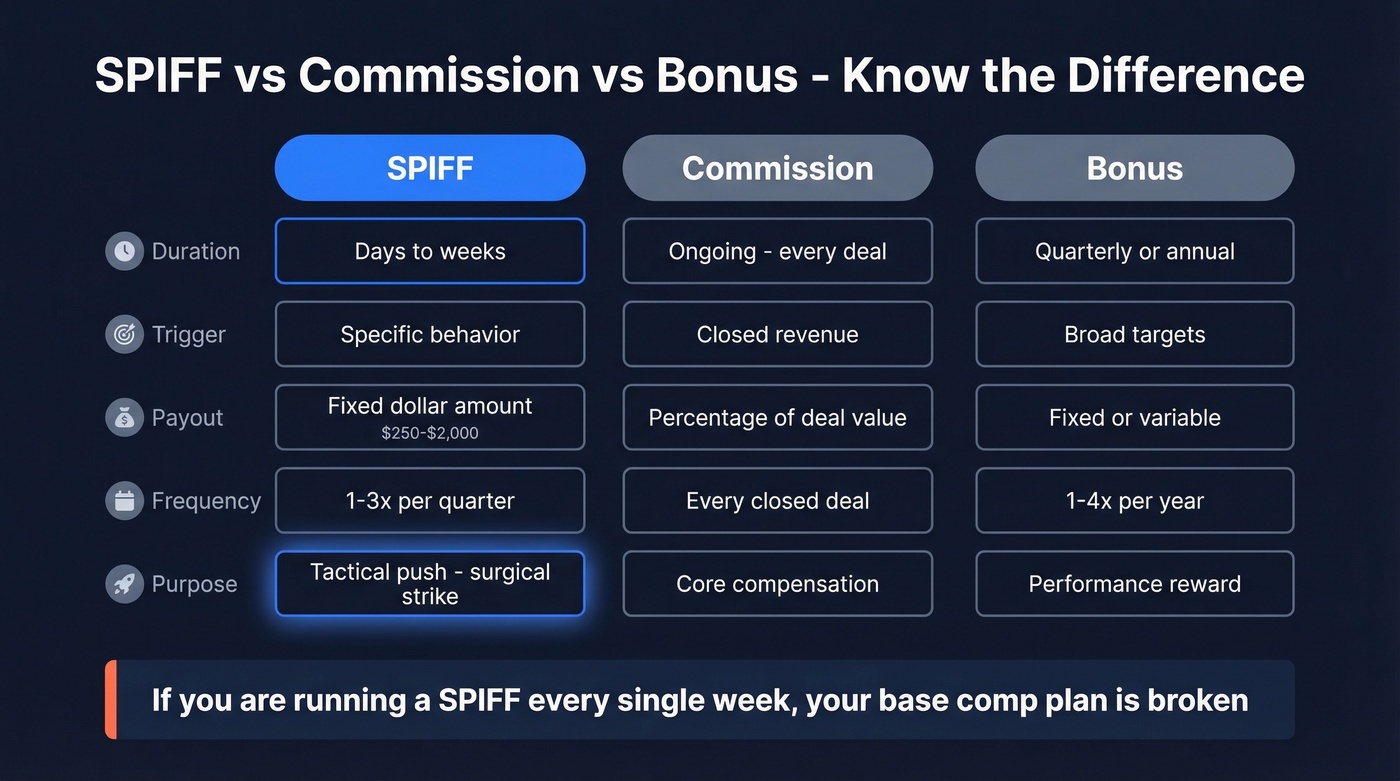
| Dimension | SPIFF | Commission | Bonus |
|---|---|---|---|
| Duration | Days to weeks | Ongoing | Quarterly/annual |
| Trigger | Specific behavior | Closed revenue | Broad targets |
| Payout | Fixed amount | % of deal | Fixed or variable |
| Frequency | 1-3x per quarter | Every deal | 1-4x per year |
| Purpose | Tactical push | Core comp | Performance reward |
The critical distinction: SPIFFs complement the comp plan. They never replace it. If you're running one every single week, your base compensation structure is broken.
Here's the thing: if your reps need a bonus incentive to do their baseline job, you have a hiring problem, a comp problem, or a product-market fit problem. SPIFFs should accelerate already-functional teams, not prop up dysfunctional ones. Most companies reaching for incentives every month would get better ROI from fixing their comp plan once.

Your SPIFF just motivated reps to book 10 meetings - but how many bounce? Bad contact data turns incentive spend into wasted pipeline. Prospeo delivers 98% email accuracy and 125M+ verified mobiles so every SPIFF-driven dial and email actually reaches a decision-maker.
Stop paying SPIFFs for meetings that never connect.
How to Design a SPIFF Program
This is where most programs fail. The concept is simple - pay reps extra to do more of something - but the execution has a dozen failure modes.
Pick the Right Behavior
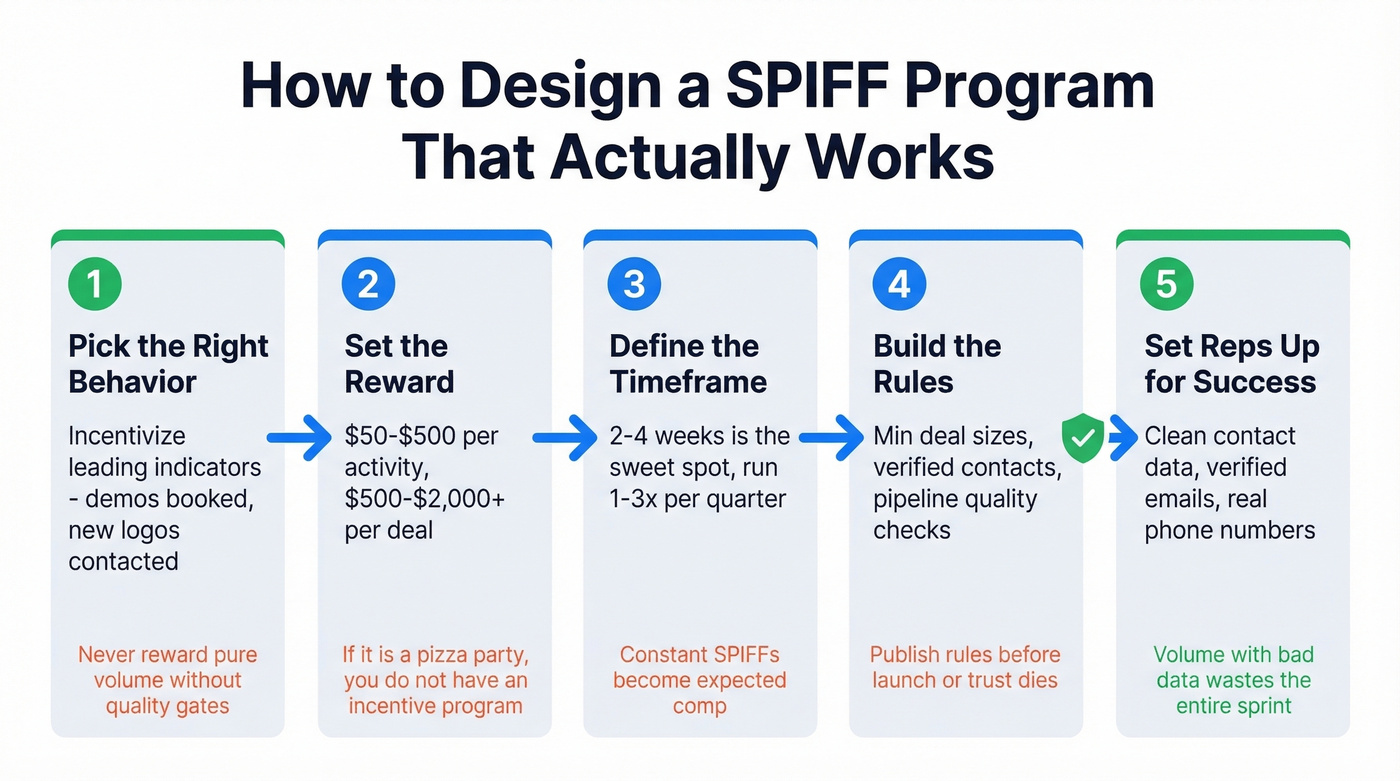
Incentivize leading indicators, not just closed deals. Meetings booked, demos completed, new logos contacted, multi-threaded accounts - these are the behaviors that build pipeline. If you only reward closed revenue, you're incentivizing lagging indicators and encouraging reps to discount existing pipeline rather than generate new opportunities.
The critical guardrail: never incentivize pure volume without quality gates. "Book 10 meetings this week" without a qualification standard produces 10 garbage meetings. "Book 10 meetings with director+ contacts at companies with 200+ employees" produces pipeline.
Set the Reward
The reward needs to be meaningful enough to change behavior but small enough to run multiple sprints per quarter without blowing your budget. Activity-based payouts typically land at $50-$500 per qualifying action, and deal-based payouts run $500-$2,000+.
If your reward is a pizza party, you don't have an incentive program - you have a morale problem. Reps do mental math instantly. If the extra effort to book three more demos earns them $50, they won't bother. $750? They'll rearrange their week.
One nuance worth knowing: a 2024 IRF survey found that late-career employees (51+) actually prefer drivable weekend getaways over big cash prizes. Know your team's demographics before defaulting to cash.
Define the Timeframe
Two to four weeks is the sweet spot. Shorter than two weeks doesn't give reps enough runway to change behavior. Longer programs lose urgency as the sprint feeling fades.
Run SPIFFs 1-3 times per quarter, aligned with strategic moments: end-of-quarter pushes, new product launches, slow seasonal periods. Don't run them back-to-back. Constant incentives become expected compensation, and you lose the motivational spike entirely.
Build the Rules
Anti-gaming guardrails are non-negotiable. Without them, your program will produce sandbagging, cherry-picking where reps only pursue easy wins, and junk pipeline full of unqualified meetings booked purely for the payout.
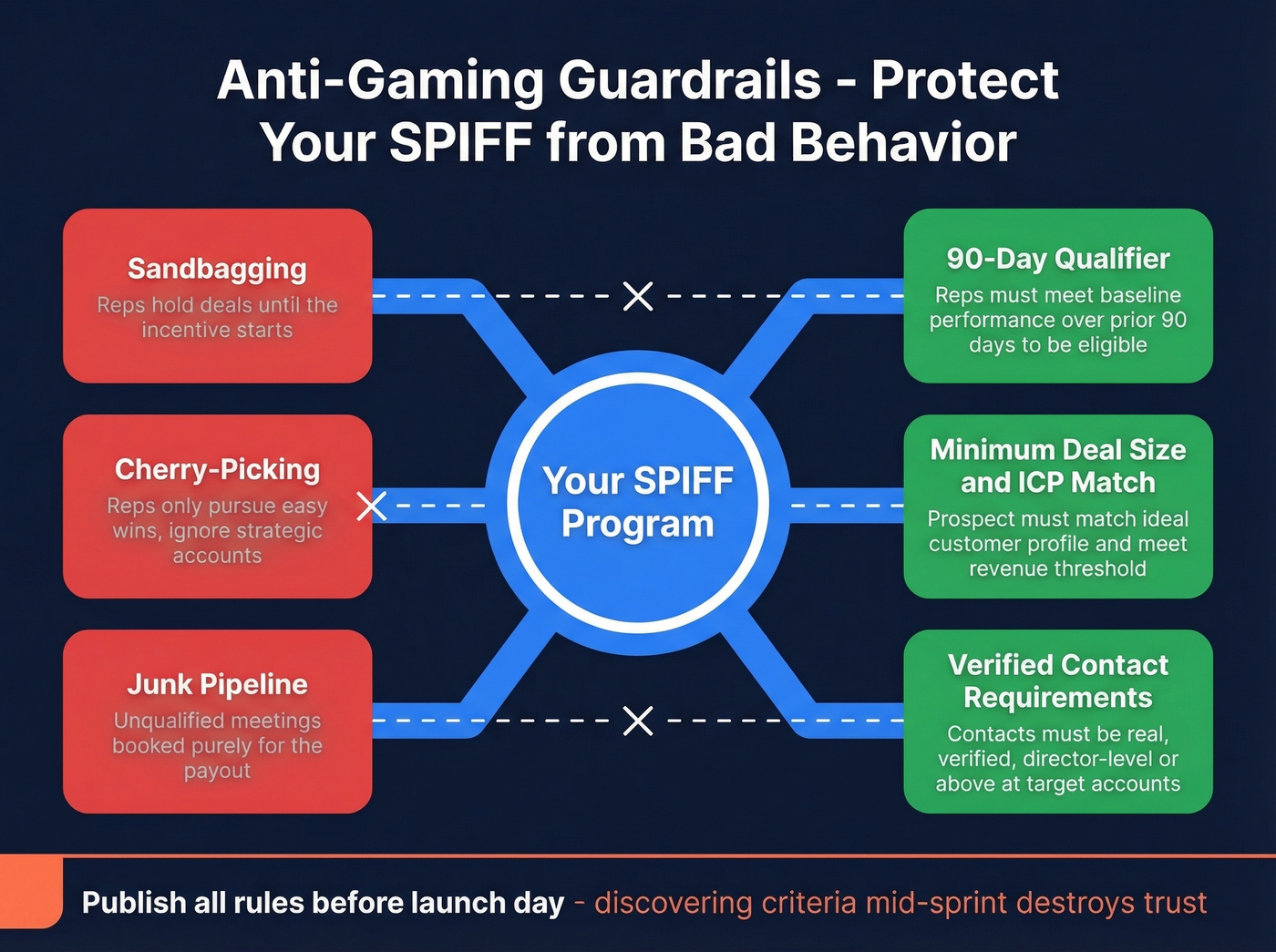
Effective guardrails include minimum deal sizes, verified contact requirements, and pipeline-quality checks. One governance tactic that works well: a 90-day qualifier where reps who miss a defined performance baseline over the prior 90 days are temporarily ineligible. This prevents payouts for baseline activity and reinforces the habits of your best people.
Publish the rules before launch. If reps discover eligibility criteria after they've already started working, you'll destroy trust faster than any incentive can rebuild it.
Set Reps Up for Success
SPIFFs incentivize volume. But volume with bad data wastes the entire sprint - reps "hit activity" and still generate nothing but bounces and no-shows.
Before launching, make sure your team's contact data is clean. We've found that verifying your target list in bulk before the clock starts is the difference between a program that generates pipeline and one that generates bounced emails. Prospeo's real-time email verification runs at 98% accuracy across 143M+ verified emails, so every dial and send during the sprint reaches a real person.
Real-World Program Examples
SaaS - End-of-Quarter Pipeline Push
Two weeks left in Q3, pipeline's light. The incentive: $250 per qualified demo booked with a VP+ contact at a target account. Tiered structure - $250 for 3 demos, $500 for 5+, $1,000 for 8+. Qualification gate: the prospect must match ICP criteria and attend the demo. No-shows don't count.
Field Service - Upsell Blitz
A field service company runs a 3-week program paying $100 per maintenance contract upsold during routine service calls. Technicians already have face time with customers - the incentive redirects that conversation toward renewals and upgrades. Simple, low-cost, high-margin.
Channel / Reseller - New Product Launch
A manufacturer pays channel partners $500 per unit sold of a new SKU during the first 30 days post-launch. Channel programs often run longer windows than internal ones because partner sales cycles are slower - some stretch to 60 days. The manufacturer funds the incentive directly, which means 1099 reporting may be required for payouts to external partner reps. Budget for the compliance overhead before launch.
Retail - When the Mystery Format Actually Worked
A regional electronics retailer needed to clear $180K in slow-moving inventory before a new product line arrived. Instead of the standard "X dollars per unit" approach, the floor manager introduced scratch-off cards for every unit sold, with prizes ranging from $25 to $150. Nobody knew what they'd get until they scratched.
The floor cleared 70% of the target inventory in 10 days. Reps were comparing cards, talking about near-misses, competing for the big reveal. It worked because the stakes were low and the goal was energy, not precision pipeline. For anything more strategic, stick with a predictable payout structure.
Measuring SPIFF ROI
If you can't measure it, you can't improve it.
Net ROI = (Revenue Lift x Gross Margin) - Total Incentive Cost
Worked example: you spend $10,000 on a program that generates $100,000 in incremental revenue at a 40% gross margin. That's $40,000 in gross profit minus $10,000 in incentive costs = $30,000 net ROI. A 3:1 return. This is the baseline math every sales leader should run before approving a program.
Beyond the top-line formula, track these KPIs:
- Participation rate - what percentage of eligible reps actually engaged? Below 60% means the reward or design missed the mark.
- Revenue influenced - total pipeline and closed revenue attributable to the incentive period.
- Cost per incremental sale - total spend divided by incremental deals closed.
- Lift vs baseline - compare incentive-period performance against the prior equivalent period.
- Redemption rate - for non-cash rewards, how many reps actually claimed their prize?
The gold standard is A/B testing: run the program with one team segment and use another as a control group, then compare performance, pipeline quality, and deal velocity across both.
Then run a mandatory post-mortem within a week of the program ending. What worked, what got gamed, what would you change? Let's be honest - most teams skip retrospectives and repeat the same mistakes next quarter. That 30-minute debrief is the single highest-leverage improvement to any incentive program.
Common Mistakes That Kill SPIFFs
Vague goals. "Sell more" isn't an objective. "Book 5 qualified demos with VP+ contacts at companies with 200+ employees" is. Use SMART criteria or don't bother.
Rewards nobody wants. If your reward is a branded water bottle, you're insulting your team. Survey reps before designing the reward. The consensus on r/sales is pretty clear: cash talks, swag walks.
Only top performers can win. If the same three reps win every time, the other 80% of your team stops trying. Tiered structures and "most improved" categories keep the middle of the pack engaged.
Goals set too high or too low. Too high and nobody participates. Too low and everyone hits it without changing behavior. Use historical baseline data to set targets that stretch but don't break.
Always-on programs. This is the #1 structural mistake. When there's always an incentive running, it stops being motivational and becomes expected compensation. Reps will sandbag deals between sprints, waiting for the next one to start. Limit to 1-3 per quarter.
No tracking, no post-mortem. If reps can't see their progress in real time - leaderboards, daily updates, Slack notifications - the motivational effect dies. And without a structured review after each sprint, you'll repeat the same mistakes. Build both into the program from day one.
Incentivizing volume without quality gates. Reps will book meetings with anyone who picks up the phone. Require verified contact data and minimum qualification criteria, or your pipeline will be full of ghosts. Skip this rule at your own risk.
Sandbagging deserves special attention. If reps know an incentive is coming, they'll hold deals. Announce programs with minimal lead time and vary the timing so reps can't predict the next one.
Quality gates make or break a SPIFF program. Prospeo's 30+ filters - buyer intent, headcount growth, technographics, job changes - let reps target director+ contacts at companies that actually fit your ICP. At $0.01 per email, the data costs less than a single SPIFF payout.
Give your reps the targeting to earn every SPIFF honestly.
Tax and Compliance Rules
SPIFFs are taxable income. Full stop.
For employees, payouts are treated as supplemental wages and reported on W-2s. Your payroll system handles the withholding just like it would for a bonus - nothing special here.
The compliance picture gets more complex with channel and reseller programs. When a manufacturer pays incentives directly to external partner reps, those payouts require 1099 reporting. If you're running a program with lots of external payees, automate the tracking and reporting - manual management leads to missed payments, duplicate payouts, and tax filing headaches that compound quarter over quarter.
One more thing: in regulated industries like healthcare, certain incentive structures are restricted or outright prohibited. Check with legal before launching any program that touches regulated products or services. This is a compliance area most sales leaders overlook until it's too late.
FAQ
What is a SPIFF in sales?
A SPIFF is a short-term sales incentive - typically lasting days to weeks - that rewards reps for completing specific behaviors or closing particular deals. Unlike ongoing commissions, SPIFFs are tactical tools deployed for a defined window to drive a targeted outcome like clearing inventory, launching a new product, or boosting end-of-quarter pipeline.
How do SPIFFs differ from bonuses?
SPIFFs are time-bound, behavior-specific incentives running days or weeks, while bonuses tie to broader quarterly or annual performance targets. The core difference is urgency and precision - you're rewarding a narrow action within a compressed timeframe, not overall quota attainment.
How much should a SPIFF pay?
Activity-based programs typically run $50-$500 per qualifying action; deal-based programs range from $500-$2,000+. The reward should be meaningful enough to change behavior but small enough to run multiple sprints per quarter without blowing budget.
Are SPIFFs taxable?
Yes. Employee payouts are reported as supplemental wages on W-2s. Manufacturer-paid incentives to external channel partners require 1099 reporting. Both are taxable income regardless of whether the reward is cash, gift cards, or experiences.
How do you prevent reps from gaming a SPIFF?
Set quality gates: minimum deal size, verified contact data, and pipeline-quality checks. Use a 90-day eligibility qualifier so consistently underperforming reps don't collect payouts for baseline activity. Verify your prospect list before the sprint starts so activity metrics reflect real outreach rather than bounced emails.