

Subject Lines That Get Emails Opened: What 5.5 Million Emails Reveal
Your SDR sent 500 cold emails last week. The dashboard says 52% open rate - sounds great until you notice the 0.4% reply rate. Apple's Mail Privacy Protection inflated those opens, and a chunk of the list was dead addresses bouncing into the void. The subject line wasn't the problem. Everything underneath it was.
64% of recipients decide to open or delete based on the subject line. But that decision only happens if the email actually reaches the inbox. Here's what the data says about subject lines that get emails opened in 2026 - and the step most teams skip entirely.
Key Findings
Three findings from a 5.5-million-email study that should shape every subject line you write: questions hit a 46% open rate, personalized openers lift opens by 31% over generic lines, and 2-4 word subject lines outperform everything longer.
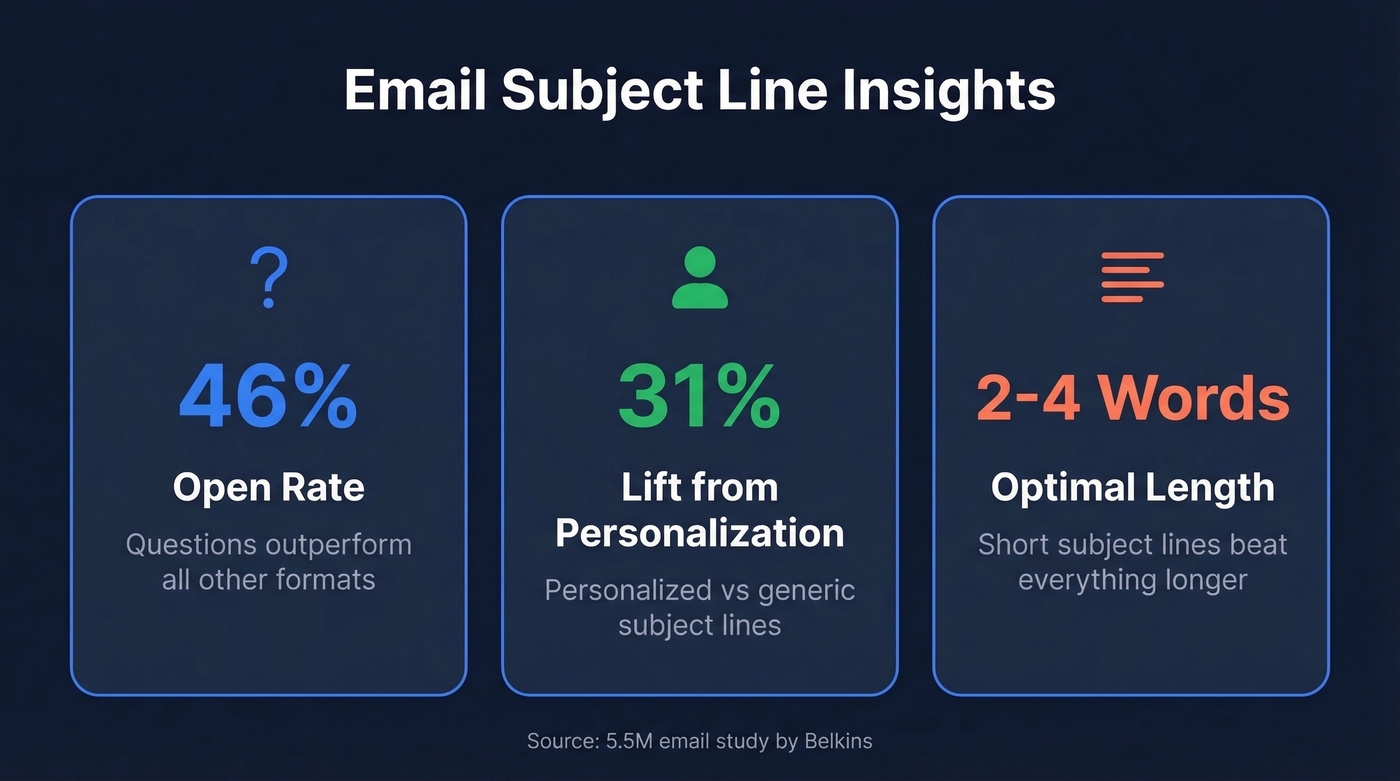
Here's the uncomfortable truth, though - the single biggest lever on your open rate isn't the subject line. It's list quality and deliverability. If your emails land in spam, the world's best subject line is invisible. Track replies, not opens. A 5%+ positive reply rate is the benchmark that actually correlates with pipeline.
What "Good" Looks Like in 2026
A 31% open rate is average for a newsletter-style campaign but mediocre for a well-targeted cold sequence. The numbers break down differently across email types:
| Metric | Newsletter/Campaign | Automated Flow | Cold Email |
|---|---|---|---|
| Open Rate | 31% avg | 40-55% | 35-46% |
| Click Rate | 1.69% avg | 5.58% avg | N/A |
| Reply Rate | N/A | N/A | 3-7% |
ActiveCampaign's dataset reports a 39.26% average open rate across its customer base, and the top 10% of senders in Klaviyo's 183K-brand benchmark hit 45.1% opens. But every one of these numbers is inflated by Apple MPP.
Why Your Open Rate Is Lying
Apple Mail Privacy Protection launched in 2021 and fundamentally broke open-rate tracking. When someone uses Apple Mail - regardless of their email provider - Apple's proxy servers preload tracking pixels automatically. The email registers as "opened" whether the recipient read it, glanced at it, or never scrolled past it.
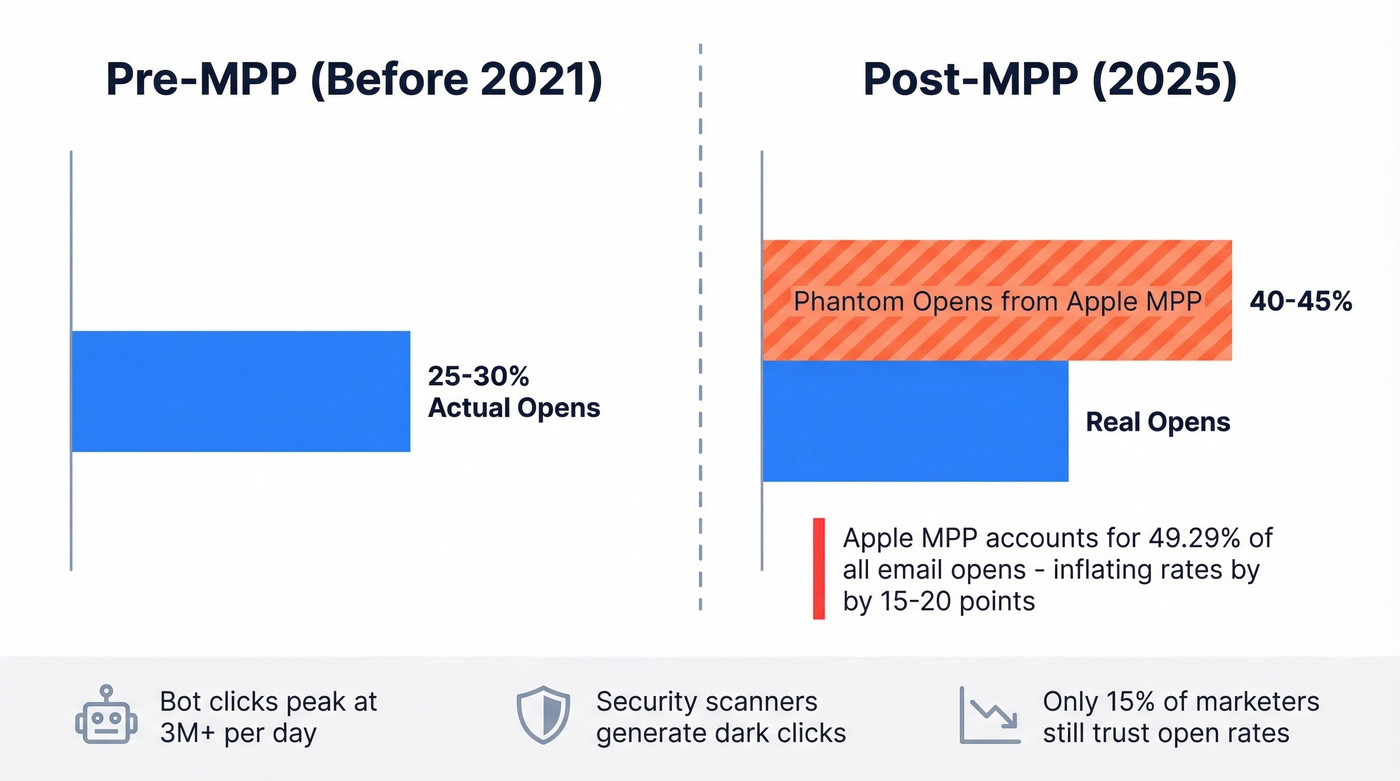
Apple MPP accounts for 49.29% of all email opens as of early 2025. That inflates reported open rates by 15-20 points. Pre-MPP, a healthy campaign showed 25-30% opens. Post-MPP, the same campaign reports 40-45% with zero change in actual engagement.
It gets worse. Beyond phantom opens, you're dealing with dark clicks from security scanners like Outlook Safe Links and Gmail link protections, plus AI bot crawling that generates massive volumes of fake clicks - peaking at 3M+ bot clicks per day in early 2025. Only 15% of email marketers still treat open rates as a primary metric. The other 85% have moved on. You should too.
Metrics That Actually Matter
- Positive reply rate: The gold standard for cold email. Target 5%+.
- Click rate: For newsletters and marketing emails, this is your real engagement signal - 1.69% for campaigns, 5.58% for automated flows.
- Conversions: Meetings booked, demos scheduled, deals created. The metric your CFO actually cares about.
- Bounce rate: Keep this at 1% or lower. If it's higher, stop testing subject lines. You have a data quality problem.
If your open rate sits below 15% after warm-up, the subject line is irrelevant. You have a deliverability problem.
Seven Proven Subject Line Formulas
Each formula below is backed by data from the 5.5M-email study or practitioner results. Not theory - performance.
1. Questions
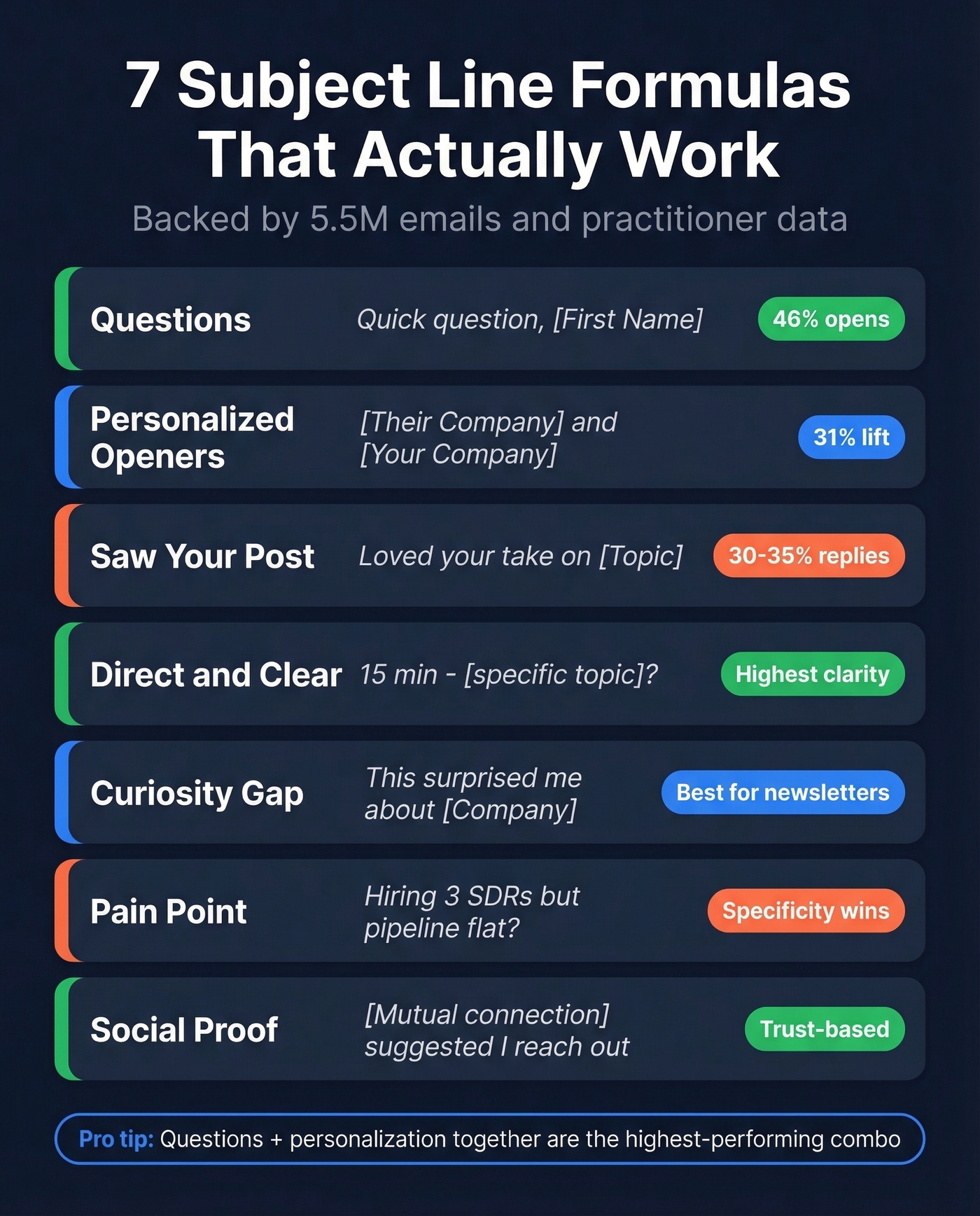
Questions hit a 46% open rate, making them the top-performing format. A question creates an open loop the brain wants to close. "Quick question, [First Name]" drives ~25-30% response rates in practitioner results shared on r/b2bmarketing. Keep the question short and genuine - not rhetorical, not salesy.
2. Personalized Openers
Personalized subject lines hit 46% opens versus 35% without - a 31% lift. Reply rates jump even harder: 7% versus 3%, a 133% increase. 72% of consumers are more likely to open emails with personalized subject lines. The format "[Their Company] and [Your Company]" works because it feels like a real person reaching out, not a blast. Practitioners report ~20-25% response rates with this pattern.
3. "Saw Your Post About [Topic]"
This is the highest-effort, highest-reward format. Referencing something specific a prospect posted or published drives ~30-35% response rates in practitioner reports. It requires actually knowing what your prospect cares about right now - which means doing research or using intent signals. Prospeo's intent data tracks 15,000 topics via Bombora, so you can reference what prospects actually care about this week instead of guessing.
4. Direct and Clear
"15 min - [specific topic]?" outperforms clever wordplay in cold outreach every time. The anti-pattern is marketing-speak: "Boost your ROI" and "Transform your business" get ignored or filtered. Direct openers share one trait: they tell the reader exactly what to expect.
5. Curiosity Gap
"This surprised me about [Company]" works because it creates a gap between what the reader knows and what they want to know - George Loewenstein coined the term. Strong for newsletters, risky for cold email. The gap feels clickbaity when you're a stranger, and clickbait spikes opens but kills replies.
6. Pain Point
Name the specific problem. "Hiring 3 SDRs but pipeline flat?" works because it signals you understand their world. Generic pain points like "struggling with growth?" read as spam. The more specific the problem, the higher the open rate.
7. Social Proof
"[Mutual connection] suggested I reach out" uses existing trust - when it's authentic. HubSpot found that 69% of recipients decide whether to mark an email as spam based on the subject line alone. A fabricated connection is the fastest way to earn that spam report.
The 33-Character Rule
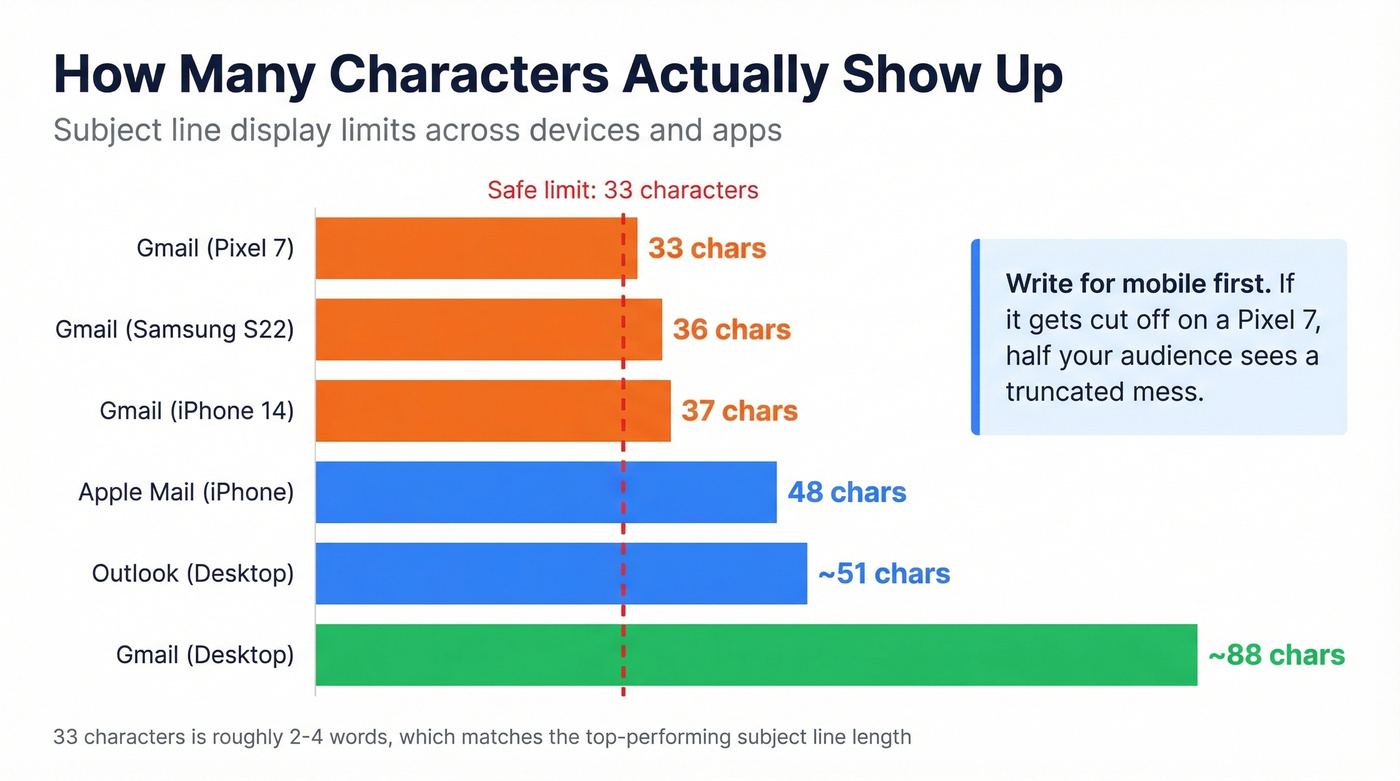
Most advice focuses on word count, but characters are what actually matter on mobile. EmailToolTester ran empirical tests across devices:
| Device / App | Characters Shown |
|---|---|
| Gmail (Pixel 7) | 33 |
| Gmail (Samsung S22) | 36 |
| Gmail (iPhone 14) | 37 |
| Apple Mail (iPhone) | 48 |
| Outlook (desktop) | ~51 |
| Gmail (desktop 1400px) | ~88 |
The safe universal limit is 33 characters. That often lands you in the 2-4 word range, which lines up with the finding that 2-4 word openers hit 46% open rates. Twilio SendGrid's Cyber Week data confirms it: the shortest lines performed best.
Write for mobile first. If your subject line gets truncated on a Pixel 7, half your audience sees "Quick question about yo..." instead of the full line.

Your subject line isn't the problem - your bounce rate is. If more than 1% of emails bounce, no formula will save you. Prospeo's 5-step verification delivers 98% email accuracy, cutting bounce rates below 4% on average.
Stop optimizing subject lines for emails that never reach the inbox.
Words That Kill Deliverability
45% of all emails end up in spam folders. Modern spam filters use machine learning that evaluates context, frequency, sender reputation, and engagement history - a single "free" won't kill you, but "FREE!!!" from a new domain with no engagement history absolutely will.
| Don't Say | Say Instead | Why |
|---|---|---|
| Last chance!!! | Enrollment closes Friday | Urgency + caps = spam signal |
| 100% guaranteed | Here's what we've seen | Exaggerated guarantee |
| Buy now | Worth a look? | Aggressive sales language |
| FREE trial | Try it this week | "Free" + formatting flags |
| Double your revenue | How [Company] grew 40% | Too-good-to-be-true |
| Act now | Quick question | Pressure language |
Formatting matters as much as the words. Multiple exclamation marks, ALL CAPS, and dollar signs are red flags regardless of context. Keep your lines lowercase or sentence case, skip the emoji in cold outreach, and don't stack multiple trigger words in the same line.
Cold Email vs Newsletter: Different Rules
Most subject line advice is written for newsletter marketers. Cold email operates under completely different rules, and mixing the two will tank your results.
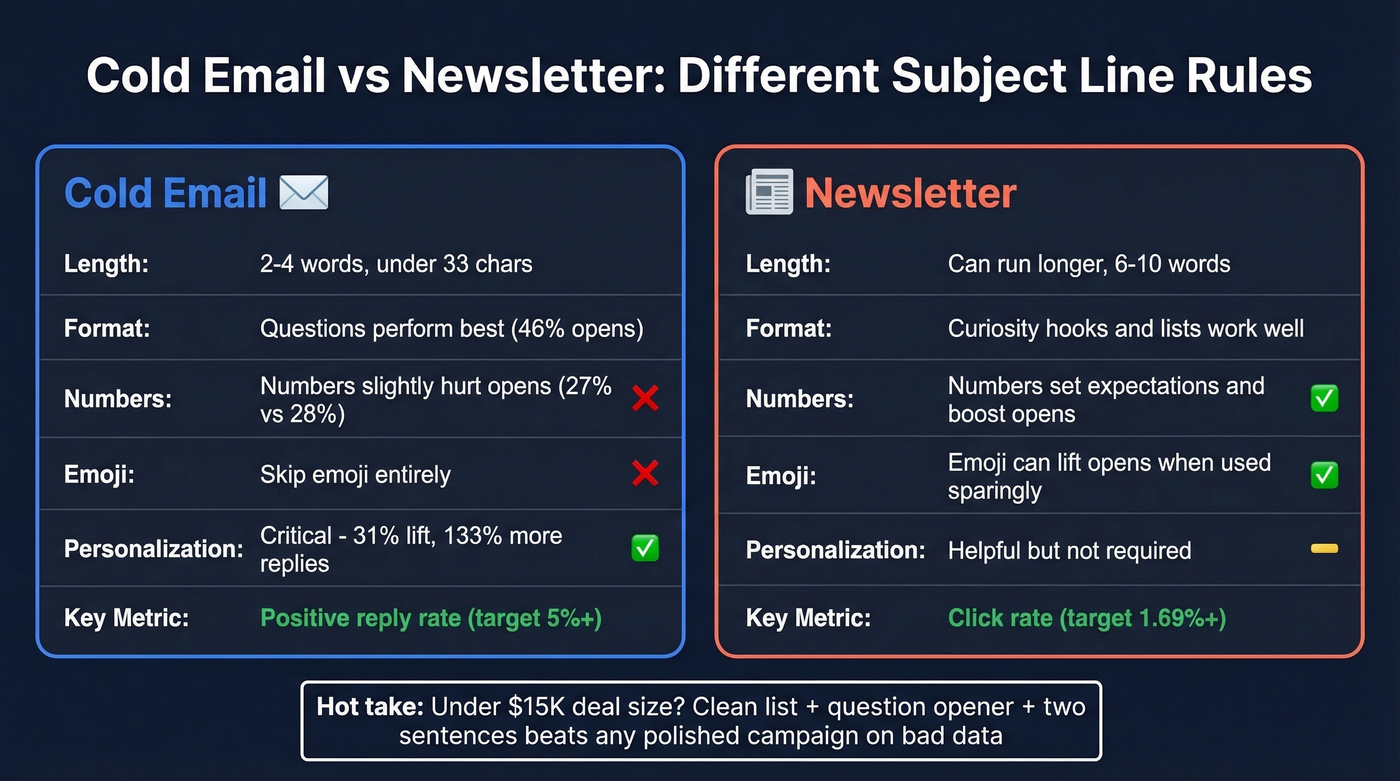
Cold email rewards brevity, questions, and personalization. Newsletter openers can run longer, use emojis, and lean into curiosity hooks. The 5.5M-email dataset shows numbers actually hurt cold email opens slightly - 27% with numbers vs 28% without - the opposite of newsletter best practice, where "7 tips for..." sets clear expectations.
Hot take: If your deal size is under $15K, you probably don't need a 7-step cold email sequence with A/B-tested subject lines. A clean list, a question-format opener, and a two-sentence body will outperform a polished campaign built on bad data every single time. The average cold email response rate is below 1%, but personalization can move replies from 3% to 7%. That gap is the difference between a dead campaign and a pipeline-generating one.
How to A/B Test Without Wasting Sends
Most teams test wrong - too many variables, too few contacts, measuring the wrong metric. Let's break down what disciplined testing actually looks like.
Isolate one variable. Change the subject line and nothing else. Not the send time, not the body, not the CTA.
Send to 250+ contacts per variant. Push toward 500+ for statistical confidence. Anything less and you're reading noise.
Measure positive reply rate, not opens. A clickbait opener will spike opens and kill replies. That's a net negative.
Watch for the 15% floor. If your open rate is below 15%, stop testing entirely. Check inbox placement, SPF/DKIM/DMARC records, and list quality first.
Test timing too. Tue-Thu, 9-11am in the recipient's timezone tends to outperform Monday and Friday. For international audiences, adjusting language, cultural references, and send times can lift engagement beyond what any English-only optimization achieves.
In our experience, teams that test subject lines before fixing deliverability waste weeks of sends. We've seen this play out repeatedly: a team runs A/B tests, finds a "winning" line, and their reply rate stays flat because a big chunk of the list was bouncing. Fix the foundation first.
The Step Before the Subject Line
Look - a team spends weeks optimizing subject lines, testing variants, rewriting copy, and their bounce rate is 12%. None of it matters. Bad data leads to bounces, bounces damage sender reputation, damaged reputation lands you in spam, and spam means your subject line never gets seen.
The fix starts with list hygiene. Before you send a single email, verify every address. Prospeo runs a 5-step verification process across 300M+ professional profiles with catch-all handling, spam-trap removal, and honeypot filtering - the kind of infrastructure that catches the addresses other tools miss. The 98% email accuracy rate keeps your bounce rate under the 1% threshold that protects your domain, with records refreshed every 7 days versus the 6-week industry average. Stack Optimize built their agency to $1M ARR on that data foundation - client deliverability stays above 94%, bounce rates under 3%, zero domain flags across all clients.
"Saw your post about [Topic]" is the highest-converting subject line format - but only if you know what prospects actually care about right now. Prospeo tracks 15,000 intent topics via Bombora so you can reference real buyer signals, not guesses.
Write subject lines based on real intent data, not assumptions.
40+ High-Converting Templates
Cold Outreach (First Touch)
- Quick question, [First Name]
- [Their Company] + [Your Company]
- Saw your post about [topic]
- [Mutual connection] mentioned you
- Idea for [specific challenge]
- [First Name], quick thought
- Noticed [specific trigger event]
- [Their Company]'s [specific metric]
- 15 min this week?
- Re: [their recent initiative]
- Thought of you when I saw [thing]
- [First Name] - one idea
Follow-Up Emails
- Did this land?
- [First Name], one more thing
- Re: [previous subject]
- Bumping this up
- Any thoughts on this?
- Forgot to mention
- Still relevant?
Newsletter / Marketing
- [Number] [topic] trends this week
- What we got wrong about [topic]
- This changed how we [specific action]
- [First Name], you'll want to see this
- The [topic] playbook (updated)
- We tested [thing] - here's what happened
- Sephora does this differently
- The [metric] nobody talks about
Re-Engagement
- It's been a while, [First Name]
- Things have changed since we last talked
- Still thinking about [problem]?
- New approach to [their challenge]
- Worth another look?
- [First Name], missed this?
- Quick update on [topic]
Meeting Requests
- 15 min - [specific topic]?
- Coffee chat about [topic]?
- [First Name], quick sync this week?
- Can we talk [specific problem]?
- [Day] at [time] work?
- Open Thursday afternoon?
- [First Name] / [Your Name] intro
FAQ
What's a good open rate in 2026?
Reported rates land between 30-40% across major platforms, but Apple MPP inflates these by 15-20 points. Track click rate (1.69% campaign average) and reply rate (5%+ target for cold email) instead - those numbers reflect actual human engagement, not proxy-server artifacts.
How long should a subject line be?
Two to four words hit a 46% open rate in the 5.5-million-email study. Stay under 33 characters to display fully across all major mobile devices and email apps. Longer lines get truncated on phones, where most recipients read.
Do emojis help or hurt?
Emojis can boost newsletter opens by 1-3% but tend to hurt cold email performance. They add visual noise in a professional inbox and can trigger spam filters when combined with other risky formatting. Save them for marketing emails to opted-in lists.
Should I use numbers in cold email subject lines?
The 5.5M-email dataset shows numbers slightly hurt cold email opens - 27% with numbers versus 28% without. Save numbers for newsletter content where specificity like "7 tips" sets clear reader expectations. In cold outreach, conversational phrasing consistently outperforms formatted lines.
How do I fix deliverability before testing subject lines?
If your open rate is below 15% after warm-up, it's almost certainly a deliverability issue. Check SPF/DKIM/DMARC records, verify every address on your list, and keep bounce rate at 1% or lower. Skip this if your bounce rate is already under 1% and you're seeing healthy reply rates - in that case, your subject line really is the bottleneck, and the formulas above will help.