

How to Run a Summer Sales Incentive That Actually Moves Pipeline
It's the second week of July. Half your team is on PTO, the other half is mailing it in, and your pipeline dashboard looks like a flatline. During peak vacation weeks, outbound response rates typically fall 10-25% - and a lot of teams respond with a hastily thrown-together summer sales incentive that fizzles by day five.
We've watched this play out dozens of times. The contest launches with fanfare, three reps care, and by the following Monday nobody remembers the rules. Here's how to build one that doesn't end that way.
What You Need (Quick Version)
- Budget $150-$200 per rep for a 4-week program. Anything under $100 signals you don't value the effort.
- Run Sales Bingo or a Daily Prize format - not winner-take-all. Multiple paths to win keep mid-performers engaged.
Do Summer Incentives Actually Work?
Yes - if you design them right. The IRF's ROI research includes a manufacturer case study where a $3.5M incentive investment generated $7.44M in incremental profit, a 112.5% ROI. A hand tools manufacturer saw a roughly 7.5% net sales gain during their incentive window, improved accounts receivable from 59 to 32 days, and boosted cash flow by an estimated $328,000 per month. An office equipment channel program attributed $37.2M in incremental purchases to its incentive program.
Those are the numbers that make a CFO stop questioning your contest budget.
Budgeting Per Rep
The IRF's 2026 Industry Outlook pegs average annual non-cash reward spend at $921 per person in North America, with 62% of programs in the $100-$500 range. For a focused 4-week summer program, $150-$200 per rep is the sweet spot.
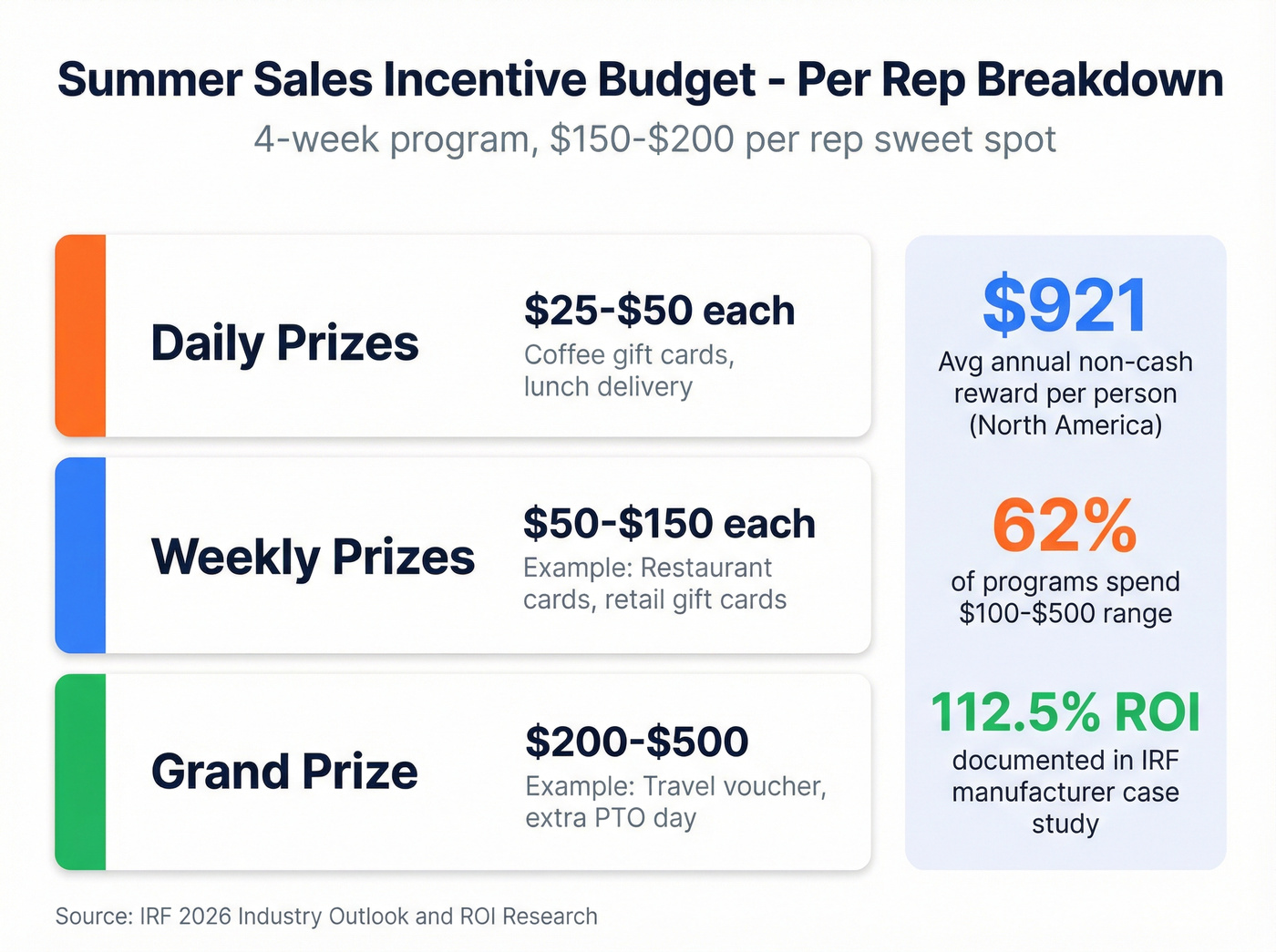
| Prize Level | Amount | Example |
|---|---|---|
| Daily | $25-$50 | Coffee gift card |
| Weekly | $50-$150 | Restaurant or retail card |
| Grand | $200-$500 | Travel voucher or extra PTO |

Your summer incentive budget is wasted if reps are dialing disconnected numbers. One team dropped bounce rates from 35% to under 4% after switching to Prospeo's 98% accurate emails and verified mobiles. At ~$0.01 per email, cleaning your contest list costs less than a single daily prize.
Verify your list before launch day - not after reps burn out on bad data.
Designing a Summer SPIFF
Keep it to two to four weeks. Anything longer and reps lose urgency. Anything shorter and you're creating a lottery, not changing behavior.
Match the reward to the audience. Cash works for senior AEs. Non-cash rewards like gift cards, experiences, and extra PTO work better for SDRs where recognition matters as much as dollars - gift cards account for 43% of all incentives in North America. Use percentage-of-quota qualification so everyone who hits 110% wins, not just the top rep across territories with wildly different potential.
Measure leading indicators - calls, emails, meetings booked - not just closed revenue. Leading metrics give reps daily feedback and keep the energy up even when deals take weeks to close.
Hot take: if you need frequent SPIFFs, your comp plan is broken. SPIFFs are overlays for specific moments, not band-aids for structural problems.
5 Contest Ideas Worth Stealing
Sales Bingo
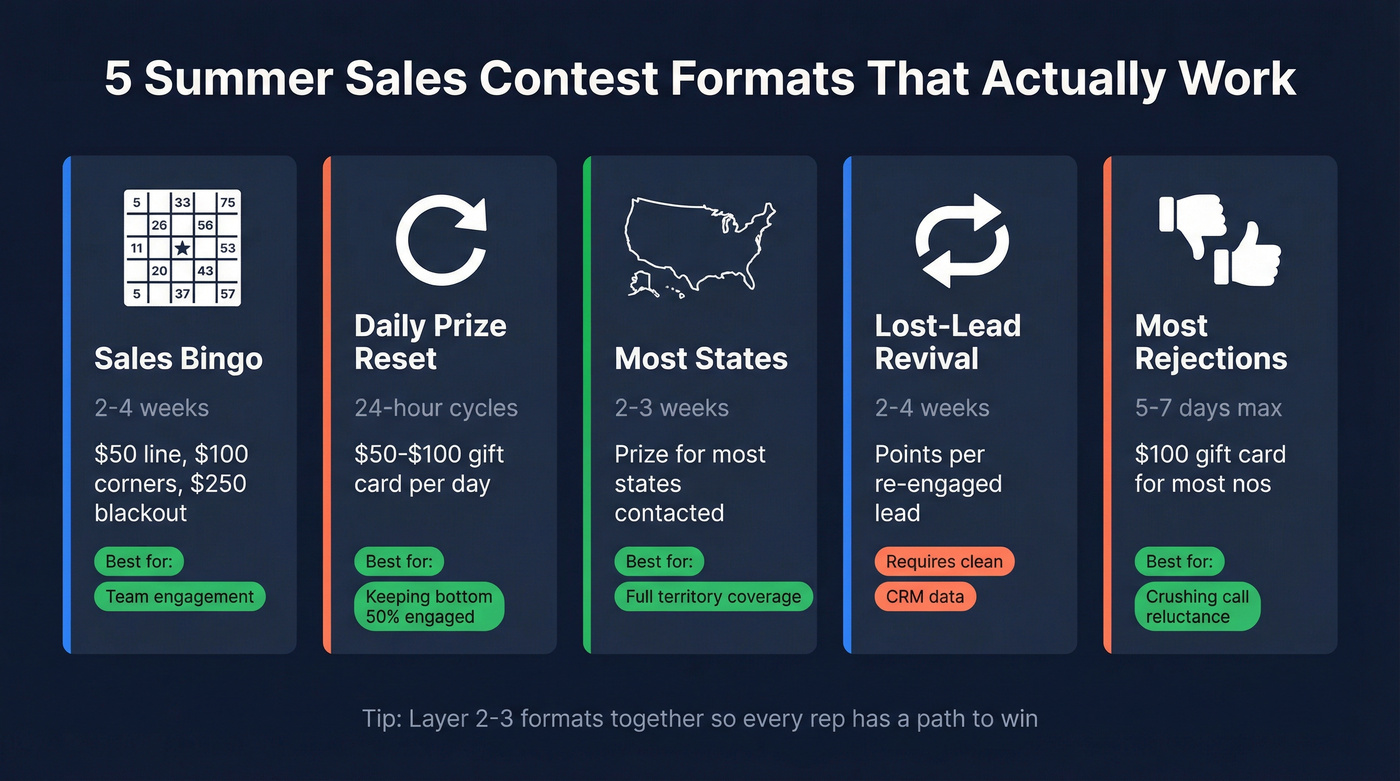
Build a card with activity squares: book a meeting, send 50 emails, get a referral, close a deal under 14 days. Tiered prizes - $50 for a line, $100 for four corners, $250 for blackout. Runs 2-4 weeks. In our experience, this format generates the most Slack chatter because reps are constantly one square away from something.
Daily Prize Reset
Your SDR had a rough Monday? Doesn't matter - the leaderboard resets every 24 hours. Track a controllable metric like dials or emails sent. Award a $50-$100 gift card to the daily winner. This is the format that keeps your bottom 50% in the game, which is the entire point.
Most States
Simplest contest on this list, and one of the most effective. Reward the rep who talks to leads in the most U.S. states. It pushes reps to work their full territory instead of cherry-picking familiar accounts. We've seen teams uncover entire neglected regions this way.
Lost-Lead Revival
Pull lost opportunities from your CRM, assign them evenly, and award points per call with bonus points per re-engaged lead. This turns dead pipeline into a contest mechanic - and occasionally resurfaces real deals. Skip this one if your CRM hygiene is a disaster, though, because reps will waste time chasing contacts who left the company two years ago.
Most Rejections
Prize: $100 gift card. The rep who collects the most "no" responses wins. Sounds counterintuitive, but it crushes call reluctance. Run it for 5-7 days max - any longer and it becomes a joke instead of a tool.
5 Mistakes That Kill Your Contest
Winner-take-all design. The same top rep wins every time, and 80% of your team checks out by day three. Fix it with quota-based qualification so hitting 110% earns a prize regardless of rank.
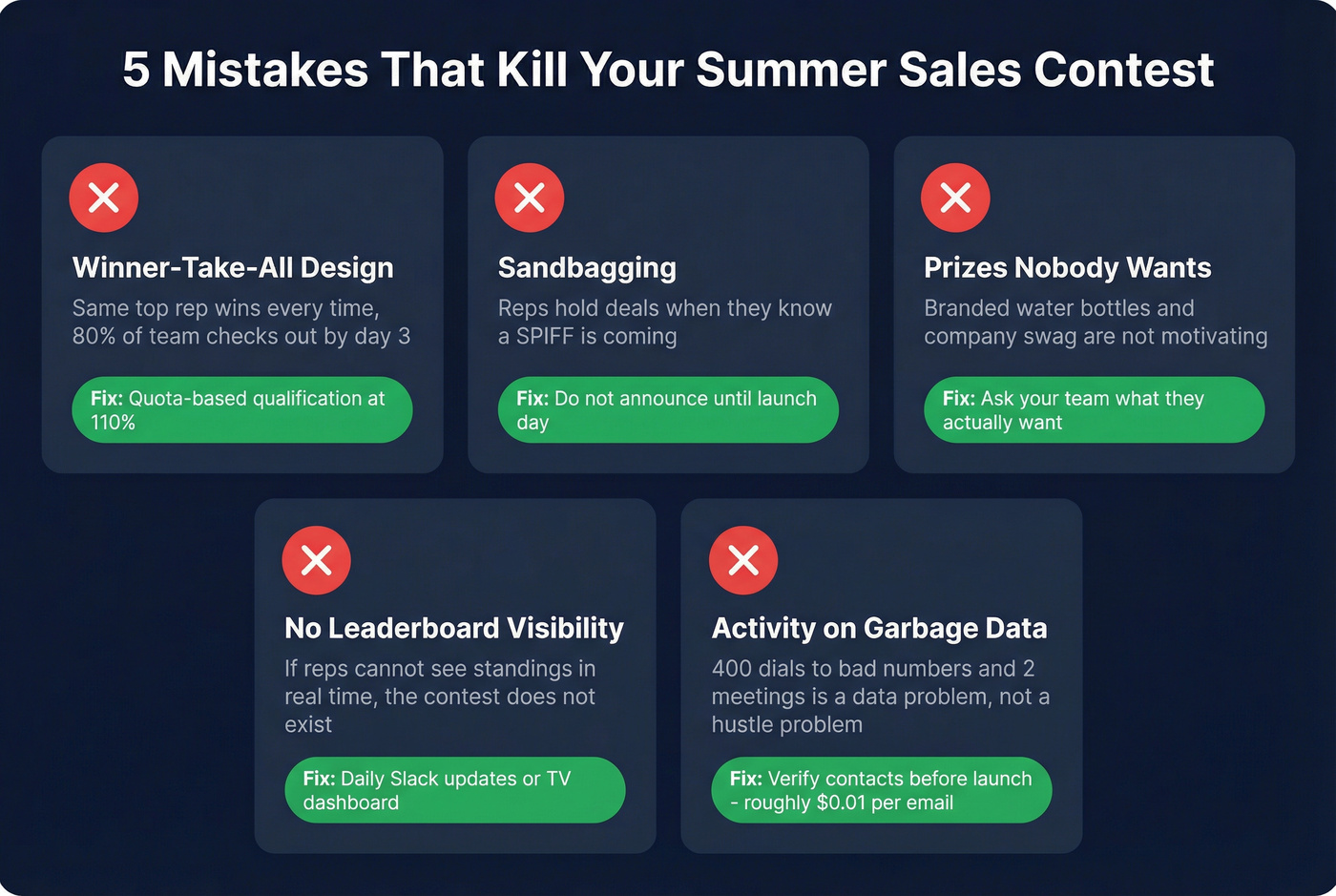
Sandbagging. If reps know a SPIFF is coming, they'll hold deals. Don't announce it until launch day.
Prizes nobody wants. A branded water bottle isn't motivating anyone. Ask your team what they actually want. One manager I talked to last summer spent $2,000 on company-branded Yeti tumblers. His team already had four each.
No leaderboard visibility. If reps can't see where they stand in real time, the contest doesn't exist. Post daily updates in Slack or throw it on a TV dashboard. (If you need a framework, start with a sales leaderboard that updates daily.)
Activity contests on garbage data. Here's the thing - your SDR making 400 dials to bad numbers and booking 2 meetings isn't a hustle problem. It's a data problem. Before any activity-based contest, verify your data. At roughly $0.01 per email, cleaning your list costs almost nothing. Letting reps burn effort on disconnected numbers costs you the entire program.
For a concrete benchmark: one team cut bounce rates from 35% to under 4% and pushed connect rates up to 20-25% after switching to verified contact data. That's the difference between a "fun contest" and a contest that actually creates pipeline.
Tools to Run Your Contest
You don't need expensive software, but visibility matters.
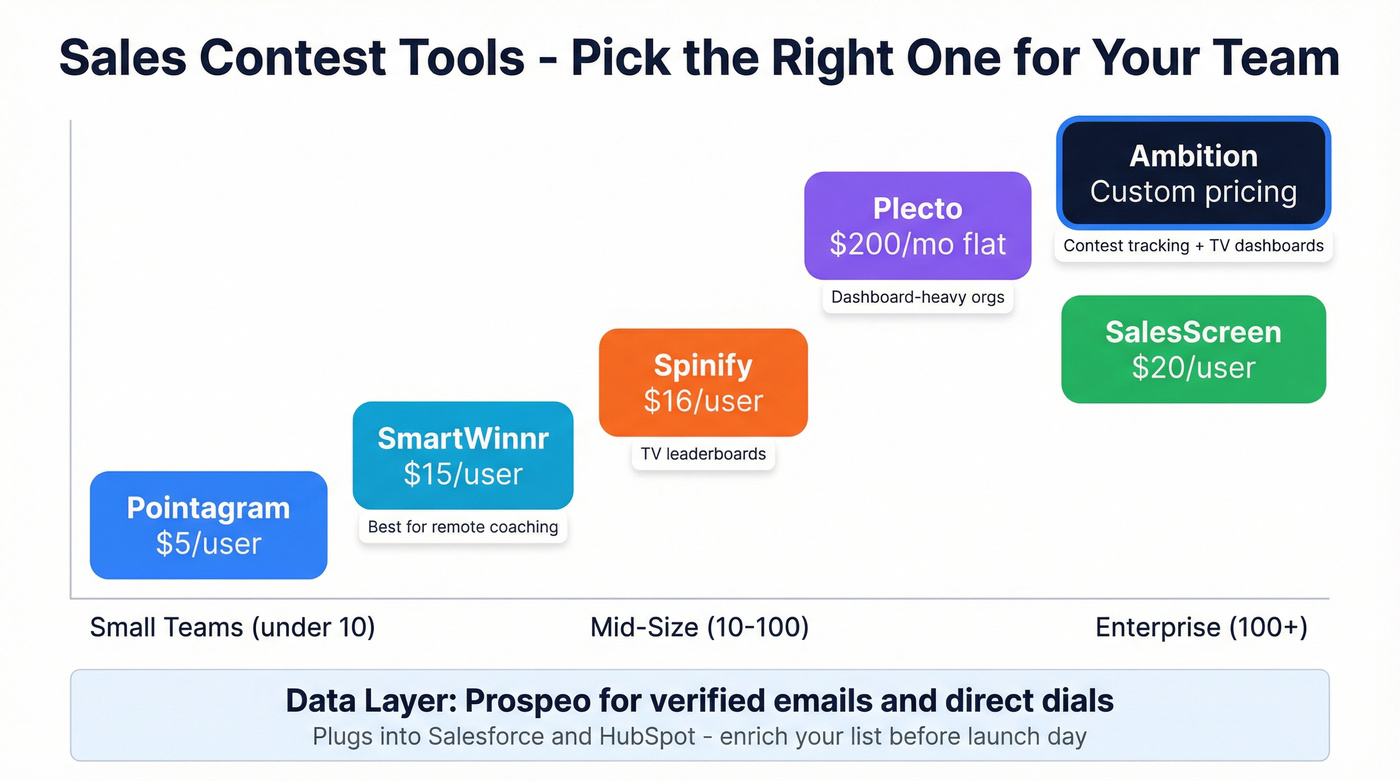
| Tool | Starting Price | Best For |
|---|---|---|
| Pointagram | $5/user | Teams under 10 reps |
| SmartWinnr | $15/user | Remote coaching |
| Spinify | $16/user | TV leaderboards |
| SalesScreen | $20/user | 100+ rep orgs |
| Plecto | $200/mo | Dashboard-heavy orgs |
| Ambition | Custom | Contest tracking + TV dashboards |
For CRM tracking, Salesforce and HubSpot reports handle basic contest metrics out of the box. For gamification strategy, GTMnow's breakdown of common sales contest mistakes is worth bookmarking.
If you want more formats beyond the five above, steal from this list of sales team contest ideas and mix them with a few proven sales contest prize ideas.
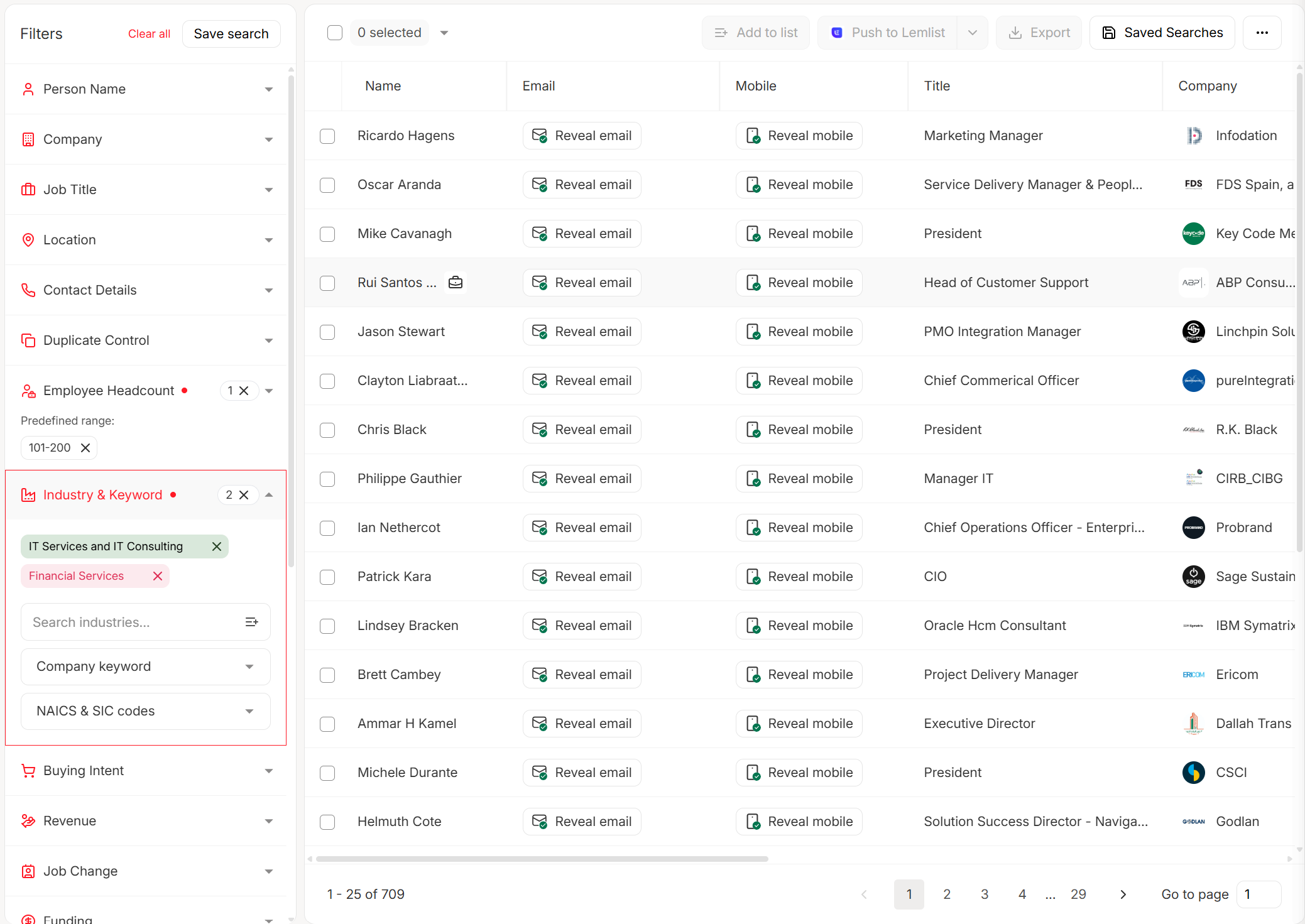
And for the data layer underneath your contest - the verified emails and direct dials your reps need to hit activity targets - Prospeo plugs directly into both Salesforce and HubSpot. Enrich your list before launch day so every dial and email counts toward something real.
Activity-based contests like Sales Bingo and Daily Prize Resets only work when every dial and email reaches a real person. Prospeo gives your team 125M+ verified mobile numbers with a 30% pickup rate and emails refreshed every 7 days - so contest activity turns into actual pipeline, not wasted effort.
Give your reps real contacts and watch your leaderboard actually mean something.
FAQ
How long should a summer sales contest run?
Three weeks is the sweet spot for most teams - enough time to shift behavior without killing urgency. Two weeks works for simple daily-prize formats. Four weeks is the absolute max before engagement drops off a cliff.
What's the best prize for a summer SPIFF?
Gift cards in the $50-$150 range for weekly prizes. For grand prizes, extra PTO or travel vouchers consistently outperform cash. Let's be honest - nobody's getting excited about a $200 check after taxes. A Friday off in August? That moves people.
How do I keep mid-performers engaged?
Use percentage-of-quota qualification so everyone who hits 110% wins, not just the top closer. Layer in multiple contest types - bingo, daily resets, rejections - so different skills get rewarded and every rep has a realistic path to a prize.
How do I prevent reps from gaming activity metrics?
Verify your contact data before launch so dials and emails hit real people. Then tie activity metrics to outcomes - require a minimum meeting-booked rate alongside dial counts. Pure activity numbers without quality gates will always get gamed.