

The Best Targeted Leads Generators for B2B Teams That Hate Bad Data
A RevOps lead we know ran a 3-tool bake-off last quarter. The "best" database created 4,000 duplicate contacts in Salesforce in five days. The cheapest tool had better phone connect rates. And the tool with the biggest brand name? It bounced 23% of emails on the first sequence.
That tracks with what practitioners say on Reddit: roughly 90% of leads from data vendors don't fit the actual ICP, and the ones that do still need verification before you can trust them. One poster summed up the frustration perfectly - "Cold emails: 2% reply rate, LinkedIn requests: ignored, Ads: expensive, low conversion. I need an actual workflow, not theory."
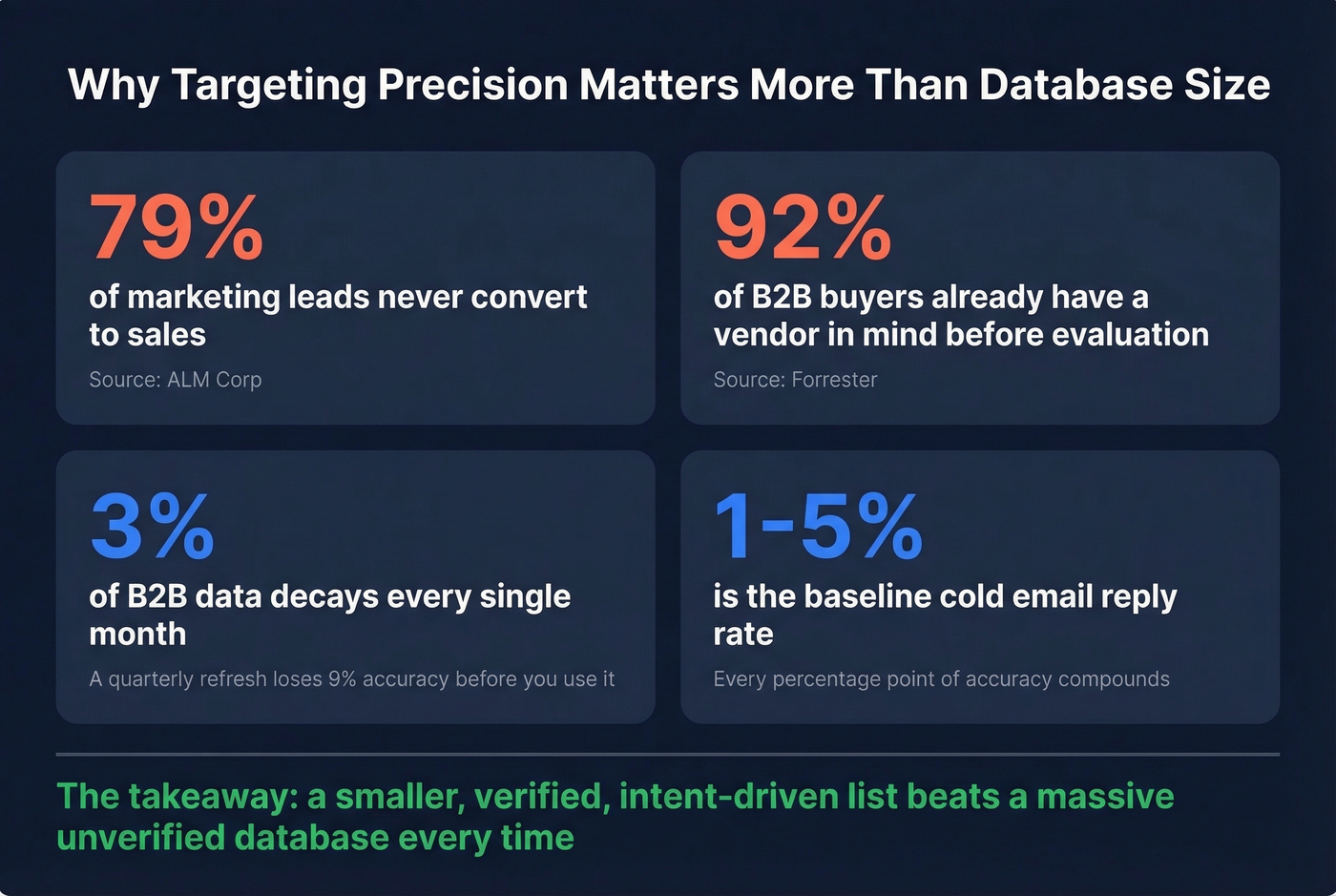
79% of marketing leads never convert into sales, and the baseline cold email reply rate sits at 1-5%. The gap between "generating leads" and picking the right targeted leads generator comes down to targeting precision, data freshness, and verification. Here are eight tools worth your time - and the stack logic behind them.
Our Picks (TL;DR)
Best for data accuracy and verified targeting: Prospeo - 98% email accuracy, 300M+ profiles, 30+ search filters including buyer intent and technographics. Starts free, paid plans run ~$0.01/email. No contracts.
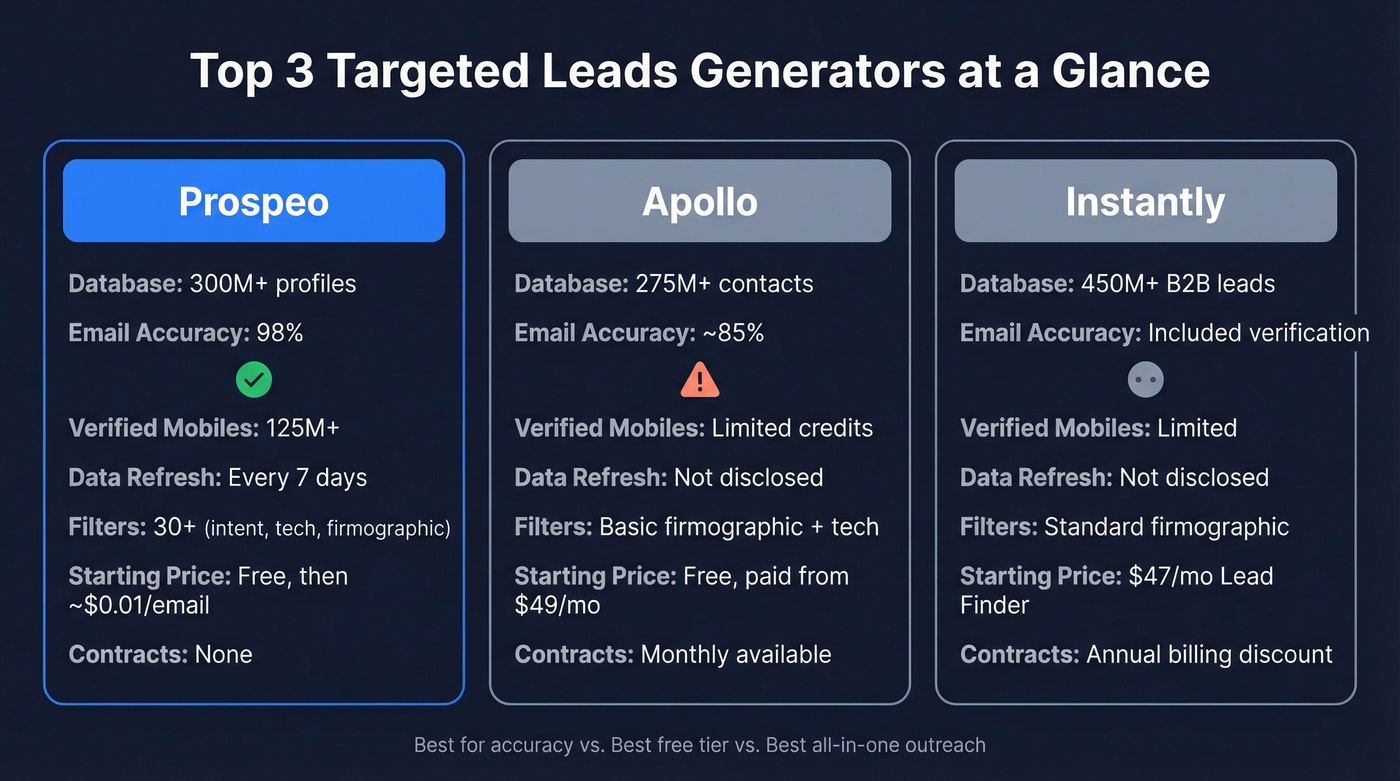
Best free starting point: Apollo - 275M+ contacts, genuinely useful free tier, paid plans from $49/mo per user. Accuracy runs lower at around 85%, but you can't beat the price of zero.
Best all-in-one outreach + lead finding: Instantly - 450M+ B2B leads paired with email sending and warmup. Lead Finder from $47/mo, Outreach from $30/mo billed yearly.
What Makes a Lead Generator "Targeted"
Not every tool that calls itself a "lead generator" actually does targeting. Many are glorified search bars on top of a static database. Here's what separates a real targeted leads generator from a contact dump.
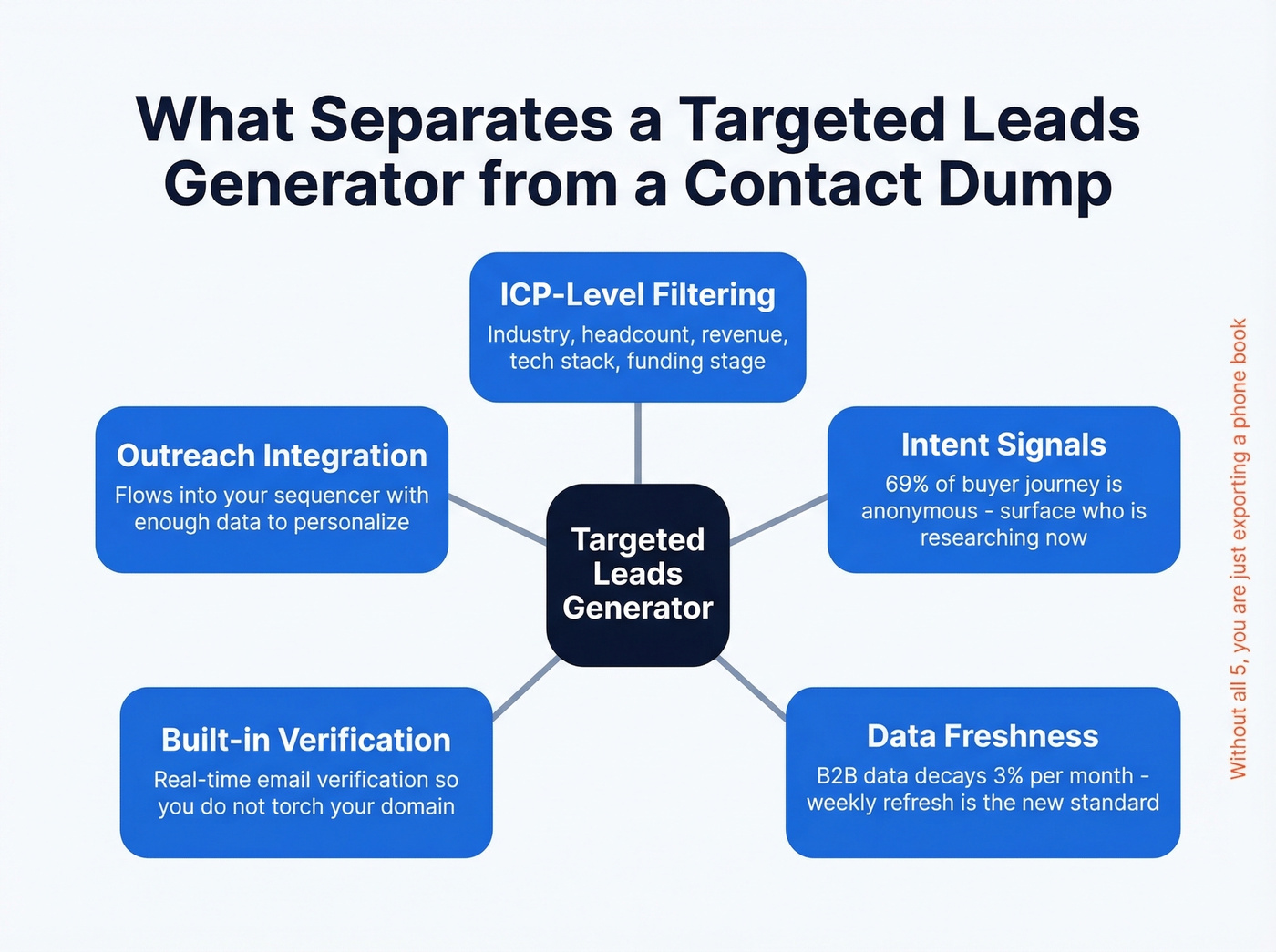
ICP-level filtering. You need firmographic filters like industry, headcount, revenue, and funding stage alongside technographic filters covering the tools a company runs. Without these, you're pulling names from a phone book. The ability to build targeted lists - rather than generic exports - is the single biggest differentiator between tools that drive pipeline and tools that waste rep time.
Intent signals. Buyers complete up to 69% of their journey anonymously. Worse, 92% of B2B buyers already have a vendor in mind before formal evaluation begins, and the Day One shortlist winner closes the deal 95% of the time. If your tool can't surface who's actively researching your category, you're not on that list.
Data freshness. B2B data decays at roughly 3% per month. A database refreshed quarterly has already lost 9% of its accuracy before you touch it. Weekly refresh cycles are the new standard for teams that care about deliverability.
Built-in verification. Finding an email is step one. Knowing it won't bounce is step two. The best tools verify in real time so you don't torch your domain reputation on the first campaign.
Outreach integration. Your leads need to flow into Instantly, Lemlist, Outreach, or whatever sequencer you run - with enough data points to personalize at scale. Manual CSV exports are a workflow tax that compounds every week.
8 Best Targeted Leads Generators in 2026
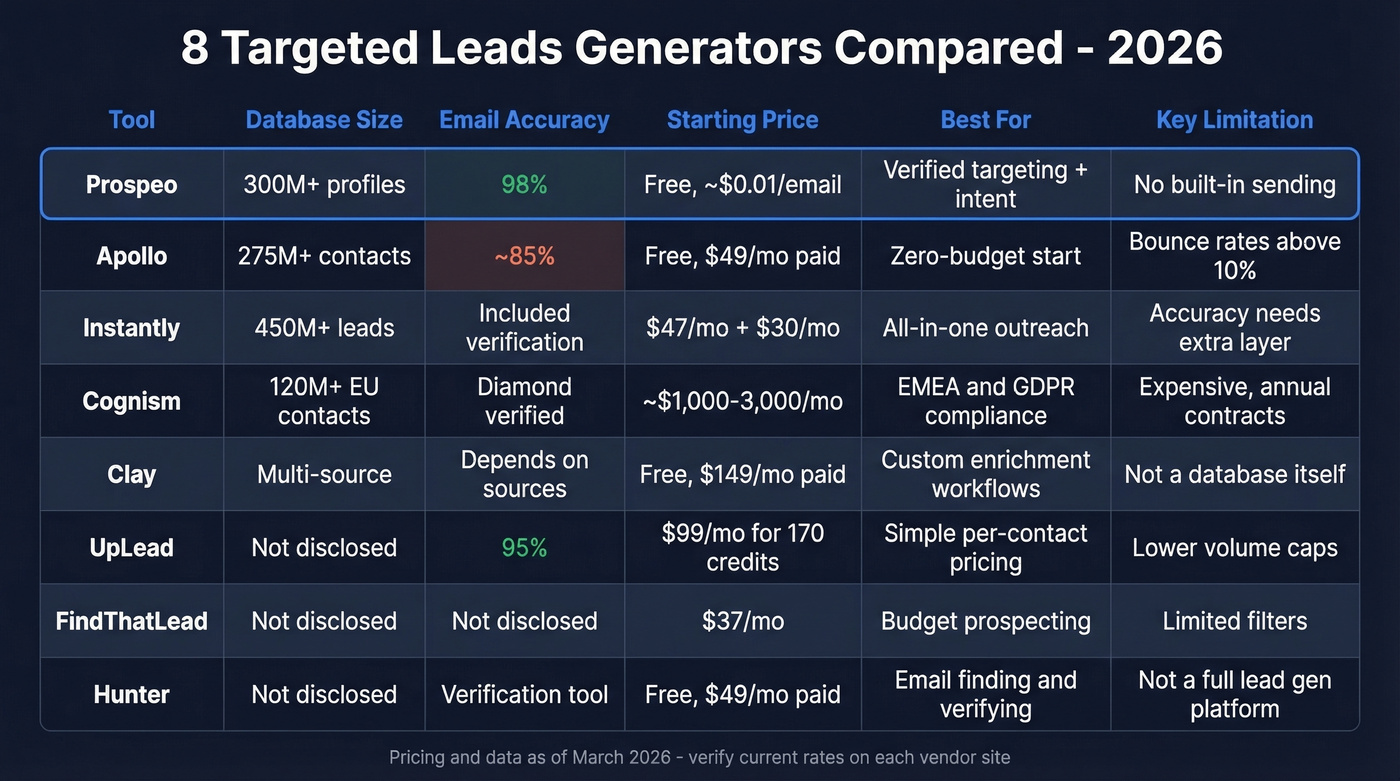
Prospeo
Prospeo covers 300M+ professional profiles, 143M+ verified emails, and 125M+ verified mobile numbers, all refreshed on a 7-day cycle. That refresh cadence alone puts it ahead of the roughly 6-week industry average. The platform runs proprietary email-finding infrastructure rather than reselling third-party data, which is how it maintains 98% email accuracy.
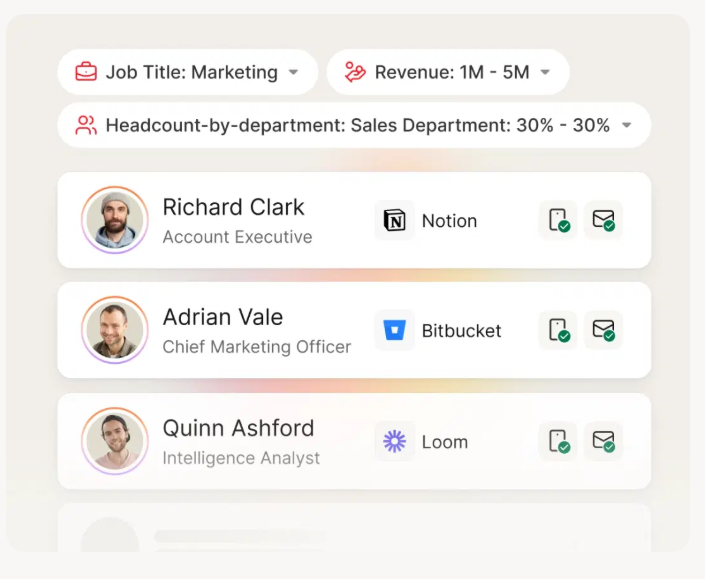
Thirty-plus search filters cover buyer intent powered by 15,000 Bombora topics, technographic data via Wappalyzer and live job postings, job change signals, headcount growth, department-level headcount, funding rounds, and revenue. You're building a list of companies actively in-market for what you sell, not just filtering by title and industry. Teams that need phone-verified contacts will appreciate the 125M+ verified mobile numbers carrying a 30% pickup rate across all regions - a depth of direct-dial coverage that most competitors gate behind enterprise pricing.

CRM enrichment returns 50+ data points per contact with a 92% API match rate. Integrations cover Salesforce, HubSpot, Instantly, Lemlist, Clay, Zapier, and Make. You can also find lookalike leads by filtering for companies that share firmographic and technographic traits with your best existing customers - a fast way to expand into adjacent segments without guessing.
Pricing starts free with 75 emails/month, and paid plans run ~$0.01 per email. No annual contracts, no sales calls required. In our experience, the combination of weekly data refresh and real-time verification means we've seen teams cut bounce rates from 35%+ down to under 4% within the first month.
Use this if: You need verified, targeted contacts without enterprise pricing or annual lock-in.
Skip this if: You only need a sending tool - pair it with Instantly or Lemlist for outreach.
Apollo
Apollo is the obvious starting point for most SMB teams, and for one reason: the free tier is genuinely generous. You get access to 275M+ contacts, basic search filters, and enough credits to run real campaigns before spending a dollar.
Paid plans range from $49-$149/mo per user, which is reasonable until you hit the credit walls. The highest plan caps you at 125 mobile credits and 2,000 export credits - a ceiling that mid-volume teams slam into fast. The credit model creates a scarcity mindset that slows reps down.
Accuracy is the real trade-off. Industry benchmarks commonly put Apollo's email accuracy around 85%. That's workable for low-volume prospecting, but if you're running 500+ emails per week, a 15% miss rate will damage your sender reputation. We've tested this firsthand and watched bounce rates climb past 10% on Apollo-sourced lists that weren't run through a second verification pass.
Use this if: Budget is zero and you need to start prospecting today.
Skip this if: Bounce rates above 10% are unacceptable for your domain, or you need reliable mobile numbers at scale.
Instantly
Instantly's pitch is simple: find leads and send emails from one platform. The Lead Finder taps a 450M+ database, and the Outreach product handles unlimited email accounts, warmup, and sending. Growth plans start at $47/mo for Lead Finder and $30/mo for Outreach, billed yearly.
The combined platform is compelling for solo founders and small agencies who don't want to manage three tools. But there's a common Reddit dilemma: $37/mo can feel like overkill when you're only sourcing 20 leads a day. The warmup feature keeps people paying even when volume is low.
Instantly includes lead verification as part of its database workflow. For high-volume campaigns, adding a dedicated verification layer upstream still makes sense for extra protection.
Use this if: You want one platform for finding and sending cold emails.
Skip this if: Data accuracy is your top priority - add a verification tool upstream.
Cognism
Cognism is the answer for teams selling into Europe who can't afford GDPR headaches. DNC checking comes standard across the US, UK, Canada, Australia, and Europe - not as an add-on. Their Diamond Data program manually verifies mobile numbers by actually calling them, a level of phone verification nobody else offers at scale.
The database runs 50M+ US mobiles and 120M+ European contacts. Custom pricing typically lands at $1,000-3,000/mo with annual contracts. Where Cognism wins over ZoomInfo: EMEA compliance and mobile verification. Where ZoomInfo still wins: US database depth and workflow breadth. For teams focused exclusively on North America, the premium is hard to justify.
Use this if: EMEA is a primary market and GDPR compliance isn't optional.
Skip this if: You sell mostly in the US and don't want annual contracts.
Clay
Clay isn't a lead database - it's a workflow engine that pulls enrichment data from dozens of sources and lets you build multi-step automation sequences. Think of it as the glue between your data providers and your outreach tools.
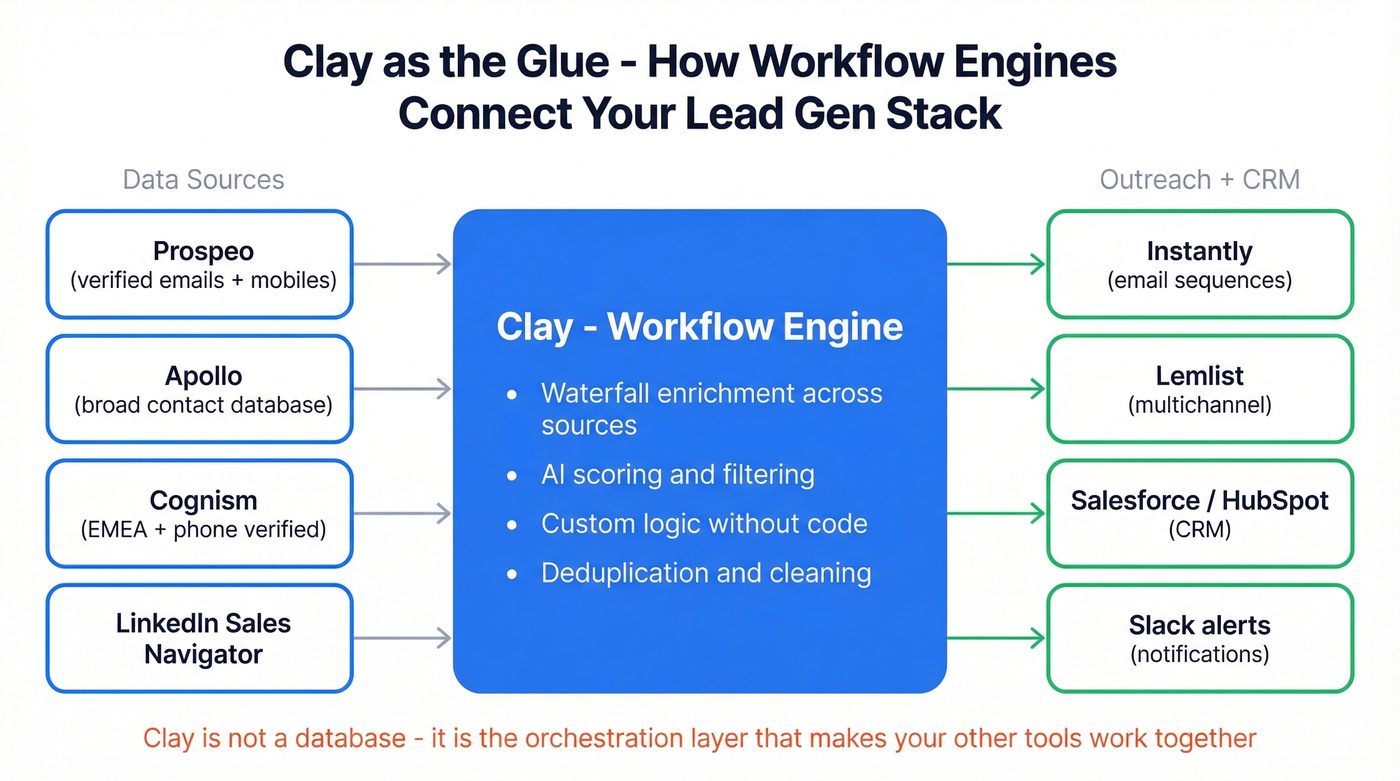
The consensus on r/sales is overwhelmingly positive. "Clay is doing it for me again" was a typical sentiment, and practitioners regularly pair Clay with tools like Trigify for trigger-based prospecting, which shows how flexible the ecosystem has become. Free tier available, paid plans from ~$149/mo on a credit-based model.
Use this if: You want to waterfall multiple data sources and build custom enrichment logic without writing code.
Skip this if: You just need a simple database search - Clay's power is overkill for basic list building.
UpLead
UpLead keeps things simple: one credit equals one contact, and that contact comes with both email and direct dial. They report 95% email accuracy with real-time verification at the point of export.
Essentials runs $99/mo for 170 credits, Plus is $199/mo for 400 credits. No hidden modules, no seat minimums on lower tiers. It's a solid mid-market option for teams that want predictable per-contact pricing without the complexity of Apollo's credit tiers or the sticker shock of Cognism's annual contracts.
FindThatLead
Budget pick. Starter at $37/mo on monthly billing, Ultimate at $75/mo with unlimited emails under fair use. Free 7-day trial with 50 credits. Targeting filters are more limited than the Tier 1 tools, but the price-to-volume ratio works for early-stage teams burning through lists. If you're sourcing small business owner leads on a tight budget, FindThatLead's low entry price makes it easy to test before committing to something bigger.
Hunter
Hunter is an email finder and verifier, not a full lead generation platform. Free tier available, paid plans start at $49/mo. Best used as a verification utility layered on top of a data source like Apollo or Clay. If you already have names and companies, Hunter finds and verifies the emails. It's not a targeted leads generator on its own, but it fills a critical gap in almost any outbound stack.

Most targeted leads generators decay before you hit send. Prospeo refreshes 300M+ profiles every 7 days - not every 6 weeks - so your ICP filters pull live contacts, not dead ends. 98% email accuracy, 30+ targeting filters, ~$0.01/email.
Stop verifying leads your tool should have verified for you.
If 79% of leads never convert, targeting precision isn't optional - it's the whole game. Prospeo layers buyer intent across 15,000 Bombora topics with technographic and headcount growth filters so you reach in-market buyers, not just matching job titles.
Generate targeted leads that actually pick up the phone.
Pricing Compared
| Tool | Starting Price | Model | Terms | Accuracy |
|---|---|---|---|---|
| Prospeo | ~$0.01/email | Credits | Free tier, no contract | 98% |
| Apollo | $49/mo/user | Credits + seats | Free tier, no contract | ~85% |
| Instantly | $47/mo (Leads) | Credits | Annual billing, no contract | Verified leads |
| Cognism | ~$1,000/mo | Custom | Annual commitment | Diamond verified |
| Clay | ~$149/mo | Credits | Free tier, no contract | Varies by source |
| UpLead | $99/mo | Credits | Trial only, no contract | 95% |
| FindThatLead | $37/mo | Credits | Trial only, no contract | Not published |
| Hunter | $49/mo | Credits | Free tier, no contract | Verifier tool |
For context, a 10-seat ZoomInfo contract with intent data and mobile numbers can run $15K-40K+/year. That's real money for a Series A company.
Build Your Stack, Not a Toolbox
Lead gen works as a stack, not a single tool. You need three layers working together.
Layer 1: Data + targeting. Build targeted business leads by filtering for people who match your ICP and show buying signals. This is where 30+ filters, intent data, and verified contact info do the heavy lifting.
Layer 2: Verification. Even if your data source verifies emails, running a second pass catches edge cases. Hunter works well here as a standalone verification layer.
Layer 3: Outreach. Instantly, Lemlist, or Smartlead for email sequences. Native integrations between your data layer and your sequencer eliminate CSV gymnastics.
Here's the thing: you need 2-3 tools, not 20. We've seen teams stack six data providers and still bounce 15% of emails because nobody owned the verification step. If your average deal size is under five figures, you probably don't need ZoomInfo-level data - a self-serve tool with strong verification will outperform an enterprise database you're only using at 20% capacity.
Mistakes That Kill Your Targeting
Targeting too broadly. "VP of Sales at companies with 50-5,000 employees" isn't an ICP - it's a census. Layer in intent signals, technographics, and growth indicators to narrow your list to people who might actually care.
Ignoring data decay. B2B data decays at ~3% per month. A list you built in January is 18% stale by July. Use tools with weekly refresh cycles or re-verify before every campaign.
Slow follow-up. Up to 50% of sales go to the first vendor to respond. The chance of converting drops dramatically when you wait longer than an hour. The average B2B buying cycle runs 10.1 months - but the window to get on the shortlist is measured in days, not months. Your targeted leads generator is only as good as your speed-to-sequence workflow.
Measuring vanity metrics. Leads generated per week means nothing if they don't convert. Track pipeline created, reply rates, and meetings booked - not list size. Let's be honest: a 10,000-lead export that books zero meetings is worse than a 200-lead list that fills your calendar.
FAQ
What's the difference between a targeted leads generator and a lead database?
A targeted leads generator filters contacts by ICP criteria - intent signals, technographics, firmographics - and delivers ready-to-contact lists. A lead database is a static repository you search manually. The best tools combine both, but the "generator" piece is the targeting logic that separates signal from noise.
How many leads should I generate per day?
Twenty to fifty highly targeted leads with verified contact data will outperform 500 unfiltered contacts from a bulk export. Focus on match-to-ICP rate and reply rate, not raw list size.
Do I need separate tools for finding and verifying leads?
Not always. Some platforms handle both - you search with targeting filters and get verified emails and mobiles in the same workflow. Teams running 1,000+ emails per week often add a second verification pass with Hunter for extra safety.
What's a good email bounce rate for outbound?
Under 5% is the target. Above 10% actively damages your domain reputation and tanks deliverability for every future campaign. The fix is always upstream: fresher data and real-time verification before you hit send.
Is ZoomInfo worth it for small teams?
Rarely. Contracts start at $15K/year with typically 2-3 seat minimums and annual commitments. Self-serve tools deliver comparable contact data and targeting at a fraction of the cost - without locking you into a 12-month deal.